絵でわかる日本語
Meaning
should have done ~ rather than ~
~ would have been more appropriate than ~
How to use it
Verb [dictionary form, ない-form, or た-form] + ほうがよかった
い-adjective [ーい] + ほうがよかった
な-adjective [ーな] + ほうがよかった
Noun [dictionary form] + のほうがよかった
Explanation
「〜ほうがよかった」 means “should have done ~” or “~ would have been more appropriate.”
It is used when you want to say, “Doing ~ would have been more appropriate than what actually happened,” or “I actually did ~, but I should have done something else.”
When used about your own actions, it expresses
[regret].
When used about another person’s actions, it expresses feelings such as
[disappointment] or [feeling let down].
[Examples]
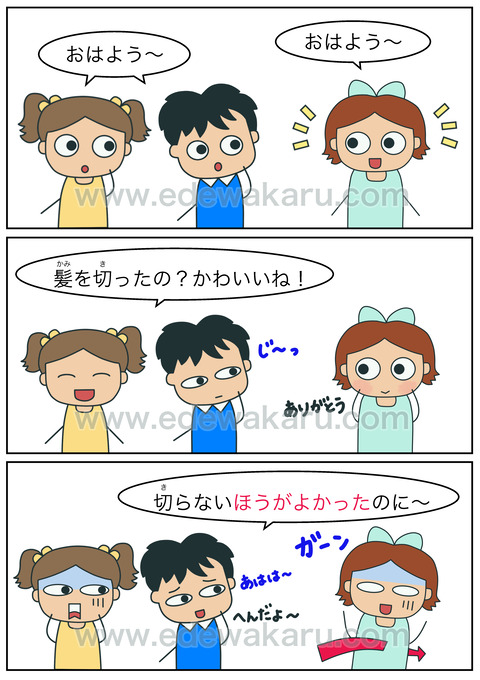
I guess I should have left my hair uncut after all…
[Regret] One’s own action
A: Did you get your hair cut?
B: Yeah.
C: You shouldn’t have cut it~
[Feeling disappointed] Someone else’s action
Let’s review patterns similar to 「〜ほうがよかった」. 😉
[Similar patterns]
[Related articles]
In context 5 examples
A:髪を切ったの?B:うんC:切らないほうがよかったのに〜
→切るよりも切らないほうが似合っていたのに〜A: Did you get your hair cut? B: Yeah. C: You shouldn’t have cut it~ →You looked better with it uncut than with it cut~
こんなに混んでいるんだったら、来ないほうがよかった
→実際は来たが、来ないほうが適切だったIf it was going to be this crowded, I shouldn’t have come. →I came, but it would have been more appropriate not to come.
父:シュークリームを買ってきたぞ〜娘:…ケーキのほうがよかった
→シュークリームよりケーキのほうが食べたかったFather: I bought some cream puffs~ Daughter: …I would have preferred cake. →I would have rather eaten cake than cream puffs.
A:オーダーストップだからって、こんなに注文しないほうがよかったね…B:うん。多すぎて食べきれないね…
→実際はたくさん注文してしまったが、こんなに注文するべきではなかったA: We shouldn’t have ordered this much just because last orders were being taken… B: Yeah. It’s too much to finish… →We actually ordered a lot, but we shouldn’t have ordered this much.
学生の時に、もっとちゃんと勉強したほうがよかったな…
→実際はちゃんと勉強しなかったが、学生の時にもっと勉強するべきだったI wish I’d studied harder when I was a student… →I didn’t study properly, but I should have studied harder when I was a student.
Read the original source text
Meaning
〜するよりも、〜するべきだった
〜よりも、〜のほうが適切だった
How to use it
動詞[辞書形・ない形・た形]+ほうがよかった
い形容詞[ーい]+ほうがよかった
な形容詞[ーな]+ほうがよかった
名詞[辞書形]+のほうがよかった
Explanation
「〜ほうがよかった」は「〜するべきだった」「〜のほうが適切だった」という意味の文型です。
「実際に起こったことよりも、〜したほうが適切だった」「実際は〜したが、〜するべきだった」と言いたい時に使われます。
自分の行動に対して使う場合は
[後悔している気持ち]
を表します。また、他の人の行動に対して使用する場合は
[残念だと思う気持ち][がっかりした気持ち]
などを表します。
[例]
やっぱり、髪を切らない
ほうがよかった
な…
【後悔】自分の行動
A:髪を切ったの?
B:うん
C:切らない
ほうがよかった
のに〜
【残念だと思う気持ち】相手の行動
「〜ほうがよかった」に似ている文型を復習しておきましょう😉
【類似文型】
【関連記事】
毎日のんびり日本語教師
How to use it
Verb dictionary form+ほうがよかった
Verb た-form+ほうがよかった
Verb ない-form+ほうがよかった
Noun+の+ほうがよかった
い-adjective dictionary form+ほうがよかった
な-adjective+な+ほうがよかった
Explanation
When talking about one's own past actions, it expresses regret.
When talking about another person's past actions, it expresses disappointment about them.
Notes
Similar grammar: 「~ほうがいい」
Similar grammar: 「~ほうがましだ」
In context 8 examples
こんなことになるなら、私なんて生まれてこないほうがよかった。
If this was how things were going to turn out, it would have been better if I had never been born.
あの人に彼氏がいるなんて、知らないほうがよかった。
I wish I hadn’t found out that person has a boyfriend.
美味しいといえば美味しいけど、もう少し煮たほうがよかったかな。
It is tasty, in a way, but I wonder if I should have simmered it a little longer.
いろいろと注文しないほうがよかった。この量は食べ切れない。
I shouldn’t have ordered so many different things. There’s no way I can finish all this.
どうせ失うことになるのなら、最初から無いほうがよかった。
If I was going to lose it anyway, I’d have been better off never having it in the first place.
子供の頃に真面目に勉強したほうがよかったと、社会人になってみて強く思う。
Now that I’m working, I strongly feel I should have studied harder when I was a child.
髪を切ったみたいだけど、私は短髪のほうがよかったと思う。
It looks like you got your hair cut, but I think you looked better with short hair.
友人に聞いたら余計分からなくなったし、最初から先生に聞いたほうがよかった。
Asking my friend only confused me more; I should have asked the teacher from the start.
Read the original source text
How to use it
動辞形+ほうがよかった
動た形+ほうがよかった
動ない形+ほうがよかった
名詞+の+ほうがよかった
い形容詞原形+ほうがよかった
な形容詞+な+ほうがよかった
Explanation
自分の過去の行動について述べる時は後悔の念を表します。
他人の過去の行動について述べる時はそのことに対する失望の念を表します。
Notes
似ている文法「~ほうがいい」
似ている文法「~ほうがましだ」