絵でわかる日本語
Meaning
Because … was the cause/reason … (a good result happened)
How to use it
Verb [plain form] + おかげで・おかげか
い-adjective [dictionary form] + おかげで・おかげか
な-adjective [dictionary form] + なおかげで・なおかげか (Examples: きれいなおかげで・便利なおかげで)
Noun [dictionary form] + のおかげで・のおかげか (Examples: あなたのおかげで・薬のおかげで)
Explanation
「〜おかげで」is a sentence pattern that expresses a cause or reason, meaning “... happened because ... was the cause/reason” 😊
It is used mostly when a good result occurs, but at N2 level and above, it may also be used with a feeling of irony or criticism 😮
[Examples used with an ironic feeling]
①The train was delayed because of heavy snow, and I ended up being late.
→The train was delayed and I ended up being late because heavy snow was the cause.
②I made a huge mistake because of you.
→I made a huge mistake because you were the cause.
Also, when a good result occurs because of someone else’s action, the forms 「〜てくれったおかげで」「〜てもらったおかげで」are used 😀
[Examples]
①Thanks to my teacher explaining it to me, I was able to pass.
→I was able to pass because my teacher explained it to me.
②Thanks to Mom waking me up, I made it to class on time.
→I made it to class on time because Mom woke me up.
【Supplementary explanation ①】
「〜おかげで」also has the form 「おかげさまで〜」😮 This is an idiomatic expression and
can only be used at the beginning of a sentence 😨
⭕️Thanks to you, I passed.
❌I passed thanks to my teacher. → ⭕️I passed thanks to my teacher.
❌The reason I passed the N1 was my teacher’s 「おかげさま」. → ⭕️The reason I passed the N1 was my teacher’s help.
【Supplementary explanation ②】
Lastly, the difference between 「〜おかげで」and「〜おかげか」: 「〜おかげで」is used when the cause or reason is clearly known, whereas
「〜おかげか」is used when the cause or reason is not clearly known 😀
薬の
おかげで
頭痛が治った → It is clearly known that taking the medicine was the reason the headache went away.
薬の
おかげか
頭痛が治った → It is not clear whether the headache went away because I took the medicine.
It may help to remember 「〜おかげか」as “probably because …” 😉
In context 3 examples
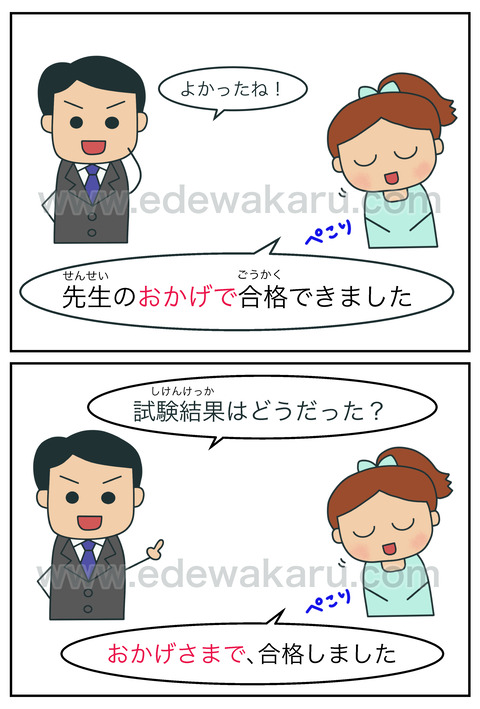
先生のおかげで合格できました
→先生に教えてもらったから合格できましたThanks to my teacher, I was able to pass. →I was able to pass because my teacher taught me.
薬を飲んだおかげで頭痛が治った
→薬を飲んだから頭痛が治ったMy headache went away thanks to taking the medicine. →My headache went away because I took the medicine.
毎日NHKを見ていたおかげで、リスニング力がアップした
→毎日NHKを見ていたから、リスニング力がアップしたMy listening skills improved thanks to watching NHK every day. →My listening skills improved because I watched NHK every day.
Read the original source text
Meaning
〜が原因・理由で…(いい結果が起こった)
How to use it
動詞[普通形]+おかげで・おかげか
い形容詞[辞書形]+おかげで・おかげか
な形容詞[辞書形]+なおかげで・なおかげか (例:きれいなおかげで・便利なおかげで)
名詞[辞書形]+のおかげで・のおかげか (例:あなたのおかげで・薬のおかげで)
Explanation
「〜おかげで」は原因・理由を表す文型で「〜が原因・理由で…が起こった」という意味で使用される文法です
😊
いい結果が発生した場合に使用するのがほとんどです
が、N2以上のレベルになると、皮肉・非難の気持ちを入れて使われることもあります😮
[皮肉の気持ちを入れて使われる場合の例]
①大雪の
おかげで
電車が遅れて遅刻してしまった
→大雪が
原因で、電車が遅れて遅刻してしまった
②あなたの
おかげで
大失敗したよ
→あなたが
原因で、大失敗したよ
また相手の動作でいい結果が発生した場合は
「〜てくれったおかげで」「〜てもらったおかげで」
というようになります😀
[例]
①先生に
教えてもらったおかげで
合格できました
→先生に教えてもらったから合格できました
②お母さんが
起こしてくれたおかげで
授業に間に合った
→お母さんが起こしてくれたから授業に間に合った
【補足説明①】
「〜おかげで」には「おかげさまで〜」という形もあります
😮これは慣用的な表現で、
文の最初にしか使うことができません
😨
⭕️
おかげさまで、合格しました
❌先生のおかげさまで、合格しました→⭕️先生の
おかげで、合格しました
❌N1に合格したのは、先生のおかげさまです→⭕️N1に合格したのは、先生の
おかげです
【補足説明②】
最後に「〜おかげで」と「〜おかげか」の違いについてです。「〜おかげで」は原因理由がはっきりわかっている時に使用するのに対して、
「〜おかげか」は原因理由がはっきりわかっていない時に使います
😀
薬の
おかげで
頭痛が治った→「薬」を飲んだことが治った理由だとはっきりとわかっている
薬の
おかげか
頭痛が治った→「薬」を飲んだから治ったのかはっきりとわからない
「〜おかげか」は「たぶん〜が原因・理由で…」と覚えておくといいですね
😉
NINJAL 日本語文型データベース
Meaning
Used when you want to say that something may have led to a good result, without asserting the cause-and-effect relationship.
How to use it
V plain form + おかげか
i-adjective plain form + おかげか
na-adjective plain form + おかげか (however, 「na-Aだ」 changes to 「na-Aな+おかげか・na-Aである+おかげか」)
Nのおかげか・N plain form + おかげか (however, 「Nだ」 changes to 「Nである+おかげか・Nの+おかげか」)
Notes
A negative sentence rarely comes in the “〜” slot. After 「〜おかげか」, a sentence expressing the speaker’s hopes or intentions, or a sentence urging the other person to do something, cannot follow.
In context 19 examples
最近、早寝早起きを実践できているおかげか、体調がよくなってきた。
Perhaps because I’ve recently been managing to go to bed and get up early, my health has been improving.
このところ残業がないおかげか疲労感がない。
Perhaps because I haven’t had any overtime lately, I don’t feel tired.
今日は口うるさい課長が出張でいなかったおかげか、職場の雰囲気がよかった気がする。
Perhaps because the nitpicky section manager was away on a business trip today, I feel like the atmosphere at work was good.
この部屋はあまり広くはないが、天井が高いおかげか、圧迫感は感じない。
This room isn’t very spacious, but perhaps because the ceiling is high, it doesn’t feel cramped.
私は兄弟が多いおかげか、人付き合いは得意だ。
Perhaps because I have a lot of siblings, I’m good at getting along with people.
毎朝ジョギングをしている。最近はあまり寒くないおかげか、体がよく動く。
I go jogging every morning. Perhaps because it hasn’t been very cold lately, my body moves well.
手にけがをしてしまったが、傷が浅かったおかげか出血は少なくてすんだ。
I injured my hand, but perhaps because the wound was shallow, there was little bleeding.
アンさんのスピーチは、使っていた言葉が難しくなかったおかげか、英語があまり得意でない私にもわかりやすかった。
Perhaps because the words in Ann’s speech weren’t difficult, it was easy to understand even for me, though I’m not very good at English.
大掃除をした。部屋がきれいなおかげか、今日は仕事がはかどる。
I did a thorough cleaning. Perhaps because the room is clean, I’m getting a lot of work done today.
ここは町の中心から離れてはいるが、交通が不便ではないおかげか、暮らしやすい。
This place is far from the town center, but perhaps because transportation isn’t inconvenient, it’s easy to live here.
このえびの炒め物は、下処理が丁寧であるおかげか、臭みがなくておいしい。
Perhaps because these stir-fried shrimp were carefully prepared, they have no unpleasant smell and taste delicious.
先月の売上が好調だったおかげか、社長の機嫌がいい。
Perhaps because sales were strong last month, the president is in a good mood.
親がそれほど厳格ではなかったおかげか、私たち兄弟はおおらかな性格に育った。
Perhaps because our parents weren’t very strict, we siblings grew up to be easygoing.
神社で買ったお守りのおかげか、面接試験では落ち着いて話すことができた。
Perhaps because of the good-luck charm I bought at the shrine, I was able to speak calmly during the interview.
この写真は、シャツが白っぽい色のおかげか、顔が明るく見える。
Perhaps because the shirt is a light color in this photo, the face looks bright.
今回の作文コンクールのテーマは「私の大切なもの」。身近なテーマであるおかげか、書きやすかった。
The theme of this year’s essay contest was “Something Precious to Me.” Perhaps because it was a familiar theme, it was easy to write about.
人気の展覧会だが、混んでいる時間帯でないおかげか、今ならあまり待たずにすぐに入れそうだ。
It’s a popular exhibition, but perhaps because it isn’t a busy time of day, it looks like we can go in right away without waiting long.
友達と一緒だったおかげか、会場までの長い道のりも短く感じた。
Perhaps because I was with a friend, the long journey to the venue felt short.
母が買ってくれたコートは、安物じゃなかったおかげか、とても長持ちした。
Perhaps because the coat my mother bought me wasn’t cheap, it lasted a very long time.
Read the original source text
Meaning
〜から恩恵を受けて、いい結果になったのかもしれないと、因果関係を断定しないで言いたいときに使います。
How to use it
V普通形+おかげか
i-A普通形+おかげか
na-A普通形+おかげか(ただし、「na-Aだ」→「na-Aな+おかげか・na-Aである+おかげか」)
Nのおかげか・N普通形+おかげか(ただし、「Nだ」→「Nである+おかげか・Nの+おかげか」)
Notes
「〜」に否定文がくることは少ないです。「〜おかげか」の後には、話し手の希望・意向を表す文や相手への働きかけの文はきません。