どんなときどう使う 日本語表現文型辞典
Meaning
being in such straits
How to use it
Vる/N + に至ってFW
Explanation
~という重大な事態になって
「~に至って」の形で、「~という重大な事態になって」という意味を表す。後の文に「やっと・ようやく・はじめて」などの言葉をよくいっしょに使う。
Something becomes a serious situation. Words such as やっと、ようやく、and はじめて are often used with this pattern.
In context 3 examples
39度もの熱が3日も続くという事態に至って、彼はやっと医者へ行く気になった。
Only when he reached the point where he had had a fever of as much as 39 degrees for three days did he finally decide to go to the doctor.
関係者は子どもが自殺するに至って初めて事の重大さを知った。
It was only when the child committed suicide that those involved realized how serious the matter was.
学校へほとんど行かずにアルバイトばかりしていた彼は、いよいよ留年という状況に至って、親に本当のことを言わざるを得なかった。
He hardly went to school and did nothing but work part-time. When things finally reached the point where he had to repeat a year, he had no choice but to tell his parents the truth.
Read the original source text
Meaning
being in such straits
How to use it
Vる/N+に至ってFW
Explanation
~という重大な事態になって
「~に至って」の形で、「~という重大な事態になって」という意味を表す。後の文に「やっと・ようやく・はじめて」などの言葉をよくいっしょに使う。
Something becomes a serious situation. Words such as やっと、ようやく、and はじめて are often used with this pattern.
絵でわかる日本語
Meaning
It was not until the situation reached 〜 that 〜 finally happened.
It was not until the situation reached 〜 that someone finally did 〜.
How to use it
Verb [dictionary form] + に至って
Noun [dictionary form] + に至って
Explanation
“Aに至ってB” is a pattern meaning “It was not until the situation reached A that B finally happened” or “It was not until the situation reached A that someone finally did B.” It is often used to say, “It was only at stage A that someone realized B.”
There are several grammar patterns that use “至る,” so let’s learn them together 😉
[Grammar patterns with “至る”]
In context 5 examples
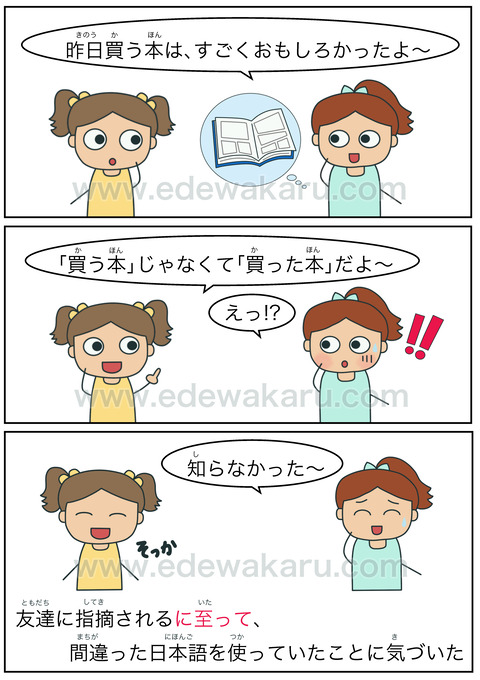
友達に指摘されるに至って、間違った日本語を使っていたことに気づいた
→友達に指摘されて、やっと間違った日本語を使っていたことに気づいたIt was not until a friend pointed it out that I realized I had been using incorrect Japanese. →After my friend pointed it out, I finally realized I had been using incorrect Japanese.
ストレスで病気になるという状況に至って、会社を辞めることを決意した
→ストレスで病気になるという状況になって、やっと会社を辞めることを決意したIt was only when stress made me ill that I decided to quit my job. →When the situation reached the point of my becoming ill from stress, I finally decided to quit my job.
大きな問題が発生するに至って、やっと会議が行われた
→大きな問題が発生して、やっと会議が行われたIt was only when a major problem arose that a meeting was finally held. →A major problem arose, and then a meeting was finally held.
上司に注意されるに至って、敬語の使い方がおかしいとわかった
→上司に注意されてはじめて、敬語の使い方がおかしいとわかったIt was only when my boss called me out that I realized I was using honorific language incorrectly. →It was only after my boss called me out that I realized I was using honorific language incorrectly.
彼はなかなか新しい仕事が見つからない状況に至って、仕事を辞めてしまったことを後悔し出したようだ
→なかなか新しい仕事が見つからない状況になって、やっと仕事を辞めてしまったことを後悔し出したようだApparently, it was only when he found himself unable to find a new job that he began to regret quitting his job. →When he found himself unable to find a new job, he finally began to regret having quit.
Read the original source text
Meaning
〜という状況になって、やっと〜になった
〜という状況になって、やっと〜した
How to use it
動詞[辞書形]+に至って
名詞[辞書形]+に至って
Explanation
「Aに至ってB」は「Aという状況になって、やっとBになった」「Aという状況になって、やっとBした」という意味の文型です。「Aという段階になってはじめてBだとわかった」と言いたい時によく使われます。
「至る」がつく文型は、いくつかありますので一緒に覚えておきましょう😉
【「至る」がつく文型】
毎日のんびり日本語教師
How to use it
Noun + に至って
Verb dictionary form + に至って
Explanation
Expresses a particular, special situation.
It often co-occurs with words such as 「ようやく」 (at last), 「初めて」 (for the first time), 「やっと」 (finally), and 「いまさら」 (at this late stage).
Notes
The 「至る」 series
In context 6 examples
海外留学するに至り、初めて自国を客観的に見ることができるようになったと思う。
It was only after I went to study abroad that I think I became able to see my own country objectively for the first time.
今に至って今さらそんなことを言うのはおかしい。
It's strange to say something like that now, at this late stage.
先生に注意されるに至り、ようやく自分の間違いに気づいた。
It was only when my teacher reprimanded me that I finally realized my mistake.
マラソンなんて余裕だと高をくくっていたが、5km地点に至ってようやくその辛さを痛感した。
I had arrogantly assumed a marathon would be easy, but it was only at the 5 km mark that I finally felt just how grueling it was.
アルバイト経験がないものだから、就職するに至って初めて社会の厳しさを体感した。
Since I had no part-time work experience, it was only when I got a job that I experienced the harshness of society firsthand.
この年に至り、ようやくあの時の父の言葉が正しかったのだと気づかされた。
It was only at this age that I finally realized my father's words back then had been right.
Read the original source text
How to use it
名詞+に至って
動辞形+に至って
Explanation
ある特別な状況を表します。
「ようやく」「初めて」「やっと」「いまさら」等が呼応しやすいです。
Notes
「至る」シリーズ
NINJAL 日本語文型データベース
Meaning
Used when you want to say that something finally happened after reaching a particular stage called ~.
How to use it
V-dictionary form に至って
N に至って
Notes
When ~ is a noun, words such as “situation” and “circumstances” often come in this position.
It is usually used about an undesirable situation.
In context 8 examples
医師になるという夢を持っていたが、3年続けて医学部受験に失敗するに至ってやっと諦めがついた。
I had dreamed of becoming a doctor, but after failing the medical school entrance exams three years in a row, I finally came to accept that I had to give up.
母親は、息子が体がだるいというのを聞き流していたが、39度も熱があることを知るに至ってようやく事態の深刻さに気が付いた。
The mother had been brushing off her son's complaints that he felt lethargic, but only when she learned that he had a fever as high as 39 degrees did she finally realize how serious the situation was.
警察の取り調べに対し、男は「やっていない」と主張していたが、目撃者が見つかるに至ってやっと犯行を認めた。
The man insisted to the police during questioning that he “didn't do it,” but only when a witness was found did he finally admit to the crime.
この商品は最近売り上げが低迷していたが、ついに前年比の半分以下になるに至って、生産中止が決まった。
Sales of this product had been sluggish recently, but it was only when they finally fell to less than half of the previous year's level that production was discontinued.
私は食にあまり興味がなく、いつもいい加減な食事をしていたが、体調を崩すに至ってはじめて、食生活の重要性を意識するようになった。
I wasn't very interested in food and always ate carelessly, but it was only after my health deteriorated that I first became aware of the importance of my diet.
あの政治家は自分の不正を隠そうとしていたが、テレビで取り上げられ、同じ党からも批判が出る事態に至ってついに記者会見を開いた。
That politician had been trying to cover up his wrongdoing, but only when the situation reached the point where it was covered on television and criticized even by members of his own party did he finally hold a press conference.
今までさんざん自分勝手なことをしてきたが、周りに味方が誰もいなくなるという状況に至ってはじめて自分の間違いに気づいた。
I had been doing selfish things all along, but it was only when I reached the situation where I had no one around me on my side that I realized my mistake.
この部署では新入社員が2年間で3人も辞めてしまった。ここに至ってようやく部長は指導役を交代させた。
In this department, as many as three new employees quit in two years. Only at this point did the department head finally replace the person responsible for training them.
Read the original source text
Meaning
〜という特別な段階まで進んで、やっとあることが起きたと言いたいときに使います。
How to use it
Vるに至って
Nに至って
Notes
「〜」が名詞の場合、「事態・状況」などの言葉がくることが多いです。
ふつう、好ましくない事態について使います。