どんなときどう使う 日本語表現文型辞典
Meaning
just barely…when
How to use it
Vるか・Vたか+Vないか+のうちに
Explanation
か~ないかのうちに
~すると、同時に
1)「~か~ないかのうちに…」の形で、「~」が起こったすぐ直後に「…」が起こる、と言いたいときに使う。
2)「か~ないかのうちに」は現実のできごとを描写するのであるから、意志的な行為を表す文や「よう・つもり」などの意志の文、命令文、否定文などが後に来ることはない。
◆ × 空港に着くか着かないかのうちに会社に電話をかけるつもりです。
3)同様の意味・用法を持つ表現には次のものがある。
2)Phrase ~か~ないかのうちに describes actual event. Phrases expressing volitional action or words of volition, such as よう or つもり, commands, or negatives cannot follow.
◆ × 空港に着くか着かないかのうちに会社に電話をかけるつもりです。
1)One event happens shortly after another.
3)Patterns with similar meanings or usage are:
In context 3 examples
子どもは「おやすみなさい」と言ったか言わないかのうちに、もう眠ってしまった。
The child had barely said “Good night” when they had already fallen asleep.
彼はいつも終了のベルが鳴ったか鳴らないかのうちに、教室を飛び出していく。
He always dashes out of the classroom just as the end-of-class bell is about to ring.
このごろ、うちの会社では一つの問題が解決するかしないかのうちに、次々と新しい問題が起こってくる。
These days at our company, one problem after another crops up before one problem has even been resolved.
Read the original source text
Meaning
just barely…when
How to use it
Vるか・Vたか+Vないか+のうちに
Explanation
か~ないかのうちに
~すると、同時に
1)「~か~ないかのうちに…」の形で、「~」が起こったすぐ直後に「…」が起こる、と言いたいときに使う。
2)「か~ないかのうちに」は現実のできごとを描写するのであるから、意志的な行為を表す文や「よう・つもり」などの意志の文、命令文、否定文などが後に来ることはない。
◆ × 空港に着くか着かないかのうちに会社に電話をかけるつもりです。
3)同様の意味・用法を持つ表現には次のものがある。
2)Phrase ~か~ないかのうちに describes actual event. Phrases expressing volitional action or words of volition, such as よう or つもり, commands, or negatives cannot follow.
◆ × 空港に着くか着かないかのうちに会社に電話をかけるつもりです。
1)One event happens shortly after another.
3)Patterns with similar meanings or usage are:
絵でわかる日本語
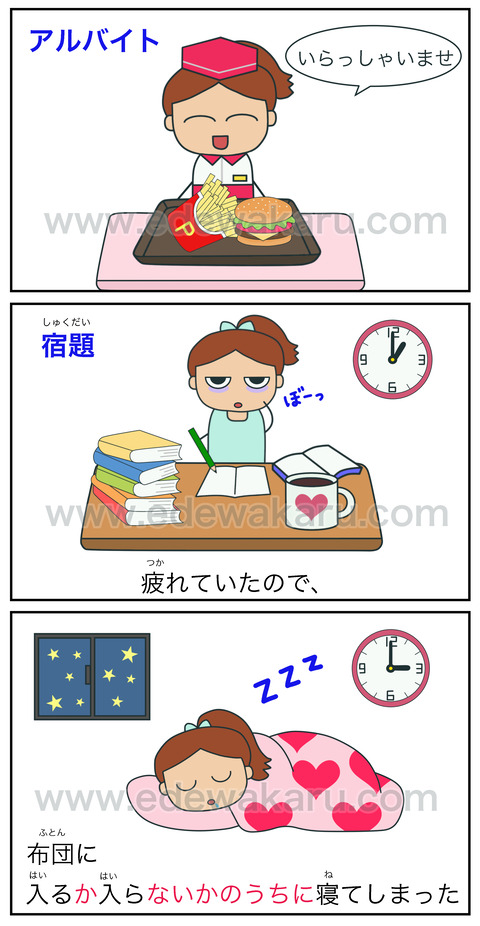
Meaning
As soon as …
As soon as … happens
How to use it
Verb [dictionary form] + か + Verb [ない-form] + かのうちに
Explanation
“〜か〜ないかのうちに” is a sentence pattern meaning “as soon as…”. It is used in the form “AかAないかのうちにB” when you want to emphasize “B happens shortly after A begins” or “B happens almost simultaneously with A.” 😊 This pattern is used for something that has already happened, so remember that it is always followed by the た-form. 😉
[Examples]
① I got into bed
か
before I knew it, I had
ないかのうちに
fallen asleep.
② The cakes had all sold out
か
before the shop had
ないかのうちに
opened.
③ The train came
か
as soon as I had
ないかのうちに
arrived at the station.
④ It started raining
か
as soon as the clouds had
ないかのうちに
started appearing.
There are many sentence patterns meaning “as soon as…,” so be sure to distinguish them and learn them carefully. 😀
[Related sentence patterns]
In context 4 examples
疲れていたので、布団に入るか入らないかのうちに寝てしまった
→疲れていたので、布団に入ったらすぐに寝てしまったBecause I was tired, I fell asleep as soon as I got into bed. → Because I was tired, I fell asleep as soon as I got into bed.
お店が開店するか開店しないかのうちに、ケーキは全部売れてしまった
→お店が開店したらすぐに、ケーキは全部売れてしまったThe cakes had all sold out as soon as the shop opened. → The cakes had all sold out as soon as the shop opened.
駅に着くか着かないかのうちに電車がきた
→駅に着いたらすぐに、電車がきたThe train came as soon as I arrived at the station. → The train came as soon as I arrived at the station.
雲が出てくるか出てこないかのうちに、雨が降り出した
→雲が出てくるとすぐに、雨が降り出した(復習:〜てくる(出現))As soon as clouds appeared, it started raining. (Review: 〜てくる (appearance))
Read the original source text
Meaning
〜するとすぐに〜
〜したらすぐに〜
How to use it
動詞[辞書形]+か+動詞[ない形]かのうちに
Explanation
「〜か〜ないかのうちに」は「〜するとすぐに〜」という意味を表す文型です。この文型は「AかAないかのうちにB」の形で
「Aを始めてから、あまり時間が経過しない時にB」「Aしたのと、ほとんど同時にB」
ということを強調したい時に使われます😊この文型は、
すでに発生したことに使いますので、後ろには必ず「た形」がくると覚えておきましょう
😉
[例]
①布団に入る
か
入ら
ないかのうちに
寝てしまっ
た
②お店が開店する
か
開店し
ないかのうちに、ケーキは全部売れてしまった
③駅に着く
か
着か
ないかのうちに
電車がきた
④雲が出てくる
か
出てこ
ないかのうちに、雨が降り出した
「〜するとすぐに〜」という意味の文型はたくさんありますので、しっかりと区別をして覚えておきましょう😀
【関連文型】
毎日のんびり日本語教師
How to use it
Verb dictionary form + か + Verbない-form + ないかのうちに
Verbた-form + か + Verbない-form + ないかのうちに
Explanation
This connects the dictionary and negative forms or the past and negative forms of the same verb. It expresses that the latter action occurred just before the action in the first clause actually took place. It can also be understood as the two actions occurring almost simultaneously.
Notes
The 「うち」series
In context 8 examples
日曜休んだか休んでないかのうちに終わってまた月曜。
I’d barely had Sunday off before it was over and Monday came around again.
バスは私が座るか座らないかのうちに走り出した。
The bus started moving just as I was sitting down.
演奏が終わるか終わらないかのうちに拍手をした。
I applauded just as the performance ended.
買ってきたビールを冷蔵庫に入れて、冷えたか冷えないかのうちに飲んだ。
I put the beer I’d bought in the refrigerator and drank it as soon as it had barely begun to chill.
吸い終わるか終わらないかのうちに、また新しいタバコに火をつけた。
Before I’d even finished smoking, I lit another cigarette.
息子は「おやすみ」と言うか言わないかのうちに寝付いた。
My son fell asleep as soon as he’d said, “Good night.”
ホームに着くか着かないかのうちに電車は出発してしまった。
The train had already left just as I was arriving at the platform.
チャイムが鳴るか鳴らないかのうちに学生は教室から飛び出していった。
As soon as the bell rang, the students rushed out of the classroom.
Read the original source text
How to use it
動辞形+か+動ない形+ないかのうちに
動た形+か+動ない形+ないかのうちに
Explanation
同じ動詞の辞書形、動た形とナイ形を使って接続し、実際は前件の動作が行われる直前に後件が発生したことを表します。前件と後件の動作がほぼ同時に発生したとも捉えられます。
Notes
「うち」シリーズ
AIUEO JLPT Grammar
Meaning
This sentence pattern expresses that two events happen almost simultaneously.
How to use it
Verb (dictionary form) か + Verb (ない-form) か + の + うちに
In context 5 examples
授業が終わるか終わらないかのうちに、学生たちは教室を出ていった。
As soon as the class ended, the students left the classroom.
ドアが開くか開かないかのうちに、彼は部屋に飛び込んだ。
As soon as the door opened, he rushed into the room.
店が開くか開かないかのうちに、多くの客が押し寄せた。
As soon as the store opened, a lot of customers rushed in.
電話が鳴るか鳴らないかのうちに、彼女が受話器を取った。
Just as the phone rang, she picked up the receiver.
映画が始まるか始まらないかのうちに、観客は静かになった。
As soon as the movie started, the audience quieted down.
Read the original source text
Meaning
This sentence pattern expresses that two events happen almost simultaneously.
How to use it
動詞辞書形か+動詞ない形か+の+うちに
Explanation · 日本語
この文型は、二つの出来事がほぼ同時に起こることを表す表現です。
文法
Meaning
"Almost at the same time as ~"
Indicates that the latter event occurs just before the former event has happened.
How to use it
V (dictionary form / past form) + か + V (ない form) + かのうちに
※ V is the same verb in both places.
Notes
Since this is used for things that actually happened, the following clause cannot express intention or a request, and cannot be negative or a command.
In context 4 examples
会社に着くか着かないかのうちに雨が降り出しました。
Just as I arrived at the company, it started to rain.
電車が駅に着くか着かないかのうちに、たくさんの人が降りる準備をした。
Just as the train was arriving at the station, many people got ready to get off.
映画が終わるか終わらないかのうちに、観客は席を立った。
Just as the movie was ending, the audience got up from their seats.
息子はベッドに入るか入らないかのうちに寝てしまった。
My son fell asleep almost as soon as he got into bed.
Read the original source text
Meaning
"~するのとほぼ同時に"
前の事象が起こる直前で、後ろの事象が起こることを表す。
How to use it
V(辞書形 / タ形) + か + V(ナイ形) + かのうちに
※Vは同じ動詞
Notes
実際に起こったことに対して使うため、意志や依頼の文、否定文や命令文は後ろに来ない。
Bunpro Grammar Reference
Meaning
Right after, As soon as, Just when, Barely
How to use it
Verb[る]+ か + Verb ない(*) + かのうちに
(*) The same Verb has to be repeated
Nuance
A formal grammar point that indicates when the state of (A) being finished or still going cannot be determined before (B) suddenly happens.
Explanation
か~ないかのうちに is a slightly formal grammar structure used in Japanese to indicate a precise point in time where the action of (A) can not be determined as either being started, or finished. Usually, it highlights the exact moment either before or after (A) commences. This grammar structure is comprised of か, ない, か, の, the noun 内 'within', and に. Literally, it just means 'while not knowing whether (A) or not (A), (B)'.
The verb that appears before か and ないか must be repeated in this grammar pattern, and may be used in its dictionary form. Standard translations include 'right after (A)', 'as soon as (A)', and 'barely when (A)'.
父はビールを飲み終わるか飲み終わらないかのうちに、新しい缶を開けた。
My father opened a new can of beer as soon as he finished his beer.
彼は椅子に座るか座らないかのうちに、テレビをつけた。
He turned his TV on just as he sat down.
彼女は車が止まるか止まらないかのうちに、ドアを開けて駅へと走っていった。
Just as the car stopped, she opened the door and ran to the station.
Additionally, か~ないかのうちに may be used to highlight relatively short periods of time within which something happens. This is usually in regard to some sort of positive or negative occurrence that would not usually be expected to be able to happen so quickly.
就活を初めて一週間経つか経たないかのうちに、仕事が見つかった。
In just a week of looking for a new job, I found a job.
戦争が終わるか終わらないかのうちに、原爆が落とされた。
An atomic bomb was dropped, just when the war was about to end.
In context 17 examples
- 焦がすか焦がさないかの内に、肉を取るのが僕の流儀。
My style is to take off the meat just when it starts to burn.
- 父はビールを飲み終わるか飲み終わらないかのうちに、新しい缶を開けた。
My father opened a new can of beer as soon as he finished his beer.
- 彼女は車が止まるか止まらないかのうちに、ドアを開けて駅へと走っていった。
Just as the car stopped, she opened the door and ran to the station.
- 就活を初めて一週間経つか経たないかのうちに、仕事が見つかった。
In just a week of looking for a new job, I found a job.
- 戦争が終わるか終わらないかのうちに、原爆が落とされた。
An atomic bomb was dropped, just when the war was about to end.
- 彼は椅子に座るか座らないかのうちに、テレビをつけた。
He turned his TV on just as he sat down.
- 御馳走をいただくかいただかないかの内に、帰る時間になってしまった。
Just as I was about to eat, it was time to go home.
- 削除されるかされないかの内に、自ら手を引いた方がいい。
Just when you are about to be eliminated, it is better to withdraw oneself.
- 清書するかしないかの内に、下書きを紛失してしまいました。
Just as I was about to write a clean copy, I lost my rough draft.
- 言葉が終わるか終わらないかの内に、彼女は意識を失った。
As soon as she finished her remark, she had lost consciousness.
- 乗車するかしないかの内にドアを閉めるなんて危ないじゃないか。
Right after I boarded, they closed the doors. That is dangerous isn't it?
- 勝敗が決まるか決まらないかの内に、お客さんが帰り始めた。
Just as they were about to determine the outcome, spectators started going home.
- 宣伝するかしないかの内に、有名人がツイートしてくれて人気が出た。
Just as I was about to advertise, a famous person tweeted about it and it became popular.
- 車を洗いきるか洗いきらないかの内に雨が降り出したんだ。とてもイライラしたよ。
Right after I washed my car, it started raining. I was so frustrated.
- 現代人って目を覚ますか目を覚まさないかの内に、スマホをとってネットサーフィンする。
These days, people take out their smartphones and surf the web as soon as they wake up.
- 私が試験の答案を書き終えるか終えないかの内に、火災警報が鳴った。
Just when I was about to finish filling out the test sheet, the fire alarm rang.
- いつも、家の戸を開けるか開けないかの内にうちの犬が家から飛び出して顔をなめる。
As soon as I open the door our dog always jumps out and licks my face.
くらべてわかる日本語表現文型辞典
Meaning
Meaning 1: B happens immediately before A or before A has been completely finished.
Meaning 2: B happens within a short time, almost at the same time as A.
How to use it
AかAないかのうちにB
[Verb—る form] か [Verb—ない form] ないかのうちに
Explanation
【Contrast 1】
“AたとたんにB” (meaning 2, p. 122)
“AかAないかのうちにB” means before A has been completely finished, whereas “AたとたんにB” means after A has finished, so there are sentences where they cannot be substituted for each other.
○受話器を置いたとたんに、またかかってきた。 — The phone rang again as soon as I hung up.
×受話器を置くか置かないかのうちに、またかかってきた。 — The phone rang again before I had even finished hanging up.
However, if the speaker wants to emphasize that there was no time gap between action A and B, “受話器を置くか置かないかのうちに〜” may also be used.
“Aが早いかB” (meaning 1, p. 63)
“Aや否やB” (meaning 1, p. 313)
In context 8 examples
ベルが鳴るか鳴らないかのうちに、子供たちは教室を飛び出した。
The children dashed out of the classroom just as the bell was about to ring.
たまごが固まるか固まらないかのウチに、火を止めてください。
Turn off the heat just before the eggs set.
その話に触れるか触れないかのうちに「その話はよそう」と言われた。
Just as I was about to bring up the subject, I was told, “Let’s not talk about that.”
試験用紙を全員に配るか配らないかのうちに、始めている学生がいた。
Some students had started before the exam papers had even been handed out to everyone.
新しい学年になって1週間経つか経たないかのうちに、友達ができた。
I made a friend within barely a week of starting the new school year.
彼は来日して半年過ぎるか過ぎないかのうちに、国へ帰ってしまった。
He went back to his country before even six months had passed since he came to Japan.
3、4カ月経つか経たないかのうちに、もう次の新製品が出ている。
Before even three or four months had passed, the next new product was already out.
あの店は5分待つか待たないかのうちに、席に座れるのでいい。
That shop is nice because you can get a seat in barely five minutes.
Read the original source text
Meaning
意味1:Aの直前に、あるいは完全にAし終わる前にB。
意味2:ほぼAという短い時間内にB。
How to use it
AかAないかのうちにB
[動詞-る形]か[動詞-ない形]ないかのうちに
Explanation
【対比1】
「AたとたんにB」(意味2 P.122)
「AかAないかのうちにB」は完全にAし終わる前にという意味であり、「AたとたんにB」はAが終わってからという意味であるため、置き換えられない文もある。
○受話器を置いたとたんに、またかかってきた。
×受話器を置くか置かないかのうちに、またかかってきた。
ただし、話し手がAの行為とBに時間差がないことを強調したいときは、「受話器を置くか置かないかのうちに〜」も使う場合がある。
「Aが早いかB」(意味1 P.63)
「Aや否やB」(意味1 P.313)
日本語NET JLPT文法解説まとめ
Meaning
"Almost at the same time as ~"
Indicates that the latter event occurs just before the former event has happened.
How to use it
V (dictionary form / past form) + か + V (ない form) + かのうちに
※ V is the same verb in both places.
Explanation
"Almost simultaneously with ~ / as soon as"
This phrase indicates that the subsequent event happens just before or at the same time as the preceding event.
Since it is used for things that actually happened, expressions of will, requests, negations, or imperatives do not follow it.
To be used in relation to actual events, it does not follow with expressions of will, requests, negations, or imperatives.
In context 3 examples
会社に着くか着かないかのうちに雨が降り出しました。
Just as I arrived at the company, it started to rain.
電車が駅に着くか着かないかのうちに、たくさんの人が降りる準備をした。
Just as the train was arriving at the station, many people got ready to get off.
映画が終わるか終わらないかのうちに、観客は席を立った。
Just as the movie was ending, the audience got up from their seats.
Read the original source text
Meaning
"~するのとほぼ同時に"
前の事象が起こる直前で、後ろの事象が起こることを表す。
How to use it
V(辞書形 / タ形) + か + V(ナイ形) + かのうちに
※Vは同じ動詞
Explanation
"Almost simultaneously with ~ / as soon as"
This phrase indicates that the subsequent event happens just before or at the same time as the preceding event.
実際に起こったことに対して使うため、意志や依頼の文、否定文や命令文は後ろに来ない。
To be used in relation to actual events, it does not follow with expressions of will, requests, negations, or imperatives.
NINJAL 日本語文型データベース
Meaning
Used when you want to say that the next event occurs almost simultaneously with something.
How to use it
VるかVないかのうちに・VたかVないかのうちに
Notes
“〜” is a verb expressing a momentary action or event. The ta-form is used when you want to clearly express that the action or event in “〜” has been completed. After 「〜か〜ないかのうちに」 comes a sentence describing an unexpected event. A sentence expressing the speaker’s hopes or intentions, or a sentence urging the other person to do something, usually does not follow.
In context 5 examples
健は恋人と別れて1週間たつかたたないかのうちに、別の女性と付き合い始めた。
Less than a week after Ken broke up with his girlfriend, he started dating another woman.
課長は珍しく残業せずに、就業時間が終わるか終わらないかのうちに帰っていった。
Unusually, the section manager didn’t work overtime and went home just as the workday was ending.
私が「食べてもいいよ」と言ったか言わないかのうちに、妹はもう私のケーキに手をつけていた。
No sooner had I said, “You can have some,” than my younger sister had already started eating my cake.
店の自動ドアが開いたか開かないかのうちに、店員が「いらっしゃいませ」と声をかけてきた。
As soon as the shop’s automatic doors opened, a staff member greeted me with “Welcome.”
彼は、私が返信したかしないかのうちに、立て続けにメールを送ってきた。
He sent me one email after another almost as soon as I had replied.
Read the original source text
Meaning
〜とほぼ同時に、次の出来事が起こると言いたいときに使います。
How to use it
VるかVないかのうちに・VたかVないかのうちに
Notes
「〜」には瞬間的な動作や出来事を表す動詞がきます。「〜」の動作・出来事の完了をはっきり表したいとき、タ形を使います。「〜か〜ないかのうちに」の後には、意外性のある出来事を表す文がきます。話し手の希望・意向を表す文や相手への働きかけの文はふつうきません。