くらべてわかる日本語表現文型辞典
Meaning
Meaning 1: A was originally planned / would normally be done, but B is done because A has become impossible or one does not want to do it.
Meaning 2: B is offered in exchange for A.
Meaning 3: In the form 「A がわりに B」, something that is not originally A is treated as A, and B is done.
How to use it
A かわりに B (A がわりに B)
Connection 1:
[verb dictionary form] かわりに
[noun の] かわりに
Connection 2:
[verb] かわりに
Connection 3:
[noun with no particle] がわりに
Notes
[Note 2]
・The expression 「かわりにと言ってはなんですが~」 (“It’s not much of a substitute for A, but …”) is a humble way of saying “This may not make up for A, but …” and is often used in conversation.
○申し訳ございませんが、この商品は新作ですので値引きできません。かわりにと言ってはなんですが、粗品を付けさせていただきます。 — I’m sorry, but since this is a new product, we can’t give you a discount. It’s not much of a substitute, but please accept this small gift.
In context 12 examples
大雨だったので映画に行くかわりに家でビデオを見ていた。
Because it was pouring, I watched a video at home instead of going to the movies.
姉はダイエットだといって、ご飯を食べるかわりに果物を食べている。
My older sister says she is dieting and eats fruit instead of rice.
彼女は病気の夫のかわりに仕事に出ている。
She goes to work in place of her sick husband.
値段が高かったので、牛肉のかわりに豚肉を買った。
The price was high, so I bought pork instead of beef.
バイトを代わってあげるかわりに、食事をごちそうしてちょうだい。
I’ll cover your shift, so treat me to a meal in return.
彼は出世して不動の地位を手に入れたかわりに、家庭生活を失った。
He got ahead and secured an unassailable position, but in exchange he lost his family life.
私があなたに日本語を教えます。かわりに英語を教えてください。
I’ll teach you Japanese. In exchange, please teach me English.
父は自分が行かないかわりに、兄をあいさつに行かせた。
Since my father wasn’t going himself, he sent my older brother to offer the greetings in his place.
彼女は香水を芳香剤がわりにトイレで使っている。
She uses perfume in the toilet as an air freshener.
彼は水がわりに牛乳を飲んで大きくなったらしい。
Apparently, he grew up drinking milk instead of water.
山頂はあまりにも寒くて、持っていた新聞紙をコートがわりに羽織って寒さをしのいだ。
It was so cold at the summit that I draped the newspaper I had with me over my shoulders as a substitute for a coat and kept warm.
まずはごあいさつがわりに新年の抱負を述べます。
First, as a kind of greeting, I’ll share my New Year’s resolutions.
Read the original source text
Meaning
意味1:はじめはAを予定していた/Aが普通だが、それができなくなって/したくなくてB。
意味2:Aの交換条件としてBを出す。
意味3:「AがわりにB」の形で。本来AでないものをAとしてB。
How to use it
AかわりにB(AがわりにB)
接続1:
[動詞-る形]かわりに
[名詞-の]かわりに
接続2:
[動詞]かわりに
接続3:
[名詞-∅]がわりに
Notes
【注意2】
・「かわりにと言ってはなんですが〜」という表現は、「Aのかわりにはならないけれども〜」と、謙遜して言う表現で、会話でよく使われる。
○申し訳ございませんが、この商品は新作ですので値引きできません。かわりにと言ってはなんですが、粗品を付けさせていただきます。
絵でわかる日本語
Usage 1
Read this source entry ↗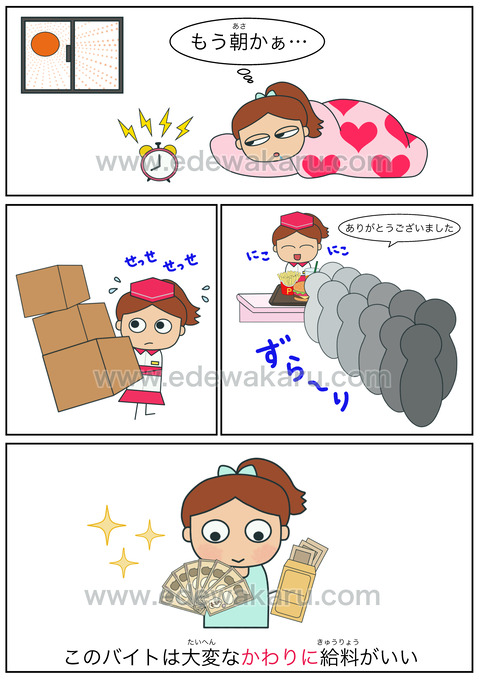
Meaning
~ but ~
How to use it
い-adjective [without ーい]+かわりに
な-adjective [without ーな]+かわりに
Explanation
「〜かわりに〜」 is a sentence pattern meaning “~ but ~.” It is used when you want to say that one thing has two sides: “it has good points, but also bad points,” or “it has bad points, but also good points” 😮 One thing to be careful about is that the subject before and after must be the same.
[Examples]
This part-time job is hard, but the pay is good.
[Subject] This part-time job
[Good point] The pay is good
[Bad point] It is hard
My house is conveniently close to the station, but the rent is high.
[Subject] My house
[Good point] It is conveniently close to the station
[Bad point] The rent is high
「〜かわりに」 has several meanings, so learn to distinguish them 😀
(Review: 〜かわりに (substitution))
(Review: 〜かわりに (acting on someone’s behalf))
In context 5 examples
このバイトは大変なかわりに給料がいい
→このバイトは大変だけれども給料がいいThis part-time job is hard, but the pay is good. → This part-time job is hard, but the pay is good.
私の家は駅に近くて便利なかわりに家賃が高い
→私の家は駅に近くて便利だけれども家賃が高いMy house is conveniently close to the station, but the rent is high. → My house is conveniently close to the station, but the rent is high.
息子は運動が得意なかわりに勉強があまりできない
→息子は運動が得意だけれども勉強があまりできないMy son is good at sports, but he isn’t very good at studying. → My son is good at sports, but he isn’t very good at studying.
クーラーは便利で快適なかわりにお金がかかる
→クーラーは便利で快適だけれどもお金がかかる(復習:〜かかる)Air conditioning is convenient and comfortable, but it costs money. → Air conditioning is convenient and comfortable, but it costs money. (Review: 〜かかる)
このパソコンはとても高いかわりに性能がいい
→このパソコンはとても高いけれども性能がいいThis computer is very expensive, but it performs well. → This computer is very expensive, but it performs well.
Read the original source text
Meaning
〜けれども〜
How to use it
い形容詞[ーい]+かわりに
な形容詞[ーな]+かわりに
Explanation
「〜かわりに〜」は「〜けれども〜」という意味を表す文型です。これは「いいところもあるが、悪いところもある」または「悪いところもあるがいいところもある」というように1つのことについて、2つの面があると言いたい時に使われます
😮注意しなければいけないことは、
前と後ろの主語は同じではなければいけない
ことです。
[例]
このバイトは大変な
かわりに
給料がいい
【主語】このバイト
【いいところ】給料がいい
【悪いところ】大変
私の家は駅に近くて便利な
かわりに
家賃が高い
【主語】私の家
【いいところ】駅に近くて便利
【悪いところ】家賃が高い
「〜かわりに」にはいくつか意味がありますので、区別して覚えておきましょう😀
(復習:〜かわりに(代用))
(復習:〜かわりに(代理))
Usage 2
Read this source entry ↗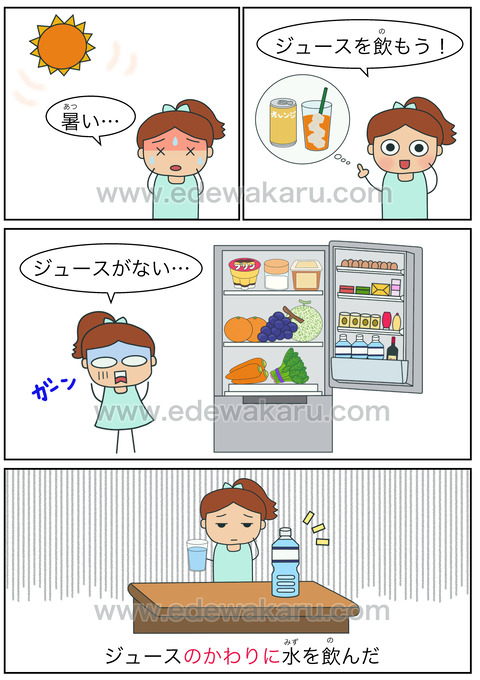
Meaning
Use ~ instead of ~
How to use it
Noun [dictionary form]+のかわりに
Explanation
「AのかわりにB」 is a sentence pattern meaning “do B instead of A.” It is used when you want to say, “When A (which you usually use) is unavailable, use B as a substitute.” 😊 Since it is a pattern expressing [substitution], “A” is a thing 😮
[Examples]
① I drank water instead of juice.
→ I usually drink juice, but there wasn’t any today, so I drank water.
② Spread jam instead of butter.
→ I usually spread butter, but there wasn’t any, so I spread jam.
「〜かわりに」 has many meanings and is a little complex, so it’s good to learn to distinguish them carefully. The other uses of 「〜かわりに」 will be posted in order from here on 😉
(Review: 〜ておく)
(Review: 〜ていく (continuation))
In context 5 examples
ジュースのかわりに水を飲んだ
→ジュースではなく、水を飲んだI drank water instead of juice. → I drank water, not juice.
バターのかわりにジャムを塗る
→バターではなく、ジャムを塗るSpread jam instead of butter. → Spread jam, not butter.
ごはんのかわりにパンを食べる
→ごはんではなく、パンを食べるEat bread instead of rice. → Eat bread, not rice.
お箸のかわりにフォークを使う
→お箸ではなく、フォークを使うUse a fork instead of chopsticks. → Use a fork, not chopsticks.
ダイエットをしているので、ごはんのかわりに豆腐を食べるようにしている
→ごはんではなく豆腐を食べるようにしている(復習:〜ている(結果の状態))(復習:〜ようにしている)Because I’m dieting, I try to eat tofu instead of rice. → I try to eat tofu instead of rice. (Review: 〜ている (resulting state)) (Review: 〜ようにしている)
Read the original source text
Meaning
〜ではなく〜を使う
How to use it
名詞[辞書形]+のかわりに
Explanation
「AのかわりにB」は「AではなくBを〜する」という意味の文型です。これは「(いつも使う)Aがなかった時に、代用としてBを〜する」と言いたい時に使います😊【代用】を表す文型ですので、「A」には「もの」が入ります😮
[例]
①ジュース
のかわりに
水を飲んだ
→いつもはジュースを飲むが、今日はなかったので水を飲んだ
②バター
のかわりに
ジャムを塗る
→いつもはバターを塗るが、なかったのでジャムを塗った
「〜かわりに」にはたくさん意味があり少し複雑です
ので、しっかりと区別をして覚えておくといいと思います。他の「〜かわりに」は、これから順番に載せていきます😉
(復習:〜ておく)
(復習:〜ていく(継続))
Usage 3
Read this source entry ↗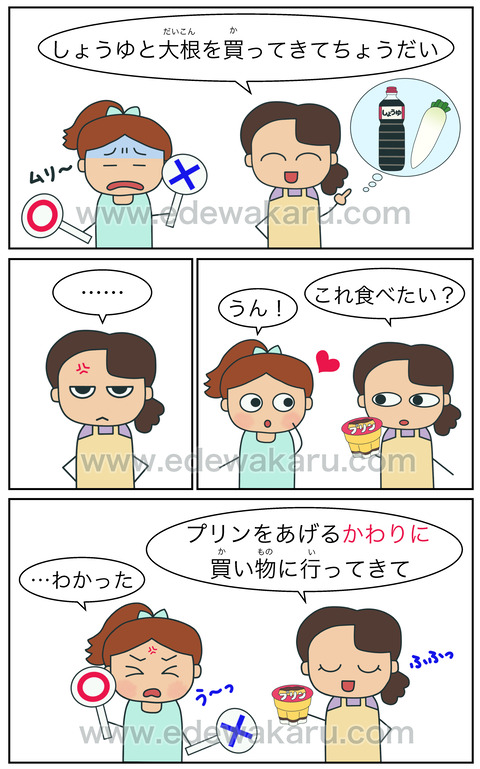
Meaning
I’ll do ~, so you do ~
~ in exchange for ~
~ as an apology for ~
How to use it
Verb [plain form]+かわりに
Explanation
「〜かわりに」 is a sentence pattern meaning “in exchange for ~.” It is used to state an [exchange condition], as in “I’ll do ~, so please do ~” or “You did ~ for me, so I’ll do ~ for you” 😊 It is also used, as in example ⑤, to say “I’ll do ~ as an apology” when you have done something wrong 😮
(Review: 〜として)
[Examples]
I’ll give you pudding in exchange for you going shopping.
[MOTHER] Give you pudding
[DAUGHTER] Go shopping
→ I (the mother) will give you pudding, so you (the daughter) please go shopping.
I taught you Japanese in exchange for you teaching me English.
[ME] Teach Japanese
[YOU] Teach English
→ I taught you Japanese, so you taught me English.
You treated me last week, so I’ll treat you today.
[YOU] Treated me last week
[ME] Treat you today
→ You treated me last week, so I’ll treat you today.
I worked on Sunday in exchange for having Monday off.
[SUNDAY] Normally a day off, but I worked.
[MONDAY] Normally not a day off, but I got the day off.
→ I worked on Sunday, so I had Monday off.
I canceled at the last minute yesterday, so I’ll treat you to cake.
[BAD THING] Canceling at the last minute
[APOLOGY] Treating you to cake
→ I canceled at the last minute yesterday, so I’ll treat you to cake as an apology.
[For those who want an extra challenge]
「〜かわりに」 can also be used at the beginning of a sentence in forms such as 「かわりに〜」 or 「そのかわりに〜」 😮
[Examples]
Teach me English.
In exchange, I’ll teach you Japanese.
(Review: 〜たげる)
I’ll treat you today.
In exchange, you treat me next time.
This 「〜かわりに」 is often used in conversation. It can be a little difficult to use, but it’s good to remember 😉 Distinguish it from 「〜かわりに」 expressing [substitution].
(Review: 〜ておく)
(Review: 〜かわりに (substitution))
In context 4 examples
プリンをあげるかわりに買い物に行ってきて(復習:〜てくる(継起))
I’ll give you pudding in exchange for you going shopping. (Review: 〜てくる (sequence))
先週おごってもらったかわりに、今日は私がおごるわ(復習:おごる)
You treated me last week, so I’ll treat you today. (Review: おごる)
日曜日に出勤したかわりに、月曜日が休みになった
I worked on Sunday in exchange for getting Monday off.
昨日ドタキャンしたかわりに、ケーキをごちそうするね(復習:ドタキャン)
I canceled at the last minute yesterday, so I’ll treat you to cake. (Review: ドタキャン)
Read the original source text
Meaning
(私は)〜するから〜して
〜の交換として〜
〜のおわびとして〜
How to use it
動詞[普通形]+かわりに
Explanation
「〜かわりに」は「〜の交換として〜」という意味を表す文型です。
「私は〜するから、あなたは〜してください」「あなたは〜してくれたから、私は〜します」
というように、
【交換条件(こうかんじょうけん)】
を言う時に使います😊また例文⑤のように、
何か悪いことをした時に「〜のおわびとして〜する」と言いたい時にも使います
😮
(復習:〜として)
[例]
プリンをあげる
かわりに
買い物に行ってきて
【お母さん】プリンをあげる
【娘】買い物に行く
→私(お母さん)はプリンをあげるから、あなた(娘)は買い物に行ってきてください
日本語を教える
かわりに、英語を教えてもらった
【私】日本語を教える
【あなた】英語を教える
→私は英語を教えたから、あなたは(私)に英語を教えた
先週おごってもらった
かわりに、今日は私がおごるわ
【あなた】先週おごった
【私】今日おごる
→あなたは先週おごったから、私は今日おごる
日曜日に出勤した
かわりに、月曜日が休みになった
【日曜日】本当は休みだが出勤した
【月曜日】本当は休みではないが休みになった
→日曜日出勤したから、月曜日休んだ
昨日ドタキャンした
かわりに、ケーキをごちそうするね
【悪いこと】ドタキャン
【おわび】ケーキをごちそうする
→昨日ドタキャンしたから、
おわびとして
ケーキをごちそうするね
【余裕のある人へ】
「〜かわりに」は、「かわりに〜」「そのかわりに〜」という形で文頭に使うこともできます😮
[例]
英語を教えて〜。
かわりに
私が日本語を教えたげる
(復習:〜たげる)
今日は私がおごるわ。
そのかわりに
今度はあなたがおごってね
この「〜かわりに」は会話でもよく使われます。使い方が少し難しいですが、覚えておくといいと思います😉【代用】を表す「〜かわりに」とは区別しておきましょう。
(復習:〜ておく)
(復習:〜かわりに(代用))
日本語NET JLPT文法解説まとめ
Meaning
Do something else without doing V.
Instead of N (a person or thing), ... another person or thing.
How to use it
V (dictionary form) + かわりに
N + のかわりに
Explanation
Instead of V
(Instead of V, do another thing / Instead of N (a person or thing), another person or thing)
“Nのかわりに” can also be expressed as “Nにかわって.”
【JLPT N3】Grammar and example sentences: 〜に代わって 2019.7.21 Sentence pattern: 〜に代わって 〜in place of / as a representative of N + にかわって N3 When followed by a noun, it becomes “〜代わるN.” (adsbygoogle = window.adsbygoogle ||
In context 14 examples
最近の旅行はマイカーで行くかわりに、バスツアーに参加する人が多くなった。
These days, more people take bus tours instead of going on trips in their own cars.
今の子供たちは、テレビを見るかわりに、Youtubeを見ているそうだ。
I hear that children nowadays watch YouTube instead of television.
この頃、車を持つかわりに、カーシェアリングを利用する人が増えている。
Lately, more people are using car-sharing instead of owning a car.
最近はお店で服を買うかわりに、インターネットで買う人が増えてきている。
These days, more and more people are buying clothes on the internet instead of at stores.
学校に行くかわりに、参考書を買って自分で勉強したほうが効率が良いこともある。
Sometimes it is more efficient to buy reference books and study on your own instead of going to school.
今日は木村先生のかわりに、私が日本語を教えます。
Today, I will teach Japanese in place of Kimura-sensei.
バナナがなかったので、バナナのかわりにりんごを食べた。
There were no bananas, so I ate an apple instead.
最近はメールのかわりに、LINEを使う人が多い。
These days, many people use LINE instead of email.
今日の発表はナタポンさんのかわりに、リーさんがします。
Lee will give today's presentation in place of Natapon.
最近は現金のかわりに、電子マネーでお金を払う人が増えてきた。
These days, more and more people are paying with electronic money instead of cash.
印鑑のかわりに、サインでも構いませんよ。
A signature is fine instead of a seal, too.
もうすぐ子供が生まれそうなので、私のかわりに、同僚の田中さんが海外へ転勤することになった。
Since my child is due to be born soon, my colleague Tanaka will be transferred overseas in my place.
もしこのプロジェクトが失敗に終わると、私の代わりに部長が責任を取らなければならない。
If this project ends in failure, the department head will have to take responsibility in my place.
肉のかわりに豆腐を使ってハンバーグを作った。
I made hamburg steaks using tofu instead of meat.
Read the original source text
Meaning
Vしないで、他のことをする。
N(人や物)ではなく他の(人や物)が・・・。
How to use it
V(辞書形)+ かわりに
N + のかわりに
Explanation
Instead of V
(Instead of V, do another thing / Instead of N(person or thing), another(person or thing))
「Nのかわりに」は「Nにかわって」という言い方もある。
【JLPT N3】文法・例文:〜に代わって2019.7.21文型:〜に代わって 〜と入れ替わって / 〜の代理として Instead of N + にかわって N3 後ろに名詞が来る場合は「〜代わるN」となる。 (adsbygoogle = window.adsbygoogle ||
日本語文型辞典 英語版
Meaning
【かわりに】[Nのかわりに][Vかわりに]
Expresses substitution of other people or things, as in
(1)
,
(2)
, and
(3)
. Also expresses that, while there is a good aspect to something, there is also a bad aspect, or vice versa, as in
(4)
and
(5)
.
In context 5 examples
わたしのかわりに山田さんが会議にでる予定です。
Instead of me, Yamada-san will attend the meeting.
ママは熱があるので、きょうはパパがかわりにむかえに行ってあげる。
Dad: Your mom has a fever, so today I’ll pick you up instead.
じゃあ、きょうはぼくが作るかわりに、あしたかぜがなおってたらきみが料理するんだぞ。
OK, I’ll cook today and then you can cook tomorrow, if you’re over your cold.
今度転勤して来たこのまちはしずかでおちついているかわりに交通の便がややわるい。
While the town I was transferred to this time is quiet and calm, the public transportation is not so good.
彼女のような生き方をしていたんでは、大きな失敗もしない代わりに、胸おどるような経験もないだろうね。
Living like she does means that there aren’t any big failures, but on the other hand, nothing thrilling happens, you know?
AIUEO JLPT Grammar
Meaning
This sentence pattern is used when suggesting an alternative or offering a different option.
How to use it
Verb + かわりに; adjective + かわりに; noun + の + かわりに
In context 5 examples
今日は雨なので、自転車で行くかわりにバスで行きます。
Since it is raining today, I will go by bus instead of by bike.
彼が忙しいので、私が彼のかわりにプレゼンテーションをします。
Since he is busy, I will do the presentation instead of him.
授業に出るかわりに、図書館で勉強します。
Instead of attending the class, I will study in the library.
薬を飲むかわりに、自然療法を試します。
Instead of taking medicine, I will try natural therapy.
外食するかわりに、家で料理をします。
Instead of eating out, I will cook at home.
Read the original source text
Meaning
This sentence pattern is used when suggesting an alternative or offering a different option.
How to use it
動詞+かわりに形容詞+かわりに名詞の+かわりに
Explanation · 日本語
この文型は、何かの代替を意味する、または別の選択肢を提示するときに使われる表現です。
文法
Meaning
Do something else without doing V.
Instead of N (a person or thing), ... another person or thing.
How to use it
V (dictionary form) + かわりに
N + のかわりに
Notes
「Nのかわりに」 can also be phrased as 「Nにかわって」.
In context 14 examples
最近の旅行はマイカーで行くかわりに、バスツアーに参加する人が多くなった。
These days, more people take bus tours instead of going on trips in their own cars.
今の子供たちは、テレビを見るかわりに、Youtubeを見ているそうだ。
I hear that children nowadays watch YouTube instead of television.
この頃、車を持つかわりに、カーシェアリングを利用する人が増えている。
Lately, more people are using car-sharing instead of owning a car.
最近はお店で服を買うかわりに、インターネットで買う人が増えてきている。
These days, more and more people are buying clothes on the internet instead of at stores.
学校に行くかわりに、参考書を買って自分で勉強したほうが効率が良いこともある。
Sometimes it is more efficient to buy reference books and study on your own instead of going to school.
今日は木村先生のかわりに、私が日本語を教えます。
Today, I will teach Japanese in place of Kimura-sensei.
バナナがなかったので、バナナのかわりにりんごを食べた。
There were no bananas, so I ate an apple instead.
最近はメールのかわりに、LINEを使う人が多い。
These days, many people use LINE instead of email.
今日の発表はナタポンさんのかわりに、リーさんがします。
Lee will give today's presentation in place of Natapon.
最近は現金のかわりに、電子マネーでお金を払う人が増えてきた。
These days, more and more people are paying with electronic money instead of cash.
印鑑のかわりに、サインでも構いませんよ。
A signature is fine instead of a seal, too.
もうすぐ子供が生まれそうなので、私のかわりに、同僚の田中さんが海外へ転勤することになった。
Since my child is due to be born soon, my colleague Tanaka will be transferred overseas in my place.
もしこのプロジェクトが失敗に終わると、私の代わりに部長が責任を取らなければならない。
If this project ends in failure, the department head will have to take responsibility in my place.
肉のかわりに豆腐を使ってハンバーグを作った。
I made hamburg steaks using tofu instead of meat.
Read the original source text
Meaning
Vしないで、他のことをする。
N(人や物)ではなく他の(人や物)が・・・。
How to use it
V(辞書形)+ かわりに
N + のかわりに
Notes
「Nのかわりに」は「Nにかわって」という言い方もある。
NINJAL 日本語文型データベース
Meaning
[1] Used when you want to say that, for some purpose, instead of doing 〜, the basic method, you do something else or use something else as a substitute.
[2] Used when you want to say that there is something else that makes up for 〜, or that you do something else to make up for 〜.
How to use it
Vるかわりに
Nのかわりに
Other forms
V plain form + かわりに
i-A plain form + かわりに
na-A plain form + かわりに (however, “na-Aだ” → na-Aな + かわりに / na-Aである + かわりに)
N plain form + かわりに (however, “Nだ” → “Nである + かわりに”)
Notes
[1] After “〜かわりに,” a word expressing something that can achieve the same purpose as “〜” comes.
[2] The matters before “〜” and after “かわりに” are often different matters in a parallel relationship, with contrasting evaluations (mainly something bad and something good).
In context 32 examples
ダイエット中なので、ご飯を食べるかわりに野菜をたくさん食べています。
Since I’m on a diet, I eat lots of vegetables instead of rice.
先生「今日は雨ですから、校庭でサッカーをするかわりに体育館でバスケットボールをします」
Teacher: “Since it’s raining today, we’ll play basketball in the gym instead of soccer on the school field.”
鶏肉がなかったので、いつものチキンカレーを作るかわりにポークカレーを作ってみた。
Since we didn’t have any chicken, I tried making pork curry instead of my usual chicken curry.
部長が出張に行けなくなった。部長が行くかわりに課長が行くことになった。
The department head became unable to go on the business trip. The section chief was to go in their place.
私たち夫婦はフルタイムで働いている。平日の子どもの面倒は、私たちがみる代わりに同居している母がみてくれている。
My spouse and I both work full time. On weekdays, my mother, who lives with us, looks after the children in our place.
まな板を使わないで済むから、包丁のかわりにはさみを使って野菜を切ることが多い。
Since I don’t have to use a cutting board, I often cut vegetables with scissors instead of a kitchen knife.
ここで生クリームを加えます。生クリームのかわりに同量の牛乳を入れてもおいしいですよ。
Add the cream here. It also tastes good if you add the same amount of milk instead of cream.
子どものころ、仕事が忙しい両親のかわりに姉が授業参観に来てくれた。
When I was a child, my older sister came to my class observation day in place of my parents, who were busy with work.
パスポートの申請をするときは、本人のかわりに代理の人が申請書類を提出することもできます。
When applying for a passport, a representative may submit the application documents in place of the applicant.
この頃雨続きだから、いつものウォーキングの代わりに毎日部屋でヨガをしている。
Since it’s been raining these days, I do yoga in my room every day instead of my usual walks.
「いつものコロッケ弁当が売り切れていたから、その代わりにトンカツ弁当を買ってきたよ」
“My usual croquette lunch box was sold out, so I bought a tonkatsu lunch box instead.”
予算が足りないので、夏休みの海外旅行を諦めるかわりに、車で国内旅行をしようと思う。
Since we don’t have enough money in the budget, I’m thinking of giving up our summer vacation trip abroad and traveling domestically by car instead.
忙しくて日課の散歩をやめたかわりに、車はなるべく使わないで歩くようにしている。
Since I was busy, I stopped taking my daily walks, but in their place I try to walk whenever possible instead of using the car.
今は仕事がないかわりに好きなことができる時間が山ほどある。
I don’t have a job right now, but in return I have heaps of time to do what I like.
母は専業主婦だ。外で仕事をしないかわりに、家事はしっかりしようと心がけているようだ。
My mother is a full-time homemaker. Instead of working outside the home, she seems to make an effort to do the housework properly.
子どもの頃、病弱だった弟は、学校にあまり行けなかったかわりに家でたくさんの本を読んでいた。
When we were children, my younger brother was frail and couldn’t go to school much, but in return he read lots of books at home.
昔はコンピューターゲームがなかったかわりに、子どもが自分たちで考えた遊びがたくさんあった。
In the past, there were no computer games, but in their place there were many games that children thought up themselves.
私たちは結婚式を挙げなかった代わりに、親族だけを招待して食事会を開いた。
Instead of having a wedding ceremony, we held a meal gathering and invited only our relatives.
今の会社は、仕事が忙しいかわりに給料がいい。
At my current company, the work is busy, but the pay is good.
このレストランは値段が安いかわりにサービスはそこそこだ。
This restaurant is inexpensive, but the service is only so-so.
このケーキは生地が甘くないかわりに甘いソースがかかっている。
This cake’s sponge isn’t sweet, but it is topped with a sweet sauce.
上司は仕事に厳しかったかわりに、能力をきちんと評価してくれた。
My boss was strict about work, but in return, they properly recognised my abilities.
以前住んでいたマンションは、各戸の専有面積はそれほど広くなかった代わりに、エントランスなどの共有スペースが広かった。
The apartment building I lived in before had fairly small private areas in each unit, but in return, the shared spaces such as the entrance were spacious.
母は料理が得意なかわりに後片付けは下手だった。
My mother was good at cooking, but in return, she wasn’t good at cleaning up.
親から独立した社会人は、自由であるかわりに自らの行動の責任も問われる。
Adults who have become independent from their parents are free, but in return, they are also held responsible for their own actions.
この家具はあまりスタイリッシュではないかわりにとても実用的だ。
This piece of furniture isn’t very stylish, but in return, it’s very practical.
筆記試験が簡単だったかわりに、面接ではぎゅうぎゅう絞られた。
The written exam was easy, but in return, I was grilled mercilessly in the interview.
彼は口べたで器用じゃなかった代わりに努力家だった。
He was taciturn and not dexterous, but in return, he was hardworking.
スマートフォンは便利なものであるかわりに、個人情報が集約されているものであるため危険性もある。
Smartphones are convenient, but in return, they also carry risks because they consolidate personal information.
この映画のストーリー展開は、誰にでもわかりやすいものであるかわりに、新鮮味はない。
The plot of this film is easy for anyone to follow, but in return, it isn’t very original.
亡き母は優しくつつましい女性だった代わりに、自立心や決断力には欠けていた。
My late mother was a kind and modest woman, but in return, she lacked independence and decisiveness.
「この店は僕がおごるよ。その代わりに後でコーヒーをおごってね」
“I’ll treat you at this restaurant. In return, you can buy me coffee later.”
Read the original source text
Meaning
[1] ある目的のために、基本的な方法である〜ではなく、別のことをしたり、別のもので代用したりすると言いたいときに使います。
[2] 〜を埋め合わせるような別のことがある・〜を埋め合わせるために別のことをすると言いたいときに使います。
How to use it
Vるかわりに
Nのかわりに
その他
V普通形+かわりに
i-A普通形+かわりに
na-A普通形+かわりに(ただし、「na-Aだ」→na-Aな+かわりに・na-Aである+かわりに)
N普通形+かわりに(ただし、「Nだ」→「Nである+かわりに」)
Notes
[1] 「〜かわりに」の後には、「〜」と同じ目的を達成できることやものを表す言葉がきます。
[2] 「~」と「かわりに」の後には、並列関係にある異なる評価(主に良くないことと良いこと)の事柄がくることが多いです。
DoJG 日本語文法辞典(全集)
Meaning
Instead of; instead; but (to make up for ~); so (to make up for ~); in place of
How to use it
(i) {V/Adjective い} informal | 代わりに | |
| 話す代わりに | Instead of talking |
| 高い代わりに | Instead of being expensive |
(ii) Adjective な stem | {な/だった}代わりに | |
| 静か{な/だった}代わりに | Is/was quiet but (to make up for ~) |
(iii) Noun | {の/だった}代わりに | |
| 先生の代わりに | In place of the teacher |
| いい先生だった代わりに | Someone was a good teacher, but (to make up for ~) |
Explanation
(の)代わりに An action/state that is expressed in the subordinate clause is balanced by another action/state expressed in the main clause, or something/someone that is replaced by something/someone else.
In context 13 examples
昼間遊ぶ代わりに夜勉強するつもりだ。
I am going to enjoy myself in the daytime, so /but (to make up for it) I will study at night.
山田さんにはちょっと余分に働いてもらった代わりに特別手当てを出した。
Mr. Yamada worked for us a bit extra, so / but (to make up-for it) we paid him special compensation.
前のアパートは設備が悪かった代わりに家賃が安かった。
The former apartment had bad facilities, so /but (to make up for it) the rent was cheap.
今朝は、コーヒーの代わりにココアを飲んだ。
This morning I drank cocoa instead of coffee.
今日は図書館で勉強する代わりに寮の部屋で勉強した。
Today I didn't study in the library. Instead, I studied in my dorm room.
私はトムに日本語を教えてあげた代わりに彼に英語を教えてもらった。
I taught Tom Japanese, so (to make up for it) he taught me English.
高い長距離電話をかける代わりに、手紙をよく書いています。
Instead of making expensive long distance calls I often write letters.
私のアパートは家賃が高い代わりに、駅に近くてとても便利です。
My apartment is expensive, but it is close to the station and very convenient.
私達の日本語の先生は厳しい代わりに学生の面倒見がいい。
Our teacher is strict, but (instead) he takes good care of his students.
大学の先生は給料が低い代わりに自由がある。
College professors' salaries are low, but (instead) they have freedom.
父は体が弱い代わりに意志がとても強い。
My father is physically weak, but (instead) he has a very strong will.
この辺は静かな代わりに、店も遠くて不便です。
This area is quiet, but (instead) it's inconvenient because the stores are far away.
日本語の授業にいつもの山田先生の代わりに田中という新しい先生がいらっしゃった。
To our Japanese class came a new teacher Ms. Tanaka instead of our regular teacher Ms. Yamada.
どんなときどう使う 日本語表現文型辞典
Usage 1
Meaning
the other side is; in exchange; in lieu of
How to use it
〔Plain form〕(ナAな・ナAである/Nである)+代わりに (in exchange for; instead; while)
Explanation
かわりに〈代償〉
~の代償として
1) ❷ ❸ のように「プラスのことがある反面、マイナスのこともある、または、その逆のこともある」という意味で使うことが多い。また、 ❶ ❹ のように、あることの代償に別のことをする、という使い方もある。
2) ❶ は「Vてもらう代わりに、Vてあげる」または「Vてあげる代わりに、Vてもらう」という相互関係を持つことを言う。
2)In sentence ❶ , mutual relationships are contrasted using Vてもらう代わりに, Vてあげる (in exchange for having something done for me, I will do…for someone), or Vてあげる代わりに, Vてもらう (in exchange for doing something for someone, I will have…done for me).
1)Often used as in sentences ❷ and ❸ to show that something has both merits and demerits, or that the issue has an opposite side. Also used as in sentences ❶ and ❹ , in which something is done in compensation for something else.
In context 4 examples
ジムさんに英語を教えてもらう代わりに、彼に日本語を教えてあげることにした。
I decided to teach Jim Japanese in exchange for him teaching me English.
この辺は買い物などに不便な代わりに、自然が豊かで気持ちがいい。
This area is inconvenient for shopping and such, but in exchange it is rich in nature and pleasant.
現代人は生活の便利さを手に入れた代わりに、自然を壊してしまったのではないか。
Haven't modern people destroyed nature in exchange for gaining the conveniences of life?
夫は新聞は読まない代わりに、雑誌はすみずみまで読む。
My husband doesn't read newspapers, but in exchange he reads magazines thoroughly.
Read the original source text
Meaning
the other side is; in exchange; in lieu of
How to use it
〔普通形〕(ナAな・ナAである/Nである)+代わりに
Explanation
かわりに〈代償〉
~の代償として
1) ❷ ❸ のように「プラスのことがある反面、マイナスのこともある、または、その逆のこともある」という意味で使うことが多い。また、 ❶ ❹ のように、あることの代償に別のことをする、という使い方もある。
2) ❶ は「Vてもらう代わりに、Vてあげる」または「Vてあげる代わりに、Vてもらう」という相互関係を持つことを言う。
2)In sentence ❶ , mutual relationships are contrasted using Vてもらう代わりに, Vてあげる (in exchange for having something done for me, I will do…for someone), or Vてあげる代わりに, Vてもらう (in exchange for doing something for someone, I will have…done for me).
1)Often used as in sentences ❷ and ❸ to show that something has both merits and demerits, or that the issue has an opposite side. Also used as in sentences ❶ and ❹ , in which something is done in compensation for something else.
Usage 2
Meaning
in place of
How to use it
Vる/Nの+代わりに (instead of; in exchange for)
Explanation
かわりに〈代理〉
~の代理として/~するのではなく
In sentences ❶ and ❷ , a proxy or substitute acts on behalf of someone or something else. In sentences ❸ through ❺ , means to do something other than one's habitual action.
In context 5 examples
雨が降ったのでテニスの練習をする代わりに、うちでテレビを見て過ごしました。
Since it was raining, I spent the time watching TV at home instead of practicing tennis.
いつものコーヒーの代わりに、安い紅茶を飲んでみたがけっこうおいしかった。
I tried drinking inexpensive tea instead of my usual coffee, and it was quite good.
出張中の課長の代わりに、わたしが会議に出ます。
I will attend the meeting in place of the section chief, who is away on a business trip.
市役所に行くのに、自分で行く代わりに、姉に行ってもらった。
Instead of going to city hall myself, I had my older sister go.
メールをする代わりに、今日は久しぶりで長い手紙を書いた。
Instead of sending an email, today I wrote a long letter for the first time in a while.
Read the original source text
Meaning
in place of
How to use it
Vる/Nの+代わりに
Explanation
かわりに〈代理〉
~の代理として/~するのではなく
In sentences ❶ and ❷ , a proxy or substitute acts on behalf of someone or something else. In sentences ❸ through ❺ , means to do something other than one's habitual action.
日本語文型辞典
Meaning
Basic information: Nのかわりに; Vかわりに. In ①–③, it means acting as a substitute for another person or thing; in ④–⑤, it means that while something has a desirable aspect, it also has an undesirable one, or conversely that while it has an undesirable aspect, it also has a desirable one. Examples: ① Mr. Yamada is scheduled to attend the meeting in my place. ② Mom has a fever, so Dad will go pick you up today instead. ③ Well, I’ll do the cooking today, but if your cold is better tomorrow, you’ll cook then. ④ The town I transferred to this time is quiet and peaceful, but transportation is somewhat inconvenient. ⑤ If you live the way she does, you probably won’t have any major failures, but you won’t have any thrilling experiences either.
Read the original source text
Meaning
基本情報NのかわりにVかわりに説明①②③のように、ほかのものや人の代理として、という意味の場合と、④⑤のように、あることについて、このましいことの反面そうでないこともある、あるいはその反対に、このましくないこともある反面このましいこともある、という意味の場合とがある。例文① わたしのかわりに山田さんが会議にでる予定です。② ママは熱があるので、きょうはパパがかわりにむかえに行ってあげる。③ じゃあ、きょうはぼくが作るかわりに、あしたかぜがなおってたらきみが料理するんだぞ。④ 今度転勤して来たこのまちはしずかでおちついているかわりに交通の便がややわるい。⑤ 彼女のような生き方をしていたんでは、大きな失敗もしない代わりに、胸おどるような経験もないだろうね。
毎日のんびり日本語教師
How to use it
Verb in plain form + 代わりに
い-adjective in plain form + 代わりに
な-adjective stem + な + 代わりに
Noun + の + 代わりに
Explanation
There are four main meanings.
① Substitution
It indicates doing something in someone's place.
It is usually attached to a noun referring to a person.
② Two contrasting aspects (concessive expression)
Two contrasting aspects are stated in the first and second clauses. One is something good and the other something bad.
The subjects of the first and second clauses must be the same.
③ Using something as a substitute
It indicates using something else as a substitute, or doing something else instead of doing something.
④ An exchange condition
The first and second clauses express an exchange or trade-off.
「代わりに」 and 「その代わりに」 can also be used like conjunctions.
Notes
Related grammar: 「【N3文法】~に代わって/に代わり」
In context 15 examples
課長の代わりに私が会議に出席します。
I will attend the meeting in place of the section chief.
後輩の代わりに尻拭いをするはめになった。
I ended up having to clean up after my junior colleague.
この仕事について、彼の代わりになる人はいない。
There is no one who can take his place in this job.
今の仕事は給料が高い代わりに残業が多い。
My current job pays well, but in exchange, there's a lot of overtime.
運動が全般的に得意な代わりに勉強があまりできない。
I'm good at sports in general, but I'm not very good at studying.
彼は知らない人には厳しい代わりに、一度親しくなるとめちゃくちゃ優しい。
He's harsh toward people he doesn't know, but once he gets close to someone, he's incredibly kind.
印鑑の代わりにサインでも構いません。(不盖章签字也可以。)
A signature is fine in place of a seal. (You can sign instead of stamping a seal.)
現金の代わりにこの商品券を使えますか?
Can I use this gift certificate instead of cash?
お酒に強くないなら無理して飲まず、お酒の代わりに何か飲みなよ。
If you can't hold your liquor, don't force yourself to drink; have something else instead.
雨が降ったので、外食する代わりに豪勢な出前を取った。
Because it was raining, we ordered an extravagant meal to be delivered instead of eating out.
プログラミング教室に行く代わりに、参考書を買って自分で勉強している。
Instead of going to a programming class, I bought a reference book and am studying on my own.
時間が合わないので、代わりに伝言を残していった。
Since our schedules didn't match, I left a message instead.
日本語を教えるので、代わりに韓国語を教えてください。
I'll teach you Japanese, so please teach me Korean in return.
明日出勤する代わりに、明後日は休みになった。
In exchange for working tomorrow, I got the day after tomorrow off.
今度休日出勤しますので、その代わりに明日休みを頂けないでしょうか。
I'm going to work on my day off next time, so could I have tomorrow off in exchange?
Read the original source text
How to use it
動詞普通形+代わりに
い形容詞普通形+代わりに
な形語幹+な+代わりに
名詞+の+代わりに
Explanation
意味は大きく4つに分けられます。
①代替
誰かの代わりに何かをすることを表します。
通常は人物を表す名詞に接続されます。
②相反する2つの側面(逆接表現)
前項と後項で相反する2つの側面が述べられます。それぞれ良いことと悪いことがきます。
前項と後項の主語は同一でなければいけません。
③代用
他の物事で代用すること、何かをせずに他のことをすることを表します。
④交換条件
前項と後項で交換条件の関係を表します。
「代わりに」「その代わりに」と接続詞的な使い方もできます。
Notes
関連文法「【N3文法】~に代わって/に代わり」