AIUEO JLPT Grammar
Meaning
This sentence pattern is used when the speaker feels a strong emotion or physical sensation that cannot be suppressed, emphasizing the intensity of the emotion or desire.
How to use it
Verb て-form + たまらない; adjective て-form + たまらない; な-adjective で + たまらない
In context 5 examples
彼女に会いたくてたまらない。
I can’t bear how much I want to see her.
外がうるさくてたまりません。
It's so noisy outside, I can't stand it.
彼の無責任な態度に腹が立ってたまらなかった。
His irresponsible attitude made me incredibly angry.
この曲を聞くと、懐かしくてたまらないんです。
Listening to this song makes me incredibly nostalgic.
ペットがいなくなって、寂しくてたまらない。
I’m unbearably lonely without my pet.
Read the original source text
Meaning
This sentence pattern is used when the speaker feels a strong emotion or physical sensation that cannot be suppressed, emphasizing the intensity of the emotion or desire.
How to use it
動詞て形+たまらない形容詞て形+たまらない形容動詞で+たまらない
Explanation · 日本語
この文型は、感情や感覚が非常に強く抑えきれない状態を表す表現で、主に話し手の強い感情や欲求、または身体的感覚を強調するときに用いられます。
文法
Meaning
“~ unbearably / extremely ~”
Used when a strong emotion arises and you want to say you cannot suppress that feeling.
How to use it
V (て-form) + たまらない
い-adjectiveくて + たまらない
な-adjectiveで + たまらない
Notes
There is also an emphatic form that repeats the phrase, as in 「〜て〜て たまらない」.
In context 15 examples
あ~、暑くて暑くてたまらないよ。
Ah, it’s unbearably hot!
もう、お腹が空いてたまらないよ。
I’m so hungry I can’t stand it.
さっき薬を飲んだせいで、眠くてたまらないよ。
Because I took medicine a little while ago, I’m unbearably sleepy.
今、彼と遠距離恋愛だから、なかなか会えないんだ。本当に会いたくてたまらないのよ。
My boyfriend and I are in a long-distance relationship right now, so we can hardly see each other. I want to see him so badly.
国の家族に会いたくてたまらない。
I miss my family back home so much.
さっき、弟から母が入院したという連絡を受けて、心配でたまらない。
A little while ago, my younger brother told me that my mother had been hospitalized, and I’m unbearably worried.
あー、トムさんのことが好きで好きでたまらない。告白したいけど、ふられるのは嫌だし・・・。
Ah, I love Tom so much. I want to confess my feelings, but I don’t want to get rejected...
最近、仕事のミスが多いし、上司から毎日怒られるし、もう嫌でたまらない。
I’ve been making a lot of mistakes at work lately, and my boss scolds me every day. I can’t stand it anymore.
どうして、日本人の会社員はみんな定時になっても帰らないんだろう。不思議でたまらない。
I wonder why Japanese office workers never go home when it’s time to leave. It’s utterly baffling.
明日のプレゼンテーションのことを考えると、不安でたまらない。
When I think about tomorrow’s presentation, I feel unbearably anxious.
試合に負けたのが、悔しくてたまらない。
I’m so frustrated that we lost the match.
さっき蚊にさされたところが、痒くて痒くてたまらない。
The spot where a mosquito bit me a little while ago is unbearably itchy.
鈴木先生の授業は毎回、眠くてたまらない。
I get unbearably sleepy in every one of Mr. Suzuki’s classes.
もう、日本は嫌だ。国の家族に会いたくてたまらない。
I hate Japan now. I miss my family back home so much.
この会社を辞めたくてたまらないが、転職先が見つからないので辞められない。
I want so badly to quit this company, but I can’t because I haven’t found another job.
Read the original source text
Meaning
"我慢できないほど~ / 非常に~"
強い感情がわき起こり、その気持ちを抑えることができないと言いたい時に使う。
How to use it
V(て形) + たまらない
イAくて + たまらない
ナAで + たまらない
Notes
「〜て〜て たまらない」のように繰り返して、強調する言い方もある。
Bunpro Grammar Reference
Meaning
Can't help but want to, Very, Extremely
How to use it
Can't help but want to...
Verb[たい][て] + たまらない
Very・Extremely
[い]Adjective[て]+ たまらない
[な]Adjective + で + たまらない
Can't help but want to...
Verb[たい][て]+ たまりません
Very・Extremely
[い]Adjective[て]+ たまりません
[な]Adjective + で + たまりません
Nuance
A phrase which expresses not doing (A) as being intolerable, or unbearable.
Explanation
てたまらない is made up of the conjunction particle て, and the negated form of the う-Verb 堪る meaning 'to bear', 'to endure', or 'to tolerate'. Common translations include 'to not be able to help wanting to (A)', or 'extremely (A)'.
The primary difference between both meanings is that the 'can't help but want to (A)' nuance is seen attached to verbs conjugated with たい, while the 'extremely (A)' nuance is seen conjugated with both い and な-Adjectives. In both of these situations, the more literal interpretation is 'to be unbearably (A)'.
来月公開される映画が見たくてたまらない。
I can't help but want to watch the movie that is going to be released next month.
昨日は3時間しか寝てないから、眠たくてたまらない。
I only slept for 3 hours last night, so I'm extremely sleepy.
娘をお使いに行かせたが、ちゃんと一人で行って帰ってこれるかが心配でたまらない。
I sent my daughter on an errand, but I'm extremely worried about whether she would be able to go and come back by herself.
As always, で will replace て when な-Adjectives are used.
In context 15 examples
- サイレンの音がうるさくてたまらない。
The sound of the siren is extremely loud. (I can't stand it)
- 来月公開される映画が見たくてたまらない。
I can't help but want to watch the movie that is going to be released next month.
- 昨日は3時間しか寝てないから、眠たくてたまらない。
I only slept for 3 hours last night, so I'm extremely sleepy.
- 娘をお使いに行かせたが、ちゃんと一人で行って帰ってこれるかが心配でたまらない。
I sent my daughter on an errand, but I'm extremely worried about whether she would be able to go and come back by herself.
- 蚊に刺されてかゆくてたまらない。
I was bitten by a mosquito and it is extremely itchy. (I can't stand it・I can't help but itch)
- 自分の子供のことが心配でたまらない。
I am extremely worried about my own kids.
- 暑くてたまらない。だからクーラーをつけた。
It is extremely hot. So, I turned on the air conditioner. (I can't stand it・I can't help but be hot)
- あのコーラスグループのコンサートが見たくてたまらない。
I can't help but want to see that chorus group's concert.
- 胡椒をかけたら、くしゃみがひどくてたまらない。
If you put pepper on it, I can't help but sneeze a lot.
- 彼のコレクションの中の一つが欲しくてたまらない。
I really want one of the things in his collection. (extremely)
- 梅雨の季節は湿気がひどくてたまらない。
The humidity in the rainy season is extremely awful. (I can't stand it)
- 納豆の嫌いなところは、臭くてたまらないところだ。
What I don't like about natto is that it smells very bad. (I can't stand it)
- 彼の家はいつも散らかっている。汚くてたまらない。
His house is always in a state of disorder. It is extremely dirty. (I can't stand it)
- あの工場から出る匂い、焦げ臭くてたまらない。
The smell coming from that factory is extremely stinky like something is burning. (I can't stand it)
- 今日はたくさん仕事をしたので、眠くてたまらない。
Because I did a lot of work today, I am extremely tired. (I can't help but feel tired)
どんなときどう使う 日本語表現文型辞典
Meaning
be dying to; unbearably
How to use it
Vて/い-adjectiveくて/な-adjectiveで+たまらない
Explanation
非常に~、我慢できないほど~
1)ある感情や体の感覚が起こってその状態が「強くて抑えられない」というときに使う。
2)話者の感情・体感・欲求を表すときに使う。3人称に使うときは文末に「ようだ・らしい・のだ」をつける必要がある。
3)自発を表す言葉「思える・泣ける」などといっしょには使えない。
◆ × 病気の母のことを思うと泣けてたまらない。
→○病気の母のことを思うと泣けてならない。
2)Describes speaker's feelings, physical senses, or desires. For the third person, must append ようだ, らしい, or のだ to sentence ending.
3)Cannot be used with reflexive verbs such as 思える or 泣ける.
1)Inability to repress strong feelings or physical sensations.
In context 4 examples
風邪薬を飲んだから、眠くてたまらない。
I took cold medicine, so I’m unbearably sleepy.
試験のことが心配でたまらず、夜もよく眠れない。
I’m so worried about the exam that I can’t sleep well at night.
若いころは親元を離れたくてたまらなかったが、今は親のことがとても懐かしい。
When I was young, I desperately wanted to leave my parents’ home, but now I miss my parents very much.
どうしたんだろう。今日は朝からのどが渇いてたまらない。何か飲みたくてたまらない。
What could be wrong? My throat has been unbearably dry since this morning. I’m desperate for something to drink.
Read the original source text
Meaning
be dying to; unbearably
How to use it
Vて/イAくて/ナAで+たまらない
Explanation
非常に~、我慢できないほど~
1)ある感情や体の感覚が起こってその状態が「強くて抑えられない」というときに使う。
2)話者の感情・体感・欲求を表すときに使う。3人称に使うときは文末に「ようだ・らしい・のだ」をつける必要がある。
3)自発を表す言葉「思える・泣ける」などといっしょには使えない。
◆ × 病気の母のことを思うと泣けてたまらない。
→○病気の母のことを思うと泣けてならない。
2)Describes speaker's feelings, physical senses, or desires. For the third person, must append ようだ, らしい, or のだ to sentence ending.
3)Cannot be used with reflexive verbs such as 思える or 泣ける.
1)Inability to repress strong feelings or physical sensations.
絵でわかる日本語
Meaning
~ to an unbearable degree
Very ~
How to use it
い-adjective [ーくて] + たまらない
な-adjective [ーで] + たまらない
Explanation
“〜てたまらない” is a sentence pattern that expresses strong feelings or sensations, and means “~ to an unbearable degree” or “very ~.” It is used with [adjectives expressing emotions] such as “うれしい・悲しい・残念だ・不思議だ,” [adjectives expressing sensations] such as “暑い・寒い・眠い・痛い,” and also with “〜たい・〜ほしい.” “〜てたまらない” can be used for both good and bad things. To add further emphasis, the form “〜て〜てたまらない” is used.
[Example]
I’m sleepy
てたまらない
→I’m sleepy
て
sleepy
てたまらない
[For those with room for more]
When using “〜てたまらない” about a third party, use it together with “〜ようだ,” “〜らしい,” or “〜みたいだ,” which express [inference based on the five senses].
[Examples]
(I) want a new smartphone
てたまらない
My friend seems to want a new smartphone
てたまらないようだ
“〜てたまらない” has many similar sentence patterns and is complex, so be sure to review it thoroughly.
[Related patterns]
In context 7 examples
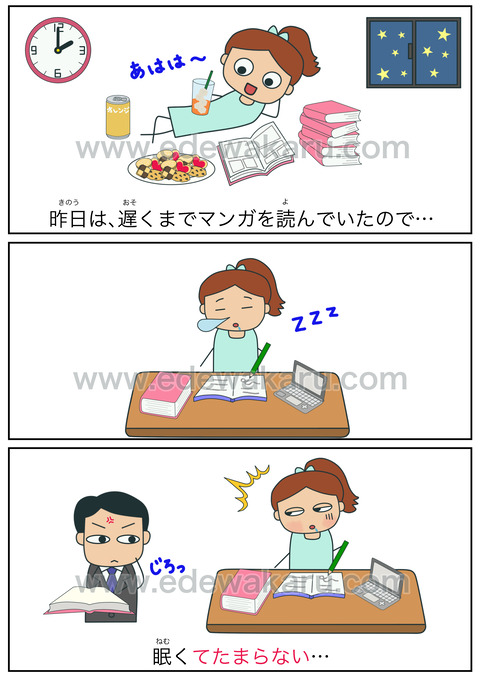
昨日、遅くまでマンガを読んでいたので眠くてたまらない…
→遅くまでマンガを読んでいたので、すごく眠いI read manga until late last night, so I’m unbearably sleepy… →I read manga until late, so I’m really sleepy.
今日は寒くてたまらない
→今日は我慢できないくらい寒いIt’s unbearably cold today. →It’s so cold today I can’t stand it.
お腹が痛くてたまらない
→お腹が、我慢できないくらい痛いMy stomach hurts unbearably. →My stomach hurts so much I can’t stand it.
彼氏のことが好きでたまらない
→彼氏のことがとても好きだI love my boyfriend so much I can’t stand it. →I love my boyfriend very much.
N1に合格した!うれしくてたまらない!!
→すごくうれしいI passed N1! I’m so happy I can’t stand it!! →I’m extremely happy.
1点足りず、不合格だった…悔しくてたまらない
→とても悔しいI failed by one point… I’m so frustrated I can’t stand it. →I’m very frustrated.
新しいスマホがほしくてたまらない
→新しいスマホがすごくほしいI want a new smartphone so badly I can’t stand it. →I really want a new smartphone.
Read the original source text
Meaning
我慢できないくらい〜だ
とても〜だ
How to use it
い形容詞[ーくて]たまらない
な形容詞[ーで]たまらない
Explanation
「〜てたまらない」は強い感情や感覚を表す文型で、「我慢できないくらい〜だ」「とても〜だ」という意味で使われます。「うれしい・悲しい・残念だ・不思議だ」など
【感情を表す形容詞】
や、「暑い・寒い・眠い・痛い」など
【感覚を表す形容詞】、また
「〜たい・〜ほしい」
と使われます。 「〜てたまらない」はいいことにも悪いことにも使用可能です。さらに強調したい場合は
「〜て〜てたまらない」
という形が使われます。
[例]
眠く
てたまらない
→眠く
て
眠く
てたまらない
【余裕のある人へ】
「〜てたまらない」を第三者に使う場合は[五感推量(ごかんすいりょう)]を表す「〜ようだ」「〜らしい」「〜みたいだ」と一緒に使いましょう。
[例]
(私は)新しいスマホがほしく
てたまらない
友達は、新しいスマホがほしく
てたまらないようだ
「〜てたまらない」は類似文型(るいじぶんけい)も多く複雑ですので、しっかりと復習をしておきましょう。
【関連文型】
日本語文型辞典
Meaning
Basic information: Nでたまらない, A-くてたまらない. This expresses an intense degree of the speaker’s feelings, sensations, or desires. For example, ① is close in meaning to “very hot.” It is more or less synonymous with “てしかたがない.” When describing a third party’s state, it is accompanied by “ようだ,” “そうだ,” “らしい,” etc., as in ⑥. Examples: ① It’s unbearably hot today. ② I want to quit this job so badly, but circumstances prevent me. ③ I want so badly to see her. ④ I wanted the hat displayed in the shop window so much that I went back to the store. ⑤ My first trip abroad ended up being canceled. I’m terribly disappointed. ⑥ My child seems incredibly frustrated about losing the match.
Read the original source text
Meaning
基本情報NaでたまらないA-くてたまらない説明話し手の感情・感覚・欲求の程度が激しいことを表す。たとえば、①は「とても暑い」に近い。「てしかたがない」とだいたい同義。第三者の様子を表すときは⑥のように「ようだ」「そうだ」「らしい」などを伴う。例文① 今日は暑くてたまらない。② この仕事はやめたくてたまらないが、事情があってやめられないのだ。③ 彼女に会いたくてたまらない。④ ショーウインドーに飾ってあった帽子がほしくてたまらなかったから、もう一度その店に行ったんです。⑤ はじめての海外旅行が中止になってしまった。残念でたまらない。⑥ うちの子供は試合に負けたのがくやしくてたまらないようです。
日本語文型辞典 英語版
Meaning
【てたまらない】[Na でたまらない][A-くてたまらない]
Expresses a strong feeling, sensation, or want on the part of the speaker. For example,
(1)
is similar to “It is really hot.” Has approximately the same meaning as てしかたがない. Comments concerning the condition of a third person are accompanied by ようだ, そうだ, or らしい, as in
(6)
.
In context 6 examples
今日は暑くてたまらない。
Today is so hot I can’t stand it.
この仕事はやめたくてたまらないが、事情があってやめられないのだ。
I want to quit this job more than anything, but there are reasons I just can’t.
彼女に会いたくてたまらない。
I can’t wait to see her.
ショーウィンドーに飾ってあった帽子がほしくてたまらなかったから、もう一度その店に行ったんです。
There was a hat in the show window that I really wanted, so I went back to that store one more time.
はじめての海外旅行が中止になってしまった。残念でたまらない。
My first overseas trip has been canceled. I am so disappointed.
うちの子供は試合に負けたのがくやしくてたまらないようです。
It seems our child just can’t get over losing the game.
くらべてわかる日本語表現文型辞典
Meaning
A feeling or sensation A is strongly felt at that moment and cannot be restrained or endured.
How to use it
Aてたまらない
[i-adjective—く] てたまらない
[na-adjective—で] たまらない
Explanation
[Contrast 1]
“Aてしょうがない” (Meaning 3, p. 142)
“Aてしょうがない” expresses a feeling or sensation A that has lasted for a long time, whereas “Aてたまらない” expresses a strong feeling or sensation at that particular moment.
○赤ん坊をお風呂に入れると、気持ちよくてたまらないという顔をしていた。 — When you put a baby in the bath, it had an expression that said it felt so good it could hardly stand it.
×赤ん坊をお風呂に入れると、気持ちよくてしょうがないという顔をしていた。 — When you put a baby in the bath, it had an expression that said it felt so good it could hardly stand it. [Using “気持ちよくてしょうがない”]
Also, “Aてたまらない” can mean “A to the utmost,” but “Aてしょうがない” does not have this meaning.
○風呂上がりのビールは、うまくてたまらん。 — A beer after a bath is so delicious I can’t get enough of it.
×風呂上がりのビールは、うまくてしょうがない。 — A beer after a bath is unbearably delicious. [Using “うまくてしょうがない”]
“Aてはたまらない”
“Aてたまらない” means that the speaker cannot restrain or endure their own feelings or sensations, whereas “Aてはたまらない” means that the speaker cannot tolerate the inconvenience or other trouble that befalls them.
○人の持っているものがほしくてたまらない。 — I want what other people have so badly I can’t stand it.
×人の持っているものがほしくてはたまらない。 — I can’t stand it when I want what other people have. [Using “ほしくてはたまらない”]
○こう値上げが続いてはたまらない。 — I can’t put up with prices continuing to rise like this.
×こう値上げが続いてたまらない。 — Prices keep rising like this, and I can’t stand it. [Using “続いてたまらない”]
“Aてやまない” (Meaning 1, p. 149)
In context 4 examples
あんなに仕事ができない人が昇進するなんて、不思議でたまらない。
I can’t get over how someone so incapable at work could be promoted.
写真を見ていると急に、彼女に会いたくてたまらなくなった。
As I looked at the photo, I suddenly wanted so badly to see her.
時々、背中がかゆくてたまらなくなる。
Sometimes my back gets unbearably itchy.
今朝、電車の中で足を踏まれ、痛くてたまらなかった。
This morning, someone stepped on my foot on the train, and it hurt terribly.
Read the original source text
Meaning
Aという気持ちや感覚が、その時点で強く感じられて、押さえたり我慢することができない。
How to use it
Aてたまらない
[イ形-く]てたまらない
[ナ形-で]たまらない
Explanation
【対比1】
「Aてしょうがない」(意味3 P.142)
「Aてしょうがない」は長く持続しているAという感覚を表し、「Aてたまらない」は、その時点の強い気持ちや感覚を表している。
○赤ん坊をお風呂に入れると、気持ちよくてたまらないという顔をしていた。
×赤ん坊をお風呂に入れると、気持ちよくてしょうがないという顔をしていた。
また、「Aてたまらない」には最高にAだという意味があるが、「Aてしょうがない」には、この意味はない。
○風呂上がりのビールは、うまくてたまらん。
×風呂上がりのビールは、うまくてしょうがない。
「Aてはたまらない」
「Aてたまらない」は話し手自身が感情、感覚を押さえられない、我慢できないという意味で、「Aてはたまらない」は話し手に迷惑などが降りかかることが許せないという意味。
○人の持っているものがほしくてたまらない。
×人の持っているものがほしくてはたまらない。
○こう値上げが続いてはたまらない。
×こう値上げが続いてたまらない。
「Aてやまない」(意味1 P.149)
日本語NET JLPT文法解説まとめ
Meaning
“~ to an unbearable degree / extremely ~”
Used when a strong emotion wells up and you want to say that you cannot suppress that feeling.
How to use it
V (て-form) + たまらない
イAくて + たまらない
ナAで + たまらない
Explanation
unbearably
Used when strong emotions arise and one cannot contain those feelings.
There is also an emphatic expression that repeats the phrase, as in “〜て〜て たまらない.”
In context 15 examples
あ~、暑くて暑くてたまらないよ。
Ah, it’s unbearably hot!
もう、お腹が空いてたまらないよ。
I’m so hungry I can’t stand it.
さっき薬を飲んだせいで、眠くてたまらないよ。
Because I took medicine a little while ago, I’m unbearably sleepy.
今、彼と遠距離恋愛だから、なかなか会えないんだ。本当に会いたくてたまらないのよ。
My boyfriend and I are in a long-distance relationship right now, so we can hardly see each other. I want to see him so badly.
国の家族に会いたくてたまらない。
I miss my family back home so much.
さっき、弟から母が入院したという連絡を受けて、心配でたまらない。
A little while ago, my younger brother told me that my mother had been hospitalized, and I’m unbearably worried.
あー、トムさんのことが好きで好きでたまらない。告白したいけど、ふられるのは嫌だし・・・。
Ah, I love Tom so much. I want to confess my feelings, but I don’t want to get rejected...
最近、仕事のミスが多いし、上司から毎日怒られるし、もう嫌でたまらない。
I’ve been making a lot of mistakes at work lately, and my boss scolds me every day. I can’t stand it anymore.
どうして、日本人の会社員はみんな定時になっても帰らないんだろう。不思議でたまらない。
I wonder why Japanese office workers never go home when it’s time to leave. It’s utterly baffling.
明日のプレゼンテーションのことを考えると、不安でたまらない。
When I think about tomorrow’s presentation, I feel unbearably anxious.
試合に負けたのが、悔しくてたまらない。
I’m so frustrated that we lost the match.
さっき蚊にさされたところが、痒くて痒くてたまらない。
The spot where a mosquito bit me a little while ago is unbearably itchy.
鈴木先生の授業は毎回、眠くてたまらない。
I get unbearably sleepy in every one of Mr. Suzuki’s classes.
もう、日本は嫌だ。国の家族に会いたくてたまらない。
I hate Japan now. I miss my family back home so much.
この会社を辞めたくてたまらないが、転職先が見つからないので辞められない。
I want so badly to quit this company, but I can’t because I haven’t found another job.
Read the original source text
Meaning
"我慢できないほど~ / 非常に~"
強い感情がわき起こり、その気持ちを抑えることができないと言いたい時に使う。
How to use it
V(て形) + たまらない
イAくて + たまらない
ナAで + たまらない
Explanation
unbearably
Used when strong emotions arise and one cannot contain those feelings.
「〜て〜て たまらない」のように繰り返して、強調する言い方もある。
毎日のんびり日本語教師
How to use it
Verb, te-form + たまらない
i-adjective stem + くてたまらない
na-adjective stem + でたまらない
Explanation
Attaches to words expressing emotions or sensations and indicates that they are at an unbearable level.
As in examples (11) and (12), the word it attaches to can also be repeated twice for emphasis.
Notes
Comparison with similar grammar
In context 12 examples
来年の春が楽しみでたまらない。(非常期待明年的春天。)
I can’t wait for next spring.
一人は暇でたまらない。
Being alone is unbearably boring.
暑いしジメジメしてるし不快でたまらない。
It’s hot and muggy, and unbearably uncomfortable.
彼は体臭が臭くてたまらない。(他身上臭的让人受不了。)
His body odor is unbearable.
手が痒くてたまらない。(手痒的受不了。)
My hand is unbearably itchy.
カラオケ行きたくてたまらない。(非常想去卡拉OK。)
I want to go to karaoke so badly.
悲しくて寂しくてたまらない。(悲伤寂寞得受不了。)
I’m unbearably sad and lonely.
新しいイヤホン欲しくてたまらない。(非常想要一副新耳机。)
I want a new pair of earphones so badly.
この料理どうやって作るんだろう。知りたくてたまらない。
I wonder how you make this dish. I’m dying to know.
離婚したくてたまらない。(想离婚得不得了)
I want a divorce so badly.
辛くて辛くてたまらない時は逃げてもいい。(痛苦不堪的时候可以逃走。)
When things are unbearably painful, it’s okay to run away.
もうすぐ同窓会がある。早く昔の友人に会いたくて会いたくてたまらない。
There’s a class reunion coming up soon. I can’t wait to see my old friends.
Read the original source text
How to use it
動て形+たまらない
い形容詞語幹+くてたまらない
な形容詞語幹+でたまらない
Explanation
感情・感覚を表す語につき、それらが我慢できない程度であることを表します。
例文(11)(12)のように、接続する語を2度繰り返して強調することもできます。
Notes
似ている文法の比較
IMABI
Can’t Help II
Read this IMABI lesson ↗Explanation
Can’t Help II: ~てならない, ~てやまない, ~てしかたがない, ~にたえない, & ~てたまらない
This lesson will continue coverage on phrases regarding “not being able to restrain” one’s emotions or feeling. The phrases here with exception to ~にたえない, which is brought up because of ~てこたらない, all use the て form to attach to verbs/adjectives, but be careful about what kind of words they can semantically be used with.
~てならない
~てならない is found primarily in the written language, though this doesn’t mean you can’t hear it be used in the spoken language, and its purpose is to show that a certain feeling can’t be helped being felt/thought. If the verb, though, does not refer to emotion or something spontaneous, it cannot be used. This pattern, also, does not attach to the negative form.
1. 不思議に思えてならない。
I can’t help but think it’s strange.
2. 悪化するように思えてならない。
I can’t help but think that it’s going to get worse.
3. もう10年も故郷ふるさとに帰っていないので、両親に会いたくてならない。
Since it’s already been 10 years since I haven’t been home at my hometown, I can’t help but want to meet my parents.
漢字 Note: 故郷 may also be read as こきょう.
4. 肘ひじが痛くてならない。
I can’t help but think about my hurting elbow.
5. 退屈たいくつな日本語の授業に出ていると、眠くてならない。
I can’t help but sleep when I’m at my boring Japanese class.
6. 毎日寂さびしくてならない。
I can’t help but be sad every day.
7. 日本語能力試験が心配でならない。
I can’t help but worry about the JLPT.
8. 失敗するような気がしてなりません。
I can’t help but have the feeling that I’m going to fail.
Warning Note: Do not confuse this with the must/must not pattern ~てはならない.
~てやまない
~てやまない is a somewhat 硬かたい phrase that is used to show that one will continue to be holding a strong feeling. You just won’t stop. It is used with verbs concerning emotion, but it is not used with emotional verbs that describe temporary states. The grammatical person is usually first person. Understandably, it is not appropriate to attach this phrase to the negative form.
9. この写真に写うつっているのは私が愛してやまない犬だ。
The thing in this picture is a dog that I shall always love.
10. 親は子供の将来を期待してやまないものだ。
Parents never stop hoping for their children;s future.
11. 愛犬が死んで悲しくてやまない。
I will continue to be sad over my beloved dog dying.
12. 皆さんの幸せを願ってやみません。
I will continue to wish for everyone’s happiness.
13. ご活躍かつやくを願ってやまない。
I can’t stop wishing for you to flourish.
~てしかたがない
~てしかたがない is very similar to ~てならない, but since it originally referred to there not being a way to withstand or conquer, it gives off a feeling that one can’t stand something while thinking at the same time that there is nothing else that could be done. Therefore, it is also very common in the spoken language. This is unlike ~てならない which is often felt to be quite old-fashioned.
~てならない and ~てしかたがない are different when the verb doesn’t express something spontaneous or emotional, in which case you use ~てしかたがない because nothing is predicated in its definition that it must be used with a verb of emotion. However, this does not mean that ~てしかたがない can’t be used with verbs of spontaneity and or emotion because it still can.
Variant Note: ~しようがない and ~てしょうがない are more casual versions with the latter being the most casual.
Examples
14. もう残念でしかたがない。
It’s no use that it’s already regrettable.
15. いくら着込んでも寒くてしょうねーな。
No matter how much I wear, I’m still cold!
16. 彼が言うと、僕を非難しているように聞こえて{ならない・しかたがない}。
Whenever he says (something), I can’t help but hear it that he’s criticizing me.
17. 朝っぱらからくそ犬めが鳴くんで、うるさくしょうがねーよ。(Vulgar)
Since the damn dog barks from early in the morning, it’s annoying as hell.
18.抽選ちゅうせんにもれたなんて、残念でしかたないね。
It can’t be helped that I’m disappointed that I didn’t get drawn.
~にたえる・~にたえない
耐える means ” to endure”. ~に耐える is seen after nouns and verbs of personal attention to show the worth of something. With する verbs, する is dropped. For example, it is used in contexts such as being worth to read, hear, criticize, applaud, value, etc.
~に耐えない, though, has two usages. When used with the 連体形, it means “cannot stand/endure to…”. When used after a noun, it shows a strong emotional reaction in which one can’t hold back such emotions. This may sound very similar to the first usage, but this usage is strictly used with nouns.
Spelling Note: The phrase can also be spelled as に堪えない.
Style/Word Choice Note: It is somewhat of a stiff phrase and used with a limited number of nouns such as 感謝, 感激, 慙愧ざんき(shame), 等.
Examples
19. 感謝に耐えません。
I can’t help but thank you.
20. 見るに耐えないOLだぞ。
She’s a butt-ugly office lady.
21. 慙愧ざんき(の念)に堪えない。
To be deeply ashamed of oneself.
22. お忙しいところを多くの方にお集まりいただき、感激に堪えません。(謙譲語)
I am overwhelmed with emotion from receiving all of you gathering while you are all busy.
23. 気の毒で同情に堪えない。
I am deeply sorry for you and sympathize with you.
24. 誠まことに慨嘆がいたんに堪えない。
It is truly a matter for great regret.
25. 父は聞くに耐えない歌たいぶりをする。
My dad has an awful manner of singing.
26. 鑑賞に耐えるものだ。
It is something worth appreciating.
Word Note: Again, this phrase is used with limited words such as 見る、聞く、批判、鑑賞かんしょう、議論、etc.
~てたまらない
Although usually left in かな, if you do see this pattern written in 漢字, don’t confuse the reading for the one in ~(に)堪えない. They’re not the same, of course. This is a very common phrase in the spoken language, unlike a lot of the phrases in this lesson, and it is a strong speech style meant to show that one can’t resist a certain emotion, sense, or want.
~てたまらない can’t be used with spontaneous verbs. This is contrast with things like ~てならない and ~てしかたがない. On the other hand, if you are using an adjective that shows an objective degree, ~てたまらない can be used but ~てならない・~てしかたがない can’t.
Examples
26. 日本へ帰りたくてたまらない。
I can’t stand but want to go back home to Japan.
27. 隣の車のマフラー音がうるさくて、たまらないよ。
The muffler of the car next to me is annoying, and I can’t stand it.
28. 隣の駐車場の車の音がうるさくて、たまりません。困ってますよ。
The car noise from the parking lot next to me is annoying, and I can’t stand it. I’m at a loss.
29. お兄さんは毎日退屈で堪らないそうです。
I hear that your older brother can’t stand him being bored every day?
In context 30 examples
不思議に思えてならない。
I can’t help but think it’s strange.
悪化するように思えてならない。
I can’t help but think that it’s going to get worse.
もう10年も故郷ふるさとに帰っていないので、両親に会いたくてならない。
Since it’s already been 10 years since I haven’t been home at my hometown, I can’t help but want to meet my parents.
肘ひじが痛くてならない。
I can’t help but think about my hurting elbow.
退屈たいくつな日本語の授業に出ていると、眠くてならない。
I can’t help but sleep when I’m at my boring Japanese class.
毎日寂さびしくてならない。
I can’t help but be sad every day.
日本語能力試験が心配でならない。
I can’t help but worry about the JLPT.
失敗するような気がしてなりません。
I can’t help but have the feeling that I’m going to fail.
この写真に写うつっているのは私が愛してやまない犬だ。
The thing in this picture is a dog that I shall always love.
親は子供の将来を期待してやまないものだ。
Parents never stop hoping for their children;s future.
愛犬が死んで悲しくてやまない。
I will continue to be sad over my beloved dog dying.
皆さんの幸せを願ってやみません。
I will continue to wish for everyone’s happiness.
ご活躍かつやくを願ってやまない。
I can’t stop wishing for you to flourish.
もう残念でしかたがない。
It’s no use that it’s already regrettable.
いくら着込んでも寒くてしょうねーな。
No matter how much I wear, I’m still cold!
彼が言うと、僕を非難しているように聞こえて{ならない・しかたがない}。
Whenever he says (something), I can’t help but hear it that he’s criticizing me.
朝っぱらからくそ犬めが鳴くんで、うるさくしょうがねーよ。(Vulgar)
Since the damn dog barks from early in the morning, it’s annoying as hell.
抽選ちゅうせんにもれたなんて、残念でしかたないね。
It can’t be helped that I’m disappointed that I didn’t get drawn.
感謝に耐えません。
I can’t help but thank you.
見るに耐えないOLだぞ。
She’s a butt-ugly office lady.
慙愧ざんき(の念)に堪えない。
To be deeply ashamed of oneself.
お忙しいところを多くの方にお集まりいただき、感激に堪えません。(謙譲語)
I am overwhelmed with emotion from receiving all of you gathering while you are all busy.
気の毒で同情に堪えない。
I am deeply sorry for you and sympathize with you.
誠まことに慨嘆がいたんに堪えない。
It is truly a matter for great regret.
父は聞くに耐えない歌たいぶりをする。
My dad has an awful manner of singing.
鑑賞に耐えるものだ。
It is something worth appreciating.
日本へ帰りたくてたまらない。
I can’t stand but want to go back home to Japan.
隣の車のマフラー音がうるさくて、たまらないよ。
The muffler of the car next to me is annoying, and I can’t stand it.
隣の駐車場の車の音がうるさくて、たまりません。困ってますよ。
The car noise from the parking lot next to me is annoying, and I can’t stand it. I’m at a loss.
お兄さんは毎日退屈で堪らないそうです。
I hear that your older brother can’t stand him being bored every day?