絵でわかる日本語
Meaning
whether to call it ~, or whether to call it ~
How to use it
Verb, adjective, or noun [plain form] + というか
Explanation
「AというかBというか〜」 means “whether to call it A or B.” It is used when you don’t really know how to describe something.
[Examples]
①えらい
というか
ケチすぎる
というか、すごいよね…
→I don’t know whether to call him admirable or way too stingy, but he’s amazing…
②嬉しい
というか
さみしい
というか、複雑な気持ちだ
→I don’t know whether to call it happiness or sadness; I have mixed feelings.
③彼は変
というか
ユニーク
というか、とても変わっている
→I don’t know whether to call him strange or unique, but I think he’s very unusual.
④私がN1に合格するなんて、奇跡
というか
ラッキーだった
というか
信じられないわ!
→I don’t know whether to call it a miracle or just luck, but I can’t believe I passed N1!
There are lots of grammar patterns with 「という」, so let’s review them. 😉
[List of grammar patterns with 「という」]
In context 4 examples
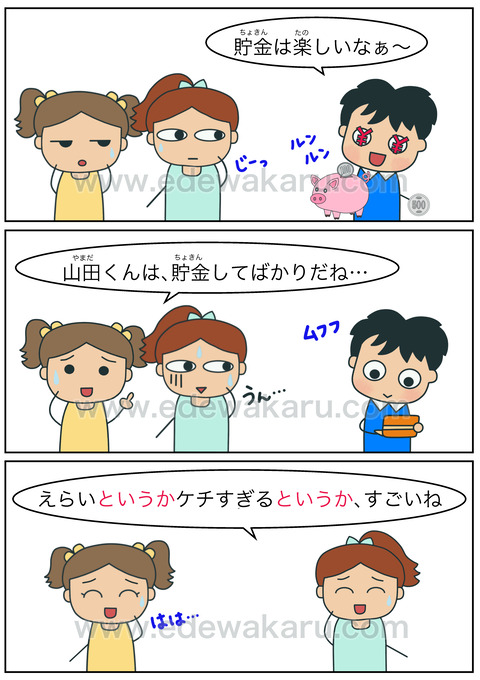
A:山田くんは、貯金してばかりだね…B:うん。えらいというかケチすぎるというか、すごいよね…
A: Yamada-kun does nothing but save money… B: Yeah. I don’t know whether to call him admirable or way too stingy, but he’s amazing…
明日は娘の結婚式だ。嬉しいというかさみしいというか、複雑な気持ちだ
Tomorrow is my daughter’s wedding. I don’t know whether to call it happiness or sadness; I have mixed feelings.
彼は変というかユニークというか、とても変わっている
I don’t know whether to call him strange or unique, but he’s very unusual.
私がN1に合格するなんて、奇跡というかラッキーだったというか信じられないわ!
I can’t believe I passed N1—is it a miracle, or was I just lucky?!
Read the original source text
Meaning
〜と言っていいのか、〜と言っていいのかわからないが
How to use it
動詞・形容詞・名詞[普通形]+というか
Explanation
「AというかBというか〜」は「Aと言っていいのか、Bと言っていいのかわからないが」という意味の文型です。どう表現したらいいのか、よくわからない時に使われます。
[例]
①えらい
というか
ケチすぎる
というか、すごいよね…
→えらいと言っていいのか、ケチすぎると言っていいのかわからないけど、すごいよね
②嬉しい
というか
さみしい
というか、複雑な気持ちだ
→嬉しいと言っていいのか、さみしいと言っていいのか複雑な気持ちだ
③彼は変
というか
ユニーク
というか、とても変わっている
→変と言っていいのかユニークと言っていいのかわからないが、とても変わっていると思う
④私がN1に合格するなんて、奇跡
というか
ラッキーだった
というか
信じられないわ!
→奇跡と言っていいのかラッキーと言っていいのかわからないが、信じられない
「という」がつく文型はたくさんありますので、復習しておきましょう😉
【「という」がつく文型リスト】
日本語文型辞典
Meaning
Attached to a person or event, it is used to insert an impression or judgment, with the sense of “you could also put it this way, for example.” It is often followed by an overall judgment.
Used to list impressions or judgments about people or events as they come to mind. An overall judgment often follows.
How to use it
…というか
…というか…というか
In context 7 examples
そんなことをするなんて、ほんとに馬鹿というか、困った人だ。
To do something like that—he's really stupid, or just such a troublesome person.
この決断は、勇気があるというか、とにかく凡人にはなかなかできないことだ。
This decision is courageous, or rather, it's something an ordinary person could hardly do.
持っていたお金を全部あげてしまうとは、人がいいというか、びっくりさせられた。
Giving away all the money he had—he's so kindhearted, or rather, it really surprised me.
そんなことを言うなんて、無神経というか、馬鹿というか、あきれてものもいえない。
To say something like that—whether tactless or stupid, I'm so appalled I can't say a word.
彼女の行動は大胆というか、無邪気というか、みんなを困惑させた。
Her behavior, whether bold or innocent, left everyone perplexed.
そのときの彼の表情は、悲壮というか、雄々しいというか、言葉にはしがたいものがあった。
His expression at the time was something hard to put into words—whether tragic or heroic.
そのほめ言葉を聞いたときのわたしの気持ちは、うれしいというか、恥ずかしいというか、何とも説明しがたいものだった。
When I heard those words of praise, my feelings were hard to describe—whether happy or embarrassed.
Read the original source text
Meaning
人やできごとに付いて、「たとえばこんな風にも言える」という気持ちで印象や判断を挿入的に述べるのに用いる。後に、総括的な判断を述べることが多い。
人やできごとについて、その印象や判断などを,思いつくままに並べあげるのに用いる。あとに、総括的な判断などを述べることが多い。
How to use it
…というか
…というか…というか
日本語文型辞典 英語版
Meaning
Used to make a parenthetical statement of an impression or judgment about a person, event, etc. Means something like “for example, it’s possible to say something like this.” Often followed by a statement of overall evaluation.
Used for thinking out loud about an impression or opinion of a person or event. Often followed by a statement of overall evaluation.
How to use it
1. ...というか
2. ...というか...というか
In context 7 examples
そんなことをするなんて、ほんとに馬鹿というか、困った人だ。
That he would do something like that means he’s really a fool, or maybe I should say troublemaker.
この決断は、勇気があるというか、とにかく凡人にはなかなかできないことだ。
This decision is one that shows courage, or at any rate, it would be pretty hard for just an ordinary person.
持っていたお金を全部あげてしまうとは、人がいいというか、びっくりさせられた。
You could say she’s a wonderful person to give all her money away, or whatever, but it certainly surprised me.
そんなことを言うなんて、無神経というか、馬鹿というか、あきれてものもいえない。
That he would say something like that makes him either an insensitive clod or an idiot and leaves me utterly speechless.
彼女の行動は大胆というか、無邪気というか、みんなを困惑させた。
Her actions were bold or perhaps naive, but everyone was baffled by them.
そのときの彼の表情は、悲壮というか、雄々しいというか、言葉にはしがたいものがあった。
His expression at the time was somewhere between tragic and dauntless—a little hard to describe in words.
そのほめ言葉を聞いたときのわたしの気持ちは、うれしいというか、恥ずかしいというか、何とも説明しがたいものだった。
My feelings at hearing such words of praise were somewhere between happy and embarrassed—it’s really hard to explain.
Read the original source text
Meaning
Used to make a parenthetical statement of an impression or judgment about a person, event, etc. Means something like “for example, it’s possible to say something like this.” Often followed by a statement of overall evaluation.
Used for thinking out loud about an impression or opinion of a person or event. Often followed by a statement of overall evaluation.
How to use it
1. ...というか
2. ...というか...というか
毎日のんびり日本語教師
How to use it
Verb plain form + というか
い-adjective plain form + というか
な-adjective stem + というか
Noun + というか
Explanation
This sentence pattern states the impression or judgment one has and evaluates or describes it.
It is used when avoiding saying something directly.
Notes
Nothing in particular.
In context 7 examples
この映画のオチには失望というか残念というか、見なければ良かったと思う。
The ending of this movie left me disappointed—or maybe just frustrated; I wish I hadn't watched it.
あんなところに一人で行くなんて、無謀というか無茶というか、とにかく私には理解できない。
Going to a place like that alone is reckless—or foolhardy, I don't know; in any case, I just can't understand it.
たくさんお祝いをしていただき、嬉しいというか感謝というか、言葉になりません。
You've celebrated me so much; I'm so happy—or perhaps so grateful—I can't put it into words.
この質問には答えづらいというか何というか、女性にする質問としては不適切だと思う。
I find this question difficult to answer—or how should I put it? I think it's inappropriate to ask a woman.
彼は変というか面白いというか、どこか他の人と違う。
He's strange—or maybe interesting; somehow, he's different from other people.
そんなことを言うなんて無神経というか何というか、彼の人格を疑う。
To say something like that is insensitive—or whatever you want to call it; it makes me question his character.
自分でチャーハン作ってみたけど食感が悪いというか味が濃いというか、反省点がたくさんある。
I tried making fried rice myself, but the texture is bad—or maybe the flavor is too strong; there are lots of things I need to improve.
Read the original source text
How to use it
動詞普通形+というか
い形普通形+というか
な形容詞語幹+というか
名詞+というか
Explanation
自分が感じている印象や判断を述べ、それをしたり評価する文型です。
直接的に言うのを避けるようなときに使います。
Notes
特になし
NINJAL 日本語文型データベース
Usage 1
Meaning
Used when explaining something while hesitating over whether 「〜」 or another expression is better. It is also used when explaining something while unsure whether a judgment expressed as 「〜」 or a different judgment is appropriate.
It can be used at the beginning of a sentence in conversation to respond to what the other person has said, rephrase it, or add one’s own words. It can also be used at the end of a sentence when the speaker does not want to make their own words explicit.
How to use it
V plain form + というか
i-A plain form + というか
na-A plain form + というか (「na-Aだ」 most often takes the form 「na-A+というか」)
Nというか / N plain form + というか (「Nだ」 most often takes the form 「N+というか」)
Other
Notes
After 「〜というか」 comes the expression or judgment that the speaker considers more appropriate.
In context 23 examples
店主は店を長期休業するというか、辞めるつもりでいるようだ。
It seems the shop owner intends to close the shop for a long time—or rather, to quit altogether.
おなかがあまりすいていないというか、今は何も食べたくない。
It’s not so much that I’m not very hungry; I just don’t want to eat anything right now.
佐藤さんとは学生時代とても仲がよかったんですが、社会人になってからは、お互いの価値観が違ってきたというか、まったく話がかみ合わなくなってしまいました。
Sato and I were very close when we were students, but after we entered the workforce, our values started to differ—or rather, we ended up unable to understand each other at all.
「夏休みはどこかに行かれたんですか?」「夏休みですか。どこにも行かなかったというか、どこにも行けなかったんですがね。暇もお金もなくて」
“Did you go anywhere during summer vacation?” “Summer vacation? It’s not that I didn’t go anywhere; I couldn’t go anywhere. I had neither time nor money.”
「どうして連絡くれなかったの」「いや、忘れてたというか……」
“Why didn’t you get in touch?” “Well, it’s not that I forgot…”
「ごめんなさい。結婚のことについては、すぐに返事ができないというか」
“I’m sorry. It’s not that I can’t give you an answer about getting married right away…”
この仕事は楽しいというか、やりがいがあって大好きなんです。
This job is fun—or rather, it’s rewarding, and I love it.
「絵美って、もう彼氏なんかと話したくないって感じだね」「んー、話したくないというか、実際は向こうが私のことを無視しているんだけど」
“Emi, you seem like you don’t want to talk to your boyfriend anymore.” “Hmm, it’s not that I don’t want to talk to him; actually, he’s the one ignoring me.”
幼なじみのリョウちゃんは賢かったというか、年のわりに落ち着いた感じの男の子だったという記憶がある。
I remember my childhood friend Ryo-chan as being smart—or rather, as a boy who seemed mature for his age.
あの人の話は、私には難しかったというか、全然意味がわからなかった。
What that person said was difficult for me—or rather, I couldn’t understand it at all.
父は、酒はかなり飲めるほうですが、若い頃は強くなかったというか、ほとんど飲めなかったようです。
My father can drink quite a lot now, but when he was young, he wasn’t a strong drinker—or rather, it seems he could hardly drink at all.
斎藤さんは大雑把というか、かなりルーズだったので、よく上司に叱られていた。
Saito was careless—or rather, quite lax, so he was often scolded by his superiors.
木原さんの発言はいつも過激だなあと思う。排他的というか。
I always think Kihara’s remarks are extreme. Exclusionary, I mean.
スポーツは得意ではないというか、好きではないからしない。
It’s not so much that I’m bad at sports; I don’t do them because I don’t like them.
昨日、美術館で見た「人間の生と死」という絵は、奇妙だったというか、不気味だった。
The painting 『人間の生と死』 (“The Life and Death of Human Beings”) that I saw at the museum yesterday was strange—or rather, eerie.
「この前、囚人が刑務所から脱走した事件があったでしょう。あの刑務所のセキュリティって、万全じゃなかったというか、すごくお粗末なものだったらしいよ」
“You know the incident the other day when a prisoner escaped from prison? I heard that prison’s security wasn’t exactly foolproof—or rather, it was really shoddy.”
「あ、きれいな実がなっているよ。実というか、花なのかな」
“Oh, what beautiful fruit! Fruit, I mean—is it a flower?”
その大学は私の第1志望じゃないというか、私の実力ではちょっと無理だと思っているんです。
It’s not so much that that university isn’t my first choice; I think it’s a bit beyond my abilities.
その格闘家のプレーはフェアプレーではなかったというか、もはや殺人行為に近かった。
That martial artist’s performance wasn’t fair play—or rather, it was practically attempted murder.
叔父は正直者だったというか、みんながあきれるぐらいのお人好しだった。
My uncle was honest—or rather, so trusting that everyone was exasperated by it.
将来のためというか、私に何かあった時、家族が困らないように貯金しています。
I’m saving money for the future—or rather, so that my family won’t be in trouble if something happens to me.
「山田監督の新作、すごいよね。大作というか」
“Director Yamada’s new film is amazing, isn’t it? A huge production, I mean…”
「宿題は明日までだったよね」「というか、今日までじゃなかった?」
“The homework was due tomorrow, right?” “Actually, wasn’t it due today?”
Read the original source text
Meaning
〜という表現がいいか、別の表現がいいか迷いながら説明するときに使います。また、〜という判断が適切か、別の判断が適切か迷いながら説明するときにも使います。
会話で文頭に使い、相手の言った言葉を受けて、それを言い換えたり、自分の言葉を付け加えたりすることもあります。また、自分の言葉をはっきりさせたくないときに文末に使うこともあります。
How to use it
V普通形+というか
i-A普通形+というか
na-A普通形+というか(「na-Aだ」→「na-A+というか」の形になることが多い)
Nというか・N普通形+というか(「Nだ」→「N+というか」の形になることが多い)
その他
Notes
「〜というか」の後には、話し手がより適切だと考えている表現や判断がきます。
Usage 2
Meaning
Used with 「〜」 to give two examples and say that something is similar to them. It is often used when the speaker cannot think of the best expression to describe a situation or wants to avoid stating it explicitly.
「~といいますか~といいますか」 is the polite form.
The form 「〜というか何というか」 is also used to show that the speaker thinks there may be some other way of putting it.
How to use it
V1 plain form + というか + V2 plain form + というか
i-A1 plain form + というか + i-A2 plain form + というか
na-A1 plain form + というか + na-A2 plain form + というか (「na-Aだ」 most often takes the form 「na-A+というか」)
N1というかN2というか / N1 plain form + というか + N2 plain form + というか (「Nだ」 most often takes the form 「N+というか」)
Notes
The two 「〜」 expressions can sometimes be different parts of speech.
A sentence that brings together the two 「〜」 expressions often follows 「〜というか〜というか」, but that sentence may also be omitted.
There are usually two instances of 「〜というか」 in a sentence, but there can be three or more.
In context 23 examples
私にとって藤田さんは、何でも相談できるというか甘えられるというか、同僚というよりお兄さんみたいな存在です。
To me, Fujita is someone I can talk to about anything—or rather, lean on; he’s more like an older brother than a colleague.
私は、料理ができないというかしようと思っていないというか、これまでに一度も料理を作ったことがない。
It’s not so much that I can’t cook as that I don’t intend to; I’ve never cooked even once.
夫は融通が利かないというか、真面目すぎるというか、日課のジョギングは雨の日でもやめない。
My husband is inflexible—or rather, too serious; he never skips his daily jog, even on rainy days.
この小説は、違和感があったというか理解できなかったというか、どうも私には楽しめませんでした。
This novel felt off—or rather, I couldn’t understand it; somehow I couldn’t enjoy it.
その立候補者の演説を聞いてみたが、口先だけで言っていたというか魂がこもっていなかったというか、その人に一票を投じたいという気持ちには全くなれなかった。
I listened to the candidate’s speech, but it was all empty words—or rather, it had no soul in it, so I couldn’t bring myself to want to vote for that person at all.
叔父のことは最初から信用していなかったというか相手にしていなかったというか何というか……。 今でも疎遠なんです。
I never trusted my uncle from the start—or rather, never took him seriously—or what can I say… We’re still estranged.
患者「虫に刺されたところがかゆいというか痛いというか、変になっているようなので、診てもらいたいんですが」
Patient: “The place where the insect bit me is itchy—or rather, painful; it seems to be getting strange, so I’d like you to take a look.”
このラーメン、辛いというか味が濃いというか、あまり好きな味じゃない。
This ramen is spicy—or rather, strongly flavored; it’s not really to my taste.
我が社のAIの導入は決して早くないというか遅すぎるというか、もう少し頑張らなくてはいけない。
Our company’s adoption of AI is by no means early—or rather, it’s far too late; we need to make a little more effort.
就職先が決まって、うれしかったというかほっとしたというか、これでやっと気持ちが楽になりました。
I got a job, and I was happy—or rather, relieved; now I can finally feel at ease.
楽しみにしていた昨日の3時間ドラマ、よくなかったというか期待外れだったというか、がっかりした。
Yesterday’s three-hour drama, which I’d been looking forward to, wasn’t good—or rather, it was a letdown. I was disappointed.
憧れの山田先輩は、心が広いというか情が深いというか太っ腹というか、とても素敵な人なんです。
My admired senior, Yamada, is broad-minded—or rather, compassionate—or rather, generous. They’re a truly wonderful person.
その湖周辺は神秘的というか不気味というか、今まで見たことのないような景色だった。
The scenery around that lake was mysterious—or rather, eerie—and unlike anything I had ever seen.
この服のデザインは、平凡だというか無難だというか、面白みに欠ける。
The design of these clothes is ordinary—or rather, safe; it lacks interest.
スポーツは得意ではないというか好きではないというか、できればしたくないです。
It’s not so much that I’m bad at sports as that I don’t like them; I’d rather not do them if possible.
亡くなった祖父は頑固だったというか柔軟性に欠けていたというか、ちょっと扱いにくいところもあった。
My late grandfather was stubborn—or rather, lacked flexibility, and could be a little difficult to deal with.
文章を書くのは子どものころから苦手ではなかったというか苦ではなかったというか。よく褒められてました。
I wasn’t bad at writing—or rather, it wasn’t a struggle for me—ever since I was a child. I was often praised for it.
林さんは会社を辞めて起業するようだ。無謀というか、物事を深く考えていないというか、心配だ。
It seems Hayashi is quitting the company to start a business. Reckless—or rather, not thinking things through deeply—I’m worried.
雪というかあられというか、冷たいものが降ってきた。
Something cold came falling down, snow—or rather, sleet.
京都は町並みというかたたずまいというか、町全体の雰囲気が本当に素敵で大好きなんです。
Kyoto’s streets—or rather, its overall atmosphere; I really love the wonderful feeling of the whole city.
彼女の瞳は青というか青緑というか、とても神秘的な色をしている。
Her eyes are blue—or rather, blue-green—a very mysterious color.
田中さんは、個性的な人だったというか変わった人だったというか……。とにかく付き合いづらかった。
Tanaka was a distinctive person—or rather, an odd person… In any case, he was hard to get along with.
退職した理由は、労働環境の悪さといいますか上司との関係がよくなかったことといいますか……。
The reason I retired was the poor working conditions—or rather, my bad relationship with my boss…
Read the original source text
Meaning
〜で2つの表現の例を挙げて、それらに近い何かであると言いたいときに使います。ある状況を説明するとき、最適な表現が思いつかない場合や明言を避けたい場合などに使うことが多いです。
「~といいますか~といいますか」は丁寧な形です。
「〜というか何というか」の形も使い、さらに別の表現があるかもしれないと思っていることを表します。
How to use it
V1普通形+というかV2普通形+というか
i-A1普通形+というかi-A2普通形+というか
na-A1普通形+というかna-A2普通形+というか(「na-Aだ」→「na-A+というか」の形になることが多い)
N1というかN2というか・N1普通形+というかN2普通形+というか(「Nだ」→「N+というか」の形になることが多い)
Notes
2つの「〜」には異なる品詞がくる場合もあります。
「〜というか〜というか」の後には、2つの「~」をまとめるような文が来ることが多いですが、その文を省略する場合もあります。
「〜というか」は1文中にふつう2つですが、3つ以上のこともあります。
AIUEO JLPT Grammar
Meaning
This sentence pattern is used when the speaker is unsure and cannot express the exact word but still feels that one of the options is appropriate. It is often used when selecting the right word to explain emotions or situations.
How to use it
Verb と + いうか + Verb と + いうか; i-adjective と + いうか + i-adjective と + いうか; na-adjective と + いうか + na-adjective と + いうか; Noun と + いうか + Noun と + いうか
In context 5 examples
彼の行動は大胆というか、無謀というか、とにかく驚いた。
His actions were either bold or reckless—either way, I was surprised.
寂しいというか、情けないというか、なんとも言えない気持ちだ。
I feel lonely, or rather pathetic—I can’t quite put it into words.
これはりんごというかミカンというか、よく分からない果物だ。
This is a fruit that I'm not sure if it's an apple or a mandarin orange.
これはピンチというかチャンスというか、なんとも言えない。
It's hard to say whether this is a crisis or an opportunity.
彼の態度は冷たいというか、無関心というか、とにかく不愉快だ。
His attitude was either cold or indifferent—anyway, it was unpleasant.
Read the original source text
Meaning
This sentence pattern is used when the speaker is unsure and cannot express the exact word but still feels that one of the options is appropriate. It is often used when selecting the right word to explain emotions or situations.
How to use it
動詞と+いうか+動詞と+いうか形容詞と+いうか+形容詞と+いうか形容動詞と+いうか+形容動詞と+いうか名詞と+いうか+名詞と+いうか
Explanation · 日本語
この文型は、話し手がいくつかの言葉を挙げて、そのいずれかが適切だと感じつつも、なんとも言い切れない場合に使われる表現です。感情や状況を説明する際、適切な言葉を選びかねている時に使うことが多いです。
DoJG 日本語文法辞典(全集)
Meaning
Or; or rather; or I’d (rather) call it; or I may call it; or I’d (rather) say; or I may say
Explanation
A phrase used to restate what was just said in order to be more accurate or appropriate.
In context 10 examples
自分の勘違いと言うか、不注意でした。
It was my misunderstanding . . . or carelessness, rather.
彼のことは諦めたと言うか、もうどうでもよくなった。
I'm through with him. Or rather, I don't care anymore.
我が社の話は何もできません。と言うか、何も話すことはありません。
I cannot talk about our company. Or, I should say, I have nothing to say about it.
彼は議論好きと言うか、いつも人の意見に反対したがります。
He is argumentative, or should I say, he always wants to disagree with others.
この事件については、私たちも驚いていると言うか、困惑しています。
We are also surprised by this incident, or perplexed, rather.
今日来た人は、商魂たくましいと言うか、本当に厚かましい人でした。
The person who visited us today was an aggressive salesman, or maybe I should just say he was a really shameless person.
何度裏切られても涙を見ると許してしまう自分に腹が立つと言うか、愛想が尽きる。
No matter how many times I get betrayed, I end up forgiving him when I see his tears. I'm angry at myself, or I should say, I'm sick of myself. (literally: I'm angry at myself, who ends up...)
これは何と言うか、まあ、一種の妥協でしょうね。
What should I call it? Hmm, it's a kind of compromise, I guess.
これは日記と言うか覚え書きと言うか…。
Should I call this a diary, or a memo?
A:あの人は奥さんですか。 B:うーん、と言うか、恋人みたいなもんです。
A: Is she your wife? B: Well, actually, (I'd say) she's something like a lover.
どんなときどう使う 日本語表現文型辞典
Meaning
don't know if should call it…or…
How to use it
N / 〔Plain form〕 (ナ-adjective / Noun) + というか + N / 〔Plain form〕 (ナ-adjective / Noun) + というか
Explanation
というか~というか
~と言ったらいいのか~と言ったらいいのか
B:ええ、まあ、別荘というか小屋というか、たまに週末を過ごしに行くだけなんですがね。
話題になっているものごとについて、一つの言い方での断定を避けて、いろいろ言葉を変えて説明してみる言い方。
When explaining topic, speaker avoids deciding on one description and instead tries a variety of ways to explain problem.
In context 3 examples
A:山の方に別荘をお持ちなんですって。
A: I hear you have a vacation home in the mountains.
わたしが子どものころ住んでいた所には、川というか小川というかきれいな流れがあって、そこでよく魚をとって遊んだものです。
Where I lived as a child, there was a beautiful stream—maybe a river, or perhaps just a brook—and I often played there catching fish.
この店の従業員は親切というかよく気がつくというか、とにかくみんな感じがいい。
The employees at this shop are kind—or maybe just very attentive; anyway, they all make a good impression.
Read the original source text
Meaning
don't know if should call it…or…
How to use it
N/〔普通形〕(ナA/N)+というか+N/〔普通形〕(ナA/N)+というか
Explanation
というか~というか
~と言ったらいいのか~と言ったらいいのか
B:ええ、まあ、別荘というか小屋というか、たまに週末を過ごしに行くだけなんですがね。
話題になっているものごとについて、一つの言い方での断定を避けて、いろいろ言葉を変えて説明してみる言い方。
When explaining topic, speaker avoids deciding on one description and instead tries a variety of ways to explain problem.