日本語文型辞典
Usage 1
Meaning
Basic information: V-よう. One of the conjugated forms of verbs, expressing the speaker’s volition or conjecture. “-よう” attaches to the continuative form of ichidan verbs (e.g. 見よう, 食べよう). “来る” and “する” become “こよう” and “しよう.” With godan verbs, attach “-う” to the sound in the o-row (e.g. 行こう, 読もう, 話そう). The polite form is “R-ましょう,” as in “食べましょう” and “行きましょう.”
Used with verbs that express intentional actions to express the speaker’s intention to act. Depending on the situation in which it is used, it also has distinct uses such as [offer], [invitation], and [indirect request]. Polite expressions such as “…しましょう/いたしましょう” are used.
a. V-よう [volition]
Used with verbs expressing intentional actions to indicate the speaker’s intention to perform that action. “V-ようっと” in ③ is a self-directed expression used in speech. It may also be pronounced in shortened form as “V-よっと.”
b. V-よう [offer]
Used when the speaker offers to do something for the other person. The speaker intends to do something for the other person’s benefit. As in ③–⑤, humble expressions take forms such as “…いたしましょう” or “お…しましょう/いたしましょう.”
c. V一よう [invitation]
Used to invite the listener to act together with the speaker. In use B, [offer], only the speaker performs the action, whereas [invitation] is used to invite the listener to act together with the speaker.
d. V-よう [appeal]
Used to call on two or more people to take (or refrain from) an action, as in “…する/しないようにしよう.” It is often used in slogans on posters or banners seen by many people, as a way of calling on people to follow them.
e. もらおう/V-てもらおう
The form “(V一て)もらおう/いただこう” is used to indirectly request that the listener do something. It is similar to requests such as “ビールをください,” “死んでくれ,” and “来てください,” but “(V-て)もらおう” has a stronger nuance of unilaterally imposing the speaker’s demand. It is difficult to use unless the speaker is socially superior or has professional authority.
A somewhat old-fashioned written expression of “だろう,” which expresses the speaker’s conjecture. The i-adjective form “A-かろう,” as in “よかろう/寒かろう,” has the same use. In speech, “だろう(と思う)” or “でしょう” is used.
a. V-よう
Expresses the speaker’s conjecture. It is often used with non-volitional verbs such as “ある” and “なる,” and expressions of possibility such as “言える,” “できる,” “考えられる,” and “あり得る.” The negative form is “V-まい.” It is a written, old-fashioned expression. In speech, “だろう” is used. “V-ましょう” is the polite form of “V-よう”; it was used in old weather forecasts and the like, but recently “でしょう” is used.
b. V-ようか
A written expression for “だろうか.” It expresses a question or rhetorical question. ②–④ are examples of rhetorical questions and can be interpreted as “…だろうか。いやそうではない” (“Could it be …? No, it cannot”). The plain form is more commonly used.
This is the volitional form of a verb, “V-よう,” followed by the question particle “か.” It is used when the speaker is unsure of their own intention or asks about the listener’s wishes. Its basic use is the same as “V-よう,” but the addition of “か” adds a sense of doubt or a question.
a. V-ようか [volition]
Expresses a state in which the speaker is hesitating over whether to do the action or has not decided. “かな” or “かしら” may also be added in place of “か.” Since “かな” and “かしら” are self-directed expressions, they are not readily used with the polite form, and one ordinarily does not say “ましょうかな/ましょうかしら.”
b. V-ようか [offer]
Used with either rising or falling intonation, but rising intonation strengthens the sense of asking.
c. V-ようか [invitation]
Used to ask the listener whether they would like to act together with the speaker. It is often spoken with falling intonation, but rising intonation strengthens the sense of asking.
d. もらおうか/V-てもらおうか
Used to indirectly request that the listener do something. The addition of “か” adds the sense that the speaker has just thought of this, or a feeling of hesitation, so the one-sided demand is softened somewhat compared with when it is absent. It is normally used by a socially superior person to someone below them.
A written expression meaning “whatever action one takes / whatever the circumstances.” It is followed by something that holds true regardless, or by expressions of resolve or request, or evaluations such as “自由だ/勝手だ.” It can often be paraphrased as “V-ようと,” but it cannot always be paraphrased as “ても.”
a. V-ようが
Expresses that what follows holds true without being constrained by what precedes it. The latter part uses expressions of intention or resolve, or evaluations such as “自由だ/手だ.”
b. うがV-ようが
Repeats items with opposite or similar meanings to express “whatever happens / whatever one does.” Its use is the same as A above.
c. V-ようがV-まいが
Uses the affirmative and negative volitional forms of the same verb and means “whichever action one takes.” A formal way of saying “…してもしなくても.”
Attached to verbs expressing intentional actions, it is used to strongly assert one’s intention or invite the other person to act together. It has a stronger prompting effect on the other person than “V-ようか,” and is used mainly by men. Women usually use “…ましょう.” The polite form is “…ようではありませんか/ないですか.”
A written expression equivalent to “V-ても,” meaning “whatever action one takes / whatever the circumstances.” The latter part is followed by something that holds true regardless, or evaluations such as “自由だ/勝手だ.” It can often be paraphrased as “V-ようが,” but it cannot always be paraphrased as “ても.”
a. V-ようと
Expresses that what follows holds true without being constrained by what precedes it. The latter part is followed by an expression meaning “it’s up to you / free / irrelevant.”
b. V-ようとV-ようと
Repeats items with opposite or similar meanings to express “it doesn’t matter what one does / one is free to do as one likes,” or that the latter part holds true regardless of which action is taken.
c. V-ようとV一まいと
Means “…whether one does it or not.”
d. V-ようとも
Formed by adding “も” to “V-ようと,” this is a written expression for “V-ても.” Its meaning and use are the same as when “も” is absent, but it has a somewhat more old-fashioned nuance. It is often accompanied by “(たとえ)どんなに/いかに.”
Used after verbs expressing intentional actions to express the speaker’s plans or intentions. In questions, it asks about the listener’s intention. Also, “かと思う” in ④ expresses the speaker’s uncertainty or hesitation. “V-ようと(は)思わない” expresses that the speaker has no such intention. It is similar to “つもりだ,” but differs in that “つもりだ” can express a third party’s intention.
Note that “V-ると思う” expresses the speaker’s conjecture, not intention, so it cannot be used to express intention; “V-ようと思う” must be used instead.
a. V-ようとする [immediately before]
Means “immediately before / on the verge of” an action or change beginning or ending. Typically, non-volitional verbs such as “始まる” and “終わる,” which do not involve human intention, are used, but intentional verbs are also used in patterns such as “V-ようとするところ.” When non-volitional verbs are used, the expression is often literary or poetic.
b. V-ようとする [attempt]
Used with verbs expressing intentional actions to indicate trying or making an effort to carry out the action.
c. V-ようと(も/は)しない
Used with verbs expressing intentional actions to indicate that there is no intention to perform the action. “V-ようともしない,” with “も” inserted, emphasizes the negation and means “doesn’t even try to….” As in ⑤, “は” may also be inserted.
Used after non-volitional verbs expressing things beyond human intention, such as “なる,” to mean “did not expect it to turn out that way.” “合格しよう” and “完成しよう” in ③ and ④ express that something “would pass / would be completed” or “would come to pass / be completed” naturally; they do not express the speaker’s intention. The following verb, other than “思う,” is typically a verb such as “予想/想像する,” and is always used in the form “-なかった.” Written language.
Attached to verbs expressing intentional actions, it means “though one intends to do…, one cannot.” The same verb is used before and after this form. It is often used when circumstances make something impossible despite a strong desire to do it.
How to use it
V-よう [volitional]
V-よう [conjecture]
V-ようか [volitional]
V-ようが “V-ても”
V-ようじゃないか
V-ようと
V-ようと思う
V-ようとする
V-ようとは思わなかった
V-ようにもV-れない
In context 110 examples
夏休みには海に行こう。
Let’s go to the sea during summer vacation.
来年こそはよい成績がとれるように頑張ろう。
Let’s work hard so that next year we can finally get good grades.
何にもすることないから、テレビでも見ようっと。
I’ve got nothing to do, so I think I’ll watch some TV.
はっきり申しましょう。あなたにはこの仕事は無理です。
Let me be clear. This job is beyond you.
A:今夜一杯いかがですか。
B:そうですねえ。今日は遠慮しておきましょう。A: Would you like to have a drink tonight? B: Hmm. I think I’ll pass today.
足が痛いのか。おぶってやろう。
Does your leg hurt? I’ll carry you on my back.
忙しいのなら、手伝ってあげよう。
If you’re busy, I’ll help you.
その荷物、お持ちしましょう。
I’ll carry that luggage for you.
切符は私が手配いたしましょう。
I’ll arrange the tickets.
駅までお送りしましょう。
I’ll escort you to the station.
君もいっしょに行こうよ。
Come along with me, too.
一度ゆっくり話し合おう。
Let’s have a good, unhurried talk sometime.
今夜は飲み明かそうよ。
Let’s drink the night away tonight.
お待たせしました。では出かけましょう。
Sorry to have kept you waiting. Well then, let’s go.
横断する時は左右の車に注意しよう。
When crossing the road, let’s watch out for cars on both sides.
飲酒運転は絶対に虚けよう。
Let’s absolutely avoid drunk driving.
食事の前には手を洗いましょう。
Let’s wash our hands before meals.
動物にいたずらしないようにしましょう。
Let’s not tease the animals.
ビールをもう一本もらおう。
I’ll have one more beer.
あんたには死んでもらおう。
I’ll have you die.
ちょっと警察署まで来ていただきましょう。
Let’s have you come to the police station for a moment.
場合によっては延期されることもあろう。
Depending on the circumstances, it may be postponed.
この点については次のようなことが言えよう。
The following can be said about this point.
午後からは全国的に晴れましょう。
It will be sunny across the country from the afternoon onward.
山沿いでは雪になりましょう。
It will turn to snow along the mountains.
結論としては、次のようなことが言えようか。
Could the conclusion be summarized as follows?
こんなひどいことをする人間がこの世にあろうか。
Could there be a person in this world who would do something so terrible?
こんなに貧しい人達をどうして放っておけようか。
How could we leave such poor people alone?
そんな馬鹿げたことがありえましょうか。
Could anything so ridiculous be possible?
どうしようか。
What should I do?
昼ご飯は何にしようかな。
What shall I have for lunch?
行こうか、それともやめておこうか。
Shall I go, or should I just forget it?
私の考えていること、白状しちゃおうか。
Shall I confess what I’ve been thinking?
こんな仕事やめてしまおうかしら。
Maybe I should quit this job.
これからどうして暮らしていこうか。
How am I going to make a living from now on?
君の代わりに僕がやろうか。
Shall I do it in your place?
荷物、僕が持とうか。
Shall I carry the luggage?
何かお手伝いしましょうか。
Can I help you with anything?
いいこと教えてあげましょうか。
Would you like me to tell you something good?
結婚しようか。
Shall we get married?
何時に待ち合わせしようか。
What time shall we meet?
どこかで食事しましょうか。
Shall we have a meal somewhere?
いっしょに海外旅行しましょうか。
Shall we take a trip abroad together?
お茶を一杯もらおうか。
Shall I have a cup of tea?
これ、コピーしてもらおうか。
Shall I get this copied?
君には、しばらく席をはずしていただきましょうか。
Shall I have you leave your seat for a while?
A:もうすぐ、帰ると思います。
B:じゃ、ここで待たせてもらいましょうか。A: I think they’ll be back soon. B: Then shall I wait here?
どこで何をしようが私の勝手でしょう。
Wherever I go and whatever I do is my own business, isn’t it?
人になんと言われようが、自分の決めたことは実行する。
No matter what people say about me, I’ll carry out what I’ve decided.
彼がどうなろうが、私の知ったことではない。
Whatever happens to him is none of my concern.
出掛けようが家にいようが、あなたの自由です。
Whether you go out or stay home is up to you.
雨が降ろうがやりが降ろうが、試合は決行します。
Whether it rains or hails, we will go ahead with the game.
みんなに笑われようがバカにされようが、気にしない。
Whether everyone laughs at me or makes fun of me, I don’t care.
あなたが出席しようがしまいが、私は出席します。
Whether you attend or not, I will attend.
勉強をやろうがやるまいが私の勝手でしょう。
Whether I study or not is my own business, isn’t it?
パーティーは参加しようがしまいが、皆さんの自由です。
Whether you participate in the party or not is up to you all.
一緒に飲もうじゃないか。
Let’s have a drink together.
みんなでがんばろうじゃないか。
Come on, let’s all do our best.
よし、そんなにおれと喧嘩したいのなら、受けて立とうじゃないか。
All right, if you want to fight me that badly, then I’ll take you on!
今夜は、語り明かそうではありませんか。
Let’s stay up talking all night tonight.
なにをしようと私の自由でしょう。
Whatever I do is up to me, isn’t it?
どこへ行こうとあなたの勝手です。
Wherever you go is your business.
どんなに馬鹿にされようと腹をたてるでもなく彼はひたすら働いている。
No matter how much he is mocked, he does not get angry; he just keeps working.
努力しようと怠けようと結果がすべてだ。
Whether you make an effort or slack off, the result is everything.
あなたが泣こうとわめこうと、僕には関係ない。
Whether you cry or shout, it has nothing to do with me.
行こうとやめようと私の勝手だ。
Whether I go or stay is my own business.
遊ぼうと勉強しようとお好きなようにしてください。
Do as you please, whether you play or study.
煮て食おうと焼いて食おうとご自由に。
Boil it and eat it, or grill it and eat it—whatever you like.
駆け落ちしようと心中しようと勝手にしろ。
Run away together or commit double suicide—do whatever you want.
行こうと行くまいとあなたの自由だ。
Whether you go or don’t go is up to you.
たくさん食べようと食べまいと料金は同じだ。
The price is the same whether you eat a lot or not.
君が彼女に会おうと会うまいと僕には関係のないことだ。
Whether you meet her or not is none of my concern.
皆にどんなに反対されようとも決めたことは実行する。
No matter how strongly everyone opposes it, I will carry out what I’ve decided.
たとえどんなことが起ころうとも、彼からは一生離れない。
No matter what happens, I’ll never leave him.
どんなに脅かされようとも、彼は毅然とした態度をくずさなかった。
No matter how much he was threatened, he did not lose his resolute attitude.
いかに富に恵まれようとも、精神が質しくては幸せとは言えない。
No matter how much one is blessed with wealth, one cannot be called happy if one’s spirit is impoverished.
お正月には温泉に行こうと思う。
I think I’ll go to a hot spring over New Year’s.
来年はもっと頑張ろうと思う。
I think I’ll work harder next year.
今夜は早く寝ようと思っている。
I’m planning to go to bed early tonight.
今の仕事を辞めようかと思っている。
I’m thinking I might quit my current job.
外国に住もうとは思わない。
I don’t intend to live abroad.
あなたは一生この仕事を続けようと思いますか。
Do you intend to continue this work for the rest of your life?
(正) 山田さんは留学するつもりだ。
(Correct) Mr. Yamada intends to study abroad.
(誤) 山田さんは留学しようと思う。
(Incorrect) Mr. Yamada intends to study abroad.
(誤) 私は東京へ行くと思う。(意志の表現としては誤り)
(Incorrect) I think I’ll go to Tokyo. (Incorrect as an expression of intention.)
(正) 私は東京へ行こうと思う。
(Correct) I think I’ll go to Tokyo.
時計は正午を知らせようとしている。
The clock is about to strike noon.
長かった夏休みもじきに終わろうとしている。
The long summer vacation is about to end.
日は地平線の彼方に沈もうとしている。
The sun is about to set beyond the horizon.
上り坂にさしかかろうとする所で車がエンストを起こしてしまった。
Just as we were about to reach the uphill slope, the car stalled.
お風呂に入ろうとしていたところに、電話がかかってきた。
Just as I was about to get into the bath, the phone rang.
息子は東大に入ろうとしている。
My son is trying to get into the University of Tokyo.
彼女は25歳になる前に何とか結婚しようとしている。
She is trying somehow to get married before turning twenty-five.
いくら思い出そうとしても、名前が思い出せない。
No matter how hard I try to remember, I can’t recall the name.
棚の上の花びんをとろうとして、足を踏みはずしてしまった。
As I tried to take the vase from the shelf, I missed my footing.
本人にやろうとする意欲がなければ、いくら言っても無駄です。
If the person themselves has no desire to do it, it’s no use telling them no matter how much you say.
寝ようとすればするほど、目がさえてきてしまった。
The harder I tried to fall asleep, the more alert I became.
うちの息子はいくら言っても勉強をしようとしない。
No matter how much we tell our son, he won’t even try to study.
隣の奥さんは私に会っても挨拶ひとつしようとしない。
The woman next door won’t even say hello when she sees me.
その患者は食べ物を一切うけつけようとしない。
That patient refuses to take any food at all.
声をかけても振り向こうともしない。
Even when I call out to her, she won’t so much as turn around.
彼女はこの見合い話をおそらく承諾しようとはしないだろう。
She probably won’t agree to this arranged marriage proposal.
こんなことになろうとは思わなかった。
I never thought things would come to this.
被害がこれほどまで広がろうとは、専門家も予想しなかった。
Even the experts never expected the damage to spread this far.
息子が、たった一度の受験で司法試験に合格しようとは夢にも思わなかった。
I never dreamed my son would pass the bar exam on his very first try.
たったの五日で論文が完成しようとは誰一人想像しなかった。
No one imagined that the paper would be completed in only five days.
頭が痛くて、起きようにも起きられない。
My head hurts so much that even if I wanted to get up, I can’t.
まわりがうるさくて、落ち着いて考えようにも考えられない。
It’s so noisy around me that I can’t even think calmly, no matter how hard I try.
風が強すぎて走ろうにも走れない。
The wind is too strong for me to run, even if I wanted to.
雨が降っているので、外で遊ぽうにも遊べない。
It’s raining, so I can’t play outside even if I want to.
Read the original source text
Meaning
基本情報V-よう説明動詞の活用形のひとつで、話し手の意志や推量を表す。「-よう」は一段動詞の連用形に付く(例:見よう、食べよう)。「来る」「する」は「こよう」「しよう」となる。五段動詞の場合は「お段」の音に「-う」をつける(例:行こう、読もう、話そう)。丁寧体は「食べましょう、行きましょう」のように「R-ましょう」となる。
意志的な行為を表す動詞を用いて、話し手の行動の意志を表す。また、使用される状況によって、【申し出】、【誘いかけ】、【間接的要求】など、異なる用法をもつ。丁寧な言い方では「…しましょう/いたしましょう」などが用いられる。
a. V-よう【意志】
意志的な行為を表す動詞に用いて、その行為を行おうとする話し手の意志を表す。③の「V-ようっと」は、話しことばで用いられる独り言的な言い方。短く「V-よっと」と発音されることもある。
b. V-よう【申し出】
相手のために話し手が何かすることを申し出るのに用いる。相手の利益になる行為を話し手が相手のためにしようとするもの。謙譲表現は③~⑤のように「…いたしましょう」や「お…しましょう/いたしましょう」となる。
c. V一よう【誘いかけ】
聞き手も自分といっしょに行動するように誘いかけるのに用いる。Bの【申し出】では、行為を行うのが話し手だけなのに対し、【誘いかけ】は、聞き手も話し手と共に行動するよう誘いかける用法である。
d. V-よう【呼びかけ】
二複数の人々に「…する/しないようにしよう」とある行動をとる(とらない)ように呼びかけるのに用いる。多くの人の目に触れるポスターや、たれ幕などの標語でよく用いられ、人々にそれに従うように呼びかける言い方。
e. もらおう/V-てもらおう
「(V一て)もらおう/いただこう」の形で、間接的に聞き手に行動を要求するのに用いる。「ビールをください」「死んでくれ」「来てください」のような依頼表現と似ているが、「(V-て)もらおう」のほうが話し手の要求を一方的に押し付けるニュアンスが強い。社会的に上位の人物や、職業上の権威をもつ人物などでないと使いにくい。
話し手の推量を表す「だろう」のやや古めかしい言い方。書きことば的。「よかろう/寒かろう」のようにイ形容詞の「A-かろう」もこれと同様の用法である。話しことばでは「だろう(と思う)」「でしょう」などを使う。
a. V-よう
話し手の推量を表す。意志を表さない「ある」「なる」や、「言える」「できる」「考えられる」「あり得る」のような可能の意味を表すものが用いられることが多い。否定形は「V-まい」となる。書きことば的で、古めかしい言い方。話しことばでは、「だろう」を使う。「V-ましょう」は「V-よう」の丁寧形で、昔の天気予報などで用いられたが、最近では、「でしょう」が使われる。
b. V-ようか
「だろうか」の書きことば的表現。疑問や反語を表す。②~④は反語の例で、「…だろうか。いやそうではない」と解釈できる。普通体が用いられる方が多い。
動詞の意向形「V-よう」に疑問の「か」がついたもので、話し手自身の意志に不確かな部分があったり、聞き手の意向を問うような場合に用いる。基本的な用法は「V-よう」と同様だが、「か」が付くことによって疑い・問いかけの意味が加わっている点が異なる。
a. V-ようか【意志】
話し手がその行為をしようかどうか迷ったり、意志が決まらないでいる状態を表す。「か」以外に「かな」「かしら」が付くこともある。「かな」「かしら」は、独り言的な表現なので、丁寧体と共には用いられにくく、「ましょうかな/ましょうかしら」などとは言わないのが普通。
b. V-ようか【申し出】
上がり調子、下がり調子のどちらのイントネーションでも用いるが、上がり調子のときは問いかけの気持ちが強まる。
c. V-ようか【誘いかけ】
聞き手も話し手と一緒に行動しようという誘いかけを問いかけるのに用いる。下がり調子のイントネーションで発せられることが多いが、上がり調子のときは問いかけの気持ちが強まる。
d. もらおうか/V-てもらおうか
間接的に聞き手に行動を要求するのに用いる。「か」が付くことによって、たった今、話し手がそのように考えついたという意味やためらいの気持ちが加わるので、それがない場合より一方的な要求の意味が少しやわらげられる。普通、社会的に上位の人物が目下に対して使う。
の書きことば的な表現で「どのような行動をとっても/どのような状況であっても」という意味を表す。後ろにはそれにかかわらず成立することがらや決意・要求や「自由だ/勝手だ」などの評価の表現が続く。「V-ようと」とも言いかえられる場合が多いが、「ても」とは言いかえられないことがある。
a. V-ようが
前のことがらに拘束されずに後のことがらが成立することを表す。後半には意志・決意や「自由だ/手だ」のような評価の表現が用いられる。
b. うがV-ようが
正反対、あるいは類似の意味のことがらを重ねて述べ、「何が起こっても/どのようなことをしても」という意味を表す。用法は上のAと同様。
c. V-ようがV-まいが
同じ動詞の肯定と否定の意向形が用いられ、「どちらの行動をとったとしても」という意味を表す。「…してもしなくても」のかたい言い方。
意志的な行為を表す動詞に付いて、自分の意志を強く表明したり、相手に一緒に行動するよう誘いかけるのに用いる。「V-ようか」よりも相手に対する働きかけの意味が強く、主に男性が用いる。女性は普通「…ましょう」を使う。丁寧な形は「…ようではありませんか/ないですか」となる。
「V-ても」の書きことば的な表現で「どのような行動をとっても/どのような状況であっても」という意味を表す。後半にはそれにかかわらず成立することがらや「自由だ/勝手だ」などの評価の表現が続く。「V-ようが」と言いかえできる場合が多いが、「ても」とは言いかえられないことがある。
a. V-ようと
前のことがらに拘束されずに後のことがらが成立することを表す。後半には「勝手だ/自由だ/関係ない」といった意味の表現が来る。
b. V-ようとV-ようと
正反対、あるいは環似の意味のことがらを重ねて述べ、「何をしてもかまわない/自由だ」といった意味や、どのような行動をとった場合でも、それと無関係に後のことがらが成立することを表す。
c. V-ようとV一まいと
「…してもしなくても」という意味を表す。
d. V-ようとも
「V-ようと」に「も」がついたもので、「V-ても」の書きことば的な言い方。意味・用法は「も」がつかない場合と同様だが、こちらのほうが少し古めかしいニュアンスをもつ。「(たとえ)どんなに/いかに」などを伴うことが多い。
意志的な行為を表す動詞を受けて、話し手の予定や意志を表すのに用いる。疑問文は聞き手の意志を問う表現となる。また、④の「かと思う」は、話し手に迷いやためらいがあることを表す。「V-ようと(は)思わない」はそのような意志が話し手にないことを表す。「つもりだ」と似ているが、「つもりだ」は第三者の意志を表すことができる点で異なる。
なお、「V-ると思う」は話し手の意志ではなく推量を表すため、意志を表したい場合は使えず、「V-ようと思う」を使わなければならない。
a. V-ようとする【直前】
動作や変化が始まったり終わったりする「直前・寸前」という意味を表す。「始まる」「終わる」などの、人間の意志に関わらない無意志的な動詞が使われるのが典型的だが、「V-ようとするところ」のような文型では、意志的な動詞も使われる。無意志的な動詞が使用される場合は、文学や詩的な表現のことが多い。
b. V-ようとする【試み】
意志的な行為を表す動詞を受けて、その動作行為を実現しようと努力したり試みたりすることを表す。
c. V-ようと(も/は)しない
意志的な行為を表す動詞を受け、その動作や行為を行おうとする意志がないことを表す。「も」が間に入った「V-ようともしない」は、「…しようとさえしない」という、否定を強調する言い方。⑤のように「は」が間に入ることもある。
「なる」のような、人間の意志に関わらないことがらを表す無意志的な動詞を受けて、「そのようになるとは予測しなかった」という意味を表す。③④の「合格しよう」「完成しよう」は、「合格/完成できる」「合格/完成することになる」のような、自然にそうなるという意味を表しており、話し手の意志を表すものではない。後に続く動詞は、「思う」以外には、「予想/想像する」などの動詞が、いつも「-なかった」の形で用いられる。書きことば的。
意志的な行為を表す動詞に付いて、「…しようと思ってもできない」という意味を表す。前後には同じ動詞が使われる。そうしたいという強い希望があるにもかかわらず、それを不可能にする状況があるような場合に使われることが多い。
How to use it
V-よう【意向】
V-よう【推量】
V-ようか【意向】
V-ようが 「V-ても」
V-ようじやないか
V-ようと
V-ようとおもう
V-ようとする
V-ようとはおもわなかった
V-ようにもV-れない
Usage 2
Meaning
Means “it is impossible by any means.” Used when there is no other possible method. With Sino-Japanese verbs such as “修復する” and “改善する,” the form “漢語+の+しようがない” may also be used.
Means “depending on one’s way of thinking / method.” In ③, the form “R-ようひとつで” means that this alone determines what follows. In the latter part, expressions such as “どのようにもできる/どうにでもなる” (“can be done in any way / can turn out any way”) or “異なる/いろいろだ” (“differs / varies”) follow. ⑥ omits the latter part of “使いようでどうにもなる”; it is a proverb meaning that things can be made to work out depending on how they are used.
Means “depending on one’s way of thinking / method,” and is used when saying that the result differs according to the method or point of view.
How to use it
R-ようがない
R-ようで(は)
R-ようによっては
In context 14 examples
こんなにひどく壊れていては、直しようがない。
It’s so badly broken that there’s no way to fix it.
あの二人の関係はもう修復しようがない。
There’s no way to repair the relationship between those two now.
ここまで来てしまったからにはもう戻りようがない。
Now that we’ve come this far, there’s no way to go back.
そんなにひどいことをしたのなら、言い訳のしようがないと思う。
If you did something that terrible, I don’t think there’s any way to make excuses.
(例) あの二人の関係はもう修復のしようがない。
(Example) There’s no way to repair the relationship between those two now.
気の持ちようで何とでもなることだ。
It’s something that can turn out any way, depending on your frame of mind.
考えようではサラリーマン生活も悪くはない。
Depending on how you look at it, the life of a salaried worker isn’t so bad.
あなたの気持ちの持ちようひとつできまるんだから。
It all depends on your frame of mind.
物は言いようで角が立つ。
Depending on how you put things, you can offend people.
仕事はやりようでいくらでも時間を節約できる。
Depending on how you do the work, you can save as much time as you like.
馬鹿とはさみは使いよう。
Fools and scissors are only as good as the way they’re used.
考えようによっては、彼らの人生も幸せだったと言えるのかもしれない。
Depending on how you look at it, perhaps one could say their lives were happy too.
その仕事はやりようによってはとても素晴らしいものになるだろう。
Depending on how it is done, that work could turn out to be wonderful.
あの山は、見ようによっては仏像が寝ているように見える。
Depending on how you look at it, that mountain looks like a reclining Buddha.
Read the original source text
Meaning
「どんな方法をとっても不可能だ」という意味を表す。ほかに可能な手段が何もないような場合に用いる。「修復する」「改善する」などの漢語の動詞では、「漢語+の+しようがない」の形をとることもある。
「考え方/やり方によって」という意味。③は「R-ようひとつで」のような形で、それだけで後のことが決まるという意味を表す。後半の部分には「どのようにもできる/どうにでもなる」、あるいは「異なる/いろいろだ」などの表現が来る。⑥は「使いようでどうにもなる」の後半が省略されたもので、ものごとはやり方によってどうにもできるという意味のことわざ。
「考え方/やり方によっては」の意味で、方法や観点によって結果が異なることを言う場合に使う。
How to use it
R-ようがない
R-ようで(は)
R-ようによっては
IMABI
The Volition Form: ~(よ)う
Read this IMABI lesson ↗Explanation
The Volition Form: ~(よ)う
In grammar, volition indicates the willingness on the part of the agent (doer) to do said action, and with that willingness, a degree of control to do said action is also inherently implied.
Volition plays a fundamental role in Japanese grammar, with parallel structures often differing depending on whether “willpower/control” is being exerted.
i. 心の中に嵐が吹き荒れている。(Zero Volition)
A storm is raging in my heart.
ii. 来年の春に結婚することになった。(Low Volition)
I am to get married next spring.
iii. 最寄りの駅まで歩いた。(Volition)
I walked to the nearest station.
iv. 焼き立てのピザをまるごと食べました。(Volition)
I ate a whole pizza fresh out of the oven.
While a lot of intransitive structures like i. and ii. are non-volitional (無意志動詞) in nature, transitivity is not a clear-cut method of determining whether volition is involved in a structure more so than the inherent nature of the verbal structure itself.
Meanwhile, the “volitional form” (意向1形) of a verb explicitly announces the volition of a doer (=agent) to carry out said action. This is carried about two versions of the same auxiliary verb, differing only by what verb class they follow.
v. 憧れの地に家を買おう。
I intend to buy a home in my dream location.
vi. 一緒にご飯を食べよう。
Let’s go eat together.
The Auxiliary Verb ~よ(う)
For verbs that are inherently carried out by a doer who can have control over its execution, the auxiliary verb ~(よ)う attaches to its 未然形 to indicate either that…
The agent is definitively carrying out an action, translating as “will/shall…”
The agent is definitively carrying out an action while also calling upon others to join in the effort, translating as “let’s…”
As for which version of the auxiliary verb, ~よう and ~う2, is used, the verb class assignments are as follows:
Verb ClassEx.未然形 + ~(よ)うTranslation
上一段動詞見るmi–見ようlet’s/I’ll see
下一段動詞食べるtabe–食べようlet’s/I’ll eat
ワ行五段動詞買うkao–買おうlet’s/I’ll buy
カ行五段動詞書くkako–書こうlet’s/I’ll write
ガ行五段動詞泳ぐoyogo–泳ごうlet’s/I’ll swim
サ行五段動詞話すhanaso–話そうlet’s/I’ll talk
タ行五段動詞勝つkato–勝とうlet’s/I’ll win
ナ行五段動詞死ぬshino–死のうlet’s/I shall die
マ行五段動詞読むyomo–読もうlet’s/I’ll read
ラ行五段動詞走るhashiro–走ろうlet’s/I’ll run
サ変するshi–しようlet’s/I’ll do
カ変来るko–来(こ)ようlet’s/I’ll come
In the spoken language, the difference between the two nuances of the volitional form are more easily discernable. When enunciated, its “will/shall…” meaning is associated with a ↘ intonation, whereas its “let’s/shall…” meaning is associated with a ⤴ intonation.
Even without intonation as a guide, context alone can generally suffice to determine which nuance is intended by determining the likelihood others would be involved in carrying it out in the first place. Even in English, contexts such as those seen in Ex. 2 may render these two nuances completely synonymous, which just goes to show why the same form is used in Japanese.
1. 寿司を食べよう。
i. Time to eat sushi.
ii. Let’s eat sushi.
2. これだけははっきりとさせておこう。
i. Let’s get this much straight.
ii. Allow me to get this much straight.
3. もう間に合わないから、ゆっくりしよう。
We’re already not going to make it on time, so let’s take our time.
4. 混んでるから、次のに乗ろう。
i. Since (this train) is crowded, let’s get on the next one.
ii. I’ll just go on the next one since (this train) is crowded. (独り言)
5. 週末は、友達と遊びに行こう。
Let’s go out and have fun with our friend on the weekend.
6.「ねえ、今夜飲まない?」「いいねえ、飲もう飲もう3!」
“Hey, why don’t we drink tonight?” “Great idea! Let’s drink!”
7. みんなで歌おう。
Let’s all sing together.
8. また来よう。
i. I’ll be coming again.
ii. Let’s come again.
9. 今年こそ富士山に登ろう!
This year, I’m definitely climbing Mt. Fuji!
10. 一緒に泳ごうよ。
Let’s swim together!
Grammar Note: The volitional form may be followed by final particles such as よ, as they agree with the affirmative modality built into it.
It is worth noting that the 意志形 is not implemented when the speaker is merely informing what they are going to do next. In such scenarios, the non-past form suffices.
11a. わたしは午後5時に退社します。〇
11b. わたしは午後5時に退社しましょう。X
It also goes without saying that the 意志形 may not be used with non-volitional verbs and/or usages of verbs that are non-volitional in nature. On rare occasions, verbs that are non-volitional in nature may imply a degree of willful control via personification; however, such instances are not typical of everyday speech.
12. どこに置かれてどう咲こうか。
Now, where to be placed and how I should bloom.
In Ex. 12, the speaker is either a plant being personified or a person likening themselves to a plant in poetic fashion. As 咲く(to bloom) is non-volitional in nature, without such contexts, 咲こう would otherwise be unnatural.
~(よ)う{か・かな・かしら}
When the volitional form is followed by the particles か・かな・かしら with a ↘ intonation, the speaker has been prompted in someway, whether it be via external input or an internal realization, to contemplate carrying out said action. While the speaker (= possible agent) has not entirely decided upon going through with it, the idea is there, with かな・かしら4 hinting at less initiative than simply using か.
13a. じゃあ、行ってみようか。
13b. じゃあ、行ってみよう{かな・かしら}。
13a. Well then, I might as well go.
13b. Well then, I guess I might go.
14. 明日の授業めんどいからサボろうかな〜
Class tomorrow’s gonna be such a drag, so I’m thinking about skipping.
15. さて、何を歌おうかしら。
Now then, what shall I sing…?
16. 次は抹茶ラテを頼もうかな。
I could go for a match latte next.
17. 雨にひとり泣こうか。
I suppose I’ll cry alone in the rain.
It must be noted that the volitional form by itself can be used in a question, but such questions are directed back at oneself in an emotional plea, which is distinctly different from ~よう(か・かな・かしら).
18. どうしよう?
What should I do?
19. どうしようか。
What to do…
~(よ)う{では・じゃ}ないか
Whether it be ~(よ)う{では・じゃ}ないか in plain speech or ~(よ)う{では・じゃ5}ありませんか in polite speech, this pattern is used to invite everyone to participate on the lines of “how about we…?” with a rising intonation or more on the lines of “I say we…” with a high intonation.
20. みんなでハワイに行こう{では・じゃ}ないか!
How about we all go to Hawaii together!
21. 仕事のことなんかは忘れて楽しく飲もうじゃないか。
I say we forget about work and what not and have fun drinking.
22. 最後まで頑張ろうではないか!
I say we all strive to do our best till the end! (Who’s with me?!)
23. 自分たちにできることを考えようではないか。
How about we think about what we ourselves can do?
24. 地球温暖化の問題について、真剣に考えようではありませんか。
How about we think seriously about the issue of global warming?
25. どうか皆さん、全力でこの1か月頑張ろうじゃありませんか!
I saw we all put out our best effort this coming month! Who’s with me, everyone?!
~(よ)うと思う
With the volitional form being a representation of an agent’s desire to carry out an action, that desire can be represented as a thought. As such, it may be followed by the quotation particle と and any suitable citation verb that can represent an agent’s desires. Of the citation verbs that could be used, 思う is most basic and appropriate for describing such thoughts in the moment.
26. きょうから日記を書こうと思います。
I think I’ll start a diary tomorrow.
27. ハワイに行こうと思います。
I think I’m going to Hawaii.
29. 夏休みはずっと見たかった映画やアニメなどを見ようと思います。
I think I’ll watch all the movies and anime I’ve been wanting to watch this whole over my summer break.
30.「死のう」と思ったことはないが「死にたい」と思ったことはある。
While I haven’t thought of dying, I have wished to die before.
Similarly to how the auxiliary ~たい is restricted to first-person desire, the volitional form in its basic implementation is restricted to first-person statements of volition. To express third-person volition, ~(よ)うと思っている must be used. While this also implies some duration on the part of the other person for how long they have been aiming to do whatever action is being discussed, it also naturally takes some time to ascertain someone else’s motives.
31. 姉は中国で日本語を教えようと思っています。
My older sister is thinking about teaching Japanese in China.
32. キムさんは留学しようと思っています。
Kim-san is considering studying abroad.
The third-person restriction on stating volition does not exclude the possibility of using ~(よ)うと思う in the second person so long as the sentence is used in a question, in which case the speaker is confirming with another person where their volition lies. Incidentally, ~(よ)うと思うか is a very nuanced, explicit line of questioning, akin to a rhetorical question (反語) as opposed to a simple inquiry.
33. キムさんは留学しようと思いますか。
Kim-san, are you to consider studying abroad?
Typically, second-person questions utilizing ~(よ)うと思う include ~ている. As should be expected, the question implies the intent has been brewing in the other person’s mind for some time.
34. 母国を離れようと思っていますか。
Are you considering leaving your home country?
Moreover, ~(よ)うと思っている is NOT restricted to second and third person. In fact, its use to express first-person contemplation of a desired course of action, which in turn describes their determination to carry said plans out.
35. 将来しょうらいは映画監督えいがかんとくになろうと思っている。
I’m thinking of becoming a movie director in the future.
36. 大学院を卒業してから、国へ帰ろうと思っています。
I’m thinking about going back to my country once I graduate from graduate school.
37. 将来は東京に引っ越そうと思っています。
I’m thinking about moving to Tokyo in the future.
38. 来年はJLPT N#を受けようと思っています。
I’m thinking about taking the JLPT N# next year.
39. 今月末までに、彼氏の諒君にプロポーズしようと思ってる。
I’m thinking about proposing to my boyfriend Ryo-kun by the end of this month.
40. 諒君と結婚しようかなと思ってます。
I’m thinking about marrying Ryo-kun.
Grammar Note: As demonstrated in Ex. 40, the particles か・かな・かしら can be inserted in between ~(よ)う and 思う.
As hinted at earlier, other citation verbs are possible. Whether the non-past, past, or progressive aspect is used will depend on the context. The mechanics of which aspect is used are no different for ~(よ)うと + citation verb than with any other verbal construction.
41. 奨学金しょうがくきんをもらおうと考えています。
I’m considering receiving scholarship money.
42. 人生を仕事の犠牲にするのはやめようと決めました。
I decided that I would stop sacrificing my life for work.
43. コンビニは少し遠くて大雨の中行く程でもないし、昼休みも短いし、果物を食べたら空腹は収まったので、私は夜弁当を食べようと判断しました。
The convenience store is a little too far, not worth going there with it raining hard, and with my lunch break being short and staving off hungry by eating some fruit, I decided to have a bento for my night meal.
44. 重要なのは「不安でどうしよう」 と考えるのではなく、 「自分はどうしたいか」「何が理想なのか」 からの逆算で考えるんだよ。
The important thing is to work backwards by thinking, “what do I want to do?” and “what would be ideal?” as opposed to thinking “I’m so anxious, what should I do?”
45. さらに食べようっていうの?
You’re going to eat on top of this?
While third-person statements of volition usually do not utilize the non-past, whenever the statement is generic, not pertaining to anyone individual, such statements do become natural. This is often seen in the written language in which authors have greater control over the expression of thoughts, whether it be their own or others which appear in their writing.
46. 誰もが世界を変えようと考えるが、自分を変えようとは思わない。
Everyone thinks about changing the world, but no one thinks about changing themselves.
Future Study
In addition to being followed by the quotative particle と in the capacity outlined thus far, ~(よ)う is also incorporated into an array of other patterns. Ones which we will cover soon include:
~(よ)うとする
~(よ)うと
~(よ)うとも
~(よ)うにも (Section Under Construction)
~(よ)うものなら (Lesson Under Construction)
Conversely, ~ましょう, the polite iteration of ~(よ)う to be discussed next, is NOT built into all these other grammatical structures due to it being relegated to sentence-final position, a limitation imposed on it by it being a form of ~ます – following the general rule that politeness is marked in the main clause.
Polite Speech: ~ましょう
To create the volitional form in polite speech, the auxiliary verb ~う attaches to the 未然形 of the politeness marker ~ます.
Auxiliary Verb未然形+~う
~ますmasho–~ましょう
Then, to add ~ましょう to a verb, all you need to do is attach it to the 連用形.
Verb ClassEx.連用形+ ~ましょうTranslation
上一段動詞見るmi– 見ましょう Let’s/I’ll see
下一段動詞食べるtabe– 食べましょう Let’s/I’ll eat
ワ行五段動詞買うkai– 買いましょう Let’s/I’ll buy
カ行五段動詞書くkaki– 書きましょう Let’s/I’ll write
ガ行五段動詞泳ぐoyogi– 泳ぎましょう Let’s/I’ll swim
サ行五段動詞話すhanashi– 話しましょう Let’s/I’ll talk
タ行五段動詞勝つkachi– 勝ちましょう Let’s/I’ll win
ナ行五段動詞死ぬshini– 死にましょう Let’s/I shall die
マ行五段動詞読むyomi– 読みましょう Let’s/I’ll read
ラ行五段動詞走るhashiri– 走りましょう Let’s/I’ll run
サ変するshi– しましょう Let’s/I’ll do
カ変来るki– 来(き)ましょう Let’s/I’ll come
With the addition of the politeness marker ~ます, the volitional form still carries the same two principle nuances:
The agent is definitively carrying out an action, translating as “will/shall…”
The agent is definitively carrying out an action while also calling upon others to join in the effort, translating as “let’s…”
Just like we learned with ~(よ)う in plain speech, in the spoken language, the difference between the two nuances of the volitional form are more easily discernable. When enunciated, its “will/shall…” meaning is associated with a ↘ intonation, whereas its “let’s/shall…” meaning is associated with a ⤴ intonation. Even without intonation as a guide, context alone can generally suffice to determine which nuance is intended.
47. その荷物は僕が持ちましょう。
I’ll be the one to carry [that/your] luggage.
48. 価格を下げることで売り上げが伸のびるように定価から2千円を割り引びきましょう。
In lowering prices in order to boost sales, let’s knock off 2000 yen from the price.
49. 乾杯かんぱいしましょう。
Let’s make a toast!
50. 今夜一緒に外食しましょう。
Let’s eat out tonight.
51. 早速出かけましょう!
Let’s head out at once!
52. 世よにある限かぎり最善さいぜんを尽つくしましょう。
Let’s do our best to live in this world as much as possible.
~ましょうか
With the inclusion of the politeness marker ~ます, ~ましょうか denotes a personal offer to either do something on behalf of the listener or for the listener to join in on an offer made by the speaker. This is heavily employed when offering help to someone.
53. 私から電話しましょうか。
Shall I call (from my end)?
54. 傘を貸しましょうか。
Shall I lend you my umbrella?
55. お寿司でも食べに行きましょうか。
Shall we go eat sushi?
56. 帰ったら日本酒でも飲みましょうか。
How about we have some sake once we get home?
Variations
Though casual, the final う in these forms can be heard omitted. While this shortening is typical throughout Japan, it is especially common in Kansai Dialects. It is also possible to hear the しょ pronounced as ひょ in addition to the final う6 being dropped in Kansai dialects.
57a. はよ行こや!(Kansai Dialect)
57b. 早く行こうよ!(Standard Japanese)
Let’s hurry and go!
58a. お茶淹れまひょか。(Kansai Dialect)
58b. お茶淹れましょうか。(Standard Japanese)
Shall I put on some tea?
Also occasionally referred to as the 意志形, 意向 highlights the inclination aspect behind both its meanings. ↩︎
Both ~よう and ~う derive from the Classical Japanese volitional auxiliary verb ~む. Over time, ~む reduced to ~ん before further reducing to ~う. Initially, non-五段 verbs did involve ~う directly following their 未然形. This resulted in verb forms such as [myo:] before palatalization of the 未然形 was reversed to bring about ~よう. Sometimes, these palatalized fusions of the 未然形 + ~う can still be heard, especially in Western Japanese dialects. ↩︎
Repeating a verb in its volitional form is not so childish in tone as the direct equivalent would be in English. ↩︎
While かしら is often described as the feminine equivalent of かな, this, too, is dependent on nuance, dialect, intonation, and historical context. The final particle was used heavily by both men and women up until the early 1900s, but as the century went on, かしら largely fell out of use, having always been overshadowed by かな, at least for when it means “I wonder…” In requests, it typically accompanies a giving verb such as くれる, and in this context, it is largely associated with female speech, perhaps further implicated by the inherent rising intonation from being used in a question. In the wake of its decline, かしら became associated with てわ・だよ言葉=女性語, and that association has persisted into the present. In modern times as gender-specific language itself is waning, かしら has once again taken a hit in how frequency it is used. In some dialects, however, it has remained as a typical variant of ~か知らん from whence it came. ↩︎
~ようじゃありませんか is a mixture of the casual contraction では → じゃ and polite speech. While not as formal, speakers who wish to remain highly polite yet also invoke a familial tone may choose to employ this form. ↩︎
For 五段 verbs, this results in the bare 未然形 itself sufficing in expressing the volitional form. ↩︎
In context 61 examples
寿司を食べよう。
i. Time to eat sushi.
これだけははっきりとさせておこう。
i. Let’s get this much straight.
もう間に合わないから、ゆっくりしよう。
We’re already not going to make it on time, so let’s take our time.
混んでるから、次のに乗ろう。
i. Since (this train) is crowded, let’s get on the next one.
週末は、友達と遊びに行こう。
Let’s go out and have fun with our friend on the weekend.
「ねえ、今夜飲まない?」「いいねえ、飲もう飲もう3!」
“Hey, why don’t we drink tonight?” “Great idea! Let’s drink!”
みんなで歌おう。
Let’s all sing together.
また来よう。
i. I’ll be coming again.
今年こそ富士山に登ろう!
This year, I’m definitely climbing Mt. Fuji!
一緒に泳ごうよ。
Let’s swim together!
わたしは午後5時に退社します。〇
I leave work at 5 p.m. 〇
わたしは午後5時に退社しましょう。X
Let’s leave work at 5 p.m. X
どこに置かれてどう咲こうか。
Now, where to be placed and how I should bloom.
じゃあ、行ってみようか。
13a. Well then, I might as well go.
じゃあ、行ってみよう{かな・かしら}。
13a. Well then, I might as well go.
明日の授業めんどいからサボろうかな〜
Class tomorrow’s gonna be such a drag, so I’m thinking about skipping.
さて、何を歌おうかしら。
Now then, what shall I sing…?
次は抹茶ラテを頼もうかな。
I could go for a match latte next.
雨にひとり泣こうか。
I suppose I’ll cry alone in the rain.
どうしよう?
What should I do?
どうしようか。
What to do…
みんなでハワイに行こう{では・じゃ}ないか!
How about we all go to Hawaii together!
仕事のことなんかは忘れて楽しく飲もうじゃないか。
I say we forget about work and what not and have fun drinking.
最後まで頑張ろうではないか!
I say we all strive to do our best till the end! (Who’s with me?!)
自分たちにできることを考えようではないか。
How about we think about what we ourselves can do?
地球温暖化の問題について、真剣に考えようではありませんか。
How about we think seriously about the issue of global warming?
どうか皆さん、全力でこの1か月頑張ろうじゃありませんか!
I saw we all put out our best effort this coming month! Who’s with me, everyone?!
きょうから日記を書こうと思います。
I think I’ll start a diary tomorrow.
ハワイに行こうと思います。
I think I’m going to Hawaii.
夏休みはずっと見たかった映画やアニメなどを見ようと思います。
I think I’ll watch all the movies and anime I’ve been wanting to watch this whole over my summer break.
「死のう」と思ったことはないが「死にたい」と思ったことはある。
While I haven’t thought of dying, I have wished to die before.
姉は中国で日本語を教えようと思っています。
My older sister is thinking about teaching Japanese in China.
キムさんは留学しようと思っています。
Kim-san is considering studying abroad.
キムさんは留学しようと思いますか。
Kim-san, are you to consider studying abroad?
母国を離れようと思っていますか。
Are you considering leaving your home country?
将来しょうらいは映画監督えいがかんとくになろうと思っている。
I’m thinking of becoming a movie director in the future.
大学院を卒業してから、国へ帰ろうと思っています。
I’m thinking about going back to my country once I graduate from graduate school.
将来は東京に引っ越そうと思っています。
I’m thinking about moving to Tokyo in the future.
来年はJLPT N#を受けようと思っています。
I’m thinking about taking the JLPT N# next year.
今月末までに、彼氏の諒君にプロポーズしようと思ってる。
I’m thinking about proposing to my boyfriend Ryo-kun by the end of this month.
諒君と結婚しようかなと思ってます。
I’m thinking about marrying Ryo-kun.
奨学金しょうがくきんをもらおうと考えています。
I’m considering receiving scholarship money.
人生を仕事の犠牲にするのはやめようと決めました。
I decided that I would stop sacrificing my life for work.
コンビニは少し遠くて大雨の中行く程でもないし、昼休みも短いし、果物を食べたら空腹は収まったので、私は夜弁当を食べようと判断しました。
The convenience store is a little too far, not worth going there with it raining hard, and with my lunch break being short and staving off hungry by eating some fruit, I decided to have a bento for my night meal.
重要なのは「不安でどうしよう」 と考えるのではなく、 「自分はどうしたいか」「何が理想なのか」 からの逆算で考えるんだよ。
The important thing is to work backwards by thinking, “what do I want to do?” and “what would be ideal?” as opposed to thinking “I’m so anxious, what should I do?”
さらに食べようっていうの?
You’re going to eat on top of this?
誰もが世界を変えようと考えるが、自分を変えようとは思わない。
Everyone thinks about changing the world, but no one thinks about changing themselves.
その荷物は僕が持ちましょう。
I’ll be the one to carry [that/your] luggage.
価格を下げることで売り上げが伸のびるように定価から2千円を割り引びきましょう。
In lowering prices in order to boost sales, let’s knock off 2000 yen from the price.
乾杯かんぱいしましょう。
Let’s make a toast!
今夜一緒に外食しましょう。
Let’s eat out tonight.
早速出かけましょう!
Let’s head out at once!
世よにある限かぎり最善さいぜんを尽つくしましょう。
Let’s do our best to live in this world as much as possible.
私から電話しましょうか。
Shall I call (from my end)?
傘を貸しましょうか。
Shall I lend you my umbrella?
お寿司でも食べに行きましょうか。
Shall we go eat sushi?
帰ったら日本酒でも飲みましょうか。
How about we have some sake once we get home?
はよ行こや!(Kansai Dialect)
Let’s hurry and go!
早く行こうよ!(Standard Japanese)
Let’s hurry and go!
お茶淹れまひょか。(Kansai Dialect)
Shall I put on some tea?
お茶淹れましょうか。(Standard Japanese)
Shall I put on some tea?
Read the original source text
Explanation
The Volition Form: ~(よ)う
In grammar, volition indicates the willingness on the part of the agent (doer) to do said action, and with that willingness, a degree of control to do said action is also inherently implied.
Volition plays a fundamental role in Japanese grammar, with parallel structures often differing depending on whether “willpower/control” is being exerted.
i. 心の中に嵐が吹き荒れている。(Zero Volition)
A storm is raging in my heart.
ii. 来年の春に結婚することになった。(Low Volition)
I am to get married next spring.
iii. 最寄りの駅まで歩いた。(Volition)
I walked to the nearest station.
iv. 焼き立てのピザをまるごと食べました。(Volition)
I ate a whole pizza fresh out of the oven.
While a lot of intransitive structures like i. and ii. are non-volitional (無意志動詞) in nature, transitivity is not a clear-cut method of determining whether volition is involved in a structure more so than the inherent nature of the verbal structure itself.
Meanwhile, the “volitional form” (意向1形) of a verb explicitly announces the volition of a doer (=agent) to carry out said action. This is carried about two versions of the same auxiliary verb, differing only by what verb class they follow.
v. 憧れの地に家を買おう。
I intend to buy a home in my dream location.
vi. 一緒にご飯を食べよう。
Let’s go eat together.
The Auxiliary Verb ~よ(う)
For verbs that are inherently carried out by a doer who can have control over its execution, the auxiliary verb ~(よ)う attaches to its 未然形 to indicate either that…
The agent is definitively carrying out an action, translating as “will/shall…”
The agent is definitively carrying out an action while also calling upon others to join in the effort, translating as “let’s…”
As for which version of the auxiliary verb, ~よう and ~う2, is used, the verb class assignments are as follows:
Verb ClassEx.未然形 + ~(よ)うTranslation
上一段動詞見るmi–見ようlet’s/I’ll see
下一段動詞食べるtabe–食べようlet’s/I’ll eat
ワ行五段動詞買うkao–買おうlet’s/I’ll buy
カ行五段動詞書くkako–書こうlet’s/I’ll write
ガ行五段動詞泳ぐoyogo–泳ごうlet’s/I’ll swim
サ行五段動詞話すhanaso–話そうlet’s/I’ll talk
タ行五段動詞勝つkato–勝とうlet’s/I’ll win
ナ行五段動詞死ぬshino–死のうlet’s/I shall die
マ行五段動詞読むyomo–読もうlet’s/I’ll read
ラ行五段動詞走るhashiro–走ろうlet’s/I’ll run
サ変するshi–しようlet’s/I’ll do
カ変来るko–来(こ)ようlet’s/I’ll come
In the spoken language, the difference between the two nuances of the volitional form are more easily discernable. When enunciated, its “will/shall…” meaning is associated with a ↘ intonation, whereas its “let’s/shall…” meaning is associated with a ⤴ intonation.
Even without intonation as a guide, context alone can generally suffice to determine which nuance is intended by determining the likelihood others would be involved in carrying it out in the first place. Even in English, contexts such as those seen in Ex. 2 may render these two nuances completely synonymous, which just goes to show why the same form is used in Japanese.
1. 寿司を食べよう。
i. Time to eat sushi.
ii. Let’s eat sushi.
2. これだけははっきりとさせておこう。
i. Let’s get this much straight.
ii. Allow me to get this much straight.
3. もう間に合わないから、ゆっくりしよう。
We’re already not going to make it on time, so let’s take our time.
4. 混んでるから、次のに乗ろう。
i. Since (this train) is crowded, let’s get on the next one.
ii. I’ll just go on the next one since (this train) is crowded. (独り言)
5. 週末は、友達と遊びに行こう。
Let’s go out and have fun with our friend on the weekend.
6.「ねえ、今夜飲まない?」「いいねえ、飲もう飲もう3!」
“Hey, why don’t we drink tonight?” “Great idea! Let’s drink!”
7. みんなで歌おう。
Let’s all sing together.
8. また来よう。
i. I’ll be coming again.
ii. Let’s come again.
9. 今年こそ富士山に登ろう!
This year, I’m definitely climbing Mt. Fuji!
10. 一緒に泳ごうよ。
Let’s swim together!
Grammar Note: The volitional form may be followed by final particles such as よ, as they agree with the affirmative modality built into it.
It is worth noting that the 意志形 is not implemented when the speaker is merely informing what they are going to do next. In such scenarios, the non-past form suffices.
11a. わたしは午後5時に退社します。〇
11b. わたしは午後5時に退社しましょう。X
It also goes without saying that the 意志形 may not be used with non-volitional verbs and/or usages of verbs that are non-volitional in nature. On rare occasions, verbs that are non-volitional in nature may imply a degree of willful control via personification; however, such instances are not typical of everyday speech.
12. どこに置かれてどう咲こうか。
Now, where to be placed and how I should bloom.
In Ex. 12, the speaker is either a plant being personified or a person likening themselves to a plant in poetic fashion. As 咲く(to bloom) is non-volitional in nature, without such contexts, 咲こう would otherwise be unnatural.
~(よ)う{か・かな・かしら}
When the volitional form is followed by the particles か・かな・かしら with a ↘ intonation, the speaker has been prompted in someway, whether it be via external input or an internal realization, to contemplate carrying out said action. While the speaker (= possible agent) has not entirely decided upon going through with it, the idea is there, with かな・かしら4 hinting at less initiative than simply using か.
13a. じゃあ、行ってみようか。
13b. じゃあ、行ってみよう{かな・かしら}。
13a. Well then, I might as well go.
13b. Well then, I guess I might go.
14. 明日の授業めんどいからサボろうかな〜
Class tomorrow’s gonna be such a drag, so I’m thinking about skipping.
15. さて、何を歌おうかしら。
Now then, what shall I sing…?
16. 次は抹茶ラテを頼もうかな。
I could go for a match latte next.
17. 雨にひとり泣こうか。
I suppose I’ll cry alone in the rain.
It must be noted that the volitional form by itself can be used in a question, but such questions are directed back at oneself in an emotional plea, which is distinctly different from ~よう(か・かな・かしら).
18. どうしよう?
What should I do?
19. どうしようか。
What to do…
~(よ)う{では・じゃ}ないか
Whether it be ~(よ)う{では・じゃ}ないか in plain speech or ~(よ)う{では・じゃ5}ありませんか in polite speech, this pattern is used to invite everyone to participate on the lines of “how about we…?” with a rising intonation or more on the lines of “I say we…” with a high intonation.
20. みんなでハワイに行こう{では・じゃ}ないか!
How about we all go to Hawaii together!
21. 仕事のことなんかは忘れて楽しく飲もうじゃないか。
I say we forget about work and what not and have fun drinking.
22. 最後まで頑張ろうではないか!
I say we all strive to do our best till the end! (Who’s with me?!)
23. 自分たちにできることを考えようではないか。
How about we think about what we ourselves can do?
24. 地球温暖化の問題について、真剣に考えようではありませんか。
How about we think seriously about the issue of global warming?
25. どうか皆さん、全力でこの1か月頑張ろうじゃありませんか!
I saw we all put out our best effort this coming month! Who’s with me, everyone?!
~(よ)うと思う
With the volitional form being a representation of an agent’s desire to carry out an action, that desire can be represented as a thought. As such, it may be followed by the quotation particle と and any suitable citation verb that can represent an agent’s desires. Of the citation verbs that could be used, 思う is most basic and appropriate for describing such thoughts in the moment.
26. きょうから日記を書こうと思います。
I think I’ll start a diary tomorrow.
27. ハワイに行こうと思います。
I think I’m going to Hawaii.
29. 夏休みはずっと見たかった映画やアニメなどを見ようと思います。
I think I’ll watch all the movies and anime I’ve been wanting to watch this whole over my summer break.
30.「死のう」と思ったことはないが「死にたい」と思ったことはある。
While I haven’t thought of dying, I have wished to die before.
Similarly to how the auxiliary ~たい is restricted to first-person desire, the volitional form in its basic implementation is restricted to first-person statements of volition. To express third-person volition, ~(よ)うと思っている must be used. While this also implies some duration on the part of the other person for how long they have been aiming to do whatever action is being discussed, it also naturally takes some time to ascertain someone else’s motives.
31. 姉は中国で日本語を教えようと思っています。
My older sister is thinking about teaching Japanese in China.
32. キムさんは留学しようと思っています。
Kim-san is considering studying abroad.
The third-person restriction on stating volition does not exclude the possibility of using ~(よ)うと思う in the second person so long as the sentence is used in a question, in which case the speaker is confirming with another person where their volition lies. Incidentally, ~(よ)うと思うか is a very nuanced, explicit line of questioning, akin to a rhetorical question (反語) as opposed to a simple inquiry.
33. キムさんは留学しようと思いますか。
Kim-san, are you to consider studying abroad?
Typically, second-person questions utilizing ~(よ)うと思う include ~ている. As should be expected, the question implies the intent has been brewing in the other person’s mind for some time.
34. 母国を離れようと思っていますか。
Are you considering leaving your home country?
Moreover, ~(よ)うと思っている is NOT restricted to second and third person. In fact, its use to express first-person contemplation of a desired course of action, which in turn describes their determination to carry said plans out.
35. 将来しょうらいは映画監督えいがかんとくになろうと思っている。
I’m thinking of becoming a movie director in the future.
36. 大学院を卒業してから、国へ帰ろうと思っています。
I’m thinking about going back to my country once I graduate from graduate school.
37. 将来は東京に引っ越そうと思っています。
I’m thinking about moving to Tokyo in the future.
38. 来年はJLPT N#を受けようと思っています。
I’m thinking about taking the JLPT N# next year.
39. 今月末までに、彼氏の諒君にプロポーズしようと思ってる。
I’m thinking about proposing to my boyfriend Ryo-kun by the end of this month.
40. 諒君と結婚しようかなと思ってます。
I’m thinking about marrying Ryo-kun.
Grammar Note: As demonstrated in Ex. 40, the particles か・かな・かしら can be inserted in between ~(よ)う and 思う.
As hinted at earlier, other citation verbs are possible. Whether the non-past, past, or progressive aspect is used will depend on the context. The mechanics of which aspect is used are no different for ~(よ)うと + citation verb than with any other verbal construction.
41. 奨学金しょうがくきんをもらおうと考えています。
I’m considering receiving scholarship money.
42. 人生を仕事の犠牲にするのはやめようと決めました。
I decided that I would stop sacrificing my life for work.
43. コンビニは少し遠くて大雨の中行く程でもないし、昼休みも短いし、果物を食べたら空腹は収まったので、私は夜弁当を食べようと判断しました。
The convenience store is a little too far, not worth going there with it raining hard, and with my lunch break being short and staving off hungry by eating some fruit, I decided to have a bento for my night meal.
44. 重要なのは「不安でどうしよう」 と考えるのではなく、 「自分はどうしたいか」「何が理想なのか」 からの逆算で考えるんだよ。
The important thing is to work backwards by thinking, “what do I want to do?” and “what would be ideal?” as opposed to thinking “I’m so anxious, what should I do?”
45. さらに食べようっていうの?
You’re going to eat on top of this?
While third-person statements of volition usually do not utilize the non-past, whenever the statement is generic, not pertaining to anyone individual, such statements do become natural. This is often seen in the written language in which authors have greater control over the expression of thoughts, whether it be their own or others which appear in their writing.
46. 誰もが世界を変えようと考えるが、自分を変えようとは思わない。
Everyone thinks about changing the world, but no one thinks about changing themselves.
Future Study
In addition to being followed by the quotative particle と in the capacity outlined thus far, ~(よ)う is also incorporated into an array of other patterns. Ones which we will cover soon include:
~(よ)うとする
~(よ)うと
~(よ)うとも
~(よ)うにも (Section Under Construction)
~(よ)うものなら (Lesson Under Construction)
Conversely, ~ましょう, the polite iteration of ~(よ)う to be discussed next, is NOT built into all these other grammatical structures due to it being relegated to sentence-final position, a limitation imposed on it by it being a form of ~ます – following the general rule that politeness is marked in the main clause.
Polite Speech: ~ましょう
To create the volitional form in polite speech, the auxiliary verb ~う attaches to the 未然形 of the politeness marker ~ます.
Auxiliary Verb未然形+~う
~ますmasho–~ましょう
Then, to add ~ましょう to a verb, all you need to do is attach it to the 連用形.
Verb ClassEx.連用形+ ~ましょうTranslation
上一段動詞見るmi– 見ましょう Let’s/I’ll see
下一段動詞食べるtabe– 食べましょう Let’s/I’ll eat
ワ行五段動詞買うkai– 買いましょう Let’s/I’ll buy
カ行五段動詞書くkaki– 書きましょう Let’s/I’ll write
ガ行五段動詞泳ぐoyogi– 泳ぎましょう Let’s/I’ll swim
サ行五段動詞話すhanashi– 話しましょう Let’s/I’ll talk
タ行五段動詞勝つkachi– 勝ちましょう Let’s/I’ll win
ナ行五段動詞死ぬshini– 死にましょう Let’s/I shall die
マ行五段動詞読むyomi– 読みましょう Let’s/I’ll read
ラ行五段動詞走るhashiri– 走りましょう Let’s/I’ll run
サ変するshi– しましょう Let’s/I’ll do
カ変来るki– 来(き)ましょう Let’s/I’ll come
With the addition of the politeness marker ~ます, the volitional form still carries the same two principle nuances:
The agent is definitively carrying out an action, translating as “will/shall…”
The agent is definitively carrying out an action while also calling upon others to join in the effort, translating as “let’s…”
Just like we learned with ~(よ)う in plain speech, in the spoken language, the difference between the two nuances of the volitional form are more easily discernable. When enunciated, its “will/shall…” meaning is associated with a ↘ intonation, whereas its “let’s/shall…” meaning is associated with a ⤴ intonation. Even without intonation as a guide, context alone can generally suffice to determine which nuance is intended.
47. その荷物は僕が持ちましょう。
I’ll be the one to carry [that/your] luggage.
48. 価格を下げることで売り上げが伸のびるように定価から2千円を割り引びきましょう。
In lowering prices in order to boost sales, let’s knock off 2000 yen from the price.
49. 乾杯かんぱいしましょう。
Let’s make a toast!
50. 今夜一緒に外食しましょう。
Let’s eat out tonight.
51. 早速出かけましょう!
Let’s head out at once!
52. 世よにある限かぎり最善さいぜんを尽つくしましょう。
Let’s do our best to live in this world as much as possible.
~ましょうか
With the inclusion of the politeness marker ~ます, ~ましょうか denotes a personal offer to either do something on behalf of the listener or for the listener to join in on an offer made by the speaker. This is heavily employed when offering help to someone.
53. 私から電話しましょうか。
Shall I call (from my end)?
54. 傘を貸しましょうか。
Shall I lend you my umbrella?
55. お寿司でも食べに行きましょうか。
Shall we go eat sushi?
56. 帰ったら日本酒でも飲みましょうか。
How about we have some sake once we get home?
Variations
Though casual, the final う in these forms can be heard omitted. While this shortening is typical throughout Japan, it is especially common in Kansai Dialects. It is also possible to hear the しょ pronounced as ひょ in addition to the final う6 being dropped in Kansai dialects.
57a. はよ行こや!(Kansai Dialect)
57b. 早く行こうよ!(Standard Japanese)
Let’s hurry and go!
58a. お茶淹れまひょか。(Kansai Dialect)
58b. お茶淹れましょうか。(Standard Japanese)
Shall I put on some tea?
Also occasionally referred to as the 意志形, 意向 highlights the inclination aspect behind both its meanings. ↩︎
Both ~よう and ~う derive from the Classical Japanese volitional auxiliary verb ~む. Over time, ~む reduced to ~ん before further reducing to ~う. Initially, non-五段 verbs did involve ~う directly following their 未然形. This resulted in verb forms such as [myo:] before palatalization of the 未然形 was reversed to bring about ~よう. Sometimes, these palatalized fusions of the 未然形 + ~う can still be heard, especially in Western Japanese dialects. ↩︎
Repeating a verb in its volitional form is not so childish in tone as the direct equivalent would be in English. ↩︎
While かしら is often described as the feminine equivalent of かな, this, too, is dependent on nuance, dialect, intonation, and historical context. The final particle was used heavily by both men and women up until the early 1900s, but as the century went on, かしら largely fell out of use, having always been overshadowed by かな, at least for when it means “I wonder…” In requests, it typically accompanies a giving verb such as くれる, and in this context, it is largely associated with female speech, perhaps further implicated by the inherent rising intonation from being used in a question. In the wake of its decline, かしら became associated with てわ・だよ言葉=女性語, and that association has persisted into the present. In modern times as gender-specific language itself is waning, かしら has once again taken a hit in how frequency it is used. In some dialects, however, it has remained as a typical variant of ~か知らん from whence it came. ↩︎
~ようじゃありませんか is a mixture of the casual contraction では → じゃ and polite speech. While not as formal, speakers who wish to remain highly polite yet also invoke a familial tone may choose to employ this form. ↩︎
For 五段 verbs, this results in the bare 未然形 itself sufficing in expressing the volitional form. ↩︎
Suppositional ~(よ)う w/ Adjectives & Verbs
Read this IMABI lesson ↗Explanation
Suppositional ~(よ)う w/ Adjectives & Verbs
In this lesson, we will learn about how the suppositional auxiliary ~(よ)う works with adjectival and verbal predicates, putting aside how this grammar has largely been replaced by 終止形+~だろう・でしょう. Because this grammar may still be found in older literature, set phrases, and in niche grammatical environments, the examples showcased are predicated on their being antiquated.
Adjective: ~う
The suppositional auxiliary ~う attaches to the 未然形 of adjectives, which conjugates as follows.
Class未然形+~う
形容詞karo–新しかろう
寂しかろう
早かろう
These forms are identical to using 終止形+だろう. Unlike だろう, which has its polite speech variant でしょう, this traditional grammar has no plain-polite speech distinction, which is due to the resultant suppositional phrases not necessarily being directed at any given person.
As far as tense/aspect is concerned, adjectival suppositional statements may be interpreted as either being present or future tense. “Would be…” is also often an appropriate translation if the suppositional statement is purely hypothetical.
1. 安かろう悪かろう。(Set Phrase)
You get what you pay for.
2. 早かろう悪かろう。 (Set Phrase)
Finishing early surely pays off poorly.
3. 一人きりは寂しかろう。
It must be lonely being all alone.
4. さぞ楽しかろう。
It must surely be fun.
5. 水面の下を泳ぐ魚たちは悲しかろう。
The fish swimming beneath the water’s surface are surely sad.
6. それを考えるとここはやはり穏便に済ませておいた方がよろしかろう。
Considering that, it would probably be best to settle this without fuss.
~なかろう
With the auxiliary verb ~ない exhibiting adjectival bases, it too may take the suppositional auxiliary ~う, creating ~なかろう which functions as ~ない{だろう・でしょう} for verbs as well.
7. 猪を目の前で解体されては食べる気がしなかろうと思うが・・・
While I wouldn’t imagine anyone would feel like eating witnessing a boar being butchered right in from of them…
From 『道具が語る生活史』by 小泉和子.
The same also goes for the appear of the auxiliary verb ~ない with the copula for nominal and adjectival noun predicates.
8. 純粋な月影石でなかろう。
It is probably not a genuine moon rock.
9. テロでなかろうがデモは規制する。
Though it may not be terror, we will control demonstrations.
Infamous poor words of 石破茂.
~たろう・~ましたろう
The direct predecessors to ~ただろう is ~たろう, which is the case for all predicate types. In the same vein, the predecessor of ~たでしょう for verbal predicates is ~ましたろう.
10. 新しくなかったろう。
It was likely not new.
11. よろしかったろう。
It was surely fine.
12. もう少し注意したなら、成功したろうに。
If you would have paid just a little more attention, you would have succeeded.
13. したら、反対したろう。
If so, I would have been in opposition of it.
14. 散歩の楽しみを覚えたのはいつの頃だったろうか。
When exactly did I first learn the joy of going on walks?
15. ああ、なるほど。あなたはどうも覚えがいい。あれはもう去年のことでしたろう。
Ah, I see. You have a great memory. That must have been last year.
From 『半七捕物帳』by 岡本綺堂.
16. 特に本宅の裏の寮に寝泊りしている若いものは七、八人もいましたろうか、本宅と寮の掃除をするのがそら大変で…。
In particular, with there being perhaps seven-eight young people living in the dormitory behind the main house, cleaning the main house and dormitory was a real pain…
From『語り継ぐなにわ商法』by 和田亮介.
17. 村じゅうの元気な者が森へ逃げこみましたろうが!
Agh, all the well-bodied people of the village have fled to the forest!
From『万延元年のフットボール』by 大江健三郎.
Verbs + Suppositional ~(よ)う
A meaning that has fallen out of use but is still seen in old-fashioned speech and literature is the ability to show supposition (likelihood). This has largely been replaced with ~だろう. Though this meaning is largely defunct, it can be distinguished from the others by not just differences in tone but also by context. This meaning of the volitional endings involves statements about state, not an action in which the speaker has control over.
18a. 長時間歩いたのでお腹もすいていよう。
18b. 長時間歩いたのでお腹もすいているだろう。
You’re also probably starving because you’ve been walking for so long.
19a. 彼らは指摘してきできよう。(Old-fashioned)
19b. 彼らは指摘できるのだろう。
They’ll probably be able to point it out.
There are some grammatical instances where this meaning of the volitional endings lives on in modern language use. These instances include the patterns ~(よ)うはずがない and (よ)うものなら.
20. そんなことがあろうはずがない。
Such a thing should not happen.
21. 黙っていようものなら、自滅するぞ。
If you are to remain quiet, you will end yourself.
22. そんなものが楽しかろうはずはないのである。
There is no way something like that could be fun.
Another usage of these endings is making rhetorical questions when followed by the rhetorical question-marker か. In this situation, か has a sharp drop in pitch. This usage has largely been replaced by ~(の)だろうか.
23. 許されようか。
Will [I/you/he/she/it] really be forgiven?
24. あやつにはそれができようか。
Can he really do that?
A meaning that has fallen out of use but is still seen in old-fashioned speech and literature is the ability to show supposition (likelihood). This has largely been replaced with ~だろう. Though this meaning is largely defunct, it can be distinguished from the others by not just differences in tone but also by context. This meaning of the volitional endings involves statements about state, not an action in which the speaker has control over.
25. 長時間歩いたのでお腹もすいていよう。
You’re also probably starving because you’ve been walking for so long.
26. 彼らは指摘してきできよう。
They’ll probably be able to point it out.
~ましょう
終止形+でしょう is immediately preceded by ~ましょう for verbal predicates. Up until the late 1980s, such phrasing was still quite common in daily speech. While dated, it remains relatively easier to find examples of ~ましょう used in a suppositional capacity than its plain speech counterpart.
27. 明日は雨が降りましょう。
It will likely rain tomorrow.
In context 28 examples
安かろう悪かろう。(Set Phrase)
You get what you pay for.
早かろう悪かろう。 (Set Phrase)
Finishing early surely pays off poorly.
一人きりは寂しかろう。
It must be lonely being all alone.
さぞ楽しかろう。
It must surely be fun.
水面の下を泳ぐ魚たちは悲しかろう。
The fish swimming beneath the water’s surface are surely sad.
それを考えるとここはやはり穏便に済ませておいた方がよろしかろう。
Considering that, it would probably be best to settle this without fuss.
猪を目の前で解体されては食べる気がしなかろうと思うが・・・
While I wouldn’t imagine anyone would feel like eating witnessing a boar being butchered right in from of them…
純粋な月影石でなかろう。
It is probably not a genuine moon rock.
テロでなかろうがデモは規制する。
Though it may not be terror, we will control demonstrations.
新しくなかったろう。
It was likely not new.
よろしかったろう。
It was surely fine.
もう少し注意したなら、成功したろうに。
If you would have paid just a little more attention, you would have succeeded.
したら、反対したろう。
If so, I would have been in opposition of it.
散歩の楽しみを覚えたのはいつの頃だったろうか。
When exactly did I first learn the joy of going on walks?
ああ、なるほど。あなたはどうも覚えがいい。あれはもう去年のことでしたろう。
Ah, I see. You have a great memory. That must have been last year.
特に本宅の裏の寮に寝泊りしている若いものは七、八人もいましたろうか、本宅と寮の掃除をするのがそら大変で…。
In particular, with there being perhaps seven-eight young people living in the dormitory behind the main house, cleaning the main house and dormitory was a real pain…
村じゅうの元気な者が森へ逃げこみましたろうが!
Agh, all the well-bodied people of the village have fled to the forest!
長時間歩いたのでお腹もすいていよう。
You’re also probably starving because you’ve been walking for so long.
長時間歩いたのでお腹もすいているだろう。
You’re also probably starving because you’ve been walking for so long.
彼らは指摘してきできよう。(Old-fashioned)
They’ll probably be able to point it out.
彼らは指摘できるのだろう。
They’ll probably be able to point it out.
そんなことがあろうはずがない。
Such a thing should not happen.
黙っていようものなら、自滅するぞ。
If you are to remain quiet, you will end yourself.
そんなものが楽しかろうはずはないのである。
There is no way something like that could be fun.
許されようか。
Will [I/you/he/she/it] really be forgiven?
あやつにはそれができようか。
Can he really do that?
彼らは指摘してきできよう。
They’ll probably be able to point it out.
明日は雨が降りましょう。
It will likely rain tomorrow.
Bunpro Grammar Reference
Usage 1
Meaning
Let's, I shall (Casual volitional)
How to use it
Examples:
[る1]Verb → 見る̶ + よう
[る5]Verb → 座る̶ + ろう
[う]Verb → 歌う̶ + おう
[く]Verb → 歩く̶ + こう
[す]Verb → 話す̶ + そう
[つ]Verb → 打つ̶ + とう
[ぬ]Verb → 死ぬ̶ + のう
[ぶ]Verb → 飛ぶ̶ + ぼう
[む]Verb → 休む̶ + もう
[ぐ]Verb → 泳ぐ̶ + ごう
Exceptions:
する → しよう
くる → こよう
Examples:
[る1]Verb → 見る̶ + ましょう
[る5]Verb → 座る̶ + りましょう
[う]Verb → 歌う̶ + いましょう
[く]Verb → 歩く̶ + きましょう
[す]Verb → 話す̶ + しましょう
[つ]Verb → 打つ̶ + ちましょう
[ぬ]Verb → 死ぬ̶ + にましょう
[ぶ]Verb → 飛ぶ̶ + びましょう
[む]Verb → 休む̶ + みましょう
[ぐ]Verb → 泳ぐ̶ + ぎましょう
Exceptions:
する → しましょう
くる → きましょう
Nuance
A casual way to suggest mutual actions, or strongly highlight one's intentions.
Explanation
よう (and う) are grammar constructions that function in a similar way to ましょう, or to be more precise, ましょう is the polite (conjugated) form of these auxiliary verbs. They are used as a casual way of expressing 'let's' when making suggestions, or 'I shall' when making statements.
よう is only one of the potential forms of this grammar point, and can actually be divided into two separate auxiliary verbs, う (used with う-Verbs), and よう (used with る-Verbs, する, and くる).
When attaching う to う-Verbs, simply replace the last kana with the equivalent お sound kana from within the same column (く becomes こ, う becomes お, す becomes そ, etc.), before adding う. For る-Verbs, replace る with よう.
今夜は先輩の試合を見に行こう!
Tonight, let's go watch the senpai's tournament!
早く食べよう。
Let's eat already!
As with many other verb conjugations, する and くる behave in a slightly different way to regular う-Verbs and る-Verbs. する will become しよう, while くる will become こよう.
私が運転しようか?
Shall I drive?
今日はお金が無いから明日こよう。
I don't have money today, so let's come tomorrow.
The type of statements that う, and よう can be used for in Japanese are usually divided into three categories.
推量 - Expresses guesses (has a similar meaning to だろう, which itself is the よう form of だ)
意志 - Expresses intentions (has a similar meaning to ~するつもりだ)
勧誘 - Expresses invitations or encouragement (has a similar meaning to 誘う 'to invite')
Caution
Although よう is used with る-Verbs, する, and くる, it should not be confused with ようだ, another auxiliary verb that is used when describing likeness (in a similar way to そうだ).
In context 16 examples
- あなたが好きなケーキを買ってあげよう。
I'll buy you a cake that you like.
- 私が運転しようか?
Shall I drive?
- 今日はお金が無いから明日こよう。
I don't have money today, so let's come tomorrow.
- 早く食べよう。
Let's eat already!
- 今夜は先輩の試合を見に行こう!
Tonight, let's go watch the senpai's tournament!
- 毎日スポーツをしよう。
Let's play sports every day.
- 朝ご飯を食べに行こう。
Let's go out to eat for breakfast.
- ここにはあまりいいものがないから帰ろう。
There is not really anything good here, so let's go home.
- 今日は早く帰ろう。
Let's go home early today.
- 日本語を勉強しなくてはいけない。頑張ろう!
We have to study Japanese. Let's do our best!
- 天気は雨でも晴れでもハイキングに行こうね。
Rain or shine, let's go hiking.
- このレストランは良さそうだから、ここで食べよう。
This restaurant looks nice, so let's eat here.
- ここで働きたいから、いい履歴書を書こう。
I want to work here, so I'll write a good resume.
- また雨が降っている。今日も野球をするのを諦めよう。
It's raining again. I'll give up on playing baseball today too.
- 毎日日本語で話したら、どんどん上手になるから、頑張って日本語で話そう。
If you speak Japanese every day, you will get better in strides, so let's do our best to speak together.
- この店は毎週月曜日がセールだから、牛乳を買うのを月曜日まで待とう。
Since this store has a sale every Monday, let's wait until Monday to buy milk.
Usage 2
Meaning
And (adverb)
How to use it
Examples:
早く → はや̶く̶ + よ(う)
小さく → ちいさ̶く̶ + そ(う)
高く → たか̶く̶ + こ(う)
Exceptions:
大きく → おおき̶く̶ + きゅ(う)
Nuance
The Kansai way of using い-adjectives like adverbs.
Explanation
One of the common sound (euphonic) changes in 関西弁 is that of い-Adjectives. Usually, a euphonic change is something that changes the pronunciation of a specific word, without changing the meaning/using a different word. The sound change that occurs with い-Adjectives in the Kansai dialect is that of the く form, otherwise known as the indeterminate form.
In the Kansai dialect, く will be replaced by う, while the previous kana will be replaced by an お sound kana from the same row. This means that い-Adjectives in 関西弁 actually behave in exactly the same was as the auxiliary verb う, when paired with う - Verbs. Let's take a look at a few examples.
早く Will become 早 (with or without う).
小さく Will become 小そ (with or without う).
高く Will become 高 (with or without う).
大きく Will become 大きゅ (with or without う).
Note with the last example that きゅう is used instead of きう in order to prevent an unnatural (two syllable) pronunciation change.
Caution
In almost all cases, う may be omitted, meaning that the お sound change will appear by itself.
For い-Adjectives that have an お sound kana before く, they will retain their previous form, rather than being changed. This can be seen with 広く 'wide', which already has a ろ before く, and therefore will remain the same when paired with う.
Caution
い-Adjectives actually have two forms that use く. The indeterminate form, and the conjunctive form. The reason that we are able to determine that indeterminate form is being used in this case is primarily due to う itself behaving in the same way as it would with う - verbs, making this う a pseudo auxiliary verb.
Notes
Kansai dialect
In context 14 examples
- はやく食べて。
はよ食べて。Hurry up and eat.
- はよう起き。
Hurry up and wake up.
- 全然会わないうちに太うなったな。
You got fat while we haven't seen each other. (You got fatter since the last time I saw you)
- 最近は米も高うなったな。
Recently, even rice has been rising in price, don't you think?
- 自転車やすくして。
自転車やそして。Can you make the bicycle cheaper for me?
- ここにはやく来て。
ここにはよう来て。Hurry up and come here.
- このリンゴ高くなった。
このリンゴたこうなった。These apples got more expensive.
- はやく寝て。
はよ寝て。Hurry up and sleep for me.
- 冷蔵庫やすくしてくれた。
冷蔵庫やそうしてくれた。They made the refrigerator cheap for me.
- 電車がくる!はやく来て!
電車がくる!はよ来て!The train is coming! Come here quickly!
- はやく起きて、遅れるよ!
はよう起きて、遅れるで!Hurry up, wake up! You are going to be late!
- はよ寝ぇ。
Hurry up and sleep.
- この数ヶ月の間でほそなったね。
In the past few months you got skinnier.
- この辺も昔と比べて道路がひろうなったな。
The roads around here have gotten wider, compared to how it was back in the days.
Read the original source text
Meaning
And (adverb)
How to use it
Examples:
早く → はや̶く̶ + よ(う)
小さく → ちいさ̶く̶ + そ(う)
高く → たか̶く̶ + こ(う)
Exceptions:
大きく → おおき̶く̶ + きゅ(う)
Nuance
The Kansai way of using い-adjectives like adverbs.
Explanation
One of the common sound (euphonic) changes in 関西弁 is that of い-Adjectives. Usually, a euphonic change is something that changes the pronunciation of a specific word, without changing the meaning/using a different word. The sound change that occurs with い-Adjectives in the Kansai dialect is that of the く form, otherwise known as the indeterminate form.
In the Kansai dialect, く will be replaced by う, while the previous kana will be replaced by an お sound kana from the same row. This means that い-Adjectives in 関西弁 actually behave in exactly the same was as the auxiliary verb う, when paired with う - Verbs. Let's take a look at a few examples.
早く Will become 早 (with or without う).
小さく Will become 小そ (with or without う).
高く Will become 高 (with or without う).
大きく Will become 大きゅ (with or without う).
Note with the last example that きゅう is used instead of きう in order to prevent an unnatural (two syllable) pronunciation change.
Caution
In almost all cases, う may be omitted, meaning that the お sound change will appear by itself.
For い-Adjectives that have an お sound kana before く, they will retain their previous form, rather than being changed. This can be seen with 広く 'wide', which already has a ろ before く, and therefore will remain the same when paired with う.
Caution
い-Adjectives actually have two forms that use く. The indeterminate form, and the conjunctive form. The reason that we are able to determine that indeterminate form is being used in this case is primarily due to う itself behaving in the same way as it would with う - verbs, making this う a pseudo auxiliary verb.
Notes
関西弁
Nuance · 日本語
関西弁で形容詞を副詞として使う際に使われる活用法。
NINJAL 日本語文型データベース
Usage 1
Meaning
[1] Expresses the speaker’s intention. Used when the speaker thinks something to themselves, mutters as if talking to themselves, or writes in a diary.
[2] Used to invite someone to do something together with the speaker. This is an assertive way of inviting someone without asking what they want to do. It is also used when accepting an invitation or suggestion. In that case, 「そうしよう」 (Let’s do that) is often used instead of repeating “〜.” It is also used to address the listener or a group that includes the listener.
As the plain form of 「〜ましょう」, it is used with people one is psychologically close to, such as friends and family, or in situations where politeness is not important.
[3] Used when the speaker offers to do something that will benefit the listener. This is an assertive way of offering without asking what the listener wants.
As the plain form of 「〜ましょう」, it is used with people one is psychologically close to, such as friends and family, or in situations where politeness is not important.
How to use it
V (よ)う
V (よ)う
Notes
[1] “~” is a verb expressing an intentional action, such as 「行く・起きる・勉強する」 (go, get up, study).
The subject is first person, but it usually does not appear in the sentence.
[2] “~” is a verb expressing an intentional action, such as 「会う・考える・散歩する」 (meet, think, go for a walk).
[3] “~” is a verb expressing an intentional action, such as 「手伝う・作る・運ぶ」 (help, make, carry).
In context 16 examples
今日は駅まで歩いて行こう。
Let’s walk to the station today.
あ、11時だ。もう寝よう。
Oh, it’s already eleven. Let’s go to bed.
今日は天気がいいから、カーテンを洗濯しようかな。
The weather’s nice today, so maybe I’ll wash the curtains.
ここはいいホテルだったなあ。今度は子どもたちも連れて来よう。
This was a nice hotel. Next time, I’ll bring the kids here too.
今日は暑い中たくさん歩いて、汗で体がべたべただ。とにかく、まずシャワーを浴びよう。
I walked a lot in the heat today, and I’m all sticky with sweat. Anyway, I’ll take a shower first.
「おなかすいた。ねえ、もう帰ろう」
“I’m hungry. Hey, let’s go home already.”
「坂本君、夏休みに一緒に旅行しようよ」
“Sakamoto, let’s take a trip together during summer vacation!”
「海はいいなあ。来年もまたここに来ようね」
“The sea is so lovely. Let’s come here again next year, okay?”
「あ、電車来てる。あれに乗らないと」「走ろう」
“Oh, the train’s here. We have to catch that one.” “Let’s run.”
「今日は寿司でも食べに行こうか」「いいね。そうしよう」
“Shall we go get some sushi or something today?” “Sounds good. Let’s do that.”
「みんな、試合まであと1週間だ。頑張ろう」
“Everyone, there’s only one week until the match. Let’s do our best.”
皆でこの地域の環境問題について考えよう。
Let’s all think about the environmental problems in this area.
「休憩にしない?」「じゃ、僕がコーヒーでもいれよう」
“Want to take a break?” “Then I’ll make some coffee.”
「机、運ぶの手伝ってくれる?」「よし、じゃ、こっち持とう」
“Can you help me carry the desk?” “Sure, I’ll take this end.”
「誰から始める?」「じゃ、俺からやろう」
“Who’ll start?” “Then I’ll go first.”
「うーん。びんのふたが開かない」「どれ、私がやってみよう」
“Hmm. I can’t get this jar lid off.” “Here, let me try.”
Read the original source text
Meaning
[1] 話し手の意志を表します。話し手が心の中で思ったり、独り言のようにつぶやいたり、日記に書いたりするときに使います。
[2] 話し手自身と同じことを一緒にするように誘うときに使います。聞き手の意向を尋ねないで、積極的に誘う言い方です。また、誘いや提案を受け入れるときも使います。その場合、「〜」を繰り返さない言い方として「そうしよう」をよく使います。さらに、聞き手や聞き手を含む多数の人に呼びかけるときにも使います。
「〜ましょう」の普通体として、友達や家族など心理的に近い人に言ったり、丁寧さが重要でない場面で使ったりします。
[3] 話し手が、聞き手の利益になる行為をすることを申し出るときに使います。聞き手の意向を尋ねないで、積極的に申し出る言い方です。
「〜ましょう」の普通体として、友達や家族など心理的に近い人に言ったり、丁寧さが重要でない場面で使ったりします。
How to use it
V(よ)う
V(よ)う
Notes
[1] 「~」には、「行く・起きる・勉強する」など、意志的な行為を表す動詞がきます。
主語は一人称ですが、ふつう、文中に現れません。
[2] 「~」には、「会う・考える・散歩する」など、意志的な行為を表す動詞がきます。
[3] 「~」には、「手伝う・作る・運ぶ」など、意志的な行為を表す動詞がきます。
Usage 2
Meaning
Used to quote the content of a command, instruction, or request and include it in a sentence.
How to use it
Vるよう/Vないよう
Notes
A verb such as “言う・頼む・伝える” (“say,” “ask,” “tell”) follows “〜よう”.
It carries a somewhat forceful meaning. It is often used when someone in a position to give instructions states what they want requested.
“〜くださいますようお願いいたします・〜いただきますようお願いいたします” are set expressions.
In context 6 examples
旅行中、体調管理にはくれぐれも気をつけるよう、母に言われています。
My mother has told me to be very careful about managing my health while traveling.
神を信じるよう説得を受けたが、今の僕は、そんな気持ちには全くなれない。
I was urged to believe in God, but I just can’t bring myself to feel that way now.
我々高齢者施設のスタッフは、入所している方の気持ちを考えてお世話するよう教育を受けています。
We staff members at this senior care facility have been trained to care for residents with consideration for their feelings.
周囲の人の信頼を失わないよう、子どもの時から親に教育されてきました。
Since I was a child, my parents have taught me to act in ways that don’t make people around me lose trust in me.
研究班のメンバーには、成果を焦って結論を急ぐことのないよう警告した。
I warned the research team members not to rush to conclusions in their eagerness for results.
上演中は、大声を出す、身を乗り出すなど、周りのお客様のご迷惑となる行為はお控えくださいますよう、お願いいたします。
During the performance, please refrain from behavior that may inconvenience other patrons, such as shouting or leaning forward.
Read the original source text
Meaning
命令・指示したり頼んだりする内容を引用して、1文の中に入れるときに使います。
How to use it
Vるよう/Vないよう
Notes
「~よう」の後には、「言う・頼む・伝える」などの動詞がきます。
少し強制する意味があります。指示できる立場の人が頼む内容を言う場合に使うことが多いです。
「〜くださいますようお願いいたします・〜いただきますようお願いいたします」は慣用的な言い方です。
Usage 3
Meaning
Used when you want to say that you do something with the aim of achieving the state of ~.
How to use it
Notes
When “〜” is a verb sentence and its subject is the same as the subject of the sentence after “〜よう”, “〜” takes a verb that does not express the speaker’s volition (a verb that does not express a volitional action, such as “治る・見つかる・間に合う” (“get better,” “be found,” “be in time”), or a potential verb, such as “見える・わかる・できる” (“be visible,” “understand,” “be able to”)). If the subject of the “〜” sentence is not the same as the subject of the sentence after “よう”, any kind of verb sentence is acceptable.
In context 11 examples
面接でどんな質問をされても答えられるよう、前もって準備しておく。
I’ll prepare in advance so that I can answer whatever questions I’m asked in the interview.
確実に期限までに書類が届くよう、早めに発送したほうがいい。
You should send the documents early so that they’re sure to arrive by the deadline.
外国人にもわかるよう、日本語のほかに英語、中国語、韓国語でも道案内が書かれている。
Directions are written in English, Chinese, and Korean as well as Japanese so that foreigners can understand them.
雨の日は、汚れても目立たないよう、濃い色の服を着ている。
On rainy days, I wear dark-colored clothes so that stains won’t show even if they get dirty.
お降りの際は、お忘れ物、落とし物をなさいませんよう、ご注意ください。
When getting off, please take care not to leave behind or drop any of your belongings.
古いバージョンとの違いがわかりやすいよう、文章の変更した箇所を赤字で示す。
I mark the parts of the text that have been changed in red so that the differences from the old version are easy to understand.
大相撲の力士は、見苦しくないよう、ひげを伸ばすことが禁止されている。
Professional sumo wrestlers are prohibited from growing beards so that they do not look unseemly.
当医院では、麻酔の注射がなるべく痛くないよう、細い注射針を使用しています。
At our clinic, we use fine needles so that the anesthetic injection hurts as little as possible.
当店ではお子様連れのご来店でも安心なよう、キッズスペースを充実させました。
At our shop, we have made the kids’ area well equipped so that customers can feel at ease even when visiting with children.
接客業に従事する者は、お客様に失礼ではないよう、言葉遣いに注意しなければならない。
People working in customer service must watch their language so that they are not rude to customers.
医院の待合室には、待ち時間に退屈でないよう、テレビが備え付けてある。
A television is provided in the clinic waiting room so that people won’t be bored while waiting.
Read the original source text
Meaning
〜という状態を目指して、何かをすると言いたいときに使います。
How to use it
Notes
「〜」が動詞の文で、その主語が「〜よう」の後の文と同じ場合、「〜」には話し手の意志を表さない動詞(意志的な行為を表さない動詞(「治る・見つかる・間に合う」など)・可能の動詞(「見える・わかる・できる」など))がきます。「〜」の文の主語が「よう」の後の文と同じではない場合は、どんな動詞の文でもいいです。
DoJG 日本語文法辞典(全集)
Usage 1
Meaning
Probably; likely; must be; should; ought; naturally
How to use it
Vます | よう | |
| 書きよう | A way to write |
Explanation
よう (2) An auxiliary verb that expresses the writer's conjecture about some potentiality or his certainty about a given state of affairs.
In context 11 examples
この程度の文章なら日本語の一年生でも読めよう。
Even the first year students of Japanese (probably) can read a passage of this level.
こんな寒い日にオーバーも着ないで歩き回れば、風邪も引こう。
If you walk around without wearing an overcoat on such a cold day, it is a matter of course that you will catch a cold.
この政治的問題を解決するのは容易であろう。
It is probably/must be easy to solve this political problem
この問題については色々政治的解決が考えられよう。
Regarding this problem, all sorts of political solutions can (probably) be considered.
このピアノソナタだったら子供にも弾けよう。
Even a child should be able to play this piano sonata.
この報告書は来週の金曜日までには書けよう。
We should be able to write this report by next Friday.
あのタワーに上れば、町全体がよく見えよう。
If you go up that tower, you should be able to see the entire city.
米ソ関係の改善で、世界の平和は維持出来よう。
With the improvement of U.S.-Russia relations, it is likely that world peace can be maintained.
あんなにひどいことをされたら、腹も立とう。
If you are treated as badly as that you naturally get mad.
あれだけむちゃくちゃに働けば、病気にもなろう。
If you work as crazy as that, you will naturally get ill.
この辺りでは夜の一人歩きは危険であろう。
In this neighbourhood it is probably/must be dangerous to walk alone at night.
Read the original source text
Meaning
Probably; likely; must be; should; ought; naturally
How to use it
Vます | よう | |
| 書きよう | A way to write |
Explanation
よう (2) An auxiliary verb that expresses the writer's conjecture about some potentiality or his certainty about a given state of affairs.
Usage 2
Meaning
A/the way to; a/the way of -ing; the way (someone does something)
How to use it
Vます | よう | |
| 書きよう | A way to write |
Explanation
よう (1) A noun forming suffix which means a way (of doing something).
In context 13 examples
この作文は直しようがない。
There is no way to correct this composition.
この成績じゃ・では救いようがない。
There is no way to save (him) with this grade.
こんなに壊れてしまっては直しようがない。
We cannot fix it now that it is broken to this extent.
みんなで同時に攻めて来たら防ぎようがない。
There is no way to defend ourselves if all of them attack us at the same time.
それ以外に考えようがない。
There is no other way to think (about it).
日本語があんなに下手じゃどうしようもない。
There is no hope to do with such poor Japanese. (literally: There is no way even to do if his Japanese is that poor.)
漢字が読めないんじゃ(=のでは)仕事のさせようがない。
There is no way to have him work if he cannot read kanji.
こんなに学生が多くては教えようがない。
There is no way to teach if there are this many students.
そんな聞き方をされたら答えようがない。
I cannot answer if you ask (literally: I am asked) that way.
私に謝ってもらってもしようがない。
There is no point apologizing to me (literally: even if you apologize to me).
ほかにやりようはないのだろうか。
Isn't there any other way to do it, I wonder?
見つからないのは探しようが悪いんだよ。
It's because your way of searching (for it) is wrong that you cannot find it.
読みようによってはこの手紙は遺書ともとれる。
Depending on how you read it, this letter can be taken as a suicide note.
Read the original source text
Meaning
A/the way to; a/the way of -ing; the way (someone does something)
How to use it
Vます | よう | |
| 書きよう | A way to write |
Explanation
よう (1) A noun forming suffix which means a way (of doing something).
絵でわかる日本語
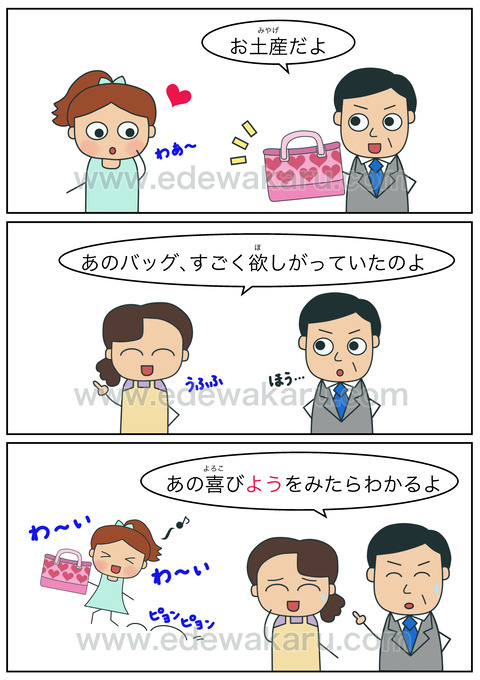
Meaning
A state of doing 〜 intensely
How to use it
Verb [ます-form] + よう
Explanation
“〜よう” is a pattern meaning “the state of doing 〜.” It is used when the degree is extreme, to say “the way someone does 〜 is incredible.”
“〜よう” also has a use expressing [method], so let’s review it 😊
In context 5 examples
母:あの子、あのバッグをすごく欲しがっていたのよ父:そうみたいだな。あの喜びようを見たらわかるよ
→あのすごく喜んでいる様子を見たらわかるよMother: That child wanted that bag so badly. Father: Looks that way. You can tell from how delighted they were. →You can tell by how incredibly happy they looked.
A:彼女は、高校を卒業してからすごくキレイになったよねB:うん!変わりようにびっくりしたよ〜
→すごく変わっている様子にびっくりしたよ〜A: She became so beautiful after graduating from high school, didn’t she? B: Yeah! I was surprised by how much she had changed. →I was surprised by how much she had changed.
A:山田くんは、また遅刻して店長を怒らせたの?B:うん。それにしても、店長の怒りようはすごかったわ…
→店長の怒る様子はすごかったわA: Did Yamada make the manager angry by being late again? B: Yeah. Even so, the way the manager got angry was incredible… →The manager’s anger was incredible.
彼女の悲しみようといったら、私まで泣きたくなるくらいだった
→彼女の悲しむ様子といったら、私まで泣きたくなるくらいだったThe way she grieved was such that even I felt like crying.
うそがバレた時の彼のパニクりようはひどかった
→彼のパニクっている様子はひどかったHe completely lost it when his lie was exposed.
Read the original source text
Meaning
すごく〜する様子
How to use it
動詞[ます形]+よう
Explanation
「〜よう」は「〜する様子」という意味の文型です。程度がすごい時に使われる文型で、「すごく〜する様子は〜」と言いたい時に使用します。
「〜よう」には[方法]を表す用法もありますので、復習をしておきましょう😊
どんなときどう使う 日本語表現文型辞典
Meaning
I think I will
How to use it
See the conjugation table at the end of the book.
Explanation
よう〈意志〉
動詞の意志形をそのまま、日記に書いたり、心の中で思ったりなど、話す人がひとりごとのように使って、自分の意志を表す言い方。相手を誘う言い方「いっしょに帰ろう・帰りましょう」と区別すること。
Volitional form of verb for writing in diaries, thinking or talking to oneself, or expressing speaker's volition. Distinguish from よう of solicitation, such as inいっしょに帰ろう (let's go home together) or 帰りましょう (let's go home).
In context 4 examples
熱があるから、今日は早く帰ろう。
I have a fever, so I'll go home early today.
(1月1日に)今年からは、日記を書こう。
(On January 1) Starting this year, I'll keep a diary.
田中君のうちへ行く前に、ちょっと電話をしよう。
I'll make a quick phone call before going to Tanaka's house.
もう12時か。そろそろ寝よう。
It's already twelve? I'd better go to bed soon.
Read the original source text
Meaning
I think I will
How to use it
巻末の活用表参照
Explanation
よう〈意志〉
動詞の意志形をそのまま、日記に書いたり、心の中で思ったりなど、話す人がひとりごとのように使って、自分の意志を表す言い方。相手を誘う言い方「いっしょに帰ろう・帰りましょう」と区別すること。
Volitional form of verb for writing in diaries, thinking or talking to oneself, or expressing speaker's volition. Distinguish from よう of solicitation, such as inいっしょに帰ろう (let's go home together) or 帰りましょう (let's go home).
毎日のんびり日本語教師
Meaning
A way of doing something (the manner / degree of something)
How to use it
Verb ます-form + よう
Explanation
Attaches to the ます-form of intransitive verbs expressing emotions, such as 悲しむ, 起こる, 驚く, and 喜ぶ, and intransitive verbs expressing states, such as 変わる and 似る, to indicate the manner or appearance of something.
Notes
The “よう” series
In context 5 examples
その悲しみようは、見ている人さえも悲しくさせた。
The way he grieved made even those watching feel sad.
突然声をかけられて、尋常ではない驚きようだった。(突然被不同寻常的惊慌失措的声音叫住了。)
I was suddenly called out to, and the way I was startled was extraordinary. (I was suddenly called out to in an extraordinarily panicked voice.)
何年も見ないうちに、顔も雰囲気もすごい変わりようだった。
In the several years since I last saw them, their face and overall appearance have changed so much.
まるで少女のような喜びようだった。(宛如少女般欣喜。)
She was overjoyed like a young girl. (She was as delighted as a young girl.)
部下がちょっとミスしただけでこの怒りようだ。
This is how angry he gets just because his subordinate made a small mistake.
Read the original source text
Meaning
~の方法(~の様子/~の程度)
How to use it
動ます形+よう
Explanation
悲しむ、起こる、驚く、喜ぶなどの感情を表す自動詞と、変わる、似るなどの状態を表す自動詞のます形に接続して、その方法や様子を表します。
Notes
「よう」シリーズ
日本語文型辞典 英語版
Meaning
Means “whatever means you use, it is impossible.” Used in cases where there are no other possible steps. With verbs such as 修復する(restore) and 改善する(improve), also takes the form ...のしようがない other than ...しようがない.
(例)あの二人の関係はもう修復のしようがない。
Their relationship cannot be mended.
Means “depending on one’s way of thinking/way of doing.” The form R-ようひとつで, as in example
(3)
, means the thing which comes after will be decided by that alone. Phrases such as どのようにもできる/どうにでもなる (can do/can be done in whatever ways) or 異なる/いろいろだ(different/varied) come afterwards. The latter half of
(6)
, 使いようでどうにもなる is omitted, and in its entirety it is a proverb meaning “anything can be put to good use; it depends on how you use it.”
Means “depending on one’s way of thinking/way of doing.” Used to say that the result differs depending on one’s method or viewpoint.
【よう2】[V-よう]One of the Japanese verb conjugation forms. Expresses the speaker’s will or conjecture. -よう attaches to the continuative form of Group 2 verbs, for example: 見よう((will) see) , 食べよう((will) eat). 来る(come) and する(do) become こよう((will) come) and しよう((will) do). In the case of Group 1 verbs, -う is added to the o-row, for example: 行こう((will) go), 読もう((will) read), 話そう((will) speak). In polite Japanese, the form is R-ましょう, as in 食べましょう, 行きましょう.
In polite Japanese, expressions such as ...しましょう/いたしましょう are used.
a. V-よう〈volition〉
B:そうですねえ。今日は遠慮しておきましょう。
Hmm. I’m going to take it easy today.
Using verbs which demonstrate intentional acts expresses the speaker’s intention and assumption that the action will take place. Example
(3)
is an expression typical of someone speaking to themselves. Can also be pronounced in the shorter form V-よっと.
b. V-よう〈offer〉
Used by the speaker to offer something they can do for another person. It is an action the speaker intends to do for the benefit of another. In humble speech, as in examples
(3)
-
(5)
, it becomes ...いたしましょう or お...しましょう/いたしましょう.
c. V-よう〈invitation〉
Used to invite the listener to act together with the speaker. In contrast to the meaning〈offer〉in b, where only the speaker is to undertake the action,〈invitation〉is used to invite the listener also to act together with the speaker.
d. V-よう〈appeal〉
Used to appeal to a mass of people either to carry out or to refrain from carrying out a certain action. An expression often used on posters or bunting which is to be seen by many people and appeals to people to follow its instructions/advice.
e. もらおう/V-てもらおう
In the form (V-て)もらおう/いただこう, used to make an indirect demand of the listener. Similar to expressions used to make requests such as ビールをください(please give (me) beer), 死んでくれ(die!), and 来てください(please come) but (V-て)もらおう has the stronger nuance that the speaker is making a unilateral demand. From a social perspective, it is difficult to use this if one is not a person of higher social rank or in a position of higher authority in the workplace.
a. V-よう
This shows the speaker’s conjecture. It is often used with phrases which express possibility but not will, such as ある and なる or 言える, できる, 考えられる and あり得る. The negative form is V-まい.
An old-fashioned, written expression. In speech, だろう is used. V-ましょうis the polite form of V-ようand was often used on weather forecasts in the past but nowadays でしょう is used.
b. V-ようか
A way of saying だろうか in writing. Shows doubt or rhetorical negation. The irony in examples
(2)
-
(4)
can be interpreted as meaning “I wonder/no, that’s not the case.” Many use it in the direct style.
a. V-ようか〈volition〉
Expresses that the speaker is in two minds over whether to conduct the act or not and has not decided. Apart from か, かな and かしら can also be attached. As かな and かしら are more in the style of someone speaking to themselves, it is difficult to use them with polite Japanese and ましょうかな/ましょうかしら and so on are not usually used.
b. V-ようか〈offer〉
Used with both rising and falling intonation but, when used with a rising intonation, the sense that a question is being asked is stronger.
c. V-ようか〈invitation〉
Used to invite the listener to undertake an action together with the speaker. Often used with falling intonation but, when rising intonation is used, the sense that a question is being asked is stronger.
d. もらおうか/V-てもらおうか
B:じゃ、ここで待たせてもらいましょうか。
In that case, I will wait here.
Used to indirectly make a demand of the listener. The attachment of the か adds the sense that the speaker has only just arrived at that thought or that there is a feeling of hesitation and so this makes the request slightly softer than without it. From a social perspective, it is usually used by people of superior rank speaking to their subordinates.
a. V-ようが
Shows that the latter thing occurs without being restricted by the former. The latter part uses expressions such as 自由だ(be free(to do))/勝手だ(be up to (the person)) which demonstrate intention or determination.
b. V-ようがV-ようが
Used to list things which are opposite or which are similar, this means “whatever happens/whatever (one) does.” The rules of usage are the same as for Usage 4a above.
c. V-ようがV-まいが
Using both the positive and the negative volitional form of the same verb, this means “whichever action (one) takes.” A formal way of saying ...してもしなくても.
Attached to verbs which express intention, this is a strong declaration of one’s intentions and is used to invite the listener to act together with the speaker. Mainly used by men and has a stronger sense of influence over the other person than V-ようか. Women usually use ...ましょう. The polite form is ...ようではありませんか/ないですか.
a. V-ようと
Expresses that the latter thing occurs without being restricted by the former. Phrases such as 勝手だ(up to (someone))/自由だ(free (to do)/関係ない(nothing to do with) come afterwards.
b. V-ようとV-ようと
Used to list things which are opposite or which are similar, this means “it doesn’t matter what (you) do/it’s up to you” and that, whatever action one takes, regardless of that the latter thing will occur.
c. V-ようとV-まいと
Means “whether one does... or not.”
d. V-ようとも
Adding も to V-ようと, this is a written expression for V-ても. The meaning and rules of usage are the same as for instances without も but this carries a slightly more old-fashioned nuance. Often used with phrases such as (たとえ)どんなに/いかに.
Taking verbs which demonstrate intention, this is used to express the speaker’s plans or intentions. In interrogative sentences it is used to ask the listener’s intentions. Also, the かと思う of example
(4)
demonstrates that the speaker’s indecisiveness or hesitancy. V-ようと(は)思わない means that the speaker has no such intention.
Similar to つもりだ but differs in that つもりだ can be used to express the will of a third person.
(○)山田さんは留学するつもりだ。
Yamada-san intends to study abroad.
(×)山田さんは留学しようと思う。
Yamada-san intends to study abroad.
Moreover, V-ると思う is used to express the speaker’s conjecture rather than will and cannot be used in cases where one wishes to express intention. In such cases V-ようと思う must be used.
(×)私は東京へ行くと思う。(意志の表現としては誤り)
I think I will go to Tokyo. (Incorrect as an expression of intention.)
(○)私は東京へ行こうと思う。
I think I will go to Tokyo.
Means “just before/on the verge of” an action or change taking place. Typically used with non-volitional verbs such as 始まる(begin) and 終わる(end) but, when used in the form V-ようとするところ, it can also be used with volitional verbs. In instances in which non-volitional verbs are used, it is often a literary or poetic expression.
b. V-ようとする〈attempt〉
2
5.
Taking verbs which demonstrate intentional action, this expresses that attempts or efforts are made to realize that action.
c. V-ようと(も/は)しない
Taking verbs which express intentional action, this expresses a lack of intention to carry out that action or deed. When も is inserted, as in V-ようともしない, it emphasizes a denial and means “have no intention even of ...ing.” As in example
(5)
, は is also sometimes inserted.
Taking non-volitional verbs such as なる, means “that such a thing would happen was not predicted.”合格しよう(will pass) and 完成しよう(will do) of examples
(3)
and
(4)
express that the thing happened naturally or spontaneously and, as such, like 合格/完成できる and 合格/完成することになる, they do not express the speaker’s intention. Apart from 思う, verbs which follow are those such as 予想/想像する(predict/imagine) and always take the form -なかった. It is a written expression.
1
Attached to verbs which demonstrate intentional actions, means “even though one intends to... one can’t.” The same verb is repeated before and after. It is often used in cases where something cannot be done regardless of a strong wish to do it.
How to use it
1. R-ようがない
2. R-ようで(は)
3. R-ようによっては
1. V-よう〈intention〉Using verbs which demonstrate intentional acts, expresses the intent behind the speaker’s action. The rules of usage differ depending on the situation in which it is used, for example in a report, an invitation, or an indirect demand.
2. V-よう〈supposition, conjecture〉Like だろう, this expresses the speaker’s conjecture but is somewhat more old-fashioned. Has the tone of written language. i-adjectives also have the same rules of usage as this (A-かろう) , as inよかろう/寒かろう.
3. V-ようか〈intention〉Makes a question of the volitional form of a verb and is used in cases where the speaker is expressing some doubt as to their own intentions or ideas and asks for the listener’s intent. The basic rules of usage are the same as V-よう but, through the addition of the か, the meaning changes to expressing uncertainty or asking a question.
4. V-ようがA written version of V-ても and means “whatever kind of action is taken/whatever kind of situation occurs.” Phrases such as 自由だ/勝手だ(be free (to do)/be up to (someone)), which express that an event, a decision, or a demand will come to take place regardless of that action/situation come afterwards. There are many instances in which it can be rephrased as V-ようと but there are also cases in which it cannot be rephrased.
5. V-ようじゃないか
6. V-ようとA written version of V-ても and means “whatever kind of action is taken/whatever kind of situation occurs.” Phrases such as 自由だ/勝手だ(be free (to do)/be up to (someone)), which express that a thing will come to take place regardless of that action/situation come afterwards. There are many instances in which it can be rephrased as V-ようが but there are also cases in which it cannot be rephrased as ても.
7. V-ようとおもう
8. V-ようとするa. V-ようとする〈immediately before〉
9. V-ようとはおもわなかった
0. V-ようにもV-られない
In context 119 examples
こんなにひどく壊れていては、直しようがない。
As it is this badly broken, you cannot mend it.
あの二人の関係はもう修復しようがない。
Their relationship has gone beyond repair.
ここまで来てしまったからにはもう戻りようがない。
As you’ve come this far, there is no option of going back.
そんなにひどいことをしたのなら、言い訳のしようがないと思う。
In my opinion, there’s no room for excuses when you’ve done something so bad.
気の持ちようで何とでもなることだ。
By changing your outlook, it could work out.
考えようではサラリーマン生活も悪くはない。
Depending on how you think, the life of a salaryman is not bad.
あなたの気持ちの持ちようひとつできまるんだから。
It all depends on how you feel.
物は言いようで角が立つ。
The way you say things can offend.
仕事はやりようでいくらでも時間を節約できる。
Depending on how you work, you can save as much time as you like.
馬鹿とはさみは使いよう。
Even fools and (blunt) scissors can be useful (depending on how they are used).
考えようによっては、彼らの人生も幸せだったと言えるのかもしれない。
Depending on your way of thinking, you could say that their life was happy too.
その仕事はやりようによってはとても素晴らしいものになるだろう。
Depending on how you do that job, it could be something really wonderful.
あの山は、見ようによっては仏像が寝ているように見える。
Depending on how you cast your eyes, that mountain can look like a statue of a sleeping Buddha.
夏休みには海に行こう。
Let’s go to the sea during summer vacation.
来年こそはよい成績がとれるように頑張ろう。
Let’s do our best to get good grades next year for sure.
何にもすることないから、テレビでも見ようっと。
As there is nothing to do, I’ll watch television or something.
はっきり申しましょう。あなたにはこの仕事は無理です。
Let me be frank with you. For you, this job is impossible.
A:今夜一杯いかがですか。
How about a drink this evening?
足が痛いのか。おぶってやろう。
Do your legs hurt? I’ll carry you.
忙しいのなら、手伝ってあげよう。
If you’re busy, I’ll help you.
その荷物、お持ちしましょう。
Let me carry that luggage (for you).
切符は私が手配いたしましょう。
I’ll arrange the tickets.
駅までお送りしましょう。
I’ll take you to the station.
君もいっしょに行こうよ。
Why don’t you come with us?
一度ゆっくり話し合おう。
Let’s discuss it at our leisure some time.
今夜は飲み明かそうよ。
Let’s drink the night away tonight.
お待たせしました。では出かけましょう。
Thank you for waiting. Right, let’s be going.
横断する時は左右の車に注意しよう。
Watch out for cars from the left and right when crossing.
飲酒運転は絶対に避けよう。
Let us make sure we will never drink and drive.
食事の前には手を洗いましょう。
Please wash your hands before eating.
動物にいたずらしないようにしましょう。
Please don’t disturb the animals.
ビールをもう一本もらおう。
Get me another beer.
あんたには死んでもらおう。
You must die!
ちょっと警察署まで来ていただきましょう。
We’d like you to come to the police station.
場合によっては延期されることもあろう。
Depending on the situation, it may be postponed.
この点については次のようなことが言えよう。
Regarding this point, perhaps we can say the following.
午後からは全国的に晴れましょう。
It is likely to be sunny across the country from the afternoon.
山沿いでは雪になりましょう。
There is likely to be snow in the mountains.
結論としては、次のようなことが言えようか。
I wonder if we might conclude the following.
こんなひどいことをする人間がこの世にあろうか。
Are there really people in this world who would do such a horrible thing?
こんなに貧しい人達をどうして放っておけようか。
How can we ignore such needy people?
そんな馬鹿げたことがありえましょうか。
Is such stupidity possible?
どうしようか。
What should we do?
昼ご飯は何にしようかな。
What should we have for lunch?
行こうか、それともやめておこうか。
Should I go or should I give it a miss?
私の考えていること、白状しちゃおうか。
Should I confess what I’m thinking?
こんな仕事やめてしまおうかしら。
Perhaps I ought to quit this kind of work?
これからどうして暮らしていこうか。
How am I going to live now?
君の代わりに僕がやろうか。
Shall I do it instead of you?
荷物、僕が持とうか。
Shall I carry your luggage?
何かお手伝いしましょうか。
Can I help you with something?
いいこと教えてあげましょうか。
Shall I tell you something good?
結婚しようか。
Shall we get married?
何時に待ち合わせしようか。
What time shall we meet?
どこかで食事しましょうか。
Shall we get a meal somewhere?
いっしょに海外旅行しましょうか。
Shall we take a trip abroad together?
お茶を一杯もらおうか。
Could I have a cup of tea?
これ、コピーしてもらおうか。
Copy this for me.
君には、しばらく席をはずしていだだきましょうか。
Would you leave us for a moment?
A:もうすぐ、帰ると思います。
I think she’ll return soon.
どこで何をしようが私の勝手でしょう。
What I do and where is up to me.
人になんと言われようが、自分の決めたことは実行する。
Whatever people say to you, do what you have decided to do.
彼がどうなろうが、私の知ったことではない。
Whatever happens to him is nothing to do with me.
出掛けようが家にいようが、あなたの自由です。
Go out, stay in, it’s up to you.
雨が降ろうがやりが降ろうが、試合は決行します。
Whether drops or spears fall from the sky, the match shall take place.
みんなに笑われようがバカにされようが、気にしない。
I don’t care whether I’m laughed at or made fun of by everyone.
あなたが出席しようがしまいが、私は出席します。
Whether you attend or not, I will.
勉強をやろうがやるまいが私の勝手でしょう。
It’s up to me whether I study or not.
パーティは参加しようがしまいが、皆さんの自由です。
Whether they attend the party or not is up to everyone individually.
一緒に飲もうじゃないか。
We should go drinking together.
みんなでがんばろうじゃないか。
Let’s do our best together.
よし、そんなにおれと喧嘩したいのなら、受けて立とうじゃないか。
Right, if you want to fight with me so much, I’ll take you on.
今夜は、語り明かそうではありませんか。
Let’s talk all night tonight.
なにをしようと私の自由でしょう。
What I do is up to me.
どこへ行こうとあなたの勝手です。
Where you go is up to you.
どんなに馬鹿にされようと、腹をたてるでもなく彼はひたすら働いている。
However much people make fun of him, he just carries on working without getting angry.
努力しようと怠けようと結果がすべてだ。
Whether you work hard or are lazy, it’s the result that counts.
あなたが泣こうとわめこうと、僕には関係ない。
Whether you cry or shout, it’s nothing to do with me.
行こうとやめようと私の勝手だ。
Whether I go or not is up to me.
遊ぼうと勉強しようとお好きなようにしてください。
Whether you play or study, please do as you wish.
煮て食おうと焼いて食おうとご自由に。
Eat boiled or baked as you wish.
駆け落ちしようと心中しようと勝手にしろ。
Elope or commit double (lovers’) suicide as you wish.
行こうと行くまいとあなたの自由だ。
Whether you stay or go is up to you.
たくさん食べようと食べまいと料金は同じだ。
Whether you eat a lot or not, the cost is the same.
君が彼女に会おうと会うまいと僕には関係のないことだ。
Whether you meet her or not is nothing to do with me.
皆にどんなに反対されようとも決めたことは実行する。
However much people oppose me, I’ll do what I’ve decided.
たとえどんなことが起ころうとも、彼からは一生離れない。
Whatever happens, I’ll never leave him.
どんなに脅かされようとも、彼は毅然とした態度をくずさなかった。
However much he was threatened, they didn’t break his resolve.
いかに富に恵まれようとも、精神が貧しくては幸せとは言えない。
However much wealth you are blessed with, if you have no heart it cannot be called happiness.
お正月には温泉に行こうと思う。
I think I’ll go to a hot spring at New Year’s.
来年はもっと頑張ろうと思う。
I think I’ll try harder next year.
今夜は早く寝ようと思っている。
I’m thinking of going to bed early this evening.
今の仕事を辞めようかと思っている。
I’m wondering whether I should quit my job.
外国に住もうとは思わない。
I have no intention of living abroad.
あなたは一生この仕事を続けようと思いますか。
Do you think you’ll do this job for life?
時計は正午を知らせようとしている。
The clock is about to strike midday.
長かった夏休みもじきに終わろうとしている。
The long summer holiday is coming to an end.
日は地平線の彼方に沈もうとしている。
The sun is setting over there on the horizon.
上り坂にさしかかろうとする所で車がエンストを起こしてしまった。
I stalled the car’s engine as I approached the ascent.
お風呂に入ろうとしていたところに、電話がかかってきた。
Just as I was about to get in the bath, the phone rang.
息子は東大に入ろうとしている。
My son is trying to get into Tokyo University.
彼女は 25 歳になる前に何とか結婚しようとしている。
She is trying to get married somehow before she turns
いくら思い出そうとしても、名前が思い出せない。
However hard I try, I cannot remember his name.
棚の上の花びんをとろうとして、足を踏みはずしてしまった。
I lost my footing trying to get the vase from the shelf.
本人にやろうとする意欲がなければ、いくら言っても無駄です。
If the person him/herself has no motivation, whatever you say is futile.
寝ようとすればするほど、目がさえてきてしまった。
The more I tried to sleep, the more wide-awake I became.
うちの息子はいくら言っても勉強をしようとしない。
Whatever I say, my son has no intention of studying.
隣の奥さんは私に会っても挨拶ひとつしようとしない。
Even when she sees me, the lady next door never greets me.
その患者は食べ物を一切うけつけようとしない。
That patient won’t have any food.
声をかけても振り向こうともしない。
Even when I call out, he will not even turn to face me.
彼女はこの見合い話をおそらく承諾しようとはしないだろう。
I don’t think she’ll consent to this arranged marriage.
こんなことになろうとは思わなかった。
I had no idea this kind of thing would happen.
被害がこれほどまで広がろうとは、専門家も予想しなかった。
Even the experts didn’t predict that the damage would be so widespread.
息子が、たった一度の受験で司法試験に合格しようとは夢にも思わなかった。
I didn’t even dream that my son would pass the bar exam at just the first attempt.
たったの五日で論文が完成しようとは誰一人想像しなかった。
No one imagined that I would finish my thesis in just five days.
頭が痛くて、起きようにも起きられない。
My head hurts and I couldn’t get up even if I wanted to.
まわりがうるさくて、落ち着いて考えようにも考えられない。
It’s noisy around me and, even though I want to calm down and think, I can’t.
風が強すぎて走ろうにも走れない。
The wind is so strong and I can’t run however much I try.
雨が降っているので、外で遊ぼうにも遊べない。
Because it’s raining, even though you want to play outside you can’t.
文法
Meaning
① A way of doing 〜
② The way someone does 〜
How to use it
V (ます-form stem) + よう
In context 8 examples
5年ぶりにマレーシアを訪れたら、あまりの変わりように、びっくりしました。
When I visited Malaysia for the first time in five years, I was surprised by how much it had changed.
彼女は偶然、街中で大好きな俳優を目撃してすごい喜びようだった。
She happened to spot her favorite actor in town and was incredibly excited.
最初はバイトからのスタートになりますが、働きようによっては3ヶ月以内に正社員になれます。
You’ll start out as a part-time worker, but depending on how you work, you can become a full-time employee within three months.
便利なアイテムでも使いようによっては凶器にもなり得る。
Even a useful item can become a weapon depending on how it is used.
相手が強豪チームだとしても、やりようによっては勝てないわけではない。
Even if our opponent is a strong team, depending on how we play, it’s not impossible to win.
語学の勉強はやりようによっては、面白くもなるし、つまらなくもなる。
Depending on how you study a language, it can be fun or boring.
この絵は見ようによっては男性にも見えるし、女性にも見えます。
Depending on how you look at this picture, it can look like a man or a woman.
SNSは便利だが使いようによっては誰かを傷つけてしまうこともある。
Social media is convenient, but depending on how it is used, it can hurt someone.
Read the original source text
Meaning
①〜のやりかた
②〜する様子
How to use it
V(ます形)ます+ よう