絵でわかる日本語
Meaning
Something that had been continuing comes to an end.
Something that had been continuing stops.
How to use it
Verb [ます-form] + やむ
Explanation
“〜やむ” is a sentence pattern expressing completion. It means “something that had been continuing for a long time comes to an end” or “something had been continuing, but then stops.” This pattern is used only with [natural phenomena] or [things that express emotions] 😮
The verbs it is used with are fixed, so memorize them 😉
[Verbs used with “〜やむ”]
・降りやむ (stop falling, of rain/snow)
・吹きやむ (die down, of wind)
・鳴りやむ (stop ringing)
・泣きやむ (stop crying)
・鳴きやむ (stop calling, of an animal)
・笑いやむ (stop laughing) *Not often used in everyday speech
Also, “〜やむ” is written with the kanji as “〜止む,” so make sure you can read it 😀
In context 5 examples
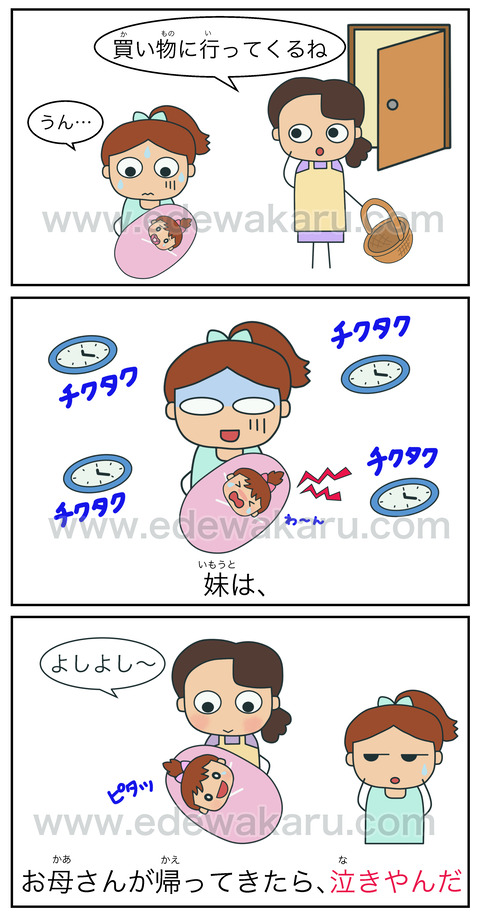
妹は、お母さんが帰ってきたら泣きやんだ
→妹はずっと泣いていたが、お母さんが帰ってきたら泣かなくなったMy younger sister stopped crying when Mom came home. →My younger sister had been crying continuously, but stopped when Mom came home.
1週間降り続いた雨が、降りやんだ
→1週間ずっと雨が降っていたが、降らなくなったThe rain that had continued for a week stopped. →It had been raining continuously for a week, but then it stopped.
台風が行ってしまったので、風が吹きやんだ
→台風が行ってしまったので、風が吹かなくなったThe typhoon passed, so the wind died down. →The typhoon passed, so the wind stopped blowing.
雨が降りやんだら、買い物に行こう
→雨が降らなくなったら、買い物に行こうLet’s go shopping once the rain stops. →Let’s go shopping once it stops raining.
電話がずっと鳴っていたが、やっと鳴りやんだ
→電話がずっと鳴っていたが、やっと鳴らなくなったThe phone had been ringing continuously, but it finally stopped. →The phone had been ringing continuously, but it finally stopped ringing.
Read the original source text
Meaning
続いていたことが終わる
続いていたことが〜なくなる
How to use it
動詞[ます形]+やむ
Explanation
「〜やむ」は、完了を表す文型で「ずっと続いていたことが終わる」「ずっと続いていたが、続かなくなる」という意味を表します。この文型は
【自然現象(しぜんげんしょう)】
や
【感情を表すもの】
にしか使われません😮
使われる動詞は決まっています
ので、暗記しておきましょう😉
[「〜やむ」に使う動詞]
・降りやむ
・吹きやむ
・鳴りやむ
・泣きやむ
・鳴きやむ
・笑いやむ *日常的(にちじょうてき)にはあまり使われません
また「〜やむ」は漢字で書くと
「〜止む」
と書きますので、読めるようにしておいてください😀
日本語文型辞典
Meaning
Basic information: R-やむ. Means “for a continuing phenomenon to come to an end.” It is used with a limited set of intransitive verbs such as “泣く,” “鳴る,” and “降る.” “降りやむ” is usually simply said as “やむ.” Example sentences: ① It was finally around three in the morning when the baby stopped crying. ② The telephone bell in the next room stopped ringing. ③ After the rain, which had continued for a month, stopped, everything was flooded.
Read the original source text
Meaning
基本情報R-やむ説明「続いていた現象が終わる」の意味。「泣く」「鳴る」「降る」などの限られた自動詞とともに使われる。「降りやむ」は単に「やむ」というのが普通。例文① 夜中の三時ごろになってやっと赤ん妨は泣きやんだ。② となりの部屋の電話のベルが鳴りやんだ。③ 一ヶ月降り続いた雨が降りやんだ後は一面の洪水だった。
日本語文型辞典 英語版
Meaning
【やむ】[R-やむ]
Means “a phenomenon, which had been continuing, stops.” Used together with limited intransitive verbs such as 泣く(cry), 鳴る(sound) and 降る(raining/snowing). 降りやむ(stop raining/snowing) is usually abbreviated to やむ.
In context 3 examples
夜中の三時ごろになってやっと赤ん坊は泣きやんだ。
At around three in the morning the baby at last stopped crying.
となりの部屋の電話のベルが鳴りやんだ。
The telephone in the next room stopped ringing.
一ヶ月降り続いた雨が降りやんだ後は一面の洪水だった。
After the rain which had been falling for one month stopped, the whole area was flooded.
IMABI
End: ~終わる・終える, ~やむ
Read this IMABI lesson ↗Explanation
End: ~終わる・終える, & ~やむ
In this lesson, we will learn about the compound verb endings (V2) ~終わる, ~終える, and ~やむ, all of which pertain to V1 coming to a close.
The Transitivity of 終わる & 終える
The concept of “to end/finish” is handled by the intransitive-transitive verb pair 終わる・終える. Typically, one would expect 終わる to not take direct objects and for 終える to take direct objects. Yet, 終わる happens to be one of many intransitive verbs that can be repurposed as a transitive verb. In the case of 終わる, its intransitive and transitive nuances differ in how agency manifests.
~が終わるEvent X ends with no implied agent resulting in X’s conclusion.
~を終わるAn agent does conclude Event X, but the volition of the agent is not pertinent.
~を終えるAn agent actively goes about concluding Event X.
1. 授業1が終わった。
Class ended.
2. 道路はここで終わっている2。
The road ends here.
3. 先生は講義こうぎを終えましたか。
Has the teacher concluded his lecture?
4. 昨夜の演奏は歌って終わった。
Last night’s performance ended with singing.
5. 試合しあいは引き分けに終わった。
The game ended in a tie.
6. 動物の権利活動家らが抗議を終えましたが、反対の声をあげつづけるそうです。
The animal rights activists ending the protest, but they are to continue raising voices of opposition.
7. 修理しゅうりを終えましたか。
Did you finish the repairs?
8a. 会議かいぎを終わる。
8b. 会議を終える。
8c. 会議が終わる。
8a. To wrap up a/the meeting.
8b. To end a/the meeting.
8c. For a/the meeting to end.
~終わる・終える as V2 in Compound Verbs
In compounds, ~終わる and ~終える behave just as they do in isolation. Naturally, ~終える is restricted to transitive V1, and as such, the completion of V1 marked by ~終える is felt to be a purposeful outcome by the agent. Meanwhile, ~終わる is typically not used with V1 which do not pertain to an agent’s volition, which largely limits it to transitive V1. While V1 does conclude due to the agent’s action(s), the completion of the action seems more consequential than necessarily being driven to complete V1 as is the case with ~終える. In totality, ~終える is not nearly as common as ~終わる, which is likely due to just how strongly it conveys the agent’s volition in finishing V1.
9. ローンを払はらい終わりました。
I finished paying off the loan.
10. 宿題をし終えて、外へ遊びに行った。
I finished my homework and went outside to play.
11. その本を読み終えましたか。
Did you finish reading that book?
12. 早くやり終える。
To get it over with.
13. 彼は歌い終わりました。
He finished singing.
14. 小説を書き終えた。
I ended writing the novel.
15. 彼が意見を言い終わるか終わらないうちに、あの人は邪魔をして口を挟んだ。
Before he could finish saying his opinion, that person interjected himself.
While ~終わる is mostly used with transitive verbs, it is still on occasion paired with intransitive V1 which pertain to states that take some time to transpire so long as an agent can be foreseen in the background which would be overseeing the conclusion of the action. Even so, ~終わる is never paired with intransitive verbs pertaining to natural phenomenon as well as verbs with spontaneous onsets (降る, 吹く, 泣く, etc.). Without an agent in the overarching context, other endings such as ~切る become far more natural options.
16. バターを焦がして、焦げ終わる直前にシナモンを加えてください。
Brown the butter, and right before it finishes browning, add cinnamon.
17. 洗剤が溶け{終わった 〇・切った ◎}のを確認した。
I made sure that the detergent finished dissolving.
~やむ
Interestingly, the verb intransitive verb 止む meaning “to stop/quit” is also used in compound verbs, specifically with V1 pertaining to actions with spontaneous onsets like “to laugh/cry” and weather phenomena such as “to rain” for which attaching ~終わる is ungrammatical.
18a. 雨が降り止んだ。〇
18b. 雨が止んだ。〇
18c. 雨が降り終わった。X
It stopped raining.
19. その子はやっと泣き止んだ。
That child finally stopped crying.
The use of ~止む is quite limited, and for most intransitive instances of “to stop/quit,” either the use of 止む as a standalone verb or other verbs such as 止まる become more appropriate with nouns or nominalized expressions.
20. 風が(吹き)やんだ。
The wind stopped (blowing).
21. 騒動がやんだ。
The turmoil stopped.
22. 時が止まった。
Time stopped/froze.
23. すると、身体が沈むのが止まった。
Then, my body stopped sinking.
To Quit Doing
While 止む may mean “to stop/quit” in an intransitive sense, it begs the question how one would express “to stop/quit” in a transitive sense. Although the transitive verb 止める does exist in this capacity and is frequently seen with nouns and nominalized expressions to that effect, it does not attach directly to the 連用形 of V1.
24. 彼はスペイン語を勉強するのをやめた。
He stopped studying Spanish.
25. 毎日掃除するのをやめた。
I stopped cleaning daily.
26. 考えるのをやめた。
I quit thinking (about it).
Similar to the last pattern, ~ないようになる indicates a new state of being in which Event X is not done. This could indicate a change in habit (Ex. 27) or a some consequence that was not necessarily intentional but still caused by the agent’s action(s) (Ex. 28).
27. 彼はタバコを吸すわないようになった。
He stopped smoking.
28. 私はそれを表示できないようになってしまいました。
I ended up not being able to display it.
クラスが終わった for “class ended” would be fairly unnatural, as クラス generally refers to the “group/body of the class.” While it could also refer to one’s “class” in the sense of “homeroom” such that 終わる would not be nonsensical, 授業 would still be the natural word choice. ↩︎
The use of ~ている denotes that the state of the road terminating at the juncture has been the case and remains so. ↩︎
In context 32 examples
授業1が終わった。
Class ended.
道路はここで終わっている2。
The road ends here.
先生は講義こうぎを終えましたか。
Has the teacher concluded his lecture?
昨夜の演奏は歌って終わった。
Last night’s performance ended with singing.
試合しあいは引き分けに終わった。
The game ended in a tie.
動物の権利活動家らが抗議を終えましたが、反対の声をあげつづけるそうです。
The animal rights activists ending the protest, but they are to continue raising voices of opposition.
修理しゅうりを終えましたか。
Did you finish the repairs?
会議かいぎを終わる。
8a. To wrap up a/the meeting.
会議を終える。
8a. To wrap up a/the meeting.
会議が終わる。
8a. To wrap up a/the meeting.
ローンを払はらい終わりました。
I finished paying off the loan.
宿題をし終えて、外へ遊びに行った。
I finished my homework and went outside to play.
その本を読み終えましたか。
Did you finish reading that book?
早くやり終える。
To get it over with.
彼は歌い終わりました。
He finished singing.
小説を書き終えた。
I ended writing the novel.
彼が意見を言い終わるか終わらないうちに、あの人は邪魔をして口を挟んだ。
Before he could finish saying his opinion, that person interjected himself.
バターを焦がして、焦げ終わる直前にシナモンを加えてください。
Brown the butter, and right before it finishes browning, add cinnamon.
洗剤が溶け{終わった 〇・切った ◎}のを確認した。
I made sure that the detergent finished dissolving.
雨が降り止んだ。〇
It stopped raining.
雨が止んだ。〇
It stopped raining.
雨が降り終わった。X
It stopped raining.
その子はやっと泣き止んだ。
That child finally stopped crying.
風が(吹き)やんだ。
The wind stopped (blowing).
騒動がやんだ。
The turmoil stopped.
時が止まった。
Time stopped/froze.
すると、身体が沈むのが止まった。
Then, my body stopped sinking.
彼はスペイン語を勉強するのをやめた。
He stopped studying Spanish.
毎日掃除するのをやめた。
I stopped cleaning daily.
考えるのをやめた。
I quit thinking (about it).
彼はタバコを吸すわないようになった。
He stopped smoking.
私はそれを表示できないようになってしまいました。
I ended up not being able to display it.
毎日のんびり日本語教師
How to use it
Verb ます-form + 止む
Explanation
Attaches to the verb ます-form and indicates completion.
It can be used for phenomena that occur independently of human will, such as natural phenomena and emotions.
降る, 吹く, 鳴く, 泣く, 笑う, 怒る, etc.
For other verbs, ~終わる/~終える can be used.
✕ ご飯を食べ止んだ (I finished eating rice.)
◯ ご飯を食べ終わった (I finished eating rice.)
Notes
Nothing in particular.
In context 3 examples
雨が降り止んだら出発しよう。(雨停了就出发吧)
Let’s set out once the rain stops.
泣き止ませようとすればするほど泣き止まない。
The more I try to get them to stop crying, the more they keep crying.
台風の目に入り風がすっかり吹き止んだ。
We entered the eye of the typhoon, and the wind stopped blowing completely.
Read the original source text
How to use it
動ます形+止む
Explanation
動ます形に接続して、完了を表します。
自然現象や感情などの人の意志とは関係なく発生する現象に対して用いることができます。
降る、吹く、鳴く、泣く、笑う、怒る等…
それ以外の動詞には「~終わる/~終える」が使えます。
✕ ご飯を食べ止んだ
◯ ご飯を食べ終わった
Notes
特になし