絵でわかる日本語
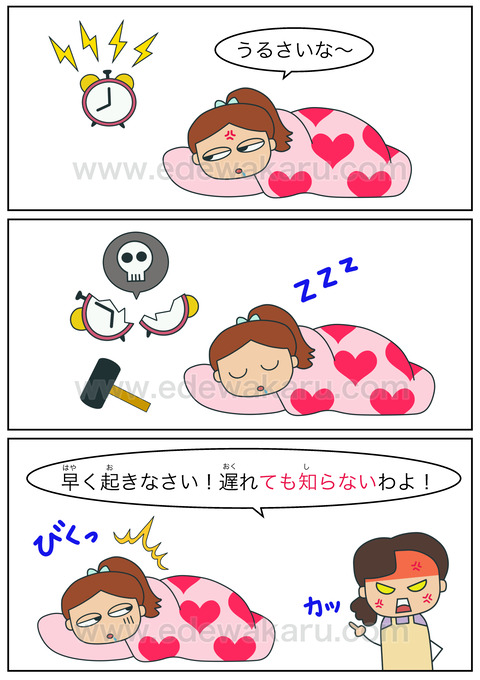
Meaning
If you keep doing ~, it’ll lead to a bad outcome.
Even if things come to that, I won’t help you.
How to use it
Verb [て-form] + ても知らない
Explanation
“〜ても知らない” is a sentence pattern expressing [advice] or [warning] to the other person.
It is used when you want to say “If you keep doing ~, you’ll get a bad result” or “If you don’t do ~, you won’t be able to ~.”
It is also used when you want to say “If you keep doing ~, you’ll get a bad result, so you’d better not do it,” or “Even if that happens, I’m not going to help you!”
[Examples]
①早く起きなさい!学校に遅れ
ても知らない
わよ!
→If you don’t get up soon, you’ll be late for school!
Get up soon so you won’t be late for school!
②毎日遊んでばかりいるね…試験に落ち
ても知らない
よ
→If you do nothing but play every day, you’ll fail the exam!
You might fail the exam, so you should study properly!
③そんなに甘い物ばっかり食べて…太っ
ても知らない
よ
→If you keep eating nothing but sweets, you’ll gain weight!
You should stop eating nothing but sweets, or you’ll gain weight!
④A: You shouldn’t lend Yamada money!
B: It’s fine. He says he’ll pay me back tomorrow.
A: …どうなっ
ても知らない
よ
→You shouldn’t lend Yamada money.
Even if you don’t get it back, I’m not going to help you.
⑤A: Binge eating and drinking isn’t good for you…
B: I’m young, so I’m fine~
A: …病気になっ
ても知らない
よ
→If you keep binge eating and drinking, you’ll get sick.
You should stop binge eating and drinking, or you’ll get sick.
“〜ても知らない” is often used in everyday conversation, so remember it. 😉
In context 5 examples
母:早く起きなさい!学校に遅れても知らないわよ!娘:は〜い
Mother: Get up soon! Don’t blame me if you’re late for school! Daughter: Okaaay.
A:毎日遊んでばかりいるね…試験に落ちても知らないよB:今日からちゃんと勉強するよ…
A: You do nothing but play every day… Don’t blame me if you fail the exam. B: I’ll start studying properly today…
そんなに甘い物ばっかり食べて…太っても知らないよ
You keep eating so many sweets… Don’t blame me if you gain weight.
A:山田くんには、お金を貸さないほうがいいよ!B:大丈夫だよ。明日返してくれるって言ってるしA:…どうなっても知らないよ
A: You shouldn’t lend Yamada money! B: It’s fine. He says he’ll pay me back tomorrow. A: …Don’t blame me if things go wrong.
A:暴飲暴食(ぼういんぼうしょく)はよくないよ…B:若いから平気だよ〜A:…病気になっても知らないよ
A: Binge eating and drinking isn’t good for you… B: I’m young, so I’m fine~ A: …Don’t blame me if you get sick.
Read the original source text
Meaning
〜していたら、〜という悪い結果になるよ
〜という状況になっても、助けてあげないよ
How to use it
動詞[て形]+ても知らない
Explanation
「〜ても知らない」は、相手に対する
[忠告]
や[
警告]
を表す文型です。
「〜していたら、〜という悪い結果になるよ」「〜しなかったら、〜できないよ」と言いたい時に使われます。
「〜していたら、〜という悪い結果になるから、〜しないほうがいいよ」「〜になっても、私は助けてあげないよ!」と言いたい場合にも使用されます。
[例]
①早く起きなさい!学校に遅れ
ても知らない
わよ!
→早く起きないと、学校に遅れるわよ!
学校に遅れるから、早く起きなさい!
②毎日遊んでばかりいるね…試験に落ち
ても知らない
よ
→遊んでばかりいると、試験に落ちるよ!
試験に落ちるかもしれないから、ちゃんと勉強したほうがいいよ!
③そんなに甘い物ばっかり食べて…太っ
ても知らない
よ
→甘いものばっかり食べてたら、太るよ!
太るから、甘い物ばかり食べないほうがいいよ!
④A:山田くんには、お金を貸さないほうがいいよ!
B:大丈夫だよ。明日返してくれるって言ってるし
A:…どうなっ
ても知らない
よ
→山田くんにお金を貸さないほうがいいよ
もし返してもらえなくても、私は助けてあげないよ
⑤A:暴飲暴食はよくないよ…
B:若いから平気だよ〜
A:…病気になっ
ても知らない
よ
→暴飲暴食していたら、病気になってしまうよ
病気になるから、暴飲暴食はしないほうがいいよ
「〜ても知らない」は、日常会話(にちじょうかいわ)でもよく使われますので覚えておきましょう😉
毎日のんびり日本語教師
How to use it
Verb て-form + も知らない + (sentence-final particle)
Explanation
Expresses a warning or caution to the other person.
It is used when continuing in a certain state will cause some serious problem, and it carries a somewhat dismissive nuance even as the speaker warns them.
In many cases, sentence-final particles such as 「よ」, 「ぞ」, 「から」, or 「からね」 follow it.
Notes
Nothing in particular.
In context 8 examples
こんな時間まで起きていて、明日朝起きれなくても知らないよ。
If you stay up this late, don’t blame me if you can’t get up tomorrow morning.
提出すべきものも提出しないで、卒業できなくても知らないよ。
If you don’t submit the things you’re supposed to, don’t blame me if you can’t graduate.
そんな無理して体を壊しても知らないからね。
Don’t blame me if you push yourself that hard and wreck your health.
講義をサボってばかりで、単位取れなくても知らないぞ。
If you keep skipping lectures, don’t blame me if you don’t earn your credits.
早く起きなさい。間に合わなくても知らないよ。
Get up early. Don’t blame me if you don’t make it on time.
初対面で立ち入ったことを聞いて、嫌われても知らないよ。
Don’t blame me if you annoy someone by asking such personal questions the first time you meet them.
そんな大声で話して、バレても知らないよ。
Don’t blame me if you talk that loudly and get found out.
そんな軽装備で登山なんて、どうなっても知らないからね。
Don’t blame me if something happens while you’re climbing a mountain with such inadequate gear.
Read the original source text
How to use it
動て形+も知らない+(終助詞)
Explanation
相手に対する警告や忠告を表します。
相手がある状態を継続し続けると何らかの重大な問題が発生するときに使い、警告しつつもやや突き放したようなニュアンスが含まれます。
多くの場合は後ろには「よ」「ぞ」「から」「からね」などの終助詞がつきます。
Notes
特になし