どんなときどう使う 日本語表現文型辞典
Meaning
even just~/also
How to use it
N/Vる/する動詞のN+だにW
Explanation
~だけでも/~も
1)文語的な言い方で慣用的に使われる。
2)それぞれの意味は ❶ 「夢にだに思わない」は「夢にも思わない」、 ❷ 「想像だにしない」は「想像さえしない」、 ❸ 「考えるだに」は「考えるだけでも」である。
3) ❸ のように「考える・聞く」などの動詞とともに「~するだけでも」の意味で慣用的に使われる。
2)Meaning in sentence ❶ is: 夢にも思わない (I never even dreamed); sentence ❷ : 想像さえしない (never even imagined); sentence ❸ : 考えるだけでも (even just thinking about).
3)Used as idiom with verbs 考える (think), and 聞く (hear) to convey the meaning of "even just doing…," as in sentence ❸ .
1)A literary term used in idioms.
In context 3 examples
わたしがこのような立派な賞をいただくなどとは夢にだに思わなかった。
このように地球温暖化が進むとは、30年前には、想像だにしなかった。
テロで大勢の人が殺されるなんて考えるだに恐ろしい。
IMABI
The Particles さえ, すら, & だに
Read this IMABI lesson ↗Explanation
The Particles さえ, すら, & だに
The particles さえ, すら, and だに are often interchangeable, but pay close attention to detail. There is some history involved, so try not to use these words anachronistically. Although they’re interchangeable with each other, there are subtle differences.
The Adverbial Particle すら
すら is the original particle for minimal example–“even…not to mention..”. Now it has evolved to show minimal expectation, which is showing an extreme (usually negative) example. So, it is equal to “(not) even”. It can be seen as ですら. すら is faded into literature and somehow survived to the present. Now, だに is ironically rarer than すら.
Using this with other particles is very tricky as there is historical and personal variation. For instance, using it with を isn’t wrong. However, many people just use すら. For when you do want to use it with を, をすら and すらを are both possible, but the latter is extremely old-fashioned. Even so, it still pops up.
1. なにしろ、警視庁みずから一般人の犯歴データを流していたことが問題になったばかりなのに、公の裁判所の正式決定すらをはねつけたんですからね。
Anyhow, although the Metropolitan Police themselves having been leaking out general people’s criminal record data has just become a problem, it’s because they even rejected a public court’s official decision.
From 明日はどっちだ! by 岡留安則.
The Adverbial Particle さえ
さえ comes from the verb 添ふ (to add), which has become 添える in Modern Japanese. So, the original meaning of this particle was “in addition to”. Eventually, さえ began to be used to show minimal example. Both usages survive today, but the latter can be alternatively expressed with でさえ, as is demonstrated in the example below. It is to note that both ですら and でさえ are only used after nouns! This is because the case particle で is in these expressions.
2. 今どき、男の子だったら、小学生でさえ知ってるよ。
These days even boys in elementary school know.
The meaning of X(で)さえY is this. Some X matter and some Y action/happening/condition are usually not connected in any one, yet when you bind them together, you emphasize a situation that is not the norm by any means. This is what minimal example means.
3. 虎でさえ彼を傷つけることはできない。
Not even a tiger can hurt him.4. 彼は食費{さえ・すら}惜しんだ。
He even begrudged taking the money for food.
It’s sometimes hard to tell which meaning is meant. Minimal example is often used in negative expressions, but when this is not the case, consider the context. “Even a kid can understand it” is minimum example. “In addition to us, even the dogs understand” shows addition. It doesn’t help that both English and Japanese are vague on this.
5. 雪どころか雨さえ降らなかった。
Not even rain fell, let alone snow.
6 初心者にさえできることだ。
It’s something even a beginner can do.
7a. 子供{(で){さえ・すら}・でも}(そのこと)知ってる(ことだ)よ。〇
7b. 子供もさえそんなこと知ってるよ。X
Even kids know that.
8. ただでさえ電車が遅れているのに、寄り道をしようだなんて。
Even under normal circumstances, hanging out along the way even when the train is late is just…
9a. ぼくは独りだから、君さえぼくの心の頼りだよ。X
9b. ぼくは独りだから、君だけがぼくの心の頼りだよ。〇
Because I’m all alone, you’re the only thing my heart relies on.
Particle Note:
1. さえ can be after other particles like に. をさえ is also possible, but を is usually dropped. In literature, however, をさえ is more common.
10. 秘密にしていたのに、三歳の子供にさえ気づかれてしまった。
Even though I was keeping it a secret, it was even found out by a three year old.
11. 自分はまだ生きているのだという実感をさえ持つことができたのだった。
I was able to have the realization that I myself was still alive.
From 光の雨 by 立松和平.
2. There is also さえも and さえもが. Both are more emphatic than さえ and show minimal example, but が implies new information and or surprise. If you understand も and が well enough, this shouldn’t be hard to visualize.
12. 死さえもが玉井にとっては安楽なのだ。
Even death was something which would be bring ease to Tamai.
From 光の雨 by 立松和平. 13. 子どもばっかりじゃなく、大人さえも悲鳴をあげたよ。
The children and even the adults screamed.
Important Patterns
Both さえ and すら can be after the 連用形 of verbs similar to は, や. etc. You can also use them after て. This creates a phrase that puts emphasis on the action rather than the noun. すら, again, is increasingly becoming rarer, so you will probably only see it with nouns. Here is a chart using the pattern さえ…ば (if only you~) to illustrate this grammar.
Noun + さえ + Verb + ば 薬さえ飲めば If you only drank this medicine (and no other)
Verb (連用形) + さえ + すれば 薬を飲みさえすれば If you only drink this medicine (and do nothing else)
Verb + て + さえ + いれば 薬を飲んでさえいれば If you are drinking this medicine (and doing nothing else)
Grammar Note: Verb+ている+さえすれば → Verb+ていさえすれば. In this case, it doesn’t matter that 連用形 of いる is left like that. Remember, this is not like ~ており、・・・.
14. 食べ((すぎ)さえし)なければ、もっとやせ(られる・るようになるよ)。
If you would only not eat, you would be able to lose more weight.
15. 幸せでありさえすればかまわないんだ。
I don’t care so long as you are happy.
16. 知ってさえいればな~。(Colloquial Spelling)
If only I had known!
17. 時間さえあれば、手伝うんだが。
If only I had time, I’d help.
18. 生きていさえすれば、何も要らない。
If you just live on, you won’t need anything.
19. 勉強さえすれば、試験はできるでしょう。
If you just study, you should be able to do the exam.
20. 一生懸命頑張りさえすれば、何でも好きなことができる。
If you just try with all your hardest, you should be able to do anything you like.
21. 分からない漢字は、調べさえすれば分かりますよ。
If you simply look up Kanji you don’t understand, you’ll understand them.
22. 日本語は、日本人と毎日話そうとしてさえいれば話せるようになります。
If you just try talking to Japanese people everyday, you’ll become able to speak in Japanese.
23. 病気は、この漢方薬さえ飲めば、よくなります。
If you drink just this herbal medicine, your sickness should become better.
24. 和書さえ読めれば、幸せです。
If I read just Japanese books, I’m happy.
25. これさえあれば、後は何も要らない。
If we only had this, we’d need nothing later.
Nuance Note: Again, these particles emphasize what they directly follow, so although there is some levity on where to place さえ in a sentence, be aware of this.
Speech Style Note: Though さえ may be used in the spoken language, it is more common in the written language.
26. しかしこの進学については、思い出すさえ忌々しい事情がある。
But, remembering about going onto university brought on annoying circumstances by just remembering.
From 金閣寺 by 三島由紀夫.
Grammar Note: さえ also rarely follows the 連体形 of verbs. This is essentially old-fashioned.
The Adverbial Particle だに
だに, not to be confused with the noun ダニ (tick), is used in both negative and positive sentences. It raises the most probable thing and negates it and anything aside from it. Originally, it showed minimal desire or want. In this sense it means “at the least”. This led to it being used to show minimal example just like さえ and すら. This is equivalent to だけで. It is the rarest of the three.
27a. 夢にだに思ったことはない。(かなり古風)
27b. 夢でさえ思ったこともない。(もっと一般的)
I have not thought of something in just a dream.
28. ネオンは錯綜し、吞み屋の大きな赤い提灯は微動だもしなかった。
The neon lights complicated things, and the bar’s big, red lantern didn’t even sway a bit.
From スタア by 三島由紀夫.
Grammar Note: だも is a contraction of だにも.
In context 30 examples
なにしろ、警視庁みずから一般人の犯歴データを流していたことが問題になったばかりなのに、公の裁判所の正式決定すらをはねつけたんですからね。
Anyhow, although the Metropolitan Police themselves having been leaking out general people’s criminal record data has just become a problem, it’s because they even rejected a public court’s official decision.
今どき、男の子だったら、小学生でさえ知ってるよ。
These days even boys in elementary school know.
虎でさえ彼を傷つけることはできない。
雪どころか雨さえ降らなかった。
Not even rain fell, let alone snow.
子供{(で){さえ・すら}・でも}(そのこと)知ってる(ことだ)よ。〇
Even kids know that.
子供もさえそんなこと知ってるよ。X
Even kids know that.
ただでさえ電車が遅れているのに、寄り道をしようだなんて。
Even under normal circumstances, hanging out along the way even when the train is late is just…
ぼくは独りだから、君さえぼくの心の頼りだよ。X
Because I’m all alone, you’re the only thing my heart relies on.
ぼくは独りだから、君だけがぼくの心の頼りだよ。〇
Because I’m all alone, you’re the only thing my heart relies on.
さえ can be after other particles like に. をさえ is also possible, but を is usually dropped. In literature, however, をさえ is more common.
Even though I was keeping it a secret, it was even found out by a three year old.
秘密にしていたのに、三歳の子供にさえ気づかれてしまった。
Even though I was keeping it a secret, it was even found out by a three year old.
自分はまだ生きているのだという実感をさえ持つことができたのだった。
I was able to have the realization that I myself was still alive.
There is also さえも and さえもが. Both are more emphatic than さえ and show minimal example, but が implies new information and or surprise. If you understand も and が well enough, this shouldn’t be hard to visualize.
Even death was something which would be bring ease to Tamai.
死さえもが玉井にとっては安楽なのだ。
Even death was something which would be bring ease to Tamai.
食べ((すぎ)さえし)なければ、もっとやせ(られる・るようになるよ)。
If you would only not eat, you would be able to lose more weight.
幸せでありさえすればかまわないんだ。
I don’t care so long as you are happy.
知ってさえいればな~。(Colloquial Spelling)
If only I had known!
時間さえあれば、手伝うんだが。
If only I had time, I’d help.
生きていさえすれば、何も要らない。
If you just live on, you won’t need anything.
勉強さえすれば、試験はできるでしょう。
If you just study, you should be able to do the exam.
一生懸命頑張りさえすれば、何でも好きなことができる。
If you just try with all your hardest, you should be able to do anything you like.
分からない漢字は、調べさえすれば分かりますよ。
If you simply look up Kanji you don’t understand, you’ll understand them.
日本語は、日本人と毎日話そうとしてさえいれば話せるようになります。
If you just try talking to Japanese people everyday, you’ll become able to speak in Japanese.
病気は、この漢方薬さえ飲めば、よくなります。
If you drink just this herbal medicine, your sickness should become better.
和書さえ読めれば、幸せです。
If I read just Japanese books, I’m happy.
これさえあれば、後は何も要らない。
If we only had this, we’d need nothing later.
しかしこの進学については、思い出すさえ忌々しい事情がある。
But, remembering about going onto university brought on annoying circumstances by just remembering.
夢にだに思ったことはない。(かなり古風)
I have not thought of something in just a dream.
夢でさえ思ったこともない。(もっと一般的)
I have not thought of something in just a dream.
ネオンは錯綜し、吞み屋の大きな赤い提灯は微動だもしなかった。
The neon lights complicated things, and the bar’s big, red lantern didn’t even sway a bit.
Adverbial Particles
Read this IMABI lesson ↗Explanation
第032課: Adverbial Particles
All of the particles that will be discussed in this lesson are those that you should already know from Modern Japanese. Essentially little has changed, which will hopefully make this an easy lesson. The particles that will be studied in this lesson are the following.
まで など し(も) ばかり
のみ だに すら さえ
The Particle まで
As you know, the particle まで created some sort of extent, and this is rather concrete, even when it is dealing with unexpected degree as opposed to other phrases like にかけて. As is the case in Modern Japanese, this particle may follow noun phrases and the 連体形. Just like in Modern Japanese it can be paired with either the particles から or より to create “from…to…”.
1. 明くるより暮るるまで、東の山ぎはを眺めて過ぐす。
From the time the sun came up till it went down, I passed the time by gazing at the edge of the eastern hills.
From the 更級日記.
2. 夜更くるまで酒飲み物語して、あるじの親王、酔ひて入りたまひなむとも。
The Prince of the household drank and talked until night and was completely drunk as he tried to enter (his bedroom).
From the 伊勢物語.
3. 武蔵の國まで惑ひ歩きけり。
He walked wandering as far as Musashi Province.
From the 伊勢物語.
4. わが宿は道もなきまで荒れにけり。
As for our house, it has been overrun to the point that the road has disappeared.
From the 古今和歌集.
5. 朝ぼらけ有明の月と見るまでに吉野の里に降れる白雪
It’s the white snow piled up in Yoshino village to the point that one mistakes it for the moon at dawn’s light shining across.
From the 古今和歌集.
The Particle など
The particle など first appeared in the 平安時代. Its primary function is to show example(s), implying similar items of such group are included as well. However, just as in Modern Japanese, it may just be used primarily to soften the sentence.
6. 雨など降るもをかし。
It is also charming when the rain and such falls.
From the 枕草子.
7. いみじううつくしきちごの、いちごなど食ひたる。
Extremely kids ate strawberries and such.
From the 枕草子.
8. いざ、いと心安き所にて、のどかに聞こえむなど語らひ給へば…
Since (Genji) said such things as “Well, let’s talk all relaxed somewhere very comfortable”,…
From the 源氏物語.
9. 閼伽棚に菊紅葉など折り散らしたる、さすがに住む人のあればなるべし。
The chrysanthemums and colored leaves bent and scattered on the water offering board is no doubt because people are living there.
From the 徒然草.
10. 大人、童、下衆なんど、かたちよし。
The adults, children, and low class people and such have beautiful appearances.
From the 宇津保物語.
11. 車の音すれば、若き者どもの覗きなどすべかめるに
It looked like the young (lady) attendants were looking for an opening of such when there was noise from a cart, but…
From the 源氏物語.
The Particle し(も)
Up until the 平安時代, the particle し was seen in all sorts of positions in a sentence, but it quickly became more commonly seen in combinations such as し…ば… or combined with bound particles. This is where the form しも comes to play, which is sometimes classified as a bound particle with there being も. The particle is quite emphatic and singles out a single item from a list of things, and thus, it is very limiting. Just like in Modern Japanese, this means it’s perfect for strengthening a negation.
12. 今し、かもめむれゐてあそぶ所あり。
Right now, there is a place where the seagulls are gathering and playing.
From the 土佐日記.
13. 折りしも雨風うしつづきて、心あわただしく散りすぎぬ。
The rain and wind unfortunately continued, and (the cherry blossoms) restlessly ended up scattering away.
From the 徒然草.
14. 飛鳥川の淵瀬常ならぬ世にしあれば
Since this is the world just like the rapids and abysses of the Asuka river ever changing
From the 徒然草.
15. 心には月見むとしも思はねどうきには空ぞながめられける。
Though in my heart, I didn’t have any thought of looking at the moon, in my sorrow I found myself gazing at the sky.
From the 後拾遺集.
The Particle ばかり
Just like in Modern Japanese, the primary usage of ばかり is to show approximation. This approximation deals with numbers, place, age, time, weight, etc. It can also show degree/extent. The use of “just”, which is also found in Modern Japanese, began in the 平安時代. This is pretty distinguishable from the other usage because it wouldn’t be used with a “counter/quantity noun”.
Now, the intense repetition usage found in things like 鳴いてばかりいる in Modern Japanese started out in the 鎌倉時代 as a final particle usage, but now it is the most important usage, with its use for “just” as a means of restriction being almost entirely given to だけ and its approximation usage fighting with くらい over minute semantics (Lesson 83).
Origin Note: The particle ばかり comes from the verb 計る. If you know that はかり・秤 means a “scale/weighing machine” even to this day, you can see the direct correlation it has with its fundamental meaning of showing approximation, which all of its other usages evolved from over time.
Sound Change Note: Starting in the 江戸時代, the particle underwent dialectical sound changes, of which some have survived into Modern Japanese as slang/colloquial variants. Those that are important include ばっかり, ばっかし, ばかし, and ばっか.
Base Note: ばかり goes after the 終止形 for approximation usages but after the 連体形 for limitation usages.
Examples
16. 廣瀬河袖衝許 淺乎也 心深目手 吾念有良武 (原文)
広瀬川袖つくばかり浅きをや 心深めて我が思へるらむ。
Just like the Hirose River being so shallow that my sleeves are wet,
I wonder why I’m taking it so deep to the heart.
From the 万葉集.
17. 如此許恋乍不有者高山之磐根四巻手死奈麻死物乎 (原文)
かくばかり恋ひつつあらずは高山の磐根し枕まきて死なましものを
Without yearning and suffering this much,
I want to end up dying upon the rocks as my pillow in that tall mountain.
From the 万葉集.
18. されど、なほ夕顔という名ばかりはをかし。
But after all, only the name of the evening face is charming.
From the 枕草子.
19. 頚もちぎるばかり引きたるに。
They pulled (his head) to the extent that his neck was almost torn off.
From the 徒然草.
20. 卯のときばかりにふねいだす。
We set out on the boat around the Hour of the Rabbit.
From the 土佐日記.
21. 人しれずおつる涙のつもりつつ數かくばかりなりにけるかな。
As my tears in secret piled up, I ended up at the point of writing down the number of tears in vain.
From the 拾遺和歌集.
22. 命あらば逢ふよもあらん世の中になど死ぬばかりおもふ心ぞ。
If I had life, I would probably have a time of being able to meet that person, but even so, why does my heart fret as if I’m going to die?
From the 金葉集.
Word Note: 世の中 in this passage has both the meaning of “male-female relationship” and “longevity”. This adds to the modern translation as referring to the speaker and the partner as well as the twist on “life”.
23. 吾屋前 芽子花咲有 見来益 今二日許 有者将落 (原文)
我が屋戸の萩が花咲けり見に来ませいま二日ばかりあらば散りなむ
The ogi flowers have bloomed at my yard. Come see them! Won’t they scatter away in two days?
From the 万葉集.
24. 有明のつれなく見えし別れより暁ほど憂きものはなし。
Nothing is better than the dawn from the day we parted as the dawn moonlight shined coldly above.
From the 古今和歌集.
25. かぞふれば年の残りもなかりけり老いぬるばかり悲しきはなし。
When you count, there is no remaining years. There is nothing more said that getting old.
From the 新古今和歌集.
26. 今来んと言ひしばかりに長月のありあけの月を待ちいでつるかな。
I wait for the moon of the dawn of the ninth month saying it will show now, but will it emerge?
From the 古今和歌集.
The Particle のみ
The particle のみ during the 奈良時代 was used far more frequently than ばかり, but ever since it has lost its steam, and even in Modern Japanese were it has survived to, it is used in a limited fashion in more literary/formal situations. Its use, just like today is to show “limitation” meaning “only”. Up until the 平安時代, it would be placed before particles like を and に, but the order switched to をのみ and にのみ respectively, as is the case to the present day.
27. ただ浪の白きのみぞ見ゆる。
The only thing that was visible was the white of the waves.
From the 土佐日記.
28. 秋の夜も名のみなりけり逢ふといへば事ぞともなく明けぬるものを。
The fall night was in name only. If I were to meet (my lover), I wish this night would end oh so soon.
From the 古今和歌集.
29. 筑波祢尓 可加奈久和之能 祢乃未乎可 奈伎和多里南牟 安布登波奈思尓 (原文)
筑波嶺に かか鳴く鷲の音のみをか 泣きわたりなむ 逢ふとはなしに。
Like the eagles crying at Tsukubane, I too shall cry for I can no longer see that child.
From the 万葉集.
30. 花は盛りに、月はくまなきをのみ見るものかは。
Should we look at the moon only when it is clear or at flowers only at their peak?
From the 徒然草.
The Particles だに, すら, & さえ
Except for some particle details, the original coverage of these particles almost completely applies here as well.
だに was used a lot in the 奈良時代 to primarily show minimal desire (せめて…でも), and then afterwards it began being used to show minimal example, eventually replacing すら. However, as we know, in Modern Japanese さえ took over all of them.
すら was used in the ancient period too, in which it showed minimal example. So, at least in the 奈良時代, the two particles weren’t really confused in function with each other. There wasn’t even any true consistency on how it was used with case particles. Combinations like をすら, すらを, すらに, にすら, etc. were all common. At one point it also appeared as そら, and managed to survive into Modern Japanese be being consistently used in writing.
さえ is slightly different in that it can mean “on top of that” and show minimal example. “Minimal example” in Modern Japanese can appear as でさえ(も) to distinguish the usages. It came from the verb “to add”, 添ふ. This shouldn’t be a surprise. It too was used in the ancient period. With the similar roles of だに, すら, and さえ, it’s not surprising that they’d be confused with each other and that one would become used more than the others as a result.
Examples
31. 今一度聲をだに聞かせ給へ。
Now let me hear your voice at least once.
From the 源氏物語.
32. かたみに打ちて、男をさへぞ打つめる。
They took turns hitting each other, and it appears that they even hit the men!
From the 枕草子.
33. 昇らんをだに見送り給へ。
At the very least, watch me ascend.
From the 竹取物語.
34. 言不問 木尚妹興兄 有云乎 直独子尓 有之苦者 (原文)
言問はぬ木すら妹いもと兄せありとふをただ独子ひとりごにあるが苦しさ。
They say that even the mute tree has sisters and brothers; oh how hard it must be as an only child!
From the 万葉集.
35. ひとつ子にさへありければ、いとかなしうし給ひけり。
In addition, since he was the only child, (the mother) was even more saddened.
From the 伊勢物語.
36. 星の光だに見えず暗きに。
It was dark and even the light of the stars wasn’t visible.
From the 更級日記.
37. 人所寝 味宿不寝 早敷八四 公目尚 欲嘆 (原文)
人の寝る 味眠は寝ずて愛はしきやし 君が目すらを欲りて嘆くも。
Having not had sweet sleep with someone, my dear, I sigh desiring at least a glimpse of you.
From the 万葉集.
In context 37 examples
明くるより暮るるまで、東の山ぎはを眺めて過ぐす。
From the time the sun came up till it went down, I passed the time by gazing at the edge of the eastern hills.
夜更くるまで酒飲み物語して、あるじの親王、酔ひて入りたまひなむとも。
The Prince of the household drank and talked until night and was completely drunk as he tried to enter (his bedroom).
武蔵の國まで惑ひ歩きけり。
He walked wandering as far as Musashi Province.
わが宿は道もなきまで荒れにけり。
As for our house, it has been overrun to the point that the road has disappeared.
朝ぼらけ有明の月と見るまでに吉野の里に降れる白雪
It’s the white snow piled up in Yoshino village to the point that one mistakes it for the moon at dawn’s light shining across.
雨など降るもをかし。
It is also charming when the rain and such falls.
いみじううつくしきちごの、いちごなど食ひたる。
Extremely kids ate strawberries and such.
いざ、いと心安き所にて、のどかに聞こえむなど語らひ給へば…
Since (Genji) said such things as “Well, let’s talk all relaxed somewhere very comfortable”,…
閼伽棚に菊紅葉など折り散らしたる、さすがに住む人のあればなるべし。
The chrysanthemums and colored leaves bent and scattered on the water offering board is no doubt because people are living there.
大人、童、下衆なんど、かたちよし。
The adults, children, and low class people and such have beautiful appearances.
車の音すれば、若き者どもの覗きなどすべかめるに
It looked like the young (lady) attendants were looking for an opening of such when there was noise from a cart, but…
今し、かもめむれゐてあそぶ所あり。
Right now, there is a place where the seagulls are gathering and playing.
折りしも雨風うしつづきて、心あわただしく散りすぎぬ。
The rain and wind unfortunately continued, and (the cherry blossoms) restlessly ended up scattering away.
飛鳥川の淵瀬常ならぬ世にしあれば
Since this is the world just like the rapids and abysses of the Asuka river ever changing
心には月見むとしも思はねどうきには空ぞながめられける。
Though in my heart, I didn’t have any thought of looking at the moon, in my sorrow I found myself gazing at the sky.
廣瀬河袖衝許 淺乎也 心深目手 吾念有良武 (原文)
如此許恋乍不有者高山之磐根四巻手死奈麻死物乎 (原文)
されど、なほ夕顔という名ばかりはをかし。
But after all, only the name of the evening face is charming.
頚もちぎるばかり引きたるに。
They pulled (his head) to the extent that his neck was almost torn off.
卯のときばかりにふねいだす。
We set out on the boat around the Hour of the Rabbit.
人しれずおつる涙のつもりつつ數かくばかりなりにけるかな。
As my tears in secret piled up, I ended up at the point of writing down the number of tears in vain.
命あらば逢ふよもあらん世の中になど死ぬばかりおもふ心ぞ。
If I had life, I would probably have a time of being able to meet that person, but even so, why does my heart fret as if I’m going to die?
吾屋前 芽子花咲有 見来益 今二日許 有者将落 (原文)
有明のつれなく見えし別れより暁ほど憂きものはなし。
Nothing is better than the dawn from the day we parted as the dawn moonlight shined coldly above.
かぞふれば年の残りもなかりけり老いぬるばかり悲しきはなし。
When you count, there is no remaining years. There is nothing more said that getting old.
今来んと言ひしばかりに長月のありあけの月を待ちいでつるかな。
I wait for the moon of the dawn of the ninth month saying it will show now, but will it emerge?
ただ浪の白きのみぞ見ゆる。
The only thing that was visible was the white of the waves.
秋の夜も名のみなりけり逢ふといへば事ぞともなく明けぬるものを。
The fall night was in name only. If I were to meet (my lover), I wish this night would end oh so soon.
筑波祢尓 可加奈久和之能 祢乃未乎可 奈伎和多里南牟 安布登波奈思尓 (原文)
花は盛りに、月はくまなきをのみ見るものかは。
Should we look at the moon only when it is clear or at flowers only at their peak?
今一度聲をだに聞かせ給へ。
Now let me hear your voice at least once.
かたみに打ちて、男をさへぞ打つめる。
They took turns hitting each other, and it appears that they even hit the men!
昇らんをだに見送り給へ。
At the very least, watch me ascend.
言不問 木尚妹興兄 有云乎 直独子尓 有之苦者 (原文)
ひとつ子にさへありければ、いとかなしうし給ひけり。
In addition, since he was the only child, (the mother) was even more saddened.
星の光だに見えず暗きに。
It was dark and even the light of the stars wasn’t visible.
人所寝 味宿不寝 早敷八四 公目尚 欲嘆 (原文)
Bunpro Grammar Reference
Meaning
Just, Even just, Even merely
How to use it
Verb + だに
Nuance
A formal particle structure, indicating that even the slightest amount of (A) is enough to trigger (B). Merely by (A), (B).
Explanation
As mentioned in our だに+しない grammar point, だに is an adverbial particle that shares a similar meaning to さえ and すら 'even', but is more commonly found in classical literature. It presents (A) as 'minimum' or 'light' examples, and therefore implies that anything greater than (A) would be more than can be handled, imagined, etc. In this use, it is often translated as 'just (A)', or 'merely (A)'.
だに will appear directly following verbs in their dictionary form.
あんな地獄みたいな職場にまた明日も行かないとって考えるだに気が重くなる。
Even just the thought of having to go back to that hellish workplace again tomorrow makes me feel depressed.
彼のことを思い出すだに、悲しくなります。
Just remembering about him makes me sad.
部長からもらった仕事の量を見るだに、やる気が失せる。
I lose all motivation by just looking at the amount of work my boss gave me.
This is a formal structure, and will be seen far more often in literature than it will be spoken. Despite this, it is actually quite common in anime and manga when characters are being dramatic.
As (A) presents a 'minimum', it will often be a word which expresses something that depicts the difference between reality and fantasy. For example, if (A) was 想像するだに 'even in my imagination'. The 'minimum' is the imagination, for which the opposite end of the spectrum would be 'in reality'.
Nuance · 日本語
少数の(A)であっても(B)を引き起こすには十分だということを示す時に使われる丁寧な接続詞。(A)をするだけで、(B)。
Explanation · 日本語
文法「だに+しない」で説明した通り、副助詞の「だに」は、「さえ」や「すら」と似た意味を持ち、主に古典文学の中で使われる表現です。この「だに」が動詞と一緒に使われると、「ただ (A) するだけで」といった意味になります。このような「だに」は、(A) を「最低限」あるいは「ごく軽い」例として挙げ、それ以上のものには対処できない、想像もできないといったニュアンスを含んで使われます。
「だに」は、動詞の辞書形の後に置いて使われます。
あんな地獄みたいな職場にまた明日も行かないとって考えるだに気が重くなる。
Even just the thought of having to go back to that hellish workplace again tomorrow makes me feel depressed.
彼のことを思い出すだに、悲しくなります。
Just remembering about him makes me sad.
部長からもらった仕事の量を見るだに、やる気が失せる。
I lose all motivation by just looking at the amount of work my boss gave me.
これはとても硬表現なので、話し言葉よりも書き言葉として使われることがほとんどです。また、アニメや漫画などで、芝居がかったキャラクターのセリフとして見かけることもあります。
この「最低限」を表す「だに」は、現実と空想を対比させる文脈でよく使われます。例えば、「想像するだに」という表現であれば、「最低限」を表すのは「想像」の部分であり、その対極にあるのは「現実」です。
In context 9 examples
- 記事:「人間にとってはダニを食べるのは考えるだにおぞましい。」
Article: 'For a human being, just thinking about eating ticks is repulsive.'
- あんな地獄みたいな職場にまた明日も行かないとって考えるだに気が重くなる。
Even just the thought of having to go back to that hellish workplace again tomorrow makes me feel depressed.
- 彼のことを思い出すだに、悲しくなります。
Just remembering about him makes me sad.
- 部長からもらった仕事の量を見るだに、やる気が失せる。
I lose all motivation by just looking at the amount of work my boss gave me.
- 小説:「クトゥルフは見るだに正気を失ってしまうほどたいへん恐ろしい化物であるらしい。」
Novel: 'It is said that Cthulhu is a monster so awfully scary that one goes mad just by seeing it.'
- 記事:「その映画のワンシーンを思い出すだに、胸が痛くなります。」
Article: 'Just recalling that movie scene breaks my heart.'
- 小説:「ただ、その事故の話を聞くだに古傷が疼く。」
Novel: 'Just hearing a conversation about that accident makes my old wound throb with pain.'
- 記事:「太陽の中心の温度は想像するだに恐ろしい。」
Article: 'Just imagining the temperature at the center of the sun is terrifying.'
- 小説:「どんなことになるのか思うだに恐ろしくなる。」
Novel: 'Just thinking about what will happen scares me.'
AIUEO JLPT Grammar
Meaning
「だに」is a particle expressing that something cannot even be imagined or conceived of. It conveys an extreme sense of improbability or surprise.
How to use it
動詞辞書形+だに名詞+だに
Explanation · 日本語
「だに」は、ある状態や事柄に対して、その事が起こることを想像することさえできない、または思いもよらないという意味を表す助詞です。
In context 5 examples
彼が裏切るなんて、予想だにしなかった。
I never even imagined that he would betray me.
その光景は、想像だに恐ろしい。
Just imagining that scene is terrifying.
そのニュースを聞いて、考えるだに悲しくなった。
Just hearing the news made me sad to even think about it.
災害がこんなに大きな被害をもたらすとは、考えるだに恐ろしい。
Just thinking about the disaster causing such huge damage is terrifying.
彼は殴られても微動だにしなかった。
He didn't move even when he was hit.
文法
Meaning
〜さえ / 〜すら / 〜するだけでも
基本的には否定形と一緒に「〜だに〜ない」の形で使われることが多い。
How to use it
V(辞書形) + だに
N + だに※「夢」は例外で「夢にだに」となる。
Notes
古い表現。
In context 7 examples
大きな事件が起きても、その大男とは微動だにしなかった。
宝くじで、1億円が当たるなんて夢にだに思わなかったよ。
生で見る相撲の試合がこんなにも迫力があるなんて、想像だにしなかった。
こんな事故が起きるとは想像だにしなかった。
こんな結末になるなんて、誰もが予想だにしなかった。
シード校が無名の学校に惨敗するなんて、予想だにしなかった。
将来、ロボットに仕事を奪われる時代が来るなんて、考えるだに恐ろしい。
DoJG 日本語文法辞典(全集)
Meaning
Just; (not) even
How to use it
(i) Vinformal nonpast | だに | |
| 思うだに | Just to think |
(ii) VN | だにしない | |
| 考慮だにしない | Someone doesn’t even consider |
| 注意だにしない | Someone doesn’t even warn |
Explanation
A particle indicating that something expressed by the preceding verb alone produces a certain feeling or the meaning "(not) even doing something; doesn’t even occur".
In context 10 examples
あの時の大きな失敗は思い出すだに恥ずかしい。
Just remembering the big mistake I made at that time makes me feel embarrassed.
イチローが、84年間続いたジョージ・シスラーの最多安打記録を破るとは想像だにしなかった。
I couldn't (literally: didn't) even imagine that Ichiro would break George Sisler's 84-year-old record for the most hits in one season.
私の体脂肪率は今どれくらいあるんだろうか。考えるだに、恐ろしい。
I wonder what my percentage of body fat is right now? Just the thought of it scares me.
私が父の真似をしていたら、どんなことになったか。想像するだに心細いものがあります。
What would have happened if I had followed in my father's footsteps? Just imagining it makes me feel uneasy.
この猛暑の中、友人は避暑地で休日を楽しんでいるとは、思うだにうらやましい。
It makes me envious just to think that my friend is enjoying her holiday at a summer resort while I'm stuck here in this scorching heat.
アメリカの指導者たちの大多数は9/11のようなテロが発生する可能性を考慮だにしなかったらしい。
It appears that the majority of U.S. leaders didn't even consider the possibility that terrorism like 9/11 could occur.
若者たちは毎晩スケートボードで駅前のロータリーを走り回っているのに、警官は注意だにしない。
Every night the young men skateboard around the rotary in front of the station, but the police don't even warn them not to.
発表当時、彼の文献学的方法論は否定的評価を受けたが、彼の信念は微動だにしなかった。
His philological method received negative reviews at the time it was published, but his faith has not wavered even an inch.
小林は何か心配事があるのか、青い顔をして、こちらを一瞥だにしなかった。
Kobayashi looked pale and didn't even cast a glance in my direction, seeming as if something was bothering him.
人間は他の種を絶滅させるような環境を作り出しても一顧だにしない。
Even though humans have created an environment that drives other species into extinction, they don't give it a second thought.
絵でわかる日本語
Meaning
〜するだけでも
全く〜しない
How to use it
動詞[辞書形]+だに
動詞[ます形]+だに
名詞[辞書形]+だに
Explanation
「〜だに」は「〜だけでも」「全く〜しない」という意味を表す表現です
😊この文型はほとんど決まった単語に使用されますので覚えてしまうのもいいかもしれませんね😌
[よく使われるもの]
【慣用表現】
夢にだに思わない
→全く思わない
【慣用表現】
微動だにしない
→全く動かない
【慣用表現】
一顧だにしない
→全く振り返らない
【慣用表現】
一べつだにしない
→全く見ない
想像だにしない
→全く想像しない
思いだにしない
→全く思わない
考えるだに〜
→考えるだけで〜
文章や新聞、ニュースなどで見たり聞いたりするような古く、かたい表現ですので、テスト用に覚えておくといいと思います😊
In context 3 examples
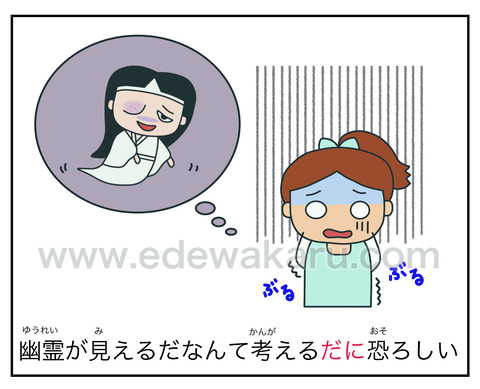
幽霊が見えるだなんて、考えるだに恐ろしい…
→幽霊が見えるだなんて、考えるだけで恐ろしいロトが当たるなんて、夢にだに思わなかった
→ロトが当たるなんて、全く思わなかったあんな事件が起こるなんて、想像だにしなかった
→あんな事件が起こるなんて、全く想像もしなかった
くらべてわかる日本語表現文型辞典
Meaning
Aを例としてあげ、AするだけでBとBを強調する。慣用的表現。
How to use it
AだにB(AにだにB)
[動詞-る形]だに
[名詞-∅]+(に)+だに
Explanation
【対比1】
「AさえB」(意味1 P.101)
「AすらB」(意味1 P.110)
「だに」は古い表現で「だに→すら→さえ」の順に新しい。動詞との接続は「すら・さえ」は「動詞+こと」につくが、「だに」はル形につく。
○あの人の名を口にすることさえ(すら)恐ろしい。
○あの人の名を口にするだに恐ろしい。
「すら・さえ」はAがBなら当然A以外のものも
Bだというが、「だに」はAするだけでBだ、AだけでもBだ。だからBはすごいと強調される。
In context 4 examples
あの話を思い出すだに胸が熱くなる。
幼い頃に別れた母に一目だに会いたいと、遠く日本までやってきた。
人類滅亡の瞬間など、想像するだに恐ろしくなる。
あの人が犯人だなんて、夢にだに思っていなかった。
日本語NET JLPT文法解説まとめ
Meaning
〜さえ / 〜すら / 〜するだけでも
基本的には否定形と一緒に「〜だに〜ない」の形で使われることが多い。
How to use it
V(辞書形) + だに
N + だに
※「夢」は例外で「夢にだに」となる。
Explanation
"even"
古い表現。
毎日のんびり日本語教師
Meaning
~するだけで
How to use it
動辞形+だに
Explanation
「~するだけで」と同じ意味です。
「思う」「考える」「想像する」「思い出す」などの語につきやすく、話者の負の感情を表すときに用います。
Notes
「だに」シリーズ
In context 9 examples
考えるだに恐ろしい事態だ。(哪怕想想都觉得恐怖。)
坂本龍馬が当時何を思って生きていたのか、それを思うだに私も胸が熱くなる。
洪水で浸水した1階を綺麗にするなんて、考えるだに気が狂いそうだ。
生意気な後輩のことはいまだに思い出すだに腹が立つ。
政府の対応をニュースで聞くだにイライラさせられる。
激辛の真っ赤なスープを見るだに、辛さに弱い私は死を感じる。
これから2週間ホテルで隔離生活… 想像するだに気が滅入る。
数分遅れていたら私も事故にあっていた。そう思うだに怖くなる。
あの時の失敗を思うだに赤面してしまう。
NINJAL 日本語文型データベース
Meaning
もし何かをしたら、もしくは、何かが起こったら、と少し考えたときに感じる恐怖や不快感を表します。
How to use it
Vるだに
Notes
「だに」の後には、「思う・考える」など思考を表す文がきます。
In context 5 examples
冬山を準備をせずに登るというのは、考えるだに恐ろしい。
これからもっと景気が悪くなるとは、想像するだに辛くなる。
このまま貧しい生活が続くのは、思うだに心も暗くなっていく。
昨晩起こった恐ろしい事件を思い出すだに、不安になる。
これから起こる環境問題について調べるだに、恐ろしくなってくる。