AIUEO JLPT Grammar
Meaning
This sentence pattern expresses the speaker’s intention or plans. It is used when the speaker has a certain action or plan in mind, and it is also used to convey future plans.
How to use it
動詞意向形と+思う
Explanation · 日本語
この文型は、自分の意志や予定を表すときに使われる表現です。話し手が特定の行動に対して意図や計画を持っていることを表します。また、今後の予定を伝えるときにも使用されます。
In context 5 examples
今夜は早く寝ようと思う。
I think I’ll go to bed early tonight.
来週、新しいプロジェクトを始めようと思っています。
I think I’ll start a new project next week.
来年、日本語の勉強をもっと頑張ろうと思います。
I think I’ll study Japanese harder next year.
今夜はカレーを作ろうと思います。
I think I’ll make curry tonight.
明日、ジムに行こうと思います。
I think I’ll go to the gym tomorrow.
文法
Meaning
話し手が発話の時点で考えた計画や決心を述べる時に使う表現。
How to use it
V(意向形) + と思う
In context 11 examples
これから、図書館で勉強しようと思います。
今日は給料日なので、欲しかったゲームを買おうと思います。
早く仕事が終わったので、ちょっと飲みに行こうと思います。
風邪を引いたので、今日はゆっくり家で休もうと思います。
明日は早く起きようと思います。
忘れ物をしたので、一度家に帰ろうと思います。
夏休みはアルバイトを増やそうと思います。
お年玉でゲームを買おうと思います。
授業が簡単すぎるので、もう少し難しい本を買って自分で勉強しようと思います。
来年はJLPTを受けようと思います。
体調が悪いので、今日はもう帰ろうと思います。
Bunpro Grammar Reference
Meaning
I think I will, I think I shall, Going to, Gonna (Volitional + と思う)
How to use it
Verb[よう] + と思う(1)
(1) と思っている
Verb[よう] + と思います(1)
(1) 思っています
Nuance
A phrase that expresses when someone thinks that they are resolved to do (A).
Explanation
The combination of a verb with the auxiliary verb う, or よう, followed by the う-Verb 思う gives us the common expression ようと思う. This expression is often translated as 'I think I will (A)', or 'I shall (A)'. It is also close to the casual expression 'I'm gonna (A)'.
Remembering that う and よう can have one of three possible meanings in Japanese (as discussed in the よう grammar point), ようと思う is usually only used to express one of those three. That 'one' is as follows:
意志 - Expresses intentions (has a similar meaning to ~するつもりだ).
このゲームはもうあきらめようと思う。
I think I will give up on this game already. (I have arrived at the conclusion that I will give it up)
私は明日から電車で通おうと思う。
I think I shall commute by train from tomorrow. (I have arrived at the conclusion that I will do it)
来月、バイクを買おうと思う。
I think I will buy a bike next month. (I have arrived at the conclusion that I will buy one)
This expression is also often used with 思っている. In these cases, it highlights that the intention of the speaker is something that they regularly think, or have been thinking about for some time.
今晩はレストランで美味しいものを食べようと思っているけど、ナオミも来る?
I am thinking of eating something delicious at a restaurant tonight, but do you want to come too, Naomi?
思っている may also be used when describing the intentions of another person, as discussed in our lesson about と思う.
タケル、お前は絶対サチコと別れようと思っているでしょう。
Takeru, you are definitely thinking of breaking up with Sachiko, aren't you?
Caution
Let's be careful to remember the difference between the auxiliary verbs よう, and ようだ. They are different constructions that have different meanings, and behave in unique ways grammatically.
Nuance · 日本語
誰かが(A)をする決心が付いたと思ったときに使う表現。
In context 17 examples
- 明日、勉強をしようと思う。
I think I will study tomorrow.
- タケル、お前は絶対サチコと別れようと思っているでしょう。
Takeru, you are definitely thinking of breaking up with Sachiko, aren't you?
- このゲームはもうあきらめようと思う。
I think I will give up on this game already. (I have arrived at the conclusion that I will give it up)
- 今晩はレストランで美味しいものを食べようと思っているけど、ナオミも来る?
I am thinking of eating something delicious at a restaurant tonight, but do you want to come too, Naomi?
- 私は明日から電車で通おうと思う。
I think I shall commute by train from tomorrow. (I have arrived at the conclusion that I will do it)
- 来月、バイクを買おうと思う。
I think I will buy a bike next month. (I have arrived at the conclusion that I will buy one)
- 来年、家を買おうと思う。
I think I will buy a house next year.
- 帰ってから、お菓子を食べようと思います。
I think I will eat candy after returning home.
- 今日から文法の勉強を始めようと思う。
I think I will start studying grammar from today.
- 息子はレゴを欲しがっているから、買ってあげようと思う。
My son wants lego, so I think I will buy him some.
- 牛乳がないから、スーパーに行こうと思う。
There is no milk, so I think I will go to the store.
- 冷蔵庫に入っているチーズを誰も食べないから、食べようと思う。
Since no one is going to eat the cheese in the refrigerator I think I will eat it.
- この週末は雪がいっぱい降るから、スキーをしに行こうと思う。
This weekend it will snow a lot, so I think I will go skiing.
- 私は家事をしたくないから、弟にしてもらおうと思う。
I don't want to do housework, so I think I will have my little brother do it for me.
- 後でクッキーを作ろうと思っているけど、あなたも一緒に作る?
I am thinking I will make cookies later, but do you want to make them with me?
- 今日は面白そうなテレビ番組があるから、見ようと思う。
There is a TV program on today that looks interesting, so I think I will watch it.
- 先生が説明をしてくれたことがあまり分からなかったから、後で先生に聞こうと思う。
I didn't really understand what the teacher was explaining, so I think I will ask the teacher about it later.
DoJG 日本語文法辞典(全集)
Meaning
~ think ~ will
How to use it
(i) Vinformal volitional | と思う | |
| 話そうと思う | I think I will talk |
| 食べようと思う | I think I will eat |
(ii) Vinformal nonpast | まいと思う | |
| 話すまいと思う | I think I will not talk |
| 食べるまいと思う | I think I will not eat |
Explanation
The speaker desires or decides to do something.
In context 5 examples
私は日本歴史を読もうと思う・思います。
I think I will read Japanese history (books).
私はもう酒を飲むまいと思う・思います。
I think I will not drink alcohol any longer.
夏休みに日本アルプスに登ろうと思います。
I think I will climb the Japan Alps during summer vacation.
森さんはワープロを買おうと思っています。
Mr. Mori is thinking of buying a word processor.
僕はあの人とはもう話すまいと思う。
I think I won't talk to that person any more.
どんなときどう使う 日本語表現文型辞典
Meaning
I think I will…
How to use it
Vよう+と思う
Explanation
B:そうですね、今日はまっすぐ帰ろうと思います。
B:ほんとうですか。ぜんぜん知りませんでした。
1)これから、または、将来何かをするという話す人の意志を表す。
2)「Vようと思っています」は、決心してからずっとそう思っているときに使う。「Vようと思います」は、話す時点での判断や決心を表す。
◆ × あ、おいしそうなケーキ。ちょっと買っていこうと思っています。
→○あ、おいしそうなケーキ。ちょっと買っていこうと思います。
3)否定の形「Vようとは思いません」は強い否定の意志を表す。
4)3人称の意志を言いたいときは、「と思っているそうだ・ようだ・らしい」などの形にする。
2)Vようと思っています is used when speaker has been resolved to doing something for some time. Vようと思います expresses judgment or resolution made at moment of speaking.
◆ × あ、おいしそうなケーキ。ちょっと買っていこうと思っています。→○あ、おいしそうなケーキ。ちょっと買っていこうと思います。
3)The negative form, Vようとは思いません, shows strong negation of volition.
4)When expressing volition in the third person, takes: と思っているそうだ, ようだ, or らしい, etc.
1)Speaker's volition concerning future plans.
In context 5 examples
会社をやめて、1年ぐらい留学しようと思っています。
わたしは子どものころからずっと医者になろうと思っていました。でも、今は考えが変わりました。
A:ちょっとあの本屋に寄ろうと思いますが、あなたは?
A:山田君、結婚しようと思っているそうだよ。
この仕事はたいせつだから、アルバイトの人に頼もうとは思いません。
絵でわかる日本語
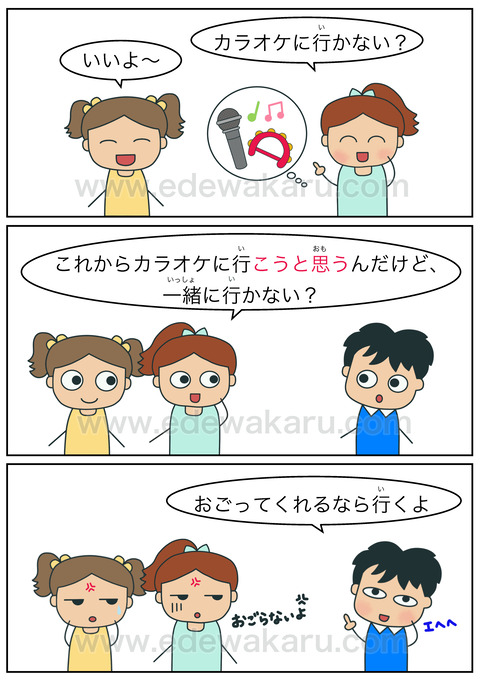
Meaning
今〜すると決めた
How to use it
動詞[意向形]+と思う
Explanation
「〜ようと思う」は、「今〜すると決めた」と言いたい時に使われる文型で、話し手の[意志]や[決定]を表します。この文型は、
話し手がその時に決めたことを言う時に使用されます。
似ている文型に「〜ようと思っている」があります。「〜ようと思っている」は前から考えていた予定や決定を表しますので、区別をしておきましょう😉
「よう」がつく文型はたくさんありますので、復習しておきましょう😄
In context 6 examples
A:これからカラオケに行こうと思うんだけど一緒に行く?B:うん!行く!!
→これからカラオケに行くと決めたんだけど、一緒に行く?今日からダイエットを始めようと思う
→今日からダイエットを始めようと、今決めた明日は早く起きようと思う
→明日は早く起きようと決めた海外旅行(かいがいりょこう)に行きたいので、アルバイトを増やそうと思う
→アルバイトを増やそうと決めたお父さんにお金をもらったので、ずっと欲しかったバッグを買おうと思う
→お金をもらったので、欲しかったバッグを買うと決めたお腹を壊したので、今日は学校を休もうと思います
→今日は学校を休むと決めました
日本語NET JLPT文法解説まとめ
Meaning
話し手が発話の時点で考えた計画や決心を述べる時に使う表現。
How to use it
V(意向形) + と思う
Explanation
This sentence pattern is used to talk about the speaker’s determinations or plans.
In context 11 examples
これから、図書館で勉強しようと思います。
今日は給料日なので、欲しかったゲームを買おうと思います。
早く仕事が終わったので、ちょっと飲みに行こうと思います。
風邪を引いたので、今日はゆっくり家で休もうと思います。
明日は早く起きようと思います。
忘れ物をしたので、一度家に帰ろうと思います。
夏休みはアルバイトを増やそうと思います。
お年玉でゲームを買おうと思います。
授業が簡単すぎるので、もう少し難しい本を買って自分で勉強しようと思います。
来年はJLPTを受けようと思います。
体調が悪いので、今日はもう帰ろうと思います。
IMABI
The Volition Form: ~(よ)う
Read this IMABI lesson ↗Explanation
The Volition Form: ~(よ)う
In grammar, volition indicates the willingness on the part of the agent (doer) to do said action, and with that willingness, a degree of control to do said action is also inherently implied.
Volition plays a fundamental role in Japanese grammar, with parallel structures often differing depending on whether “willpower/control” is being exerted.
i. 心の中に嵐が吹き荒れている。(Zero Volition)
A storm is raging in my heart.
ii. 来年の春に結婚することになった。(Low Volition)
I am to get married next spring.
iii. 最寄りの駅まで歩いた。(Volition)
I walked to the nearest station.
iv. 焼き立てのピザをまるごと食べました。(Volition)
I ate a whole pizza fresh out of the oven.
While a lot of intransitive structures like i. and ii. are non-volitional (無意志動詞) in nature, transitivity is not a clear-cut method of determining whether volition is involved in a structure more so than the inherent nature of the verbal structure itself.
Meanwhile, the “volitional form” (意向1形) of a verb explicitly announces the volition of a doer (=agent) to carry out said action. This is carried about two versions of the same auxiliary verb, differing only by what verb class they follow.
v. 憧れの地に家を買おう。
I intend to buy a home in my dream location.
vi. 一緒にご飯を食べよう。
Let’s go eat together.
The Auxiliary Verb ~よ(う)
For verbs that are inherently carried out by a doer who can have control over its execution, the auxiliary verb ~(よ)う attaches to its 未然形 to indicate either that…
The agent is definitively carrying out an action, translating as “will/shall…”
The agent is definitively carrying out an action while also calling upon others to join in the effort, translating as “let’s…”
As for which version of the auxiliary verb, ~よう and ~う2, is used, the verb class assignments are as follows:
Verb ClassEx.未然形 + ~(よ)うTranslation
上一段動詞見るmi–見ようlet’s/I’ll see
下一段動詞食べるtabe–食べようlet’s/I’ll eat
ワ行五段動詞買うkao–買おうlet’s/I’ll buy
カ行五段動詞書くkako–書こうlet’s/I’ll write
ガ行五段動詞泳ぐoyogo–泳ごうlet’s/I’ll swim
サ行五段動詞話すhanaso–話そうlet’s/I’ll talk
タ行五段動詞勝つkato–勝とうlet’s/I’ll win
ナ行五段動詞死ぬshino–死のうlet’s/I shall die
マ行五段動詞読むyomo–読もうlet’s/I’ll read
ラ行五段動詞走るhashiro–走ろうlet’s/I’ll run
サ変するshi–しようlet’s/I’ll do
カ変来るko–来(こ)ようlet’s/I’ll come
In the spoken language, the difference between the two nuances of the volitional form are more easily discernable. When enunciated, its “will/shall…” meaning is associated with a ↘ intonation, whereas its “let’s/shall…” meaning is associated with a ⤴ intonation.
Even without intonation as a guide, context alone can generally suffice to determine which nuance is intended by determining the likelihood others would be involved in carrying it out in the first place. Even in English, contexts such as those seen in Ex. 2 may render these two nuances completely synonymous, which just goes to show why the same form is used in Japanese.
1. 寿司を食べよう。
i. Time to eat sushi.
ii. Let’s eat sushi.
2. これだけははっきりとさせておこう。
i. Let’s get this much straight.
ii. Allow me to get this much straight.
3. もう間に合わないから、ゆっくりしよう。
We’re already not going to make it on time, so let’s take our time.
4. 混んでるから、次のに乗ろう。
i. Since (this train) is crowded, let’s get on the next one.
ii. I’ll just go on the next one since (this train) is crowded. (独り言)
5. 週末は、友達と遊びに行こう。
Let’s go out and have fun with our friend on the weekend.
6.「ねえ、今夜飲まない?」「いいねえ、飲もう飲もう3!」
“Hey, why don’t we drink tonight?” “Great idea! Let’s drink!”
7. みんなで歌おう。
Let’s all sing together.
8. また来よう。
i. I’ll be coming again.
ii. Let’s come again.
9. 今年こそ富士山に登ろう!
This year, I’m definitely climbing Mt. Fuji!
10. 一緒に泳ごうよ。
Let’s swim together!
Grammar Note: The volitional form may be followed by final particles such as よ, as they agree with the affirmative modality built into it.
It is worth noting that the 意志形 is not implemented when the speaker is merely informing what they are going to do next. In such scenarios, the non-past form suffices.
11a. わたしは午後5時に退社します。〇
11b. わたしは午後5時に退社しましょう。X
It also goes without saying that the 意志形 may not be used with non-volitional verbs and/or usages of verbs that are non-volitional in nature. On rare occasions, verbs that are non-volitional in nature may imply a degree of willful control via personification; however, such instances are not typical of everyday speech.
12. どこに置かれてどう咲こうか。
Now, where to be placed and how I should bloom.
In Ex. 12, the speaker is either a plant being personified or a person likening themselves to a plant in poetic fashion. As 咲く(to bloom) is non-volitional in nature, without such contexts, 咲こう would otherwise be unnatural.
~(よ)う{か・かな・かしら}
When the volitional form is followed by the particles か・かな・かしら with a ↘ intonation, the speaker has been prompted in someway, whether it be via external input or an internal realization, to contemplate carrying out said action. While the speaker (= possible agent) has not entirely decided upon going through with it, the idea is there, with かな・かしら4 hinting at less initiative than simply using か.
13a. じゃあ、行ってみようか。
13b. じゃあ、行ってみよう{かな・かしら}。
13a. Well then, I might as well go.
13b. Well then, I guess I might go.
14. 明日の授業めんどいからサボろうかな〜
Class tomorrow’s gonna be such a drag, so I’m thinking about skipping.
15. さて、何を歌おうかしら。
Now then, what shall I sing…?
16. 次は抹茶ラテを頼もうかな。
I could go for a match latte next.
17. 雨にひとり泣こうか。
I suppose I’ll cry alone in the rain.
It must be noted that the volitional form by itself can be used in a question, but such questions are directed back at oneself in an emotional plea, which is distinctly different from ~よう(か・かな・かしら).
18. どうしよう?
What should I do?
19. どうしようか。
What to do…
~(よ)う{では・じゃ}ないか
Whether it be ~(よ)う{では・じゃ}ないか in plain speech or ~(よ)う{では・じゃ5}ありませんか in polite speech, this pattern is used to invite everyone to participate on the lines of “how about we…?” with a rising intonation or more on the lines of “I say we…” with a high intonation.
20. みんなでハワイに行こう{では・じゃ}ないか!
How about we all go to Hawaii together!
21. 仕事のことなんかは忘れて楽しく飲もうじゃないか。
I say we forget about work and what not and have fun drinking.
22. 最後まで頑張ろうではないか!
I say we all strive to do our best till the end! (Who’s with me?!)
23. 自分たちにできることを考えようではないか。
How about we think about what we ourselves can do?
24. 地球温暖化の問題について、真剣に考えようではありませんか。
How about we think seriously about the issue of global warming?
25. どうか皆さん、全力でこの1か月頑張ろうじゃありませんか!
I saw we all put out our best effort this coming month! Who’s with me, everyone?!
~(よ)うと思う
With the volitional form being a representation of an agent’s desire to carry out an action, that desire can be represented as a thought. As such, it may be followed by the quotation particle と and any suitable citation verb that can represent an agent’s desires. Of the citation verbs that could be used, 思う is most basic and appropriate for describing such thoughts in the moment.
26. きょうから日記を書こうと思います。
I think I’ll start a diary tomorrow.
27. ハワイに行こうと思います。
I think I’m going to Hawaii.
29. 夏休みはずっと見たかった映画やアニメなどを見ようと思います。
I think I’ll watch all the movies and anime I’ve been wanting to watch this whole over my summer break.
30.「死のう」と思ったことはないが「死にたい」と思ったことはある。
While I haven’t thought of dying, I have wished to die before.
Similarly to how the auxiliary ~たい is restricted to first-person desire, the volitional form in its basic implementation is restricted to first-person statements of volition. To express third-person volition, ~(よ)うと思っている must be used. While this also implies some duration on the part of the other person for how long they have been aiming to do whatever action is being discussed, it also naturally takes some time to ascertain someone else’s motives.
31. 姉は中国で日本語を教えようと思っています。
My older sister is thinking about teaching Japanese in China.
32. キムさんは留学しようと思っています。
Kim-san is considering studying abroad.
The third-person restriction on stating volition does not exclude the possibility of using ~(よ)うと思う in the second person so long as the sentence is used in a question, in which case the speaker is confirming with another person where their volition lies. Incidentally, ~(よ)うと思うか is a very nuanced, explicit line of questioning, akin to a rhetorical question (反語) as opposed to a simple inquiry.
33. キムさんは留学しようと思いますか。
Kim-san, are you to consider studying abroad?
Typically, second-person questions utilizing ~(よ)うと思う include ~ている. As should be expected, the question implies the intent has been brewing in the other person’s mind for some time.
34. 母国を離れようと思っていますか。
Are you considering leaving your home country?
Moreover, ~(よ)うと思っている is NOT restricted to second and third person. In fact, its use to express first-person contemplation of a desired course of action, which in turn describes their determination to carry said plans out.
35. 将来しょうらいは映画監督えいがかんとくになろうと思っている。
I’m thinking of becoming a movie director in the future.
36. 大学院を卒業してから、国へ帰ろうと思っています。
I’m thinking about going back to my country once I graduate from graduate school.
37. 将来は東京に引っ越そうと思っています。
I’m thinking about moving to Tokyo in the future.
38. 来年はJLPT N#を受けようと思っています。
I’m thinking about taking the JLPT N# next year.
39. 今月末までに、彼氏の諒君にプロポーズしようと思ってる。
I’m thinking about proposing to my boyfriend Ryo-kun by the end of this month.
40. 諒君と結婚しようかなと思ってます。
I’m thinking about marrying Ryo-kun.
Grammar Note: As demonstrated in Ex. 40, the particles か・かな・かしら can be inserted in between ~(よ)う and 思う.
As hinted at earlier, other citation verbs are possible. Whether the non-past, past, or progressive aspect is used will depend on the context. The mechanics of which aspect is used are no different for ~(よ)うと + citation verb than with any other verbal construction.
41. 奨学金しょうがくきんをもらおうと考えています。
I’m considering receiving scholarship money.
42. 人生を仕事の犠牲にするのはやめようと決めました。
I decided that I would stop sacrificing my life for work.
43. コンビニは少し遠くて大雨の中行く程でもないし、昼休みも短いし、果物を食べたら空腹は収まったので、私は夜弁当を食べようと判断しました。
The convenience store is a little too far, not worth going there with it raining hard, and with my lunch break being short and staving off hungry by eating some fruit, I decided to have a bento for my night meal.
44. 重要なのは「不安でどうしよう」 と考えるのではなく、 「自分はどうしたいか」「何が理想なのか」 からの逆算で考えるんだよ。
The important thing is to work backwards by thinking, “what do I want to do?” and “what would be ideal?” as opposed to thinking “I’m so anxious, what should I do?”
45. さらに食べようっていうの?
You’re going to eat on top of this?
While third-person statements of volition usually do not utilize the non-past, whenever the statement is generic, not pertaining to anyone individual, such statements do become natural. This is often seen in the written language in which authors have greater control over the expression of thoughts, whether it be their own or others which appear in their writing.
46. 誰もが世界を変えようと考えるが、自分を変えようとは思わない。
Everyone thinks about changing the world, but no one thinks about changing themselves.
Future Study
In addition to being followed by the quotative particle と in the capacity outlined thus far, ~(よ)う is also incorporated into an array of other patterns. Ones which we will cover soon include:
~(よ)うとする
~(よ)うと
~(よ)うとも
~(よ)うにも (Section Under Construction)
~(よ)うものなら (Lesson Under Construction)
Conversely, ~ましょう, the polite iteration of ~(よ)う to be discussed next, is NOT built into all these other grammatical structures due to it being relegated to sentence-final position, a limitation imposed on it by it being a form of ~ます – following the general rule that politeness is marked in the main clause.
Polite Speech: ~ましょう
To create the volitional form in polite speech, the auxiliary verb ~う attaches to the 未然形 of the politeness marker ~ます.
Auxiliary Verb未然形+~う
~ますmasho–~ましょう
Then, to add ~ましょう to a verb, all you need to do is attach it to the 連用形.
Verb ClassEx.連用形+ ~ましょうTranslation
上一段動詞見るmi– 見ましょう Let’s/I’ll see
下一段動詞食べるtabe– 食べましょう Let’s/I’ll eat
ワ行五段動詞買うkai– 買いましょう Let’s/I’ll buy
カ行五段動詞書くkaki– 書きましょう Let’s/I’ll write
ガ行五段動詞泳ぐoyogi– 泳ぎましょう Let’s/I’ll swim
サ行五段動詞話すhanashi– 話しましょう Let’s/I’ll talk
タ行五段動詞勝つkachi– 勝ちましょう Let’s/I’ll win
ナ行五段動詞死ぬshini– 死にましょう Let’s/I shall die
マ行五段動詞読むyomi– 読みましょう Let’s/I’ll read
ラ行五段動詞走るhashiri– 走りましょう Let’s/I’ll run
サ変するshi– しましょう Let’s/I’ll do
カ変来るki– 来(き)ましょう Let’s/I’ll come
With the addition of the politeness marker ~ます, the volitional form still carries the same two principle nuances:
The agent is definitively carrying out an action, translating as “will/shall…”
The agent is definitively carrying out an action while also calling upon others to join in the effort, translating as “let’s…”
Just like we learned with ~(よ)う in plain speech, in the spoken language, the difference between the two nuances of the volitional form are more easily discernable. When enunciated, its “will/shall…” meaning is associated with a ↘ intonation, whereas its “let’s/shall…” meaning is associated with a ⤴ intonation. Even without intonation as a guide, context alone can generally suffice to determine which nuance is intended.
47. その荷物は僕が持ちましょう。
I’ll be the one to carry [that/your] luggage.
48. 価格を下げることで売り上げが伸のびるように定価から2千円を割り引びきましょう。
In lowering prices in order to boost sales, let’s knock off 2000 yen from the price.
49. 乾杯かんぱいしましょう。
Let’s make a toast!
50. 今夜一緒に外食しましょう。
Let’s eat out tonight.
51. 早速出かけましょう!
Let’s head out at once!
52. 世よにある限かぎり最善さいぜんを尽つくしましょう。
Let’s do our best to live in this world as much as possible.
~ましょうか
With the inclusion of the politeness marker ~ます, ~ましょうか denotes a personal offer to either do something on behalf of the listener or for the listener to join in on an offer made by the speaker. This is heavily employed when offering help to someone.
53. 私から電話しましょうか。
Shall I call (from my end)?
54. 傘を貸しましょうか。
Shall I lend you my umbrella?
55. お寿司でも食べに行きましょうか。
Shall we go eat sushi?
56. 帰ったら日本酒でも飲みましょうか。
How about we have some sake once we get home?
Variations
Though casual, the final う in these forms can be heard omitted. While this shortening is typical throughout Japan, it is especially common in Kansai Dialects. It is also possible to hear the しょ pronounced as ひょ in addition to the final う6 being dropped in Kansai dialects.
57a. はよ行こや!(Kansai Dialect)
57b. 早く行こうよ!(Standard Japanese)
Let’s hurry and go!
58a. お茶淹れまひょか。(Kansai Dialect)
58b. お茶淹れましょうか。(Standard Japanese)
Shall I put on some tea?
Also occasionally referred to as the 意志形, 意向 highlights the inclination aspect behind both its meanings. ↩︎
Both ~よう and ~う derive from the Classical Japanese volitional auxiliary verb ~む. Over time, ~む reduced to ~ん before further reducing to ~う. Initially, non-五段 verbs did involve ~う directly following their 未然形. This resulted in verb forms such as [myo:] before palatalization of the 未然形 was reversed to bring about ~よう. Sometimes, these palatalized fusions of the 未然形 + ~う can still be heard, especially in Western Japanese dialects. ↩︎
Repeating a verb in its volitional form is not so childish in tone as the direct equivalent would be in English. ↩︎
While かしら is often described as the feminine equivalent of かな, this, too, is dependent on nuance, dialect, intonation, and historical context. The final particle was used heavily by both men and women up until the early 1900s, but as the century went on, かしら largely fell out of use, having always been overshadowed by かな, at least for when it means “I wonder…” In requests, it typically accompanies a giving verb such as くれる, and in this context, it is largely associated with female speech, perhaps further implicated by the inherent rising intonation from being used in a question. In the wake of its decline, かしら became associated with てわ・だよ言葉=女性語, and that association has persisted into the present. In modern times as gender-specific language itself is waning, かしら has once again taken a hit in how frequency it is used. In some dialects, however, it has remained as a typical variant of ~か知らん from whence it came. ↩︎
~ようじゃありませんか is a mixture of the casual contraction では → じゃ and polite speech. While not as formal, speakers who wish to remain highly polite yet also invoke a familial tone may choose to employ this form. ↩︎
For 五段 verbs, this results in the bare 未然形 itself sufficing in expressing the volitional form. ↩︎
In context 61 examples
寿司を食べよう。
i. Time to eat sushi.
これだけははっきりとさせておこう。
i. Let’s get this much straight.
もう間に合わないから、ゆっくりしよう。
We’re already not going to make it on time, so let’s take our time.
混んでるから、次のに乗ろう。
i. Since (this train) is crowded, let’s get on the next one.
週末は、友達と遊びに行こう。
Let’s go out and have fun with our friend on the weekend.
「ねえ、今夜飲まない?」「いいねえ、飲もう飲もう3!」
“Hey, why don’t we drink tonight?” “Great idea! Let’s drink!”
みんなで歌おう。
Let’s all sing together.
また来よう。
i. I’ll be coming again.
今年こそ富士山に登ろう!
This year, I’m definitely climbing Mt. Fuji!
一緒に泳ごうよ。
Let’s swim together!
わたしは午後5時に退社します。〇
わたしは午後5時に退社しましょう。X
どこに置かれてどう咲こうか。
Now, where to be placed and how I should bloom.
じゃあ、行ってみようか。
13a. Well then, I might as well go.
じゃあ、行ってみよう{かな・かしら}。
13a. Well then, I might as well go.
明日の授業めんどいからサボろうかな〜
Class tomorrow’s gonna be such a drag, so I’m thinking about skipping.
さて、何を歌おうかしら。
Now then, what shall I sing…?
次は抹茶ラテを頼もうかな。
I could go for a match latte next.
雨にひとり泣こうか。
I suppose I’ll cry alone in the rain.
どうしよう?
What should I do?
どうしようか。
What to do…
みんなでハワイに行こう{では・じゃ}ないか!
How about we all go to Hawaii together!
仕事のことなんかは忘れて楽しく飲もうじゃないか。
I say we forget about work and what not and have fun drinking.
最後まで頑張ろうではないか!
I say we all strive to do our best till the end! (Who’s with me?!)
自分たちにできることを考えようではないか。
How about we think about what we ourselves can do?
地球温暖化の問題について、真剣に考えようではありませんか。
How about we think seriously about the issue of global warming?
どうか皆さん、全力でこの1か月頑張ろうじゃありませんか!
I saw we all put out our best effort this coming month! Who’s with me, everyone?!
きょうから日記を書こうと思います。
I think I’ll start a diary tomorrow.
ハワイに行こうと思います。
I think I’m going to Hawaii.
夏休みはずっと見たかった映画やアニメなどを見ようと思います。
I think I’ll watch all the movies and anime I’ve been wanting to watch this whole over my summer break.
「死のう」と思ったことはないが「死にたい」と思ったことはある。
While I haven’t thought of dying, I have wished to die before.
姉は中国で日本語を教えようと思っています。
My older sister is thinking about teaching Japanese in China.
キムさんは留学しようと思っています。
Kim-san is considering studying abroad.
キムさんは留学しようと思いますか。
Kim-san, are you to consider studying abroad?
母国を離れようと思っていますか。
Are you considering leaving your home country?
将来しょうらいは映画監督えいがかんとくになろうと思っている。
I’m thinking of becoming a movie director in the future.
大学院を卒業してから、国へ帰ろうと思っています。
I’m thinking about going back to my country once I graduate from graduate school.
将来は東京に引っ越そうと思っています。
I’m thinking about moving to Tokyo in the future.
来年はJLPT N#を受けようと思っています。
I’m thinking about taking the JLPT N# next year.
今月末までに、彼氏の諒君にプロポーズしようと思ってる。
I’m thinking about proposing to my boyfriend Ryo-kun by the end of this month.
諒君と結婚しようかなと思ってます。
I’m thinking about marrying Ryo-kun.
奨学金しょうがくきんをもらおうと考えています。
I’m considering receiving scholarship money.
人生を仕事の犠牲にするのはやめようと決めました。
I decided that I would stop sacrificing my life for work.
コンビニは少し遠くて大雨の中行く程でもないし、昼休みも短いし、果物を食べたら空腹は収まったので、私は夜弁当を食べようと判断しました。
The convenience store is a little too far, not worth going there with it raining hard, and with my lunch break being short and staving off hungry by eating some fruit, I decided to have a bento for my night meal.
重要なのは「不安でどうしよう」 と考えるのではなく、 「自分はどうしたいか」「何が理想なのか」 からの逆算で考えるんだよ。
The important thing is to work backwards by thinking, “what do I want to do?” and “what would be ideal?” as opposed to thinking “I’m so anxious, what should I do?”
さらに食べようっていうの?
You’re going to eat on top of this?
誰もが世界を変えようと考えるが、自分を変えようとは思わない。
Everyone thinks about changing the world, but no one thinks about changing themselves.
その荷物は僕が持ちましょう。
I’ll be the one to carry [that/your] luggage.
価格を下げることで売り上げが伸のびるように定価から2千円を割り引びきましょう。
In lowering prices in order to boost sales, let’s knock off 2000 yen from the price.
乾杯かんぱいしましょう。
Let’s make a toast!
今夜一緒に外食しましょう。
Let’s eat out tonight.
早速出かけましょう!
Let’s head out at once!
世よにある限かぎり最善さいぜんを尽つくしましょう。
Let’s do our best to live in this world as much as possible.
私から電話しましょうか。
Shall I call (from my end)?
傘を貸しましょうか。
Shall I lend you my umbrella?
お寿司でも食べに行きましょうか。
Shall we go eat sushi?
帰ったら日本酒でも飲みましょうか。
How about we have some sake once we get home?
はよ行こや!(Kansai Dialect)
Let’s hurry and go!
早く行こうよ!(Standard Japanese)
Let’s hurry and go!
お茶淹れまひょか。(Kansai Dialect)
Shall I put on some tea?
お茶淹れましょうか。(Standard Japanese)
Shall I put on some tea?