Bunpro Grammar Reference
Meaning
Apparently, Looks Like, Seems like
How to use it
どうやら + Phrase + みたいだ(1)
(1) ようだ、そうだ 、らしい、って 感じだ
Nuance
An expression indicating that how (A) seems or appears is creating feelings of uncertainty or confusion in the speaker.
Explanation
どうやら can be translated as 'apparently', or 'it seems like', and is often grouped together with other phrases of speculation such as ようだ, そうだ, and らしい. Due to this, どうやら simply strengthens the uncertainty of things that the speaker is already unsure about. This is in a similar fashion to phrases like 'in some way it seems like (A)'.
Like many adverbs that express amount or speculation, どうやら will appear at the beginning of sentences and modify the meaning of the entire phrase.
鈴木くんはいるか?居ないのかな?どうやら今日も休んでいるみたいだね。
Is Suzuki-kun present? Maybe he's not here? It seems like he's taking today off as well.
どうやら私は彼女には必要がないようだ。
It seems like I am not needed by her.
どうやら彼は結婚しているらしいよ。
I heard that he is apparently married.
Fun-fact
While classified as a standalone adverb, どうやら is originally a combination of どう 'how' and やら, a 助詞 (particle) that is used for denoting uncertainty about singular things or lists. With this in mind, it is similar to the way that 'or whatever', or 'or some such' may be added to a sentence in English in order to emphasize that (A) is not certain.
お隣の鈴木さんがどうやら来月からイギリスに行くらしいですよ。
Our neighbor, Suzuki-san, is apparently going to England next month, or something.
Nuance · 日本語
(A)の在り方や姿が話し手に不安や混乱を感じさせているということを表す表現。
Explanation · 日本語
「どうやら」は「はっきりとはわからないが」や「なんとなく」のような意味を持ち、「ようだ」「そうだ」「らしい」などの推量を表す言葉と一緒に使われることが多い文型です。もともと確かかどうかわからないことに「どうやら」が付くと、より不確かさが加わった表現になります。
推量や程度を表す多くの副詞と同じように、「どうやら」は文の最初に置かれ、文全体を修飾します。
鈴木くんはいるか?居ないのかな?どうやら今日も休んでいるみたいだね。
Is Suzuki-kun present? Maybe he's not here? It seems like he's taking today off as well.
どうやら私は彼女には必要がないようだ。
It seems like I am not needed by her.
どうやら彼は結婚しているらしいよ。
I heard that he is apparently married.
豆知識
「どうやら」は単独の副詞に分類されますが、もともとは「どのような」という意味の「どう」と、不確実なことや並列を表す助詞の「やら」が組み合わさった言葉です。
お隣の鈴木さんがどうやら来月からイギリスに行くらしいですよ。
Our neighbor, Suzuki-san, is apparently going to England next month, or something.
In context 16 examples
- あの二人、どうやら結婚してる感じだよ。
It seems like those two are married.
- 鈴木くんはいるか?居ないのかな?どうやら今日も休んでいるみたいだね。
Is Suzuki-kun present? Maybe he's not here? It seems like he's taking today off as well.
- どうやら彼は結婚しているらしいよ。
I heard that he is apparently married.
- どうやら私は彼女には必要がないようだ。
It seems like I am not needed by her.
- あの動画、どうやら削除されたみたいだ。
It looks like that video was deleted.
- どうやら今年の紅葉は遅れているらしい。
It looks like fall colors are late this year.
- どうやら「心当たりがない」というのは本当らしい。
Apparently it is true that he 'has no clue.'
- 彼はどうやらお小遣いをもらったことがないようです。
It seems like he has never received an allowance.
- どうやら、俺は電気をつけっぱなしにしたらしい。すみません。
It looks like I left the light on. I'm sorry.
- 彼女はどうやら本気でコンクールに出品したいらしい。
It looks like she is serious in wanting to enter an exhibit in the contest.
- どうやら祭日はあのお店やってないみたいだよ。
Apparently that store isn't open on national holidays.
- あの施設の完成は、どうやら再来年になるらしいです。
It looks like that facility will be finished the year after next.
- NHK(エヌエイチケー)集金人:「どうやら、私はこの辺りでは歓迎されないようだ...」
NHK Collector: 'Apparently, I am not welcome here.'
- 結婚式の客1:「あれは誰?」
結婚式の客2:「どうやら花嫁の兄みたいだな。」Wedding Guest 1: 'Who is that?' Wedding Guest 2: 'Apparently, it is the bride's elder brother.'
- 知ってた? どうやら 田中さんは彼氏と別れて、今はフリーらしいよ。
Did you know? Apparently, Tanaka broke up with her boyfriend. She is free now!
- お隣の鈴木さんがどうやら来月からイギリスに行くらしいですよ。
Our neighbor, Suzuki-san, is apparently going to England next month, or something.
絵でわかる日本語
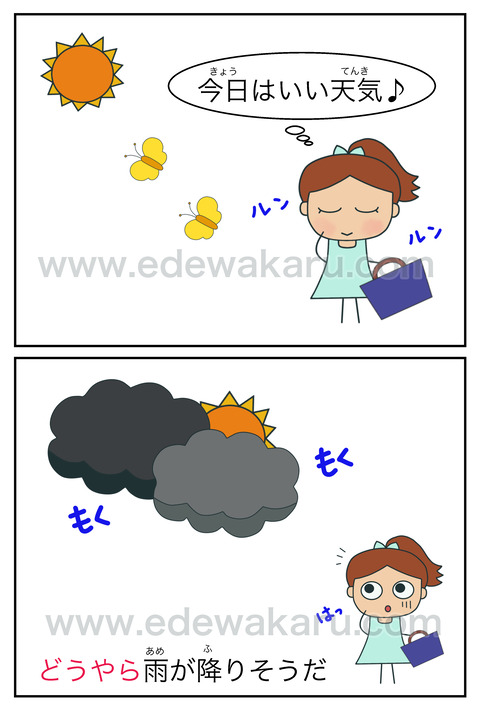
Meaning
はっきりとわからないが〜ようだ
はっきりとわからないが、たぶん〜だと思う
Explanation
「どうやら+推量表現」は「はっきりとわからないが〜ようだ」という意味を表す文型です。話者が
「はっきりとわからないが、たぶん〜だと思う」
というように、不確かな気持ちを表す時に使われます😊後ろには推量表現(すいりょうひょうげん)がくると覚えておきましょう😀
[「どうやら」とよく使う推量表現]
・どうやら+
〜そうだ
・どうやら+
〜ようだ
・どうやら+
〜らしい
初級で勉強したように、
「〜そうだ」には【推量】と【伝聞】の意味があります
ので、間違えないように気をつけてください😨
雨が
降りそうだ
【推量・可能性】
雨が
降るそうだ
【
伝聞】
【推量・可能性】
動詞[ます形]
+そうだ
【伝聞】
動詞[普通形]
+そうだ
「なんでも〜そうだ」(復習:なんでも+伝聞表現)と「どうやら〜そうだ」はどちらも「はっきりとわからないが〜」という意味ですので、混乱しがちです😥(復習:〜がち)
「なんでも〜」は後ろには必ず伝聞表現がきて、「はっきりとわからないが〜だそうだ」と覚えておきましょう
😉
日本語文型辞典
Meaning
後ろに「そうだ」「ようだ」「らしい」などの推量を表す表現を伴って、はっきりとは分からないが、そのように推量されるという話し手の不確かな気持ちを表す。
十分ではないが努力した結果、ようやく目標としていた状態や完成の段階に到達する様子を表す。
How to use it
どうやら…そうだ
どうやら(こうやら
In context 6 examples
このぶんでいくと、どうやら桜の開花は早まりそうだ。
むこうから歩いて来るのは、どうやら田中さんのようだ。
部屋から次々と人が出て来るところをみると、どうやら会議は終わったらしい。
急いだので、どうやら間に合った。
どうやら論文も完成に近づいた。
どうやらこうやら卒業することができました。
日本語文型辞典 英語版
Meaning
Followed by expressions of conjecture such as そうだ, ようだ, or らしい. Indicates uncertainty on the part of the speaker, in the sense that although s/he isn’t absolutely sure, s/he thinks that such an inference is possible.
Expresses that, although the outcome is in some way insufficient, a situation or stage of completion that was set as a goal has finally been achieved, as a result of one’s efforts.
How to use it
1. どうやら...そうだ
2. どうやら(こうやら)
In context 6 examples
この分でいくと、どうやら桜の開花は早まりそうだ。
If it (the weather) continues like this, the cherry blossoms may well bloom early.
むこうから歩いて来るのはどうやら田中さんのようだ。
That looks like Tanaka-san walking toward us from over there.
部屋から次々と人が出て来るところをみると、どうやら会議は終わったらしい。
Seeing people come out of the room one after the other, it looks like the meeting is over.
急いだのでどうやら間に合った。
We hurried, so somehow or other, we made it on time.
どうやら論文も完成に近づいた。
I’ve somehow managed to come close to finishing my thesis.
どうやらこうやら卒業することができました。
By hook or by crook, I was able to graduate.