AIUEO JLPT Grammar
Meaning
This sentence pattern indicates performing a secondary activity alongside a primary one, often referring to a job, academic pursuit, or other major endeavor combined with additional side activities.
How to use it
名詞の+かたわら動詞辞書形+かたわら
Explanation · 日本語
この文型は、ある主要な活動をしながら、それと同時に別の活動も行っていることを表す表現です。主に、職業や仕事、学業などの本業と、同時に行っている副次的な活動を示すときに使われます。
In context 5 examples
彼は教師の仕事をするかたわら、小説を書いている。
He works as a teacher while writing novels on the side.
彼は弁護士の仕事をするかたわら、大学で法律の講師もしている。
He works as a lawyer while also teaching law at a university.
父は農業のかたわら、地域の活動にも積極的に参加している。
My father works in agriculture while also actively participating in community activities.
彼女は育児をするかたわら、自宅でフリーランスの仕事をしている。
She takes care of her children while working freelance from home.
彼は本業のかたわら、副業としてオンラインビジネスも展開している。
He runs an online business as a side job while working in his main profession.
文法
Meaning
〜一方で、別に〜
仕事や研究などの社会的活動をしながら、別のこともしていることを表す文型。
2つの活動は異なる時間帯で行われ、かつ「ながら」に比べ長期間続けている活動に対して使われる。また、習慣的な行為に用いられることが多い。
How to use it
V(辞書形)+かたわら
N + のかたわら
Notes
誤用例
・テレビを見るかたわら、新聞を読む。
→テレビを見ながら、新聞を読む。
・ギターを弾くかたわら、歌う。
→ギターを弾きながら、歌う。
In context 8 examples
トムさんは英会話の学校で務めるかたわら、週末は日本語学校で日本語を学んでいる。
田中先生は教師として働くかたわら、新しい教科書の開発にも取り組んでいる。
母は家事のかたわら、近所に住む外国人に日本語を教えている。
最近はサラリーマンとして働くかたわら、ブログやYouTubeでお金を稼ごうとする人が増えてきた。
彼女は子育てのかたわら、大学に通っている。
彼は書店で働くかたわら、カフェも経営している。
彼女は歌手のかたわら、モデルとしても活躍している。
トムさんは日本語を勉強するかたわら、英語を教える仕事をしている。
Bunpro Grammar Reference
Meaning
While, Besides, In addition to
How to use it
Verb[る]+ かたわら
Noun + の + かたわら
Nuance
A formal phrase which emphasizes in addition to (A), (B). Beside or alongside the more important (A), (B).
Explanation
傍ら, seen primarily in hiragana, is a noun in Japanese that means 'bystander', in regard to something that is alongside or in the same place as the main focus. As a grammatical structure, it will be translated as 'while (A)', 'in addition to (A)', or 'besides (A)'.
かたわら may come after nouns followed by の, or after the dictionary form of verbs.
彼は飲食店を経営しているかたわら、鳶職人としても働いている。
Besides running a restaurant, he also works as a steeplejack.
グレッググラフィンは大学の教授をしているかたわら、歌手として活動している。
In addition to being a college professor, Greg Graffin is also active as a singer.
私の妹は本業のかたわら、英会話教室で英語を教えている。
My sister teaches English at an English conversation class in addition to her day job.
妻は子育てのかたわら、近所の子供達にそろばんを教えている。
My wife teaches abacus to kids in the neighborhood in addition to raising our children.
Something that can be remembered from the 'bystander' meaning of this word is that かたわら will always come after the primary action or state of (A), while (B) is considered to just be there incidentally to (A), or as being done secondarily to it. This usually takes the form of something like a side job or a hobby.
Caution
Unlike ながら, かたわら does not necessarily indicate two actions that are happening at the exact same time, just actions that are happening independently of each other with one being the focus, and the other happening to a lesser extent within the same subject's life, day to day activities, etc.
Nuance · 日本語
(A)に加えて(B)ということを丁寧に強調する時に使う表現。(A)という重要なことに加えて、(B)。
Explanation · 日本語
「傍ら」は、「中心となる物事の横・そば」を意味する名詞で、基本的にひらがなで書かれます。これが文法表現として使われると、「(A) しながら」や「(A) とは別に」、「(A) の一方で」といった意味を表します。
「かたわら」は、助詞「の」がついた名詞の後、または動詞の辞書形の後に置かれます。
彼は飲食店を経営しているかたわら、鳶職人としても働いている。
Besides running a restaurant, he also works as a steeplejack.
グレッググラフィンは大学の教授をしているかたわら、歌手として活動している。
In addition to being a college professor, Greg Graffin is also active as a singer.
私の妹は本業のかたわら、英会話教室で英語を教えている。
My sister teaches English at an English conversation class in addition to her day job.
妻は子育てのかたわら、近所の子供達にそろばんを教えている。
My wife teaches abacus to kids in the neighborhood in addition to raising our children.
この表現は、常に主要な状態や動作である (A) の後に置かれます。その後に置かれる (B) の状態や動作は、(A) に付随する、あるいは副次的なものと見なされます。例えば、(A) が本業であれば、(B) には副業や趣味などになります。これは、「かたわら」がもともと持つ「中心となる物事の横・そば」という意味にも通じています。
注意点
「かたわら」は、「ながら」とは異なり、必ずしも二つの活動が同時に行われていることを意味するわけではありません。それぞれの活動は独立しており、一方は主要な活動、もう一方は日常生活の中で、比較的重要性や頻度が低い活動となることが多いです。
In context 16 examples
- 本業の傍らバイトなどの副業をしている多数の人々がいる。
Besides working their main jobs, there are many people that also work part-time jobs on the side.
- 彼は飲食店を経営しているかたわら、鳶職人としても働いている。
Besides running a restaurant, he also works as a steeplejack.
- 私の妹は本業のかたわら、英会話教室で英語を教えている。
My sister teaches English at an English conversation class in addition to her day job.
- グレッググラフィンは大学の教授をしているかたわら、歌手として活動している。
In addition to being a college professor, Greg Graffin is also active as a singer.
- 妻は子育てのかたわら、近所の子供達にそろばんを教えている。
My wife teaches abacus to kids in the neighborhood in addition to raising our children.
- 彼女は大学で教える傍ら、家でも個人指導をしている。
Besides teaching at university, she gives private lessons at home.
- さらに大学での国語の教授をしている傍ら、漫画家として活躍している。
Moreover, besides holding the position of a Japanese professor at the university, he is also active as a manga artist.
- ブルースは、昼は財閥を経営する傍ら、夜はバーマンとして危険地域を見回っている。
During the daytime, Bruce manages his family corporation, while at night he patrols dangerous areas as BARMAN.
- いくつかの国では、女性は仕事の傍ら、苦労をいとわず子供を育てている。立派なことだと思う。
In some countries, women work in addition to raising their children, not minding the hardships. I think that is quite praiseworthy.
- 指導医として病院に務める傍ら、コンサルタントと専門医として企業でも業務を行っています。
In addition to working as the preceptor at the hospital, she also engages in business as a consultant and a medical specialist.
- 歌手として活動する傍ら女優業も立派にこなす彼女は、一体一年でいくら稼いでいるのだろう…。
In relation to her, who in addition to getting along as a singer, is also doing well as an excellent actress, I wonder how much she earns in a year.
- 娘は美容の専門学校に通う傍らアルバイトを通して自分で学費を賄っているので感心している。
In addition to my daughter going to a beauty school, she is also paying her own tuition fees through part-time work, so I'm thankful.
- 僕が務める会社は釣りに関する製品を製造する傍ら、環境保全のために木を植える活動もしています。
In addition to manufacturing fishing-related products, the company I work for also engages in tree-planting activities for environmental preservation.
- 僕の父は製薬会社で新薬の開発をする傍ら僕たち三人兄弟の子育てにも奮闘しています。
My father, who in addition to developing novel drugs at a drug manufacturing company, is also putting strenuous efforts into raising us three siblings.
- 私の将来の夢は主婦として子育てに全うする傍ら、自分の芸術の才能を生かして少しお金を稼ぐ事です。
As for my future dream, in addition to carrying out the raising of children as a housewife, I'd also like to make the most of my performance abilities and earn a bit of money.
- 大学に通う傍ら自身の壮絶な幼少期に関する自叙伝を執筆するなんて、彼には相当体力があるのだろう。
In addition to going to university, something like writing an autobiography about the prime of their youth, that guy has a considerable amount of stamina.
絵でわかる日本語
Usage 1
Read this source entry ↗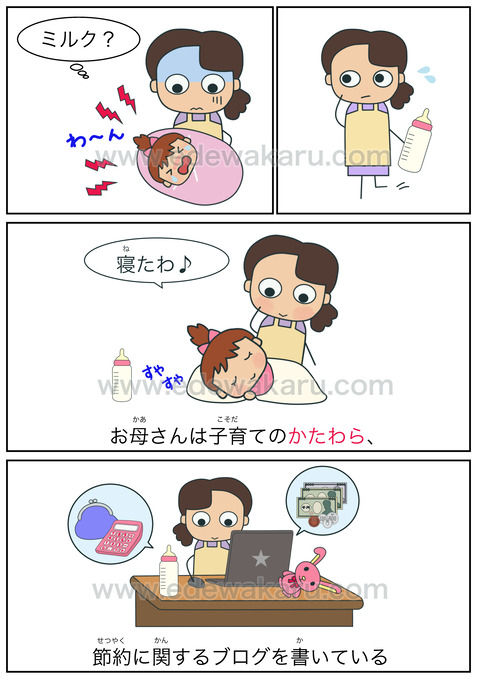
Meaning
〜と並行して
〜しながら、時間がある時に〜する
How to use it
動詞[辞書形]+かたわら
名詞[辞書形]+のかたわら
Explanation
「AかたわらB」は「Aと並行してBする」「Aしながら、時間がある時にBする」という意味を表す文型です。この文型は「A」と「B」は違う時間に行われ、長く続けている習慣的(しゅうかんてき)なことに使われます。ほとんどの場合「A」にはいつもしている仕事や本業が入り、「B」にはその他にしていることや副業が入ります。
[例]
①お母さんは子育てのかたわら、節約に関するブログを書いている
【いつもしていること】子育て
【他にしていること】ブログ
→子育て
をしながら、時間がある時に
ブログを書いている
②彼はサラリーマンとして働く
かたわら、週末は子供にサッカーを教えている
【本業】サラリーマン
【他にしていること】サッカーを教える
→サラリーマン
をしながら、(時間がある)週末は
サッカーを教えている
③彼女は大学に通う
かたわら、モデルとして活動している
【本業】学生
【他にしていること】モデル
→学生
をしながら、
モデルもしている
④田中さんは日本語教師をしている
かたわら、漫画家としても活躍している
【本業】日本語教師
【副業】漫画家
→日本語教師
をしながら、漫画家もしている
⑤彼は日本語学校に通うかたわら、学費のためにアルバイトをしている
【本業】学生
【他にしていること】アルバイト
→学校に通い
ながら、アルバイトをしている
「AかたわらB」のポイントは、【「A」と「B」は違う時間に行うこと】と【長く続けている習慣的なこと】に使うというところです。N1を受ける人はしっかりと覚えておきましょう😊
In context 5 examples
お母さんは子育てのかたわら、節約に関するブログを書いている
彼はサラリーマンとして働くかたわら、週末は子供にサッカーを教えている
彼女は大学に通うかたわら、モデルとして活動している
田中さんは日本語教師をしているかたわら、漫画家としても活躍している
彼は日本語学校に通うかたわら、学費のためにアルバイトをしている
Usage 2
Read this source entry ↗Meaning
〜と並行して
〜しながら、時間がある時に〜する
How to use it
動詞[辞書形]+かたわら
名詞[辞書形]+のかたわら
Explanation
「AかたわらB」は「Aと並行してBする」「Aしながら、時間がある時にBする」という意味を表す文型です。この文型は「A」と「B」は違う時間に行われ、長く続けている習慣的(しゅうかんてき)なことに使われます。ほとんどの場合「A」にはいつもしている仕事や本業が入り、「B」にはその他にしていることや副業が入ります。
[例]
①お母さんは子育てのかたわら、節約に関するブログを書いている
【いつもしていること】子育て
【他にしていること】ブログ
→子育て
をしながら、時間がある時に
ブログを書いている
②彼はサラリーマンとして働く
かたわら、週末は子供にサッカーを教えている
【本業】サラリーマン
【他にしていること】サッカーを教える
→サラリーマン
をしながら、(時間がある)週末は
サッカーを教えている
③彼女は大学に通う
かたわら、モデルとして活動している
【本業】学生
【他にしていること】モデル
→学生
をしながら、
モデルもしている
④田中さんは日本語教師をしている
かたわら、漫画家としても活躍している
【本業】日本語教師
【副業】漫画家
→日本語教師
をしながら、漫画家もしている
⑤彼は日本語学校に通うかたわら、学費のためにアルバイトをしている
【本業】学生
【他にしていること】アルバイト
→学校に通い
ながら、アルバイトをしている
「AかたわらB」のポイントは、【「A」と「B」は違う時間に行うこと】と【長く続けている習慣的なこと】に使うというところです。N1を受ける人はしっかりと覚えておきましょう😊
In context 5 examples
お母さんは子育てのかたわら、節約に関するブログを書いている
彼はサラリーマンとして働くかたわら、週末は子供にサッカーを教えている
彼女は大学に通うかたわら、モデルとして活動している
田中さんは日本語教師をしているかたわら、漫画家としても活躍している
彼は日本語学校に通うかたわら、学費のためにアルバイトをしている
日本語文型辞典
Meaning
動作を表す名詞や動詞に付く。「…のそば」の意味で、情景描写に用いることが多い。物語などに用いられる書きことば的な表現。
「主な活動・作業以外の空いた時間に、一方で」という意味。書きことば的な表現。
How to use it
…かたわら【そば】
Nのかたわら
V-るかたわら
…かたわら【副次的動作】
Nのかたわら V-るかたわら
In context 5 examples
母が編み物をするかたわらで、女の子は折り紙をして遊んでいた。
楽しそうにおしゃべりしている田中くんのかたわらで、田川さんはしょんぼりうつむいていた。
その教授は、自分の専門の研究をするかたわら、好きな作家の翻訳をすることを趣味としている。
そのロック歌手は、演奏活動のかたわら、中高生向けの小説も書いているそうだ。
その年老いた職人は、本職の家具作りのかたわら、孫のために簡単な木のおもちゃを作ってやるのが楽しみだった。
日本語文型辞典 英語版
Meaning
Attaches to a noun or a verb that expresses an action. Means “beside, alongside” and is often used in descriptions of scenes. A formal expression used in stories and the like.
Means “in one’s spare time, in addition to one’s usual activities/tasks.” A formal expression typical of written language.
How to use it
1. ...かたわら〈beside〉[Nのかたわら][V-るかたわら]
2. ...かたわら〈secondary action〉[Nのかたわら][V-るかたわら]
In context 5 examples
母が編み物をするかたわらで、女の子は折り紙をして遊んでいた。
The girl was playing with origami while her mother was knitting.
楽しそうにおしゃべりしている田中くんのかたわらで、田川さんはしょんぼりうつむいていた。
Tagawa-san looked down with dejection all the while Tanaka-kun was chatting away cheerfully.
その教授は、自分の専門の研究をするかたわら、好きな作家の翻訳をすることを趣味としている。
That professor translates the works of his favorite authors, in addition to carrying out research in his field.
そのロック歌手は、演奏活動のかたわら、中高生向けの小説も書いているそうだ。
In addition to being a professional rock singer, they say he also writes novels for teenagers in his spare time.
その年老いた職人は、本職の家具作りのかたわら、孫のために簡単な木のおもちゃを作ってやるのが楽しみだった。
The elderly craftsman took pleasure in making simple wooden toys for his grandchildren, alongside his regular occupation making furniture.
くらべてわかる日本語表現文型辞典
Meaning
Aを主としながら、B。
How to use it
AかたわらB
[動詞-る形]かたわら
[名詞-の]かたわら
Explanation
【対比1】
「AながらB」(意味2 P.195)
「AながらB」とは、並列動作の場合、置き換え可能な文も多いが、「AかたわらB」は主となる本業と従となることを表す文に使うことが多い。
○働きながら、学校に通う。
○働くかたわら、学校に通う。
○最近は便利になって、洗濯しながら、掃除ができる。
×最近は便利になって、洗濯するかたわら、掃除ができる。
「A一方B」(意味1 P.33)
Notes
【注意1】
・接続詞的に使う場合もある。
○彼は演劇評論家として広く活躍した。かたわら、内外の演劇資料の収集にも努めた。
・「かたわら」は「~の近く/そば」という意味の名詞もある。
○妻がケーキを焼くかたわらで、子どもが遊んでいる。
In context 4 examples
父は仕事のかたわら、日曜日は少年野球の監督をしている。
彼女は子どもを育てるかたわら、大学院に通っている。
あの店は米を売るかたわら、たばこも扱っている。
あの先生は研究のかたわら、ボランティアとして世界の子どもたちの支援も行っている。
日本語NET JLPT文法解説まとめ
Meaning
"〜一方で、別に・・・"仕事や研究などの社会的活動をしながら、別のこともしていることを表す文型。
2つの活動は異なる時間帯で行われ、かつ「ながら」に比べ長期間続けている活動に対して使われる。また、習慣的な行為に用いられることが多い。
How to use it
V(辞書形)+かたわら
N + のかたわら
Explanation
"while / besides" This grammatical structure expresses that someone is engaged in a social activity such as work or research while also doing something else. The two activities typically occur at different times and, compared to '〜ながら,' this structure is used for activities that continue over a longer period and are often habitual.
In context 4 examples
彼女は子育てのかたわら、大学に通っている。
彼は書店で働くかたわら、カフェも経営している。
彼女は歌手のかたわら、モデルとしても活躍している。
トムさんは日本語を勉強するかたわら、英語を教える仕事をしている。
NINJAL 日本語文型データベース
Meaning
〜という活動をしながら、その一方で他の活動もすると言いたいときに使います。職業などの社会的な活動について言うことが多いです。
How to use it
Vるかたわら
Nのかたわら
その他
Notes
「〜」には、本業などの主要な活動がきます。「〜かたわら」の後には、それと同程度か、主要ではない活動を表す文がきます。
In context 11 examples
佐々木さんは高校で英語を教えるかたわら、英文学を研究しています。
彼は俳優として活躍するかたわら、歌手としても活動している。
チョウさんは日本にいたとき、日本語学校で勉強するかたわら、インターネットショップで自作のアクセサリーを売っていた。
あの人は大手企業に勤務するかたわら、毎週末は地域のボランティアに参加している。
A国は隣国との紛争で、直接和平交渉を続ける傍ら、第三国による調停の可能性を模索している。
姉は通訳の仕事のかたわら、各国の料理を紹介するグルメガイドを書き続けている。
この店の店長は、店の経営のかたわら、地元商店街の理事長も務めている。
大山氏は新聞記者としての活動のかたわら、地域の歴史研究も行っている。
この作家は本業のかたわら、テレビのコメンテーターもしている。
このたび、会社勤務の傍ら続けてきた執筆活動に力を入れたいと思いまして、退職することにいたしました。
父は学生時代、大学で政治学を学び、そのかたわら、ある議員の秘書もしていたそうだ。
IMABI
Incidental
Read this IMABI lesson ↗Explanation
Incidental: がてら, かたがた, かたわら, & ついで
All of these items have a common theme, but don’t let this confuse you! Pay attention to how these items are exactly used, and see if you can come up with a chart to differentiate them. Then, compare your chart to the one that ends this lesson.
がてら
~がてら either attaches to the 連用形 of a verb or to a noun. ~がてら shows that while you’re doing something, you’re also taking the opportunity to do something else. So, whatever it attaches to, there should be some sense of movement implied.
~がてら is primarily used with nouns that express an action of movement such as walking or shopping. Unlike ~ながら, ~がてら doesn’t indicate that two things are simultaneous. In both cases, though, the two actions are happening in the same time period.
~がてら shows that things are happening in a relatively close time span. This is rather old-fashioned, so you probably will not see it often. However, it does show up in writing and the JLPT 1, so you still need to know what it is.
Examples
1. 散歩がてら友達と話し合う。
While taking a walk, I talk with my friend.
2. 散歩がてら買い物に行く。
While taking a walk, I go shopping.
3. 駅に行きがてら郵便局に立ち寄ります。
While going to the train station, I’ll drop by the post office.
4. 教会に行きがてら、おじさんの家に寄ってきた。
While I went to church, I went to visit my uncle (on the way).
5. 散歩がてらちょっとピーマンを買いに行ってきます。
I’ll get some peppers on my walk.
6. 外に行きがてら、手紙を出してきてくれない?
Can’t you send out this letter as you go outside?
7. 友だちを駅まで送りがてら本を返してきた。
I returned a book back to my friend while I sent him to the train station.
8. 運動がてら犬の散歩に出かけたっけ。
You said you took the dog on a walk in exercising?
Grammar Note: When using a noun that can be made verbs by adding する, you shouldn’t attach がてら to the 連用形. So, rather than ever saying 運動しがてら, simply use 運動がてら.
9. 暖かい日の午過ひるすぎ食後の運動がてら水仙の水を易かえてやろうと思って洗面所へ出て、水道の栓せんを捩ねじっていると、その看護婦が受持の室へやの茶器を洗いに来て、例の通り挨拶あいさつをしながら、しばらく自分の手にした朱泥しゅでいの鉢はちと、その中に盛り上げられたように膨ふくれて見える珠根たまねを眺めていたが、やがてその眼を自分の横顔に移して、この前御入院の時よりもうずっと御顔色が好くなりましたねと、三カ月前の自分と今の自分を比較したような批評をした。
Past noon on a warm day, I thought about watering the daffodil on going to exercise and went to the washroom, and when I had twisted the water nob, the nurse had come to wash the tea utensils of the room she was in charge of, and as she gave regular greetings, she gazed at the reddish-brown pot in my hand and the bulbs that seemed swollen up like they had been piled in there, but she finally moved her glance to my profile and gave the comment, “Your complexion has really improved lately since you came in the hospital”, which seemed to be a comparison of me now and three months ago.
From 変な音 by 夏目漱石. 暖かい日の午過(ひるすぎ)食後の運動がてら水仙の水を易(か)えてやろうと思って洗面所へ出て、水道の栓(せん)を捩(ねじ)っていると、その看護婦が受持の室(へや)の茶器を洗いに来て、例の通り挨拶(あいさつ)をしながら、しばらく自分の手にした朱泥(しゅでい)の鉢(はち)と、その中に盛り上げられたように膨(ふく)れて見える珠根(たまね)を眺めていたが、やがてその眼を自分の横顔に移して、この前御入院の時よりもうずっと御顔色が好くなりましたねと、三カ月前の自分と今の自分を比較したような批評をした。Past noon on a warm day, I thought about watering the daffodil on going to exercise and went to the washroom, and when I had twisted the water nob, the nurse had come to wash the tea utensils of the room she was in charge of, and as she gave regular greetings, she gazed at the bulbs, which looked swollen up like they had been piled in the flower pot that I held in my hand, but she finally moved her glance to my face and gave the comment, “Your complex has really improved lately since you came in the hospital”, which seemed to be a comparison of me now and three months ago.
Fr
Some usages of ~がてら, given that it has passed its heyday, may be questionable. If it is a situation seemingly not completely within one’s free will, it can sound unnatural. In the following case, it would be natural if the meeting is most important to you and you just had to go on a 出張 for your own comfort.
10a. イギリスへの出張がてら、地球環境会議に出席しました。
10b. イギリスへの出張(の)ついでに、地球環境会議に出席しました。
On the occasion of going on a business trip to England, I attended a global environment meeting.
To reiterate, if there isn’t a sense of moving, ~がてら becomes ungrammatical and you would have to use something else like ついでに (see below) or rephrase the sentence entirely.
11a. 食事がてらこの間話していた映画でも見に行こう。〇
11b. 食事がてらこの間話していた映画でも見よう。X
Let’s go see the movie we’ve been talking about recently while out to dinner.
12. 散歩がてら(に)行って来よう。
I’ll come by way of going on a walk.
Particle Note: You can also rarely see がてらに. This explicitly establishes a sense of direction/movement.
かたがた
~かたがた: attaches to nouns. “Previously” or “on the occasion/same time as”. It is mainly used with verbs related to movement such as 行く. Essentially, you do a certain thing on the occasion of tending to another prerogative. As you will see, this is typically only used in 敬語 in the form of あいさつ文. It can still be used in the sense of ~がてら by older speakers, which still makes it old-fashioned.
13. お礼かたがたご機嫌伺いをしてきましょう。
Let’s go come and make an inquiry on good times for their previous gratitude to us.
14. 見舞いかたがた手伝いに行った。
On the occasion of inquiring on (him), I went to give some help.
15. お近くにお越しの節は、お遊びかたがた、お立ち寄りください。
Please stop by when you are near while on your excursion.
16. ご挨拶かたがたお宅に伺います。
I will come to your house as I give my salutations.
17. 散歩かたがた
On the same time as my walk
Usage Note: This suffix is normally replaced with something like ついでに in the spoken language.
漢字 Note: かたがた may also rarely be written as 旁(々).
かたわら
Literally meaning “beside”, 傍ら is after the 連体形 of verbs or the nominal form of a verb to show simultaneous action and is equivalent to “一方で…と同時に”. 傍ら is often used with time frames that are much broader. This pattern implies that the first action is the primary action and the second is something that is also occurring in parallel with the first.
If you were to turn this into a verbal expression, they would all turn to “連用形+ながら”. かたわら is used a lot in the written language whereas ~ながら would be used in the spoken language. The former is used a lot in regard to protagonists in describing their lifestyle backgrounds in novels. If a description was given for a character to only appear once, ~ながら would be used. The pattern Xは動詞+人の+かたわらで is also literary, and it is used in describing condition, but it is only describing place of activity. In this manner, the distance between X and A (動詞+人) is like the following with the right being larger: そば → 隣 → 横 → かたわら.
Examples
18. 道のかたわらで
Beside the road
19. 彼女は高校の数学の教師の傍ら、バレーボール部の監督かんとくをしています。
While she is a high school mathematics teacher, she is at the same time the volleyball department manager.
20. 私はスペイン語を習う傍ら、韓国語を習うことにしました。
Alongside Spanish, I have also decided to study Korean.
21a. 先生たちのかたわらで、彼らの相談事そうだんごとに耳を傾けていた。X
21b. 先生たちのそばで、彼らの相談事に耳を傾けていた。
I was listening to the side of the teachers discussing things.
22. 傍らに人なきがごとし。(Set Phrase)
Act outrageously as if no one is around.
ついで
Written as 次いで, ついで is a conjunction meaning “subsequently”. Written as 序で, ついで is a noun meaning “opportunity”. Building on this, 序でに means “incidentally”.
23. 序でに一言ひとこと言っておく。
To incidentally give a word about something in advance.
24. 開会式が終わりました。次いで、競技きょうぎに移ります。
The opening ceremony ended. Subsequently/afterwards, we’ll move to the events.
25. 「一瞬いっしゅんの塵ちり」という歌に次いで「ヴェロニカ」というのは僕の好きな歌だよ。
After the song, “Dust of a Moment”, my favorite song is called, “Velonica”.
26. 序でがあったら、これを渡わたしておいてください。
If you have a chance, please send this to him.
~ついでに is somewhat interchangeable with ~がてら. However, they’re not exactly the same. 「A-る・た・動作名詞(の)+ついでにB」 shows that the speaker does/wants to end up doing B as well in the case that A–a daily task, chore, duty, or obligation–has to be done. Using ~がてら has no such requirements. Rather, ~がてら is more like saying “Aというせっかくの機会だから、Bもしてみよう”.
27a. 図書館へ本を返しに行くついでに、ジョギングする。
27b. 図書館へ本を返しに行きがてら、ジョギングする。
I’ll go jogging while I go return the book/books to the library.
28a. 周りの景色を楽しむついでに、山を下りた。X
28b. 周りの景色を楽しみがてら、山を下りた。〇
On the occasion of enjoying the surrounding scenery, I descended down the mountain.
When ついでに shows ordinariness, の may be dropped with 動作名詞 in the spoken language. Don’t do this in writing unless you’re writing a dialogue.
29. 登山ついでに、いろんな写真を撮ってみたよ。
I took all sorts of pictures when going mountain climbing.
Although context is crucial, there are instances when it doesn’t have to be used with a 動作名詞, but the conditions mentioned above still apply.
30a. お風呂がてら、浴槽よくそうを洗っておいて。X
30b. お風呂ついでに、浴槽を洗っておいて。 〇
30c. お風呂のついでに、浴槽を洗っておいて。〇
When you get a bath, be sure to wash the tub.
31. 居間の壁かべのついでに、家の外壁がいへきも塗ぬる。
To paint the outside of the house on the occasion of (painting) the living room walls.
32a. 彼女を見舞まうついでに、定期健診けんしんを受けてくる。
32b. 彼女を見舞いがてら、定期健診を受けてくる。
I’ll get my regular medical check up on the occasion that I see her.
When reversed, only ついでに is possible because it’s something you have an obligation for. In this situation, the order of events is unclear. It’s also unclear whether the two events are happening in the same place or not. If in the same place, then the speaker would be taking the checkup in the midst of going to see about her.
It’s thought to be that the two events are taking place at basically same time. However, when strictly speaking, taking the latter action as the standard point of time, one can express whether or not it is before, after, or at the same time as A. On the other hand, がてら limits interpretations to just getting both down during the time you’re at the same hospital/facility.
When the non-past tense is used before ついでに, A and B can either be happening at the same time or B happens before A. When the past tense is used before ついでに, B happens after A.
33. 友達の家へ行くついでに、海岸で泳いだ。
I swam in the ocean on the occasion of going to my friend’s house.
Note: The swimming can be simultaneous to going to your friend’s house or before.
34a. こっちへ来るついでに、土産みやげを買ってきてほしいんだけど。
34b. こっちへ来たついでに、土産を買ってきてほしいんだけど。X
You want someone as they are to come over to get a souvenir. Why on Earth would you want a souvenir from your own place anyway? Is that even a possible usage of the word 土産? No! In reality, speakers, even when B is after A, will use the non-past with ついでに because of the previous statement that the two actions are usually deemed as happening basically at the same time. This practical interchangeability, though, is in regards to 瞬間動詞.
35. 花瓶かびんを壊すついでに、それらの皿も壊しといてくれないか?
While you destroy the vase, can’t you also break those plates?
Consider the following where the opposite situation holds: flipping them potentially makes ついでに ungrammatical. It just so happens that the following sentences don’t have this problem as both directions are logical. The meanings of these phrases are summarized below, so don’t think that all of these mean the same things.
36a. 実家に帰るついでに遊んできた。〇
36b. 実家に帰ったついでに遊んできた。〇
36c. 実家に帰りがてら、遊んできた。〇
36d. 遊ぶついでに、実家に帰ってきた。〇
36e. 遊んだついでに、実家に帰ってきた。△
36f. 遊びがてら、実家に帰ってきた。〇
がてら VS ついでに VS かたわら VS かたがた VS ながら
Hopefully you’ve seen a lot of differences and overlap between these phrases. So, to summarize, here is a chart to act as your cheat sheet on how to distinguish.
Phrase Characteristics of A Importance Time Ordering Period
A+ながら+B Ordinary A≦B Same time One scene
A+かたわら+B Ordinary A>B Parallel Long time
A+かたがた+B Unordinary A=B Same time Short time
A+ついでに+B Obligatory A>B Before or after or same Short time
A+がてら+B Pleasure 不明 Same time Short distance
In context 50 examples
散歩がてら友達と話し合う。
While taking a walk, I talk with my friend.
散歩がてら買い物に行く。
While taking a walk, I go shopping.
駅に行きがてら郵便局に立ち寄ります。
While going to the train station, I’ll drop by the post office.
教会に行きがてら、おじさんの家に寄ってきた。
While I went to church, I went to visit my uncle (on the way).
散歩がてらちょっとピーマンを買いに行ってきます。
I’ll get some peppers on my walk.
外に行きがてら、手紙を出してきてくれない?
Can’t you send out this letter as you go outside?
友だちを駅まで送りがてら本を返してきた。
I returned a book back to my friend while I sent him to the train station.
運動がてら犬の散歩に出かけたっけ。
You said you took the dog on a walk in exercising?
暖かい日の午過ひるすぎ食後の運動がてら水仙の水を易かえてやろうと思って洗面所へ出て、水道の栓せんを捩ねじっていると、その看護婦が受持の室へやの茶器を洗いに来て、例の通り挨拶あいさつをしながら、しばらく自分の手にした朱泥しゅでいの鉢はちと、その中に盛り上げられたように膨ふくれて見える珠根たまねを眺めていたが、やがてその眼を自分の横顔に移して、この前御入院の時よりもうずっと御顔色が好くなりましたねと、三カ月前の自分と今の自分を比較したような批評をした。
Past noon on a warm day, I thought about watering the daffodil on going to exercise and went to the washroom, and when I had twisted the water nob, the nurse had come to wash the tea utensils of the room she was in charge of, and as she gave regular greetings, she gazed at the reddish-brown pot in my hand and the bulbs that seemed swollen up like they had been piled in there, but she finally moved her glance to my profile and gave the comment, “Your complexion has really improved lately since you came in the hospital”, which seemed to be a comparison of me now and three months ago.
イギリスへの出張がてら、地球環境会議に出席しました。
On the occasion of going on a business trip to England, I attended a global environment meeting.
イギリスへの出張(の)ついでに、地球環境会議に出席しました。
On the occasion of going on a business trip to England, I attended a global environment meeting.
食事がてらこの間話していた映画でも見に行こう。〇
Let’s go see the movie we’ve been talking about recently while out to dinner.
食事がてらこの間話していた映画でも見よう。X
Let’s go see the movie we’ve been talking about recently while out to dinner.
散歩がてら(に)行って来よう。
I’ll come by way of going on a walk.
お礼かたがたご機嫌伺いをしてきましょう。
Let’s go come and make an inquiry on good times for their previous gratitude to us.
見舞いかたがた手伝いに行った。
On the occasion of inquiring on (him), I went to give some help.
お近くにお越しの節は、お遊びかたがた、お立ち寄りください。
Please stop by when you are near while on your excursion.
ご挨拶かたがたお宅に伺います。
I will come to your house as I give my salutations.
散歩かたがた
On the same time as my walk
道のかたわらで
Beside the road
彼女は高校の数学の教師の傍ら、バレーボール部の監督かんとくをしています。
While she is a high school mathematics teacher, she is at the same time the volleyball department manager.
私はスペイン語を習う傍ら、韓国語を習うことにしました。
Alongside Spanish, I have also decided to study Korean.
先生たちのかたわらで、彼らの相談事そうだんごとに耳を傾けていた。X
I was listening to the side of the teachers discussing things.
先生たちのそばで、彼らの相談事に耳を傾けていた。
I was listening to the side of the teachers discussing things.
傍らに人なきがごとし。(Set Phrase)
Act outrageously as if no one is around.
序でに一言ひとこと言っておく。
To incidentally give a word about something in advance.
開会式が終わりました。次いで、競技きょうぎに移ります。
The opening ceremony ended. Subsequently/afterwards, we’ll move to the events.
「一瞬いっしゅんの塵ちり」という歌に次いで「ヴェロニカ」というのは僕の好きな歌だよ。
After the song, “Dust of a Moment”, my favorite song is called, “Velonica”.
序でがあったら、これを渡わたしておいてください。
If you have a chance, please send this to him.
図書館へ本を返しに行くついでに、ジョギングする。
I’ll go jogging while I go return the book/books to the library.
図書館へ本を返しに行きがてら、ジョギングする。
I’ll go jogging while I go return the book/books to the library.
周りの景色を楽しむついでに、山を下りた。X
On the occasion of enjoying the surrounding scenery, I descended down the mountain.
周りの景色を楽しみがてら、山を下りた。〇
On the occasion of enjoying the surrounding scenery, I descended down the mountain.
登山ついでに、いろんな写真を撮ってみたよ。
I took all sorts of pictures when going mountain climbing.
お風呂がてら、浴槽よくそうを洗っておいて。X
When you get a bath, be sure to wash the tub.
お風呂ついでに、浴槽を洗っておいて。 〇
When you get a bath, be sure to wash the tub.
お風呂のついでに、浴槽を洗っておいて。〇
When you get a bath, be sure to wash the tub.
居間の壁かべのついでに、家の外壁がいへきも塗ぬる。
To paint the outside of the house on the occasion of (painting) the living room walls.
彼女を見舞まうついでに、定期健診けんしんを受けてくる。
I’ll get my regular medical check up on the occasion that I see her.
彼女を見舞いがてら、定期健診を受けてくる。
I’ll get my regular medical check up on the occasion that I see her.
友達の家へ行くついでに、海岸で泳いだ。
I swam in the ocean on the occasion of going to my friend’s house.
こっちへ来るついでに、土産みやげを買ってきてほしいんだけど。
こっちへ来たついでに、土産を買ってきてほしいんだけど。X
花瓶かびんを壊すついでに、それらの皿も壊しといてくれないか?
While you destroy the vase, can’t you also break those plates?
実家に帰るついでに遊んできた。〇
実家に帰ったついでに遊んできた。〇
実家に帰りがてら、遊んできた。〇
遊ぶついでに、実家に帰ってきた。〇
遊んだついでに、実家に帰ってきた。△
遊びがてら、実家に帰ってきた。〇
どんなときどう使う 日本語表現文型辞典
Meaning
as a sideline; besides
How to use it
Vる/Nの+かたわら
Explanation
~一方で、別に
1)「~かたわら、…」の形で、「~をする一方で、並行して…もしている」という表現。
2)「かたわら」は「ながら」に比べ、長期間続いていることに使う。職業や立場などを両立させている場合によく使われる。
3)「~」がその人が本来していることである。
2)Compared to -ながら, used for action continued over a long interval. Often used when balancing work and separate role.
3) Phrase preceding -かたわら indicates person's main activity.
1)Continue to do one thing while doing another in tandem.
In context 3 examples
市川氏は役所で働くかたわら、ボランティアとして外国人に日本語を教えている。
田中さんは銀行に勤めるかたわら、作曲家としても活躍している。
あの人は大学院での研究のかたわら、小説を書いているそうです。
毎日のんびり日本語教師
How to use it
名詞+のかたわら
動辞形+かたわら
Explanation
仕事や学校などの社会的活動をしながら、別のこともしていることを表します。
多くの場合は本業と副業の関係に触れます。前件が中心的動作(本業)です。なので前件と後件は同一主語でなければいけません。
ニュースなど番組の人物紹介で用いられることが多いです。
「~ついでに」や「~しながら」は短期間で2つの動作が行われるのに対し、「~かたわら」は長期間です。
Notes
動作の並立シリーズ
In context 8 examples
彼女はモデルのかたわら、歌手でも活躍している。
大学に通うかたわら、会社の社長をしている。
母は家事のかたわら、ピアノを教えている。
会社に勤めるかたわら、夜は家でも副業をしている。
彼は小説家のかたわら、ボランティアなどの慈善活動にも熱心だ。
私は本業のかたわらブログを書いています。
就職してからは勤務するかたわら、小説を書いていました。
農業のかたわらバンド活動しています。用法② 対比