くらべてわかる日本語表現文型辞典
Meaning
意味1:Aの状態ではなくなるまでにBを完了する。
意味2:「AないうちにB」の形で。必ずAという状態になることを想定し、その前にBをする。
意味3:「AないうちにB」の形で。普通はAからBの順なのに、Aの前にBという意味で、Bが早いというニュアンスがある。
意味4:Aの状態が続いている間に、自然に(いつのまにか)B。
意味5:Aという雰囲気に包まれてB。
How to use it
AうちにB(AないうちにB)
接続1:
[動詞-る形/ている]うちに
[イ形-い/くない]うちに
[ナ形-な/である]うちに
[名詞-の]うちに
接続2:
[動詞-ない形]ないうちに
接続3:
[動詞-ない形]ないうちに
接続4:
[動詞-ている]うちに
接続5:
[名詞-の]うちに
Explanation
【対比1】
「AあいだにB」
「AあいだにB」はAという決められた期間(始まりから終わりまでがはっきりしている期間)の中で、Bということをする、あるいは起こるという意味である。「AうちにB」は、始まりの部分ははっきりせず、それよりもAという状態が終わってしまうので、それまでにBをしてしまわなければBをするチャンスがなくなるというニュアンスを持つ。
○学生の間に、したいことを決めておきなさい。(社会に出てからのことを決める)
○学生のうちに、したいことをしておきなさい。(社会に出たら自由がなくなるから、今、したいことをする)
「AうちはB」
「AうちはB」は、Aという状態の続く間に限ってBであり、その後のことは関知しないという意味。「AうちにB」は、Aという状態のその後のことを考えて、Aの状態の続く間にBするのが一番いいという判断が入る。
○体が動くうちは、働いたほうがいい。(今後はともかく、今は働け)
○体が動くうちに、働いたほうがいい。(いずれダメになる。働くのは今)
【対比2】
「AまえにB」
「AないうちにB」は、いつかはわからないが、状況から見てAが起こる可能性があるので、それまでにBをしておかなくてはならないという意味。「AまえにB」は、BについてAとの前後関係を客観的に述べる文。
○桜が散らないうちに、花見に行きましょう。
×桜が散る前に花見に行きましょう。
【対比3】
「AまえにB」
「AまえにB」はAとBの前後関係を述べる文だが、「AないうちにB」はBになる(する)のが早いというニュアンスを持つ。
○あの人は父が死なないうちに、葬式の用意をした。(まだ死んでいないのに、早すぎるというニュアンス)
○あの人は父が死ぬ前に、葬式の用意をした。(葬式の用意をしたのは、死んでからでなく、死ぬ前だ)
【対比5】
「AなかでB」
「AなかでB」は具体的にAという状態が続いている間にBという意味。「AうちにB」のAは具体的状態ではなく、全体的な雰囲気を表し、Bにはその雰囲気で終了したことがくる。
○人々の歓声のなかでゴールを決めた。
×人々の歓声のうちにゴールを決めた。
Notes
【注意4】
・「見る見るうちに」は「見ているうちに」という意味の慣用的な表現で、Bに急速な変化の表現がくる。
○大雨が降って、見る見るうちに川の水かさは増していった。
Aがル形、ナイ形でも状態を表す場合は続けられる。
○知らないうちに影響を受けている。(知らない状態が続いている間に〜)
○読み進めていくうちにわかるようになった。(読んでいる間に〜)
【注意5】
・Aは主に感情を表す名詞で、慣用的な表現である。
In context 20 examples
明るいうちに、帰ったほうがいい。
元気なうちに、世界一周旅行がしたい。
この商品が話題にのぼっているうちに、在庫処分をしよう。
朝のうちに、洗濯しないと乾かないよ。
先生が来ないうちに、黒板の落書きを消そう。
雨が降らないうちに、急いで帰ってきなさい。
かぜをひかないうちに、早く服を着なさい。
冷めないうちに、召し上がってください。
この商品は宣伝もしないうちに、予約が殺到した。
立地条件がよいので、ビルが完成しないうちにテナントが埋まった。
彼は自分の計画の成果を見ないうちに、死んでしまった。
先生の説明が終わらないうちに、質問するのはよくない。
先生の話を聞いているうちに、眠くなってしまった。
地下街を歩いているうちに、方角がわからなくなった。
昔の写真を見ているうちに、気がついたことがある。
ぼんやりしているうちに、友達はみんな就職してしまった。
葬儀は悲しみのうちにも厳かにとり行われた。
新車の展示会は、成功のうちに終わった。
大相撲は、期待と興奮のうちに千秋楽を迎えた。
首脳会談は大成功のうちに終わった。
DoJG 日本語文法辞典(全集)
Meaning
While; before; during
How to use it
(i) Vinformal nonpast | うちに | (Verb: stative) |
| いるうちに | While someone is there |
| 話せるうちに | While someone can talk |
| | |
(ii) Vinformal negative nonpast | うちに | |
| 話さないうちに | Before someone talks |
| 食べないうちに | Before someone eats |
(iii) Vている | うちに | |
| 話しているうちに | While someone is talking |
| 食べているうちに | While someone is eating |
(iv) Adjective い informal nonpast | うちに | |
| 高いうちに | While something is expensive |
(v) Adjective な stem | なうちに | |
| 静かなうちに | While something is quiet |
(vi) Noun の | のうちに | |
| 休みのうちに | During the vaction |
Explanation
During a period when a certain situation remains in effect.
In context 10 examples
前田さんはアメリカにいるうちに英語が上手なった・なりました。
Mr. Maeda's English improved while he was in America.
何もしないうちに今年も終わった・終わりました。
Before I've achieved anything, this year is over.
走っているうちにお腹が痛くなった・なりました。
My stomach started to ache while I was running.
若いうちに本を沢山読みなさい。
Read many books while you're young.
雨が降らないうちにテニスをして来ます。
I'll go and play tennis (and come back) before it rains.
忘れないうちに言っておきたいことがある。
There is something I want to tell you before I forget.
考えているうちに分からなくなった。
While thinking about it, I got lost.
働けるうちに出来るだけ働きたい。
I'd like to work as much as possible while I can work.
温かいうちに飲んで下さい。
Please drink it while it is warm.
休みのうちによく寝ておきます。
I’ll sleep a lot during the vacation.
絵でわかる日本語
Usage 1
Read this source entry ↗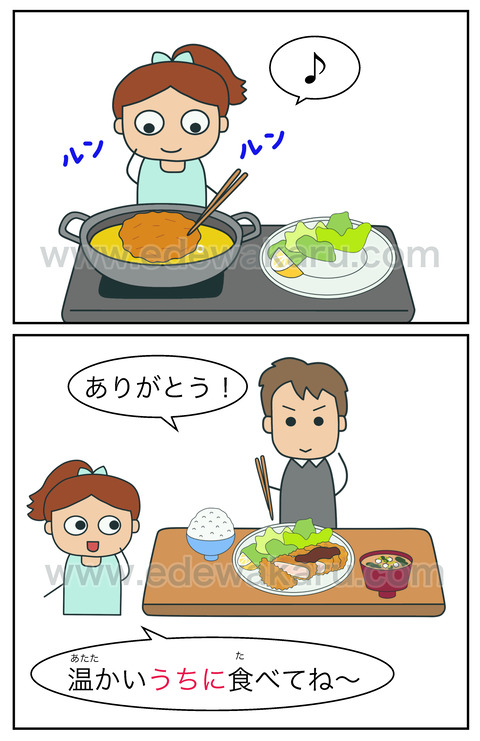
Meaning
〜の状態が続く時に
〜の状態の時に
〜の時間の時に
〜の時間以内に
How to use it
動詞[辞書形]+うちに
動詞[ない形]+うちに
動詞[ている形]+うちに
形容詞[辞書形]+うちに
名詞[辞書形]+のうちに
Explanation
「AうちにB」は「Aの状態が続く時にBをする」「Aの時間以内にBする」という意味を表す文型です。「B」には意志をあらわすことがきます。
この文型は「Aの状態が続く時にB」という意味ですので、「A」に
動詞を使う場合は【状態動詞の辞書形・ない形】や状態を表す【ている形】にしか使いません
😀
[例]
桜が咲いているうちにお花見に行きたかった
→咲いている
【〜ている(状態)】
日本にいるうちにスカイツリーを見に行きたい
→いる
【状態動詞の辞書形】
お母さんがいないうちに、ゲームをしよっと
→いない
【状態動詞のない形】
スーパーが開いているうちに、買い物に行かなくちゃ
→開いている
【〜ている(状態)】
【中級レベル以上の人へ】
「今のうちに」「今のうち」は「今の機会に」「今の機会」という意味で、「後でするのではなく、今」と言いたい時に使います😮文法としてではなく、1つの単語として覚えておくといいと思います😉
(復習:〜として)
[例]
娘がやっと寝た!
今のうちに
ブログを書いちゃおう
→
今の機会に、ブログを書いちゃおう
(復習:〜ちゃう・〜じゃう)
謝るなら、
今のうち
だよ!
→謝るなら、
今の機会に
謝ったほうがいいよ
*「後で謝ったら、もう許してもらえないよ」という意味
「〜うちに」は意味がたくさんあり、とても複雑な文型です。今回は、少し例文を多めに作りました。N3以上を受ける人はしっかりと区別をして覚えておきましょう😊
(復習:〜め)
In context 7 examples
温かいうちに食べてね
→温かい状態の時に食べてね学生のうちに留学したいものだ
→学生の状態でいる時に留学したいものだ(復習:〜たいものだ)桜が咲いているうちにお花見に行きたかった
→桜が咲いている状態の時にお花見に行きたかったお母さんがいないうちに、ゲームをしよっと
→今、お母さんがいないから、ゲームをしよっと(復習:〜ようっと)スーパーが開いているうちに、買い物に行かなくちゃ
→スーパーが開いている時間に、買い物に行かなくちゃ(復習:〜なくちゃ)朝のうちに宿題をしてしまったほうがいいよ
→朝の時間に宿題をしてしまったほうがいいよ(復習:〜てしまう(完了))(復習:〜ほうがいい)ここ3日のうちに、レポートを書き上げなければいけない
→ここ3日以内に、レポートを書き上げなければいけない(復習:ここ〜)(復習:〜上げる)
Usage 2
Read this source entry ↗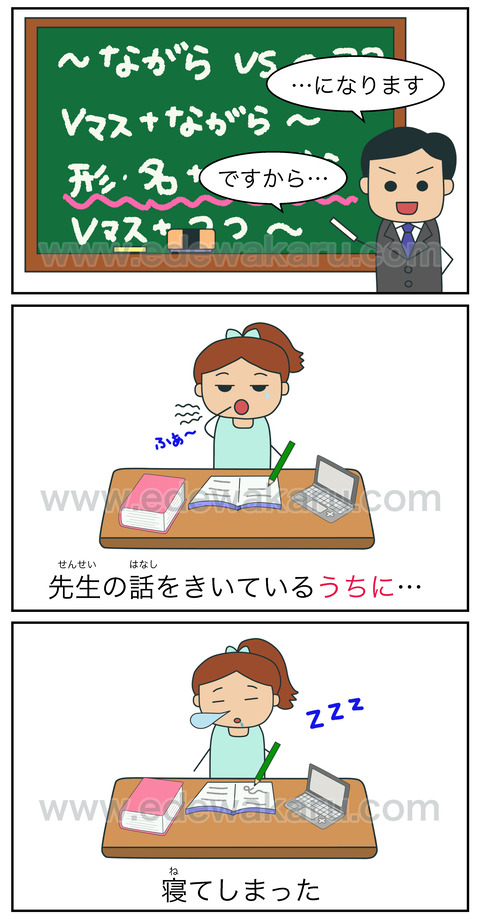
Meaning
〜していると、自然に〜した
〜していると、自然に〜になった
〜していると、〜に変わった
〜ない期間に〜になった
何回も〜していると〜になった
How to use it
動詞[ている形]+うちに
動詞[ない形]+うちに
Explanation
「AうちにB」は「Aしていると、自然にBした」「Aしていると、自然にBになった」「Aない期間にBに変わった」という意味を表す文型です。
「B」には意志を表す文は使えません
😨この文型は自然に
何かが起こったり、変化があった時
に使われます😊
[例]
①先生の話を聞いている
うちに
寝てしまった
【変化】
起きていた→寝た
②日本のアニメを見ている
うちに、日本語が話せるようになった
【変化】日本語が
話せなかった→
日本語が
話せる
③久しぶり!ちょっと会わない
うちに、きれいになったね
【変化】前よりきれいになった
④納豆が嫌いだったが、毎日食べる
うちに
おいしいと思うようになった
【変化】納豆が
嫌い→
今は
おいしいと思う
⑤知らない
うちに、雨が降っていた
【変化】
晴れ→雨
⑥気づかない
うちに、体重が5kgも増えていた
【変化】体重
45kg→
体重
50kg
「〜うちに」は意外な変化があった時などによく使われます。
会話でもよく使われます。【状態継続時(じょうたいけいぞくじ)】を表す「〜うちに」と区別して覚えておきましょう😉
(復習:〜うちに(状態継続時))
In context 6 examples
先生の話をきいているうちに寝てしまった
→先生の話をきいていると、寝てしまった(復習:〜てしまう(残念・後悔))日本のアニメを見ているうちに、日本語が話せるようになった
→何回も日本のアニメを見ていると、自然に日本語が話せるようになった(復習:〜ようになる)(復習:なん+助数詞+も)A:久しぶり!B:久しぶり!ちょっと会わないうちに、きれいになったね
→ちょっと会わなかった期間に、きれいになったね納豆が嫌いだったが、毎日食べるうちにおいしいと思うようになった
→納豆が嫌いだったが、毎日食べていると、おいしいと思うようになった朝は晴れていたが、知らないうちに雨が降っていた
→知らない間に雨が降っていた気づかないうちに、体重が5kgも増えていた
→気づかない間に、体重が5kgも増えていた(復習:〜も(数量詞+も))
どんなときどう使う 日本語表現文型辞典
Usage 1
Meaning
before you know it
How to use it
Vる・Vている・Vない/Nの+うちに
Explanation
うちに〈時間幅〉
~している間に
継続性を表す語につながり、その継続状態の間に、はじめは予想しなかったような変化が表れることを表す。後の文は事態の変化を表す文。
Links to phrases of continuation; expresses notion that during period of continuation, some unforeseen change occurred. Clause following indicates change in condition.
In context 4 examples
今は上手に話せなくても練習を重ねるうちに上手になります。
友達に誘われて何回か山登りをしているうちに、わたしもすっかり山が好きになった。
親しい仲間が集まると、いつも楽しいおしゃべりのうちに時間が過ぎてしまう。
ふと外を見ると、気がつかないうちに雨が降り出していた。
Usage 2
Meaning
while
How to use it
Vる・Vない/イAい/ナAな/Nの+うちに
Explanation
うちに〈事前〉
ある状況になる前に
「うちに」の前に述べることと反対の状態になったら実現が難しいから、そうなる前に、と言いたいときに使う。
Unless someone does something before what comes ahead of うちに, the subsequent opposite state will make realization of the action difficult.
In context 6 examples
独身のうちに、いろいろなことをやってみたいです。
若いうちに勉強しなかったら、いったいいつ勉強するんですか。
体が丈夫なうちに、1度富士山に登ってみたい。
タンさんが東京にいるうちに、ぜひ3人で食事をしませんか。
(料理の本から)スープに生クリームを加えたら、沸騰しないうちに火から降ろす。
暗くならないうちに家に帰らなければなりません。
毎日のんびり日本語教師
How to use it
名詞+のうちに
な形容詞語幹+なうちに
な形容詞語幹+ではないうちに
い形容詞普通形+うちに
動ない形+ないうちに
動詞ている形+うちに
動辞形+うちに
Explanation
ある状態が持続している期間を表します。後件にはその期間内に何らかの動作を行うことや、変化が生じることが述べられます。
後件に接続する動詞の種類によってニュアンスが変わります。
①後件に意志的な動作
後件に話者自身の意志的な動作が来る場合、「その短い時間を利用して~する」「その隙に~する」のようなニュアンスを持ちます。この文型で表される期間は主観的に短いと感じる程度でなければいけません。
②後件に無意志性の動作
後件が無意志性の動詞や他者の動作、あるいは状態変化の場合、①のようなニュアンスはありません。そしてこの文型で表される期間は長くても短くても構いません。
Notes
「うち」シリーズ
In context 11 examples
休めるうちに休もう。(在休息的时候休息吧。)
ひとりのうちにやりたいこと全部やっときな。
今のうちに頑張らないと…。(趁现在再不努力就晚了。)
環境とか変わって無意識のうちに疲れとかたまってるかも。
風邪引かないうちに風呂に入ってきて下さい。
生きてるうちに一度は行きたい。
ゴールデンウィークに何するかを考えてるうちにゴールデンウィークが終わりそう。
痛くないうちに治療できればいい。
膝に知らないうちに青あざができてた。
話しているうちに眠気が襲ってきた。
難しい曲でも練習を重ねるうちに弾けるようになる。
AIUEO JLPT Grammar
Meaning
「〜うちに」is a phrase used to express performing an action within a certain range of time or state. It is often used when something needs to be done before a condition changes.
How to use it
動詞+うちに形容詞辞書形+うちに形容動詞な+うちに名詞の+うちに
Explanation · 日本語
「〜うちに」は、ある状態や時間の範囲内で何かを行うことを示す表現です。この表現は、ある条件が変わる前に何かをする必要があるときによく使われます。
In context 5 examples
雨が降らないうちに帰りましょう。
Let’s go home before it starts raining.
学生のうちにもっと勉強しておくべきだ。
You should study more while you are still a student.
天気がいいうちに写真を撮りましょう。
Let’s take pictures while the weather is good.
安全なうちに避難してください。
Please evacuate while it is still safe.
ネットワークが繋がっているうちにデータを送信してください。
Please send the data while the network is connected.
文法
Usage 1
Meaning
〜という状況になる前に
How to use it
V (辞書形 / ている形 / ない形) + うちに
イA + うちに
ナAな + うちに
Nの + うちに
In context 13 examples
ジョンさんが大阪にいるうちに、USJに行こう。
雨が降らないうちに、帰りましょう。
母が出かけているうちに、こっそり冷蔵庫のケーキを食べてしまった。
忘れないうちに、大切なことはメモしておきます。
若いうちに、色々なことにチャレンジしておいたほうがいいよ。
どうぞ、温かいうちに召し上がってください。
天気がいいうちに、買い物を済ませてしまいましょう。
明るいうちに、帰りましょう。
祖父母が元気なうちに、たくさん思い出を作りたいね。
桜が綺麗なうちに、たくさん写真をとってしまいましょう。
独身のうちに、たくさん遊んでおきたい。
今のうちに、やりたいことをやっておかなくちゃ後悔するよ。
学生のうちに、やっておいたほうがいいって何かありますか。
Usage 2
Meaning
〜している間に
How to use it
V(辞書形 / ている形 /ない形)+ うちに
In context 6 examples
何度も口に出して練習しているうちに、上手に話せるようになりました。
会わないうちに、ずいぶん大人っぽくなりましたね。
知らないうちに、山田さんは会社を辞めていた。
気がつかないうちに、雨が降っていた。
テレビを見ているうちに、寝てしまった。
毎日会っているうちに、だんだん彼のことが気になってきた。
Bunpro Grammar Reference
Meaning
While, During
How to use it
Verb[ている]+ うちに
[い]Adjective + うちに
[な]Adjective + な + うちに
Noun + の + うちに
Nuance
A grammar point which highlights (A) as being the optimal time to do (B), or that (B) happened at some imprecise time within (A).
Explanation
When うち, (sometimes seen using the kanji 内, or 裡) is paired with the case marking particle に, it expresses a period/space 'within' which something else will/should happen/exist. It quite often (but not always) carries the nuance of (A) being the 'best', or the 'optimal' time/space within which (B) could occur/exist. In English, うちに can simply be translated as 'while', or 'during'.
うちに may be paired with the dictionary or ている form of verbs, the plain form of い-Adjectives, nouns followed by の, or な-Adjectives that are followed by な.
彼と毎日会ううちに、だんだんと彼のことが好きになってきた。
As I meet with him every day, I have gradually come to like him. (As I spend more time with him every day, I have grown to like him)
熱いうちに食べて!
Eat it while it's hot!
お爺ちゃんがまだ元気なうちに家族皆で旅行に行こう!
Let's all go on a family trip while grandpa is still healthy!
今のうちに明日の準備をしておこう。
Let's get ready for tomorrow while we have time. (Before it is too late)
Unlike 間に, うちに expresses something that can happen/exist anywhere 'within' the span of (A), and is therefore non-specific as to where (B) is located.
運転している間に眠くなったので、コンビニで休憩をした。
I got sleepy while driving, so I took a break at a convenience store. (While in the process of driving)
運転しているうちに眠くなったので、コンビニで休憩をした。
I got sleepy while driving, so I took a break at a convenience store. (At one point while driving)
Fun Fact
The kanji 裡 refers literally to the inner walls/lining of something, and anything that is enclosed within that space. This can be thought of as where the 'non-specificity' of うち comes from, in regard to where within that space something is.
Nuance · 日本語
(A)が(B)をやるのに一番最適な時期だ、または(B)が(A)が起こっている間に起こったことを強調するために使われる表現。
Explanation · 日本語
「うち」(漢字では「内」または「裡」)を格助詞の「に」と一緒に使うと、(A) の期間や状態の中で、何かをしたり何かが起きたりすることを表します。この文法は、(A) の期間や状態が、(B) に一番適したタイミングだとか、(B) をするチャンスだと話し手が感じているときに使われることが多いです。
「うちに」は、動詞のテイル形や、イ形容詞の普通形、名詞と「の」、ナ形容詞と「な」、と一緒に使われます。
彼と毎日会ううちに、だんだんと彼のことが好きになってきた。
As I meet with him every day, I have gradually come to like him. (As I spend more time with him every day, I have grown to like him)
熱いうちに食べて!
Eat it while it's hot!
お爺ちゃんがまだ元気なうちに家族皆で旅行に行こう!
Let's all go on a family trip while grandpa is still healthy!
今のうちに明日の準備をしておこう。
Let's get ready for tomorrow while we have time. (Before it is too late)
「間に」とは違って、「うちに」は、(B) がいつ起こるかを特定しません。(A) の間のいつでも (B) が起こる可能性があるときに使います。
運転している間に眠くなったので、コンビニで休憩をした。
I got sleepy while driving, so I took a break at a convenience store. (While in the process of driving)
運転しているうちに眠くなったので、コンビニで休憩をした。
I got sleepy while driving, so I took a break at a convenience store. (At one point while driving)
豆知識
漢字の「裡」は、「裏」や「中」を意味します。「裏」も「中」も、その中のどこかまでは特定していないので、「うち」が持つ「(A) のどこで起きるかは特定されていない」ニュアンスは、漢字の意味をイメージすると覚えやすいかもしれません。
In context 18 examples
- 近い内に連絡します。
I'll be in touch before long.
- 今のうちに明日の準備をしておこう。
Let's get ready for tomorrow while we have time. (Before it is too late)
- 熱いうちに食べて!
Eat it while it's hot!
- お爺ちゃんがまだ元気なうちに家族皆で旅行に行こう!
Let's all go on a family trip while grandpa is still healthy!
- 運転している間に眠くなったので、コンビニで休憩をした。
I got sleepy while driving, so I took a break at a convenience store. (While in the process of driving)
- 運転しているうちに眠くなったので、コンビニで休憩をした。
I got sleepy while driving, so I took a break at a convenience store. (At one point while driving)
- 彼と毎日会ううちに、だんだんと彼のことが好きになってきた。
As I meet with him every day, I have gradually come to like him. (As I spend more time with him every day, I have grown to like him)
- 鉄は熱い内に打て。
Strike while the iron is hot.
- 授業を受けている内に、宿題を完成させた。
I was able to finish my homework while taking a class.
- 赤ちゃんは食べている内に寝てしまった。
The baby fell asleep while eating.
- 日本にいる内に東京に行ってみたい。
While I am in Japan, I want to see Tokyo.
- 朝顔はみるみる内に成長し、大きくなった。
The Morning Glory grew taller and got bigger within / during a short time.
- 一晩の内に性格を変えることはできない。
It is impossible to change your personality over the course of / during one night.
- 明るい内に家に帰ろう。あの道は暗いから。
Let's go home while it's still light out. Since that street is dark.
- 若い内にお酒を飲んだりタバコを吸ったりしてはいけません。
You must not drink and smoke while you are young.
- 僕が仕事をしている内に、君が夕食を作ってくれるから助かる。
It is quite helpful that you make dinner while I do my work.
- やっている内にどんどん上達するから、あきらめてはいけない。
You must not give up because you will continue to get better while doing it.
- 一生の内に一度は聖書を読んでみたいと思っている。
I would like to try to read the Bible at least once in / during my lifetime.
Yokubi — The Common Grammar Guide (https://yoku.bi)
Explanation
This lesson focuses on how to state that something happens while something else is going on.
ながら states that two actions are concurrently true as they happen at the same time. The subject of the two actions **must** be the same. Like "I watch TV while eating chips" is okay, but "I watch TV while my brother plays video games" is not. ながら attaches to the masu stem of the verb.
ながら is in the form of AながらB, where the action described by B is the "primary" action and the action described by A is a "secondary" action that is done at the same time. In English this nuance does not easily show up, so let's look at two examples instead:
In the first example, the main action is to study and that is what the speaker wants to do, while in the second example the speaker is focused on the action of waiting, and while doing so they study.
つつ is another auxiliary that can be used more or less the same as ながら, except it sounds more formal and is almost only relegated to literary sentences.
つつある is a special usage of つつ that implies an action is happening continuously, like a more formal ている.
However, unlike ている it cannot be used for verbs that describe states to mean "to be in a state of":
間/あいだ(に) and うちに are two other ways to state that something happens while something else is happening, however the usage is more general and they have a broader scope than ながら and つつ.
間/あいだ says that two events cover the same exact interval of time, **in its entirety**. This places constraints on what sorts of statements it accepts. 間 itself acts like a noun.
A間**に**B says that B starts and ends **within** the span of time when A takes place. Unlike the 間 version without に, it implies that the duration of B is shorter than the duration of A, as it needs to be completely contained within A's interval.
うちに says that an event happens while the statement before うちに remains true.
It often has a nuance that the event marked by うちに is limited in time and will eventually finish.
This is often used to give recommendations or suggestions like "before X happens, we should do Y".
In context 3 examples
そんな事を考えているうちに、完全に日が沈んでしまった。
While I was thinking about that stuff, the sun set completely.
蜘蛛がいないうちに救出するか
Are you going to rescue them while the spiders are away?
冷めないうちに食べましょう。
Let's eat before it gets cold. (lit. let's eat while it is not cold)
IMABI
While II: ~うち
Read this IMABI lesson ↗Explanation
While II: うち
As with so many nouns which denote a point/domain of space, the noun うち, whose primary meaning is to mean “interior,” may function as a temporal noun for the function of “while” but with a catch: ~うち specifically denotes that before the timeline of V1 runs out of time, V2 is undertaken, and not only that, by V2 being undertaken, V1‘s timeline will have (likely) ended.
The Spatial 内(うち)
The primary meaning of うち in a spatial sense is indicating “within” a certain domain. When that domain is compartmented off, it may translate as “interior/inside,” and when extrapolated onto groups of people or situations, it may also translate as “among” or “amidst.”
Orthography Note: Unlike the temporal meaning of ~うち which is typically written in kana, the spatial meanings are normally represented by the use of its kanji spelled 内.
Though 内 is rather synonymous with 中 (inside/middle) when it means “interior,” 内 tends to be used more often in metaphoric contexts in modern usage. When indicating “inward,” we find 内 interchangeable with 内側, but 中 would have to be interpreted as towards “the center” in a sense of directionality.
1. あのドアは内に向かって開きます。
That door opens inward.
2. 内側から鍵がかかってしまった。
It was locked from the inside.
3. 内に秘めた力を解き放て!
Release the power hidden within!
4. 賞味期限って、 暗黙のうち1に未開封、が条件ですか?
Is (the thing) being “unopened” an unspoken condition to a use-by date?
5. 百人残ったうちの一人が犯人だ。
One of these remaining 100 people is the criminal.
6. 五つのうちから一つ選んでください。
Please choose one from these five.
7. これも仕事のうちですよ。
This is also a part of the job.
8. 運も実力のうち。
Luck is also a part of your skills.
9. 近いうちに連絡します。
I’ll contact you before long.
10. 町の大半が一瞬のうちに消えた。
The majority of the town disappeared in an instant.
内 may also indicate the place in which one belongs, and this can be interpreted in various ways, including “one’s home/household,” “one’s inner circle (including “team,” “club,” “workplace,” etc.,” “one’s family,” or even, “one’s spouse.” For the meanings of “one’s home/household/spouse,” it may be alternatively written in kanji as 家.
11. うちと鹿島だけ日曜試合なんだけど、なんでだろう?
Only our (team) and Kashima are on Sunday matches, but why, though?
12. うちの会社にはフランス人のスタッフがいます。
There is a French staff member in the company I work at.
13. 家じゅうで山へ行くんです。
(We)’re going to the mountains as a family.
14. 家に相談します。
I’ll discuss (it) with my spouse.
These meanings have even led うち to develop into a first person pronoun in casual, familial speech. Although associated more so with female speakers in some regions, it has largely become gender neutral in recent decades.
15. ウチと付き合ってくれない?
Would you go out with me?
The Temporal ~うち
The spatial meanings of うち help build an image of a circle, and the matter being discussed is within that circle. When used temporarily, we see that the main clause must always be performed within the “circle” a.k.a time frame that うち creates.
The closest equivalent to the temporal ~うち is ~間, and while both translate as “while” and appear with the same variety of predicates – verbal, adjectival, noun – the specific difference in meaning of the former results in unique differences in how particles, tense, and aspect function with it.
Just like in our previous discussion on ~間に, the dependent clause which precedes ~うちに will be referenced as V1. Also, “V” may be substituted with other predicates provided the time frame implied is still logical. The main clause which follows ~うちに will be denoted as V2, which is also not restricted to verbs alone. Because the use of the negative in V1 has a major impact on how ~うちに is interpreted, that will be denoted as V1neg.
Both ~うちに and ~間に involve V2 realizing within the time frame of V1. While V2 occurs within the time frame of V1 with ~間に and can last however long in that interval, V2 must be completed before V1‘s time frame expires with ~うちに. It is implied that by V2 not realizing in that deadline set by V1 that a negative consequence is to be expected.
16. 若わかい(うちに 〇・間に X}英語を勉強した方ほうがいいよ。
It’s best that you study English while you’re young.
The consequence of not learning English while one is young is that doing so will be far harder. It is also worth noting that learning English before “being young” is illogical, and that logic is extended to the pattern itself. Meaning, V1 and V2 cannot be flipped and still be valid. Relating this back to the spatial meaning of うち, V2 is within the circle, not the circle itself.
One must also not misconstrue the fact that 若い間に itself is a possible phrase, but it is ungrammatical in Ex. 16 due to the time limit set by the speaker for V2 to occur. When such a time limit set on V2 is so intrinsic to achieving a favorable outcome, ~うちに cannot be replaced by ~間に.
17. スープがまだ熱い{うちに 〇・間に X}飲むのが好きです。
I like eating my soup while it’s still hot.
18. 警察けいさつが来ないうちに、逃にげるから、心配しんぱいないよ。(Casual)
I’ll run away before the police come, so no worries.
In Ex. 18, the main point is escaping while V1neg is still valid, which is synonymous with saying before V1pos realizes. As the principle of V2 being completed in the time limit set by V1 still applies when it is rendered in the negative as V1neg, and so long as the time frame is sufficient yet critical to completing V2, the stakes implied prevent ~ない間に from being possible, though as we saw in the previous lesson, the structure is valid when outcome is not such a contingency.
19. 妻つまが帰ってこない{うちに・間に}、部屋を片かたづけました。
I cleaned up the room in the time my wife wasn’t home yet.
Using ~うちに in Ex. 19 would suggest not cleaning the room before your wife comes home would result in punishment, whereas by using ~ない間に, the agent just so happened to complete V2 while V1 was the case.
The dynamic of a time limit that has to be met is fueled by there being a willful agent committing V2. When this volition is taken out of the equation entirely, interchangeability between ~うちに and ~間に is heightened.
20. 知らない{間に・うちに}、眠ねむってしまっていた。
I had been asleep [without even knowing it/before I knew it].
With ~間, we learned that the timelines of V1 and V2 are on parallel paths, but because ~うちに is always visualized as a “circle” within the time domain of V1, に is almost never dropped, as it is に which anchors the time frame of V1 as a point of reference. Another difference is that while 間 may be interpreted as “interval” in a broader sense—capable of being paired with various other case particles which indicate direction like から (from) and まで (to)—this is not possible with ~うちに.
Using ~うちに with まで is ungrammatical, largely because it would be redundant but also contradictory to the time limit set by まで. The purpose of まで would be to indicate that the time frame of V2 must be contained within the time limit set for V1, and the use of ~間(に・には・は)can be viewed as highlighting that time frame.
21. 家に帰るまでの{間(に)〇・うちに X}、雨が降ってきてしまった。
I was caught in the rain during the time it took to get home.
~うちに w/ Instantaneous Verbs
When ~うちに is paired with an instantaneous verb, the time limit enforced on V1 results in the “before” interpretation that is exhibited when paired with V1neg, but with a slight twist, the action – though syntactically treated as being “instantaneous” – is reinterpreted as still following on a timeline of its own. Here, we find considerable interchangeability between ~うちに and ~間に with their difference in nuance maintained.
22. 自宅へ帰る{間に・うちに}、手を見て電車に傘かさを忘れてきたのに気づいた。
[While going home/before getting home], I (happened to) look at my hand and noticed that I had gotten so far having left my umbrella in the train.
Restrictions on Non-Past
Though the non-past tense is seen out of necessity with instantaneous verbs, with non-instantaneous verbs, ~うちに is generally paired with the progressive tense (~ている). The reasoning for why the non-past is not used with ~うちに is: if even after the realization/completion of V2 there is the potential that V1 continues for some time, ~間に may be used because V2 just happens to occur within V1‘s not so long timeline; however, ~うちに cannot be used because it implies that V1 will have stopped upon V2 realizing, but the feasibility of having met such a deadline with consequences on the line is not felt via the use of the non-past tense. By using the progressive tense with V1, we know that it must still be ongoing while V2 gets the chance to be completed.
23a. 彼氏かれしが晩ご飯はんの支度したくをする間に、宿題を全部済ぜんぶすませてしまった。 〇
23b. 彼氏が晩ご飯の支度をするうちに、宿題を全部済ませてしまった。X
I finished all of my homework while my boyfriend prepared dinner.
Conversely, if there is the potential that V1 stops due to V2 realizing (coming to fruition), ~うちに becomes grammatical with the non-past tense. Meanwhile, ~間に becomes ungrammatical due to having a broader time frame conflicting with the notion of abruptly stopping due to V2 realizing. Remember that ~間に captures the beginning and end of V1.
Consider the notion of drinking shots over the course of an evening. In Ex. 24, V1 marked by ~うちに necessitates the consequence stated in V2, and we know from the use of ~ていた in V2 that this is a recurring scenario. Meaning, V1 is very much a snapshot of time, but that is just enough time to get red in the face from a shot. The logical association between the act and the consequence allows for the use of the non-past tense, and the intermittent nature of V1 helps constitute a timeline similar to what we see formed with instantaneous verbs.
24. 酒をごくごくと飲む{うちに 〇・間に X}、また顔が真っ赤になっていた。
My face had gotten completely red again as I was gulping down the alcohol.
Now, let’s posit that V2 realizes but there is a chance that V1 continues or may come to a halt, the non-past may be seen with ~うちに, and interchangeability between it and ~間に is heightened. By using ~間に, it is implied that V1 did not just halt because of V2 realizing. Even if V1 is halted for now, it may potentially be resumed down the road. By using ~うちに, it would sound as though V1 were halted because of the realization of V2.
The use of non-verbal predicates are the most likely realization of this because of how the states (as opposed to actions) that they describe are impervious to change and are not necessarily maintained by an agent (doer), but when V2 is put into the equation, that situation/state might change.
25. 暖かい{うちに・間に}、ちょっと散歩さんぽに出かけます。
I’ll go out for a little walk while it’s warm.
26. その新聞は、夜の{うちに・間に}、配くばられてくるんですね。
That’s because the newspaper is delivered during the night.
27. メールを書く{うちに・間に}、パッケージが届くのを思い出したんだ。
I remembered that my package would arrive while I was writing an e-mail.
In Ex. 27, the spur of one’s memory could cause V1 to be postponed, making V1 sound intermittent like is the case in Ex. 24 and befitting of ~うちに’s use. If, however, V2 were just a floating memory in the course of V1, that would fall best under ~間に’s domain. We can also assume that because of the need of V2 to be fulfillable within the span of V1, that V1 in Ex. 27 must be occurring within a snippet of time, for V1 itself may be paused (=stopped).
~ている+{間に・うちに}
When the progressive aspect ~ている is invoked with both ~間に and ~うちに, the timeline of V1 with which V2 must be completed by is considerably long in duration, which is also a reflection of aspect—how the clauses behave over time.
28. 赤ちゃんが寝ている{うちに・間に}、新聞を読むよ。
I’ll read the newspaper while the baby is sleeping.
29. 彼氏が晩ご飯の支度をしている{うちに・間に}、宿題を全部済ませてしまった。
I finished all of my homework while my boyfriend was preparing dinner.
~ないうちに
First, consider the following examples.
30. {まだ覚えている・忘れない}うちに宿題をします。
I’ll do my homework {while I remember/before I forget}.
31. {涼すずしい・暑あつくならない}うちに、夏休みの宿題をしてしまいました。
I completed all of my summer break homework {while it was cool/before it got hot}.
32. {明るい・暗くならない}うちに帰りなさい。(Stern)
Come home {while it’s light/before it gets dark}.
~ないうちに shows that V2 is realized before V1neg were to realize in the affirmative. You can reword ~ないうちに with V1pos ~間に, granted that V1pos is the antonym of V1neg that is used with ~ないうちに. This interchangeability necessitates that viewing the situation from the opposite angle is possible. So, in the case of Ex. 32, getting home in time before it is dark is fine, in the same sense that getting home is being done when the sun is still up. When V1neg does finally occur in the affirmative, V2 ought to have been completed. Note, though, that ~ないうちに inherently implies a misfortune if V2 does not occur by the time V1neg does happen to realize. This implication does not occur with statements made with ~間に.
~ないうちに can be the only correct version of a sentence. For instance, in Exs. 33 and 34, see how the opposite isn’t possible with either うち or 間. Shots are preventative, so it’s logical that ~ないうちに makes sense.
33. 病気にならないうちに、予防注射よぼうちゅうしゃをしておいた方がいいですよ。〇
It’s best that you get immunizations in advance before you get ill.
34. 丈夫じょうぶな{うち・間}に、予防注射をしておいた方がいいですよ。X
It’s best that you get immunizations in advance while you’re sturdy.
35. 蚊かが{入らない 〇・出ている X}うちに、蚊帳かやを吊つった。
I hanged up the mosquito net {before 〇/while X} the mosquitoes got in.
Remember, when you can visualize a beginning and end point, ~ない間に can be used, but all of the facts leading up to now hold.
36. 誰だれもいない{うちに・間に}、机を片付かたづけた。
While there was no one, I fixed up the desks.
~ないうちに vs ~前に
With “V1neg+うちに+V2“, V2 is a positive situation which brings about a positive outcome so long as it happens. In the event V1neg does occur, that outcome is, likewise, unfavorable. This nuancing does not apply to ~まえに.
37. 走っていたが、家に{着かないうちに・着くまえに ?}、雨に降られてしまった。
I was running, but I got hit by the rain before I could get home.
38. 妻が{起きないうちに・起きるまえに}、家を出た。
I left the house before my wife woke up.
39. 雨が降ふ{る前に・らないうちに}、帰りましょう。
Let’s go home before it rains.
~間は vs ~うちは
One situation in which the particle に may be seen omitted from ~うちに is when it is topicalized with は for the purpose of highlighting the circumstance in which V2 is completed. Here, the difference between ~間は and ~うちは lies with whether V2 is still completed and not ongoing once V1 ends.
40. 彼氏が晩ご飯の支度する{あいだは・うちは}、宿題をしていた。
I was doing my homework while my boyfriend was preparing dinner (but not at other times).
41a. 授業のあいだは、ずっと居眠いねむりしていた。 〇
41b. 授業のうちは、ずっと居眠りしていた。X
I napped all through class.
42. コーヒーって若いうちはあまり飲まないほうがいいんですか。
Is it best to not drink a lot of coffee while you’re young?
~うちが
Although any instance of ~うちが can theoretically be rephrased out of a sentence, its existence ought not be ignored. Here, we find that the main clause is NEVER an action that must be completed by the end of the dependent clause, but it is still a state that MUST remain true for as long as the dependent clause is true.
43. 何といっても、若いうちが花だよ。
No matter what they say, youth is the flower of life.
44. お酒は、ほろ酔よいのうちが最高さいこうだと言われる。
It’s said that alcohol is the best while tipsy.
参照
『日本語類義表現使い分け辞典』 pgs 206-209 by 泉原省二.
In the phrase 暗黙のうち, うち denotes the situation in which an action is performed. For this meaning, it may also be spelled in kanji as 裡. ↩︎
In context 46 examples
あのドアは内に向かって開きます。
That door opens inward.
内側から鍵がかかってしまった。
It was locked from the inside.
内に秘めた力を解き放て!
Release the power hidden within!
賞味期限って、 暗黙のうち1に未開封、が条件ですか?
Is (the thing) being “unopened” an unspoken condition to a use-by date?
百人残ったうちの一人が犯人だ。
One of these remaining 100 people is the criminal.
五つのうちから一つ選んでください。
Please choose one from these five.
これも仕事のうちですよ。
This is also a part of the job.
運も実力のうち。
Luck is also a part of your skills.
近いうちに連絡します。
I’ll contact you before long.
町の大半が一瞬のうちに消えた。
The majority of the town disappeared in an instant.
うちと鹿島だけ日曜試合なんだけど、なんでだろう?
Only our (team) and Kashima are on Sunday matches, but why, though?
うちの会社にはフランス人のスタッフがいます。
There is a French staff member in the company I work at.
家じゅうで山へ行くんです。
(We)’re going to the mountains as a family.
家に相談します。
I’ll discuss (it) with my spouse.
ウチと付き合ってくれない?
Would you go out with me?
若わかい(うちに 〇・間に X}英語を勉強した方ほうがいいよ。
It’s best that you study English while you’re young.
スープがまだ熱い{うちに 〇・間に X}飲むのが好きです。
I like eating my soup while it’s still hot.
警察けいさつが来ないうちに、逃にげるから、心配しんぱいないよ。(Casual)
I’ll run away before the police come, so no worries.
妻つまが帰ってこない{うちに・間に}、部屋を片かたづけました。
I cleaned up the room in the time my wife wasn’t home yet.
知らない{間に・うちに}、眠ねむってしまっていた。
I had been asleep [without even knowing it/before I knew it].
家に帰るまでの{間(に)〇・うちに X}、雨が降ってきてしまった。
I was caught in the rain during the time it took to get home.
自宅へ帰る{間に・うちに}、手を見て電車に傘かさを忘れてきたのに気づいた。
[While going home/before getting home], I (happened to) look at my hand and noticed that I had gotten so far having left my umbrella in the train.
彼氏かれしが晩ご飯はんの支度したくをする間に、宿題を全部済ぜんぶすませてしまった。 〇
I finished all of my homework while my boyfriend prepared dinner.
彼氏が晩ご飯の支度をするうちに、宿題を全部済ませてしまった。X
I finished all of my homework while my boyfriend prepared dinner.
酒をごくごくと飲む{うちに 〇・間に X}、また顔が真っ赤になっていた。
My face had gotten completely red again as I was gulping down the alcohol.
暖かい{うちに・間に}、ちょっと散歩さんぽに出かけます。
I’ll go out for a little walk while it’s warm.
その新聞は、夜の{うちに・間に}、配くばられてくるんですね。
That’s because the newspaper is delivered during the night.
メールを書く{うちに・間に}、パッケージが届くのを思い出したんだ。
I remembered that my package would arrive while I was writing an e-mail.
赤ちゃんが寝ている{うちに・間に}、新聞を読むよ。
I’ll read the newspaper while the baby is sleeping.
彼氏が晩ご飯の支度をしている{うちに・間に}、宿題を全部済ませてしまった。
I finished all of my homework while my boyfriend was preparing dinner.
{まだ覚えている・忘れない}うちに宿題をします。
I’ll do my homework {while I remember/before I forget}.
{涼すずしい・暑あつくならない}うちに、夏休みの宿題をしてしまいました。
I completed all of my summer break homework {while it was cool/before it got hot}.
{明るい・暗くならない}うちに帰りなさい。(Stern)
Come home {while it’s light/before it gets dark}.
病気にならないうちに、予防注射よぼうちゅうしゃをしておいた方がいいですよ。〇
It’s best that you get immunizations in advance before you get ill.
丈夫じょうぶな{うち・間}に、予防注射をしておいた方がいいですよ。X
It’s best that you get immunizations in advance while you’re sturdy.
蚊かが{入らない 〇・出ている X}うちに、蚊帳かやを吊つった。
I hanged up the mosquito net {before 〇/while X} the mosquitoes got in.
誰だれもいない{うちに・間に}、机を片付かたづけた。
While there was no one, I fixed up the desks.
走っていたが、家に{着かないうちに・着くまえに ?}、雨に降られてしまった。
I was running, but I got hit by the rain before I could get home.
妻が{起きないうちに・起きるまえに}、家を出た。
I left the house before my wife woke up.
雨が降ふ{る前に・らないうちに}、帰りましょう。
Let’s go home before it rains.
彼氏が晩ご飯の支度する{あいだは・うちは}、宿題をしていた。
I was doing my homework while my boyfriend was preparing dinner (but not at other times).
授業のあいだは、ずっと居眠いねむりしていた。 〇
I napped all through class.
授業のうちは、ずっと居眠りしていた。X
I napped all through class.
コーヒーって若いうちはあまり飲まないほうがいいんですか。
Is it best to not drink a lot of coffee while you’re young?
何といっても、若いうちが花だよ。
No matter what they say, youth is the flower of life.
お酒は、ほろ酔よいのうちが最高さいこうだと言われる。
It’s said that alcohol is the best while tipsy.