AIUEO JLPT Grammar
Meaning
This sentence pattern emphasizes the speaker’s emotions and is used when expressing strong feelings such as emotion, sadness, or surprise.
How to use it
形容詞辞書形+限りだ形容動詞な+限りだ名詞の+限りだ
Explanation · 日本語
この文型は、話し手の感情を強調して表現する文型です。強い感情や感動、悲しみ、驚きなどの気持ちを述べるときに用いられます。
In context 5 examples
彼女と一緒にいられるなんて、幸せな限りだ。
I feel extremely happy to be able to stay with her.
彼女のことを思うと、悲しい限りです。
I feel extremely sad when I think about her.
こんなに素晴らしい景色を見ることができて、感動の限りだ。
I’m extremely moved to be able to see such a beautiful view.
彼の失敗は、残念な限りだった。
His failure was extremely disappointing.
試験に合格できて、嬉しい限りですね。
I’m extremely happy to have passed the exam.
DoJG 日本語文法辞典(全集)
Meaning
extremely
How to use it
Adjective い informal nonpast | 限りだ | Where adjectiveい=emotive adjective |
| 嬉しい限りだ | I am extremely happy |
Explanation
A phrase that indicates the extreme degree of the speaker’s/writer’s emotion — happiness, sorrow, envy, shame or loneliness, among others
In context 6 examples
いろいろなところに行っておられるんですね。うらやましい限りです。
You are traveling to all sorts of places. I'm extremely envious of you.
電子メールでご連絡いただければ、嬉しい限りです。
I would be extremely happy if you would kindly contact me by e-mail.
私の講演が皆様の知性を刺激できれば喜ばしい限りです。
If my lecture stimulates you intellectually, I will be extremely happy.
あなたの明るい顔が見られなくなって、寂しい限りです。
I cannot see your cheerful face any longer, and I couldn't feel lonelier.
私がかいた絵をお見せするのはお恥ずかしい限りです。
[a humble expression] It really makes me feel embarrassed to show you my painting.
その頃は大阪に単身赴任で行っていたが、家族から離れて夜一人でアパートで食事をするのはわびしい限りだった。
During that time I was working in Osaka, but leaving my family behind and eating dinner alone in my apartment made me feel so miserable.
どんなときどう使う 日本語表現文型辞典
Meaning
absolutely; extremely
How to use it
イAい/ナAな+かぎりだ
Explanation
最高に~だと感じる
1)「現在、自分が非常にそう感じている」という心の状態を表す。
2)話者の気持ちを表す言葉であるから、3人称の文にはほとんど使わない。
1)Speaker now feels something very strongly.
2)Being an expression of speaker's feelings, is rarely used in the third person.
In context 3 examples
明日彼が3年ぶりにアフリカから帰ってくる。うれしいかぎりだ。
このごろの若い人ははっきりと自己主張する。うらやましいかぎりである。
大事な仕事なのに彼が手伝ってくれないなんて、心細いかぎりだ。
絵でわかる日本語
Meaning
とても〜だ
How to use it
い形容詞[ーい]+限りだ
な形容詞[ーな]+限りだ
Explanation
「〜限りだ」は「とても〜だ」「非常に〜だ」という意味を表す文型です。この文型は感情を表す形容詞に使われます😊
[「〜限りだ」とよく使われる形容詞]
・残念な限りだ
・悔しい限りだ
・寂しい限りだ
・苦しい限りだ
・腹立たしい限りだ
・悲しい限りだ など
「限り」シリーズはたくさんありますので、しっかりと区別をして覚えておきましょう😉
【「限る」シリーズ】
〜限り(限界)
〜限り
〜限りだ
〜限りで・N限りのN(限定)
〜限りでは(範囲)
限りなく〜に近い
〜とは限らない
〜ない限り
〜に限ったことではない
〜に限らず(〜も)
〜に限る
〜を限りに
In context 4 examples
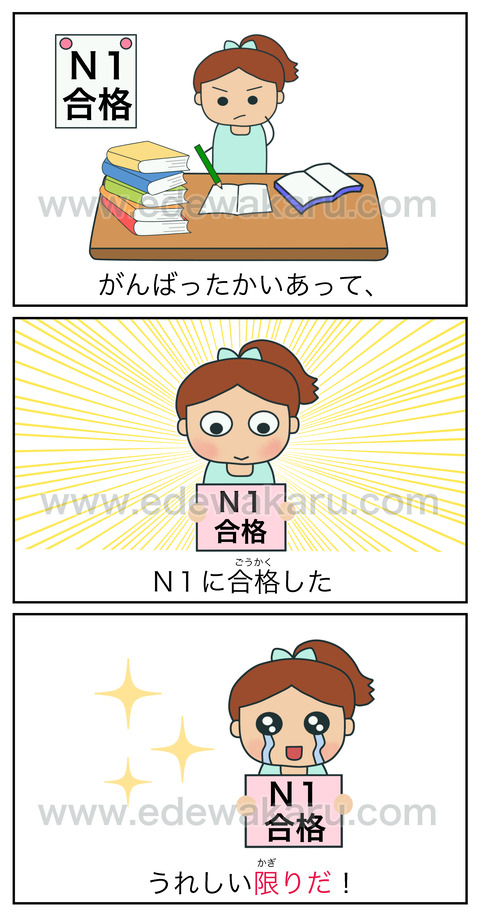
がんばったかいあってN1に合格した!うれしい限りだ!
→がんばったかいあってN1に合格した!とてもうれしい!(復習:〜かいあって)海外旅行(かいがいりょこう)に行けるなんてうらやましい限りだ
→海外旅行に行けるなんてとてもうらやましい(復習:〜なんて(感情))おばけが見えるとは、おそろしい限りだ
→おばけが見えるとは、とてもおそろしい(復習:〜とは)あんな失敗をしてしまい、恥ずかしい限りです
→あんな失敗をしてしまい、とても恥ずかしいです
毎日のんびり日本語教師
How to use it
感情を表すイ形容詞+限りだ
感情を表すナ形容詞+な+限りだ
感情を表す名詞+の+限りだ
Explanation
感情を表す語に接続する場合は、その程度を強調します。
Notes
「限る」シリーズ
In context 8 examples
彼、宝くじが当たるなんて羨ましい限りだ。(看见他中彩票只有羡慕了。)
信頼していた人に裏切られ、悲しい限りだ。
一人こんなところで待たされ、心細い限りだ。
わざわざ来ていただいて嬉しい限りです。
この街に再び活気が戻ってきたことは喜ばしい限りだ。
日米首脳会談のため街中が警察に溢れ、鬱陶しい限りだ。
誤字があって恥ずかしい限りです。
多くの人に私の作品を評価していただき、本当にありがたい限りです。用法② 限定的な数量
Bunpro Grammar Reference
Meaning
Extremely, Really, Very, As ... as one can be
How to use it
[い]Adjective + 限り + だ
[な]Adjective + な + 限り + だ
[い]Adjective + 限り + です
[な]Adjective + な + 限り + です
Nuance
A formal phrase, expressing that something is extremely (A). The characteristic of (A) is at the limit. As (A) as can be.
Explanation
限りだ is a structure that follows adjectives in order to indicate that something is 'extremely (A)', or 'as (A) as can be'. This grammar pattern is simply a mix of the noun 限り, 'limit', and the auxiliary verb だ, or です in the case of a polite sentence. Therefore, the literal meaning is just that something is 'the limit of (A)', where (A) is some describable feature.
限りだ will follow adjectives in their standard forms.
私のためにこんな素晴らしい送別会を開いてくれるなんて、嬉しい限りです。
I am very happy that you threw such an amazing farewell party for me.
宝くじで一等が当たったなんて、羨ましい限りだ。
Something like winning first place in a lottery is very enviable.
一分遅れただけで不合格にされるなんて、残念な限りだ。
It's very disappointing that I failed just by being a minute late.
同僚にあんなことを言われて、不快な限りです。
I'm very offended that my colleague said something like that to me.
限りだ is a fairly formal grammar point that simply aims to highlight the intensity of traits as perceived by the speaker. As this perception is something coming from the speaker, the adjective itself will often be an emotion that the speaker themselves is experiencing, rather than a direct quality of the object, such as its color or shape. Some examples of this are as follows.
嬉しい - The feeling of happiness, as experienced by the speaker.
頼もしい - The feeling of reliability, as experienced by the speaker.
羨ましい - The feeling of jealousy, as experienced by the speaker.
寂しい - The feeling of loneliness, as experienced by the speaker.
恥ずかしい - The feeling of embarrassment, as experienced by the speaker.
心強い - The feeling of reassurance, as experienced by the speaker.
As can be seen in all of the examples. The intensity of the adjective is something that will change depending on one speaker to the next, rather than something that the target is doing.
Nuance · 日本語
何かがものすごく(A)だということを表す丁寧な文法。(A)という特徴の頂点にある。これ以上(A)にはなれない。
Explanation · 日本語
「限りだ」は、形容詞の後に付き、「非常に (A)」や「極めて (A)」という意味を表す文型です。「限り」は限界を示す名詞で、これに助動詞の「だ」(丁寧形は「です」)が組み合わさった形です。そのため、文字通りには「(A) の極みにある」という意味になります。つまり、「(A) の程度がこれ以上ないくらい高い」ということを強調しています。
「限りだ」は、形容詞の普通形の後に置かれます。
私のためにこんな素晴らしい送別会を開いてくれるなんて、嬉しい限りです。
I am very happy that you threw such an amazing farewell party for me.
宝くじで一等が当たったなんて、羨ましい限りだ。
Something like winning first place in a lottery is very enviable.
一分遅れただけで不合格にされるなんて、残念な限りだ。
It's very disappointing that I failed just by being a minute late.
同僚にあんなことを言われて、不快な限りです。
I'm very offended that my colleague said something like that to me.
この文型は、話し手が自分の感情や気持ちの強さを表すときによく使われます。そのため、色や形など客観的な性質を表す形容詞よりも、主観的な感情を表すものと一緒に使われることが多いです。例えば、以下のような形容詞です。
嬉しい - 話し手が感じた喜び
頼もしい - 話し手が感じた信頼
羨ましい - 話し手が感じた羨ましさ
寂しい - 話し手が感じた孤独感
恥ずかしい - 話し手が感じた恥ずかしさ
心強い - 話し手が感じた安心感
これらの例からもわかるように、話し手が実際にどれくらい (A) だと感じているかは、話し手の主観的な感覚によって決まります。
In context 16 examples
- まあ、お子さんが結婚したの?羨ましい限りだわ。
Oh, your child got married? I am as jealous as one could be!
- 宝くじで一等が当たったなんて、羨ましい限りだ。
Something like winning first place in a lottery is very enviable.
- 一分遅れただけで不合格にされるなんて、残念な限りだ。
It's very disappointing that I failed just by being a minute late.
- 私のためにこんな素晴らしい送別会を開いてくれるなんて、嬉しい限りです。
I am very happy that you threw such an amazing farewell party for me.
- 同僚にあんなことを言われて、不快な限りです。
I'm very offended that my colleague said something like that to me.
- コスタリカ旅行の抽選に当たったなんて、うらやましい限りだよ。
Something like winning a Costa Rica trip on the lottery is very enviable.
- 狼人間が僕の味方なんて、心強い限りです。
Something like having a werewolf as an ally is extremely reassuring.
- 信頼していた子供に裏切られて、悲しい限りです。
I am extremely sad, having been betrayed by the child I trusted.
- 子供を先に亡くすなんて、本当に可哀想な限りだ。
Something like losing a child before you die, it is as pitiable as can be.
- 長年の研究がようやく実を結び、嬉しい限りです。
Having my research of many years finally bear fruit, I am as happy as can be.
- 足を折られた同僚に:「足のことを聞きました、お気の毒な限りです。」
To a coworker that broke his/her leg: 'I heard about the leg. Very sorry to hear that.'
- 来月から娘が一人暮らしを始めるなんて、寂しい限りだ。
To think that my daughter will start living alone from next month, I feel extremely lonely.
- 歌手のツイッターでの投稿:「私のコンサートが中止になってしまったという連絡を頂き、残念な限りです。」
Post of a singer on Twitter: 'It is very disappointing to hear that my concert has been canceled.'
- 漫画家は読者に感謝する:「私の漫画をここまで読んでくださり、嬉しい限りです。ありがとうございました。」
A mangaka expressing gratitude to readers: 'I am very glad that you have been reading my manga to this moment. Thank you very much.'
- 自分を高めたいという強い意志を持って学んでいる生徒たちの姿は、教師にとって心強い限りだ。
Seeing pupils studying with a strong wish for improvement is very reassuring for a teacher.
- 友達1:「この二人が私の娘たちです。」
娘たち:「どうぞよろしく。」
友達2:「まあ立派な娘さんたちですよね。頼もしい限りです。」Friend1: 'These 2 are my daughters.' Daughters: 'Pleased to make your acquaintance.' Friend2: 'Oh my, what fine daughters you have. They look very promising.'