絵でわかる日本語
Yokubi — The Common Grammar Guide (https://yoku.bi)
Explanation
Normally, で marks the "circumstance" or "means" behind an action, or the "location" where such action occurs.
で originally comes from contracting the compound particle にて. You may still see にて in old fashioned or formal writing or announcements.
で can function like a て form of だ, acting on nouns as it does on verbs. In this usage, it assumes the typical conjunction usage of て form as with verbs or adjectives.
Sometimes distinguishing between the case marker で particle (location, means, etc.) and the て form of だ conjunction is not always clear. What matters, however, is that the meaning of the sentence should still be clear. You shouldn't worry about pinpointing the exact dictionary definition for each particle you see used in a sentence. If you understand the meaning, that's good enough.
This brings us to the compound particle では. The は here can be considered the topic marker, but the meaning of では together is more than just the sum of its parts. This particular usage of では highlights that the statement after では applies to the context and circumstances of the noun marked by では.
This also extends to the state of being, as we already saw in [lesson 1](./Lesson1.md).
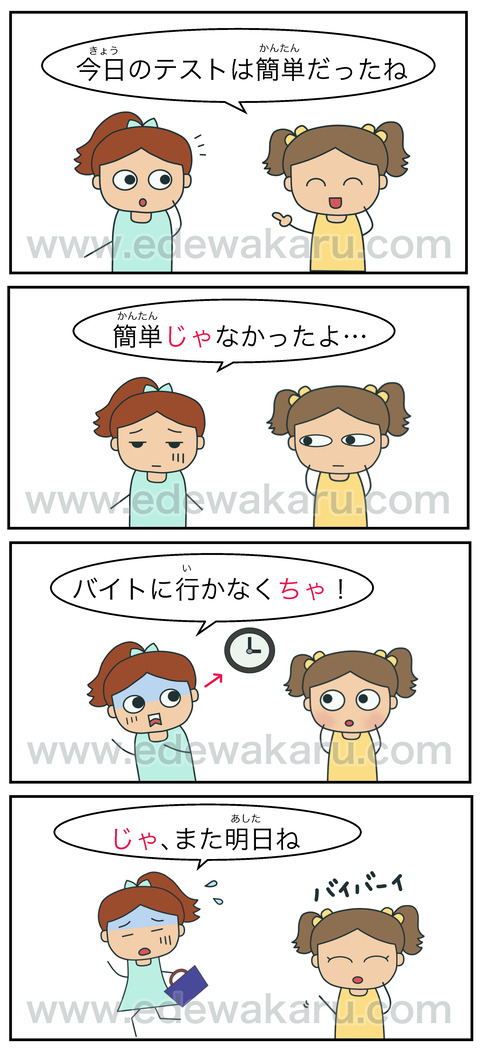
As a reminder, では is often contracted as じゃ. Some dialects may use different copulas from だ. Examples are や (often used in kansai dialect) and じゃ (often used by old men in fictional media to sound old fashioned). This じゃ is a contraction of something other than では. The usual では is not a copula.
In context 1 examples
ペンじゃ
'tis a pen. (it's a pen.)