DoJG 日本語文法辞典(全集)
How to use it
(i) {Verb/Adjective い}informal | {でしょう/だろう}に | |
| {話す/話した}{でしょう/だろう}に | Would talk/would have talked |
| {高い/高かった}{でしょう/だろう}に | Would {be/have been} expensive |
(ii) {Adjective な stem/ Noun} | {Ø/だった} {でしょう/だろう}に | |
| {静か/静かだった} {でしょう/だろう}に | Would {be/have been} quiet |
| いい{先生/先生だった} {でしょう/だろう}に | Would {be/have been} a good teacher |
Explanation
A sentence final particle that expresses the speaker's feeling of great regret or sympathy.
In context 10 examples
昨日来れば夏子に会えたでしょう・だろうに。
If you had come here yesterday, you could have met Natsuko.
老人が一人で暮らすのはさぞ寂しいでしょう・だろうに。
It must be lonely for an old man to live alone.
後一年ぐらい日本にいたら日本語がもっと上手になるでしょうに。
If you could stay in Japan another year or so your Japanese would become more proficient.
お金が沢山あればこんな家でも買えるでしょうに。
If we had a lot of money, we would be able to buy this sort of house.
僕にいい仕事があったら美智子さんと結婚出来ただろうに。
If I had had a good job I could have married Michiko.
飛行機で行けば簡単に行ける所でしょうに。
If you go by plane, you could easily get there.
彼はもう少し慎重に金を使えば、貯金出来るだろうに。
If he uses his money a little more carefully, he could save his money.
駅の近くのアパートに住んだら便利でしょうに。
If you lived in an apartment near the station, it would be convenient.
子供を二人も大学に行かせるのにはお金がかかるでしょうに。
It must cost a lot of money to send two children to college.
飛行機の切符をなくして、さぞ困ったことでしょうに。
You must have had a difficult time when you lost your airplane ticket.
日本語文型辞典
Meaning
同じ動詞を繰り返し、そこで述べられる動作や作用の程度が非常に激しいことを強調する。過去の文脈に用いられることが多い。
同じ動詞を繰り返し用いて、「そうしようと思ってもできない」「どうしても…することができない」という意味を表す。③~⑤は慣用表現で、③④はそうしたくてもそれができないぐらいひどい状況であること、⑤はやめることができない状況であることを表す。
How to use it
R-にV
V-るにV-れない
In context 8 examples
待ちに待った帰国の日がついにやってきた。
電車は遅れに遅れて、東京駅に着いたときは夜中を過ぎていた。
彼の死を悼んで、人々は泣きに泣いた。
人手が足りないのでやめるにやめられない。
ものすごくおかしな話だったけど、みんながまじめな顔をして聞いているので、笑うに笑えなかった。
戦時中は言うに言えない苦労をしてきた。
事業は失敗するし、妻には逃げられるし、全く泣くに泣けない気持ちだ。
ここまで深入りしてしまっては、いまさら引くに引けない。
絵でわかる日本語
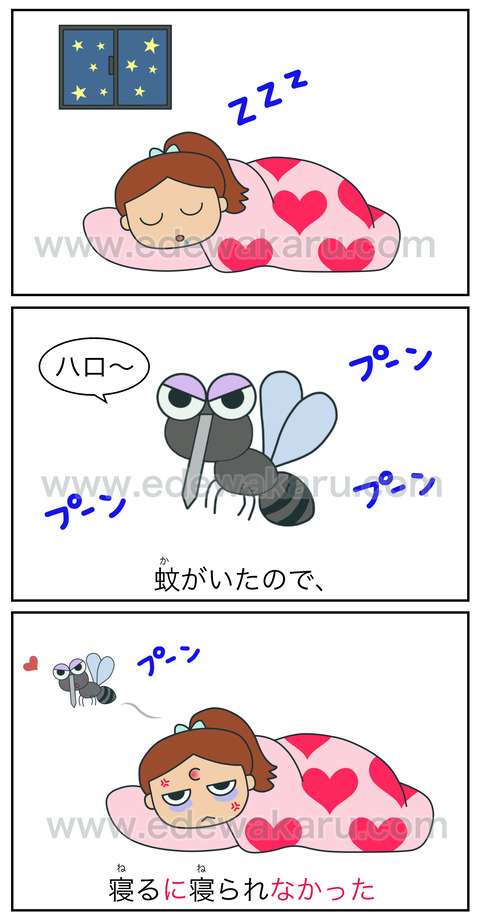
Meaning
〜たいのに〜できない
How to use it
動詞[辞書形]+に+動詞[可能否定形]
Explanation
「〜に〜ない」は「〜たいのに〜できない」という意味を表す文型です。
この文型は「何か理由があって、〜たいのに〜できない」というように、理由があるからできないということを表します
😮後ろには可能否定形(かのうひていけい)がきて、同じ動詞を繰り返すと覚えておきましょう😀
[例]
寝る
に
寝られない
買う
に
買えない
また、この文型にはいくつか慣用表現(かんようひょうげん)がありますので暗記しておきましょう😉
[慣用表現]
・
泣くに泣けない
(なくになけない)
【意味】すごくつらい
・
言うに言えない
(いうにいえない)
【意味】言葉では表現できない
・
引くに引けない
(ひくにひけない)
【意味】今さら引き下がれない
似ている文型がいくつかありますが、「〜に〜ない」は「理由があって、〜たいのに〜できない」と覚えておくといいと思います。慣用表現は少し難しいですが、N1を受ける人は必ず覚えておきましょう😀
(復習:テストをするvsテストを受ける)
In context 4 examples
蚊がいたので寝るに寝られなかった
→蚊がいたので寝たいのに寝られなかったお金がないので、買うに買えなかった
→お金がないので、買いたいのに買えなかった上司が残業しているので、帰るに帰れなかった
→上司が残業しているので、帰りたいのに帰れなかったスマホをなくして、泣くに泣けない気持ちになった
→スマホをなくして、泣きたいくらいつらい気持ちになった
どんなときどう使う 日本語表現文型辞典
Meaning
to; for the purpose of
How to use it
Vます/する動詞のN+に
Explanation
1)「~に…」の形で、「~」に「移動の目的」、「…」に「行く・来る・帰る・もどる」などの移動動詞を用いて、移動の目的を言う場合に使う。
2)目的の行為が、移動した先で完結する場合にだけ使う。
◆ × ハワイに結婚に行きます。
3)目的が日常のことではなく、重要な場合には「に」は使わずに「ために」を使う。
◆ △国際会議に出席しにパリへ行きます。→○国際会議に出席するためにパリへ行きます。
1)Aim of movement precedes pattern and is followed by verbs of movement such as 行く, 来る, 帰る, or 戻る.
◆ × ハワイに結婚に行きます。
3)In serious cases rather than every day objectives, ために is used instead of に.
◆ △国際会議に出席しにパリへ行きます。→○国際会議に出席するためにパリへ行きます。
2)Only used when action aimed for is accomplished at site moved to.
In context 4 examples
あした、デパートへくつを買いに行きます。
昼休みには、寮へ食事にもどります。
ひろし君は何をしに来たの。何もしないで帰ったけど。
空港へ友だちを送りに行きます。
毎日のんびり日本語教師
Usage 1
Read this source entry ↗How to use it
動ます形+に+動た形
動ます形+に+動て形
Explanation
同じ動詞を2度使い接続し、動作や程度の強調を表します。
後ろに接続される動詞は、多くの場合、タ形かテ形です。
Notes
特になし
In context 6 examples
ドラマを見ながら泣きに泣いた。
今日は待ちに待った初デートの日だ。
部屋中探しに探したが見つからなかった。
渋滞で到着が遅れに遅れて、取引先に迷惑をかけてしまった。
迷いに迷って答えが出ないときは直感で決めよう。
昨日は友達と遊びに遊んで楽しかった。
Usage 2
Read this source entry ↗How to use it
動辞形+に+動詞可能形の否定形+ない
Explanation
したいけど何らかの理由でできないことを表します。心理的な理由の場合に使いやすいです。
話者の「本当はしたいけどできない」という気持ちを表すのが特徴です。
後件は動詞可能形の否定形が接続されます。
前件と後件の動詞は同じ動詞を用います。
「泣くに泣けない」は「泣きたくても泣けない」と同じ意味となります。
【N1文法】~(よ)うにも~ない (物理的理由でできない)
【N1文法】~に~ない (心理的理由でできない)
Notes
似ている文法「【N1文法】~(よ)うにも~ない」
In context 8 examples
彼の仕草がとても面白かったが、周囲は真剣に聞いているので私は笑うに笑えなかった。
赤ちゃんが夜通し泣いて、私は寝るに寝れなかった。
今職場は深刻な人手不足に陥っていて、休日ですら休むに休めない状況だ。
彼らは喧嘩でヒートアップしてしまい、お互いに引くに引けない状況になってしまっている。
連日の大雨で市内は冠水し、帰るに帰れない。
経営には、理屈でない、目に見えない、言うに言えない要因が働いて、想像もできないような成果を生みだすことがある。
土下座までしてお願いされたために、断るに断れなくなった。
敵に四方を囲まれて、逃げるに逃げられない。
日本語文型辞典 英語版
Meaning
By repeating the same verb, emphasizes that a degree of an action or influence mentioned in the sentence is extreme. Often used in past contexts.
By repeating the same verb, expresses the meaning “even though one wants to do it, it cannot be done” or “one cannot possibly do something.” V-るにV-れない in
(3)
-
(5)
are examples of idiomatic expressions, and those in
(3)
and
(4)
mean that the situation is too hard for a certain action to be taken, although the speaker wants to do it. V-るにV-れない in
(5)
expresses the situation where the speaker cannot stop doing it.
How to use it
1. R-にV
2. V-るにV-れない
In context 8 examples
待ちに待った帰国の日がついにやってきた。
The long-awaited day to return to my country has finally come.
電車は遅れに遅れて、東京駅に着いたときは夜中を過ぎていた。
The train had a very long delay, so when we got to Tokyo Station, it was already past midnight.
彼の死を悼んで、人々は泣きに泣いた。
People lamented his death, so they just cried and cried.
人手が足りないのでやめるにやめられない。
Because they are short of hands, I can’t quit my job now.
ものすごくおかしな話だったけど、みんながまじめな顔をして聞いているので、笑うに笑えなかった。
Although that was a very funny story, I couldn’t laugh because everyone was listening to it with such serious faces.
戦時中は言うに言えない苦労をしてきた。
I was subjected to unspeakable hardships during the war.
事業は失敗するし、妻には逃げられるし、全く泣くに泣けない気持ちだ。
Since my business failed and my wife left me, I’m too sad even to cry.
ここまで深入りしてしまっては、いまさら引くに引けない。
Because I am so involved in this, there’s no way I can pull back now.
Bunpro Grammar Reference
Usage 1
Meaning
Times (In each time period), Every, Frequency of
How to use it
Timeframe + に + Number of Times
Nuance
A particle that often shows how frequently something occurs.
Explanation
When the case marking particle に is used, sometimes it has the nuance of 'frequency'. This means that it can be utilized to describe how often something happens/is done. In this grammatical construction, the 'time frame' is followed by に, then followed by the number of times that you would like to say that something happens.
In this way, に keeps its regular nuance of being a 'goal', or 'destination', within which something else takes place.
私は一ヶ月に一回友達と遊園地に行く。
I go to the amusement park with my friend every month. (One time per month)
彼は一週間に2回しか歯を磨かないから、口が臭い。
Because he only brushes his teeth twice every week, his mouth stinks.
Caution
This use of に should not be confused with で in relation to time. When で is used for 'time', it is expressing the amount of time that is required to do something, or how much time something is expected to take. It is not used for frequency.
2年間で50万円も貯めた。
In two years, I saved up ¥500,000. (Natural Japanese, as this expresses the amount of time that something took)
Due to this, you can think of に as marking a portion (or portions) of time inside of a larger space of time, within which something happens. However, で marks a whole space of time, within which something can be/is completed.
Nuance · 日本語
何かがどのくらいの頻度で起こるのかを表すために使われる助詞。
In context 16 examples
- 一年に三回ぐらい海外旅行に行く。
I take trips abroad about three times in a year. (frequency)
- 私は一ヶ月に一回友達と遊園地に行く。
I go to the amusement park with my friend every month. (One time per month)
- 彼は一週間に2回しか歯を磨かないから、口が臭い。
Because he only brushes his teeth twice every week, his mouth stinks.
- 一日に六時間は寝る必要がある。
It is necessary to sleep for six hours every day. (frequency)
- 一時間に十本の電車がある。
There are ten trains every hour. (frequency)
- 公務員は一年に一回ボーナスをもらう。
Public servants get a bonus every year. (Once each year) (Frequency)
- 彼はタバコを1日に40本ぐらい吸う。
He smokes about 40 cigarettes every day. (40 each day)
- 私は子供たちに1週間に500円のお小遣いをあげる。
I give my kids 500 yen every week for their allowance. (500 yen per week)
- 給料は月に20万円です。
I make 200,000 yen every month. (200,000 yen per month)
- 彼女は1日に1時間日本語を勉強している。
She studies Japanese one hour every day. (One hour each day)
- 僕はよく運動するから、1日に3回プロテインを飲む必要がある。
Because I do a lot of exercise, I need to drink protein (shakes) three times every day. (three times each day) (frequency)
- この駅には1時間に2回電車が来ます。
At this station, two trains come every hour. (Two trains each hour) (frequency)
- うちの犬は1日に2回餌をあげなくてはいけない。
I have to feed my dog two times every day. (Two times each day) (frequency)
- 週に二回は病院に来てください。
Please come to the hospital twice every week. (Two times each week) (frequency)
- 風邪を引きたくないから、1日に林檎を1個食べて、水を2リットル飲む。
I don't want to catch a cold, so I eat an apple and drink two liters of water every day. (Each day)
- 2年間で50万円も貯めた。
In two years, I saved up ¥500,000. (Natural Japanese, as this expresses the amount of time that something took)
Usage 2
Meaning
In, At, To, For, On
How to use it
Noun + に
Nuance
A particle which often focuses on the goal or end-point of an action.
Explanation
に can be a very difficult particle to master in Japanese, as it has many different translations in English. These translations are usually 'in', 'at', 'to', 'for', or 'on'. Let's look at an example of each meaning.
彼は部屋にいますよ。
He is in his room. (に as 'in')
私は家にいます。
I'm at home. (に as 'at')
公園に行く。
To go to the park. (に as 'to')
私は誕生日にケーキを食べる。
I will eat cake for my birthday. (に as 'for')
バスに乗る。
To ride on the bus. (に as 'on')
While these examples may seem quite confusing at first, it will be easier to think of に as always having one 'basic' meaning. That meaning is to be the 'end-point' of an action. This means that whatever action is being described, can only be considered complete/able to be completed once you're at/while you're at the location/time described in the sentence.
マンションに住む。
To live in an apartment.
旅館に泊まる。
To stay at a Japanese inn.
Verbs like 住む (to live/dwell) often confuse learners, as they use に instead of で. This is also due to the fact that 住む is a verb that can only be 'completed' at the destination. (You can only complete the act of living/dwelling in the place that you live, so to speak).
Nuance · 日本語
行動の目標や終着点に焦点を当てるときに使われる助詞。
In context 18 examples
- 彼はあそこにいます。
He is at that place over there.
- バスに乗る。
To ride on the bus. (に as 'on')
- マンションに住む。
To live in an apartment.
- 彼は部屋にいますよ。
He is in his room. (に as 'in')
- 私は家にいます。
I'm at home. (に as 'at')
- 公園に行く。
To go to the park. (に as 'to')
- 旅館に泊まる。
To stay at a Japanese inn.
- 私は誕生日にケーキを食べる。
I will eat cake for my birthday. (に as 'for')
- ここに本を置く。
To place a book on this place (here).
- この机の上に座る。
To sit on this desk.
- 駅に行く。
To go to the station.
- 病院に行く。
To go to the hospital.
- 美味しいレストランに行く。
To go to a delicious restaurant.
- 図書館に本を返す。
To bring back books to the library.
- 家に帰る。
To return to one's home.
- 学校に行く。
To go to school.
- 友達の家にいる。
To be at a friend's house.
- 田中さんは、公園にいる。
Tanaka-san is in the park.
Yokubi — The Common Grammar Guide (https://yoku.bi)
Usage 1
Explanation
List of items in Japanese are made by tagging each item with a specific "listing" particle that defines the nature of the list. There can be both exhaustive and non-exhaustive lists. An exhaustive list is just a list that states explicitly every element it is comprised of. A non-exhaustive list is a list that provides a few examples or a description of the nature of its elements, while leaving space for ambiguity and indirectness.
"I went to the mall with Paul and Frank" is an exhaustive list, while "I went to the mall with Paul, Frank, and the rest of the crew" on the other hand is a non-exhaustive list.
Depending on the nature of the list, the final element often has its listing particle dropped and replaced with the case particle that applies to the entire list.
や makes a **non-exhaustive** list providing a few examples of elements that correlate to a general common idea of them.
と was covered as a side-note before, but here we'll cover it explicitly and compare it to や. と makes a "generic" **exhaustive** list. It counts every element in the list.
As already mentioned, the last と is optional and usually dropped.
か can be used to provide alternatives. It is closer to "or" than "and" although the distinction is sometimes blurry.
とか makes a "vague" list. It's vague, and therefore **non-exhaustive**, but each item is its own. The items aren't necessarily considered to share a common property.
It can also be used to make things vague with just one element:
To the surprise of no one, とか is basically like と + か. It can also be used to list verbs, often to provide alternative choices. This is a distinctive feature that doesn't exist for the other listing particles in this lesson.
If the list is too long (more than 2-3 elements), it's common to use commas to separate the elements in the middle without using particles.
など is not technically a listing particle, but rather some filler particle that sounds like using "etc" or "and such" in English. It implies the notion of a list of elements open to more similar stuff. Its meaning is similar to using a single や or とか to state that more examples are implied but not directly stated.
These listing particles are also commonly used together, especially with など. The pattern Xや、Y、Zなど is incredibly common, like in the following sentence:
There is another listing particle that is sometimes overlooked: に. This particle is used to list things that come together in a set, or that the speaker is listing one-by-one as some form of chain of thought or active recollection.
In context 1 examples
サンドイッチにミルクにコーヒー。
Sandwiches... milk... and then coffee.
Usage 2
Explanation
These particles mainly deal with location. から indicates the starting point of an action, and へ and に indicate the ending point or direction of an action.
から is the same general "from" you see in English, even when it is abstract.
The English translation doesn't even have any marking all the nouns. Particles make things easier, at least for a language learner.
The subject can be dropped in Japanese if it's understood or not important. A lot of example sentences will have a lack of a clear pronoun, so our translations will just add a random one for the sake of making them readable. Remember that just because an example translation may say "he" instead of "she" it doesn't mean that it is clear in Japanese.
へ translates well as "to" or "toward" in most situations, including abstract ones. In the previous example it also works as "on". Translations can be fairly loose.
In many sentences, へ and に can be interchangeable with very minimal difference in meaning. へ can sometimes sound a bit more formal or literary.
に can mark a location of existence or target of direction. The latter use overlaps with へ a little, but へ cares more about motion and "towardsness", and に cares more about the end objective. It can also mark a point in time when an action takes place.
Be aware that these are all loose rules. In reality, the kind of particle that is the most appropriate to use depends on the specific verb used in the sentence. General rules or explanations can help you remember these situations, but the only real way to know for sure is through experience. You'll have to remember which verb goes with which particle as it often will feel rather arbitrary.
に also has many other uses that don't mark location, direction, or time. It can act as an indirect object or target of an action. An indirect object is something relevant to or affected by a verb, but not part of the verb's core meaning
Sometimes に can also replace direct objects in verbs that are considered transitive in English, but not in Japanese.
All the particles in this lesson can be used in many other ways too. You should learn them as you come across them as we won't list all of them.
This is a good time to take notice that particles can attach to phrases as well, not just words. This applies to every particle we've learned so far.
Here から attaches to 私の家 which can be considered a single phrase ("my house").
In context 6 examples
東京に暮らす
To live in Tokyo (location of existence)
学校に来る
Come to school. (target of direction)
朝の5時に起きた
I woke up at 5 in the morning. (point in time)
研究者になる
To become a researcher.
彼に手紙を渡した
I gave him the letter.
電車に乗る
To ride the train
NINJAL 日本語文型データベース
Meaning
[1] 移動の目的を表します。行った場所で目的の行為が完結するときに使います。
[2] 用途・目的を表します。
How to use it
Notes
[1] 「〜」には、意志的な行為を表す言葉がきます。「〜に」の後には、「行く・来る・帰る・戻る」などの移動を表す動詞の文がきます。
「〜」の行為と「〜に」の後の文の行為の主語は同じです。
重要な目的の場合は使いません。
[2] 「〜」には、ふつう「勉強・買い物・理解」など、行為を表す言葉がきます。「〜に」の後には、「使う・(時間・お金が)かかる」などの動詞や、その用途に対する評価を表す言葉(「便利だ・必要だ・いい・役に立つ」など)がきます。
In context 17 examples
昨日、友達がうちに遊びに来た。
「あ、藤井さん、どこ行くの?」「図書館だよ。本を返しに行くの」
「お願い、スーパーに卵を買いに行ってきて」「わかった。今、行ってくるよ」
正月には親に顔を見せに実家へ帰るつもりです。
「あれ、田中さん、どうしたの?」「忘れ物を取りに戻ってきたんだ」
昨日は家族と近くのレストランへ食事に行きました。
「外は暑いんだから、散歩に行くなら、帽子をかぶっていかないと熱中症になるよ」
妻「あ、これ、新刊本ね」夫「さっき、友達がこれ持ってお見舞いに来てきてくれたんだ」
土曜日の午前中に、みどり電気の人がクーラーの取り付け作業に来る予定だ。
家の鍵をかけたかどうか心配になったので、確認に戻りました。
夫は通勤にバスを利用しています。
このバッグは買い物に便利です。軽くて大きいので。
来年からの留学にお金がかかるので、今アルバイトをしています。
日本語の勉強に役立つ参考書を教えてくださいませんか。
「この箱、何に使うの?」「それは後で私の化粧品を入れるつもり」
庭の掃除には、このほうきが使いやすいです。
技術の進歩には長い時間がかかる。
IMABI
The Locational Marker に
Read this IMABI lesson ↗Explanation
The Locational Marker に
The particle に is another fundamental particle, encompassing so many important usages that we will be exploring individually while also relating each one to other usages, which as you will see, bounce off each other.
Contrary to mainstream approaches in Japanese education, before going into any of its specific functions, we will begin with a rather thought-provoking notion, which is that に is the particle of Establishment1. The reason for capitalizing this word reflects how macro of an idea this is: に pertains to the state of being of the subject and how that state of being manifests, and those implications vary greatly in a seemingly endless train of logic that leads every which way depending on the kind of predicate involved.
Of course, we must start somewhere, and so in this first lesson on に, we will discuss its role as a locational marker in three interrelated scenarios.
①As a locational marker.
②As a directional (the transition of a location) marker with verbs of motion.
③As an indirect object marker with verbs with any degree of directionality.
①Locational Marker
■With Existential Predicates
Resting on the notion that, in the bigger picture, the particle に pertains to Establishment, if it is one facet of its use that defines it as such the most, it would undoubtedly be its role as the locational marker with existential predicates.
Existential predicates are represented by verbs such as ある, いる, おる, etc., which indicate that something or someone exists. When に is used in conjunction with these verbs, it marks the location where said noun it marks exists. That location, therefore, is where it is established. When translating this function into English, it may translate as “in,” “on,” or even “at.”
1. この庭にわに花はない。
There aren’t any flowers in this garden (,but there might be other things).
2. 地図はどこにありますか。
Where is the map?
3. 玄関げんかんに犬が一匹いっぴきいる。
There is a dog at the door.
4. テイラー君は台所だいどころの戸口とぐちにいます。
Taylor is in the kitchen doorway.
5. 私の学校には韓国人の先生がいます。
In my school, there is a teacher who is Korean.
6. 彼女は男の子に人気にんきがある。
Literally: As for her, she has popularity among boys.
She is popular with boys.
7. 彼には子どもがいる。
Literally: As for him, child(ren) reside(s) with him.
He has a child(ren).
■With Action Verbal Predicates
When paired with an action verbal predicate, the particle に may indicate the location of said action, and in doing so, establishes said noun as where that action is fixated. This location can be anything from where one builds a shelf onto a wall to placing anything anywhere for that matter.
8. 都市としにたくさんの建物たてものを建たてる。
To build a lot of buildings in the city.
9. 椅子に座る。
To sit in a chair.
10. 壁に棚を作りました。
I built a shelf on the wall.
Say you wish to describe where you work; it may come as no surprise that に marks the location as to where that established state of being of yours resides. Such contexts provide a bridging context between existential predicates and action predicates.
11. 銀行に勤めています。
I work at the bank.
12. 旅館に泊まりました。
I stayed at a ryokan.
This logic also pertains to verbs like 乗る (to ride), as in Japanese, the noun marked by に which is the mode of transportation is where one attaches oneself, and the sense of directionality is a byproduct of that Establishment.
13. バスに乗りました。
I rode the bus.
■With Static Verbal Predicates
When paired with a static verbal/adjectival predicate, the subject of the sentence does not necessarily exert any willpower over the situation, for the predicate itself pertains to its state of being. What に marks, in turn, is where that state of being is established.
14. 氷こおりは水に浮うく。
Ice floats on water.
15. 東京に住すんでいますか。
Do you live in Tokyo?
16. この種の象ぞうはインドに生息する。
This species of elephant inhabits India.
17. 日本はアジアに位置している。
Japan is located in Asia.
18. コケは森に見える。
Moss can be seen in forests.
19. 私の家は駅に近いです。
My house is close to the train station.
At times when directionality is involved, the motion is intrinsically tied to where that relationship resides. For instance, the Sun must always rise in the east and set in the west. It does not willfully do so: it just does. The verbs “to rise” and “to set” are examples of static verbal predicates, as they pertain to states rather than the purposeful act of an agent. Furthermore, the particle に marks in what never-changing motion (direction) this occurs.
20. 太陽たいようは東に昇のぼります。
The sun (always) rises in the east.
21. 太陽は西に沈しずみます。
The Sun sets in the west.
②Directional Marker
What is usually meant by the particle に being a directional marker in a more obvious sense is when it is paired with verbal predicates composed of motion verbs. Though verbs such as 昇る and 沈む do exhibit a degree of directionality, they are not of the same vein as verbs such as 行く (to go) and 来る (to come), as these verbs imply that there is a destination to head for.
By marking the destination of a motion verb, に establishes that the state of being of the subject is in motion to that location.
22. 私達はニューヨークに着つきました。
We arrived in New York City.
23. テイラー君は自分の部屋へやに戻った。
Taylor returned to his own room.
24. 家うちに帰ったよ。
I (just) got home.
25. バスが来なくて、授業に遅おくれました。
The bus didn’t come, and so I was late to class.
26. 今期こんきの利益りえきは百億円に達しました。
This term’s profits reached2 ten billion yen.
27. 彼女は駅えきに到着とうちゃくしました。
She arrived at the station.
28. 仕事しごとに出かけました。
I headed to work.
29. 友だちがカリフォルニアに来ます。
My friend is coming to California.
30. 学生たちは教室に集まりました。
The students assembled in the classroom.
31. 離れたところに逃げました。
I ran away to a place away (from the situation).
Closely related to this function, に may still indicate directionality of an action even with transitive verbs such as 振る (to wave) when paired with a noun indicating direction.
32. 手を左右さゆうに振ふった。
I waved my hands left and right.
At times, the destination which に marks may, in fact, be a resultant state. Though of the same logic as motion verbs, there is a figurative dimension at play in which the endpoint is felt more as a consequence rather than an intended goal. Indeed, we see that in Ex. 33, 陥る (to fall into) heavily leans toward the negative outcome of ‘into what’ more so than it indicates ‘as to where’ the subject is going.
33. 私は困難こんなんに陥おちいりました。
I fell into hardship.
③Indirect Object Marker
Much can be said as to how に functions as an object marker, but to simplify things for now, we will first focus on how it does so from the perspective of directionality.
First, let’s consider how to say “to meet X.” In Japanese, ~に会う is used as opposed to ~を会う, which is notably entirely ungrammatical.
34a. 彼に会う。〇
34b. 彼を会う。X
To meet him.
The reason for this is that the person who one is meeting is viewed not as a direct object, as is the case in English, but as an indirect object. In English, an indirect object is defined as a word which receives a direct object3, but in Japanese, an indirect object may be best interpreted as an object which is NOT a direct object4. The object more broadly receives an action, so as not to be restricted by the notion of give-and-take, which also helps explain scenarios such as Ex. 34 in which に must appear. In Ex. 34, 彼 is both a destination and an entity which receives the act of “meeting.” In turn, 彼 receives your presence, and it is this notion that is built into the semantics of the verb 会う.
Now, let’s take a look at other scenarios in which に is clearly used as an indirect object marker. Notice how the noun which constitutes as the direct object and the noun which constitutes as the indirect object may flip places due to Japanese’s flexible word order.
35. 私はいとこに手紙を書きました。
I wrote a letter to my cousin.
36. ケイトさんはテイラー君にチョコをくれました。
Kate-san gave Taylor-kun chocolate.
37. 嘘のことをお客さんに伝える。
To tell a lie to a customer.
In these three examples, the indirect object ought to be viewed as the recipient of the predicate. For example, in Ex. 37, the recipient of the subject’s lie is the customer.
Whenever a sentence does not have a [Noun + を] complement, learners often get confused as to whether what they are looking at is an indirect object. Ultimately, the nature of the predicate dictates this.
In the bigger picture, に sets up the Establishment for which the predicate is true. If the predicate is existential in nature, then the location marked by に is simply where that state of being resides, with no further dynamic implied. If the predicate indicates a transition, then the noun marked by に is either a destination/end point/result – whether that be a location/outcome with intransitive verbs or a recipient with transitive verbs. If the predicate indicates a transfer for which there is an addressee/recipient, then に marks an indirect object.
In the sentences below, the verbal and adjectival predicates vary wildly in their semantics5, but they all share the commonality of falling under that final category in which the object marked by に is what is being addressed.
38. 君きみに電話でんわだよ。(Masculine; casual)
There’s a phone call for you.
39. ゲームに熱中ねっちゅうする子に対して親ができることは?
What is it that parents can do to confront their kid(s) who is engrossed in games?
40. 質問に答えてください。
Please answer the question.
41. 要求に応じる。
To comply with a demand.
42. 先生に聞いてみてください。
Please try asking Sensei.
43. 警戒心の強い犬はたまに知らない人に噛みつくことがある。
Dogs with high guard occasionally bite people they do not know.
44. 周囲の人に頼りますか。
Do you rely on people around you?
45. 試合に勝ったよ。
I won the match.
46. 助詞に関する情報を検索しました。
I searched for information regarding particles.
47. 子供に優しい夫が欲しいです。
I want a husband who is nice to kids.
48. 私自身は結構お酒に弱いです。
I myself am particularly weak to alcohol.
49. セスさんはカタルーニャ語にも詳しいですよ。
Seth-san is also knowledgeable in Catalan.
50. にきびに効く薬があります。
There is medicine that works on pimples.
Previous Lesson
Next Lesson
The notion of Establishment encompasses both spatial, temporal, and the directional state in which the noun marked by に represents that the subject finds itself. In this lesson, only its spatial and directional senses are touched on, but once we begin learning about time phrases, we will see how the temporal aspect of に defines when the predicate is true. ↩︎
This example demonstrates that the “destination” need not be a physical place but a numerical figure that is to be reached. ↩︎
On the grounds of English semantics, “to meet John” does not indicate that John is the recipient of anything; even though English speakers could certainly rationalize how one’s presence might be viewed as so in the Japanese light, that is irrelevant for “to meet” is defined as “to come into the presence of X” rather than “to go provide one’s presence to X.” This is precisely the logical difference between English and Japanese which explains the presence of に. ↩︎
Because of how restrictive the term “indirect object” is even in the context of English grammar, Japanese grammarians tend to describe its use more vaguely as an “object marker” (→動作・作用の行われる対象・相手を表す = to signify the object and/or addressee of an action and/or effect which is taken place); in the event a scenario lines up with marking an “indirect object” in Western grammar, its labeling as such is viewed as a subset of the broader “object marker” analysis. ↩︎
As has already been demonstrated with the verb 会う, there are plenty of instances in which objects are marked with に rather than を which seem strange to the English ear. Take, for instance, Ex. 39. Though in “to bite people” the word “people” functions as the direct object, the “direct object” in the Japanese sentence is “the bite” itself, albeit it is not overtly mentioned. Note that even in Japanese grammar, there are situations in which verbs do demonstrate a degree of interchangeability between を and に with a handful of verbs that waver in how their objects are internalized in relation to the predicate, which will be a topic for a future lesson. ↩︎
In context 51 examples
この庭にわに花はない。
There aren’t any flowers in this garden (,but there might be other things).
地図はどこにありますか。
Where is the map?
玄関げんかんに犬が一匹いっぴきいる。
There is a dog at the door.
テイラー君は台所だいどころの戸口とぐちにいます。
Taylor is in the kitchen doorway.
私の学校には韓国人の先生がいます。
In my school, there is a teacher who is Korean.
彼女は男の子に人気にんきがある。
Literally: As for her, she has popularity among boys.
彼には子どもがいる。
Literally: As for him, child(ren) reside(s) with him.
都市としにたくさんの建物たてものを建たてる。
To build a lot of buildings in the city.
椅子に座る。
To sit in a chair.
壁に棚を作りました。
I built a shelf on the wall.
銀行に勤めています。
I work at the bank.
旅館に泊まりました。
I stayed at a ryokan.
バスに乗りました。
I rode the bus.
氷こおりは水に浮うく。
Ice floats on water.
東京に住すんでいますか。
Do you live in Tokyo?
この種の象ぞうはインドに生息する。
This species of elephant inhabits India.
日本はアジアに位置している。
Japan is located in Asia.
コケは森に見える。
Moss can be seen in forests.
私の家は駅に近いです。
My house is close to the train station.
太陽たいようは東に昇のぼります。
The sun (always) rises in the east.
太陽は西に沈しずみます。
The Sun sets in the west.
私達はニューヨークに着つきました。
We arrived in New York City.
テイラー君は自分の部屋へやに戻った。
Taylor returned to his own room.
家うちに帰ったよ。
I (just) got home.
バスが来なくて、授業に遅おくれました。
The bus didn’t come, and so I was late to class.
今期こんきの利益りえきは百億円に達しました。
This term’s profits reached2 ten billion yen.
彼女は駅えきに到着とうちゃくしました。
She arrived at the station.
仕事しごとに出かけました。
I headed to work.
友だちがカリフォルニアに来ます。
My friend is coming to California.
学生たちは教室に集まりました。
The students assembled in the classroom.
離れたところに逃げました。
I ran away to a place away (from the situation).
手を左右さゆうに振ふった。
I waved my hands left and right.
私は困難こんなんに陥おちいりました。
I fell into hardship.
彼に会う。〇
To meet him.
彼を会う。X
To meet him.
私はいとこに手紙を書きました。
I wrote a letter to my cousin.
ケイトさんはテイラー君にチョコをくれました。
Kate-san gave Taylor-kun chocolate.
嘘のことをお客さんに伝える。
To tell a lie to a customer.
君きみに電話でんわだよ。(Masculine; casual)
There’s a phone call for you.
ゲームに熱中ねっちゅうする子に対して親ができることは?
What is it that parents can do to confront their kid(s) who is engrossed in games?
質問に答えてください。
Please answer the question.
要求に応じる。
To comply with a demand.
先生に聞いてみてください。
Please try asking Sensei.
警戒心の強い犬はたまに知らない人に噛みつくことがある。
Dogs with high guard occasionally bite people they do not know.
周囲の人に頼りますか。
Do you rely on people around you?
試合に勝ったよ。
I won the match.
助詞に関する情報を検索しました。
I searched for information regarding particles.
子供に優しい夫が欲しいです。
I want a husband who is nice to kids.
私自身は結構お酒に弱いです。
I myself am particularly weak to alcohol.
セスさんはカタルーニャ語にも詳しいですよ。
Seth-san is also knowledgeable in Catalan.
にきびに効く薬があります。
There is medicine that works on pimples.
The Standard Markers に & と
Read this IMABI lesson ↗Explanation
The Standard Markers に & と
In this lesson, we will learn how the particle に is used in various capacities for marking the standard of comparison, and in doing so, we will compare it to other case particles such as と and から.
The Standard Marker に
The case particle に is used to mark a standard/benchmark which then describes the nature or state of being of the subject.
1. 宮古空港は羽田空港に比べると、こぢんまりとした感じを受けますが、沖縄らしい建築で散歩して楽しかったです。
Miyako Airport feels small compared to Haneda Airport, but it was fun to stroll around and see the typical Okinawan architecture.
2. 諒君はすこし叔父さんに似てますね。
Ryo-kun looks a bit like his uncle, huh.
3. あいつは禅学者にも似合わない几帳面な男だ。
He’s a meticulous man, one who doesn’t seem fitting for a Zen scholar.
4. 池田さんこそ生徒会長に相応しい人物だと思います。
I think Ikeda-san is the most suitable person to be student council president.
This grammar point, as seen with Ex. 4 and the ones that follow, is heavily used with adjectives. From this angle, に’s ability as a general object marker (separate from that of a direct object marker) is apparent.
5. 「下戸」とはお酒が飲めない人、もしくはお酒に弱い人を指す言葉だ。
“Geko” is a word used to refer to someone who cannot drink alcohol or who [has a low tolerance of alcohol/is weak to alcohol].
6. 平屋の耐震性を高めるには、地震に強い土地を見極めることも大切です。
To improve the earthquake resistance of a single-story house, it is also important to identify land that is [earthquake-resistant/sturdy against earthquakes].
7. 食後にジェットコースターは体にきついですよ。
[Going on] a roller coaster after eating is tough on the body.
8. 健三はほとんど考えの及ばないような眼付をして、極端に近い一種の個人主義の下に存在しているこの一家の経済状態を眺めた。
With an almost thoughtless gaze, Kenzo surveyed the financial of this family, which existed under a kind of individualism that bordered on the extreme.
The standard marker に also aids in showing the benchmark of knowledge, in which case it can translate as “about/on/in.” It is notably also present in the grammar pattern ~について with the definition of “about.”
9. 政治家や公務員は経済に疎い人が多いですか?
Are there many politicians and civil servants who are ignorant about economics?
10. どうしてそんなに日本史に詳しいの?
Why are you that knowledgeable in Japanese history?
11. 薬草の栽培・利用などについて詳しいです。
I’m knowledgeable about the cultivation and use of medicinal herbs.
The standard marker に’s ability to mark the standard of comparison is also important in defining the subject as being in accordance/equal to that said entity.
12. そのケーブル、規格に準じてます?
Is that cable [in accordance with/complies with] standards?
13. この動画は規約違反に当たりますか?
Does this video violate the terms and conditions?
14. 宇宙は物理法則に従っている。
The universe [is in accordance with its/follows the] laws of physics.
15. 「くさぐさ」や「うたごえ」のように一部に濁点が付くのは、連濁という規則に則っているからだ。
The reason why some words, such as “kusagusa” and “utagoe,” have a part that gets the dakuten is because they follow a set of rules known as rendaku.
At times, the standard/benchmark marked by に is an entity that the subject is up against. In such instances, に follows that “opponent” or even the entity of competition like games, battles, etc.
16.【試合・〇〇選手】に勝った。
I won [the match/against the athlete ##].
17. 後輩に負けた。
I lost to my junior.
18. 経験に勝るものはない。
There is nothing that beats experience.
19. 成績も他人に劣っている。
Even (my) grades are inferior to others.
This usage of the particle に is also related to its ability to mark the agent in a potential sentence. In this context, the agent is marked as the standard doer for which that ability is capable of being carried out, as opposed to other people.
20. 私にできることは正直決して多くありません。
Honestly, there is not much that I am capable of.
This ability of the particle に to denote the agent also appears in existential sentences in general, which also ties back to what we have seen thus far with adjectival predicates with adjectives pertaining to quantity existing (Exs. 20, 22).
21. 私には夢がある。
I have a dream.
22. ピラミッドにはまだまだ謎が多い。
There are still many, many mysteries had with the pyramids.
Comparison with と= “With”
The case particle と, in the sense of “with,” may also indicate the object of comparison much like に. The primary difference is that the comparison is felt to be an equal comparison of both references, whereas に is a stilted comparison, denoting what it marks as the basis/standard for said comparison.
23a. XをYと比べる。
23b. XをYに比べる。
23a. To compare X with Y.
23b. To compare X to Y.
24. 彼と同じ考えです。
That is the same idea as his.
25. 人間と動物との違いについて詳しく説明します。
I will describe in detail about the differences between people and animals.
In Ex. 25, the first と is the parallel particle と meaning “and,” while the second と is the case particle と meaning “with.”
As for the verb 似る meaning “to resemble,” the nature of the comparison ultimately decides whether に or と is used, and grammaticality judgments are largely based on what is deemed to be a logical relationship. Are X and Y worthy of equal comparison (→ と), or is one element being directly related to (→ に)?
In other words, whereas と marks one side of a mutual relation(ship) with no particular reason, に shows a standard of comparison which follows some logic. Although both options produce a comparison between X and Y, in the case of に, X’s state is inherently reliant on Y’s state. Consider the following.
26a その父と子は似ている。〇
That father and child resemble (each other).
26b.その子はお父さんと似ている。X/??1
26c. その子はお父さんに似ている。〇
The child resembles his father.
26d. その父は息子と似ている。◎
26e. その父は息子に似ている。X/??2
The father resembles his child.
27. お父さんにそっくりだね!
You’re just like your father!
28. 彼は親父とそっくりだね3。
He’s a carbon copy of his father.
29. その年と比べるに値するほどの売上なのですね。
That’s a sales figure worthy of comparison with that year.
In Ex. 29, the use of both と and に in their respective capacity to form a comparison is on full display, but it is important to not forget that と may simply still denote “with” which a relationship is had, which is a feature not shared with に.
30. 僕とは君は、そんなに親しい間柄ではなかった。
Literally: You, you were not in that close of a relationship with me.
You and I were not that close.
31. 私が犯人と紛らわしいとでも思ったのですかね?
Did you think I would be confused with the culprit?
Comparison “From” から
Next, we will look at how even the case particle から may be used when created a comparison, but the basis of comparison is made from the opposite direction as either に or と. First, consider the following.
32a. 駅から近い 〇
32b. 駅に近い。◎
It is close to the train station.
33a. 駅から遠い。◎
33b. 駅に遠い。X/???4
It is far from the train station.
It may come off as strange that 32a would be grammatical, but the reasoning is that the location, 駅, is not where the speaker is located. Rather, 駅 is a “starting point” separated from the speaker, and what is being compared to it, distance-wise, is close to that starting point.
Sometimes, this distinction can be quite important. Take for example the context behind Ex. 34. In 2018, a volcanic eruption occurred near a ski resort in Kusatsu. With the location of the eruption being very pertinent to the conversation, other places nearby but removed from that locale specifically are at the forefront of discussion.
34. 草津町のスキー場では、噴火した所から近いゲレンデ以外では滑ることができます。
As for the ski resort in Kusatsu Town, there are places aside from the slopes that are close to the eruption site where you can ski at.
These instances of から denote a comparison which does stilt one way or another, but the directionality is still very much the opposite of に・と. However, this does not mean that から can be used to make a comparison which states that “Y” is more Z [predicate] than “X,” which none of the comparison markers thus far can attest to. Here, it is not a matter of a basis of comparison being emphasized. One entity is actually better/worse in some regard than another.
The particle which marks “than” in such a comparison is the case particle より. Note that in contexts like in Ex. 36, より may translate to “from,” but the comparison made still involves a state that is better/worse “than” some reference point. In the context of Ex. 36, “yesterday’s” and “today’s” patient counts are being compared.
35. 患者Aさんは患者Bさんより容体が悪化している。
Patient A is in a worse condition than Patient B.
36. 患者数は昨日より12人増えた。
The number of patients rose 12 people from yesterday.
In recent years, the particle から is being seen in contexts such as Ex. 36, in which case a previous point in time or statistical data is chosen as a starting point for a directional change that is then stated, and this has actually been perpetuated most notably when reporting on rises in COVID-19 cases.
37. 今日の新規感染者数は昨日の1300人{から ?・より ◎}250人多く増加しました。
The number of new infections today is 250 more than yesterday’s 1,300. (w/ より)
Starting from yesterday’s 1300 number of cases, new infections today have increased by 250 people. (w/ から)
The Proportion Marker に
When expressing a quantitative ratio using a certain number as the base number for comparison, that base number (the denominator) is marked with に.
38. うちの子は家の中では排泄を一切しないため、一日に3回散歩につれて行っています。
My dog never defecates inside the house, so I take it on walks three times a day.
39. 自動車業界は100年に一度の大変革の時代に入った。
The automotive industry has entered a once-in-a-century period of great transformation.
40. ドイツで起業した3人に1人が移民という計算になる。
This means that one in three people who have started a business in Germany has been an immigrant.
The proportion marker に does not necessarily need to be used in a ratio, however. When used with the word 倍 (times), に marks the “x” of times, which is still the denominator as in the “total number/amount” of which a statistic is expressed.
41. 人口じんこうは過去かこ4よ年間ねんかんに3倍ばいに増加ぞうかしました。
The population has increased three times in the last four years.
参照
比較基準を表すカラ格についての一考察 by 松本曜
In a context in which a commonality is the topic of discussion, and a “son” and “that son’s father” are merely the X and Y, and the resulting comparison is not stilted in either’s favor, Ex. 26b. could be grammatical. ↩︎
In a context in which the basis of comparison is unequivocally stilted toward the son, for whatever reason, the semantic weight of に would be rationalized, thus allowing Ex. 26e to be grammatical. ↩︎
そっくりだ is not entirely synonymous with 似ている, which affects the grammaticality of its affinity to に・と alike. Because it indicates a 100% likeness, both are plausible, with に directly implying the cause of said relationship being stilted to one side of the comparison. ↩︎
In older Japanese, as early as Early Modern Japanese, ~に遠い was also acceptable. In those instances, に simply marked the location where the referent existed far away, which would, inevitably, imply a completely different sense of directionality than から, being the resulting point of a path taken. This can still be found in the proverb:
東に近ければ西に遠い。
Literally: When the east is nearest you, the west is now far away.
↩︎
In context 47 examples
宮古空港は羽田空港に比べると、こぢんまりとした感じを受けますが、沖縄らしい建築で散歩して楽しかったです。
Miyako Airport feels small compared to Haneda Airport, but it was fun to stroll around and see the typical Okinawan architecture.
諒君はすこし叔父さんに似てますね。
Ryo-kun looks a bit like his uncle, huh.
あいつは禅学者にも似合わない几帳面な男だ。
He’s a meticulous man, one who doesn’t seem fitting for a Zen scholar.
池田さんこそ生徒会長に相応しい人物だと思います。
I think Ikeda-san is the most suitable person to be student council president.
「下戸」とはお酒が飲めない人、もしくはお酒に弱い人を指す言葉だ。
“Geko” is a word used to refer to someone who cannot drink alcohol or who [has a low tolerance of alcohol/is weak to alcohol].
平屋の耐震性を高めるには、地震に強い土地を見極めることも大切です。
To improve the earthquake resistance of a single-story house, it is also important to identify land that is [earthquake-resistant/sturdy against earthquakes].
食後にジェットコースターは体にきついですよ。
[Going on] a roller coaster after eating is tough on the body.
健三はほとんど考えの及ばないような眼付をして、極端に近い一種の個人主義の下に存在しているこの一家の経済状態を眺めた。
With an almost thoughtless gaze, Kenzo surveyed the financial of this family, which existed under a kind of individualism that bordered on the extreme.
政治家や公務員は経済に疎い人が多いですか?
Are there many politicians and civil servants who are ignorant about economics?
どうしてそんなに日本史に詳しいの?
Why are you that knowledgeable in Japanese history?
薬草の栽培・利用などについて詳しいです。
I’m knowledgeable about the cultivation and use of medicinal herbs.
そのケーブル、規格に準じてます?
Is that cable [in accordance with/complies with] standards?
この動画は規約違反に当たりますか?
Does this video violate the terms and conditions?
宇宙は物理法則に従っている。
The universe [is in accordance with its/follows the] laws of physics.
「くさぐさ」や「うたごえ」のように一部に濁点が付くのは、連濁という規則に則っているからだ。
The reason why some words, such as “kusagusa” and “utagoe,” have a part that gets the dakuten is because they follow a set of rules known as rendaku.
【試合・〇〇選手】に勝った。
I won [the match/against the athlete ##].
後輩に負けた。
I lost to my junior.
経験に勝るものはない。
There is nothing that beats experience.
成績も他人に劣っている。
Even (my) grades are inferior to others.
私にできることは正直決して多くありません。
Honestly, there is not much that I am capable of.
私には夢がある。
I have a dream.
ピラミッドにはまだまだ謎が多い。
There are still many, many mysteries had with the pyramids.
XをYと比べる。
23a. To compare X with Y.
XをYに比べる。
23a. To compare X with Y.
彼と同じ考えです。
That is the same idea as his.
人間と動物との違いについて詳しく説明します。
I will describe in detail about the differences between people and animals.
その子はお父さんと似ている。X/??1
The child resembles his father.
その子はお父さんに似ている。〇
The child resembles his father.
その父は息子と似ている。◎
The father resembles his child.
その父は息子に似ている。X/??2
The father resembles his child.
お父さんにそっくりだね!
You’re just like your father!
彼は親父とそっくりだね3。
He’s a carbon copy of his father.
その年と比べるに値するほどの売上なのですね。
That’s a sales figure worthy of comparison with that year.
僕とは君は、そんなに親しい間柄ではなかった。
Literally: You, you were not in that close of a relationship with me.
私が犯人と紛らわしいとでも思ったのですかね?
Did you think I would be confused with the culprit?
駅から近い 〇
It is close to the train station.
駅に近い。◎
It is close to the train station.
駅から遠い。◎
It is far from the train station.
駅に遠い。X/???4
It is far from the train station.
草津町のスキー場では、噴火した所から近いゲレンデ以外では滑ることができます。
As for the ski resort in Kusatsu Town, there are places aside from the slopes that are close to the eruption site where you can ski at.
患者Aさんは患者Bさんより容体が悪化している。
Patient A is in a worse condition than Patient B.
患者数は昨日より12人増えた。
The number of patients rose 12 people from yesterday.
今日の新規感染者数は昨日の1300人{から ?・より ◎}250人多く増加しました。
うちの子は家の中では排泄を一切しないため、一日に3回散歩につれて行っています。
My dog never defecates inside the house, so I take it on walks three times a day.
自動車業界は100年に一度の大変革の時代に入った。
The automotive industry has entered a once-in-a-century period of great transformation.
ドイツで起業した3人に1人が移民という計算になる。
This means that one in three people who have started a business in Germany has been an immigrant.
人口じんこうは過去かこ4よ年間ねんかんに3倍ばいに増加ぞうかしました。
The population has increased three times in the last four years.
Agent Marker Ni
Read this IMABI lesson ↗Explanation
The Agent Marker に
In Lesson 22, we learned how the particle が functions as an object marker for stative-transitive predicates. In this lesson, we will be learning how the particle に marks the agent of such predicates.
Stative-transitive predicates are predicates that describe states/conditions but still have objects. The term itself presents a dynamic often missed when discussing transitivity and the concepts of “object” and “agent.”
The “agent” is either the cause or the initiator/doer of the sentence. In the context of this lesson, only the latter purpose will be relevant. A doer doesn’t always have to be actively doing anything.
For example, when an animal “needs” food, it has no control over its need for sustenance, but grammatically speaking, “food” is the object of the verb “to need.” In English, “animals need food” is easily explained as involving the transitive verb “to need” and its object “food,” but in Japanese, the primary equivalent of “to need” is 要る.
In Japanese, 要る is categorized as a 自動詞. This is because the object is marked with が. The concept of “object” becomes befuddled here, though, because が for all other kinds of predicates marks the subject.
1. お金かねが要いる。
i. Money is needed.
ii. I need money.
~が要る can be interpreted as being no different as is evident in translation i. Regardless of whether が is a subject or object marker here, お金 is not the agent. The understood “I” is. An agent/doer, though, need not be the subject of a sentence. The same can be said in English such as in passive expressions.
i. [The man] was chased by /the dog/ for hours.
ii. [The cat] was sold to /an elderly couple/.
iii. [The turtle] was released back into the ocean by /its rescuers/.
In these sentences, the nouns in [] are subjects and the nouns in // are agents. If we were to view the が with stative-transitive verbs as a subject marker, then the verbs would remarkably resemble passive verbs. After all, “needed” is the passive form of “to need,” and translation i. could easily be reworded as “Money is needed by me.”
The next question to ask is how the “agent” of these predicates is marked by に.
2. 君きみのいる場所ばしょが僕ぼくにはわかるんだ。
i. I know where you are.
ii. Where you are is known by me.
In English, translation ii. is strange, but it’s exactly how Japanese expresses the emotion that can be felt in the English of translation i. The use of に exemplifies 僕 as the agent of knowledge concerning [君のいる場所]. The use of に, however, is not obligatory. As such, Ex. 2 can be reworded as follows:
3. 僕ぼくは君きみのいる場所ばしょがわかる。
I know where you are.
Nuance-wise, Exs. 2 and 3 are almost the same. However, Ex. 2 is more emphatic. Grammatically speaking, the “agent” of both Ex. 2 and Ex. 3 is 僕. Just as we learned in Lesson 12, the particle は, when it is in fact the topic marker, is best understood as only marking the topic. As such, the deep structure (the form of a sentence that represents the interworking grammar in the mind) of Ex. 3 would still, in fact, look like: “boku-wa (ø-ni) kimi-no iru basho-ga wakaru.”
Motivation for why the particle に marks the agent of a sentence can be found in its basic use of denoting the place where something exists. Although long-winded and not representative of typical speech, one could say “it is within me where the knowledge of your location resides.” By extension of this, one can view the particle に as purposely marking the existence of an agent/doer as agent/doer = someone.
We will now look at each verbal stative-transitive predicate that uses に to optionally mark the agent. This is a precursor to the next lesson in which we’ll finally learn about the passive form of verbs where に obligatorily marks the agent of a sentence. The verbs to be discussed in this lesson are as follows:
・分かる
・聞こえる
・見える
・ある
・いる
・出来る
・要る
Because you already have a basic understanding of what these verbs mean and how they’re used, each section will mainly focus on particle issues the agent-marker に presents in relation to other kinds of に and other particles.
Particle Note: The agent-marking function of に is most often accompanied with the contrast-marker は. When one feels it is necessary to explicitly state the agent, one is doing so because the natural happenstance of the verb is tied to the person being stated in contrast with others.
分かる
The verb わかる, as we have learned, refers to non-intentional, natural understanding. Its lack of volition is why Japanese categorizes it as a 自動詞. The basic patterns a sentence can take with わかる are as follows:
①XはYがわかる
②Xに(は)Yがわかる
③XはYをわかる
In these patterns, “Y” is understood to be an “object.” Even if it can be conceptualized as a “subject” due to the use of が to mark it, “X” is what is conceptualized as the subject, and as such, the exhaustive-listing function of が can be used to mark X. This can be seen in Exs. 13 and 14 below. It is also impossible to forget how there are indeed cases when the object of わかる is indeed marked by を when the verb itself is no longer treated as being non-volitional.
Ultimately, however, it is Pattern 2 that is the basic pattern of わかる. Pattern 1 is simply a derivative with the marking of the agent treated as an unspoken, understood element.
Examples
4. 分わかる人ひとには分わかるけど、分わからない人ひとには全まったく分わからない話はなしをします。
I’m going to talk about something that will be understood by those who understand it but will be totally not understood by those who don’t understand it.
Particle Note: には is obligatory. Using は would disrupt the single-dependent clause modifying the noun 話. には is also obligatory due to the contrast grammar in the sentence. Lastly, using が instead of には would be too syntactically ambiguous and would not be able to express the contrast the sentence expresses.
5. 人間にんげんの気持きもちがお前まえには分わかるものか。
You would understand what people are feeling?
Particle Note: The use of ものか is very emphatic, which matches well with the emphasis provided by には. The flipping of constituents so that お前には is not at the front of the sentence is so that が can be interpreted as being the exhaustive-listing function.
6. 俺おれにはわかるさ。
I can tell.
7. ちなみに、私わたしはドイツ語ごが分わかるから、歌詞かしの意味いみも理解りかいできます。
Incidentally, because I understand German, I can also understand the meaning of the lyrics.
Particle Note: There is no heightened sense of emotion packed into this sentence, so there is no reason to use に(は) after 私 even if it would still be grammatically correct. The same can be said for Ex. 8.
8. イルカは人間にんげんの言葉ことばが分わかるのだろうか。
I wonder if dolphins can understand human speech?
9. 人気にんきがあるのは分わかるが、微妙びみょうだね。
I understand that it’s possible, but it’s iffy, huh.
Particle Note: In this example, the は after the nominal phrase 人気があるの is the contrastive は, which means that the sentence implies that the speaker may not understand other aspects of the discussion at hand.
10. 味あじの違ちがいは分わかるんですか。
You understand the difference in taste?
Particle Note: The は of this sentence should not be interpreted as the contrastive は.
11. 君きみに俺おれの何なにが分わかる?
What about me do you understand?
Particle Note: The particle は doesn’t follow the particle に in this sentence because there is no reason for the speaker to contrast the target agent’s (you) understanding of himself with another person.
12. 私わたし{に・が}わかるように教おしえてください。
Please teach so that [it can be understood by me/I can understand it].
Particle Note: The use of the particle が should invoke the exhaustive-listing interpretation in this sentence, but that doesn’t have to be the case, especially if the object of discussion—the it—isn’t at the forefront of the speaker’s mind. In which case, が would just be marking the subject of a dependent clause like it usually does. However, if the exhaustive-listing meaning isn’t intended, the choice of が creates unnecessary grammatical ambiguity that is solved by using に.
13. 本当ほんとうの私わたしは誰だれにもわからない。そして、本当ほんとうのあなた{を・が}私わたし{が・には}わかることもできない。
The true me is understood by no one. And, I cannot understand the true you.
Particle Notes:
1. The は after 私 is the contrastive は, meaning that 私 is still the object of わからない.
2. Provided を marks 本当のあなた as the object, the following 私 would typically be marked with が as it is established via を that わかる is being treated as a typical transitive verb. には can still be used to mark 私 in this situation, but the sentence would go from sounding like “It is indeed I who doesn’t understand the true you” to “Others may, but it is not I who understands the true you.”
3. If 本当のあなた is properly marked with が, then には ought to be used. This is because the も preceding できない technically deletes another instance of が, and although the exhaustive-listing function of が does allow for two が in a clause, Japanese never allows three instances of が in a single clause.
14. 彼かれ(に)もわかっているはずだ。
He should also understand (the situation).
Particle Note: Without context, simply using も would cause the sentence to be ambiguous, making 彼 the object of understanding. This is why when も is used, に is frequently employed.
聞こえる
The verb 聞こえる is often mistaken as a potential verb, and although it is translatable as “can hear,” it merely describes the natural phenomenon of something being audible, making it fundamentally different from both 聞ける and 聞くことが出来る, which are true potential expressions in the sense that they imply volition over the exercise of said ability.
The basic patterns of a sentence with 聞こえる is as follows:
①XにはYが聞こえる
②XはYが聞こえる
③XにはYがZ(のよう)に聞こえる
①② can be translated as “Y is audible to X/Y can be heard by X.” Typically, the “X” element is not ever stated with 聞こえる in patterns for ①②. When it is, though, the first pattern is overwhelmingly the most used of the two. The second pattern would be limited to non-emphatic instances in which one wishes to contrast what’s audible to oneself with others (Ex. 24).
③ means “Y sounds like Z to X.” The reason why it has a difference in meaning is because there’s an additional argument (element) added to the sentence, and with it a different function of に comes into play, which can also be potentially modified by は. Whereas the に that follows X is the agent-marking function, the に after Z indicates an (indirect) object of comparison. Z can also be an adjective or verb instead of a noun, in which case it must be followed by よう so it can be treated as a nominal phrase.
Although Japanese often drops elements out of a sentence if they’re deemed unimportant or understood, if you see a sentence that only has 〇〇が〇〇に聞こえる, it’s going to be ③. However, just 〇〇に(は)聞こえる could have either interpretation depending on the context. One way to differentiate Xに(は)聞こえる and Zに(は)聞こえる is that X must be a sentient agent (human or personified non-human), whereas Z is usually some physical/abstract entity.
Examples
15. 彼かれらは私わたしに聞きこえるように悪口わるくちを言いっていた。
They were speaking bad of me to where I could hear them.
Particle Note: There is no logical reason to think that “they” were speaking ill of the speaker in a way that could be heard by him/her but not others. Although に is the proper particle after 私, it could be seen replaced with が, especially if one wishes to strongly emphasis the exhaustive-listing of oneself—italicizing of “I.”
16. 若わかい人ひとには聞きこえる音おとが、私わたし(に)は聞きこえない。
I can’t hear sounds that can be heard by young people.
Particle Note: For parallelism, には would be the preferred choice after 私. However, there is nothing wrong with just using は. This would be indicative of the spoken language where people are not always going to necessarily stay grammatically consistent.
17. 大人おとなには聞きこえず、若わかい人ひとにしか聞きこえない不思議ふしぎな音おと、それがモスキート音おんです!
A strange noise that cannot be heard but by the ears of young people and not adults, and that is the mosquitone!
Particle Note: It’s important to understand that しか cancels out は, meaning that it should be viewed as a derivative. しか and ~ない, and this agreement is what cancels out は. は and しか are incidentally both bound particles.
18. 人間にんげんには聞きこえないけれど犬いぬには聞きこえる音おとというのは、実際じっさいには存在そんざいする。
There are, in fact, sounds that can be heard by dogs but not by people.
Particle Note: The には after 実際 is simply the emphatic は after the adverb 実際に.
19. {夏なつ}には蝉せみの声こえが聞きこえる。
The buzz of cicadas can be heard in the summer.
Particle Note: This example is meant to remind you that には could simply emphatically denote temporal setting. This can ascertained from には not being attached to a sentient agent (people/personified non-humans).
20. 夫おっとが私わたしに聞きこえるような小声こごえで私わたしの悪口わるくちを言いうのが苦痛くつうです。
It’s painful that my husband insults me in a whisper where I can hear him.
Particle Note: Understand that the 私に in this sentence is in a dependent clause modifying よう which then modifies 小声, which is why が is used beforehand with 夫.
21. 右耳みぎみみが聞きこえるようになった。
I’ve become able to hear out of my right ear.
Particle Note: The use of に(は) would change the meaning to “I then became able to hear it in my right ear.” This sentence exemplifies how ② can be altered to Xが聞こえる, leaving out “Y” entirely. Of course, Xは聞こえる is possible as well.
22. 突然聞とつぜんきこえなくなったあと、耳みみは聞きこえるようになったが、耳鳴みみなりが残のこった。
After suddenly becoming unable to hear, my ears became able to hear to again, but severe tinnitus remained.
Particle Note: The topic of this sentence is the speaker’s ears, which is why there is no 私は or the like that accompanies the first clause. If it were stated, it would be accompanied with 耳が, creating 私は耳が〇〇. Although this is an example of ②, this is not XやYが聞こえる. Rather, it’s XはXが聞こえる. Although the nouns for X are different, they are parts of a single entity.
23. 僕ぼくの耳みみが聞きこえにくいと分わかるなら、僕ぼく{が・に}聞きこえるように話はなすのが筋すじじゃないか。
If you understand that I’m hard of hearing, then wouldn’t it be logical to speak such that [I can hear what’s being said/what’s being said can be heard by me]?
Particle Note: The が after 耳 shouldn’t be replaced, but because the use of が after 僕 may imply the exhaustive-listing function,the typical particle choice there would be に.
24. (私わたしは)今変いまへんな音おとが聞きこえました。
I heard a strange noise/sound just now.
25. めっちゃ働はたらいているように聞きこえるけれど、実際じっさいのところ、ダレて仕事しごと(を)してる。
It may sound like I’m working real hard, but in actuality, I’m slacking at my job.
26. ずいぶん成長せいちょうが早はやいように聞きこえるかもしれないですね。
It might sound like growth has been quite fast, huh.
27. 嵐あらしを運はこんでくる落雷らくらいも、南極なんきょくの氷こおりが砕くだける音おとも、このコには、この世界せかいの鼓動こどうに聞きこえているのだと思おもう。
Lightning which carry storms, the sound of Antarctic ice breaking, they must sound like the heartbeat of this world to this kid.
Particle Note: The pattern of this sentence is YがXにはZに聞こえる. Don’t let the fact that the Y elements come before the X element confuse you.
Grammar Note: The use of ている emphasizes how the truth of the statement holds for more than just the present point in time and has been so for some period of time.
28. とても日本語にほんごには聞きこえないなあ。
It sounds absolutely nothing like Japanese.
29. 遠とおくにいてもあなたの声こえは私わたしにだけは聞きこえるの。
No matter if you are afar, your voice can only be heard by me.
Particle Notes:
1. The は after あなたの声 replaces the が that would typically follow the “Y” element to topicalize/emphasize it.
2. だけに(は) is also possible, but this would shift emphasis off 聞こえる to the noun phrase that precedes the combination particle, which would be 私 in this sentence. Although 私 is emphasized thanks to だけは, the presence of に helps bring a stronger emphasis between the agent and 聞こえる.
30. 日本にっぽんの三菱電機株式会社みつびしでんきかぶしきがいしゃが、ブラインドサッカーに適応てきおうする指向性しこうせいスピーカーの開発かいはつを進すすめている。位置いちが少すこしずれるだけで、音おとが聞きこえたり聞きこえなかったりするものだ。ピッチでは音おとは聞きこえないけれど、観客席かんきゃくせきだけには聞きこえるようにすることができる。
Japan’s Mitsubishi Corporation is developing a directional speaker adapted for blind soccer. Just by shifting direction slightly, sound can be heard or not heard. Although sound won’t be heard on the field, one can have it so that sound will only be heard in the spectator stands.
Particle Note:
1. The は after 音 in the third sentence replaces the が that would otherwise follow the “Y” element so that it can be topicalized and used as the “Y” element for the next clause without having to be restated.
2. だけに(は) emphasizes the distinctiveness of the person/people who are a part of the phenomenon described by 聞こえる, which in this sentence is 観客席. Although not a typical person, the people who sit in the stands are people.
見える
見える is also often mistaken as a potential verb, and although it is translatable as “can see,” it merely describes the natural phenomenon of something being visible, making it fundamentally different from both 見(ら)れる and 見ることが出来る.
The basic sentence patterns for 見える are as follows:
①XにはYが見える
②XはYが見える
③XにはYがZ(のよう)に見える。
The grammatical dynamics for 見える are the same as with 聞こえる. ①② are interpreted as “Y is visible to/can be seen by X” and ③ is interpreted as “Y looks/seems like Z to X.” The Z is an (indirect) object of comparison and can be made up of just a noun or with an adjective or verb that is then purposed into a nominal phrase with the help of よう. So for instance, 働いているように見える = “to seem like (one) is working.”
Of ① and ②, the latter is most common, with には only really explicitly marking the agent if there is a strong, emotional appeal being made (Exs. 31 and 32). To distinguish ①② from ③ when various elements may be missing, remember that X is always a topicalized argument (sentence element) that is a sentient agent (human or personified non-human). Z has no restriction as both people and non-human entities are frequently used as objects of comparison. However, Z must be directly followed by 見える for the comparison-marker function of に to be made clear.
Translation Note: There are two translations provided for each example. The only difference being showcased is the variation in the interpretation of が with 見える.
Examples
31. 信仰者しんこうしゃには神かみが見みえる理由りゆうは何故なぜですか。
i. Why is it that God is visible to believers?
ii. Why is it that believers can see God?
32. 神かみが信仰者しんこうしゃ{にだけ(は)・だけに(は)}見みえるようにしているんでしょうか。
i. Is it that (they) are making it so that God is only visible to believers?
ii. Is it that (they) are making it so that only believers can see God?
Particle Note: だけに(は) is also possible, but this would shift emphasis off 見える to the noun phrase that precedes the combination particle, which is 信仰者 in this sentence. にだけ(は) emphasizes the distinctiveness in the phenomenon which is described by 見える, whereas だけに(は) emphasizes the distinctiveness of the person/people who are a part of the phenomenon described by 見える.
33. お前まえに見みえるか、俺おれの哀かなしい顔かおが…
Can you see, my sad face…?
Particle Note: The sentence pattern here is a derivative of ①. There is some inversion in here, which is why the “Y” element appears after the verb. Although this means that the “X” element is right next to 見える, because it is お前, there really isn’t ambiguity here to confuse it with ③.
34. 動物どうぶつ(に)は幽霊ゆうれいが見みえるのですか。
i. Can ghost be seen by animals?
ii. Can animals see ghosts?
Particle Note: The importance of being able to see spirits/ghosts can be deemed important enough to emphasize “animals” as the agent of 見える.
35. 視力しりょくの悪わるい人ひとにしか見みえない画像がぞうをご紹介しょうかいしていきます!
i. I’m going to introduce you to images that are invisible but to people whose eyesight is poor!
ii. I’m going to introduce you to images that only people with poor eyesight can see!
Particle Note: The fact that にしか appears in a dependent clause modifying 画像 indicates that 画像 is the “Y” element of ①. Furthermore, the use of しか emphasizes the fact that “X” is the agent of 見える.
36. この手相てそうの持もち主ぬし(に)は幽霊ゆうれいが見みえる。
i. Ghosts are visible to possessors of these palm lines.
ii. Possessors of these palm lines can see ghosts.
37. 昆虫こんちゅうもカラスも紫外線しがいせんが見みえる。
i. Ultra-violet rays are visible to even insects and crows.
ii. Even insects and crows can see ultra-violet rays.
Particle Note: As this is a generic statement concerning fact, there is no semantic reason for why 昆虫 and カラス to be marked with にも instead.
38. 実じつは、犬いぬは色いろが見みえるが、色弱しきじゃくの人間にんげんと同おなじ程度ていどに見みえる。
i. As for dogs, colors are in fact visible to them, but only to the same degree as a person who has slight color-blindness.
ii. Dogs can in fact see color, but only to the same degree as a person who has slight color-blindness.
Particle Note: The に after 程度 functions as a comparison-marker. It can also be seen as being adverbial, creating a degree-adverb out of 色弱の人間と同じ程度.
39. 蜜蜂みつばち(に)は紫外線しがいせんが見みえ、それを利用りようして自分じぶんの好このみの花はなを見みつけることができる。
i. Ultra-violet rays are visible to honeybees, and they can find their favorite flowers by utilizing them.
ii. Honeybees can see ultra-violet rays, and they can find their favorite flowers by utilizing them.
Particle Note: The use of には accounts for the agent of both 見える and 見つけることができる. Using it over は helps emphasize the uniqueness of honeybees being explained by both predicates.
40. 新あたらしい恐竜きょうりゅうはアライグマに見みえるかもしれない。
A new dinosaur might look like a raccoon.
Particle Note: The は of this sentence actually mark the “Y” element of Pattern 3. The “X” would be an implied あなたには.
41. トムソンガゼルの群むれを襲おそうクロコダイルたちが完全かんぜんに化ばけ物ものにしか見みえない。
Crocodiles attacking a herd of Thomson’s gazelle just completely look like monsters.
Particle Note: Due to the elements in the sentence and word order, にしか is after the “Z” element and not the “X” element, like has been the case for other examples in this lesson.
42. 猫ねこには人ひとの目めに見みえない「あるもの」が見みえているらしい!
There appears to be a “certain something” not visible to the human eye that is visible to cats!
Particle Note: The phrase 目に見える means “visible to the eye.” The use of には after 猫 establishes grammatical parallelism with 目, as both are agents. 猫 is the agent of 見えている. 見えている is used instead of見える to emphasize the ability cats (unintentionally) utilize that isn’t accessible to humans.
43. 人間にんげんのようなものに化ばけてはいるが、とても人間にんげんには見みえない。
Although it has shape-changed to something like a person, it hardly looks like a person.
44. 目めが見みえない状態じょうたいでメイクするなんてできません。
I couldn’t possibly do my make-up blind.
Particle Note: This example demonstrates how ② can be modified to Xが(Yが)見える, especially when the “Y” element is irrelevant, such as is the case here. Furthermore, が is obligatory here because it is in a dependent clause modifying the noun 状態.
45. 今夜こんやは十六夜いざよいの月つき、家いえの近ちかくでは見みえるかな。
Tonight is the sixteenth-day moon; I wonder if I can see it near my/the house.
Particle Notes:
1. This sentence reminds us not to forget other particle expressions that could appear before 見える. では shows the location of 見える and has nothing to do with the “X” or “Y” elements of the basic sentence patterns with 見える. The same can be said for 聞こえる.
2. The “Y” element of the sentence is 十六夜の月. The “X” element is an understood 私. However, the thing topicalized in the sentence is 今夜, the time which the phenomenon of 見える is to potentially occur.
ある & いる
In the sense of “to have” as in indicating possession, there are two basic sentence patterns with ある and いる, which are as follows:
①Xに(は)Yが{ある・いる}
②XはYが{ある・いる}
The use of には emphasizes the agent of possession, in other words, who is doing the possessing. “X” must be a human agent or a personified non-human agent. Both ①② are equally common with ある. For when the object of possession is people, いる almost always refer to having family members. In this situation, the agent can either take には or は. Of course, if the exhaustive-listing function of が needs to be employed, it too can follow “X.”
As we learned in Lesson 21, the possession of other animate, living things such as pets is usually not expressed with いる. However, when it is, には is used but with words such as うち and 我が家 which both refers to oneself and one’s household.
Particle Notes:
1. The use of に to mark the agent with ある and いる also calls upon に’s function of indicating where something exists, which is why には is so emphatic here.
2. に isn’t usually by itself to mark the agent with these verbs except when it’s in a dependent clause with just the “X” element that modifies the “Y” element.
Examples
46. うちにはお金かねが無ないから。
‘Cause I don’t have money.
47. 私わたしたちには、禁酒中きんしゅちゅう、ぼーっと酔よっ払ぱらっていたころでは考かんがえられないほど、時間じかんがあるんです。
When we’re abstaining from alcohol, we have so much time that we couldn’t have ever thought when we’d be spaced out drunk.
Particle Note: The adverbial phrase ending with the particle ほど does not interfere with the basic sentence pattern XにはYがある. It is just one of two adverb phrases in between Xには and Yが, the other being 禁酒中.
48. 自分じぶんにはお金かねがあるのに、なぜ周まわりの人ひとはお金かねを持もっていないだろう。
Why is it that the people around me don’t have money when one oneself does?
Particle Note: The reason for why には doesn’t follow 周りの人 is because 持っている is not a stative-transitive predicate. Although it expresses the continuous state of having money, it also implies there is an active volition behind the agent carrying money around, which is contrary to ある, which implies that the possession in question is just a natural circumstance.
49. 大学生だいがくせいは一般的いっぱんてきには時間じかんがあるように見みえるが、サークル活動かつどうやバイトなど様々さまざまなことがあり、意外いがいと忙いそがしい。
It may seem that college students, generally, have time, but they are surprisingly quite busy with various things such as club activities and part-time jobs.
Particle Notes:
1. The use of には after 大学生 would be strange as the clause it’s in is just a generic statement. In such situations, the “agent” of possession should just be marked by は and not には.
2. Note that the agent of the second が phrase in the second clause is the same as the first.
3. The には after 一般的 is simply the adverbial form of 一般的だ (to be typical) followed by the contrast-marker は.
50. 特捜班とくそうはんにはフランス語ごが分わかるメンバーが誰だれもいないんだ!
There’s not a single member in the squad that understands French!
Particle Note: 特捜班 can be treated as a location of affiliation and/or a sentient, human agent of possession of people, which is why it is marked には. Using は here would be ungrammatical.
51. うちには犬いぬがいます。
i. I have a dog.
ii. [I/we] have a dog at home.
Particle Note: The translation that best reflects the particle grammar of the sentence is translation ii.
52. 我わが家やは犬いぬがいるから、余計掃除よけいそうじするようになった。
Our house has begun to excessively clean because we have a dog.
Particle Note: This is an instance where いる can show possession of a non-human object (pet) with the agent being marked by は. For one, 我が家 is a personified noun referring to both oneself and one’s household. Two, 我が家 is both the topic of the first clause and the second clause. Although it can be viewed as the subject and agent of both clauses, the second clause is not a stative-transitive predicate, and because には doesn’t mark the agent of a regular transitive predicate, using it would be ungrammatical here.
53. 人生じんせいは犬いぬがいることによって美うつくしく輝かがやいて見みえる!
Life seems to shine so beautifully by having a dog.
Particle Note: This sentence demonstrates that you mustn’t ignore independent-dependent clause boundaries. This is not an example of ② because 犬がいる is in a dependent clause modifying こと. However, this is an example of いる indicating the possession of pets, which is common with こと with the “X” element being omitted as an understood—oneself and/or people in general.
54. 自分じぶんにしかないものは何なんだろう。
What is it that only I myself have?
55. 自分じぶんにないものを数かぞえるより、自分じぶんにあるものを考かんがえましょう。
Rather than count what you don’t have, count what you do have.
出来る
As we learned in Lesson 83, 出来る is the potential verb of する and is the representative verb of potential in general in Japanese. The agent of a potential sentence can be marked with に(は) so long as the potential phrase in question can be perceived as being a natural phenomenon. Meaning, when you see に(は), the sense of “volition” that may or may not otherwise be present becomes voided out. If cancelling out the nuance of volition is not possible, then so too is the use of には in that circumstance. To demonstrate this, consider Ex. 56.
56. 私わたし(には ??・は 〇)テニスができますよ。
I can play tennis!
Although it is not entirely ungrammatical to use には to mark 私 as the agent of this sentence due to できる being a stative-transitive predicate at its basic understanding, it is incredibly unnatural here because the strong volitional nuance of the transitiveする.
Though at this point it goes without saying, there are two basic sentence patterns involving potential phrases, which are as follows:
①Xに(は)Yができる
②XはYができる
As for ①, に is typically only seen when in a dependent clause were “X” is only present to directly modify “Y,” or when “Y” and “X” flip places. Having に directly next to the predicate helps emphasize the agent to the point that は isn’t needed unless one wishes to also contrast the agent with other people. Otherwise, には is typically seen. ① is frequently employed when showing the inherent abilities of one agent over that of another (Exs. 59 and 61). Another reason for using には is when は is used as the contrast-marker and not as the topic marker.
As for ②, this is the most common pattern for potential phrases because most people generally imply volitional control of the execution of their abilities. As we have already seen with Ex. 56, the presence of this nuance will cause には to sound unnatural. Because we have already seen plenty of examples of ② in previous lessons, all the examples below will be of ①.
Examples
57. 私わたしにできることはなんだろう。
i. What is it that I can do?
ii. What is it that can be done by me?
58. 私わたしにはできることとできないことがあります。
i. There are things that I can and cannot do.
ii. There are things that can and cannot be done by me.
Particle Note: This example is a misnomer as には is used with the predicate ある. However, the presence of できる in the sentence, emphasizes the necessity of には in the speaker’s mind. Simply using は would cause the sentence to sound rather unnatural.
59. 人ひとには出来できないが、神かみには出来できる。
It cannot be done by man, but it can be done by God.
60. 何なんでこんな馬鹿偉ばかえらそうな事ことがお前まえに書かけるんや!
How is it that you can write such absurdly cocky crap like this?!
Particle Note: Topicalizing お前 and having it come at the front of the sentence to make it follow ② would ruin the chastising tone. Although お前 could theoretically be marked by が with the exhaustive-listing function, the use of に is further enforced by the standard phenomenon of avoiding particle duplication in the same clause.
61. そりゃやれる人ひとにはやれるし、できない人ひとにはできないとしか答こたえようがない。
That’s something that can be done by those capable of doing it, and the only answer is that it cannot be done by those incapable.
Particle Notes:
1. そりゃ is a contraction of それは. The それ is the “Y” element to やれる人にはやれる. It also happens to be “X” element to ない in the second clause, but it’s important to note that the purely existential meaning of ある, with which there isn’t an agent/owner to the existence.
2. Just as に is common when “X” and “Y” are flipped in ①, the same can be said for には. Additionally, the contrast-marker は is obligatory here due to the contrast being made between やれる人 and できない人.
62. どっちにしろ、日本語にほんごにはない言葉ことばだから日本人にほんじんには発音はつおんできないんだよね。
Either way, since it’s a word that isn’t in Japanese, Japanese people can’t pronounce it, no?
Particle Note: The “Y” element here is 日本語にはない言葉. It is not repeated after 日本人には due to the lack of “it” in Japanese grammar.
63. もはや、エラーコードを人間にんげんに読よめる形式けいしきに変換へんかんする必要ひつようはない。
No longer is there a need to convert error codes into expressions that are human-readable.
Particle Note: This sentence demonstrates how ① is the base pattern of potential expressions. Although using が instead is possible here, because the conditions for using に are all met, and because it is the base pattern, に is the preferred particle choice.
64. 暗号あんごうとは、解読方法かいどくほうほうを知しらない人ひとには解読かいどくできないものだ。
An encryption is something that cannot be deciphered by someone who doesn’t know how to decode it.
65. 食たべなければならないのは人間にんげんには作つくれない物質ぶっしつがあるからです。
We must eat because there are substances that cannot be created in people.
Particle Note: には is used to contrast with how other organisms may very well be able to create substances that the human body cannot.
66. それは我々われわれには想像そうぞうができないような苦くるしみだろう。
That is surely a hardship that is unimaginable to us.
Particle Notes:
1. With する verbs, が is often inserted between the base-noun and できる, making the base-noun the object of できる. When this happens, the presence of が after “X” for the exhaustive-listing function becomes less likely.
2. Because special emphasis is being placed on 我々 for being the agent of 想像ができない, simply marking the agent with は would be inappropriate, especially also given that the topic is already established as being それ.
要る
To bring this lesson to a conclusion, the last stative-transitive predicate that we will learn about will be the very one used as an example in the opening: 要る. As we know, this is the basic verb for “to need.” As has been the case for the other verbs, 要る too has two basic sentence patterns:
①Xに(は)Yが要る
②XはYが要る
Although ① is inherently the base pattern, ② is most commonly used at a ratio of ten-to-one. Whenever the agent of “to need” is actually present, に will always be optional. には is used to emphasis the relation between the agent and 要る. As is to be expected, XにYが要る is exceedingly rare and would only be seen in dependent clauses in which “X” directly modifies “Y” (Ex. 70) or when “Y” and “X” flip places followed by some emphatic sentence ending (Ex. 71).
Examples
67. お年寄としより(に)はお金かねが要いらないんじゃないか?
Don’t old people not need money?
68. 息子むすこには、お金かねは要いらないからその代かわり旅行りょこうに連つれて行いってって頼たのんでるのさ。
I ask my son to take me on trips instead since I don’t need money.
Particle Note: This example is a misnomer. The には after 息子 goes with 頼んでる. The sentence pattern for 要らない is simply ② with only “Y” present. は is used to imply that of the things the speaker needs, money is not one of those things. However, the fact that the speaker does need things is not negated, just the need for money.
69. 奴隷どれい(に)は、お金かねは要いらない。
i. Slaves don’t need money.
ii. Money isn’t needed by slaves.
Particle Note: Translation i. is most appropriate for when は is used, whereas translation ii. is most appropriate when には is used.
70. 我われらに要いるものは、銀河ぎんがを包つつむエネルギーである。
What is needed by us is the energy that envelops the galaxy.
71. 何なにかを使つかう前まえに、自分じぶんに要いるものか(を)確認かくにんしてから使つかったほうがいいと思おもう。
Before using something, I think it’s best to use it after verifying whether it’s something you yourself need.
~に必要だ: The Purpose-Marker に
The one adjectival stative-transitive predicate that can take に is 必要だ, unsurprisingly synonymous with 要る. 必要だ means “to be necessary,” and the use of に indicates “to whom” “Y” is necessary. However, this use of に isn’t quite the agent-marker. This is because “X” is not limited to sentient entities. In fact, “X” can be anything, including nominalized expressions (Ex. 73). This に marks a purpose/reason for an action/state.
72. 運命うんめいの人ひとに出会であうために、今いまの私わたしに必要ひつようなことは何なんでしょうか。
What is it that my current self needs to meet my soulmate?
Particle Note: Thematically, both に in bold can be viewed as marking purpose/reason.
73. ギターを始はじめるのに必要ひつようなものをまとめてみました。
I’ve tried to compile the things necessary for beginning guitar.
The greatest cliffhanger in the introduction of this lesson was the lack of a Japanese translation for “animals need food.” Without further ado, the translation of this sentence is as follows:
74. 動物どうぶつが生いきるには食物しょくもつが要いる。
i. Animals need food (to live).
ii. For animals to live, they need food.
iii. For animals to live, food is needed.
This sentence represents another facet of には. This には is thematically the same as the ones in Exs. 72 and 73, making it equivalent to “for/to.” The reason why には can directly follow a verb is that the verb is actually nominalized as an effect. This makes には equal to のに(は).
The three translations above tie back to various things detailed in this lesson. The insertion of ~が生きる re-purposes に as the purpose-marker because 動物 isn’t a true agent. However, because 生きる ends up being nominalized, it is not illogical to treat this as an extension of the agent-marker に. In fact, it’s contexts like these where the purpose-marker に likely derived. A way to conceptualize this as such is translating Ex. 74 as “The state of animals living requires that there be food.”
75. 人ひとが生いきるには意味いみがあり、そして価値かちがあるのです。
There is meaning and value to people living.
Particle Note: The relation between には and ある can be interpreted as both being its existential and its possessive meaning. Where “meaning” resides is within people living, and it is the act of man living which has meaning. Additionally, if we view the purpose-marker に as being one in the same as the agent-marker, then one could translate this as “The state of people living has meaning and value.”
Verb + には
Thinking this deep into how and why には is used after verbs helps in understanding how に truly works in its various functions. Although one could create grammatically literal translations for any instance of には like the ones just presented, Verb + には is typically translated as “in + verb + -ing…”
76. 飲食店いんしょくてんをやるには、調理師免許ちょうりしめんきょが必要ひつようだと思おもっている人ひとが多おおいですが、実じつはそんな必要ひつようはありません。
There are many people who think a chef certificate is needed [in running/to run] a restaurant, in reality, there is no such need.
77. 自分じぶんに必要ひつような保険ほけんを考かんがえるには、まず保険ほけんに加入かにゅうする目的もくてきを確認かくにんすることが大切たいせつだ。
In thinking about what insurance is needed for oneself, it is important to first confirm one’s aim in subscribing for insurance.
Curriculum Note: As has been alluded to, there is overlap between “Verb + のに(は)” and “Verb + には.” However, due to the complexity of the topic, this will be foregone for now and will thoroughly discussed in a later lesson.
In context 95 examples
お金かねが要いる。
i. Money is needed.
君きみのいる場所ばしょが僕ぼくにはわかるんだ。
i. I know where you are.
僕ぼくは君きみのいる場所ばしょがわかる。
I know where you are.
分わかる人ひとには分わかるけど、分わからない人ひとには全まったく分わからない話はなしをします。
I’m going to talk about something that will be understood by those who understand it but will be totally not understood by those who don’t understand it.
人間にんげんの気持きもちがお前まえには分わかるものか。
You would understand what people are feeling?
俺おれにはわかるさ。
I can tell.
ちなみに、私わたしはドイツ語ごが分わかるから、歌詞かしの意味いみも理解りかいできます。
Incidentally, because I understand German, I can also understand the meaning of the lyrics.
イルカは人間にんげんの言葉ことばが分わかるのだろうか。
I wonder if dolphins can understand human speech?
人気にんきがあるのは分わかるが、微妙びみょうだね。
I understand that it’s possible, but it’s iffy, huh.
味あじの違ちがいは分わかるんですか。
You understand the difference in taste?
君きみに俺おれの何なにが分わかる?
What about me do you understand?
私わたし{に・が}わかるように教おしえてください。
Please teach so that [it can be understood by me/I can understand it].
本当ほんとうの私わたしは誰だれにもわからない。そして、本当ほんとうのあなた{を・が}私わたし{が・には}わかることもできない。
The true me is understood by no one. And, I cannot understand the true you.
The は after 私 is the contrastive は, meaning that 私 is still the object of わからない.
He should also understand (the situation).
Provided を marks 本当のあなた as the object, the following 私 would typically be marked with が as it is established via を that わかる is being treated as a typical transitive verb. には can still be used to mark 私 in this situation, but the sentence would go from sounding like “It is indeed I who doesn’t understand the true you” to “Others may, but it is not I who understands the true you.”
He should also understand (the situation).
If 本当のあなた is properly marked with が, then には ought to be used. This is because the も preceding できない technically deletes another instance of が, and although the exhaustive-listing function of が does allow for two が in a clause, Japanese never allows three instances of が in a single clause.
He should also understand (the situation).
彼かれ(に)もわかっているはずだ。
He should also understand (the situation).
彼かれらは私わたしに聞きこえるように悪口わるくちを言いっていた。
They were speaking bad of me to where I could hear them.
若わかい人ひとには聞きこえる音おとが、私わたし(に)は聞きこえない。
I can’t hear sounds that can be heard by young people.
大人おとなには聞きこえず、若わかい人ひとにしか聞きこえない不思議ふしぎな音おと、それがモスキート音おんです!
A strange noise that cannot be heard but by the ears of young people and not adults, and that is the mosquitone!
人間にんげんには聞きこえないけれど犬いぬには聞きこえる音おとというのは、実際じっさいには存在そんざいする。
There are, in fact, sounds that can be heard by dogs but not by people.
{夏なつ}には蝉せみの声こえが聞きこえる。
The buzz of cicadas can be heard in the summer.
夫おっとが私わたしに聞きこえるような小声こごえで私わたしの悪口わるくちを言いうのが苦痛くつうです。
It’s painful that my husband insults me in a whisper where I can hear him.
右耳みぎみみが聞きこえるようになった。
I’ve become able to hear out of my right ear.
突然聞とつぜんきこえなくなったあと、耳みみは聞きこえるようになったが、耳鳴みみなりが残のこった。
After suddenly becoming unable to hear, my ears became able to hear to again, but severe tinnitus remained.
僕ぼくの耳みみが聞きこえにくいと分わかるなら、僕ぼく{が・に}聞きこえるように話はなすのが筋すじじゃないか。
If you understand that I’m hard of hearing, then wouldn’t it be logical to speak such that [I can hear what’s being said/what’s being said can be heard by me]?
(私わたしは)今変いまへんな音おとが聞きこえました。
I heard a strange noise/sound just now.
めっちゃ働はたらいているように聞きこえるけれど、実際じっさいのところ、ダレて仕事しごと(を)してる。
It may sound like I’m working real hard, but in actuality, I’m slacking at my job.
ずいぶん成長せいちょうが早はやいように聞きこえるかもしれないですね。
It might sound like growth has been quite fast, huh.
嵐あらしを運はこんでくる落雷らくらいも、南極なんきょくの氷こおりが砕くだける音おとも、このコには、この世界せかいの鼓動こどうに聞きこえているのだと思おもう。
Lightning which carry storms, the sound of Antarctic ice breaking, they must sound like the heartbeat of this world to this kid.
とても日本語にほんごには聞きこえないなあ。
It sounds absolutely nothing like Japanese.
遠とおくにいてもあなたの声こえは私わたしにだけは聞きこえるの。
No matter if you are afar, your voice can only be heard by me.
The は after あなたの声 replaces the が that would typically follow the “Y” element to topicalize/emphasize it.
Japan’s Mitsubishi Corporation is developing a directional speaker adapted for blind soccer. Just by shifting direction slightly, sound can be heard or not heard. Although sound won’t be heard on the field, one can have it so that sound will only be heard in the spectator stands.
だけに(は) is also possible, but this would shift emphasis off 聞こえる to the noun phrase that precedes the combination particle, which would be 私 in this sentence. Although 私 is emphasized thanks to だけは, the presence of に helps bring a stronger emphasis between the agent and 聞こえる.
Japan’s Mitsubishi Corporation is developing a directional speaker adapted for blind soccer. Just by shifting direction slightly, sound can be heard or not heard. Although sound won’t be heard on the field, one can have it so that sound will only be heard in the spectator stands.
日本にっぽんの三菱電機株式会社みつびしでんきかぶしきがいしゃが、ブラインドサッカーに適応てきおうする指向性しこうせいスピーカーの開発かいはつを進すすめている。位置いちが少すこしずれるだけで、音おとが聞きこえたり聞きこえなかったりするものだ。ピッチでは音おとは聞きこえないけれど、観客席かんきゃくせきだけには聞きこえるようにすることができる。
Japan’s Mitsubishi Corporation is developing a directional speaker adapted for blind soccer. Just by shifting direction slightly, sound can be heard or not heard. Although sound won’t be heard on the field, one can have it so that sound will only be heard in the spectator stands.
The は after 音 in the third sentence replaces the が that would otherwise follow the “Y” element so that it can be topicalized and used as the “Y” element for the next clause without having to be restated.
だけに(は) emphasizes the distinctiveness of the person/people who are a part of the phenomenon described by 聞こえる, which in this sentence is 観客席. Although not a typical person, the people who sit in the stands are people.
信仰者しんこうしゃには神かみが見みえる理由りゆうは何故なぜですか。
i. Why is it that God is visible to believers?
神かみが信仰者しんこうしゃ{にだけ(は)・だけに(は)}見みえるようにしているんでしょうか。
i. Is it that (they) are making it so that God is only visible to believers?
お前まえに見みえるか、俺おれの哀かなしい顔かおが…
Can you see, my sad face…?
動物どうぶつ(に)は幽霊ゆうれいが見みえるのですか。
i. Can ghost be seen by animals?
視力しりょくの悪わるい人ひとにしか見みえない画像がぞうをご紹介しょうかいしていきます!
i. I’m going to introduce you to images that are invisible but to people whose eyesight is poor!
この手相てそうの持もち主ぬし(に)は幽霊ゆうれいが見みえる。
i. Ghosts are visible to possessors of these palm lines.
昆虫こんちゅうもカラスも紫外線しがいせんが見みえる。
i. Ultra-violet rays are visible to even insects and crows.
実じつは、犬いぬは色いろが見みえるが、色弱しきじゃくの人間にんげんと同おなじ程度ていどに見みえる。
i. As for dogs, colors are in fact visible to them, but only to the same degree as a person who has slight color-blindness.
蜜蜂みつばち(に)は紫外線しがいせんが見みえ、それを利用りようして自分じぶんの好このみの花はなを見みつけることができる。
i. Ultra-violet rays are visible to honeybees, and they can find their favorite flowers by utilizing them.
新あたらしい恐竜きょうりゅうはアライグマに見みえるかもしれない。
A new dinosaur might look like a raccoon.
トムソンガゼルの群むれを襲おそうクロコダイルたちが完全かんぜんに化ばけ物ものにしか見みえない。
Crocodiles attacking a herd of Thomson’s gazelle just completely look like monsters.
猫ねこには人ひとの目めに見みえない「あるもの」が見みえているらしい!
There appears to be a “certain something” not visible to the human eye that is visible to cats!
人間にんげんのようなものに化ばけてはいるが、とても人間にんげんには見みえない。
Although it has shape-changed to something like a person, it hardly looks like a person.
目めが見みえない状態じょうたいでメイクするなんてできません。
I couldn’t possibly do my make-up blind.
今夜こんやは十六夜いざよいの月つき、家いえの近ちかくでは見みえるかな。
Tonight is the sixteenth-day moon; I wonder if I can see it near my/the house.
This sentence reminds us not to forget other particle expressions that could appear before 見える. では shows the location of 見える and has nothing to do with the “X” or “Y” elements of the basic sentence patterns with 見える. The same can be said for 聞こえる.
The “Y” element of the sentence is 十六夜の月. The “X” element is an understood 私. However, the thing topicalized in the sentence is 今夜, the time which the phenomenon of 見える is to potentially occur.
The use of に to mark the agent with ある and いる also calls upon に’s function of indicating where something exists, which is why には is so emphatic here.
Examples
に isn’t usually by itself to mark the agent with these verbs except when it’s in a dependent clause with just the “X” element that modifies the “Y” element.
Examples
うちにはお金かねが無ないから。
‘Cause I don’t have money.
私わたしたちには、禁酒中きんしゅちゅう、ぼーっと酔よっ払ぱらっていたころでは考かんがえられないほど、時間じかんがあるんです。
When we’re abstaining from alcohol, we have so much time that we couldn’t have ever thought when we’d be spaced out drunk.
自分じぶんにはお金かねがあるのに、なぜ周まわりの人ひとはお金かねを持もっていないだろう。
Why is it that the people around me don’t have money when one oneself does?
大学生だいがくせいは一般的いっぱんてきには時間じかんがあるように見みえるが、サークル活動かつどうやバイトなど様々さまざまなことがあり、意外いがいと忙いそがしい。
It may seem that college students, generally, have time, but they are surprisingly quite busy with various things such as club activities and part-time jobs.
The use of には after 大学生 would be strange as the clause it’s in is just a generic statement. In such situations, the “agent” of possession should just be marked by は and not には.
There’s not a single member in the squad that understands French!
Note that the agent of the second が phrase in the second clause is the same as the first.
There’s not a single member in the squad that understands French!
The には after 一般的 is simply the adverbial form of 一般的だ (to be typical) followed by the contrast-marker は.
There’s not a single member in the squad that understands French!
特捜班とくそうはんにはフランス語ごが分わかるメンバーが誰だれもいないんだ!
There’s not a single member in the squad that understands French!
うちには犬いぬがいます。
i. I have a dog.
我わが家やは犬いぬがいるから、余計掃除よけいそうじするようになった。
Our house has begun to excessively clean because we have a dog.
人生じんせいは犬いぬがいることによって美うつくしく輝かがやいて見みえる!
Life seems to shine so beautifully by having a dog.
自分じぶんにしかないものは何なんだろう。
What is it that only I myself have?
自分じぶんにないものを数かぞえるより、自分じぶんにあるものを考かんがえましょう。
Rather than count what you don’t have, count what you do have.
私わたし(には ??・は 〇)テニスができますよ。
I can play tennis!
私わたしにできることはなんだろう。
i. What is it that I can do?
私わたしにはできることとできないことがあります。
i. There are things that I can and cannot do.
人ひとには出来できないが、神かみには出来できる。
It cannot be done by man, but it can be done by God.
何なんでこんな馬鹿偉ばかえらそうな事ことがお前まえに書かけるんや!
How is it that you can write such absurdly cocky crap like this?!
そりゃやれる人ひとにはやれるし、できない人ひとにはできないとしか答こたえようがない。
That’s something that can be done by those capable of doing it, and the only answer is that it cannot be done by those incapable.
そりゃ is a contraction of それは. The それ is the “Y” element to やれる人にはやれる. It also happens to be “X” element to ない in the second clause, but it’s important to note that the purely existential meaning of ある, with which there isn’t an agent/owner to the existence.
Either way, since it’s a word that isn’t in Japanese, Japanese people can’t pronounce it, no?
Just as に is common when “X” and “Y” are flipped in ①, the same can be said for には. Additionally, the contrast-marker は is obligatory here due to the contrast being made between やれる人 and できない人.
Either way, since it’s a word that isn’t in Japanese, Japanese people can’t pronounce it, no?
どっちにしろ、日本語にほんごにはない言葉ことばだから日本人にほんじんには発音はつおんできないんだよね。
Either way, since it’s a word that isn’t in Japanese, Japanese people can’t pronounce it, no?
もはや、エラーコードを人間にんげんに読よめる形式けいしきに変換へんかんする必要ひつようはない。
No longer is there a need to convert error codes into expressions that are human-readable.
暗号あんごうとは、解読方法かいどくほうほうを知しらない人ひとには解読かいどくできないものだ。
An encryption is something that cannot be deciphered by someone who doesn’t know how to decode it.
食たべなければならないのは人間にんげんには作つくれない物質ぶっしつがあるからです。
We must eat because there are substances that cannot be created in people.
それは我々われわれには想像そうぞうができないような苦くるしみだろう。
That is surely a hardship that is unimaginable to us.
With する verbs, が is often inserted between the base-noun and できる, making the base-noun the object of できる. When this happens, the presence of が after “X” for the exhaustive-listing function becomes less likely.
Because special emphasis is being placed on 我々 for being the agent of 想像ができない, simply marking the agent with は would be inappropriate, especially also given that the topic is already established as being それ.
お年寄としより(に)はお金かねが要いらないんじゃないか?
Don’t old people not need money?
息子むすこには、お金かねは要いらないからその代かわり旅行りょこうに連つれて行いってって頼たのんでるのさ。
I ask my son to take me on trips instead since I don’t need money.
奴隷どれい(に)は、お金かねは要いらない。
i. Slaves don’t need money.
我われらに要いるものは、銀河ぎんがを包つつむエネルギーである。
What is needed by us is the energy that envelops the galaxy.
何なにかを使つかう前まえに、自分じぶんに要いるものか(を)確認かくにんしてから使つかったほうがいいと思おもう。
Before using something, I think it’s best to use it after verifying whether it’s something you yourself need.
運命うんめいの人ひとに出会であうために、今いまの私わたしに必要ひつようなことは何なんでしょうか。
What is it that my current self needs to meet my soulmate?
ギターを始はじめるのに必要ひつようなものをまとめてみました。
I’ve tried to compile the things necessary for beginning guitar.
動物どうぶつが生いきるには食物しょくもつが要いる。
i. Animals need food (to live).
人ひとが生いきるには意味いみがあり、そして価値かちがあるのです。
There is meaning and value to people living.
飲食店いんしょくてんをやるには、調理師免許ちょうりしめんきょが必要ひつようだと思おもっている人ひとが多おおいですが、実じつはそんな必要ひつようはありません。
There are many people who think a chef certificate is needed [in running/to run] a restaurant, in reality, there is no such need.
自分じぶんに必要ひつような保険ほけんを考かんがえるには、まず保険ほけんに加入かにゅうする目的もくてきを確認かくにんすることが大切たいせつだ。
In thinking about what insurance is needed for oneself, it is important to first confirm one’s aim in subscribing for insurance.
ニ格 VS カラ格
Read this IMABI lesson ↗Explanation
ニ格 VS カラ格
格 refers to grammatical case. Case marking is used to state the role of individual phrases (arguments) in the sentence. Many different particles overlap each other, and に and から are no different. In this lesson, we’ll learn when they are interchangeable with each other and how they differ in those situations.
に VS から
There are three kinds of expressions in which we find に and から interchangeable.
1. ~てもらう
2. Passive phrases
3. 借りる, もらう, 教える, 聞く, etc.
Differentiating between に and から can be done several ways, but it’s best to keep all factors in mind.
Starting Point
The first thing to consider is whether the agent (doer) of the action is the same thing as the starting point of a transfer of some kind. For physical borrowing or exchange of something via favor, that makes sense because the giver is where the transaction begins.
1. 友里はセス{に・から}英語を教えてもらった。
Yuri had Seth teach her English.
2. 智哉がセス{に・から}科学の教科書を借りた。
Tomoya borrowed a/the science textbook from Seth.
In these sentences, we can see how the agent of the action is the same as the starting point of a transfer. In Ex. 1, the person giving knowledge of English is Seth, and the receiver is Yuri. In Example 2, Seth is the one actually giving the book and Tomoya is the end point of the physical transfer. Not all “transfers” are physical, however.
3. 百華は上司から褒められたよ。
Momoka was praised by her boss.
Only に
Let’s assume, then, that the actual motivation for when you can use both has to deal with the kind of recipient. The agent would still be the person doing the action and then we would have direct and indirect recipients possible. We see that if there is only an indirect recipient in the sentence, から cannot be used.
4. 秀晃は光太郎{に 〇・から X}パーティーに来てもらった。
Hidemitsu had Kotaro come to the party.
5. 有紀子は時計屋{に 〇・から X}時計を直してもらった。
Yukiko had a watch fixed by a watch shop.
Furthermore, if there is only a direct recipient, に can only be used if that recipient has a change in its condition. The recipient in this case also happens to be the subject.
6. 私はきのう、医者{に 〇・から X}診てもらった。
I had the doctor see me yesterday.
7. 私は去年、愛犬{に 〇・から X}死なれました。
Literally: I was died on by my beloved dog last year.
When Interchangeable
When the subject is receiving a direct effect from an agent but no condition change occurs, both particles may be used.
8. 私は親切な人{に・から}席を譲ってもらいました。
I got a nice person to lend me his/her seat/I had a seat given to me from a nice person.
9. 喜久子は潤子{に・から}お金を出してもらった。
Kikuko had Junko give her money/Kikuko had money given to her by Junko.
So long as the direct recipient doesn’t undergo a state change, there could be an indirect recipient in the sentence. Another dynamic that makes から more likely is if the agent and the direct recipient are both marked by に, then から would appear more frequently to prevent the doubling of the same particle. This does not mean not doing so is grammatically incorrect.
10. 藤川さんは担任教師{に・から}息子を叱ってもらった。
Fujikawa had his son scolded by the homeroom teacher.
11. 悠子は級友{から・に}代表に選ばれました。
Yuuko was elected as representative by her classmates.
12. リーさんは友達{に・から}笑われた。
Lee-san was laughed at by his friend(s).
13. 謙太は俊太朗{から・に}小田原先生にそのメッセージを伝えてもらった。
Kenta had the message sent to Odawara-Sensei by Shuntaro.
Only から?
If there are situations when you can only use に, there must also be situations when you can only use から. An agent of a transfer can always be marked with に. If no agent is even used at all, then に would not be possible.
14. セスは図書館から本を借りてもらった。
Seth had a book borrowed for him from the library.
The only known giving-receiving verb pair that does not take に is 預かる. In this case, you must use から. However, this appears to be the only case in which から must be used.
15. 有希から荷物を預かった。
My luggage was entrusted with Yuki.
If we look at the meaning of this verb pair more closely, we see that the action is only a one-way deal. In other words, when you are entrusted with something, you don’t have any way of definitively making that be the case (for the sake of the use of these words). In a few of the sentences earlier, we saw how this sort of nuance splitting could be done with に vs. から (though for many utterances no difference is typically felt when interchangeable).
Putting Verb and Particle Meaning Together
Nevertheless, it is certain that から is the only particle that can imply receiving something or an action without personal want. With this in mind, the meanings of these verbs involving giving and receiving combined with what you know about these particles now determine which one you use.
16. 誰から聞いたの?
Who did you hear that from?
17. 誰に聞いたの?
Who did you ask?
18. 智哉はセス{に 〇・ から X}古典の辞書を貸した。
Tomoya lent Seth a classics’ dictionary.
19. 花束が先生に贈られました。
A bouquet was presented to the teacher.
20. 先生からプレゼントを贈っていただきました。
I received a present from the teacher.
21. そのメダルは藤原から杉村に贈られました。
The medal was presented to Sugimura by Fujiwara.
22. セスは智哉{に 〇・から X}古典の辞書を借りた。
Seth borrowed a classics’ dictionary from Tomoya.
Particle Note: For physical borrowing, we don’t see much nuance splitting at all, and it is not possible to say that speaker want is not present in borrowing when you use から. So the pairing of it and 借りる essentially overrides から’s possible role of inferring non-volitional receiving. It is important to note, over all, though, that when both particles are possible, に is typically the most common.
参照: http://ir.nul.nagoya-u.ac.jp/jspui/bitstream/2237/5645/1/BZ001907107.pdf
In context 24 examples
~てもらう
2. Passive phrases
借りる, もらう, 教える, 聞く, etc.
友里はセス{に・から}英語を教えてもらった。
Yuri had Seth teach her English.
智哉がセス{に・から}科学の教科書を借りた。
Tomoya borrowed a/the science textbook from Seth.
百華は上司から褒められたよ。
Momoka was praised by her boss.
秀晃は光太郎{に 〇・から X}パーティーに来てもらった。
Hidemitsu had Kotaro come to the party.
有紀子は時計屋{に 〇・から X}時計を直してもらった。
Yukiko had a watch fixed by a watch shop.
私はきのう、医者{に 〇・から X}診てもらった。
I had the doctor see me yesterday.
私は去年、愛犬{に 〇・から X}死なれました。
Literally: I was died on by my beloved dog last year.
私は親切な人{に・から}席を譲ってもらいました。
I got a nice person to lend me his/her seat/I had a seat given to me from a nice person.
喜久子は潤子{に・から}お金を出してもらった。
Kikuko had Junko give her money/Kikuko had money given to her by Junko.
藤川さんは担任教師{に・から}息子を叱ってもらった。
Fujikawa had his son scolded by the homeroom teacher.
悠子は級友{から・に}代表に選ばれました。
Yuuko was elected as representative by her classmates.
リーさんは友達{に・から}笑われた。
Lee-san was laughed at by his friend(s).
謙太は俊太朗{から・に}小田原先生にそのメッセージを伝えてもらった。
Kenta had the message sent to Odawara-Sensei by Shuntaro.
セスは図書館から本を借りてもらった。
Seth had a book borrowed for him from the library.
有希から荷物を預かった。
My luggage was entrusted with Yuki.
誰から聞いたの?
Who did you hear that from?
誰に聞いたの?
Who did you ask?
智哉はセス{に 〇・ から X}古典の辞書を貸した。
Tomoya lent Seth a classics’ dictionary.
花束が先生に贈られました。
A bouquet was presented to the teacher.
先生からプレゼントを贈っていただきました。
I received a present from the teacher.
そのメダルは藤原から杉村に贈られました。
The medal was presented to Sugimura by Fujiwara.
セスは智哉{に 〇・から X}古典の辞書を借りた。
Seth borrowed a classics’ dictionary from Tomoya.
The Particle に III: The Conjunctive に
Read this IMABI lesson ↗Explanation
The Particle に III: The Conjunctive に
Basic Understanding
In Classical Japanese, に was used along with を and が almost interchangeably to mean “but”. Or, it would be after the 連体形 of verbs just as other case particles could. So, just as のに has two interpretations in Modern Japanese, the conjunctive に had two potential meanings.
1. 十月晦日みそかなるに、紅葉もみじ散らで盛さかりなり。
Though it’s already the end of the tenth month (of the lunar calendar), colored leaves have not scattered; they’re at peak.
From the 更級さらしな日記.
The first usage we will look at is how this に is used to show a prelude to an utterance. The most common example of this is the phrase 要ようするに, which essentially means “long story short” or “in brief”. The next most common example is 思うに, which means “presumably/upon thought”. The similar 考えるに meaning “in considering” is not used as much. You can also say 推測すいそくするに (in presuming) and 想像するに (in imagining).
2. 思うに、喧嘩けんかは僕のせいだった。
Upon reflection, the fight was my fault.
3. 思うに、これがAさんの本性ほんしょうなのだ。
Presumably, this is A-san’s nature.
4. 響ひびきから想像するに、バタフリーというポケモンは蝶ちょうのような姿をしているのだろう。
Imagining from its sound, the Pokémon Butterfree probably has the appearance of a butterfly.
5. 考えるには、ポケモンと一緒に戦って成長することが一番大事である。
In consideration, battling and growing with one’s pokémon is most important.
6. この記述から想像するに、ホエルオーはスタジアムよりも大きいね。
Imagining it from this description, Wailord is bigger than a stadium, right?
7. 要するに、これがあなたの言いたいことでしょう。
In short, this is what you want to say, no?
8. 状況じょうきょうから推測するに、その位置も安定している。
Judging from the conditions, that position is also stable.
9. 思うに、ポケモンは本能的ほんのうてきに進化するのだ!
Upon thought, pokémon instinctively evolve!
10. 要するに、このゲームはポケモンという生き物を捕つかまえて、育てて、対戦するゲームなんだね。
In short, this game is a game you catch creatures called pokémon and then raise and battle with them.
11. 見た目から推測するに、ピカチュウは電気タイプのポケモンだろう。
Judging from appearance, Pikachu is probably an electric type pokémon.
12. 調査結果から推測するに、今回の噴火が起こった原因はヒードランの復活のためでしょう。
Judging from the investigation results, the case of this last eruption is probably due to the revival of Heatran.
13. 要するに、モンスターボールでポケモンが捕つかまえられる。
In short, you can catch pokémon with pokeballs.
14. 私が考えるに、この案あんには問題がある。
In my thought, there is a problem in this plan.
15. この大きさから(想像)するに、この貝かいは100年は生きてきたのだろう。
Judging from the size, this shellfish has probably lived at least 100 years.
16. 要するに、注意しろということだ。
In short, this is about paying attention.
17. 要するに、答えはノーだった。
In short, the answer was no.
18. 地理的に予想するに寒そうな場所だね。
Judging geographically, it seems like a cold place.
19. 想像(する)に難かたくない (書き言葉)
Not difficult to imagine
In context 19 examples
十月晦日みそかなるに、紅葉もみじ散らで盛さかりなり。
Though it’s already the end of the tenth month (of the lunar calendar), colored leaves have not scattered; they’re at peak.
思うに、喧嘩けんかは僕のせいだった。
Upon reflection, the fight was my fault.
思うに、これがAさんの本性ほんしょうなのだ。
Presumably, this is A-san’s nature.
響ひびきから想像するに、バタフリーというポケモンは蝶ちょうのような姿をしているのだろう。
Imagining from its sound, the Pokémon Butterfree probably has the appearance of a butterfly.
考えるには、ポケモンと一緒に戦って成長することが一番大事である。
In consideration, battling and growing with one’s pokémon is most important.
この記述から想像するに、ホエルオーはスタジアムよりも大きいね。
Imagining it from this description, Wailord is bigger than a stadium, right?
要するに、これがあなたの言いたいことでしょう。
In short, this is what you want to say, no?
状況じょうきょうから推測するに、その位置も安定している。
Judging from the conditions, that position is also stable.
思うに、ポケモンは本能的ほんのうてきに進化するのだ!
Upon thought, pokémon instinctively evolve!
要するに、このゲームはポケモンという生き物を捕つかまえて、育てて、対戦するゲームなんだね。
In short, this game is a game you catch creatures called pokémon and then raise and battle with them.
見た目から推測するに、ピカチュウは電気タイプのポケモンだろう。
Judging from appearance, Pikachu is probably an electric type pokémon.
調査結果から推測するに、今回の噴火が起こった原因はヒードランの復活のためでしょう。
Judging from the investigation results, the case of this last eruption is probably due to the revival of Heatran.
要するに、モンスターボールでポケモンが捕つかまえられる。
In short, you can catch pokémon with pokeballs.
私が考えるに、この案あんには問題がある。
In my thought, there is a problem in this plan.
この大きさから(想像)するに、この貝かいは100年は生きてきたのだろう。
Judging from the size, this shellfish has probably lived at least 100 years.
要するに、注意しろということだ。
In short, this is about paying attention.
要するに、答えはノーだった。
In short, the answer was no.
地理的に予想するに寒そうな場所だね。
Judging geographically, it seems like a cold place.
想像(する)に難かたくない (書き言葉)
Not difficult to imagine
Ni, Nite, & E
Read this IMABI lesson ↗Explanation
第023課: The Particles に, にて, & へ
You can’t just assume that particles are completely the same in Classical Japanese. Although all three of these particles are very similar to what they are in Modern Japanese, there are quite a few things that make a big difference. For example, where’s で? It evolves from にて. So, way back when, に showed all of the functions now allotted to just で!
に
Just as in Modern Japanese, に has a lot of usages! In Classical Japanese it has both case and conjunctive usages. Let’s start with what’s different.
1. It can be used like the particles で and にて to show the location of an action. It may also show method by which something is done as well as cause. All of these usages have been given to で in Modern Japanese. In Modern Japanese you would be counted wrong for this. However, for a very long time up until and even a whiles after the contraction of にて to で was made, に was still used in this way.
1. この皮衣かはぎぬは、火に焼かむに焼けずはこそ、真まことならめ。
When we try to burn this leather robe with fire and it doesn’t burn, then it’s probably the real thing.
From the 竹取物語.
Particle Note: Remember the 連体形の準体法? This examples why に is after 焼かむ. The implied noun is 時.
2. 在京荒有家尓 一宿者 益旅而 可辛苦 (原文)
都なる荒れたる家にひとり寝ば旅にまさりて苦しかるべし
Sleeping by myself in my ruined home in the capital is perhaps more trying than sleeping in travel.
From the 万葉集.
3. 烏玉之 夜之深去者 久木生留 清河原尓 知鳥數鳴 (原文)
ぬばたまの夜の更けゆけば久木生おふる清き川原かはらに千鳥しば鳴く
As the pitch black night grew late, the plovers constantly chirped at the pure riverbank where the hisaki grows.
From the 万葉集.
Word Note: It’s not exactly known what plant the 久木 was.
2. The conjunctive particle に is interchangeable with the conjunctive particle を. As we learned in that lesson, this に can be used to show causation, concession, as well as sequence. The usages in order in Modern Japanese are ので, のに, and が respectively.
4. 命のあるものを見るに、人ばかり久しきはなし。
When you look at things that have life, nothing (lives) as long as people.
From the 徒然草.
3. So, what are all of those usages in Modern Japanese that are in Classical Japanese? The most important usage still in this time is doing all of what we learned way back in Lesson 19. Although most of this is the same, some things have been expanded upon, so don’t just glance through it.
に compensates the establishment of an action or state. に shows deep establishment. In doing so, it plays this role in many crucial situations. It is for the most part equivalent to “at”. The following five points describe に very well.
Shows the place of where a state (of action) deep establishment. It may show the place of existence or occurrence or person of possession (彼には子どもがいる).
Shows destination/direction/target! It’s the indirect object marker as well.
Shows the effect, condition, state, or goal of an action. Verbs like “to become” come to mind. This may also show pretext. For example, “you make your hands as a pillow”. It is also the “as” of comparison and capacity.
Shows the standard of action, condition, or state. Ex. “to lack in creativity”.
Shows what brings about some sort of measure, feelings, situation, or work.
More specifically, other applications of all of this that you have to keep in mind are how it is used with the passive and causative to mean “by”. Of course, you can’t forget how it is used to show time of action.
Examples
5. 朝あしたに死に、夕べに生まるるならひ。
The pattern of dying in the morning and being born in the evening.
From the 方丈記.
6. 葦北乃 野坂乃浦従 船出為而 水嶋尓将去 浪立莫勤 (原文)
葦北の野坂の浦ゆ船出して水嶋に行かむ浪立つなゆめ
Let’s set sail from Ashikita’s Nozaka Inlet to Mizushima. Waves, never roll!
From the 万葉集.
7. 狩りに往にけり。
He went hunting (with falcons).
From the 伊勢物語.
8. 白波の上にただよひ
Since it floated on top of the white waves
From the 平家物語.
Historical Note: Remember that the copula verb なり comes from にあり.
9. まことかと聞きて見つれば、言の葉を飾れる玉の枝にぞありける。
He listened, wondering if it was real, and when he looked, he found that to his surprise that it was a jeweled branch decorated with words!
From the 竹取物語.
10. 妹之家毛 継而見麻思乎 山跡有 大嶋嶺尓 家母有猿尾 (原文)
妹が家も継ぎて見ましを大和なる大島おほしまの嶺ねに家いへもあらましを
(If we can’t meet), at least it would be nice to see your house. If only my house were on top of the peak of the great island of Yamato(, then I could always see your house).
From the 万葉集.
11. 京に入り立ちてうれし。
We were happy to enter the capital.
From the 土佐日記.
12. 淀よどみに浮かぶうたかたは
Bubbles floating in a pool (of water)
From the 方丈記.
にて
This particle can follow both nominals and the 連体形. It is the ancestor of で. It is the combination of the case particle に and the conjunctive particle て. Just like で can be used to indicate place of action, means of action, what something is made of, age, cause, and condition. In showing condition it is often like として. When used as a conjunctive particle, it is just like ので. Remember that there was no need to have something nominalize verbs because of 連体形の準体法. で first appears in the Late 平安時代. However, it was probably in local vernaculars much earlier. Whatever you do, don’t confuse it with the て form of なり.
13. 後生でだに悪道へおもむかんずる事のかなしさよ。
Ah, the sadness of heading toward hell even in the next life!
From the 平家物語.
14. 芝の上にて飲みたるもをかし。
Drinking on top of the grass is also charming.
From the 徒然草.
15. 應還 時者成来 京師尓而 誰手本乎可 吾将枕 (原文)
帰るべく時はなりけり都にて誰が手本をか我が枕かむ
I at last may go home, but whose sleeves of someone in the capital shall I sleep on for I no longer have a wife.
From the 万葉集.
16. いみじう寂しげなるに、
He seemed very lonesome, but
From the 源氏物語.
へ
There is nothing different about this particle. One thing that you should keep in mind, though, is that originally it was meant to indicate movement going (far) away. However, it has ever since the 平安時代 been used with any direction like it is used today. The particle most likely comes from the noun 辺.
17. 住む館より出でて、舟に乗るべき所へ渡る。
We left the fort where we had lived and crossed to the place where we were to board a boat.
From the 土佐日記.
In context 19 examples
It can be used like the particles で and にて to show the location of an action. It may also show method by which something is done as well as cause. All of these usages have been given to で in Modern Japanese. In Modern Japanese you would be counted wrong for this. However, for a very long time up until and even a whiles after the contraction of にて to で was made, に was still used in this way.
When we try to burn this leather robe with fire and it doesn’t burn, then it’s probably the real thing.
この皮衣かはぎぬは、火に焼かむに焼けずはこそ、真まことならめ。
When we try to burn this leather robe with fire and it doesn’t burn, then it’s probably the real thing.
在京荒有家尓 一宿者 益旅而 可辛苦 (原文)
烏玉之 夜之深去者 久木生留 清河原尓 知鳥數鳴 (原文)
The conjunctive particle に is interchangeable with the conjunctive particle を. As we learned in that lesson, this に can be used to show causation, concession, as well as sequence. The usages in order in Modern Japanese are ので, のに, and が respectively.
When you look at things that have life, nothing (lives) as long as people.
命のあるものを見るに、人ばかり久しきはなし。
When you look at things that have life, nothing (lives) as long as people.
朝あしたに死に、夕べに生まるるならひ。
The pattern of dying in the morning and being born in the evening.
葦北乃 野坂乃浦従 船出為而 水嶋尓将去 浪立莫勤 (原文)
狩りに往にけり。
He went hunting (with falcons).
白波の上にただよひ
Since it floated on top of the white waves
まことかと聞きて見つれば、言の葉を飾れる玉の枝にぞありける。
He listened, wondering if it was real, and when he looked, he found that to his surprise that it was a jeweled branch decorated with words!
妹之家毛 継而見麻思乎 山跡有 大嶋嶺尓 家母有猿尾 (原文)
京に入り立ちてうれし。
We were happy to enter the capital.
淀よどみに浮かぶうたかたは
Bubbles floating in a pool (of water)
後生でだに悪道へおもむかんずる事のかなしさよ。
Ah, the sadness of heading toward hell even in the next life!
芝の上にて飲みたるもをかし。
Drinking on top of the grass is also charming.
應還 時者成来 京師尓而 誰手本乎可 吾将枕 (原文)
いみじう寂しげなるに、
He seemed very lonesome, but
住む館より出でて、舟に乗るべき所へ渡る。
We left the fort where we had lived and crossed to the place where we were to board a boat.
The Result Markers に & と
Read this IMABI lesson ↗Explanation
The Result Markers に & と
Both the case particles に and と may mark the result of an action, effect, and/or change.
1. テイラー君は、大学を卒業したあと、動物園の飼育員{に・と}なった。
Taylor-kun became a zookeeper after graduating college.
2. みぞれが雪{に・と}なった。
The sleet turned into snow.
Yet, there are also contexts in which only に is deemed the correct particle despite still relating to transformation.
3. クラーク・ケントは急いでスーパーマン{に 〇・と X}変身した。
Clark Kent hurriedly transformed into Superman.
Conversely, there are contexts in which only と is deemed the correct particle.
4a. 町は廃墟と化した。
The town was turned into ruins.
End Result = End Point
The first observation that can be made as to how に functions here is that its ability to mark an “(end) result/transformation” derives from its ability to mark an end point. This becomes even more apparent when a から constituent is added to the sentence.
5. 水は蒸発すると、液体から気体に変わる。
When water evaporates, it changes from being a liquid to a gas.
The change from a “liquid” to a “gaseous” state can also be viewed as a gradual process, implying that such a transformation inherently occurs over a duration (temporal anchoring) and that the process itself can be viewed as reaching a destined state. Truly, the reason for why に may mark a result is because results are borne from its ability to mark destination and duration.
6. 世界は大混乱に陥りました。
The world fell into a state of utter chaos.
Here, we see that [utter chaos] is both the result of said change indicated by 陥る as well as the location in which [the world] has fallen.
Whereas for the particle と, the results feel instantaneous, spontaneous even. Returning back to Ex. 4, the town was once normal, but due to calamity, it is now in ruins.
4b. 町は原爆で廃墟と化した。
The town was turned to ruins by the nuclear bomb.
Such a spontaneous transformation (転化) starkly contrasts with a naturally occurring change. In turn, if a change cannot be viewed in an instantaneous light, と becomes ungrammatical.
7. その子はやがて大人{に・と X}なった。
The child, in the end, became an adult.
Birth of a New State vs Altered State of an Unchanged circumstance
Another means of differentiating に and と is truly thinking about what is changing. With the particle に, we find that X noun enters some new state of being which overrides the previous state.
8. 信号が赤になった。
The light turned red.
The light is no longer blue. Its state as being red has begun.
We find this nuancing to hold true in various transformations such as in trading/substituting one thing for another, making alterations to settings, etc. that fundamentally onset a new era/stage of sorts.
9. 表示言語を日本語{に 〇・と X}設定しました。
I set my display language to Japanese.
10a. 試験は火曜日{に 〇・と X}延期されました。
The exam was delayed to Tuesday.
11. 金{に 〇・と X}なる商売を思いつきました。
I thought of a business that will turn into money.
On the other hand, と indicates a far more discrete change, in which the entity X does not fundamentally change; rather, it metamorphizes.
12. 芋虫は蛹{に 〇・と X}なってやがて蝶{と・に}なる。
The caterpillar turns into a pupa, then finally, it becomes a butterfly.
In this sentence, と is not possible in the first instance because of how the transformation is a process, but in the second instance, we find both に and と but for different purposes. As for に, becoming a butterfly is the end result of a long process, but the butterfly’s metamorphized state also does not detract from it being the same animal. In other words, it has merely entered an altered state and has not fundamentally entered a different existence.
4a. 町は廃墟と化した。
The town was turned into ruins.
As severely altered as the town might be, it is still, in fact, a town.
13. 災い転じて福{と 〇・に X}なす。
Turning a disaster into a blessing.
Putting aside how Ex. 13 is an idiom, given that set phrases are generally not flexible grammatically, “turning a disaster into a blessing” is meant to be an action taken then and there, meaning it is not indicative of an end result per se so much as it is the result specifically brought into being on the spot.
Restrictions on interchangeability
It would appear from the last few sentences that there may be more behind the interchangeability between に and と.
It turns out that verbs like 化する and 成す are in the minority for only being grammatical with と, and that generally speaking, に holds supreme in the majority of instances. In fact, if a verbal predicate which is not typically viewed as a verb indicating change is coupled with a constituent that marks a result, we find that と is not grammatical.
14. 窓を粉々{に 〇・と X}砕いた。
I shattered the window into pieces.
The major factor which truly defines と in terms of marking result is whether Y can be viewed as X. This also gives us insight into how the result と is actually derived from its use as a citation particle.
15. XをY{と 〇・ に X}しましょう。
Let’s posit that X is Y.
The ungrammaticality of に indicates how と’s ability to mark result is actually merely a means of (re-)defining, and since defining is not within the scope of に, that also corroborates the ungrammaticality of its presence in Ex. 15.
Be that as it may, we still have sentences such as Ex. 16 which account for many of the instances in which the two particles seem completely interchangeable at the surface.
16. 岸田文雄は首相{に・と}なった。
Fumio Kishida became the prime minister.
To demonstrate how と does not inherently mark result, imagine for a second if the sentence did not contain a verb of change (変化の動詞).
16′. 岸田文雄は首相と
Fumio Kishida… with the prime minister
We see that と defaults to being interpreted as marking the person with whom an activity is jointly done. Even for it to be interpreted as the citation と, a citation verb would need to be at least discernible in context.
Yet, Ex. 16 does provide us enough context to discern に from と. に is the default marker of change/result, and so for a speaker to go out of their way to use と, the speaker does so out of a desire to define the moment. This magnanimous, discrete, defining of X as Y ends up sounding more formal in tone than に, but it also still means that と remains restricted in the nature of the change just as we have seen.
10b. 試験は火曜日となりました。
The exam is (established to be on) Tuesday.
In fact, in order for と to be used to mark a transition but in the sense of redefining, it must be accompanied with the particle へ, which also serves as a bridging context for how と is perceived as being formal but also proves that it does not inherently mark result/change – serving as a nuanced (re-)defining element.
10a. 試験は火曜日と延期されました。X
10c. 試験は火曜日へと延期されました。〇
17. 昨晩からついに雪景色{へと 〇・と X}変わりました。
It has at last switched to a snowy scenery (outside) since last evening.
18. 今{と 〇・に X}なってはもう遅い。
It is too late now.
In Ex. 18, に is ungrammatical as the speaker is defining how “now” is, in fact, too late and is not so much indicative of a transition as it stating how the situation X is forgone for it to head into a truly new direction (Y).
19. 生徒の模範{に 〇・と ◎}なる先生になりたいです。
I want to become a teacher who is a role model for my students.
In Ex. 19, we find と to be more suitable for, again, its ability to define and the power behind the speaker’s intent to define themselves.
20. いよいよ運動会の日となりました。
It is now finally field day.
21. 期末試験は二週間後と決まった。
The final exam has been set to two weeks from now.
なる vs する
Now that we have gone over how に and と differ when used with verbs of change, let’s now step back to go over two of the most fundamental verbs of change in Japanese, those being: なる (intransitive contexts) and する (transitive contexts).
The Patterns ~{に・く・と}なる
The verb なる describes a change in state. When the altered state is represented with another noun, we see that に or と is possible, but in line with what we have learned, we will label the second noun as Y (for に) and X’ (for と) based on the nature of the change involved.
22. 去年、わたしが2代目の社長{に・と}なりました。
Last year, I became the second company chairman.
23. 朝{に・と}なりました。
It is now morning.
24. 私はセス先生のよう{に 〇・と X}なりたいです。
I want to become like Seth Sensei.
Grammar Notes:
①It is not possible for X (私) to be redefined as X’ (先生のよう), for the likeness of another entity (Y) can never be misconstrued as an alteration of X itself (X’).
②The pattern ~ようになる may translate directly as “to reach the point where…”
It is also possible for the altered state to be described with adverbs derived from adjectives (形容詞) or adjectival nouns (形容動詞). In both cases, the 連用形 is used to achieve this.
形容詞・連用形(~く)+なる形容動詞・連用形(~に)+なる
新しい → 新しくなる (to become new)簡単だ → 簡単になる (to become easy)
You may notice that the 連用形 of adjectival nouns (形容動詞) is also incidentally に. In fact, this adverbial rendition of the copula – with the copula itself being etymologically tied to に – is not just coincidentally parallel in function to に marking transition but yet another example of how に’s usages are so intricately interrelated1.
25. 写真がもっとかわいくなる!
(Your) photos will become cuter!
26. 眼が赤くなった!
My eyes are red (literally: “have become red”)!
27. 日本銀行の発行する紙幣のデザインが2024年7月に新しくなる。
The designs for the paper currency issued by the Bank of Japan will become new ones in July 2024.
28. なんでも簡単になった世界が「面白い」と言えるのか?。
Can you call a world in which everything has become easy “interesting”?
29. ブランコや滑り台がとっても冷たくなっているよ。
The swings and slides have gotten really cold.
30. 辺りは静かになった。
(Our) surroundings became quiet.
Note that ~なくなる is also seen with auxiliaries that conjugate as adjectives such as ~ない for negation.
31. 説明を聞けば聞くほど分からなくなる。
The more I listen to (their) explanation, the more I don’t understand.
形容動詞[±名詞性]+~となる
In principle, the 連用形 of a 形容動詞, that being に, ought NOT be replaced by the particle と. For one, the particle と is not a conjugational base for them2, and two, adverbs modify the predicate なる, which is not the same thing as a case particle modifying a preceding noun. In other words, since there is not another noun (Y) for the particle と to redefine, it becomes ungrammatical, whereas for に, it happens to manifest in both situations, but its exact nature is, of course, not the same.
32. 元気となる。X
To become well.
Yet, in actual practice, you may encounter examples such as the following:
33. 道義に合った正しい心を持っていれば、大きな元気となる。
If you have the right heart that is in line with morals, that will become a huge (source of) vitality.
34. 特に今後重要となってくる生成AIによるサポート関連のところは、すでに日本語で詳しく纏まっています。
There are already support-related pages (generated) by generative AI, which will particularly become important moving forward, that are compiled in Japanese in great detail.
35. 問題別に必要となる情報を記載しております。
We have compiled information that will be of necessity to you by problem.
36. 顧客満足度調査を実施したところ、80%超の高評価をいただいたことが明らか{と X/△3・に 〇}なりました。
Upon carrying out a customer satisfaction survey, it became evident that we have received favorable review of 80%+.
Many 形容動詞, especially those of Sino-Japanese origin, may be perceived as pure nouns in certain contexts, which is perceivable for 元気 (vitality), 重要 (importance), and 必要 (necessity).
This noun-like behavior is referred to as 名詞性. When this feature is low or non-existent, ~となる becomes ungrammatical. Nonetheless, it does appear on occasion with some words like 明らかだ which have zero 名詞性 such as in Ex. 34. While it is clear that the formal, news/business-like language is to blame for this error, it is still grammatically flawed at best and can be viewed as hypercorrected formal speech.
The Patterns ~{に・く・と}する
As mentioned above, なる is indicative of intransitive contexts because there is no object involved. When an object is involved – to have X be Y – we see する is used.
The transitive contexts in which we find する used as a verb of change are parallel grammatically to those we have just seen with なる, but because we are still adding another element to the basic sentence structure, let’s go over each scenario.
Noun X + Noun Y + にする
When you are having one noun, which we will call Noun X, behave/become/act as/be another noun, which we will call Noun Y, this is the sentence structure involved. To simplify this, it is often translated as “to make/have X be Y.”
37. 今年こそ素晴らしい年にしたいと思います!
I want to have this year, for sure, be a wonderful year!
38. 毎週火曜日を休みにしています。
I take Tuesdays off every week.
39. 殺人事件を小説にするところから物語は幕を開ける。
The story kick-starts with turning a murder mystery into a novel.
40. またお会いできることを楽しみにしています。
Literally: I’m having being able to meet you be (what my) anticipation is.
I’m looking forward to being able to meet you again.
41. 待ち合わせ場所はどこにしますか?
Where shall we have our rendezvous point be?
42. 「何になさいますか?」「天麩羅にします」
“What will you have (your meal be)?” “I’ll have (my meal be) tempura.”
With Other する Verbs
The sentence structure “Noun X + Noun Y + にする” is also valid when する is used to create other verbs so long as said する verb can be logically perceived as turning one entity into another.
43. ポンドを円に両替してください。
Please exchange (these) pounds into yen.
44. 新しいパスワードに変更してください。
Please change (it) to a new password.
With Other Forms of する
The sentence structure also holds true when する is conjugated into other forms. As self-explanatory as that may be, some forms do take some getting used to with this structure, most notably its potential form できる and especially its causative form させる.
45. 想いが4言葉にできません。
I cannot put my feelings into words.
46. 一人にさせないでください。
Literally: Do not [make me/allow me to] be by myself.
Don’t leave me alone.
Causative forms are often translated with “let/make someone… do…” Although the word “make” is also occasionally seen when translating the basic sentence structure Noun X + Noun Y + にする, causation implies that the agent – doer of the action – has complete control over the action of the present, and in exercising that control, MAKES someone else carry through the situation/action at hand. For comparison, see how Ex. 46 contrasts with Ex. 47.
47. 一人にしておいてください。
Please, have me be alone.
~ようにする
Although the exact English phrasing will differ depending on the inflection that follows, ~ようにする is the transitive version of ~ようになる seen briefly above. Broadly speaking, it indicates what state the agent is bringing about. This, however, is only one of its applications.
48. 管理者しかアクセスできないようにしました。
I made it so only administrators can access (the website).
49. 字を大きく書いて、みんなに見えるようにした。
I write in big letters, making it so that everyone could see them.
The Purpose Marker に
Though this usage of に deserves an entire discussion in and of itself, に’s ability to mark, in other words, what something is for, derives from the meaning of “having X be Y.” In these contexts, Noun Y does not completely supplant X, nor is it redefining, per se, what Noun X is; rather, Noun Y is the reason for the action of the predicate that is being applied to Noun X.
50. 写真を趣味にする。
To do pictures for a hobby.
51. 寿司を昼ご飯にする。
To have sushi for lunch.
52. 岩を枕にして眠る。
To sleep with a rock for one’s pillow.
Sentence Note: Ex. 52, in particular, is a great example of a bridging context between these two usages of に. The purpose of the rock is “to be” a pillow, but the speaker is also “having” the rock be the pillow.
Decision Making
Yet another facet of “Noun X + Noun Y + にする” is when the verb is not する but still indicates a decision that is made, similar to how する is used in Exs. 39-40. In Ex. 53, Noun X is 仕事 and Noun Y is [やめること].
53. 仕事をやめることに決めました。
I [decided/chose] to quit my job.
Noun X + Noun X’ +とする
In light of what we have learned about the particle と and its relation to change, it would be a mistake to also blanketly label ~とする as being a formal iteration of ~にする. In fact, the two could not be more different. For the time being, however, ~とする may be simply understood as (re)defining what Noun X is. As such, viewing it as “as” is the easiest way to understand its basic function here.
54. 2億円を身代金とする。
To have 200 million yen as ransom.
55. 2億円を身代金として要求する。
To demand with 200 million yen as the ransom.
56. 状況は事実としましょう。
Literally: Let’s have the circumstance as being the truth.
Let’s posit that the circumstance is true.
Noun X + Adjective (連用形・~く)+する
Noun X + Adjective Noun (連用形・~に)+する
Just as was the case with なる, the basic pattern “Noun X + Noun Y + にする” can be adapted so that instead of there being Noun Y, Noun X is being changed in such a way that Noun X itself is not changing, just a quality of Noun X, which is denoted by an adjective turned adverb.
To do so, we are once again conjugating the adjectives in question into their 連用形(~く) to be used as adverbs. In the case of adjectival nouns (形容動詞) , the same can be done with their 連用形(~に).
形容詞・連用形(~く)+する形容動詞・連用形(~に)+する
新しい → 新しくする (to make anew)簡単だ → 簡単にする (to simplify)
57. 音楽のボリュームを高くしました。
I turned up the music’s volume.
58. セスさんは夫のためにお風呂を熱くしに行ったのよ。
Seth-san went to go make the bath warm for his husband.
59. このカレー、辛すぎます。何を入れて甘くするといいでしょうか?
This curry is too spicy. What would be good for me to add to it to make it sweeter?
60. 美容院に行って髪を短くしました。
I went to a salon and cut my hair short.
61. 和室の襖の滑りを良くしました。
I improved how the fusuma (Japanese sliding screen) in (our) washitsu (Japanese-style room) slides.
62. 今回は、幸せにしてくれる彼氏の特徴について話したいと思います。
This time, I’d like to talk about the characteristics of a boyfriend who will make you happy.
63. 静かにしてください。
Literally: Please have (yourself) be quiet.
Please be quiet.
64. 部屋を綺麗にしなさい!
Clean your room!
Many adverbial instances of に that are defined as being of its use as a case particle include its role in ~ずに as well as how it may show the manner in which a state of being manifests or how an action/effect is carried out:
Ex. 直角に交わる
To intersect perpendicularly. ↩︎
と does happen to form the 連用形 of a defunct class of adjectival nouns known as タル形容動詞, which have almost entirely lost their ability to conjugate but still utilize the adverbial function of their 連用形.
Ex. 堂々と (magnificently)
This と is related to the と found in other adverbial expressions, but it is not related to the case particle と. ↩︎
Grammaticality is ultimately determined by the eye of the beholder. Hypercorrected formal speech is still ‘naturally’ used and perceived by speakers who use it, but this, of course, does not detract from it being ungrammatical in the greatest context of Japanese grammar. ↩︎
The use of が to mark the object of the verbal predicate [言葉にできる] does not rewrite the basic sentence structure; rather, the presence of potential grammar merely inserts ergativity. ↩︎
In context 68 examples
テイラー君は、大学を卒業したあと、動物園の飼育員{に・と}なった。
Taylor-kun became a zookeeper after graduating college.
みぞれが雪{に・と}なった。
The sleet turned into snow.
クラーク・ケントは急いでスーパーマン{に 〇・と X}変身した。
Clark Kent hurriedly transformed into Superman.
町は廃墟と化した。
The town was turned into ruins.
水は蒸発すると、液体から気体に変わる。
When water evaporates, it changes from being a liquid to a gas.
世界は大混乱に陥りました。
The world fell into a state of utter chaos.
町は原爆で廃墟と化した。
The town was turned to ruins by the nuclear bomb.
その子はやがて大人{に・と X}なった。
The child, in the end, became an adult.
信号が赤になった。
The light turned red.
表示言語を日本語{に 〇・と X}設定しました。
I set my display language to Japanese.
試験は火曜日{に 〇・と X}延期されました。
The exam was delayed to Tuesday.
金{に 〇・と X}なる商売を思いつきました。
I thought of a business that will turn into money.
芋虫は蛹{に 〇・と X}なってやがて蝶{と・に}なる。
The caterpillar turns into a pupa, then finally, it becomes a butterfly.
災い転じて福{と 〇・に X}なす。
Turning a disaster into a blessing.
窓を粉々{に 〇・と X}砕いた。
I shattered the window into pieces.
XをY{と 〇・ に X}しましょう。
Let’s posit that X is Y.
岸田文雄は首相{に・と}なった。
Fumio Kishida became the prime minister.
試験は火曜日となりました。
The exam is (established to be on) Tuesday.
試験は火曜日と延期されました。X
It has at last switched to a snowy scenery (outside) since last evening.
試験は火曜日へと延期されました。〇
It has at last switched to a snowy scenery (outside) since last evening.
昨晩からついに雪景色{へと 〇・と X}変わりました。
It has at last switched to a snowy scenery (outside) since last evening.
今{と 〇・に X}なってはもう遅い。
It is too late now.
生徒の模範{に 〇・と ◎}なる先生になりたいです。
I want to become a teacher who is a role model for my students.
いよいよ運動会の日となりました。
It is now finally field day.
期末試験は二週間後と決まった。
The final exam has been set to two weeks from now.
去年、わたしが2代目の社長{に・と}なりました。
Last year, I became the second company chairman.
朝{に・と}なりました。
It is now morning.
私はセス先生のよう{に 〇・と X}なりたいです。
I want to become like Seth Sensei.
写真がもっとかわいくなる!
(Your) photos will become cuter!
眼が赤くなった!
My eyes are red (literally: “have become red”)!
日本銀行の発行する紙幣のデザインが2024年7月に新しくなる。
The designs for the paper currency issued by the Bank of Japan will become new ones in July 2024.
なんでも簡単になった世界が「面白い」と言えるのか?。
Can you call a world in which everything has become easy “interesting”?
ブランコや滑り台がとっても冷たくなっているよ。
The swings and slides have gotten really cold.
辺りは静かになった。
(Our) surroundings became quiet.
説明を聞けば聞くほど分からなくなる。
The more I listen to (their) explanation, the more I don’t understand.
元気となる。X
To become well.
道義に合った正しい心を持っていれば、大きな元気となる。
If you have the right heart that is in line with morals, that will become a huge (source of) vitality.
特に今後重要となってくる生成AIによるサポート関連のところは、すでに日本語で詳しく纏まっています。
There are already support-related pages (generated) by generative AI, which will particularly become important moving forward, that are compiled in Japanese in great detail.
問題別に必要となる情報を記載しております。
We have compiled information that will be of necessity to you by problem.
顧客満足度調査を実施したところ、80%超の高評価をいただいたことが明らか{と X/△3・に 〇}なりました。
Upon carrying out a customer satisfaction survey, it became evident that we have received favorable review of 80%+.
今年こそ素晴らしい年にしたいと思います!
I want to have this year, for sure, be a wonderful year!
毎週火曜日を休みにしています。
I take Tuesdays off every week.
殺人事件を小説にするところから物語は幕を開ける。
The story kick-starts with turning a murder mystery into a novel.
またお会いできることを楽しみにしています。
Literally: I’m having being able to meet you be (what my) anticipation is.
待ち合わせ場所はどこにしますか?
Where shall we have our rendezvous point be?
「何になさいますか?」「天麩羅にします」
“What will you have (your meal be)?” “I’ll have (my meal be) tempura.”
ポンドを円に両替してください。
Please exchange (these) pounds into yen.
新しいパスワードに変更してください。
Please change (it) to a new password.
想いが4言葉にできません。
I cannot put my feelings into words.
一人にさせないでください。
Literally: Do not [make me/allow me to] be by myself.
一人にしておいてください。
Please, have me be alone.
管理者しかアクセスできないようにしました。
I made it so only administrators can access (the website).
字を大きく書いて、みんなに見えるようにした。
I write in big letters, making it so that everyone could see them.
写真を趣味にする。
To do pictures for a hobby.
寿司を昼ご飯にする。
To have sushi for lunch.
岩を枕にして眠る。
To sleep with a rock for one’s pillow.
仕事をやめることに決めました。
I [decided/chose] to quit my job.
2億円を身代金とする。
To have 200 million yen as ransom.
2億円を身代金として要求する。
To demand with 200 million yen as the ransom.
状況は事実としましょう。
Literally: Let’s have the circumstance as being the truth.
音楽のボリュームを高くしました。
I turned up the music’s volume.
セスさんは夫のためにお風呂を熱くしに行ったのよ。
Seth-san went to go make the bath warm for his husband.
このカレー、辛すぎます。何を入れて甘くするといいでしょうか?
This curry is too spicy. What would be good for me to add to it to make it sweeter?
美容院に行って髪を短くしました。
I went to a salon and cut my hair short.
和室の襖の滑りを良くしました。
I improved how the fusuma (Japanese sliding screen) in (our) washitsu (Japanese-style room) slides.
今回は、幸せにしてくれる彼氏の特徴について話したいと思います。
This time, I’d like to talk about the characteristics of a boyfriend who will make you happy.
静かにしてください。
Literally: Please have (yourself) be quiet.
部屋を綺麗にしなさい!
Clean your room!
The Purpose Marker に
Read this IMABI lesson ↗Explanation
The Purpose Marker に
Among its many functions, the particle に may also indicate purpose. Given how に’s various usages are so interrelated, there will be four unique situations discussed in this lesson that bleed into its other functions.
①Its ability to show the goal of a verb by following the 連用形 of verbs – interrelated with its “destination” marking function.
②Its ability to show that Noun Y is the purpose “for” the predicate – interrelated with its “result” and “reason” marking functions.
③Its ability to mark Noun Y as the qualification “for” which Noun Z is being purposed “as.”
④Its ability to mark Noun Y as the reason/cause for why Noun X performs the verb of the predicate – interrelated with its “result” and “purpose” marking functions, and at times, even its ability to mark indirect objects.
①Goal: 連用形+に+Movement Verb
When the particle に follows the 連用形 of a verb, it indicates that said verb is the given reason for why the movement (the predicate of the main clause = movement verb) by Noun X is occurring. First, let’s recap what the 連用形 of a verb looks like for all verbs applicable to this pattern.
Verb Class終止形連用形
上一段見る見~
下一段食べる食べ~
五段カ行働く働き~
五段サ行話す話し~
五段タ行勝つ勝ち~
五段ナ行死ぬ死に~
五段バ行呼ぶ呼び~
五段マ行飲む飲み~
五段ラ行売る売り~
五段ワ行買う買い~
サ変するし~
For semantic reasons, Verb 1 of this pattern cannot be the カ変 verb 来る, as it is illogical for a movement verb to be used here because that role is held by Verb 2.
1. 飲みに行きませんか。
Care to go have a drink?
2. ただ死にに来たんじゃないよ。
I didn’t just come (here) to die.
3. 家へ忘れ物を取りに帰りました。
I went home to get something I had forgotten.
4. カートを戻しに行くのが楽なように、ショッピングカート戻し置き場の近くに車を駐車したい。
I want to park my car close to where you return your shopping cart so that it’s easy to go return my cart.
5. 今日は手巻き寿司用にお刺身を買いにいらっしゃったお客様がいました。
Today, there was a customer who came to buy sashimi for use in hand-rolled sushi.
6. 佐藤さんの代理で資料を受け取りに参りました。
I have come to retrieve the materials on behalf of Sato-san.
7. 堀本さんから連絡を受けた加藤さんは、すぐに兄の和俊さんの安否を確認しに向かいました。
Kato-san, who had been contacted by Horimoto-san, immediately headed out to confirm (for himself) the wellbeing of his older brother Kazutoshi-san.
8. なかなか電話には出ない方なので、ときどきご飯を作ったりして定期的に様子を見に行っていたんです。
Since (he) is someone who hardly answers (his) phone, I would go check up on him periodically and occasionally do things like cook dinner (for him).
When Verb 1 is a する verb, its 連用形 is often dropped from the sentence.
9. 今日、買い物の最後に、ガソリンを給油(し)に行った。
Today, at the end of my shopping, I went to fill (my car) with gasoline.
10a. 母親と買い物(を)しに行った。
10b. 母親と買い物に行った。
I went shopping with my mother.
Notice how complements of the action such as “where to” can, in fact, intervene between [Verb 1 連用形+に] and the movement verb because of the flexibility of Japanese word order.
11a. 彼氏と新宿に飲みに行きました。
11b. 新宿へ彼氏と飲みに行きました。
11c. 彼氏と飲みに新宿へ行きました。
I went to Shinjuku with my boyfriend to go drink.
We can also see に indicate the goal of an action when it follows action nouns instead of the 連用形 of the verbal rendition.
12a. 警察けいさつは彼らの救助きゅうじょに行った。
The police went to their rescue.
12b. 警察は彼らを救助(し)に行った。
The police went to rescue them.
13. 田中さんは海外調査にでも行っているだろう。
Tanaka-san has likely gone out to do some overseas research or the like.
②Noun Y+に + Predicate: “For”
When Noun Y is the purpose of the predicate – but the predicate is notably not a movement verb – we see that に behaves much like the preposition “for” in English. In this scenario, Noun Y is most often a modal noun that is embellished by a subordinate clause. For instance, with the patterns~ために (in order to) and ~ように (so that), both ため and よう stand for Noun Y, and no matter what modifies them, に marks that noun as the purpose/reason for why the action stated in the predicate is happening.
14. 家族のために仕事は毎日頑張っています。
I work hard every day for my family.
15. ニュースを見るためにテレビをつけました。
I turned on the TV to watch the news.
16. ミスがないように、十分注意をしてください。
Please pay good enough attention so that there are no mistakes.
③Noun Xは+Noun Yに+Noun Zを: “As”
に may mark Noun Y as the qualification “for” which Noun Z is being purposed “as.” Noun X, which is the case for all the usages of に discussed in this lesson, is the agent of the sentence, which may or may not be stated. Noun Y still indicates the drive, and Noun Z is what is being acted upon. It is important to understand these roles for when these complements of the sentence are flipped around due to Japanese’s flexible word order – such as in Ex. 17 in which Noun Z (若者) is stated before Noun Y (候補者).
17. 党員たちは若者わかものを候補者こうほしゃに立たてた。
The party members put a young person as their candidate.
18. 私は沖縄旅行おきなわりょこうのお土産みやげにシーサー1を買いました。
I bought a shisa as a souvenir of the trip to Okinawa.
19. この道具は何に使うんですか。
What do you use this tool for?
In Exs. 20-21, we see that the predicate is not quite the same as the ones seen in Exs. 17-19. This is because [利益を得る] and [立てこもっていた] constitute as the main clause of their respective sentences, rendering [国民の税金を元手に] and [男が知り合いの女性を人質に] respectively as subordinate clauses with their head predicates not overtly present. This can be confirmed by how inserting して after に does not affect the grammaticality of these sentences.
20. 国民の税金を元手に(して)利益を得る。
To gain profit by using the citizen’s taxes as capital.
21. 男が知り合いの女性を人質に(して)立てこもっていた。
A man had barricaded himself with a woman acquaintance of his as his hostage.
④Noun XはNoun Yに + Predicate of Non-Volition
When Noun X (the doer) behaves in a way that is not indicative of a volitional2 act, に marks Noun Y as the cause/reason for it happening. By this definition, Noun Y is actually the agent (initiating factor) of the sentence. Typically, this cause sounds like a reaction to some stimulus. As for how に translates, it may end up as “at,” “from,” or even “by” depending on the equivalent verbal predicate in English.
22. 客の横柄な態度に腹を立てている。
I’m angry at customers’ arrogant behavior.
23. 周りの乗客の優しさにほっとしました。
I felt a sigh of relief from the kindness of the passengers around (me).
24. 世界遺産の首里城正殿が火災で全焼したことに心を痛めている。
I am heartbroken by how the Main Hall of Shuri Castle, a world heritage site, completely burned down due to fire.
25. 各地で多くの人々が飢餓に倒れていきました。
A lot of people died from starvation everywhere.
26. 日本でしか見られない光景に感動しました。
I was moved by the scenes that I could only ever see in Japan.
27. 木の葉が雨に濡れてキラキラと光っている。
The leaves are glistening, having gotten wet from the rain.
28. 潮風に帆が揺れていた。
The sails were swaying from the salty sea breeze.
29. 主人公は不慣れな道筋に戸惑いながら、目的の場所を探していた。
The protagonist searched for his destination whilst perplexed by the unfamiliar route.
In the pattern Noun Y + によって, we find that に may also portray the cause of the involuntary action/event of the predicate to occur as the agent, which renders Noun X once more specifically as the “doer.” Usually, the “doer” and the “agent” of the sentence are the same, but in certain constructs such as these, they are rendered as distinct complements to the predicate. In fact, Noun X might even simply be the subject that is affected by Noun Y, with no action from it at all. How ~によって differs from just using に is that the former better translates as “due to,” suggesting some level of dependence for the effect to take place.
30. 無理なダイエットによって健康を害してしまうことも少なくありません。
It is far from uncommon for one to damage one’s health due to unreasonable dieting.
31. 地震によって多くの建物が倒壊した。
Many buildings collapsed due to the earthquake.
32. シャッターが台風によって壊れた。
The shutter [was destroyed/broke] due to the typhoon.
A shisa is a guardian dog/lion hybrid often seen in statues and souvenirs in Okinawa. シーサー is the Okinawan word for lion, which would be シシ if it were literally translated into Japanese. ↩︎
This is not to be misconstrued as intransitive over transitive, as verbs of either transitivity may possess or lack volition. ↩︎
In context 36 examples
飲みに行きませんか。
Care to go have a drink?
ただ死にに来たんじゃないよ。
I didn’t just come (here) to die.
家へ忘れ物を取りに帰りました。
I went home to get something I had forgotten.
カートを戻しに行くのが楽なように、ショッピングカート戻し置き場の近くに車を駐車したい。
I want to park my car close to where you return your shopping cart so that it’s easy to go return my cart.
今日は手巻き寿司用にお刺身を買いにいらっしゃったお客様がいました。
Today, there was a customer who came to buy sashimi for use in hand-rolled sushi.
佐藤さんの代理で資料を受け取りに参りました。
I have come to retrieve the materials on behalf of Sato-san.
堀本さんから連絡を受けた加藤さんは、すぐに兄の和俊さんの安否を確認しに向かいました。
Kato-san, who had been contacted by Horimoto-san, immediately headed out to confirm (for himself) the wellbeing of his older brother Kazutoshi-san.
なかなか電話には出ない方なので、ときどきご飯を作ったりして定期的に様子を見に行っていたんです。
Since (he) is someone who hardly answers (his) phone, I would go check up on him periodically and occasionally do things like cook dinner (for him).
今日、買い物の最後に、ガソリンを給油(し)に行った。
Today, at the end of my shopping, I went to fill (my car) with gasoline.
母親と買い物(を)しに行った。
I went shopping with my mother.
母親と買い物に行った。
I went shopping with my mother.
彼氏と新宿に飲みに行きました。
I went to Shinjuku with my boyfriend to go drink.
新宿へ彼氏と飲みに行きました。
I went to Shinjuku with my boyfriend to go drink.
彼氏と飲みに新宿へ行きました。
I went to Shinjuku with my boyfriend to go drink.
警察けいさつは彼らの救助きゅうじょに行った。
The police went to their rescue.
警察は彼らを救助(し)に行った。
The police went to rescue them.
田中さんは海外調査にでも行っているだろう。
Tanaka-san has likely gone out to do some overseas research or the like.
家族のために仕事は毎日頑張っています。
I work hard every day for my family.
ニュースを見るためにテレビをつけました。
I turned on the TV to watch the news.
ミスがないように、十分注意をしてください。
Please pay good enough attention so that there are no mistakes.
党員たちは若者わかものを候補者こうほしゃに立たてた。
The party members put a young person as their candidate.
私は沖縄旅行おきなわりょこうのお土産みやげにシーサー1を買いました。
I bought a shisa as a souvenir of the trip to Okinawa.
この道具は何に使うんですか。
What do you use this tool for?
国民の税金を元手に(して)利益を得る。
To gain profit by using the citizen’s taxes as capital.
男が知り合いの女性を人質に(して)立てこもっていた。
A man had barricaded himself with a woman acquaintance of his as his hostage.
客の横柄な態度に腹を立てている。
I’m angry at customers’ arrogant behavior.
周りの乗客の優しさにほっとしました。
I felt a sigh of relief from the kindness of the passengers around (me).
世界遺産の首里城正殿が火災で全焼したことに心を痛めている。
I am heartbroken by how the Main Hall of Shuri Castle, a world heritage site, completely burned down due to fire.
各地で多くの人々が飢餓に倒れていきました。
A lot of people died from starvation everywhere.
日本でしか見られない光景に感動しました。
I was moved by the scenes that I could only ever see in Japan.
木の葉が雨に濡れてキラキラと光っている。
The leaves are glistening, having gotten wet from the rain.
潮風に帆が揺れていた。
The sails were swaying from the salty sea breeze.
主人公は不慣れな道筋に戸惑いながら、目的の場所を探していた。
The protagonist searched for his destination whilst perplexed by the unfamiliar route.
無理なダイエットによって健康を害してしまうことも少なくありません。
It is far from uncommon for one to damage one’s health due to unreasonable dieting.
地震によって多くの建物が倒壊した。
Many buildings collapsed due to the earthquake.
シャッターが台風によって壊れた。
The shutter [was destroyed/broke] due to the typhoon.
The Parallel Particle に
Read this IMABI lesson ↗Explanation
The Parallel Particle に
A usage of the particle に that is very similar to the parallel particle と meaning “and” is when it too functions as a parallel particle for the purpose of establishing an assortment viewed as an intrinsic pair.
Traditionally, there are two separate scenarios attributed to the parallel particle に.
①Heavily seen in proverbs, two nouns, which cannot swap places, are juxtaposed to draw attention to some intrinsic connection, often a parallel or contrastive one.
②Two or more nouns are listed in a way that makes it clear that they complement each other.
Usage ①: Inseparable Juxtapositions w/ A story
Often seen in proverbs, the particle に may juxtapose two nominal entities in the pattern [Noun1 + Noun2] (seen below as [N1 + N2]) to make a point based on their connection and/or contrast. Arguably, all examples of this usage of this usage of the particle に are instances of various usages of the case particle に whose predicates have been dropped (述語の省略), leaving the message at hand to be left for the speaker to decipher to understand the significance behind the juxtaposition of the two nouns involved.
In the examples that follow, Version A of the sentence is the actual rendering of this usage of に, while Version B is the hypothetical yet synonymous rendering in which the dropped predicate is restored.
1a. 鬼に金棒
1b. 鬼に金棒(を持たせる)
Like giving a metal rod to an ogre
2a. 多勢たぜいに無勢ぶぜい、雉と鷹1
2b. 多勢に対して無勢で立ち向かうというのは、雉と鷹とを比べるものだ。
Literally: Facing a large force with no force of one’s own is like comparing pheasants and hawks.
To be outnumbered.
3a. 猫に小判
3b. 猫に小判(を見せる)
Literally: Showing a gold coin to a cat.
Wasting good things on those who can’t appreciate them.
4a. 弱り目に祟り目
4b. 弱り目に祟り目が重なる。
Literally: Cursed disaster overlapping with when you are already weak.
Misfortunes never come singly.
Often times, several pairs of this nature are juxtaposed to further extend the analogy at hand. Even so, the same principle applies that each pair has a dropped predicate, and that predicate will be the same for each pair.
5a. [牡丹に唐獅子]、[竹に虎]
5b. 牡丹の花の下に唐獅子がいて、竹藪に虎がいる2。
Literally: As a lion lies beneath peony flowers, tigers lie in bamboo groves.
The mighty have their own safeholds = a picturesque matching
6a. [松に鶴]、[竹にスズメ]、[梅に鶯]
6b. 松に鶴が止まっているように、竹にスズメ、梅に鶯が止まっている。
6c. 松竹梅3
Literally: Just as cranes perch on pine trees, sparrows perch on bamboo, and nightingales perch on plum trees.
Auspicious pairings/matches made in heaven.
7a. 月に叢雲、花に風
7b. 月に叢雲がかかってしまうように、花に風が吹いてしまっている。
Literally: Clouds over the moon; winds over flowers
Good things are easily ruined, never lasting long.
Having looked at these examples, it may seem irrefutable that classifying the particle に here as a “parallel particle” would be a mistake. However, one thing that these phrases have in common is how [N1 + N2] may function as one noun in an attributive sense, which is a function that would not be present if に could not be perceived as parallel particle.
8. 花に嵐の例えもあるさ、さよならだけが人生だ。
You know, there’s that metaphor about what a storm does to the flowers; life is just a bunch of farewells.
Translation of the Tang poem 「勧酒」by 宇武陵 by 井伏鱒二.
9. その勇者は、多勢に無勢の戦いを強いられた。
The hero was compelled to fight a battle in which he was outnumbered.
Another argument suggests that while these instances of に certainly derive from the case particle に used in various capacities, having become grammaticalized as set phrases, the reality is that the proper function of に along with its proper predicate having been lost renders に as being functionally indistinguishable from Usage ② to be discussed next, in which に does function as a parallel particle.
However, there is one crucial problem with this: adverbial particles can intervene and attach to N1, which disproves that the relationship between the case particle function of に and its lost predicate is completely lost. No true parallel particle – と・や – allow adverbial particles to intervene within the greater nominal phrase they create.
10. 世間では、「松には鶴」と決まっているらしいが、大阪では「松にアオサギ」ということもあり得る。
Though the world seems to be fixated on “pine trees and cranes,” in Osaka, “pine trees” may also go with “grey herons.”
Usage ②: Nouns which Complement the other
For this usage, two or more nouns are paired together with the purpose of then making a general statement that is true of said pair. There are two scenarios in which this true parallel particle に manifests: pairings in which N1, N2, etc. may flip and pairings in which N1, N2, etc. may not flip.
■Interchangeable Pairings
When N1 and N2 are interchangeable, the sentence itself does not sound different in nuance based on which comes first. Usually, when pairing multiple words, in practice you may find various placements of に: [N1 + N2 に + N3], [N1 + に N2 + N3], [N1 + N2 に N3 + N4], etc.
11a. ローサさんは毎日[テキーラにビール]を飲んでいる。
11b. ローサさんは毎日[ビールにテキーラ]を飲んでいる。
11a. Rosa-san drinks tequila and beer every day.
11b. Rosa-san drinks beer and tequila every day.
12. [白いTシャツにジーンズ]の服装は、見た目も爽やかで夏コーデにぴったりです。
T-shirt with jeans attire has a fresh look and is perfect for summer cloth coordination.
13. [魚に肉、野菜に卵かけご飯]と、どんな素材も美味しく調味できるタレだ。
From fish to meat, vegetables to rice topped with raw egg, this sauce can deliciously spruce up any ingredients.
14. 田中亮介が、[帽子にサングラス、黒のスーツ]といった黒ずくめだ。
Ryosuke Tanaka was black from head to toe with the hat, sunglasses, and black suit to boot.
15. [サイ、トラに象]などたくさんの野生動物が密漁の対象となってきている。
Many wild animals such as rhinos, tigers, and elephants have really become the target of poaching.
Though not as commonly, it is also possible to find the parallel particle に after the final noun, with the final noun being the last concrete example given in the pairing that is being established. In this scenario, what follows must be a catch-all phrase from which the listener can deduce other examples that go hand-in-hand with the two already given. In this scenario, the resulting に phrase acts more like an adverb as opposed to a noun.
16. [デザートはケーキにお菓子に]、色々あるから、何でも大丈夫だろう。
As for desert, there are cake, sweets, and all sorts of things, so I’m sure you’ll be fine with whatever.
17. [ウォッカに焼酎に]、様々なお酒の瓶が、セスさんの台所のカウンターの上に並んでいる。
Vodka, shochu, and various other liquor bottles are lined up on top of Seth-san’s kitchen counter.
Just as seen in Ex. 13, it is also possible to see the final noun marked with と, and it is also even possible to see it marked with にと. In these scenarios, と can be safely assumed to be the citation particle と.
18. 朝ご飯に、パンにシリアルにとモリモリ食べていたところを、パンだけにして、その分野菜を追加したり、牛乳でカロリーを補ったりするようにしはじめた。
Even though I had been usually having lots of bread and cereal and such for breakfast, I starting going down to just bread and made up the difference by adding vegetables and drinking milk to supplement my calories.
■Non-Interchangeable Pairings
It is often the case that N1 is the predominant noun with which subsequent nouns are additions to it. In this scenario, the non-predominant noun(s) cannot swap places with the predominant noun, at least not logically or naturally.
19. チーズバーガーにドリンクがついたセットです。
It’s a combo that comes with a cheeseburger and a drink.
Though this example could easily be written off as [ドリンク] as N2 being affixed to N1 [チーズバーガー], the pairing of these two suggests more so that the two come as a set/combo4. As for whether these two nouns can flip, the simple answer is: no. If, however, you were at a bar with deals that center around lots of drinks with added-on food, then “drinks” would function as N1 and the add-on food would function as N2.
20. 筆に紙に墨に硯に筆立て
From the brush, to the paper, to the ink, to the inkstone, to the brush-holder
21. ご飯に味噌汁に卵焼きに香の物
From the rice, to the miso soup, to the fried egg, to the pickled vegetables
参照: 『現代日本語における「に」の研究ー並立助詞・接続助詞・複合辞の「に」を中心にー by 安 祥希 (2017).
The argument as to why these examples still constitute the parallel particle に is exemplified by how in this example, the set phrase has an extended second part which utilizes と rather に, which forces us to contend with how these two particles are being used similarly yet differently. Whereas in 無勢に多勢 N1 and N2 are contrasted in a metaphorical sense, in 雉と鷹 N1 and N2 are first and foremost compared by their size, and the analogy is drawn from that. Meaning, 無勢に多勢 is the analogy, while 雉と鷹 conjures up the analogy, which is further driven by the preceding phrase. Ultimately, the parallel particle と only serves to conjoin two nouns to function as one, while the ‘parallel’ particle に inherently juxtaposes nouns for an ulterior purpose, and whether the two nouns truly function as one unit is skeptical at best. ↩︎
This proverb has more to it with its backstory. Legend has it that the lions of ancient China, despite being the king of the beasts (百獣の王), detested the pests that plagued them, but when those pests were exposed to the dew of peony flowers, they would die; thus, they became a refuge for this mighty figure; likewise, tigers, despite being the king in their own domain, fear elephants, yet elephants despise bamboo groves in fear that they might destroy their tusks, and as such, bamboo groves serve as a means for this mighty figure to seek refuge. ↩︎
松, 竹, 梅 have been admired as auspicious plants for centuries, and their auspicious nature has been captured in this three-character idiom – read in Sino-Japanese fashion as ショウチクバイ – which in turn became inspiration for the Japanese proverb seen here in Ex. 6a. ↩︎
A signature feature of how parallel particles function is how they function as glue to create ‘one’ large nominal phrase. Whether に merely adds another noun to a greater noun phrase as opposed to just being a rendition of its case particle function of showing affixation in which both nouns function separately in the sentence is contended. ↩︎
In context 30 examples
鬼に金棒
Like giving a metal rod to an ogre
鬼に金棒(を持たせる)
Like giving a metal rod to an ogre
多勢たぜいに無勢ぶぜい、雉と鷹1
Literally: Facing a large force with no force of one’s own is like comparing pheasants and hawks.
多勢に対して無勢で立ち向かうというのは、雉と鷹とを比べるものだ。
Literally: Facing a large force with no force of one’s own is like comparing pheasants and hawks.
猫に小判
Literally: Showing a gold coin to a cat.
猫に小判(を見せる)
Literally: Showing a gold coin to a cat.
弱り目に祟り目
Literally: Cursed disaster overlapping with when you are already weak.
弱り目に祟り目が重なる。
Literally: Cursed disaster overlapping with when you are already weak.
[牡丹に唐獅子]、[竹に虎]
Literally: As a lion lies beneath peony flowers, tigers lie in bamboo groves.
牡丹の花の下に唐獅子がいて、竹藪に虎がいる2。
Literally: As a lion lies beneath peony flowers, tigers lie in bamboo groves.
[松に鶴]、[竹にスズメ]、[梅に鶯]
Literally: Just as cranes perch on pine trees, sparrows perch on bamboo, and nightingales perch on plum trees.
松に鶴が止まっているように、竹にスズメ、梅に鶯が止まっている。
Literally: Just as cranes perch on pine trees, sparrows perch on bamboo, and nightingales perch on plum trees.
松竹梅3
Literally: Just as cranes perch on pine trees, sparrows perch on bamboo, and nightingales perch on plum trees.
月に叢雲、花に風
Literally: Clouds over the moon; winds over flowers
月に叢雲がかかってしまうように、花に風が吹いてしまっている。
Literally: Clouds over the moon; winds over flowers
花に嵐の例えもあるさ、さよならだけが人生だ。
You know, there’s that metaphor about what a storm does to the flowers; life is just a bunch of farewells.
その勇者は、多勢に無勢の戦いを強いられた。
The hero was compelled to fight a battle in which he was outnumbered.
世間では、「松には鶴」と決まっているらしいが、大阪では「松にアオサギ」ということもあり得る。
Though the world seems to be fixated on “pine trees and cranes,” in Osaka, “pine trees” may also go with “grey herons.”
ローサさんは毎日[テキーラにビール]を飲んでいる。
11a. Rosa-san drinks tequila and beer every day.
ローサさんは毎日[ビールにテキーラ]を飲んでいる。
11a. Rosa-san drinks tequila and beer every day.
[白いTシャツにジーンズ]の服装は、見た目も爽やかで夏コーデにぴったりです。
T-shirt with jeans attire has a fresh look and is perfect for summer cloth coordination.
[魚に肉、野菜に卵かけご飯]と、どんな素材も美味しく調味できるタレだ。
From fish to meat, vegetables to rice topped with raw egg, this sauce can deliciously spruce up any ingredients.
田中亮介が、[帽子にサングラス、黒のスーツ]といった黒ずくめだ。
Ryosuke Tanaka was black from head to toe with the hat, sunglasses, and black suit to boot.
[サイ、トラに象]などたくさんの野生動物が密漁の対象となってきている。
Many wild animals such as rhinos, tigers, and elephants have really become the target of poaching.
[デザートはケーキにお菓子に]、色々あるから、何でも大丈夫だろう。
As for desert, there are cake, sweets, and all sorts of things, so I’m sure you’ll be fine with whatever.
[ウォッカに焼酎に]、様々なお酒の瓶が、セスさんの台所のカウンターの上に並んでいる。
Vodka, shochu, and various other liquor bottles are lined up on top of Seth-san’s kitchen counter.
朝ご飯に、パンにシリアルにとモリモリ食べていたところを、パンだけにして、その分野菜を追加したり、牛乳でカロリーを補ったりするようにしはじめた。
Even though I had been usually having lots of bread and cereal and such for breakfast, I starting going down to just bread and made up the difference by adding vegetables and drinking milk to supplement my calories.
チーズバーガーにドリンクがついたセットです。
It’s a combo that comes with a cheeseburger and a drink.
筆に紙に墨に硯に筆立て
From the brush, to the paper, to the ink, to the inkstone, to the brush-holder
ご飯に味噌汁に卵焼きに香の物
From the rice, to the miso soup, to the fried egg, to the pickled vegetables
The Intensifier Particle に
Read this IMABI lesson ↗Explanation
The Intensifier Particle に
Yet another function attributed to the case particle に is its ability to function as a verbal intensifier by attaching to the 連用形, then having said verb repeat, resulting in the pattern: V1 連用形 + に + V1.
V1 連用形 + に + V1
When used with verbs, this ‘intensifier’ に emphatically focuses on how the agent is performing said action meet the obvious end. Etymologically speaking, it would appear that this function is related to the purpose marker に1, instead swapping out the movement verb for V2 with V1 itself for the obvious, intended emphatic effect of describing how intense and/or prolonged an action is.
1. 当時の自分は高校生ながらに考えに考えたが、今思うと、要するにプロのシェフになる自信がなかったんだろうなと思う。
Though I had thought it over and over at the time while I was still a high school student, now that I think about it, to make a long story short, I don’t think I really had the confidence to become a professional chef.
2. 夢見ていた、待ちに待った結婚式の日がついにやってきました。
The day of my wedding, which I dreamed of and waited so long for has arrived at last.
To delve deeper into this structure (rendered as VにV below), we will go over its grammatical restraints individually. Firstly, VにV functions as if it were one verbal morpheme. This means that neither adverbs nor other particles can intervene. If tense or other auxiliaries are involved, they are to be marked by the final verb.
3. コーチは試合開始から選手たちを走りに走らせた。
The coach made the athletes run relentlessly upon the match starting.
4a. それから彼氏と明け方まで飲みに飲んだ。〇
4b. それから彼氏と飲みに明け方まで飲んだ。X
Then, I drank and drank with my boyfriend until dawn.
Because of how often the verb is usually high in volition, it is easy to make the mistake of limiting this structure to said verbs, but it may also be paired with non-volitional verbs which describe extreme change (in environment).
5. 一週間も荒れに荒れた海もようやく落ち着きを取り戻し始めた。
The sea, which had raged for no less than a week, has at last begun to calm down.
6. 雨はただ降りに降っている。
The rain just keeps on (relentlessly) falling.
There is both a temporal and severity restraint on VにV. Firstly, the action/change must have a starting point in the past and must have been a challenging experience for a considerable duration, and the severity of the situation cannot be understated. Thus, it is ungrammatical with the future tense, and it is notably less natural when the verb is not embellished with other adverbs to set the intense scene if its definition is not already ‘intense’ enough.
7a. 明日は雨が降りに降るだろう。X
7b. 明日は雨が激しく降るだろう。〇
It will rain fiercely tomorrow.
8a. 外を見たら雨が降りに降っていた。△
8b. この一週間、雨が降りに降っており、レーダーを見ても止みそうにない。〇
8a. When I looked outside, it was raining and raining. △
8b. For the past week, it has been raining and raining, and it doesn’t seem like it will ever end from the radar.
9a. 難民たちは歩きに歩いた。X
9b. 難民たちは息せき切って歩きに歩いた。〇
The refugees gasped for air as they walked incessantly.
VにV is used with a perceptually high level of emotional involvement in the situation by the agent/subject to the extreme. Meaning, no matter how intense the context may be, if another argument in the sentence lessens the ‘extremity’ of the situation, then it becomes ungrammatical.
10a. パンケーキ君はフェレットにしてもすごく痩せていたが、同じフェレットのベーコン君はもっと痩せていた。〇
10b. パンケーキ君は痩せに痩せていたが、同じフェレットのベーコンはもっと瘦せていた。X
Though Pancake was very thin, even for a ferret, Bacon, also a ferret, was thinner.
Even when duration is not necessarily at the forefront of the speaker’s mind, the extremeness behind the description being made must still be felt for VにV to remain grammatical2.
11. 当時の平林さんは五十四歳くらいだったが、肥りに肥っていて、宿の浴衣の前が合わない姿で、正座はできないとかであぐらを組んでいた。
Though Hirabayashi-san was about 54 years old at the time, he was beyond obese, so much so that the front of the inn’s yukata (given to him) did not fit him, and he sat cross-legged on the count of not being able to sit properly (lit. seiza = “kneeling with the tops of the feet flat on the floor”).
From 『奇縁まんだら』by 瀬戸内寂聴.
Next, we will discuss which kinds of verbs cannot be used with VにV.
①All サ変動詞 (suru verbs) – exs. する (to do), 勉強する (to study).
②All instantaneous verbs (瞬間動詞) – exs. 終わる (to end intrs.), 立つ (to stand).
③All static verbs (状態動詞) – exs. ある (to be), いる (to be), 要る (to need).
④All verbs whose stem is monomoraic – 寝る (to sleep), 見る (to see).
More examples
12. 今日はアメリカ人が騒ぎに騒いだ皆既日食でした。
Today was the day of the total solar eclipse that Americans went crazy over.
13. 肉体の危険を顧みずにここ一年の間、うまいものばかり食いに食った。
Over this year span of time, all I ate was delicious food with no consideration for the danger it would have to my body.
14. 祈りに祈ったが、神は沈黙された。
I prayed and prayed, yet God was silent.
15. 眠りに眠った果てには何もないんだ。
Nothing awaits from having slept and slept.
16. 彼女とお金のことで揉めに揉めた。
I fought over and over with my girlfriend over (the) money.
17. 喉が渇きに渇いた徒歩での移動中、見つけた自販機に躊躇なくコインを投入しました。
As I was traveling by foot, thirsty as all get out, I didn’t hesitate one bit from putting coins into the vending machine I found.
18. 二択問題で迷いに迷った挙句、Aを選んでBが正解だった。
After so much wavering with the two-choice problem, I choose A but B was the right answer.
19. この商品は、発売以来、ものすごい勢いで売れに売れている。
This merchandise has been selling like crazy at a staggering pace since its release.
Though not true of Modern Japanese, in older stages of the language, the adverbial particle のみ could intervene in this structure.
20. 自らはましてものだにいはれずただ泣きにのみ泣く。
I myself could not utter a word, all the more, for all I could do was cry and cry.
From the 『蜻蛉日記』.
Adjective1 Stem + に + Adjective
Historically, examples of this pattern can be seen extended to 形容詞. However, instead of attaching to the 連用形-く, に attaches directly to the stem of the adjective. For semantic reasons, this is to avoid two morphemes which can form adverbs to be used in conjunction with one another. Furthermore, it is arguably the case that this is indeed a very limited means of turning 形容詞 into adverbs for emphatic effect.
Oddly enough, there is hardly any mention of this function in mainstream dictionaries, as it does not appear in any edition of the 広辞苑 nor dictionaries specialized in Classical Japanese grammar3. Only the following example is ever referenced in online dictionaries. From what can be inferred by this single example is that the adjectives used with this were restricted to states changing for the worse.
21. 風いたう吹き、海の面ただあしにあしうなるに
The wind blew terribly, and the ocean surface only worsened.
From 『枕草子』
参照: 現代日本語の同一動詞反復表現「VにV」について
庵 (2001) suggests that this usage stems from the parallel particle に while providing examples which derive instead from the case particle に. Here, the notion of this function of に being derived from the case particle に is in line with the 広辞苑. ↩︎
More specifically, this is a case of subjectification, the process in which a linguistic expression, in this case the pattern VにV, takes on more meaning than its literal interpretation. While severity is inherently borne out from implied duration in its typical application, in such situations in which duration cannot be felt, that sense of extremeness remains in tact. The argument can also be made that syntactically, ‘extremity’ described by VにV is also borne from subjectification and not necessarily from the literal interpretation of its parts. ↩︎
参照: ベネッセ全訳古語辞典(2007) ↩︎
In context 26 examples
当時の自分は高校生ながらに考えに考えたが、今思うと、要するにプロのシェフになる自信がなかったんだろうなと思う。
Though I had thought it over and over at the time while I was still a high school student, now that I think about it, to make a long story short, I don’t think I really had the confidence to become a professional chef.
夢見ていた、待ちに待った結婚式の日がついにやってきました。
The day of my wedding, which I dreamed of and waited so long for has arrived at last.
コーチは試合開始から選手たちを走りに走らせた。
The coach made the athletes run relentlessly upon the match starting.
それから彼氏と明け方まで飲みに飲んだ。〇
Then, I drank and drank with my boyfriend until dawn.
それから彼氏と飲みに明け方まで飲んだ。X
Then, I drank and drank with my boyfriend until dawn.
一週間も荒れに荒れた海もようやく落ち着きを取り戻し始めた。
The sea, which had raged for no less than a week, has at last begun to calm down.
雨はただ降りに降っている。
The rain just keeps on (relentlessly) falling.
明日は雨が降りに降るだろう。X
It will rain fiercely tomorrow.
明日は雨が激しく降るだろう。〇
It will rain fiercely tomorrow.
外を見たら雨が降りに降っていた。△
8a. When I looked outside, it was raining and raining. △
この一週間、雨が降りに降っており、レーダーを見ても止みそうにない。〇
8a. When I looked outside, it was raining and raining. △
難民たちは歩きに歩いた。X
The refugees gasped for air as they walked incessantly.
難民たちは息せき切って歩きに歩いた。〇
The refugees gasped for air as they walked incessantly.
パンケーキ君はフェレットにしてもすごく痩せていたが、同じフェレットのベーコン君はもっと痩せていた。〇
Though Pancake was very thin, even for a ferret, Bacon, also a ferret, was thinner.
パンケーキ君は痩せに痩せていたが、同じフェレットのベーコンはもっと瘦せていた。X
Though Pancake was very thin, even for a ferret, Bacon, also a ferret, was thinner.
当時の平林さんは五十四歳くらいだったが、肥りに肥っていて、宿の浴衣の前が合わない姿で、正座はできないとかであぐらを組んでいた。
Though Hirabayashi-san was about 54 years old at the time, he was beyond obese, so much so that the front of the inn’s yukata (given to him) did not fit him, and he sat cross-legged on the count of not being able to sit properly (lit. seiza = “kneeling with the tops of the feet flat on the floor”).
今日はアメリカ人が騒ぎに騒いだ皆既日食でした。
Today was the day of the total solar eclipse that Americans went crazy over.
肉体の危険を顧みずにここ一年の間、うまいものばかり食いに食った。
Over this year span of time, all I ate was delicious food with no consideration for the danger it would have to my body.
祈りに祈ったが、神は沈黙された。
I prayed and prayed, yet God was silent.
眠りに眠った果てには何もないんだ。
Nothing awaits from having slept and slept.
彼女とお金のことで揉めに揉めた。
I fought over and over with my girlfriend over (the) money.
喉が渇きに渇いた徒歩での移動中、見つけた自販機に躊躇なくコインを投入しました。
As I was traveling by foot, thirsty as all get out, I didn’t hesitate one bit from putting coins into the vending machine I found.
二択問題で迷いに迷った挙句、Aを選んでBが正解だった。
After so much wavering with the two-choice problem, I choose A but B was the right answer.
この商品は、発売以来、ものすごい勢いで売れに売れている。
This merchandise has been selling like crazy at a staggering pace since its release.
自らはましてものだにいはれずただ泣きにのみ泣く。
I myself could not utter a word, all the more, for all I could do was cry and cry.
風いたう吹き、海の面ただあしにあしうなるに
The wind blew terribly, and the ocean surface only worsened.