AIUEO JLPT Grammar
Meaning
“〜上がる” is a sentence pattern used with the masu-stem of verbs to emphasize the completion or increase of an action. It is also used with specific nouns to indicate the achievement of an action or state.
How to use it
動詞ます形+上がる名詞+上がる
Explanation · 日本語
「〜上がる」は、動詞ます形に接続して、動作の完了や上昇を強調する表現です。また、特定の名詞に接続して、動作や状態が達成されることを表すこともあります。
In context 5 examples
プレゼンテーションの資料が出来上がりました。
The presentation materials are ready.
彼はすぐに立ち上がりました。
He stood up immediately.
卒論がやっと書き上がりました。
The graduation thesis is finally finished.
注文したドレスが仕上がりました。
The dress I ordered is ready.
商品の価格が急に値上がりました。
The prices of commodities suddenly rose.
Bunpro Grammar Reference
Meaning
Something is finished, To finish something, Something has come to an end, To do something completely, To do something through
How to use it
(Noun + が) + Verb [stem] + 上がる
(Noun + を) + Verb [stem] + 上げる
(Noun + が) + Verb [stem] + 上がります
(Noun + を) + Verb [stem] + 上げます
Nuance
A structure used for showing that a particular action has been finished up, or finished to completion.
Explanation
When used after the conjunctive form of a verb, either of the verbs 上げる 'to raise', or 上がる 'to rise' may be used. They will convey that something has been done 'to the limit'. 上がる will be used for actions that take place by themselves (intransitive), while 上げる will be used for actions that have an instigator (transitive).
Although 上げる and 上がる show that something has been done 'to the limit', the nuance is usually 'to do (A) to the point of completion', or 'to do (A) through to the end'. Therefore, the 'limit' that is being highlighted is usually a natural ending, and not due to running out of some kind of resource. Let's have a look at some examples.
レポートは書き上げた?
Did you finish writing the paper?
この炊飯器を使えば20分でご飯が炊きあがるよ。
If you use this rice cooker, your rice will finish cooking in 20 minutes.
明日の朝までに書き上げるのは無理かな?頑張らなきゃ。
Is it impossible to finish up writing this paper by tomorrow? I should give it my all.
彼は砂を使って小さな街を作り上げた。
He used sand to build up a small city.
上げる and 上がる are most commonly used when some kind of effect or product is produced as a result of the (A) action. In these cases, the literal meaning of 'to (A) up' is very similar to 'to finish up (A)' in English.
彼の作品は5分で書きあがる。
His pieces are drawn up in 5 minutes.
古いコンピューターは立ち上がるのに10分かかる。
It takes an old computer 10 minutes to finish up booting.
Caution
仕上がる is a very common expression that is used for many things. Usually it conveys that something has been completed after some involved or time consuming process.
ラッピングが仕上がったら番号でお呼びします。
We will call you by your number once we finish wrapping it.
あれはどんな風に仕上がるかな。
I wonder how that will be completed.
Nuance · 日本語
ある行動を中断した、又は終えたということを示す文法。
Explanation · 日本語
動詞の連用形のあとに「上がる」または「上げる」を付けると、その動作が「最後まで」行われたことを表すことができます。「上がる」は物事が自然に起こる場合に使われて、「上げる」はそれをする人がいる場合に使われます。
「上げる」と「上がる」は、「(A) を完成させる」や「(A) を完了させる」という意味で使われます。この表現は、(A) をそれ以上できなくなったために終わりを迎えたような場合ではなく、自然に「そこが終わりだ」と見なされる地点に達したような場合に使われます。
レポートは書き上げた?
Did you finish writing the paper?
この炊飯器を使えば20分でご飯が炊きあがるよ。
If you use this rice cooker, your rice will finish cooking in 20 minutes.
明日の朝までに書き上げるのは無理かな?頑張らなきゃ。
Is it impossible to finish up writing this paper by tomorrow? I should give it my all.
彼は砂を使って小さな街を作り上げた。
He used sand to build up a small city.
また、「上げる」や「上がる」は、行動の結果として何らかの結果や効果が生まれる場合によく使われます。
彼の作品は5分で書きあがる。
His pieces are drawn up in 5 minutes.
古いコンピューターは立ち上がるのに10分かかる。
It takes an old computer 10 minutes to finish up booting.
注意点
「仕上がる」は時間や手間をかけて完成させることを表します。これはとてもよく使われる表現です。
ラッピングが仕上がったら番号でお呼びします。
We will call you by your number once we finish wrapping it.
あれはどんな風に仕上がるかな。
I wonder how that will be completed.
In context 20 examples
- ところで、やっと絵が描き上がったよ。
By the way, the picture has finally been completely painted.
- 古いコンピューターは立ち上がるのに10分かかる。
It takes an old computer 10 minutes to finish up booting.
- この炊飯器を使えば20分でご飯が炊きあがるよ。
If you use this rice cooker, your rice will finish cooking in 20 minutes.
- 明日の朝までに書き上げるのは無理かな?頑張らなきゃ。
Is it impossible to finish up writing this paper by tomorrow? I should give it my all.
- 彼は砂を使って小さな街を作り上げた。
He used sand to build up a small city.
- 彼の作品は5分で書きあがる。
His pieces are drawn up in 5 minutes.
- レポートは書き上げた?
Did you finish writing the paper?
- 作品がし上がる。
The piece will be finished.
- なんとかドレスを縫い上げました。
I have somehow managed to finish sewing the dress.
- ご飯が炊きあがる。
The rice will finish up cooking.
- 空は雨の後で晴れ上がった。
The weather cleared completely after the rain.
- 論文が書き上がる。
To finish up writing an essay.
- 子供は雪で城を作り上げた。
Children have finished making a snow castle.
- その日のうちに部屋の壁を塗り上げた。
I finished painting the room walls before the day was over.
- 本物そっくりの模型ができ上がった。
The model that looks exactly like the real thing has been completed.
- 5分後に、卵を加えて一緒にゆで上げる。
After five minutes add an egg and boil it together until it is done.
- やっぱりご飯は炊き上がったばかりのに限るね。
As expected, the rice that has just finished cooking is the best.
- 家族の後押しのおかげで初めての子供向けの本を書き上げることができました。
Thanks to the support of my family I was able to finish writing my first book for children.
- ラッピングが仕上がったら番号でお呼びします。
We will call you by your number once we finish wrapping it.
- あれはどんな風に仕上がるかな。
I wonder how that will be completed.
絵でわかる日本語
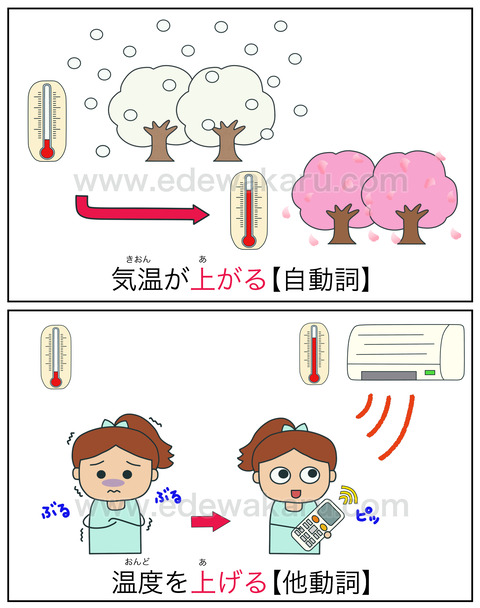
日本語文型辞典
Meaning
動詞の連用形に付いて、上の方向への動作・移動、上の方向に向いている状態を表す。⑤~⑧は、上の方向への意味での比喩的な表現。
動詞の連用形に付いて動詞の事態が極端な程度にまで進むことを表す。限られた動詞にしか用いられない。
動詞の連用形に付いてその動作が完成されることを表す。「編む」「練る」「刷る」など、ものが作られることを表す他動詞に付くのが普通。自動詞の「できる」は例外である。
How to use it
R-あがる【上方向】
R-あがる【極端な程度】
R-あがる【完成】
In context 16 examples
彼は立ち上がってあたりを見回した。
妹は帰ってくるなり階段を一気にかけ上がって、自分の部屋に飛び込んだ。
彼女はライバルを押しのけて、スターの座にのしあがった。
政治学の先生はひたいがはげ上がっている。
冬休みにみんなで温泉に行こうという計画が持ち上がった。
ツアーの申し込み人数が少なすぎるので、家族連れで参加できることにしたら、人数が倍以上にふくれ上がって旅行会社は困っている。
彼女はボーイフレンドにプロポ-ズされてすっかり舞い上がっている。
自分がリーダーになればみんなついてくるに決まっているだって?思い上がるのもいい加減にしろ。
長い間雨が降らないので、湖も干上がってしまった。
店員は男にピストルを突きつけられてふるえ上がった。
ふだんほとんど叱らない先生をバカにしていた生徒は、タバコを吸っているのを見つかって大声でどなりつけられ、縮み上がっていた。
その俳優は、たいして演技もうまくないのに周りの人たちにおだてられて、自分は誰よりも才能があるんだとのぼせ上がっている。
パンがおいしそうに焼きあがった。
みんなの意見を取り入れて、とても満足のいく旅行プランができあがった。
スパゲッティがゆであがったら、すばやくソースにからめます。
注文していた年賀状が刷りあがってきた。
毎日のんびり日本語教師
How to use it
動ます形+上がる
Explanation
意味は3つに分けられます。
①動作の完了
自動詞「~上がる」と他動詞「~上げる」が使い分けられます。
②上方向への動作
自動詞「~上がる」と他動詞「~上げる」が使い分けられます。
上方向と言っても様々な種類があります。
種類
動詞
空間的
打ち上げる/立ち上がる/汲み上げる/吸い上げる/起き上がる…
抽象的
思い上がる/つけあがる/読み上げる…
序列的
繰り上がる/繰り上げる…
形状伸縮
盛り上がる/たくし上げる/まくりあげる/腫れ上がる…
下位から上位へ
申し上げる/差し上げる…
③極限状態
動作の表す程度が極限状態に達していることを表す用法です。この用法の場合、自動詞「~上がる」のみ接続されます。
Notes
特になし
In context 20 examples
資料ができあがった。(资料做好了。)
パンが焼き上がった。(面包烤好了。)
作品が仕上がった。(作品完成了。)
論文をようやく書き上げた。
このアプリは英文を読み上げてくれるので勉強に役立っている。
トレーニングで作り上げた肉体が私の自慢だ。
原因がどこにあるのか徹底的に調べ上げるべきだ。(应该彻底调查原因在哪里。)
布団から起き上がる。
階段を駆け上がる。(跑上楼梯。)
彼女は飛び上がって喜んだ。
転んでも転んでも立ち上がる。
黄砂とは、強風で舞い上げられた黄色の砂塵が空を覆う現象のこと。
自分が特別な人間だと思い上がってはいけない。(不要以为自己是特别的人。)
息子からゲームを取り上げた。
赤ちゃんを抱き上げる。(抱起婴儿。)
干ばつで池が干上がった。(池塘因干旱而干涸。)
彼は褒めたらすぐつけあがる。(他一被表扬就得意忘形。)
近くで殺人事件が起きて恐怖に震えあがっている。
彼女は少し人気が出たからってのぼせ上がっている。(她稍微有点人气就盛气凌人。)
怯え上がった表情で返事をした。(用胆怯的表情回答。)
IMABI
Locational
Read this IMABI lesson ↗Explanation
Locational: ~渡る/渡す, ~出る, ~上がる/上げる, ~入る/入れる, ~下がる/下げる, ~おりる/おろす, ~落ちる/落とす, & ~回る/回す
This lesson is about the compound verb endings of direction. Not everything is common, but it is important for you to understand things that you may come across.
~渡る
One of the most unique things about the verb 渡る is its usage in に渡せられる・渡らせ給う, which are rare, literary alternative ways to express ある and いる in honorific speech.1. あの人は美男に渡らせられる。(Literary and old-fashioned)
He is a beautiful man.
In compound verbs after the 連用形, ~渡る is used to show the extent of a perimeter over a large area. When used in a transitive sense for the same purpose, it is replaced with its transitive form 渡す.
2. 空が晴れ渡った。
The sky is clear.
3. 城しろを明け渡すな。
Do not surrender the castle.
4. 悪魔あくまに魂たましいを売り渡すのは愚おろかことだ。
Selling your soul to the devil is a foolish thing to do.
5. 判事はんじは判決をそろそろ言い渡すだろう。
The judge will probably pass a sentence soon.
6. インターネット中に知れ渡っている。
To be well-known throughout the internet.
7. 祝砲しゅくほうが{鳴り渡る・轟とどろく}。
For gun salutes to resound.
~出る
~出る expresses that something is going out and is, with few exceptions, intransitive. Unlike ~出す which expresses great emphasis that doesn’t have to infer direction, ~出る always does.
8. 遺体いたいから突つき出ている刃やいば
A sword protruding from a body
9. 溢あふれ出る血が土に溜たまった。
The flowing blood pooled on the ground.
10. 涙が湧わき出た。
Tears welled up.
11. 彼は外へ走り出た。
He ran outside.
12. 海底かいていから石油せきゆが浮うき出た。
Oil stood out from the sea floor.
13. 目の玉たまが飛び出るような値段だよ。
It’s a price that can make your eyeballs pop out!
~上がる & -上げる
上がる and 上げる may be used in compound verbs to show that things are being lifted/raised. As we have learned, 上がる is intransitive and 上げる is transitive. ~上がる and ~上げる may also show the completion of something.
14. 浮き上がっているように見えませんか。
Does it not appear that they’re standing out? (As in being visible)
15. そんなにでかすぎる岩持ち上げれるのかい?(Rude)
Can you even lift such a humongous rock?
16. スーツケースを引き上げる。
To lug suitcases up.
17. 彼はボールを投げ上げた。
He threw the ball up into the air.
18a. メモに書き上がる。(More formal)
18b. メモに書いてある。
To be written up in a note.
19. 商品しょうひんの値段を押おし上げる。
To boost product prices.
20. 斜面しゃめんを這はい上がる。
To crawl up a slope.
21. 武器ぶきを取って立ち上がる。
To take up arms.
22. やれやれ、新たな難問が持ち上がったのー。(Old person)
Oh my, a new problem has come up.
~入る & ~入れる
~入る and ~入れる are the intransitive and transitive verbal pairs for “to enter”. In compound verbs they refer to something completely done or done deeply or ardently.
23. 味方みかたに引き入れる。
To win over.
24. 恐れ入りました。
I am much obliged.
25. 痛み入る。
To be greatly obliged.
26. 見事みごとな能力に感じ入る。
To be greatly impressed by astounding abilities.
27. 恥はじ入りました。
I was ashamed.
28. 絶たえ入るような顔
A dead looking face
29. 私たちは買い入れるペースを急激きゅうげきに上げています。
We are suddenly raising the pace of purchasing.
30. 赤ちゃんが寝入っているうちに両親は買い物に行った。
The parents went shopping while the baby was in a deep slumber.
31. 立ち入ったことを聞くようだが。
If I’m not being too inquisitive.
32. 立ち入り禁止
Keep Out
33. 空欄くうらんに書き入れる。
To fill in blank spaces.
34. 意見を聞き入れる。
To accede an opinion.
35. 新しい方針ほうしんを取り入れるつもりはない。
There is no plan to bring in a new policy.
~下がる & ~下げる
下がる and 下げる are the verbal pairs for “to hang down/fall” and are intransitive and transitive respectively. The nuances of the verbs that are created with ~下がる and ~下げる are negative.
36. あいつは引き下がるだろう。
He will probably back down.
37. 彼らは{訴願そがん・不服ふふく申し立て・異議いぎ申し立て}を引き下げた。
They pulled down the petition.
38. 垂たれ下がってる氷柱つららは明日落ちるだろうな。
The hanging icicles will probably fall tomorrow.
39a. 言ったことを取り下げるはずだ。?
39b. 言ったことを{取り消す撤回てっかいする}はずだ。〇
You should retract what you said.
Word Note: 取り下げる should be used in reference to things like documents/written statements.
~おりる & ~おろす
Meaning “to go down/drop”, おりる and おろす are used in compound expressions to show a sense of going down, but a negative emphasis is not always the case. おりる is typically written as 降りる and おろす is typically written as 下ろす.
40. 舞台ぶたいから引き下ろす。
To pluck someone done from a stage.
41. 東京を見下ろす。
To look down at Tokyo.
Word Note: 見下ろす can be used literally and metaphorically.
42. 私の友達は小説を書き下ろしました。
My friend wrote a new novel.
Nuance Note: This suggests that your friend is a professional novelist.
43a. 山頂さんちょうから駆かけ降りる。
43b. 山を駆け下りる。
To run down the peak of a mountain.
44. 舞まい降りてきた。
It came flying down.
45. 強風が吹き下ろしていた。
A strong wind was blowing down.
~落ちる & ~落とす
落ちる and 落とす are the verbal pairs for “to fall/drop” and are intransitive and transitive respectfully. These verbs show a downward sense of direction in a compound verb.
46. この世に生れ落ちなくてよかったのに。
If only I had not been born in this world.
47. 焼け落ちるのにほんの五分もかからなかったぞ。
It only took a mere five minutes to burn down.
48. 俺の皿から滑すべり落ちちまった。(Mature male; vulgar)
It slipped from my plate.
49. 彼が水を払はらい落とした。
He shook off the water.
50. {見落とされた・見過ごされた}のかな。
I wonder if it was overlooked.
51. 銀行口座から引き落とす。
To charge from one’s bank account.
52. 果物くだものを振り落とそう。
Let’s shake some fruit off.
53. 家を崖がけから突つき落とすのは危あぶないよ。
Pushing a house off of a cliff is dangerous.
~回る & ~回す
回る and 回す are the verbal pairs for “to turn/rotate” and are intransitive and transitive respectively. When used in compounds, they show movement while doing something. ~回る can be seen attached to both intransitive and transitive verbs, but ~回す is limited to transitive verbs. It is to be expected that a nuance difference is present when both ~回る and ~回す can be used. You will see this more clearly in the examples below.
54. あちこちを駆け回る。
To run around here and there.
55. 仕事を探し回るつもりがあるのか。
Do you have any intentions of looking about for a job?
56. 自分の周りを見回した方がよいです。(ちょっと古風; Formal)
It is best to look around one’s surroundings.
57. 私は新車を駐車場ちゅうしゃじょうに乗り回したいです。
I want to ride around a new car in a parking lot.
58. 警備員は輪番りんばんで見回ります。
The guards patrol in rotations.
Nuance Note: This infers that there are a lot of guards patrolling in rotation. You may consider using 交代で instead of 輪番で.
59. 犯人を追おい回す。
To chase about a criminal.
In context 61 examples
空が晴れ渡った。
The sky is clear.
城しろを明け渡すな。
Do not surrender the castle.
悪魔あくまに魂たましいを売り渡すのは愚おろかことだ。
Selling your soul to the devil is a foolish thing to do.
判事はんじは判決をそろそろ言い渡すだろう。
The judge will probably pass a sentence soon.
インターネット中に知れ渡っている。
To be well-known throughout the internet.
祝砲しゅくほうが{鳴り渡る・轟とどろく}。
For gun salutes to resound.
遺体いたいから突つき出ている刃やいば
A sword protruding from a body
溢あふれ出る血が土に溜たまった。
The flowing blood pooled on the ground.
涙が湧わき出た。
Tears welled up.
彼は外へ走り出た。
He ran outside.
海底かいていから石油せきゆが浮うき出た。
Oil stood out from the sea floor.
目の玉たまが飛び出るような値段だよ。
It’s a price that can make your eyeballs pop out!
浮き上がっているように見えませんか。
Does it not appear that they’re standing out? (As in being visible)
そんなにでかすぎる岩持ち上げれるのかい?(Rude)
Can you even lift such a humongous rock?
スーツケースを引き上げる。
To lug suitcases up.
彼はボールを投げ上げた。
He threw the ball up into the air.
メモに書き上がる。(More formal)
To be written up in a note.
メモに書いてある。
To be written up in a note.
商品しょうひんの値段を押おし上げる。
To boost product prices.
斜面しゃめんを這はい上がる。
To crawl up a slope.
武器ぶきを取って立ち上がる。
To take up arms.
やれやれ、新たな難問が持ち上がったのー。(Old person)
Oh my, a new problem has come up.
味方みかたに引き入れる。
To win over.
恐れ入りました。
I am much obliged.
痛み入る。
To be greatly obliged.
見事みごとな能力に感じ入る。
To be greatly impressed by astounding abilities.
恥はじ入りました。
I was ashamed.
絶たえ入るような顔
A dead looking face
私たちは買い入れるペースを急激きゅうげきに上げています。
We are suddenly raising the pace of purchasing.
赤ちゃんが寝入っているうちに両親は買い物に行った。
The parents went shopping while the baby was in a deep slumber.
立ち入ったことを聞くようだが。
If I’m not being too inquisitive.
立ち入り禁止
Keep Out
空欄くうらんに書き入れる。
To fill in blank spaces.
意見を聞き入れる。
To accede an opinion.
新しい方針ほうしんを取り入れるつもりはない。
There is no plan to bring in a new policy.
あいつは引き下がるだろう。
He will probably back down.
彼らは{訴願そがん・不服ふふく申し立て・異議いぎ申し立て}を引き下げた。
They pulled down the petition.
垂たれ下がってる氷柱つららは明日落ちるだろうな。
The hanging icicles will probably fall tomorrow.
言ったことを取り下げるはずだ。?
You should retract what you said.
言ったことを{取り消す撤回てっかいする}はずだ。〇
You should retract what you said.
舞台ぶたいから引き下ろす。
To pluck someone done from a stage.
東京を見下ろす。
To look down at Tokyo.
私の友達は小説を書き下ろしました。
My friend wrote a new novel.
山頂さんちょうから駆かけ降りる。
To run down the peak of a mountain.
山を駆け下りる。
To run down the peak of a mountain.
舞まい降りてきた。
It came flying down.
強風が吹き下ろしていた。
A strong wind was blowing down.
この世に生れ落ちなくてよかったのに。
If only I had not been born in this world.
焼け落ちるのにほんの五分もかからなかったぞ。
It only took a mere five minutes to burn down.
俺の皿から滑すべり落ちちまった。(Mature male; vulgar)
It slipped from my plate.
彼が水を払はらい落とした。
He shook off the water.
{見落とされた・見過ごされた}のかな。
I wonder if it was overlooked.
銀行口座から引き落とす。
To charge from one’s bank account.
果物くだものを振り落とそう。
Let’s shake some fruit off.
家を崖がけから突つき落とすのは危あぶないよ。
Pushing a house off of a cliff is dangerous.
あちこちを駆け回る。
To run around here and there.
仕事を探し回るつもりがあるのか。
Do you have any intentions of looking about for a job?
自分の周りを見回した方がよいです。(ちょっと古風; Formal)
It is best to look around one’s surroundings.
私は新車を駐車場ちゅうしゃじょうに乗り回したいです。
I want to ride around a new car in a parking lot.
警備員は輪番りんばんで見回ります。
The guards patrol in rotations.
犯人を追おい回す。
To chase about a criminal.
~上がる & ~上げる
Read this IMABI lesson ↗Explanation
~上がる & ~上げる
In this lesson, we will learn how ~上がる and ~上げる form compound verbs (複合動詞) as the second verb of the compound.
Compound verbs are created when two verbs, which would stand alone for what they represent under normal circumstances , merge together. V1 (前項動詞) of a compound always appears in the 連用形, while V2 (後項動詞) of a compound is what handles the conjugating capacity of the phrase as a whole.
Transitivity w/ 上がる & 上げる
To figure out whether a compound verb is transitive or intransitive, understanding meanings of both V1 and V2 is crucial, as the transitivity of both in isolation can tell a lot about the verbs. First, let’s look briefly at some of the basic usages of the verbs 上がる and 上げる, cherrypicked to help out with understanding them in compounds.
上がる
上がる is an intransitive verb with the basic meaning of “to rise,” indicating an upward motion, which can be used in literal contexts such as transitioning from a low point to a higher point as well as in all sorts of figurative applications which all share a theme of rising (up): rising prices, rising blood pressure, washing ashore, etc. It may also indicate stopping work, and this notion of “stopping” can be extended to rain stopping, car batteries dying, and even things like fish and the like coming up dead.
1. 虎之助は二階に上がった。
Toranosuke went up to the second floor.
2. 北極の気温が上がったことでジェット気流の速度が遅くなり、ヒートドームの頻度が上がっている。
With rising temperatures in the Artic having slowed the jet stem, the frequency of heat domes (forming) has gone up.
3. 体調は問題ないが急に血圧が上がった。
My health is fine, but my blood pressure suddenly rose.
4. 物価が騰がった分の賃金が増えなければ、消費者の生活は苦しくなるばかりだ。
Unless wages increase to compensate for the rise in the cost-of-living, consumers’ lives will only become more difficult.
5. 歓声が上がりました。
Cheers erupted.
6. どうやらこの暑さで車のバッテリーが上がってしまった。
It seems my car battery died from the heat.
7. 海が荒れるほど、貝があがる。
The more shellfish come up dead the rougher the sea gets.
8. ちょうどお風呂から上がったところだ。
I have just got out of the bath.
9. どうぞお上がりください。
Please help yourself (to what I am serving you).
10. 上がってもよろしいでしょうか。
May I come in?1
Of 上がる’s meanings, the one that is most difficult to use “naturally” is its ability to indicate that something “ends.” While this definition seems simple enough, it fails to capture the nuances which separate it from other synonyms like 終わる・止む and how they differ in practice.
11a. 雨が止んだ。◎
11b. 雨が上がった。〇/△
11a. The rain stopped.
11b. The rain ended (ushering in clear weather).
While both verbs are possible in Ex. 11, 11b. specifically implies that the weather’s condition has improved to clearer weather. This nuance is also evident with the nominal phrase 雨上がり.
12. 雨上がりの虹
Rainbow after the rain
上がる may also more specifically refer to work being completed, but in practice, 終わる is far more common.
13a. 仕事が上がった。(△)
13b. 仕事が終わった。
Work is done.
Even so, 上がる specifically implies that the work has been completed. Another more peculiar reason for why Ex. 13a. is unnatural to many speakers actually comes from how 上がる has been adapted to referring to going home once work is done (for the day). The same can be said for “to be done with work” in English.
14. 上がってOKです。
It’s okay for you to be done (for the day).
15. 仕事を上がった。
I’m done with work.
The use of the particle を here is parallel with how it is used with 終わる, making 上がる a quasi-transitive verb for “to end” in a less direct way that would necessarily imply the work is over for good. As this contradicts the original meaning of 上がる, some speakers find this to be a neologism at best. Even so, Ex. 16 is highly common as a part of バイト敬語.
16. 上がります!(△)
I’m heading out (for today)!
上げる
上げる is the transitive equivalent of 上げる with the basic meaning of “to raise,” indicating someone raising something, which can be used in literal contexts such as raising something to a higher position as well as in all sorts of figurative applications which share a theme of someone taking something to a higher/better situation, which also encompasses its meaning of “to give.”
17. 砂浜でお父さんと凧を上げた。
I flew a kite with my dad on the beach.
18. 値段を上げたのに、売り上げが伸びた。
Despite raising prices, our sales increased.
19. 料理の腕を上げたい。
I want to improve my cooking skills.
20. 孫娘にお小遣いを上げたよ。
I gave my granddaughter her allowance.
21. 成績を上げたいって気持ちを僕らは全力で応援するよ。
We will fully support your desire to improve your grades/results.
22. 体験談をもとに、結婚式を挙げた人・挙げなかった人それぞれの、満足している理由、後悔している理由にじっくり迫ります。
We will take a closer look at the reasons for being satisfied/regretting having had a wedding or not, respectively, based on their personal experiences.
23. 友人が切り株に躓き股間を打ち悲鳴を上げたのを見て笑った。
I laughed when my friend tripped over a tree stump, hit his groin, and let out a scream.
24. 天麩羅を揚げた後に具材から立ち上がる湯気が、どうしても天麩羅内部からしけらせて衣をシンナリさせてしまいます。
After deep-frying tempura, the steam that rises out from the ingredients inevitably makes the inside of the tempura soggy and causes the batter to become thin.
25. 町を挙げて選手を応援している。
The town as a whole supports the athlete.
26. 現場代理人のすべき仕事を挙げた。
I have listed the tasks that a site manager should do.
あげる also has one intransitive meaning “to come in” but specifically in reference to the tide.
27. 潮があげてきた。
The tide has risen.
Orthography
上がる and 上げる, as you may have noticed from the examples so far, have alternate kanji spellings depending on the meaning.
挙がる is used in the sense of “to turn up (as in evidence),” “to be arrested,” “for an (example) to be shown,” “to be in an uproar,” etc.
揚がる literally refers to rising midair or out of a liquid, which is how it has been largely associated with “to be done frying.” However, it may also still refer to “to rise to the surface,” “to be be washed ashore,” and even in “to amuse oneself in a red light district” in older language.
騰がる is used in the sense of “for prices to rise.”
挙げる is used in the sense of “to raise (one’s hand),” “to raise (one’s voice),” “to achieve (results),” “to give (an example)/display,” “to apprehend,” “to hold (an event),” “to take up arms,” etc.
揚げる is used in the sense to “raise (a kite, flag, etc.) high up,” “to hoist (out of the water),” “to take out of (the frier),” etc.
アガる may also be seen in the sense of “to be in high spirits/hyped.”
アゲる may also be seen in the sense of “to hype.”
It is also common to see あがる・あげる in hiragana, and this is especially so for when they are used in compound verbs.
Transitivity w/ ~上がる・上げる
For the majority of compound verbs in Japanese, the transitivity of V1 and V2 match each other, barring V2 which largely pertain to aspect and not their literal meanings in which case the transitivity of V1 takes over. As for ~上がる and ~上げる, however, transitivity is determined by them (V2). Moreover, both follow intransitive and transitive V1. First, let’s consider the following two sets of examples of these verbs in compounds to see what we glean about their transitivity and semantics in this environment.
28. 椅子から立ち上がった。
I stood up from my chair.
29. サギが突然飛びあがった。
A heron suddenly flew up into the air.
30. 器が焼き上がりました。
The ceramic is done baking.
31. ここまで這い上がってきた息子を心から誇りに思っている。
I am sincerely proud of my son, who has come so far.
32. 天然繊維で織りあげました。
I wove (this) from natural fibers.
33. 月を見上げた。
I looked up at the moon.
34. 患者は「俺の話を聞いているのか」と腹を立て、職員の尻を蹴り上げたのだった。
The patient got angry, saying, “Are you even listening to me?!” as he kicked the staff member in the butt.
35. 原稿を読み上げたあと、アドリブで一言添えることもあります。
After reading the script, I sometimes add a few ad-libbed comments.
36. これは僕が3年かけて念入りに仕上げた作品です。
This is a piece I’ve painstakingly worked on over the last three years.
37. 間違いを数え上げたところで、キリがありません。
There is no need to the number of mistakes even if were to count them up.
We see that compounds made with ~上がる are intransitive regardless of whether V1 is intransitive or transitive, but when V1 is transitive, we see that it shifts slightly from indicating “upward direction” to “completion” in a passive-like approach. As for those made with ~上げる, it is largely paired with transitive verbs, and depending on other semantic dynamics, it too may indicate “completing” an action, which can be viewed as a figurative extensive of moving toward a “higher > more complete” status.
Next, we will shift our focus to compounds with ~上がる and ~上げる, categorizing them by their meanings.
Upward Directionality w/ ~上がる and ~上げる
Whether the increase is spatial, temporal, internal, or however manner “rising/raising” can be interpreted, we find that the majority of compounds with ~上がる and ~上げる hinge on their basic definition.
38. つまり、赤道付近からロケットを打ち上げたほうが上昇しやすいということになる。
This means that it is easier for a rocket to ascend if it is launched from somewhere closer to the equator.
39. 急遽、予定を繰り上げて、きょう、自宅に戻ってきました。
I’ve hastily moved up my plans and have returned back home today.
40. 先方の都合で、会議の時間が30分繰り上がりました2。
Our meeting time has been moved up by thirty minutes for the other party’s convenience.
41. 階段を駆け上がったときに鍵を落としました。
I dropped my keys when I ran up the stairs.
42. 拳を突き上げた。
I raised a fist.
43. 誰か寝ているときに低血圧で、起き上がったときに正常か高血圧の人はいる?
Does anyone have low blood pressure when they are asleep but normal or high blood pressure when they wake up?
44. 赤ちゃんを抱き上げたときの温もりと重みに、突然どばっと涙がこみ上げてきた。
When I picked up (my) baby, their warmth and weight suddenly brought tears to my eyes.
45. 汲み上げた地下水は、浄化処理を行い、排水基準を満たしていることを確認した後に、海洋へ排水することで、原子炉建屋等に近づく地下水の量を減少させます。
The pumped groundwater is purified and discharged into the ocean after it is confirmed to meet discharge standards, thereby reducing the amount of groundwater approaching the reactor buildings, etc.
At times, the notion of “rising/raising” is distorted depending on the referent V1 action’s natural directionality of progression it takes. For instance, 縮む (intr.) means “to shrink,” while 縮みあがる (intr.) means “to shrivel up.” When something shrivels up, the entity shriveling up does not “rise” upward, but rather the exact opposite. Yet, we see a parallel dynamic with English in its use of “up” to instead indicate an aspect layer of meaning pertaining to the completion of said action.
46. 盛り上がってる!
I’m fired up!
47. 廊下ですれ違ったぽちゃりと禿げ上がったおじさんに急にナンパされてビビった。
I was startled when a chubby, balding man I passed in the hallway suddenly started hitting on me.
48. ライブ開催をより一層盛り上げてくれた。
(He) made the live performance ever more exciting.
49. 髪を短く刈り上げた。
I cropped my hair short.
打ちあがる (△) ?
In dictionaries, 打ち上がる is presented as the intransitive rendition of 打ち上げる, and it is defined as meaning “to lift off/to be launched.” To distinguish it from 打ち上げられる, which would be the passive form of its transitive form and the form closest to “to be launched,” “to lift off” would be the most fitting translation of the two. In practice, it turns out that many speakers find Ex. 50a. unnatural, favoring Ex. 50b instead.
50a. 花火が打ち上がる。(△)
50b. 花火が打ち上げられる。◎
50a. The fireworks shot up.
50b. The fireworks were set off.
The reason for why a not so small majority of people find Ex. 50a unnatural may, in fact, be how the agency of the act of launching (fireworks, a rocket, etc.) implies. While it is fairly common for there to be an intransitive means of rewriting a transitive expression to not emphasize the agent’s role, such rewrites predicate that the action be capable of occurring as happenstance, or presented as happenstance so as not to put responsibility for the action on anyone’s shoulders. The latter condition is what controls many such rewrites when speech register dynamics are at work (Ex. 40 from above).
By favoring the passive form of the transitive 打ち上げる—打ち上げられる—the predicate may still return to an intransitive state while explicitly referencing the agent’s role.
Statistically, very few instances of V1 (trans.) + ~上がる exist, and for those that do, a naturally progression to an ultimately completed (improved) state is implied (see below). Here, 打ち上がる only pertains to upward motion, and the force by which 打つ occurs happens to necessitate an agent. This can also be proved by the fact that the noun form for “launch” itself is 打ち上げ and not 打ち上がり3.
51. ロケットは打ち上げ後、1段目が分離されたものの2段目の飛行途中で停止システムが作動して落下した。
After launch, the first stage of the rocket separated, but the second stage’s shutdown system was activated mid-flight, which resulted in it coming down.
Interestingly, when agency is not so important when 打ち上がる means “to be washed up (ashore),” we find that 打ち上がる・打ち上げられる are rather interchangeable, with the latter’s agent being the ocean itself.
52. 2頭以上が同時に海岸に打ち上がる事例は珍しい。
It is rare for two or more whales to wash up on the shore at the same time.
53. 先月29日にクジラ4頭が打ち上げられた。
Four whales washed up on shore on the 29th of last month.
In speaking of non-human agents, even slight emphasis on said agent can bring about this difference between non-transitive vs transitive passive in other ~上がる・上げる pairs.
54. 放射能を含んだ土埃が舞い上がった。
Radioactive dust blew up into the air.
55. 気温の上昇と風が強まったことによって、昨日の大量飛散で地面に落ちた花粉が舞い上げられた。(agent = 風)
Pollen that had fallen to the ground during yesterday’s massive pollen count was whirled up by rising temperatures and the winds strengthening.
こみ上げる is Intransitive?
The verb 込む・混む, with various meanings such as “to be crowded ” and “to go into,” is intransitive, yet it is used with ~上げる to produce a compound verb which refers to surging of emotions, as if adding agency to the emotions themselves. This is contrast to similar verbs such as 沸き上がる (to well up) in which both V1 and V2 are intransitive.
56. 人間の喜怒哀楽は自然なことで、許せないという感情が込み上げてくるのは、自分の心が自分自身のものであるという証拠でもあるのだ。
Human emotions are natural, and the feeling of unforgiveness that wells up inside you is proof that your heart is your own.
57. 怒りの感情が沸き上がった。
Anger welled up inside me.
Completion w/ ~上がる and ~上げる
The most intriguing examples of ~上がる and ~上げる are those which pertain to completion. These compounds can be further categorized into three subgroups.
Describing the completion of an activity that has resulted in a finished product. When agency is not being highlighted, ~上がる manifests, and when agency is highlighted, ~上げる manifests.
Describing the completion of an action upon thorough execution with ~上げる. While similar to the first group, the results are not necessarily in the form of a tangible object, per se. With ~上がる, agency is absent, so rather than thoroughly executing an action willfully, V1 is done thoroughly but without a willful agent.
Only applicable to ~上がる, describing the completion of a natural phenomenon, which can be viewed as an extension of the second subgroup with ~上がる with even the “agent” thrown out of the equation.
58. 妻は夫の浮気の証拠を徹底的に調べ上げた。
The wife thoroughly investigated the evidence of her husband’s infidelity.
59. 彼の心を動かしたのは、殴られて腫れ上がった昇平君の顔だった。
What moved him was the sight of Shohei’s swollen face after being beaten.
60. 何日間も雨続きの後に晴れ上がった。
After days of rain, the sky has finally cleared up.
61. サンマが焼き上がった。
The saury is done grilling.
62. 古くは稲を刈り上げた後、神が天皇とともに食する前に、先に新米を口にするのは畏れ多いと、新嘗祭が済むまで収穫したばかりの米を食べることは慎まれていた。
In the old days, after reaping the rice, it was deemed discourteous to eat new rice before the gods partook with the emperor, so people refrained from eating the newly harvested rice until the Niiname-sai ceremony was over.
63. また、生えたばかりの永久歯も質がしっかりと出来上がっていないので、虫歯ができやすく進みやすいので注意が必要です。
Also, since newly emerged permanent teeth are not fully developed, they are prone to cavities, so care must be taken.
64. 注射前の消毒をしてもらいながら、愛猫の愛莉ちゃんは「何をされるの…」と言いたげに不安全開で震えあがっている。
As my beloved cat, Airi-chan, was being disinfected before her shots, she trembled in absolute fear as if to say, “What are they going to do to me?”
65. 子供たちが声高らかに歌いあげました。
The children sang at the top of their lungs.
66. 論文をようやく書き上げた。
I finally completed writing my thesis.
67. 我々の先人が今日の日本を作り上げたのだ。
Our predecessors built the Japan we know today.
68. やがて訪れる経済破綻の予感に市民が怯え上がっているというのに、年寄りにはできることが何もないじゃないか。
While citizens are growing terrified at the prospect of an impending economic collapse, there’s really nothing the elderly can do, now is there?
69. 旱魃で池が干上がった。
The pond has dried up from the drought.
Interestingly, some compounds which utilize ~上がる have defunct 終止形 and are only used as nouns with their 連用形. The primary example of this is 病み上がり (recuperating), in which case the “upward” improvement sense of ~上がる is intended, but if rendered as a verb via 病み上がる, the phrase would be misconstrued as “to end up completely ill” much like how 腫れ上がる means “to (completely) swell up.”
70. まだ病み上がりだから、ムリしないようにね。
You’re still recovering from that illness you had, so don’t push yourself too hard.
Another similar strange example is the phrase 持ちあがり in the sense of “homeroom teacher.” While 持ちあがる does mean “to be lifted up” or “to come up” in a figurative sense, the resultant action of remaining a group’s teacher as their “homeroom teacher” is best captured by the noun form 持ちあがり. Of course, in the sense of “maintaining the role of homeroom teacher thoroughly” can still be described with 持ちあがる.
71. 付属からの持ちあがりだよ。
(He) is our homeroom teacher from an affiliated school.
72. 六年生まで持ちあがって教えます。
I teach my classes up to the sixth grade.
Societal Actions: Directionality w/ ~上がる and ~上げる
Though not numerous in number, there are also verbs with ~上がる and ~上げる that pertain to societal actions which have built-in directionality in terms of hierarchy. The speech register of V1 determines the directionality of the compound. If the verb is humble, for instance, then the the directionality is from inferiors to superiors. If the verb is neutral, then the directionality is from superior to inferior.
73. ご報告申し上げます。 (申す = humble verb)
Allow me to give you my report.
74. 先生の功績は前々から存じ上げております4。
I have known your achievements, sensei, for quite some time.
75. 原則、国に土地を買い上げてもらうことは難しい。
In principle, it is difficult to get the government to buy up land (from you).
Being Condescending w/ ~上がる
While Japanese also has expressions such as 見下す (to look down) which demonstrate a downward directionality when it comes to being condescending to others, there is also the opposite route, which is being “cocky.” From this standpoint, the agent is outwardly being cheeky, and it is that forcing of bad energy onto someone else that warrants an upward directionality, of course for all the wrong reasons. While few examples exist, this meaning is responsible for the ending ~やがる, which is used to accuse others of being cocky in their actions.
76. 甘やかすとつけあがるので気をつけなさい。
Be careful not to spoil (them), as (they) can get carried away.
77. 怖いのは、自分がどのくらいのぼせ上がっているのか、自分自身ではわからない、ということです。
The scary thing is that you don’t realize how full of yourself you are.
78. 絵のモチーフをよく理解している、などと思いあがってはいけない。
Don’t get carried away and think you understand the motif(s) of the art piece(s).
79. 会社が潰れるというデマを作り上げた。
(He) made up a rumor that the company was going under.
80. 何しやがる!
What the hell are you doing?!
Japanese homes traditionally have visitors and residents alike step up into the resident, and the 上がり框 is the step, usually wooden, that one has to step over and onto the main floor. ↩︎
The use of 繰り上がる, even with the agent behind hastening the schedule being more or less stated as the client via the use of 先方の都合で, takes the burden of responsibility of both parties’ shoulders. ↩︎
Compare this to a verb like 禿げ上がる with a nominal form of 禿げ上がり, indicating that there is no inherent agency to bolding, just a victim. ↩︎
存じ上げる is a humble expression that pays respect to the object of the sentence (目的語), and in turn, also shows respect to the owner of the object. This is known as 所有者敬語. Incidentally, this honorific effect of 存じ上げる is largely lost when used in the negative, implying that the directionality of respect emphasized by ~上げる has to be substantiated for the respect to be had. ↩︎
In context 83 examples
虎之助は二階に上がった。
Toranosuke went up to the second floor.
北極の気温が上がったことでジェット気流の速度が遅くなり、ヒートドームの頻度が上がっている。
With rising temperatures in the Artic having slowed the jet stem, the frequency of heat domes (forming) has gone up.
体調は問題ないが急に血圧が上がった。
My health is fine, but my blood pressure suddenly rose.
物価が騰がった分の賃金が増えなければ、消費者の生活は苦しくなるばかりだ。
Unless wages increase to compensate for the rise in the cost-of-living, consumers’ lives will only become more difficult.
歓声が上がりました。
Cheers erupted.
どうやらこの暑さで車のバッテリーが上がってしまった。
It seems my car battery died from the heat.
海が荒れるほど、貝があがる。
The more shellfish come up dead the rougher the sea gets.
ちょうどお風呂から上がったところだ。
I have just got out of the bath.
どうぞお上がりください。
Please help yourself (to what I am serving you).
上がってもよろしいでしょうか。
May I come in?1
雨が止んだ。◎
11a. The rain stopped.
雨が上がった。〇/△
11a. The rain stopped.
雨上がりの虹
Rainbow after the rain
仕事が上がった。(△)
Work is done.
仕事が終わった。
Work is done.
上がってOKです。
It’s okay for you to be done (for the day).
仕事を上がった。
I’m done with work.
上がります!(△)
I’m heading out (for today)!
砂浜でお父さんと凧を上げた。
I flew a kite with my dad on the beach.
値段を上げたのに、売り上げが伸びた。
Despite raising prices, our sales increased.
料理の腕を上げたい。
I want to improve my cooking skills.
孫娘にお小遣いを上げたよ。
I gave my granddaughter her allowance.
成績を上げたいって気持ちを僕らは全力で応援するよ。
We will fully support your desire to improve your grades/results.
体験談をもとに、結婚式を挙げた人・挙げなかった人それぞれの、満足している理由、後悔している理由にじっくり迫ります。
We will take a closer look at the reasons for being satisfied/regretting having had a wedding or not, respectively, based on their personal experiences.
友人が切り株に躓き股間を打ち悲鳴を上げたのを見て笑った。
I laughed when my friend tripped over a tree stump, hit his groin, and let out a scream.
天麩羅を揚げた後に具材から立ち上がる湯気が、どうしても天麩羅内部からしけらせて衣をシンナリさせてしまいます。
After deep-frying tempura, the steam that rises out from the ingredients inevitably makes the inside of the tempura soggy and causes the batter to become thin.
町を挙げて選手を応援している。
The town as a whole supports the athlete.
現場代理人のすべき仕事を挙げた。
I have listed the tasks that a site manager should do.
潮があげてきた。
The tide has risen.
椅子から立ち上がった。
I stood up from my chair.
サギが突然飛びあがった。
A heron suddenly flew up into the air.
器が焼き上がりました。
The ceramic is done baking.
ここまで這い上がってきた息子を心から誇りに思っている。
I am sincerely proud of my son, who has come so far.
天然繊維で織りあげました。
I wove (this) from natural fibers.
月を見上げた。
I looked up at the moon.
患者は「俺の話を聞いているのか」と腹を立て、職員の尻を蹴り上げたのだった。
The patient got angry, saying, “Are you even listening to me?!” as he kicked the staff member in the butt.
原稿を読み上げたあと、アドリブで一言添えることもあります。
After reading the script, I sometimes add a few ad-libbed comments.
これは僕が3年かけて念入りに仕上げた作品です。
This is a piece I’ve painstakingly worked on over the last three years.
間違いを数え上げたところで、キリがありません。
There is no need to the number of mistakes even if were to count them up.
つまり、赤道付近からロケットを打ち上げたほうが上昇しやすいということになる。
This means that it is easier for a rocket to ascend if it is launched from somewhere closer to the equator.
急遽、予定を繰り上げて、きょう、自宅に戻ってきました。
I’ve hastily moved up my plans and have returned back home today.
先方の都合で、会議の時間が30分繰り上がりました2。
Our meeting time has been moved up by thirty minutes for the other party’s convenience.
階段を駆け上がったときに鍵を落としました。
I dropped my keys when I ran up the stairs.
拳を突き上げた。
I raised a fist.
誰か寝ているときに低血圧で、起き上がったときに正常か高血圧の人はいる?
Does anyone have low blood pressure when they are asleep but normal or high blood pressure when they wake up?
赤ちゃんを抱き上げたときの温もりと重みに、突然どばっと涙がこみ上げてきた。
When I picked up (my) baby, their warmth and weight suddenly brought tears to my eyes.
汲み上げた地下水は、浄化処理を行い、排水基準を満たしていることを確認した後に、海洋へ排水することで、原子炉建屋等に近づく地下水の量を減少させます。
The pumped groundwater is purified and discharged into the ocean after it is confirmed to meet discharge standards, thereby reducing the amount of groundwater approaching the reactor buildings, etc.
盛り上がってる!
I’m fired up!
廊下ですれ違ったぽちゃりと禿げ上がったおじさんに急にナンパされてビビった。
I was startled when a chubby, balding man I passed in the hallway suddenly started hitting on me.
ライブ開催をより一層盛り上げてくれた。
(He) made the live performance ever more exciting.
髪を短く刈り上げた。
I cropped my hair short.
花火が打ち上がる。(△)
50a. The fireworks shot up.
花火が打ち上げられる。◎
50a. The fireworks shot up.
ロケットは打ち上げ後、1段目が分離されたものの2段目の飛行途中で停止システムが作動して落下した。
After launch, the first stage of the rocket separated, but the second stage’s shutdown system was activated mid-flight, which resulted in it coming down.
2頭以上が同時に海岸に打ち上がる事例は珍しい。
It is rare for two or more whales to wash up on the shore at the same time.
先月29日にクジラ4頭が打ち上げられた。
Four whales washed up on shore on the 29th of last month.
放射能を含んだ土埃が舞い上がった。
Radioactive dust blew up into the air.
気温の上昇と風が強まったことによって、昨日の大量飛散で地面に落ちた花粉が舞い上げられた。(agent = 風)
Pollen that had fallen to the ground during yesterday’s massive pollen count was whirled up by rising temperatures and the winds strengthening.
人間の喜怒哀楽は自然なことで、許せないという感情が込み上げてくるのは、自分の心が自分自身のものであるという証拠でもあるのだ。
Human emotions are natural, and the feeling of unforgiveness that wells up inside you is proof that your heart is your own.
怒りの感情が沸き上がった。
Anger welled up inside me.
妻は夫の浮気の証拠を徹底的に調べ上げた。
The wife thoroughly investigated the evidence of her husband’s infidelity.
彼の心を動かしたのは、殴られて腫れ上がった昇平君の顔だった。
What moved him was the sight of Shohei’s swollen face after being beaten.
何日間も雨続きの後に晴れ上がった。
After days of rain, the sky has finally cleared up.
サンマが焼き上がった。
The saury is done grilling.
古くは稲を刈り上げた後、神が天皇とともに食する前に、先に新米を口にするのは畏れ多いと、新嘗祭が済むまで収穫したばかりの米を食べることは慎まれていた。
In the old days, after reaping the rice, it was deemed discourteous to eat new rice before the gods partook with the emperor, so people refrained from eating the newly harvested rice until the Niiname-sai ceremony was over.
また、生えたばかりの永久歯も質がしっかりと出来上がっていないので、虫歯ができやすく進みやすいので注意が必要です。
Also, since newly emerged permanent teeth are not fully developed, they are prone to cavities, so care must be taken.
注射前の消毒をしてもらいながら、愛猫の愛莉ちゃんは「何をされるの…」と言いたげに不安全開で震えあがっている。
As my beloved cat, Airi-chan, was being disinfected before her shots, she trembled in absolute fear as if to say, “What are they going to do to me?”
子供たちが声高らかに歌いあげました。
The children sang at the top of their lungs.
論文をようやく書き上げた。
I finally completed writing my thesis.
我々の先人が今日の日本を作り上げたのだ。
Our predecessors built the Japan we know today.
やがて訪れる経済破綻の予感に市民が怯え上がっているというのに、年寄りにはできることが何もないじゃないか。
While citizens are growing terrified at the prospect of an impending economic collapse, there’s really nothing the elderly can do, now is there?
旱魃で池が干上がった。
The pond has dried up from the drought.
まだ病み上がりだから、ムリしないようにね。
You’re still recovering from that illness you had, so don’t push yourself too hard.
付属からの持ちあがりだよ。
(He) is our homeroom teacher from an affiliated school.
六年生まで持ちあがって教えます。
I teach my classes up to the sixth grade.
ご報告申し上げます。 (申す = humble verb)
Allow me to give you my report.
先生の功績は前々から存じ上げております4。
I have known your achievements, sensei, for quite some time.
原則、国に土地を買い上げてもらうことは難しい。
In principle, it is difficult to get the government to buy up land (from you).
甘やかすとつけあがるので気をつけなさい。
Be careful not to spoil (them), as (they) can get carried away.
怖いのは、自分がどのくらいのぼせ上がっているのか、自分自身ではわからない、ということです。
The scary thing is that you don’t realize how full of yourself you are.
絵のモチーフをよく理解している、などと思いあがってはいけない。
Don’t get carried away and think you understand the motif(s) of the art piece(s).
会社が潰れるというデマを作り上げた。
(He) made up a rumor that the company was going under.
何しやがる!
What the hell are you doing?!