AIUEO JLPT Grammar
Meaning
「ものの」is a conjunction used to acknowledge a certain fact but indicate that the expected outcome does not materialize. It carries a sense of contrast and is primarily used in written language.
How to use it
動詞+ものの形容詞+ものの形容動詞な+ものの名詞である+ものの
Explanation · 日本語
「ものの」は、ある事実を認めつつも、その結果が期待通りにならないことを表すときに使う接続助詞です。逆接の意味を持ち、主に書き言葉で使われます。
In context 5 examples
資格を取得したものの、仕事に活かせていない。
Although I obtained the qualification, I haven’t been able to use it in my job.
説明書を読んだものの、使い方がよくわからない。
Even though I read the manual, I still don’t understand how to use it.
出発の準備は整ったものの、天気が悪くて旅行は延期になった。
Although we were ready to leave, the trip was postponed due to bad weather.
新しい車を買ったものの、事故が怖くて運転していない。
Although I bought a new car, I’m too scared to drive it.
勉強するつもりだったものの、結局何もしなかった。
Although I intended to study, I ended up doing nothing.
文法
Meaning
だけれども
How to use it
V(普通形) + ものの
イA(普通形) + ものの
ナAである + ものの
Nである + ものの
In context 12 examples
東京大学を卒業したものの、就職難で仕事が見つからない。
予約したものの、行くかどうか、まだ迷っている。
日本で2年、日本語を勉強したものの、全然上手にならなかった。
暖かくなってきたとはいうものの、まだまだ冬です。
長年日本語を学んでいるものの、話す力がなかなか身につかない。
今の会社は給料は安いものの、人間関係がいいので満足している。
彼は言葉遣いは丁寧なものの、態度が良くないので、印象が悪い。
最近の若者は就職したものの、すぐにやめてしまう人が多い。
頭ではわかっているものの、実際に言葉で説明するのは難しい。
日本語で基本的なコミュニケーションはできるようになったものの、まだテレビや映画の内容は全然理解できない。
バイクで派手に転倒したものの、軽傷で済んだ。
彼女から誕生日に時計をもらったものの、実はあまりデザインが好きじゃなく、一度もつけていない。
Bunpro Grammar Reference
Meaning
Although, But, Even Though
How to use it
Verb + ものの + Phrase
[い]Adjective + ものの + Phrase
[な]Adjective + な(2) + ものの + Phrase
Noun + ではある(1) + ものの + Phrase
(1) である、であった
(2) だった、ではある、であった
Nuance
A formal conjunction particle used for highlighting that although (A), (B). (B) opposes or contradicts (A).
Explanation
ものの is a formal conjunction-particle used to illustrate that while (A) is a fact, the result or condition of (B) cannot be attributed to (A), could not be predicted through (A), or is in direct contrast to (A).
ものの may appear directly after verb, い-Adjectives, nouns followed by である, or な-Adjectives followed by な.
マッチングアプリで出会った人とデートに行ったものの、共通点が何もなかったのでまた会うことはないだろう。
Although I went on a date with someone I met on a matching app, we had nothing in common, so I doubt we will meet again.
今の仕事の給料は高いものの、家族と過ごせる時間が少ないから転職を考えている。
Although my current job pays well, I am considering changing jobs because I don't have much time to spend with my family.
あのお店が出す商品はユニークではあるものの、高すぎるので手が出せない。
Although the products offered by that store are unique, they are too expensive for me to afford.
伊藤先生は英語の先生ではあるものの、日常的な英語は話せないそうだ。
Even though Ms. Ito is an English teacher, I have heard that she doesn't speak everyday English.
Caution
ものの may only be used when the subject or topic of the sentence is the same in both the statements preceding and following it.
彼女はいろんな楽器を演奏できるものの、楽譜は読めないらしい。
Although she can play a lot of instruments, I heard that she can't read music.
彼は日本語を勉強しているものの、韓国語も勉強している。
Although he is studying Japanese, he is also studying Korean.
Nuance · 日本語
(A)であっても(B)だということを強調する丁寧な接続助詞。(B)は(A)に逆らう、又は矛盾する。
Explanation · 日本語
「ものの」は、(A) が事実であることを認めつつ、(B) という結果や状況は (A) が原因ではない、 (A) からは予測できない、また (A) と正反対であることを表す硬い接続助詞です。
「ものの」は動詞、イ形容詞、「である」を伴う名詞、「な」を伴うナ形容詞の後に直接付きます。
マッチングアプリで出会った人とデートに行ったものの、共通点が何もなかったのでまた会うことはないだろう。
Although I went on a date with someone I met on a matching app, we had nothing in common, so I doubt we will meet again.
今の仕事の給料は高いものの、家族と過ごせる時間が少ないから転職を考えている。
Although my current job pays well, I am considering changing jobs because I don't have much time to spend with my family.
あのお店が出す商品はユニークではあるものの、高すぎるので手が出せない。
Although the products offered by that store are unique, they are too expensive for me to afford.
伊藤先生は英語の先生ではあるものの、日常的な英語は話せないそうだ。
Even though Ms. Ito is an English teacher, I have heard that she doesn't speak everyday English.
注意点
「ものの」は前後の文で主語や話題が同じ場合にのみ使うことができます。
彼女はいろんな楽器を演奏できるものの、楽譜は読めないらしい。
Although she can play a lot of instruments, I heard that she can't read music.
彼は日本語を勉強しているものの、韓国語も勉強している。
Although he is studying Japanese, he is also studying Korean.
In context 18 examples
- A(エー)とB(ビー)を組み合わせてみたものの、ほとんど味が変わらないな。
Although I tried combining A and B, it tastes almost the same.
- 今の仕事の給料は高いものの、家族と過ごせる時間が少ないから転職を考えている。
Although my current job pays well, I am considering changing jobs because I don't have much time to spend with my family.
- 伊藤先生は英語の先生ではあるものの、日常的な英語は話せないそうだ。
Even though Ms. Ito is an English teacher, I have heard that she doesn't speak everyday English.
- マッチングアプリで出会った人とデートに行ったものの、共通点が何もなかったのでまた会うことはないだろう。
Although I went on a date with someone I met on a matching app, we had nothing in common, so I doubt we will meet again.
- あのお店が出す商品はユニークではあるものの、高すぎるので手が出せない。
Although the products offered by that store are unique, they are too expensive for me to afford.
- 工夫してみたものの、結果は大して変わらない。
Even though I tried solving (the problem), there won't be any significant change.
- 自分で組み立ててみたものの、見栄えが悪すぎる。
Even though I built it myself, it has absolutely no charm.
- クーラーを最大にしてみたものの、全然涼しくならない。
Even though I got the largest air conditioner, (the room) doesn't get cool at all.
- 口紅をつけてみたものの、全然女性らしく見えないのはなぜ?
Although I put on lipstick, I don't look ladylike at all. Why!?
- 高価な毛皮をいただいたものの、わたしには全然似合いません。
I received some expensive furs, but they do not suit me at all.
- 競馬に行ってみたものの、ハマるのが恐くて馬券を買えなかった。
I went to a horse race, but the fear of getting addicted was so great that I could not buy a ticket.
- 今年ようやく運転免許の試験を受けてみたものの、めったに運転しない。
Although I finally tried taking my driving test this year, I rarely drive.
- 子供のころはずっと医者になりたいと言っていたものの、本当になることは期待していなかった。
Although I constantly said 'I want to become a doctor' during my childhood, I never expected to actually become one.
- 由美子先生は経済の専門家ではあるものの、学校以外の仕事をしたことがない。
Although professor Yumiko is an expert in economics, she has never worked outside of the university.
- 金魚が好きだとは言ってみたものの、本当にプレゼントされたら少し困る。
Although I said I like goldfish, if I actually received one as a present I wouldn't be thrilled.
- 「そんな意見はくだらない」と強がってみたものの、他のアイデアが思い浮かびません。
Even though I pretended to be tough and said 'Your opinions are preposterous,' I cannot think of any other ideas.
- 彼女はいろんな楽器を演奏できるものの、楽譜は読めないらしい。
Although she can play a lot of instruments, I heard that she can't read music.
- 彼は日本語を勉強しているものの、韓国語も勉強している。
Although he is studying Japanese, he is also studying Korean.
DoJG 日本語文法辞典(全集)
Meaning
Although; though; even though; but
How to use it
(i) {V/Adjectiveい}informal | ものの | |
| {行く/行った}ものの | Although someone will go/went |
| {安い/安かった}ものの | Although something is/was cheap |
(ii) Adjectiveな stem | {な/で(は)ある/だった/であった}ものの | |
| 便利{な/で(は)ある/だった/であった}ものの | Although something is/was convenient |
(iii) Noun | {で(は)ある/だった/であった}ものの | |
| 大学生{で(は)ある/だった/であった}ものの | Although someone is/was a college student |
Explanation
A conjunction that means "although".
In context 12 examples
通訳の仕事を引き受けたものの、うまくやれる自信がない。
Although I accepted the interpreting job, I'm not confident that I can do it well.
一人でいる方が気楽だとは言うものの、やはり話し相手が欲しいと思うこともある。
Although I say being alone is easier, sometimes I want someone to talk with.
大学を卒業はしたものの、不況でなかなかいい仕事が見つからない。
Even though I graduated from college, because of the recession I cannot find a good job (despite my efforts).
マネージャーになって給料は上がったものの、急にいろんな仕事が増えてとても忙しくなった。
Although I became a manager and got a raise, my work (of various kinds) quickly increased and I became very busy.
市内を抜け出すまでは時間がかかったものの、高速に入ってからは渋滞もなく、4時前にホテルにチェックインすることができた。
Although it took time to get out of the city, there were no traffic tie-ups after we got on the highway, and we were able to check in at the hotel before four o'clock.
韓国産のハマグリは形はふくらみが少なく身がややかたいものの、うま味が強く、寿司ネタにも使われている。
Clams from Korea are a little lean and tough, but they taste very good and are sometimes used for sushi.
現地の子供たちは最初こそよそよそしかったものの、時間がたつにつれて慣れてきてとても親切にしてくれました。
Although the local children were cold and unfriendly at the start, as time passed they got used to me and were very kind to me.
小林氏は身のこなしが軽快で、髪こそ真っ白なものの、「若い」という印象を与える。
Mr. Kobayashi's carriage is light and jaunty, and even though his hair is totally white, he gives the impression of being young.
我がチームは出だしは好調だったものの、夏場で失速し、シーズンが終わってみれば、勝率5割を切るという不本意な成績に終わった。
Even though our team started off well, we lost momentum over the summer, and when the season was over, to our regret we had won less than 50 percent of our games.
彼は敬虔なイスラム教徒だったものの、ドイツ国内のイスラム主義団体との交流はなかった。
Although he was a devout Muslim, he had no connection with Islamic groups in Germany.
暦の上では秋とは言うものの、まだ真夏のような暑さが続いている。
Although the calendar says that it is autumn, it's still hot like midsummer.
同居していた息子の家族が県外に引っ越したので、やっと静かな生活に戻った。とは言うものの、孫の顔がいつも見られないのはちょっと寂しい。
Our son and his family, who had been living with us, moved out of the prefecture, and we have finally returned to a quiet life. However, we feel a little lonely, not being able to see our grandchild all the time.
どんなときどう使う 日本語表現文型辞典
Meaning
although; notwithstanding
How to use it
〔普通形〕(ナAな・ナAである/Nである)+ものの
Explanation
~だが、しかし
「~ものの、…」の形で、「~の事柄は一応事実なのだが、しかし、実際はそのことから予想されるとおりにはいかない」という意味に使う。
Something is certainly true, but result does not go as expected.
In context 3 examples
頭ではわかっているものの、実際に使い方を言葉で説明するのは難しい。
新しい服を買ったものの、なかなか着ていく機会がない。
祖父は体は丈夫なものの、最近耳が聞こえにくくなってきた。
絵でわかる日本語
Meaning
〜けれども
〜が
How to use it
動詞・形容詞・名詞[普通形]+ものの
Explanation
「〜ものの」は「〜けれども」「〜が」という意味を表す文型です。前に言ったことに対して意外なことや、予想されることと違うことが起きる場合によく使われる逆接表現(ぎゃくせつひょうげん)です😊
[例]
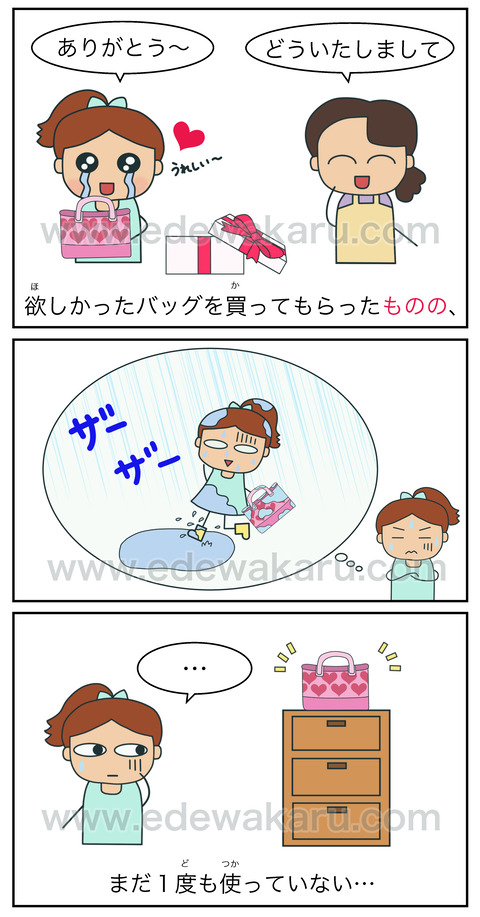
①欲しかったバッグを買ってもらった
ものの、まだ1度も使っていない
【予想されること】欲しかったバッグだから、
毎日使っている
【実際】まだ1度も使っていない
②あのレストランは高い
ものの、とても人気がある
【予想されること】高いから、
人気がない
【実際】とても人気がある
③部長になった
ものの、給料が上がらない
【予想されること】部長になったから、
給料が上がる
【実際】給料が上がらない
「〜ものの」も「もの」シリーズの1つとして覚えておくといいと思います😉
【「もの」シリーズ】
〜たいものだ・〜てほしいものだ
〜たものだ
〜たものではない
〜というもの(Nというもの)
〜ないものだろうか
〜ないものは〜ない
〜もの・〜んだもの
〜ものか
〜ものがある
〜ものだ(感慨)
〜ものだ(本来の性質・一般的な考え方)
〜ものだ・〜ものではない
〜もので・〜ものだから
〜ものと思っていた
〜ものなら
〜ものの
〜ものを
〜ようものなら
In context 4 examples
欲しかったバッグを買ってもらったものの、まだ1度も使っていない
→欲しかったバッグを買ってもらったが、まだ1度も使っていないあのレストランは高いものの、とても人気がある
→あのレストランは高いけれども、とても人気がある部長になったものの、まったく給料が上がらない
→部長になったけれども、まったく給料が上がらない(復習:まったく〜ない)大学を卒業したものの、仕事が見つからない
→大学を卒業したが、仕事が見つからない
日本語文型辞典
Meaning
過去の出来事や現在の状況を述べて、「だがしかし…」と文を続けるのに用いる。後ろには、前に述べられたことから普通に予測されることが起こらない、起こりそうにないという表現が続く。①は「高いから売れないはずだがよく売れる」の意。③の「出来るといったのにむずかしい」など自分の言ったことや、したこと、ある状態に対して、その後の事態に自信が持てない、実現がむずかしいなどの表現が続くことが多い。
「一般的に推測されることがあてはまらない」ことを表す。①は「四月はふつうならあたたかく桜の咲く季節だが、今年はそうではない。」の意味。③のようにことわざなどに続けて使われることが多い。
前のことがらから予想されることと違う事態が続くことを表す。「それはそうなのだが」「しかし」という意味。
How to use it
…ものの
…とはうものの
とはいうものの
In context 13 examples
輸入果物は、高いもののめずらしいらしく、人気があってよく売れている。
新しい登山靴を買ったものの、忙しくてまだ一度も山へ行っていない。
今日中にこの仕事をやりますと言ったものの、とてもできそうにない。
自然の多い郊外に家を買ったものの、休みの日は寝てばかりだ。
次の企画を始めるお金はあるものの、アイデアがなくて困っている。
招待状は出したものの、まだほかの準備は全くできていない。
先月仕事で久しぶりに東京へ行った。大学時代の友人に電話でもかけてみようとは思ったものの、忙しさにまぎれて、つい、そのままにしてしまった。
四月とはいうものの風がつめたく、桜もまだだ。
相手は子供とはいうものの、なかなか手ごわい。
「石の上にも三年」とは言うものの、こんなに訓練がきびしくてはやめたくなる。
人間は平等だとはいうものの、この世は不平等なことばかりだ。
大学時代は英文字専攻だった。とはいうものの、英語はほとんどしゃべれない。
車庫付きの家も買ったし、すっかり結婚の準備は整っているとはいうものの、肝心の結婚相手がまだ見つかっていないのが悩みだ。
日本語文型辞典 英語版
Meaning
Mentioning a past event or a current situation, used to continue the sentence and means “but/however....” Afterwards, the sentence usually continues with a statement that what was expected to occur did not or does not look likely to occur.
Example
(1)
means “they are expensive and, therefore, not likely to sell well and yet they do.” With phrases such as やるといったのにむずかしい in example
(3)
, phrases which express that “(the speaker) has no confidence in the situation that is to follow” or “it is difficult” often continue the sentence and relate to a thing they have said, or done, or to a particular circumstance.
This means that something which is generally thought does not apply. Example
(1)
means that “usually in April it is warm and cherry blossoms bloom, but this year that is not the case.” As in example
(3)
, it is often used in proverbs or maxims.
Expresses that the situation is different than what would be expected as a result of the previous statement. Means “that may be so but” or “however.”
How to use it
1. ...ものの
2. ...とはいうものの
3. とはいうものの
In context 13 examples
輸入果物は、高いもののめずらしいらしく、人気があってよく売れている。
Imported fruit is expensive, but perhaps because people seem to find it unusual, it is popular and sells well.
新しい登山靴を買ったものの、忙しくてまだ一度も山へ行っていない。
I bought new hiking boots, but I’ve been busy and have yet to go to the mountains even once.
今日中にこの仕事をやりますと言ったものの、とてもできそうにない。
I said I would finish this work by the end of today, but it doesn’t look at all possible.
自然の多い郊外に家を買ったものの、休みの日は寝てばかりだ。
I bought a house in the suburbs with lots of undisturbed nature (close by), but on my days off I just sleep.
次の企画を始めるお金はあるものの、アイデアがなくて困っている。
I have the money to start the next project, but I just can’t come up with any ideas for it.
招待状は出したものの、まだほかの準備は全くできていない。
I have sent out the written invitations, but I still haven’t been able to do any other preparations at all.
先月仕事で久しぶりに東京へ行った。大学時代の友人に電話でもかけてみようとは思ったものの、忙しさにまぎれて、つい、そのままにしてしまった。
Last month I went to Tokyo for the first time in a long time on business. I wanted to give one of my college friends a call or something, but I ended up being so busy that it ultimately never happened.
四月とはいうものの風がつめたく、桜もまだだ。
Although it is April, the wind is cold and the cherry blossoms are late.
相手は子供とはいうものの、なかなか手ごわい。
Although just a child, the opponent is pretty tough.
「石の上にも三年」とは言うものの、こんなに訓練がきびしくてはやめたくなる。
They say “perseverance prevails” (lit. three years on a (cold) stone (will make the stone warm)), but training like this is hard and makes me think about quitting.
人間は平等だとはいうものの、この世は不平等なことばかりだ。
All people are equal, but this world is full of inequalities.
大学時代は英文学専攻だった。とはいうものの、英語はほとんどしゃべれない。
I majored in English literature in college. Having said that, I can barely speak English.
車庫付きの家も買ったし、すっかり結婚の準備は整っている。とはいうものの、肝心の結婚相手がまだ見つかっていないのが悩みだ。
I have bought a house with a garage and all the preparations for marriage are in order. Be that as it may, the crux of the problem is that I still haven’t found someone to marry.
くらべてわかる日本語表現文型辞典
Meaning
意味1:Aは認めるがAから予想できない、Aにつながらない結果、状態、事実がB。Aは事実、あるいは確実性の高い未来のこと。
意味2:AとBを対比し、軽い逆接でつなぐ表現。話し手の言いたいことはB。
How to use it
AもののB(AとはいうもののB)
[動詞]ものの
[イ形-普]ものの
[ナ形-な/である/だった/ではない]ものの
[名詞-である/ではない/だった]ものの
[文]とはいうものの
Explanation
【対比1】
「AにもかかわらずB」(意味1 P.262)
「AとはいえB」(意味1 P.185)
「AといってもB」(意味1 P.160)
「AとはいいながらB」(意味1 P.183)
「AからといってB」(意味1 P.69)
Notes
【注意1】
・「AもののB」のAに未来の出来事が来る場合、かなり確実性の高いものでなければ使えないが、「AとはいうもののB」は、Aという情報を得たが…という意味になり、確実性の低いものでも使える。
○あした雨が降るとはいうものの、彼は釣りに行くとはりきっている。
×あした雨が降るものの、彼は釣りに行くとはりきっている。
○来月、出張が決まっているとはいうものの、父の容態が心配だ。
○来月、出張が決まっているものの、父の容態が心配だ。
【注意2】
・AとBは入れ替えられるが話し手の言いたいことは変わる。
In context 8 examples
あの店は値段は安いものの、サービスは最低だ。
雪男の存在は確認されなかったものの、足跡らしきものは発見できた。
この会社の入社試験は、筆記は簡単なものの面接が難しいらしい。
大学を卒業したとはいうものの、就職先が見つからない。
彼女は子どもの頃、数学の成績は悪かったものの、国語はよかった。
日本家屋は、夏は涼しいものの、冬は寒いという欠点がある。
長女は活発なものの、次女は物静かだ。
車に乗って行ったので、料理は食べたものの、酒は飲まなかった。
日本語NET JLPT文法解説まとめ
Meaning
だけれども
How to use it
V(普通形) + ものの
イA(普通形) + ものの
ナAである + ものの
Nである + ものの
Explanation
"It is true that it is ~ however."
Indicate that expectations or wishes based on certain established facts mentioned in the first clause differ from reality.
In context 12 examples
東京大学を卒業したものの、就職難で仕事が見つからない。
予約したものの、行くかどうか、まだ迷っている。
日本で2年、日本語を勉強したものの、全然上手にならなかった。
暖かくなってきたとはいうものの、まだまだ冬です。
長年日本語を学んでいるものの、話す力がなかなか身につかない。
今の会社は給料は安いものの、人間関係がいいので満足している。
彼は言葉遣いは丁寧なものの、態度が良くないので、印象が悪い。
最近の若者は就職したものの、すぐにやめてしまう人が多い。
頭ではわかっているものの、実際に言葉で説明するのは難しい。
日本語で基本的なコミュニケーションはできるようになったものの、まだテレビや映画の内容は全然理解できない。
バイクで派手に転倒したものの、軽傷で済んだ。
彼女から誕生日に時計をもらったものの、実はあまりデザインが好きじゃなく、一度もつけていない。
毎日のんびり日本語教師
Meaning
しかし
How to use it
動詞名詞修飾形+ものの
な形容詞動詞修飾形+ものの
い形容詞動詞修飾形+ものの
名詞+である+ものの
Explanation
既に発生したこと対して用いる。
「しかし」とほぼ同じで、それよりも硬い表現。
後項には、前項に対応する事柄がまだ行われていないか、通常起こらない、起こりそうにないことを述べる。
後項には自信がなかったり、実現困難なことが続くことが多い。
Notes
「~とはいうものの」は慣用表現(虽说…)。
In context 5 examples
五十音は発音できるようになったものの、書けと言われれば自信がない。
歩いて帰ると言ったものの、雨が降ってきたので結局タクシーで帰った。
頭から落ちたものの頭部は骨折しなかった。
咳はするものの、体調は戻ってきている。
使ってはみたものの、しっくりこない。
NINJAL 日本語文型データベース
Meaning
〜という事実はあるが、そこから考えられることと合う状態ではないと言いたいときに使います。
How to use it
V普通形+ものの
i-A普通形+ものの
na-A普通形+ものの(ただし、「na-Aだ」→「na-Aな+ものの・na-Aである+ものの」)
N普通形+ものの(ただし、「Nだ」→「Nである+ものの」)
Notes
「〜」には、事実か確実性の高いことを表す文がきます。「〜ものの」の後には、「~」から当然想像されることや考えられることとは違うことを表す文がきます。相手への働きかけの文はきません。
In context 21 examples
英語はそこそこ話せるものの、恥ずかしいので友達の前ではあまり話したくない。
やはり転職するべきだろうか。今のままではいけないと頭ではわかっているものの、なかなか一歩を踏み出すことができない。
今日も、35度は超えないものの、まだ厳しい残暑が続きます。
このドレスは気に入って買ったものの、あまり着る機会がない。
脳卒中の発作で、一命は取り止めたものの、言語障害が残った。
この地震で死者は出なかったものの、多くの建物が倒壊し、負傷者は300人に及んだ。
深夜の工事のアルバイトは給料は高いものの、体力的にきつく、けがの危険もある。安易に手を出さないほうがよい。
この研究結果は興味深いものの、実用化に向けてはさらなる研究が必要だ。
この大学は全国的な知名度はさほど高くないものの、教育力には定評がある。
旅行のとき泊まったホテルは、部屋は狭かったものの、観光地に近く便利だった。
転んで頭を打った。特に痛くはなかったものの、心配なので念のために病院で診てもらうことにした。
電気自動車は高価なものの、ランニングコストの面ではガソリン自動車より優れている。
佐藤さんは人前で話すのは苦手であるものの、人柄がよくみんなに信頼されている。
データの修正作業は1つ1つは特に大変ではないものの、量が多いので時間がかかる。
最初は授業についていけるか不安だったものの、予習復習を欠かさず頑張ったので、今では自信が持てるようになった。
レイさんのスピーチは発音や文法は完璧ではなかったものの、すばらしい内容で、観衆の心を打った。
息子はすでに大学生であるものの、考え方がまだ幼い。
オークションサイトに出品されているこの商品は、新品ではないものの、使用回数は少なく、まだきれいな状態だということだ。
天気予報では1日中雨だったものの、午後から時折晴れ間が見えた。
ロケットの打ち上げは失敗だったものの、研究には大きな成果があったと思われる。
昨日の夜は急ぎの作業があって、徹夜ではなかったものの、数時間しか寝られなかった。
IMABI
Combination Particles with もの
Read this IMABI lesson ↗Explanation
第030課: Combination Particles with もの
Just like in Modern Japanese, there are combination particles with もの and they are all conjunctive particles. The particles to be discussed in this lesson are ものを, ものから, ものの, and ものゆゑ(に).
ものを, ものから, ものの, ものゆゑ(に)
Although some have come and gone or changed in nuance, back in Classical Japanese, these four combination particles did the same thing. So, don’t let this be a reason to be confused. All of these particles follow the 連体形. they all may show a concession based on existing conditions. So, they mean “although”. Though ものを and ものの survive today with modified nuances, you have to think in more simplistic terms for this. That should be easy enough to do.
1. 鳴く声も聞こえぬものの悲しきは忍びに燃ゆる蛍なりけり。
Although I couldn’t hear their cries, the sad things were the fireflies hidden and burning.
From the 詞花集.
2. 都出でて君に会はむと来しものを来しかひもなく別れぬるかな。
Although I left the capital, there was no avail in thinking about meeting you, and we ended up parting.
From the 土佐日記.
3. いつはりと思ふ物から今さらにたがまことをか我はたのまむ
Although I think that (that person’s word) is a lie, who’s truth am I to entrust in now?
From the 古今和歌集.
4. 頼まぬものの恋ひつつぞ経る。
Though I rely on you, I pass time longing for you.
From the 伊勢物語.
5. 空蝉うつせみの世の人ごとのしげければわすれぬもののかれぬべらなり。
The rumors of the world are so annoying; though I’ll never forget, I may naturally leave them behind.
From the 古今和歌集.
6. 雖念 知僧裳無跡 知物乎 奈何幾許 吾戀渡 (原文)
思へどもしるしも無しと知るものを何かここだく我が恋ひ渡る
Although I think of you to know avail, why is that I still long for you like this?
From the 万葉集.
7. 春の野に若菜つまむと来しものを散りかふ花に道はまどひぬ。
I came for young greens in the spring field, but scattering flowers blew and obscured my path.
From the 古今和歌集.
8. 将来云毛 不来時有乎 不来云乎 将来常者不待 不来云物乎 (原文)
来むと言ふも 来ぬ時あるを 来じと言ふを 来むとは待たじ 来じと言ふものを
You say you’ll come and don’t, but I wait not for you to say you won’t since you may as you won’t.
From the 万葉集.9. 和我由恵尓 於毛比奈夜勢曽 秋風能 布可武曽能都奇 安波牟母能由恵 (原文)
我が故に思ひな痩せそ秋風の吹かむその月逢はむものゆゑ
Please don’t grow thin thinking of me as I shall moon which the autumn wind does blow.
From the 万葉集.
10. 毎年尓 来喧毛能由恵 霍公鳥 聞婆之努波久 不相日乎於保美 毎年謂之等之乃波 (原文)
年のはに 来鳴くものゆゑ 霍公鳥ほととぎす 聞けばしのはく 逢はぬ日を多み
Every year when I hear the cries of the cuckoo as they come singing, I get this unexplainable feeling. There are too many days I can’t meet them.
From the 万葉集.
11. 月は在明にて光をさまれるものから、不二の峰幽かに見えて。
The moon was that of dawn, and since the light was in check, Mount Fuji’s peak appeared faint.
From the 奥の細道.
12. ふるさとにあらぬ物からわがために人の心のあれてみゆらむ。
You may say a man’s heart is not in his hometown, but why is it that his heart goes to ruin for me?
From the 古今和歌集.
Historical Note:
1. ものを is a combination of the noun もの and the interjectory–not the case particle–を. This explains why even in Modern Japanese it can be seen as a final particle showing a concessive exclamatory statement. Though not normally the case anymore, it did at one point become a causal connector similar to the conjunctive が during the 江戸時代. Nowadays, it shows concession with a sense of the speaker’s discomfort and or dissatisfaction.
13. よど河のよどむとひとは見るらめど流れてふかき心あるものを。
(You probably think that I haven’t been coming and going a while),
although just like that Yodo River’s current is deep I too in my heart think much of you with no end.
From the 古今和歌集.
14. 雀の子を、犬君いぬきが逃しつる、伏籠ふせごの中に、こめたりつるものを。
Inuki let the baby sparrow escape even though I had kept it in the cage!
From the 源氏物語.
15. かたみこそ今はあだなれこれなくばわするる時もあらましものを。
This memento is a resentment that has hurt me even up till now. If I just didn’t have it, I would have time to forget that person.
From the 古今和歌集.
2. ものから came into existence during the 奈良時代 was one of the first phrases where から became a true conjunctive particle. As から became used even more heavily in the spoken language, it eventually made people confused to the point that it turned into a particle with similar meaning to ので. Today you would just use から or ので.
16. 心をぞわりなき物と思ひぬる見るものからや恋しかるべき。
I thought that emotion was irrational. Since I’ve met you, I feel such longing; is this supposed to be?
From the 古今和歌集.
3. ものの got to survive unscathed into Modern Japanese. It’s not used frequently, but you see it often in literature.
4. ものゆゑ(に) has such a good ring to it, yet the only place it has is in 古典. It too could be used to show reason like から. In fact, it can be seen doing this way back in the 万葉集.
In context 19 examples
鳴く声も聞こえぬものの悲しきは忍びに燃ゆる蛍なりけり。
Although I couldn’t hear their cries, the sad things were the fireflies hidden and burning.
都出でて君に会はむと来しものを来しかひもなく別れぬるかな。
Although I left the capital, there was no avail in thinking about meeting you, and we ended up parting.
いつはりと思ふ物から今さらにたがまことをか我はたのまむ
Although I think that (that person’s word) is a lie, who’s truth am I to entrust in now?
頼まぬものの恋ひつつぞ経る。
Though I rely on you, I pass time longing for you.
空蝉うつせみの世の人ごとのしげければわすれぬもののかれぬべらなり。
The rumors of the world are so annoying; though I’ll never forget, I may naturally leave them behind.
雖念 知僧裳無跡 知物乎 奈何幾許 吾戀渡 (原文)
春の野に若菜つまむと来しものを散りかふ花に道はまどひぬ。
I came for young greens in the spring field, but scattering flowers blew and obscured my path.
将来云毛 不来時有乎 不来云乎 将来常者不待 不来云物乎 (原文)
毎年尓 来喧毛能由恵 霍公鳥 聞婆之努波久 不相日乎於保美 毎年謂之等之乃波 (原文)
月は在明にて光をさまれるものから、不二の峰幽かに見えて。
The moon was that of dawn, and since the light was in check, Mount Fuji’s peak appeared faint.
ふるさとにあらぬ物からわがために人の心のあれてみゆらむ。
You may say a man’s heart is not in his hometown, but why is it that his heart goes to ruin for me?
ものを is a combination of the noun もの and the interjectory–not the case particle–を. This explains why even in Modern Japanese it can be seen as a final particle showing a concessive exclamatory statement. Though not normally the case anymore, it did at one point become a causal connector similar to the conjunctive が during the 江戸時代. Nowadays, it shows concession with a sense of the speaker’s discomfort and or dissatisfaction.
(You probably think that I haven’t been coming and going a while),
よど河のよどむとひとは見るらめど流れてふかき心あるものを。
(You probably think that I haven’t been coming and going a while),
雀の子を、犬君いぬきが逃しつる、伏籠ふせごの中に、こめたりつるものを。
Inuki let the baby sparrow escape even though I had kept it in the cage!
かたみこそ今はあだなれこれなくばわするる時もあらましものを。
This memento is a resentment that has hurt me even up till now. If I just didn’t have it, I would have time to forget that person.
ものから came into existence during the 奈良時代 was one of the first phrases where から became a true conjunctive particle. As から became used even more heavily in the spoken language, it eventually made people confused to the point that it turned into a particle with similar meaning to ので. Today you would just use から or ので.
I thought that emotion was irrational. Since I’ve met you, I feel such longing; is this supposed to be?
心をぞわりなき物と思ひぬる見るものからや恋しかるべき。
I thought that emotion was irrational. Since I’ve met you, I feel such longing; is this supposed to be?
ものの got to survive unscathed into Modern Japanese. It’s not used frequently, but you see it often in literature.
ものゆゑ(に) has such a good ring to it, yet the only place it has is in 古典. It too could be used to show reason like から. In fact, it can be seen doing this way back in the 万葉集.