DoJG 日本語文法辞典(全集)
Meaning
(don't) V; should (not); (not) ought to; may not
How to use it
(i) Vinformal nonpast | Affirmative/negative こと | |
| 話すこと | Should speak |
| 話さないこと | Should not speak |
(ii) VNoun | のこと | |
| 使用のこと | Should use |
Explanation
An auxiliary noun to express a command.
In context 9 examples
発表は十五分以内で行うこと。
Each presentation should be completed (literally: done) within fifteen minutes.
プールサイドを走らないこと。
Do not run on the pool deck.
詳細は二十三ページ(を)参照のこと。
See page 23 for details.
私語は慎むこと。
Refrain from whispering.
先に必ずテープを聞くこと。
Be sure to listen to the tape beforehand.
辞書は見ないこと。
You may not consult any dictionaries.
裸足で歩き回らないこと。
Do not walk around barefoot.
弁当(を)持参のこと。
Bring your own lunch.
制服(を)着用のこと。
Wear uniforms.
日本語文型辞典
Meaning
節に付いて、思考・発言・知識などのことがらをその内容に具体的に触れずに表すのに使う。「もの」との違いについては「もの1」参照。
節に付いて、そこで述べられたことがらを事実としてさししめすのに使う。ナ形容詞は①のように「魚がきらいなこと」、または「魚がきらいだということ」となる。
文末で用いて、命令やそうすべきだという話し手の気持ちを表す。規則や守るべき指示をつたえる表現。文章に書かれることが多い。②のように「こととする」で終わる場合もある。
人や物の状態や性質を表す表現に付いて、おどろきや感動などの感嘆の気持ちを表す。③のようなナ形容詞の場合「元気なこと」のように「な」でもよい。話しことば。女性的表現。若い世代は男女ともに使わない。
「XことY」の形でXに通称・ペンネーム・ニックネーム、Yに本名やより公的な名前を入れて使う。「XすなわちY」の意味で、XとYが同一人物であることを表す。書きことば的。
あるものを一つの個体としてではなく、それをとりまく事情・思い出・声や、時にはにおいのようなものにいたるまで、すべてをつつみこんだものとして表す。知覚・思考・感情・言語活動などの動詞の対象を表すときによく使われる。
How to use it
…こと【ことがら】
Nのこと
Naなこと
A/V こと
…(という)こと【事実】
V-る/V-ない こと【命令】
…こと【感嘆】
Nだこと
Na だこと/なこと
A-いこと
V-ていること
NことN
Nのこと
In context 27 examples
なにかおもしろいことないかなあ。
卒業したらやりたいと思っていることはありますか。
私がきのう言ったこと、おぼえてる?
世の中には君の知らないことがまだまだたくさんあるんだよ。
本を読んで思ったこと、感じたことなどは、書名・著者名などといっしょにカードに書いておくとよい。
なんでも好きなことをやってよい。
山田さんが魚がきらいなことを知っていますか。
午後から会議だということをすっかりわすれていた。
きみが将来アフリカに行きたいと思っている(という)ことは、もう彼女に話したのか。
彼は死んでもうこの世にいない(という)ことが、まだわたしには信じられない気がする。
休むときは、かならず学校に達終すること。
期末レポートは、かならず縦書き400字づめ原稿用紙を使用すること(とする)。
体育館には土足ではいらないこと。
教室を投業以外の目的で使用するときは、前もって申請をすること。
まあ、かわいいあかちゃんだこと。
あら、すてきなお洋服だこと。おかあさんに買ってもらったの?
あらあら、元気だこと。でも電車の中でさわいではいけませんよ。
え?この子まだ2才なの?まあ、大きいこと。
このネコ、見てよ。よくふとっていること。病気かしら。
小泉八雲ことラフカデイオ・ハーンはギリシャ生まれのイギリス人だ。
これが、あの太陽王ことフランスのルイ14世が毎日使っていたワイングラスです。
漱石こと夏目金之助は1867年、東京に生まれた。
私のこと、すき?
あなたのことは一生わすれない。
彼女のことはもうあきらめなさい。
パーティーのこと、もう山田さんに言った?
最近私は、どういうわけか、ふとしたひょうしに、ずいぶん前に死んだ祖母のことを考えていることが多い。
絵でわかる日本語
Meaning
〜しなさい
〜しろ
〜してはいけない
〜するな
How to use it
動詞[辞書形]+こと
動詞[ない形]+こと
Explanation
「〜こと」は「〜しなさい」「〜してはいけない」という意味の文型で、注意する時や指示する時に使われます。
動詞の辞書形と使うと「〜しなさい・〜しろ」、動詞のない形と使うと「〜してはいけない・〜するな」という意味になります。
かたい言い方ですので、ほとんどの場合は
書き言葉
として使用されます。
【注意しましょう】
「〜こと」と「〜ことだ」は似ていますが、まったく意味が違う文型ですので間違(街が)えないようにしましょう😨
(復習:〜ことだ・〜ないことだ)
(復習:まったく)
[例]
お酒を飲まない
こと
→お酒を飲ん
ではいけない
(健康になりたければ)お酒を飲まない
ことだ
→お酒を飲まないのが一番いい方法だ
【まとめ】
・〜こと
[意味]
〜しなさい・〜してはいけない
・〜ことだ
[意味]
〜するのが一番いい
〜するのが最善だ
「こと」がつく文型はたくさんありますので、区別をして覚えておきましょう😉
【「こと」シリーズ】
〜こと(命令)
〜ことか
〜ことから
〜ことがある
〜ことができる(可能)
〜ことができる(能力)
〜ことこの上ない
〜ことだ・〜ないことだ
〜ことだから
〜ことだし
〜ことで(Nのことで)
〜こととて
〜ことなしに
〜ことなく
〜ことに
〜ことにしている
〜ことにする
〜ことになっている
〜ことになる・〜こととなる
〜ことには
〜ことは〜が①(形容詞・名詞)
〜ことは〜が②(動詞)
〜ことはない
〜ことはならない
〜たことがある(経験)
〜だこと!
(〜は)〜てのこと
〜ても〜すぎることはない
〜ということだ
〜とのことだ
〜ないこともない
〜ないことには
〜なかったことがある
In context 5 examples
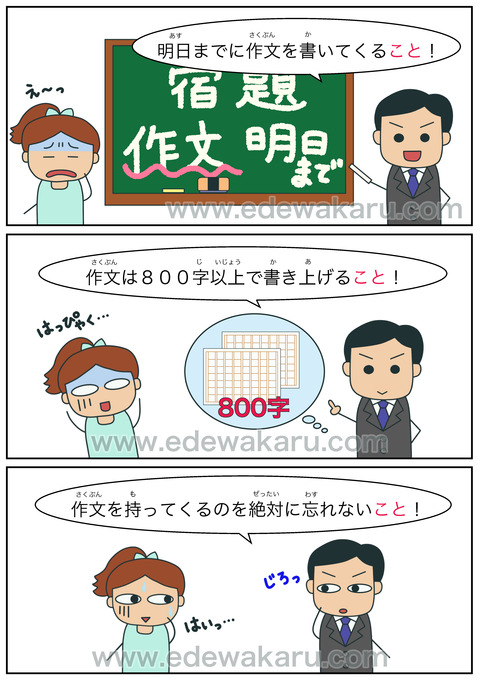
明日までに作文を書いてくること
→明日までに作文を書いてきなさい(復習:〜てくる(継起))作文は800字以上で書き上げること
→作文は800字以上で書き上げなさい(復習:〜上げる)作文を持ってくるのを絶対に忘れないこと
→作文を持ってくるのを絶対に忘れてはいけません授業中(じゅぎょうちゅう)は友達と話さないこと
→授業中は友達と話してはいけませんバイトを休む時は、電話をすること
→バイトを休む時は、電話をしなさい
どんなときどう使う 日本語表現文型辞典
Meaning
(you) should
How to use it
Vる・Vない/する動詞のNの+ことW
Explanation
~しなさい
1)文末に使って、学校、団体などで「~しなさい・~してはいけない」と指示や規則などを書いて伝えるときの表現。
2)黒板や配布用プリントなどに書いたり、時には口で伝えることもある。
1)Used in schools or groups to enforce rules and directives (you should…, you cannot…) by appending to sentence endings.
2)Written on blackboards and in printouts. Sometimes conveyed verbally.
In context 4 examples
レポートは10日までに提出すること。
15日はお弁当を持ってくること。
明日は赤鉛筆を忘れないこと。
11月3日は10時に駅前に集合のこと。
日本語NET JLPT文法解説まとめ
Meaning
~しなさい / ~してください
指示や規則などを書いて伝えるときの表現。(口で伝えることもある。)
How to use it
V(辞 / ナイ) + こと
Nの + こと
※Nはする動詞のN
Explanation
you should
In context 4 examples
テストのときは携帯電話はカバンの中にしまうこと。
明日は9時に教室前に集合のこと。
レポートは来週の火曜日までに提出すること。
お弁当は各自持ってくること。
毎日のんびり日本語教師
How to use it
名詞+こと+名詞
Explanation
「AことB」の文型を取り、前項ではある人物の愛称やあだ名、一般的な呼び方を示し、後項ではその人物の本名あるいは正式な呼び名がきます。前項と後項が示す人物は同一人物でなければいけません。
書き言葉で用いられます。
Notes
特になし
In context 5 examples
ガッキーこと、新垣結衣が2018年6月11日に30歳の誕生日を迎えた。(Gakki,新垣结衣在2018年6月11日迎来了30岁的生日。)
キムタクこと木村拓哉主演のドラマ『グランメゾン東京』が好調だ。(木村拓哉主演的电视剧“Granmenzon东京”很受欢迎。)
「ホリエモン」こと堀江貴文氏は、最近はYouTuberとしても注目されている。(“Holiemon”堀江贵文先生,最近作为YouTuber也备受瞩目。)
山Pこと山下智久は国内外問わず人気がある。(山P即山下智久在国内外都很受欢迎。)
将棋の第67期王座戦五番勝負第3局では、挑戦者の「軍曹」こと永瀬拓矢叡王(27)が「さいたろう」こと斎藤慎太郎王座(26)に勝ち、3連勝で王座を奪取し、自身初の二冠となった。
日本語文型辞典 英語版
Meaning
...こと attaches to a clause and is used to indicate a thought, statement, or piece of knowledge, without referring concretely to its content. For the difference between こと and もの, see Usage 1 of もの.
ことis attached to a clause and used to indicate that the thing stated in the clause is a fact. In the case of na-adjectives, it takes the form 魚がきらいなこと, as in
(1)
, or 魚がきらいだということ.
When used at the end of a sentence, こと expresses an imperative or a feeling on the part of the speaker that something should be done. Conveys rules or directions to be observed. Often used in writing. Can end in こととする, as in
(2)
.
Attaches to expressions that indicate a state or characteristic of a person or thing. Conveys a sense of wonder, surprise, or admiration. When na-adjectives are used, as in
(3)
, な can be used instead of だ (in this case, 元気なこと). Spoken language. Feminine expression. Not used by either males or females who belong to the younger generation.
1
8
6
7.
こと is used in the pattern XことY, where X denotes the name a person is generally known by, a pen name, or a nickname, and Y denotes his/her real name or more official name. Means “X, in other words Y” and shows that X and Y are the same person. More common in written language.
Expresses something not as an independent entity but as an integrated whole that encompasses everything surrounding it, including circumstances, memories, voices, or even in some cases things like smell. Often used to indicate the object of verbs of perception, thought, emotion, or linguistic activity.
How to use it
1. ...こと〈thing, matter〉[Nのこと][Na なこと][A/V こと]
2. ...(という)こと〈fact〉
3. V-る/V-ない こと〈imperative〉
4. ...こと〈admiration, wonder〉[Nだこと][Na だ/なこと][A-いこと][V-ていること]
5. NことN
6. Nのこと
In context 27 examples
なにかおもしろいことないかなあ。
I wonder if there’s something interesting...?
卒業したらやりたいと思っていることはありますか。
Is there something you hope to do after graduation?
私がきのう言ったこと、おぼえてる?
Do you remember what I said yesterday?
世の中には君の知らないことがまだまだたくさんあるんだよ。
There are still so many things in the world that you don’t know.
本を読んで思ったこと、感じたことなどは、書名・著者名などといっしょにカードに書いておくとよい。
It’s good to make notes on cards about what you think or feel when you read a book, along with the title, name of the author, and so on.
なんでも好きなことをやってよい。
You can do whatever you want to do.
山田さんが魚がきらいなことを知っていますか。
Do you know that Yamada-san doesn’t like fish?
午後から会議だということをすっかりわすれていた。
I completely forgot that there was a meeting in the afternoon.
きみが将来アフリカに行きたいと思っている(という)ことは、もう彼女に話したのか。
Have you already told her that you want to go to Africa in the future?
彼は死んでもうこの世にいない(という)ことが、まだわたしには信じられない気がする。
I still can’t believe that he is dead and no longer in this world.
休むときは、かならず学校に連絡すること。
Be sure to contact the school when you are absent.
期末レポートは、かならず縦書き 400 字づめ原稿用紙を使用すること(とする)。
The final term paper must be written vertically on 400-character manuscript paper.
体育館には土足ではいらないこと。
Do not enter the gymnasium with your shoes on.
教室を授業以外の目的で使用するときは、前もって申請をすること。
You must apply for permission in advance in order to use a classroom for non-class related purposes.
まあ、かわいいあかちゃんだこと。
My, what a cute baby!
あら、すてきなお洋服だこと。おかあさんに買ってもらったの?
My, what a lovely outfit! Did your mother buy it for you?
あらあら、元気だこと。でも電車の中でさわいではいけませんよ。
Now, now—you've got lots of energy! But you can't roughhouse when we're on the train, you know.
え? この子まだ2才なの? まあ、大きいこと。
What? This child is only two? My, how big she is!
このネコ、見てよ。よくふとっていること。病気かしら。
Take a look at this cat. It's so fat. I wonder if it’s sick.
小泉八雲ことラフカディオ・ハーンはギリシャ生まれのイギリス人だ。
Lafcadio Hearn, known as Koizumi Yakumo, was an Englishman born in Greece.
これが、あの太陽王ことフランスのルイ 14 世が毎日使っていたワイングラスです。
This is the wine glass that the French King Louis XIV, known as the Sun King, used every day.
漱石こと夏目金之助は 1867 年、東京に生まれた。
Natsume Kinnosuke, known as Soseki, was born in Tokyo in
私のこと、すき?
Do you like me?
あなたのことは一生わすれない。
I will never forget you for the rest of my life.
彼女のことはもうあきらめなさい。
It's time you gave up on her.
パーティのこと、もう山田さんに言った?
Did you already tell Yamada-san about the party?
最近私は、どういうわけか、ふとしたひょうしに、ずいぶん前に死んだ祖母のことを考えていることが多い。
These days, I don’t know why, but I often find myself all of a sudden thinking about my grandmother, who passed away quite long ago.
AIUEO JLPT Grammar
Usage 1
Meaning
「こと」is a formal noun used to refer to abstract matters, concepts, experiences, events, facts, or intentions.
How to use it
動詞+こと形容詞+こと形容動詞な+こと名詞の+こと
Explanation · 日本語
「こと」は、抽象的な事柄や概念を表すときに使われる形式名詞で、経験、出来事、事実、意図などを表すために広く用いられます。
In context 5 examples
今日はいいことがありました。
Something good happened today.
健康に気をつけることが大切です。
It is important to take care of your health.
旅行で楽しいことがたくさんありました。
There were many enjoyable things during the trip.
家族のことを大切にしています。
I cherish my family.
研究することが好きです。
I like doing research.
Usage 2
Meaning
This sentence pattern is commonly used in formal written instructions or regulations to command or forbid specific actions.
How to use it
動詞辞書形+こと動詞ない形+こと
Explanation · 日本語
この文型は、一般的には書面での命令や指示を表す表現で、公式な文書や規則、指示などで使用され、特定の行動をするように、またはしないように指示するときに使われます。
In context 5 examples
期日までに必ず報告書を提出すること。
Be sure to submit the report by the deadline.
他者への感謝の気持ちを忘れないこと。
Do not forget to show gratitude to others.
安全運転のため、交通ルールを守ること。
For safe driving, follow traffic rules.
火災発生時には、冷静に対応すること。
In case of a fire, act calmly.
感染予防のため、食事の前に手を洗うこと。
To prevent infection, wash your hands before eating.
文法
Meaning
~しなさい / ~してください指示や規則などを書いて伝えるときの表現。(口で伝えることもある。)
How to use it
V(辞 / ナイ) + こと
Nの + こと
※Nはする動詞のN
In context 4 examples
テストのときは携帯電話はカバンの中にしまうこと。
明日は9時に教室前に集合のこと。
レポートは来週の火曜日までに提出すること。
お弁当は各自持ってくること。
Bunpro Grammar Reference
Meaning
Converting a verb into a noun
How to use it
Verb + こと
Nuance
A word that transforms whole phrases into single, noun-like expressions.
Explanation
In a very similar way to のは, こと is used in Japanese for nominalization (creating a noun-like phrase). However, unlike のは, which is a combination of two particles, こと is a noun. To use こと, just add it to the end of a verb in its dictionary form.
こと (or 事 in its kanji form) is a noun that is often translated as 'thing', and in this way, literally means 'the thing that is (A)' when used for nominalization.
近所の迷惑になることをしてはいけない。
You should not do things that will cause annoyance to your neighbors. (That which is 'causing a problem in the neighborhood')
ファックスをすることが嫌い。
I dislike things like faxing. (That which is 'faxing')
お金を使い過ぎないことが大事です。
It is important to not use too much money. (That which is 'not using too much money')
As we can see from these examples, ない can also be used between the verb and こと, to form a 'not' statement. There are other auxiliary verbs that may be used with こと in this way, but ない is the most common.
Although this lesson discusses こと pairing with the dictionary form of verbs, it can actually pair with any standard verb form. Standard form just means anything that does not finish with the polite ます.
Fun Fact
Unlike もの (another noun used to describe 'things'), こと is a noun that is frequently used to describe things that are 'intrinsic'. This basically means things that are describable, but not necessarily always observable (feelings, conditions, events, etc.).
Caution
When a sentence (usually short) finishes with こと, it quite often has the nuance of being a rule, or command. This こと is not actually a noun, but a sentence ending particle.
1.クラスメイトをいじめないこと。
1. Do not bully your classmates.
こと as a particle will almost never be written in the kanji form. However, it does originate from the same word.
Nuance · 日本語
全体のフレーズを一つの名詞みたいな表現に変える言葉。
In context 16 examples
- 日本語を話すことは難しい。
Speaking Japanese is difficult.
- 近所の迷惑になることをしてはいけない。
You should not do things that will cause annoyance to your neighbors. (That which is 'causing a problem in the neighborhood')
- ファックスをすることが嫌い。
I dislike things like faxing. (That which is 'faxing')
- お金を使い過ぎないことが大事です。
It is important to not use too much money. (That which is 'not using too much money')
- スポーツをすることが好き。
I like playing sports.
- ダンスをすることは楽しい。
Dancing is fun!
- 大きい声で喋らないこと。
Not talking loudly.
- フォークじゃなくて、お箸を使うこと。
Not using a fork, using chopsticks.
- 健康にいいのは寝ることです。
Sleeping is good for your health.
- 職場でワープロを使うことはある?
Are there times when you are using a word processor at work?
- 毎日日本語を勉強することは楽しいです。
Studying Japanese every day is fun.
- 想像することは大切なことです。
Using your imagination is important.
- プラスチックを捨てることは環境に悪いよ。
Throwing away plastic is bad for the environment, you know.
- この部屋の中で遊ぶことはしないでください。
Please do not play in this room. (Not playing in this room)
- どんどん太るから、寝る前に甘いものを食べないことが大事です。
Not eating sweets before bed is important because you will rapidly gain weight (if you do).
- 1.クラスメイトをいじめないこと。
1. Do not bully your classmates.
NINJAL 日本語文型データベース
Meaning
強く指示するとき使います。
How to use it
Vること/Vないこと
Notes
「こと。」の形で文末に使います。
「〜」には意志的な行為を表す動詞がきます。
多くは注意書きなど、書き言葉で使います。
立場が上の人には使いません。
In context 8 examples
出かけてきます。晩ご飯の前に宿題をすること。
レポートは期日までに必ず出すこと。
門限は11時です。それまでに寮に帰ること。
自転車は決められた自転車置き場に置くこと。
この池で釣りをしないこと。
試験中、隣の人と話をしないこと。
明日は8時に駅に集合。ぜったい遅刻しないこと。
この公園の中ではサッカーや野球などのボール競技はしないこと。
IMABI
Nominalizers: の, こと, & もの
Read this IMABI lesson ↗Explanation
Nominalizers: の, こと, & もの
This lesson formally introduces you to the topic of “nominalization,” and specifically through the use of three of the most common nominalizers. First, let’s define both “nominalization” and “nominalizer” for the purpose of this discussion:
Nominalization: The grammatical process of rendering one part of speech, such as a verb or adjective, or even entire phrases and abstract nouns, into a single nominal phrase that functions as a noun, which may be done out of grammatical necessity or for some other purpose.
Nominalizer: There are three primary morphemes which may be used to nominalize something: the particle の, こと, and もの. These morphemes are collectively referred to as dummy nouns (形式名詞).
The Nominalizers の and こと
The nominalizers の and こと are both used to nominalize predicates to have them rendered as nouns syntactically, although the degree to which the resultant “noun” is noun-like is limited. At a basic understanding, the nominalizers の and こと semantically differ largely on perceived objectivity/subjectivity of the resultant statement formed.
An objective perspective is one that is not influenced by personal emotions, static in its relationship to truth statements, whereas a subject perspective would (heavily) interject emotional appeal to whatever statement is being made.
Relating all this to these nominalizers, 事 as a standalone noun1, not to be confused with its dummy function used as a nominalizer, can be translated as “matter/thing,” but it can also be translated as “circumstance.” It is this latter translation that serves as a bridging context with its nominalizer function, which is why it appears in so many constructions involving nominalizing verbal/adjectival predicates for the purpose of denoting factual statements from an objective point of view.
1. 見ることは信ずる2ことである。
Seeing is believing.
Judging whether a statement is objective or subjective is not an “all-or-nothing” dynamic. Rather, certain grammatical structures lean one way or another, creating the syntactical and desired emotional framework for what the speaker is aiming to get across. Here, the underlying structure is XはYである. Here, X and Y must both be nouns, and a sense of grammatical parallelism is enforced to make the resultant definition of X as Y. While believing whether “seeing is believing” can be a subjective debate to be had, within the confines of this sentence, こと is used as opposed to の because 見ること and 信ずること are being treated as distinct entities=circumstances that can be defined.
Meanwhile, a more subjective-leaning construction will likely involve the nominalizer の. Although it does derive from the particle の, as a nominalizer, it functions as a dummy noun. just like こと.
2. お二人が会うのは初めてですか。
Is this the first time you two have met?
The speaker (one asking the question) does not know the nature of the meeting of the two people in question. Truly, [初めてですか] is an educated guess at best, which speaks to the subjectivity of the statement as a whole. Compare this with Ex. 3, which is objectively clear about the circumstance surrounding [会うこと].
3. 私自身マッチングアプリの男性と会うことは初めてで不安です。
It’s my first time meeting a guy on an dating app, and I’m anxious about it.
Subjectivity is not always about there being an emotional appeal in the sentence. Here, the speaker is speaking about their own experience in the making, and descriptions of one’s own emotions are a reflection of one’s reality. Conjecture regarding that reality would be subjective, but, as is a common theme when debating over whether to use こと or の, is irrelevant in the context of this sentence. In the next set of examples, however, the subjectivity behind the claim made in Ex. 5 starkly differs from the generic, objective statement of fact in Ex. 4.
4. カナダが寒いことに気づいた。(Objective)
I just noticed that Canada is cold.
5. カナダってペンギンも生きれるほど寒いのに気づいたんだ!(Subjective)
I realized that Canada is cold enough for penguins to even live!
Next, for Exs. 6-10, こと is the correct nominalizer. In each sentence, the predicate encased in [] is a concrete circumstance whose truth statement is not contingent on emotional biases.
6. [彼が有名ゆうめいな音楽家おんがくかだという]ことを知りませんでした。
I didn’t know that he is a famous musician.
7. [彼女が昨夜遅さくやおそく帰ってきた]ことを知ってた。
I’ve known that she came home late last night.
8. [新鮮しんせんな息いきを吸すう]ことは素晴すばらしい。
Breathing fresh air is wonderful.
9. [警察けいさつが今ここにある]ことは疑うたがえない。
You can’t doubt that there are police here now.
10. [歌う]ことは諦あきらめていただけに[偶然ぐうぜん(に)初舞台はつぶたいを踏ふめた]ことはとても嬉うれしかったです。
Since I had given up singing, being able to debut by chance was very delightful.
For Exs. 11-19, the correct nominalizer is の. The contexts in which の are used are actually more varied than with こと, which is thanks to not being limited to things that are objective statements of reality, which makes it perfect for personal observations that may still be faulty.
11. 恋人こいびとたちは一緒いっしょにサンバを踊おどるのをやめました。
The couple stopped dancing the samba together.
12. 教育を受けるのは当たり前だ。
Receiving an education is only natural.
13. 毎日散歩まいにちさんぽするのは健康けんこうにとてもいいようです。
It seems that going for a walk every day is very good for your health.
14. 容疑者ようぎしゃがその部屋から慌あわてて出てくるのを見ましたよ。
I saw the suspect come out flustered from the room.
15. 宿題をしないで授業じゅぎょうに来るのはよくないです。
It’s not good to come to class without having done our homework.
16. 彼女の電話番号を調べるのに時間がかかった。
It took a lot of time to find her phone number.
17. 日本が経済大国になれたのは、何と言ってもアメリカのおかげではないと思います。
No matter what they say, I don’t think that Japan was able to become an economic power thanks to America.
18. 単純労働でお金を稼ぐのは大変だ。
It is difficult to earn money by simple labor.
19. 明らかに情報をもう一度目を通すのは当然ですよ。
It’s evident that we clearly look over the information once more.
こと & の As Pronouns
A similar yet different environment in which こと vs の is also apparent is when they act more as pronouns as opposed to (dummy) nouns. Here, instead of objectivity/subjectivity being the deciding factor, how exactly they replace the referent noun is what distinguishes them.
By using the pronoun の, it is clear within context that it is replacing a concrete noun that is readily inferable in said context.
By using こと, while it is clear that it means “thing,” what “thing” in particular is in the air, and it is the context that seeks to provide that clarity.
The choice between the two can also affect what sort of structures are used in tandem and how predicates with multiple meanings are ultimately interpreted (Exs. 20-22b.).
20. ドライブ中に聞く曲は、どんなのを聞いていますか。
As for the songs you listen to while driving, what kinds have you been listening to?
21a. 「どんなことを聞きましたか」「亮太君が京都に行ったか聞きました」
“What sort of thing did you ask?” “I asked whether Ryota-kun went to Kyoto.”
22b. 「どんなことを聞きましたか」「亮太君が京都に行っていると聞きました」
“What sort of thing did you hear?” “I asked whether Ryota-kun had gone to Kyoto.”
23. 生うまれたのも育ったの3もニューヨークです。
I was born and raised in New York.
24. 生まれたのは中国だが、国籍はインドネシアだ。
I was born in China, but my nationality is Indonesian.
25. もう一つ君に尋たずねたいことがある。
There’s another thing I’d like to ask you about.
26. 先生、もう一つ伺いたいことがあるんですけれども(よろしいですか)。
Sensei, there is one other thing that I would like to ask about. (Is that okay?)
27. あたし、そんなことはいわんかったわ。(Feminine; dialectical)
I didn’t say anything like that!
28. (あなたが)見たことを話してくださいませんか。
Could you tell me what you saw?
29. 彼女のいうことを真まに受うけたな。
You took her at her word, didn’t you?
Noun + のこと
At a basic understanding, there are two different yet intertwined functions of こと. The first is to focus on a certain action or state as the object of attention. The other is to expand the scope of something to encompass the situation surrounding it. In this latter sense, it abstracts. At face value, this seems like the opposite of focusing. However, this isn’t really the case.
When こと attaches itself to verbs and adjectives, which in both cases could involve an entire sentence, こと packs up these expressions into a noun phrase, making it refer to the action/state at hand. This is the focusing aspect. When it follows a noun, however, it’s following something that is already concrete to some extent. By using こと, which literally means “matter/circumstance,” you are no longer literally talking about the physical entity at hand. Rather, you’re talking about its essence, which is truly the matter at hand.
30. あの事件のことをよく覚えています。
I remember that incident well.
Sentence Note: In this example, the speaker remembers a lot about the incident. If のこと were omitted, the speaker would still remember that the incident happened, but it would not necessarily sound that he/she knows much about the incident.
31. ピザのことをピッツァーと言う人がいます。
There are some people who pronounce “piza” as “pittsā.”
32. この文は現在のことを言っています。
This sentence is talking about the present.
33. 誰の事を指しているんですか。
Who are you referring to?
34. 私たちはまだまだこの大きな地球のことを理解していないのです。
We still do not understand this great planet of ours.
35. 自分のことをどのくらい知っていますか。
How much do you know about yourself?
36. これからのことを考えるのは賢いですね。
It sure is wise to think about the future?
37. 日本語を話せる人の間では常識のことだ。
It’s common sense among Japanese speakers.
38. 僕のことがすき?
Do you like me?
In Ex. 38, the speaker is asking the listener not just that the listener likes “him” in the mere sense of physical attraction. The speaker is asking if that individual likes him at a personal level as well. In the case of 好きだ and 嫌いだ, the use of のこと also helps solve semantic ambiguity between two possible interpretations. If the sentence were just 僕が好き?, it would normally be interpreted as “do you like me?” but it could also mean “Do I like…?” depending on the context. The use of のこと, thus, helps bring clarity to what is the object at hand.
Adverb + ~のこと
Oddly enough, when ~のこと follows adverbs, the resulting phrase is still an adverb, but the emphasis is heightened, as if making the implication of said adverb sound more like a “big deal” than it otherwise would be perceived as.
39. もちろん(のこと)、あいつは失敗した。
Of course that guy failed.]
Adjective + ~こと = Adverb?
長いこと
The phrase 長いこと, literally meaning “being a long (time)” in the context of time, can be used adverbially for a “long time,” much like how “great deal of time” can also be used adverbially in English for the same nuance.
40. 長いこと待つ。
To wait for a long time.
The Nominalizer もの
The nominalizer もの, also seen colloquially as もん, derives from the noun 物, which refers to any thing. Unlike the other nominalizers, the use of もの implies that the statement is undoubtedly true.
41. 油あぶらは水に浮うくものだ。
Oil floats on water.
42. 子犬になりたいものですわ!(Feminine)
I want to become a puppy!
You may also see the nominalizer もの in the pattern よく~たものだ, which is used to refer to habitual actions in the past that the speaker is reminiscing about.
43. よく金曜日に海で泳いだものだね。
I used to swim in the sea on Fridays, you know.
もの・物・者
もの can be anything. This もの can be in particle constructions like above. 物 is a tangible (and possibly living) thing or force, used in many set expressions. When specifically used to refer to people and written in kanji as 者, it is used in a very humble/condescending tone.
44. 物ものの怪けにとりつかれる。
To be possessed by an evil spirit.
45. 物も言いようで角かどが立つ。
People may be offended by the way you speak.
46. 物の数分もしないうちに
In no more than a few minutes.
47. 物言ものいえば唇くちびる寒さむし。(Proverb)
Least said, soonest mended.
48. 早い者もの勝がち。
First come, first served.
As a nominalizer, こと is usually spelled in hiragana. However, 事 is still preferred by a not-so-small minority of writers, and writing in kanji is more common the older the work you are reading is. For means of disambiguating, in this lesson, the nominalizer こと will not be spelled in kanji for easier identification. ↩︎
信ずる is the traditional 連体形 of the verb 信ず, which is the traditional 終止形 of the verb 信じる meaning “to believe.” These so-called zuru-verbs are the traditional equivalent of their modern jiru-verb equivalents. Both constitute a single group that corresponds to suru-verbs which involve the voicing of する upon being attached to the root Sino-Japanese morpheme. ↩︎
It may even be the case that の is used in place of a thing, person, or place. In this case の refers to the city that the speaker was raised in. ↩︎
In context 48 examples
見ることは信ずる2ことである。
Seeing is believing.
お二人が会うのは初めてですか。
Is this the first time you two have met?
私自身マッチングアプリの男性と会うことは初めてで不安です。
It’s my first time meeting a guy on an dating app, and I’m anxious about it.
カナダが寒いことに気づいた。(Objective)
I just noticed that Canada is cold.
カナダってペンギンも生きれるほど寒いのに気づいたんだ!(Subjective)
I realized that Canada is cold enough for penguins to even live!
[彼が有名ゆうめいな音楽家おんがくかだという]ことを知りませんでした。
I didn’t know that he is a famous musician.
[彼女が昨夜遅さくやおそく帰ってきた]ことを知ってた。
I’ve known that she came home late last night.
[新鮮しんせんな息いきを吸すう]ことは素晴すばらしい。
Breathing fresh air is wonderful.
[警察けいさつが今ここにある]ことは疑うたがえない。
You can’t doubt that there are police here now.
[歌う]ことは諦あきらめていただけに[偶然ぐうぜん(に)初舞台はつぶたいを踏ふめた]ことはとても嬉うれしかったです。
Since I had given up singing, being able to debut by chance was very delightful.
恋人こいびとたちは一緒いっしょにサンバを踊おどるのをやめました。
The couple stopped dancing the samba together.
教育を受けるのは当たり前だ。
Receiving an education is only natural.
毎日散歩まいにちさんぽするのは健康けんこうにとてもいいようです。
It seems that going for a walk every day is very good for your health.
容疑者ようぎしゃがその部屋から慌あわてて出てくるのを見ましたよ。
I saw the suspect come out flustered from the room.
宿題をしないで授業じゅぎょうに来るのはよくないです。
It’s not good to come to class without having done our homework.
彼女の電話番号を調べるのに時間がかかった。
It took a lot of time to find her phone number.
日本が経済大国になれたのは、何と言ってもアメリカのおかげではないと思います。
No matter what they say, I don’t think that Japan was able to become an economic power thanks to America.
単純労働でお金を稼ぐのは大変だ。
It is difficult to earn money by simple labor.
明らかに情報をもう一度目を通すのは当然ですよ。
It’s evident that we clearly look over the information once more.
ドライブ中に聞く曲は、どんなのを聞いていますか。
As for the songs you listen to while driving, what kinds have you been listening to?
「どんなことを聞きましたか」「亮太君が京都に行ったか聞きました」
“What sort of thing did you ask?” “I asked whether Ryota-kun went to Kyoto.”
「どんなことを聞きましたか」「亮太君が京都に行っていると聞きました」
“What sort of thing did you hear?” “I asked whether Ryota-kun had gone to Kyoto.”
生うまれたのも育ったの3もニューヨークです。
I was born and raised in New York.
生まれたのは中国だが、国籍はインドネシアだ。
I was born in China, but my nationality is Indonesian.
もう一つ君に尋たずねたいことがある。
There’s another thing I’d like to ask you about.
先生、もう一つ伺いたいことがあるんですけれども(よろしいですか)。
Sensei, there is one other thing that I would like to ask about. (Is that okay?)
あたし、そんなことはいわんかったわ。(Feminine; dialectical)
I didn’t say anything like that!
(あなたが)見たことを話してくださいませんか。
Could you tell me what you saw?
彼女のいうことを真まに受うけたな。
You took her at her word, didn’t you?
あの事件のことをよく覚えています。
I remember that incident well.
ピザのことをピッツァーと言う人がいます。
There are some people who pronounce “piza” as “pittsā.”
この文は現在のことを言っています。
This sentence is talking about the present.
誰の事を指しているんですか。
Who are you referring to?
私たちはまだまだこの大きな地球のことを理解していないのです。
We still do not understand this great planet of ours.
自分のことをどのくらい知っていますか。
How much do you know about yourself?
これからのことを考えるのは賢いですね。
It sure is wise to think about the future?
日本語を話せる人の間では常識のことだ。
It’s common sense among Japanese speakers.
僕のことがすき?
Do you like me?
もちろん(のこと)、あいつは失敗した。
Of course that guy failed.]
長いこと待つ。
To wait for a long time.
油あぶらは水に浮うくものだ。
Oil floats on water.
子犬になりたいものですわ!(Feminine)
I want to become a puppy!
よく金曜日に海で泳いだものだね。
I used to swim in the sea on Fridays, you know.
物ものの怪けにとりつかれる。
To be possessed by an evil spirit.
物も言いようで角かどが立つ。
People may be offended by the way you speak.
物の数分もしないうちに
In no more than a few minutes.
物言ものいえば唇くちびる寒さむし。(Proverb)
Least said, soonest mended.
早い者もの勝がち。
First come, first served.
Expressions with こと
Read this IMABI lesson ↗Explanation
Expressions with こと
The nominalizer こと appears in many grammatical structures, and in all the structures showcased in this lesson, it has no interchangeability with the nominalizer の. So, as you go through each structure, this will be a great opportunity to better internalize these two nominalizers and how they are fundamentally different.
~ことがある: Experience(S) One Has
When こと follows a verbal predicate, either in the non-past form or the past form, it indicates experiences one has. The difference tense plays determines whether said experience is one that one “(often) has” or “has had.”
Vnon-past + ~ことがあるagent (often) does/experiences doing…
Vpast + ~ことがあるagent has/have done… (before)
In practice, ~たことがある is more practically translated as “has/have…” as in having done something before—an experience that is unequivocally in the past as an experience had. Meaning, this pattern may not be used to reflect the present perfect use of “have” like in “I have done my work,” in which the speaker may be referring to actions that they have just completed. ~たことがある should also NOT be misconstrued as a wordier replacement of plain past tense, either.
i. きのう、日本語を勉強したことがある。X
Intended: Yesterday, I studied Japanese.
ii. 仕事をやったことがある。??
Intended: I have done my work.
Actual Meaning: I have done a job.
iii. 営業事務の仕事をやったことがある。
I have worked in sales administration (before).
Particle Note: Whether が, は, も, or no particle at all is used in this structure is ultimately determined by the intended nuancing of the statement. With the particle は, the experience (being) had is being contrasted with other scenarios. With the particle も, the experience (being) had is in addition to other stated experiences. No particle being used is indicative of casual speech in which case the added nuances provided by は・も are not relevant as well as が’s own exhaustive-listing nuancing being irrelevant.
While it may go without saying, this construct can be used in negative sentences, in which case ある conjugates to its respective negative forms.
iv. 北京ダックを食べたことがない。
I have not had Peking duck (before).
It must also be noted that Vnon-past before こと may also be in the negative, and it is even possible for ある to be in the negative in tandem. However, each scenario is distinctly different.
v. それほど頻繁に食べることはないかもしれませんが、高塩分の食品の摂取量が多いと、胃癌リスクが高まりますよ。
Although you may not eat them that frequently, high intake of salty foods will increase your risk of stomach cancer.
vi. 鶏肉は、食べないことはないですが、あまり好きではありませんね。
While it’s not that I don’t ever eat chicken, I don’t really care for it.
While conjugating verbs into plain/polite and affirmative/negative forms should not be problematic by this point, here are the relevant forms of ある with the structure ~ことがある.
PlainPolite
Affirmative~ことがある~ことがあります
Negative~ことがない~ことがないです
~ことがありません
Past※~ことがあった~ことがありました
Negative Past※~ことがなかった~ことがなかったです
~ことがありませんでした
※While Japanese does not exhibit tense agreement, there are instances in which the pattern ~ことがある utilizes ~た for both the verb こと attaches to and ある, or even just the past tense marker on ある itself (see Exs. 14-17).
1. 富士山に登った1こともありますか。
Have you also climbed Mt. Fuji before?
2. マシュマロ入りのホットチョコレートを飲んだことがありますか。
Have you ever had hot chocolate with marshmallows?
3. 雲が多くなる時間2もあるが、雨が降ることはない。
There are times when it gets cloudy, but it will never rain.
4. 夏場でも鍋物を食べることがある。
Even during summertime, I (often) have hotpot.
5. 映画では同じようなアイデアが何度も繰り返し使われることが多い3ので、似たようなシーンを別の映画で見かけることがあるかもしれない。
In movies, similar ideas are used over and over again a lot, so you may often encounter similar scenes (to what you have seen) in other films.
6. 久しぶりに訪れた場所で道に迷うことがあります。
I often get lost when I visit places I haven’t been in a while.
7. 基本的に引き篭もっているのですが、休日に母と買い物に行くことがある。
I basically stay at home, but sometimes I go shopping with my mother on the weekends.
8. 「香港に行ったことがあるの?」「一度行ったことがあるよ。」
“Have you been to Hong Kong before?” “I’ve been there once.”
9. 歯磨きをしないで寝たことがありますか。
Have you ever gone to sleep without brushing your teeth?
10. ラーメンを食べたことある?
Have you ever had ramen?
11. 歌舞伎を観たことはありますか。
Have you seen kabuki before?
12. 外国人に日本語を教えたことがあります。
I have taught Japanese to foreigners before.
13. あまり気にすることはないよ。
There really isn’t anything to worry about.
As for when ~たことがあった is used, an experience “that had been had, or “had not been had” in the negative, is mentioned as a retelling of the past. At times, this could be done as an attempt to confirm such event occurred, either to oneself or to whoever might be listening.
14. この場所で子供のころ、よく遊んだんだよ。あの滑り台の上から飛び降りて怪我をしたことがあったな。
I used to play here a lot as a kid. I once jumped off the top of that slide and got hurt.
15. 娘の父親は東京の江戸川区で育って幼稚園へ通ったことがあったが、母親の私のほうは、幼稚園へ行かなかった。
My daughter’s father grew up in Edogawa Ward, Tokyo, and had gone to kindergarten, but I, her mother, did not go to kindergarten.
Similarly, Vnon-past+ ~ことがあった is used when the speaker is retelling common occurrences, or lack thereof when in the negative, from the past.
16. 母だって子守唄を歌うことがあっただろうが、思い出せない。
I’m sure my mother of all people sometimes sang lullabies to me, but I can’t remember.
17. 毎年きっと1冊か2冊、ときには三冊も四冊も出版することがあった。
Ever year, I would publish one or two books, sometimes three or four.
Insofar, we have only see situations in which the verb used with ~ことがある indicates the volition of an agent (doer). However, When there is no agent, the structure ought to be interpreted as indicating what “may (often) be the case.”
18. 届出に不備などがあると加入手続きが遅れることがあるのでご注意ください。
Please note that if there are any issues in your filing, the enrollment process may be delayed.
19. 何か相手の気に入らないことがあったとしか思えませんね。
The only thing I can think of is that there must’ve been something that didn’t bode well with the other person.
~ことがある w/ Adjectival Predicates
One leap away from non-volitional verbs would be adjectival predicates. In fact, adjectives and adjectival nouns may also be used with ~ことがある for describing having (had) experiences in a certain situation, tense dynamics permitting. Arguably more care must be taken to ensure that the context is not best described with the past tense, however, as the context at had must still be understood as “experience(s) in which such a state is/was so” as opposed to simply stating that “something was so.” The latter situation would be within the domain of the past tense.
20. この先、楽しいことがあるとは思えません。
I just can’t see there being anything fun to be had in the future.
21. アボカドの熟成の見極めは難しいですねえ。私も切ってみたら、すごく硬かったことがあります。
It sure is hard to judge the ripeness of an avocado, huh. I once cut into one that was really hard.
22. ときどき大変なこともあるけど、ポジティブに考えるようにしているよ。
It can be hard at times, but I try to think positively.
23. 単品だと500円なんだけど、以前はもうちょっと安かったことがあったの。
It’s 500 yen à la carte, sure, but I had bought it a little cheaper than that in times past.
24. 怖そうな人でも優しいこともあるんだよ。
Even scary people are sometimes nice.
25. 北多摩は神奈川県だったことがある。
Kita Tama has once been (in) Kanagawa Prefecture.
NON-REMODELED CONTENT BELOW
~ことにする・こととする: To decide.
26. あいつを忘れることにしただけさ。(Very colloquial)
I’ve just decided to just forget that guy.
27. 私はお酒を飲むのをやめることとしました。 (Slightly formal)
I have decided to quit drinking liquor.
~ことにしている shows that one makes a routine of doing something or that one is determined/has a strong commitment to doing something.
28. 毎日カルピスを飲むことにしています。
I’ve made it a rule to drink Calpis every day.
29. 英語では話さないことにしています。
I’ve made it a rule not to speak in English.
~ことになる・こととなる: To be decided
30. 今年日本に行くことになりました。
It has been decided that I will go to Japan this year.
31. 新製品は5月10日に発表することになりました。
It has been decided that we will announce the new product on May 10th.
山を登る, while grammatically valid, does not mean the same thing as 山に登る. In this scenario, を functions as a transition marker, indicating that the mountain is not, per se, what is being climbed, but a point along one’s hiking journey. ↩︎
This example exemplifies are こと in this pattern may be replaced with similar yet concrete nouns like 時間・時 (time). ↩︎
This example exemplifies two things: that the pattern ~ことがある can be used with passive verbs and that ある can be replaced with similar words such as 多い (for there to be a lot of…). With this in mind, [高塩分の食品の摂取量] from v. may also be viewed as a paraphrasing of [Verb + ~こと]. ↩︎
In context 31 examples
富士山に登った1こともありますか。
Have you also climbed Mt. Fuji before?
マシュマロ入りのホットチョコレートを飲んだことがありますか。
Have you ever had hot chocolate with marshmallows?
雲が多くなる時間2もあるが、雨が降ることはない。
There are times when it gets cloudy, but it will never rain.
夏場でも鍋物を食べることがある。
Even during summertime, I (often) have hotpot.
映画では同じようなアイデアが何度も繰り返し使われることが多い3ので、似たようなシーンを別の映画で見かけることがあるかもしれない。
In movies, similar ideas are used over and over again a lot, so you may often encounter similar scenes (to what you have seen) in other films.
久しぶりに訪れた場所で道に迷うことがあります。
I often get lost when I visit places I haven’t been in a while.
基本的に引き篭もっているのですが、休日に母と買い物に行くことがある。
I basically stay at home, but sometimes I go shopping with my mother on the weekends.
「香港に行ったことがあるの?」「一度行ったことがあるよ。」
“Have you been to Hong Kong before?” “I’ve been there once.”
歯磨きをしないで寝たことがありますか。
Have you ever gone to sleep without brushing your teeth?
ラーメンを食べたことある?
Have you ever had ramen?
歌舞伎を観たことはありますか。
Have you seen kabuki before?
外国人に日本語を教えたことがあります。
I have taught Japanese to foreigners before.
あまり気にすることはないよ。
There really isn’t anything to worry about.
この場所で子供のころ、よく遊んだんだよ。あの滑り台の上から飛び降りて怪我をしたことがあったな。
I used to play here a lot as a kid. I once jumped off the top of that slide and got hurt.
娘の父親は東京の江戸川区で育って幼稚園へ通ったことがあったが、母親の私のほうは、幼稚園へ行かなかった。
My daughter’s father grew up in Edogawa Ward, Tokyo, and had gone to kindergarten, but I, her mother, did not go to kindergarten.
母だって子守唄を歌うことがあっただろうが、思い出せない。
I’m sure my mother of all people sometimes sang lullabies to me, but I can’t remember.
毎年きっと1冊か2冊、ときには三冊も四冊も出版することがあった。
Ever year, I would publish one or two books, sometimes three or four.
届出に不備などがあると加入手続きが遅れることがあるのでご注意ください。
Please note that if there are any issues in your filing, the enrollment process may be delayed.
何か相手の気に入らないことがあったとしか思えませんね。
The only thing I can think of is that there must’ve been something that didn’t bode well with the other person.
この先、楽しいことがあるとは思えません。
I just can’t see there being anything fun to be had in the future.
アボカドの熟成の見極めは難しいですねえ。私も切ってみたら、すごく硬かったことがあります。
It sure is hard to judge the ripeness of an avocado, huh. I once cut into one that was really hard.
ときどき大変なこともあるけど、ポジティブに考えるようにしているよ。
It can be hard at times, but I try to think positively.
単品だと500円なんだけど、以前はもうちょっと安かったことがあったの。
It’s 500 yen à la carte, sure, but I had bought it a little cheaper than that in times past.
怖そうな人でも優しいこともあるんだよ。
Even scary people are sometimes nice.
北多摩は神奈川県だったことがある。
Kita Tama has once been (in) Kanagawa Prefecture.
あいつを忘れることにしただけさ。(Very colloquial)
I’ve just decided to just forget that guy.
私はお酒を飲むのをやめることとしました。 (Slightly formal)
I have decided to quit drinking liquor.
毎日カルピスを飲むことにしています。
I’ve made it a rule to drink Calpis every day.
英語では話さないことにしています。
I’ve made it a rule not to speak in English.
今年日本に行くことになりました。
It has been decided that I will go to Japan this year.
新製品は5月10日に発表することになりました。
It has been decided that we will announce the new product on May 10th.
The Final Particle こと
Read this IMABI lesson ↗Explanation
The Final Particle こと
The nominalizer こと may appear at the end of declarative statements, and in doing so, it may emphasize the affirmative tone of the speaker. From this meaning, it has taken on final particle-like usages, and from there, very divergent applications have also come about which bear no resemblance grammatically to the notion of “nominalization.”
~ことだ
While not a final particle, ~ことだ follows predicates to provide a range of emotional reactions depending on tone and sincerity, all which stem from a literal role of emphasizing the speaker’s affirmation of the matter at hand.
For instance, Ex. 2 indicates shock and a strong visceral reaction, Ex. 4 highlights the speaker’s envy, while Ex. 5 is more than likely sarcastic. What is true for all these examples is that the speech register is plain speech across the board, which is what allows for such a wide array of emotions to be conveyed with it.
1. そうか、それはめでたいことだ。
Huh, well, that’s great news.
2. 大きくなりすぎたからとペットを簡単に捨てる人がいる。なんてひどいことだ。
There are people out there that can so easily get rid of their pets when they get too big. How deplorable.
3. 多数の死者が出たことは大変痛ましいことだ。
It’s so tragic that there were so many casualties.
4. 子供たちは夏休みで羨ましいこと(だ)。
I envy the kids for having their summer vacation.
5. まあ、それは大変なこと。
Well, that’s awful.
The predicates shown so far in these examples are all adjectival, and you may have noticed how the copula だ is not actually required, as its deletion in plain speech is commonplace, especially for female speakers. Yet, it is also this small detail that causes this grammar point to sound an awful lot like a final particle.
When following verbal predicates, the implication behind the speaker’s affirmation is often perceived as a “hint, hint” that the listener ought to follow suit. This is frequently used for creating warnings and giving advice, but it is noteworthy that such phrasing is never used toward superiors due to the direct nature of ~ことだ. In fact, it is fairly easy to make snippy remarks with this grammar point.
6. 壊れて困るのなら、わざわざ持ってこないことだな。
If it’s going to be such a problem if you break it, then don’t be going out of your way to bring it with you, y’know.
7. ちゃんと薬を飲んでゆっくり休むことだ。
It’s all about you actually taking your medicine and getting plenty of rest.
8. バレてまずいと思うなら、そもそも秘密など作らないことだ。
If you think it’ll be so bad if everyone finds out, then don’t be making secrets (for yourself) in the first place.
9. 悔しかったら、自分を磨くことだね。
If you’re vexed about it, then work on improving yourself.
10. なら、もっと強くなることだね。
Then become stronger, y’know.
~こと!: Commands
Stemming from its ability to give advance/warnings, as a full-fledged final particle, ~こと can actually create a command. These commands are firm and most notably gender-neutral, meaning that both men and women create commands this way.
Used notably by superiors to those of lower status, ~こと may mark a practical yet firm command. In this scenario, the speaker’s tone is resolute, but the command falls short of being as abrasive and direct as say other patterns like the imperative form (命令形) or even commands made via the te-form.
Something else that is noteworthy is that the final particle ~よ does NOT follow this application of ~こと, as this would actually disrupt the gender neutrality of the expression but also
11. とにかく謝ること!
At any rate, apologize!
12. 借りたお金を返すこと!
Pay back the money I lent you!
13. とにかく謝まること!
Anyhow, apologize!
~こと{だろう・でしょう}
Adding the suppositional auxiliary to the copula, sentences ending in ~こと{だろう・でしょう} express the speaker’s deep movement toward the situation at hand in a “oh how…!” sort of tone. This pattern is frequently paired with expressions like なんと・なんて at the start of the sentence.
14. まあ、IMABIを何年参考にしてきたことだろう!
Oh, how many years I’ve used IMABI as a reference!
15. なんということでしょう、こんなに大きなケーキ!
Oh my goodness, what a big cake!
16. どんなにうれしかったことだろう。
Oh how happy (he) must have been!
17. さぞかし無念だったことだろう。
It was certainly regretful.
18. 覚めれば、全てが変わっていることだろう。
Upon awakening, everything will have surely changed.
This grammar point is also related to ~ことと思う, which can be viewed as cutting out all the heightened emotion while still reflecting the speaker’s hope that the situation at hand is fine for the listener.
19. お気づきのことと思います。
I’m sure you have probably noticed this, but…
~ことか
Exclamatory in a way that is rarely heard in speech but very plausible in writing for its near-exaggerating tone, sentences ending in ~ことか are often paired with adverbial phrases such as どれだけ・どんなに “just how much.”
20. どれだけ雨が降ったことか。
Oh how it rained!
21. どんなに料理がおいしかったことか。
Oh how the dish was delicious!
22. どれだけ私が急いだことか。
Oh how I was in a rush!
23. どれだけ君がよく食べたことか。
Oh how you ate!
One application of ~ことか that is more likely in the spoken language is when it is followed by ~と思った, in which case the exclamation is captured in a thought bubble.
24. なんて不便なことかと思った。
I thought of how inconvenient that really was.
As far as part of speech is concerned, ~こと{だろう・でしょう・か} are still only final particle-like at best, with their exact emotional effects largely due to the additional morphology.
~こと in (Dated) Female Speech
The one adaptation of final ~こと that definitively enters the space of final particles is when it is used to show pure exclamation, much like the particle よ, which has traditionally been viewed as a hallmark of “female speech.”
25. なんと珍しい動物だこと!
My, what a rare animal!
26. まあ、きれいに咲いたこと!
My, they bloomed beautifully!
What makes this usage especially interesting from a grammar perspective is that ~こと can be seen following the 終止形. In fact, it is likely the case that the main reason for why this came about was so that female speakers would not have to end declarative sentences with ~だ or ~よ. Ending declarative sentences with ~だ would be far too direct and potentially masculine in tone, while ending declarative sentences with ~よ possess the added nuance of creating the assumption that the listener is hearing new information.
Back in Early Modern Japanese, the *female speech* final particle ~こと could be seen used in a wider variety of contexts than it does today, ranging from basic exclamation like above to even prompting agreement or oh-so indirectly asking a question (also for affirmation), applications which may still be heard in traditional service industries like ryokan and in film and literature in dated settings.
27. お変わりございませんこと?
I take it no changes with you?
28. そろそろいらっしゃいませんこと・・・
It’s getting right around that time for you to…
(って)ことよ
~ことよ may be used to create euphemized declarative statements, and it is the least dated of the female final particle こと’s usages. Admittedly, though, younger speakers tend to not use it, or not at least without the intervention of って to add an “I’m telling you…” tone.
Ultimately, this grammar point is a feminized version of ~ことだ from the start of this lesson, and as a result, it possesses a similar emotional flare, just what one might expect a housewife might say and why. Rather than being sarcastic or exhibiting some other elevated emotion, ~ことよ declaratives nudge the listener.
29. そんなに気を遣わなくてもいいことよ。
You don’t have to walk on eggshells like that, you know.
Now, in the case of ~ってことよ, which can be heard by younger speakers, the tone of ~って without ~ことよ can help clue us in to how different it is. While the add on of ~ことよ does soften the tone, the speaker is still very much shrugging off something, as is evident from Ex. 30.
30. いいってことよ。
Enough, it’s fine!
In context 30 examples
そうか、それはめでたいことだ。
Huh, well, that’s great news.
大きくなりすぎたからとペットを簡単に捨てる人がいる。なんてひどいことだ。
There are people out there that can so easily get rid of their pets when they get too big. How deplorable.
多数の死者が出たことは大変痛ましいことだ。
It’s so tragic that there were so many casualties.
子供たちは夏休みで羨ましいこと(だ)。
I envy the kids for having their summer vacation.
まあ、それは大変なこと。
Well, that’s awful.
壊れて困るのなら、わざわざ持ってこないことだな。
If it’s going to be such a problem if you break it, then don’t be going out of your way to bring it with you, y’know.
ちゃんと薬を飲んでゆっくり休むことだ。
It’s all about you actually taking your medicine and getting plenty of rest.
バレてまずいと思うなら、そもそも秘密など作らないことだ。
If you think it’ll be so bad if everyone finds out, then don’t be making secrets (for yourself) in the first place.
悔しかったら、自分を磨くことだね。
If you’re vexed about it, then work on improving yourself.
なら、もっと強くなることだね。
Then become stronger, y’know.
とにかく謝ること!
At any rate, apologize!
借りたお金を返すこと!
Pay back the money I lent you!
とにかく謝まること!
Anyhow, apologize!
まあ、IMABIを何年参考にしてきたことだろう!
Oh, how many years I’ve used IMABI as a reference!
なんということでしょう、こんなに大きなケーキ!
Oh my goodness, what a big cake!
どんなにうれしかったことだろう。
Oh how happy (he) must have been!
さぞかし無念だったことだろう。
It was certainly regretful.
覚めれば、全てが変わっていることだろう。
Upon awakening, everything will have surely changed.
お気づきのことと思います。
I’m sure you have probably noticed this, but…
どれだけ雨が降ったことか。
Oh how it rained!
どんなに料理がおいしかったことか。
Oh how the dish was delicious!
どれだけ私が急いだことか。
Oh how I was in a rush!
どれだけ君がよく食べたことか。
Oh how you ate!
なんて不便なことかと思った。
I thought of how inconvenient that really was.
なんと珍しい動物だこと!
My, what a rare animal!
まあ、きれいに咲いたこと!
My, they bloomed beautifully!
お変わりございませんこと?
I take it no changes with you?
そろそろいらっしゃいませんこと・・・
It’s getting right around that time for you to…
そんなに気を遣わなくてもいいことよ。
You don’t have to walk on eggshells like that, you know.
いいってことよ。
Enough, it’s fine!
Phrasal こと
Read this IMABI lesson ↗Explanation
Phrasal こと: ~ことに・~ことには・~AことはA~・Aことこの上ない・~ということだ
The grammatical patterns involving the nominalizer こと to be discussed in this lesson are as follows:
~ことに
~ことには
AことはA
Aことこの上ない
~ということだ
Solid understanding of the other pieces to these grammatical structures combined with understanding how nominalization works with こと is essentially all you need to master these patterns.
~ことに
Following verbal or adjectival/adjectival noun predicates, ~ことに can indicate a strong emotional response toward a situation that follows. This following main clause should not indicate volition. This grammar is largely limited to phrases of the same vein as those in the chart below.
悲しいことにsadly…不思議なことにstrangely enough…
驚いたことにsurprisingly…ありがたいことにthankfully…
残念なことにunfortunately…面白いことにinterestingly…
悔しいことにto my chagrin…幸いなことにfortunately…
困ったことにawkwardly…嬉しいことにto my delight…
恐ろしいことにhorribly…興味深いことにintriguingly…
Not only is it the case that volition is absent from either clause, the commentary itself ought not to include the listener’s circumstance. Meaning, it is limited to first and third person scenarios.
1. とても残念なことに、あともう少しだったのに、負けちまった。
Very unfortunately for me, I ended up losing despite how close I was.
2. ありがたいことに、全員が無事だった。
Thankfully, everyone was alright.
3. 住民の恐ろしいことに、洪水で数千頭の家畜が溺死し、一部は木のてっぺんにとどまりました。
To the horror of the residents, thousands of livestock drowned in the floodwaters, some remaining lodged in the treetops.
If additional emphasis is warranted for these phrases, you may also see it topicalized via the particle は.
4. 驚いたことには、欠席どころか、一度遅刻したこともなかったそうだ。
What was surprising was that, far from being absent, apparently, (he) had never even been late once.
5. あきれたことには、あんな人が店長に昇進したんだよ。
It’s dumbfounded how someone like that got promoted to store manager.
に is highly adverbial in nature in this pattern. Given the emphatic tone of ~ことに, it is comparable to sentence-final ~ことだ. Meaning, we are looking at the /ni-/ 連用形 of the copula. It is this adverbial property which then limits ~ことに to adjectival/adjectival noun predicates.
Given the adverbially nature of に and how it relates quite nicely with sentence-initial instances of “-ly” in English, it is important NOT to confuse ~ことに when に functions as an object marker, which would be obvious from the clausal structuring of the sentence.
6. 悲しいことにも、うれしいことにも、 起こってしまうどんなことにも、 そんなに驚かないで、慌てないでいられたらいいなって思う。
I hope that I can remain unsurprised and not panicked by anything happens, whether sad or happy.
As longwinded as Ex. 6 might be, in the case of both 悲しいことに and うれしいことに, they are objects of the verb 驚く that does indeed follow. In which case, the appropriate translation of に would be “at/by.”
~ことには
By Condition A being the case, Condition B is sure to follow.
7. その根源を解決しないことには、一時的に課題を解決しても、また同じ課題になやまされることになります。
Unless you address the root cause, even if you solve the problem for the time being, you will end up suffering from the same problem again.
8. 早く出発しないことには、大変なことになる。
By not departing early, it’ll become a huge ordeal.
As suggested by the translation of “by,” the particle に shown in this pattern relates to its cause marking function. When applied to predicates, it is Situation/Condition A, usually not happening that causes Situation/Condition B to happen.
~ないことには~ない
This pattern is the same as ~ことには but with both the dependent clause and main clause rendered in the negative, creating a conditional statement in which “by Condition A not being met, Condition B does not come about.”
9. まず、事実関係を確認しないことには、何とも言えません。
First of all, there is really nothing I can say about it without checking the facts.
10. 何事も経験してみないことには分からないでしょう。
You won’t know until you experience it, and that’s with anything.
11. 失敗の発生要因をきちんと見つけだして解決しないことには再発防止にはならないのである。
Unless the cause of the failure is properly identified and resolved, preventing recurrence will not be feasible.
12. 本物であるかは買ってみないことにはわかりません。
You won’t know if it’s real until you buy it.
言う(こと)には・・・
This pattern is used when the speaker wishes to pass along information they have directly obtained from Source A which may still be . It is possible to find 言う in the non-past or past tense, but oddly enough, こと is not required when this pattern is used in the non-past. In its absence, it is understood that には follows the 連体形1.
As for the nature of the particle に, it is used in its standard marker capacity.
13. 村民が言う(こと)には、腹を空かせた熊が、餌を探しに街に出没しているらしい。
Villagers say that hungry bears have been lurking in the town looking for food.
14. テイラー君が言う(こと)には、明日は開店日だそうだよ。
From what Taylor-kun is saying, tomorrow is opening day.
15. メアリーさんの言う(こと)には、今年のN1はかなり難しかったらしいよ。
From what Mary-san is saying, this year’s N1 seemed pretty difficult.
16. 今菊池さんが言ったことには、もしかしたら参考になるかもしれない。
Given what Kikuike-san just said, perhaps it might be of help (to you).
While it is not a requirement that 言う be used, the verb must still be an equivalent.
17. 「鳩さんが申します2には、このお嬢さんのおとしは十歳だそうです。お嬢さんあたりましたか」
“From what Hato-san is saying, you fine lady here are ten, is that right?”
From 『電気鳩』 by 海野十三.
18. 陛下が仰せになる(こと)には、それでよいとのことでした3。
From what His Majesty is saying, that will be fine.
It is worth noting that this utilization of ~ことには ought not be confused with the sentence structure is actually [~こと]+にはある or similar sentences.
19. 検察官の仰ることにはどう見ても首をかしげるような事実誤認の部分もありました。
No matter how you look at it, there were some factual errors in what the prosecutor(s) said that made me tilt my head.
AことはA…(が・けれど)
Juxtaposing a predicate pertaining to states – nominal, adjectival, or adjectival noun – with ITSELF, the speaker admits the validity of the truth statement made by said predicate, but the commentary (Situation B) that follows downplays the importance of it in some way. In a broad sense, it is one way of qualifying one’s statement, with a meaning similar to “it is the case that… but…”
By juxtaposing a predicate (Situation A) with itself, both iterations on each side of ことは must match either in predicate type and state of affirmation (positive or negative). As for politeness, it may be marked on Situation B or on the second utterance of Situation A4.
Now, because the 連体形 must be used before こと, you will still need to know when to use な・だ・である in relation to to nominal/adjectival noun predicates.
Predicate TypeExample
動詞食べることは食べるが
形容詞美味しいことは美味しいが
形容動詞便利{な・である}ことは便利だが
20. おいしいことはおいしいが、ちょっと高すぎる。
Sure, it’s delicious, but it’s a little too expensive.
21. それ以降もミステリーを書くことは書いたが、一般小説で脚光を浴びるようになって行った。
Although (I) continued to write mystery novels after that, (I) began to gain attention for my general fiction.
22. 先月開通した道は便利なことは便利だが、事故が多い。
The road that opened last month is convenient, sure, but there are a lot of accidents (on it).
23. 自分が学生の頃は授業に出ることは出たがあんまり熱心には受講していなかった。
When I myself was a student, I did attend classes, but I was not all that enthusiastic about taking them.
Tense is not restricted by this pattern aside from “past… ~ことは non-past…” being ungrammatical. Consider the following.
24. 見ての通り、キュワワー以外にもレア度の高いモンスターが出たことは出たが、出現率が高いとは言い難い。
As you can see, there were other super rare mons that spawned besides Comfey, but I can’t say that their spawn rate was high.
25. 全部分かったことは分かったけど、時間がなくなってしまった。
I know I understood it all, but I ran out of time.
26. 書いたことは書いたんだけど、捨てちゃったかも。
I wrote it, I know it, but I guess I threw it away.
27a. きのう、本屋へ行ったことは行ったが、店が閉まっていて買えなかった。
27b. きのう、本屋へ行くことは行ったが、店が閉まっていて買えなかった。
27a. I went to the bookstore yesterday, that I did, but the store was closed and I couldn’t buy (it).
27b. Yesterday, I did in fact go to the bookstore, but the store was closed and I couldn’t buy (it).
In Ex. 27a, the speaker is emphasizing that Situation A is a thing of the past. Meanwhile, in Ex. 27b, the use of the non-past tense first indicates how the speaker’s mind has rewound to that moment in time, placing the focus on [本屋へ行く] as opposed to the time setting of yesterday. With [行ったことは行った], the emphasis is on the action having occurred in a confirmatory tone.
28a. タイに行く前にタイ語を勉強することはしたのですが、たった2週間だけです。
28b. タイに行く前にタイ語を勉強したことはしたのですが、たった2週間だけです。
28a. I did in fact study Thai before going to Thailand, but only for two weeks.
28b. I studied Thai before going to Thailand, yes, but only for two weeks.
Ex. 28 also illustrates how ellipsis can occur for the root element of a する verb when it is repeated.
w/ Nominal Predicates
Due to nominal predicates already being representations of “X being Y,” which in this case, Y=X, using AことはA with such predicates is generally unnatural5 due to grammatical redundancy. The same can be said for the English equivalent.
i. 道路{である・な}ことは道路だ。X
What is being a road is a road. X
ii. 道路は道路だ。〇
A road is a road.
Aことこの上ない
Following all predicate types, ~ことこの上ない, this emphatic pattern indicates that there is no condition/state that better fits that description than what is being stated. This, though, could be used in a literal and sarcastic sense, so whether the statement is a good thing or not will be contextually based.
29. 発音が弱くて聞き取りにくかったのかもしれませんが、やる気満々の私には悔しいことこの上ありません。
Maybe my pronunciation was poor and it was hard for them to catch what I was saying, but it was the most vexing thing for me ever considering how determined I was.
30. 昨日は雪が大したことなくて良かったですね。しかしながら、寒いことこの上ないです。
I’m so glad the snow wasn’t too bad yesterday. Even so, it was still beyond cold.
31. 床には粉々に砕けたステンドグラスが散乱しており、見ていて危なっかしいことこの上なかった。
Shattered stained glass was scattered all over the floor, making for an extremely dangerous sight to see.
32. 食べにくいことこの上ございませんことよ6!
It is beyond difficult to eat!
When this pattern is being used to modify a noun, it manifests as この上ない~.
33. 皆様を弊社にお迎えでき、この上ない喜びです。
It is my greatest pleasure to welcome all of you to our company.
34. 大切な方やペットとの死別は、この上ない悲しみや苦しみに襲われる場合があり、どうしようもない悲嘆の感情にお困りの方もいらっしゃるでしょう。
The death of a loved one or a pet can cause extreme sadness and anguish, and some people may find themselves overwhelmed by grief that they cannot cope with.
This pattern may also be used adverbially as この上なく.
35. この上なくいい天気でした。
The weather couldn’t have been better.
~ということだ(伝聞)
Oftentimes, especially in formal speech such as reporting, indicating the “facts” of the matter as first stated or observed by others is indicated with ~ということだ.
36. ロケットが打ち上げられたということだ。
This means that a rocket was launched.
37. 駆除されたクマと、4年前に町内の70代の女性を死亡させたクマのDNAも一致したということです。
The DNA of the culled bear also matched that of a bear that killed a woman in her 70s who lived in the town four years ago.
From NHK 7/19/25.
38. この岩石の年代について、放射性元素を使った手法で詳しく分析したところ、太陽系誕生直後のおよそ45億6730万年前に形成されていたことがわかったということです。
Detailed analysis of the rock’s age using radioactive isotypes revealed that it was formed approximately 4.5673 billion years ago, shortly after the birth of our solar system.
From NHK 7/19/25.
In casual conversation, in addition to seeing it manifested as ~ってことだ, tonality heavily affects the implication behind the speaker relaying what they have heard as hearsay (伝聞). For instance, in the following examples, the speaker is not all too happy about the situation and is probing for more information.
39. その夜、ご主人はご帰宅なさらなかったということですが、おかしいじゃありませんか。どうしてなのですか。
I understand that your husband didn’t come home last night, but isn’t that strange? Why did he not?
40. うちの子が怪我したってことだが、いったいどうしてくれるんだ?
So, apparently my child got hurt. What are you going to do about it?
When the statement ~ということだ follows is not necessarily hearsay, the implication is that the speaker is trying to make a matter-of-fact statement, which would be corroborated by past experiences, common sense, or actually quoting someone.
41. 社長が朝礼で言ったのは、「心をひとつにして頑張ろう」ということだよ。
As for what the president was talking about in our morning meeting, he talked about “coming together and doing our best.”
In the spoken language, you may also encounter this use of ~ということだ further abbreviated to ~って. Now, as for whether what follows ~って happens to still be an ellipsed ことだ or some other plausible replacement such as 言う would be contextually based. In any event, the statement would still be backed up in some fashion beyond the speaker simply stating what they believe to be the case.
~とのことだ is largely equivalent to ~ということだ, albeit with a far calmer tone, making it inappropriate for Exs. 39-40 from earlier. It also would not fit well in Ex. 41, either, on the basis that ~とのことだ is not used to persuade the listener that the statement is true.
42. 今夜雨が降る{という・との}ことでした。
(They) were saying how it’s going to rain tonight.
In Ex. 42, while both という・との are possible, the use of という implies a degree of positive reinforcement on the part of the speaker to get the listener up to speed, with との thus being technically politer and unassuming.
~とのことだ shifts the focus to where the information is derived, making it clear that it is not derived (solely) from the speaker’s mind, which aids in the establishing its calm tone.
43. お出かけになるとのことでしたが、まだよろしいのですか。
I had heard about you heading out, but are you still fine (to head out)?
~とのことだ is heavily used in letters and writing, especially when congratulating, sending condolences, etc. Notice also how, in sentence-medial position, this pattern manifests as ~とのこと~.
44. ご子息様、合格なさった{とのこと 〇・ということ X}ですね。
I hear your son passed the exam.
45. お祖父様、ご逝去とのこと、心よりご冥福をお祈り申し上げます。
I would like to extend my heartfelt condolences to you on the passing of your grandfather.
参照
『日本語類義表現使い分け辞典』 by 泉原省二
Case particles could regularly attach to the 連体形 of verbs, and this property of the 連体形 is found fossilized in a handful of patterns such as this one. ↩︎
In uber-polite 敬語-style speech, the 連体形 of ~ます does become frequently utilized despite politeness markers generally not being used in such capacity. ↩︎
The use of ~た should be interpreted as being confirmatory in nature and not that the measure “was” alright in the past. ↩︎
Politeness marking cannot occur in 連体形 position under normal circumstances, which is why both sides may not match in this regard. ↩︎
This also coincides with how the scope marker ~のだ is similarly ungrammatical due to grammatical redundancy, as nominal predicates naturally designate “X = Y, ” unambiguously as the “focus” of defining. ↩︎
~ませんことよ is an example of てよ・だわ言葉. ↩︎
In context 47 examples
とても残念なことに、あともう少しだったのに、負けちまった。
Very unfortunately for me, I ended up losing despite how close I was.
ありがたいことに、全員が無事だった。
Thankfully, everyone was alright.
住民の恐ろしいことに、洪水で数千頭の家畜が溺死し、一部は木のてっぺんにとどまりました。
To the horror of the residents, thousands of livestock drowned in the floodwaters, some remaining lodged in the treetops.
驚いたことには、欠席どころか、一度遅刻したこともなかったそうだ。
What was surprising was that, far from being absent, apparently, (he) had never even been late once.
あきれたことには、あんな人が店長に昇進したんだよ。
It’s dumbfounded how someone like that got promoted to store manager.
悲しいことにも、うれしいことにも、 起こってしまうどんなことにも、 そんなに驚かないで、慌てないでいられたらいいなって思う。
I hope that I can remain unsurprised and not panicked by anything happens, whether sad or happy.
その根源を解決しないことには、一時的に課題を解決しても、また同じ課題になやまされることになります。
Unless you address the root cause, even if you solve the problem for the time being, you will end up suffering from the same problem again.
早く出発しないことには、大変なことになる。
By not departing early, it’ll become a huge ordeal.
まず、事実関係を確認しないことには、何とも言えません。
First of all, there is really nothing I can say about it without checking the facts.
何事も経験してみないことには分からないでしょう。
You won’t know until you experience it, and that’s with anything.
失敗の発生要因をきちんと見つけだして解決しないことには再発防止にはならないのである。
Unless the cause of the failure is properly identified and resolved, preventing recurrence will not be feasible.
本物であるかは買ってみないことにはわかりません。
You won’t know if it’s real until you buy it.
村民が言う(こと)には、腹を空かせた熊が、餌を探しに街に出没しているらしい。
Villagers say that hungry bears have been lurking in the town looking for food.
テイラー君が言う(こと)には、明日は開店日だそうだよ。
From what Taylor-kun is saying, tomorrow is opening day.
メアリーさんの言う(こと)には、今年のN1はかなり難しかったらしいよ。
From what Mary-san is saying, this year’s N1 seemed pretty difficult.
今菊池さんが言ったことには、もしかしたら参考になるかもしれない。
Given what Kikuike-san just said, perhaps it might be of help (to you).
「鳩さんが申します2には、このお嬢さんのおとしは十歳だそうです。お嬢さんあたりましたか」
“From what Hato-san is saying, you fine lady here are ten, is that right?”
陛下が仰せになる(こと)には、それでよいとのことでした3。
From what His Majesty is saying, that will be fine.
検察官の仰ることにはどう見ても首をかしげるような事実誤認の部分もありました。
No matter how you look at it, there were some factual errors in what the prosecutor(s) said that made me tilt my head.
おいしいことはおいしいが、ちょっと高すぎる。
Sure, it’s delicious, but it’s a little too expensive.
それ以降もミステリーを書くことは書いたが、一般小説で脚光を浴びるようになって行った。
Although (I) continued to write mystery novels after that, (I) began to gain attention for my general fiction.
先月開通した道は便利なことは便利だが、事故が多い。
The road that opened last month is convenient, sure, but there are a lot of accidents (on it).
自分が学生の頃は授業に出ることは出たがあんまり熱心には受講していなかった。
When I myself was a student, I did attend classes, but I was not all that enthusiastic about taking them.
見ての通り、キュワワー以外にもレア度の高いモンスターが出たことは出たが、出現率が高いとは言い難い。
As you can see, there were other super rare mons that spawned besides Comfey, but I can’t say that their spawn rate was high.
全部分かったことは分かったけど、時間がなくなってしまった。
I know I understood it all, but I ran out of time.
書いたことは書いたんだけど、捨てちゃったかも。
I wrote it, I know it, but I guess I threw it away.
きのう、本屋へ行ったことは行ったが、店が閉まっていて買えなかった。
27a. I went to the bookstore yesterday, that I did, but the store was closed and I couldn’t buy (it).
きのう、本屋へ行くことは行ったが、店が閉まっていて買えなかった。
27a. I went to the bookstore yesterday, that I did, but the store was closed and I couldn’t buy (it).
タイに行く前にタイ語を勉強することはしたのですが、たった2週間だけです。
28a. I did in fact study Thai before going to Thailand, but only for two weeks.
タイに行く前にタイ語を勉強したことはしたのですが、たった2週間だけです。
28a. I did in fact study Thai before going to Thailand, but only for two weeks.
発音が弱くて聞き取りにくかったのかもしれませんが、やる気満々の私には悔しいことこの上ありません。
Maybe my pronunciation was poor and it was hard for them to catch what I was saying, but it was the most vexing thing for me ever considering how determined I was.
昨日は雪が大したことなくて良かったですね。しかしながら、寒いことこの上ないです。
I’m so glad the snow wasn’t too bad yesterday. Even so, it was still beyond cold.
床には粉々に砕けたステンドグラスが散乱しており、見ていて危なっかしいことこの上なかった。
Shattered stained glass was scattered all over the floor, making for an extremely dangerous sight to see.
食べにくいことこの上ございませんことよ6!
It is beyond difficult to eat!
皆様を弊社にお迎えでき、この上ない喜びです。
It is my greatest pleasure to welcome all of you to our company.
大切な方やペットとの死別は、この上ない悲しみや苦しみに襲われる場合があり、どうしようもない悲嘆の感情にお困りの方もいらっしゃるでしょう。
The death of a loved one or a pet can cause extreme sadness and anguish, and some people may find themselves overwhelmed by grief that they cannot cope with.
この上なくいい天気でした。
The weather couldn’t have been better.
ロケットが打ち上げられたということだ。
This means that a rocket was launched.
駆除されたクマと、4年前に町内の70代の女性を死亡させたクマのDNAも一致したということです。
The DNA of the culled bear also matched that of a bear that killed a woman in her 70s who lived in the town four years ago.
この岩石の年代について、放射性元素を使った手法で詳しく分析したところ、太陽系誕生直後のおよそ45億6730万年前に形成されていたことがわかったということです。
Detailed analysis of the rock’s age using radioactive isotypes revealed that it was formed approximately 4.5673 billion years ago, shortly after the birth of our solar system.
その夜、ご主人はご帰宅なさらなかったということですが、おかしいじゃありませんか。どうしてなのですか。
I understand that your husband didn’t come home last night, but isn’t that strange? Why did he not?
うちの子が怪我したってことだが、いったいどうしてくれるんだ?
So, apparently my child got hurt. What are you going to do about it?
社長が朝礼で言ったのは、「心をひとつにして頑張ろう」ということだよ。
As for what the president was talking about in our morning meeting, he talked about “coming together and doing our best.”
今夜雨が降る{という・との}ことでした。
(They) were saying how it’s going to rain tonight.
お出かけになるとのことでしたが、まだよろしいのですか。
I had heard about you heading out, but are you still fine (to head out)?
ご子息様、合格なさった{とのこと 〇・ということ X}ですね。
I hear your son passed the exam.
お祖父様、ご逝去とのこと、心よりご冥福をお祈り申し上げます。
I would like to extend my heartfelt condolences to you on the passing of your grandfather.