AIUEO JLPT Grammar
Meaning
「〜てある」is used with the te-form of a transitive verb to indicate that an action has been completed and the result of that action remains. It is used to express that an action was intentionally performed and its result continues to the present.
How to use it
主語が+他動詞て形+ある
Explanation · 日本語
「〜てある」は、他動詞のて形に接続し、ある行動が完了しており、その結果が残っている状態を表す表現です。この表現は、意図的に行った行為の結果が現在も続いていることを示すときに使用されます。
In context 5 examples
テーブルの上にお菓子が置いてある。
There are sweets on the table.
薬がちゃんと用意してあります。
The medicine is properly prepared.
必要なデータが準備してあります。
The necessary data is prepared.
レポートは提出してありますか?
Has the report been submitted?
注意事項が書いてあります。
The precautions are written down.
文法
Meaning
誰かが何か目的があってその行為を行い、その行為の結果が残っていることを表す文型。
How to use it
V(て形) + ある
Notes
動詞は他動詞が来る。
In context 10 examples
壁にポスターが貼ってあります。
テーブルにお皿が並べてあります。
もう宿題はしてあります。
お風呂はもう沸かしてあります。
あ、机の上にケーキが置いてある。
もうホテルの予約はしてありますか?
昼ごはんは用意してあるから、電子レンジでチンして食べてね。
ん?机の上に何かメモが置いてあるなあ。
この問題の答えは120ページに書いてありますよ。
A:そろそろ帰りましょうか?
B:お会計は?
A:もう払ってありますから、大丈夫です。
Bunpro Grammar Reference
Meaning
Something is done, Has been done, Remaining state
How to use it
(Transitive) Verb[て]+ ある
(Transitive) Verb[て]+ あります
Nuance
An expression that is used with transitive verbs, to show that something has been left a certain way.
Explanation
Like 'verb + ている', 'verb + てある' is a structure that will convey an ongoing state. However, てある may only be used with transitive verbs, and highlights the object itself as being the subject of the sentence (rather than the initial person/thing that performed the action).
As ある is being used, it highlights the object as being inanimate (or unable to undo the action that was performed on it). Due to this, てある is regularly translated as 'to be left (A)', or 'to remain (A)', where (A) is the original verb that somebody performed on the object.
あなたの弁当は机の上に置いてあるよ。
I have left your lunch on the desk. (Literally 'your lunch is in the state of having been left on the desk')
車は駐車場の真ん中に止めてある 。
I parked the car in the middle of the parking lot. (Literally 'your car is in the state of having been stopped in the carpark')
庭にトウモロコシが植えてある から気を付けてね。
Corn has been planted in the yard, so please be careful. (Literally 'corn is in the state of having been planted')
Whether the sentence uses が or を to mark the object will depend on what is being emphasized. In cases where を is used, the emphasis is on the whoever performed the action, regardless of whether they are strictly mentioned in the sentence. However, が focuses more on the ongoing state of the object, without any emphasis being placed on the person who may have performed that action originally. Additionally, を may mark the object in sentences where the action itself involves some kind of preparation. For example:
予約 - Reservation (requires time investment to reserve).
準備 - Preparation (requires time investment to prepare).
録音 - Recording (requires time investment to make the recording).
In situations that involve no real preparation (opening a door, for example), が will be preferred when marking the object. This 'preparation' can be thought of as a time investment, where the invested time of the doer leads to the sentence more naturally expressing that person as the subject, and the object as what will take を.
Nuance · 日本語
何かがあるように残されたことを表す、他動詞と使われる表現。
In context 14 examples
- このドアは開けてある。
This door has been left open.
- あなたの弁当は机の上に置いてあるよ。
I have left your lunch on the desk. (Literally 'your lunch is in the state of having been left on the desk')
- 車は駐車場の真ん中に止めてある 。
I parked the car in the middle of the parking lot. (Literally 'your car is in the state of having been stopped in the carpark')
- 庭にトウモロコシが植えてある から気を付けてね。
Corn has been planted in the yard, so please be careful. (Literally 'corn is in the state of having been planted')
- テレビ台の上に置いてあるよ。
It has been placed on top of the TV stand.
- 明日の準備してあるんですか。
Have tomorrow's preparations been done?
- 明日の準備をしてあるので、もう寝ます。
I have done my preparation for tomorrow so I am going to bed.
- 1000年前に建てられたビルがまだ残してある。
The building that was built 1000 years ago is still standing.
- もう晩ご飯を作ってあるから、早く帰って来て。
Dinner has already been made, so hurry home.
- 次の劇のセリフをもう考えてあるから、早く書きたい。
I have already thought about my lines for the next play, so I want to write them quickly.
- 私の部屋に貼ってあったポスターはどこにいったんですか。
Where did the poster that had been hanging in my room go?
- ここに置いてあった漢字テストがどこに行ったか分かる?
Do you know where the kanji test that had been placed here went?
- 和室に置いてある布団をこっちに持って来てくれる?
Can you bring the futon that is in the Japanese-style room here for me?
- ツリーに飾ってあるオーナメント(の写真)を撮り直さなくてはいけない。
I have to retake the photo of the ornaments that are on the tree.
どんなときどう使う 日本語表現文型辞典
Meaning
is; are…
How to use it
Vて+ある
Explanation
B:へえ。机の上に人形がたくさんかざってありますね。あ、テレビの上にも人形が置いてありますね。
B:それはどうもありがとうございます。
B:ええ、3時の新幹線と駅前のホテルを予約してありますから、だいじょうぶです。
「V(他動詞)+てある」の形で、人が何かの目的を持って行った行為の結果が残っているという状態を表す。 ❶ ~ ❸ のように、目で見た様子を表すときには、「NがVてある」という形を使う。 ❹ ~ ❻ のように直接目で見たことではなく、準備が整った状態を言いたいときには、「NをVてある」という形になることが多い。この場合、人が主語になるが、省略されることが多い。
Verb is transitive. Result of action taken by someone with an objective continues. As in sentences ❶ to ❸ , when expressing some situation witnessed, N が Vてある is used. In sentences ❹ to ❻ , when event is not directly witnessed but preparations are already in place for a situation, N を Vてある is often used. In those cases, people become the subjects, but are often omitted.
In context 6 examples
A:これ、見てください。わたしの部屋の写真です。
リンさんの持ち物には、みんなリンさんの名前が書いてあります。
駅のかべに、いろいろなポスターがはってある。
A:お迎えに来ました。門の前にわたしの車を止めてありますから、すぐに出発できます。
A:旅行は来週ですよね。準備はもうしてありますか。
わたしはもう夏休みの計画表を作ってあります。
絵でわかる日本語
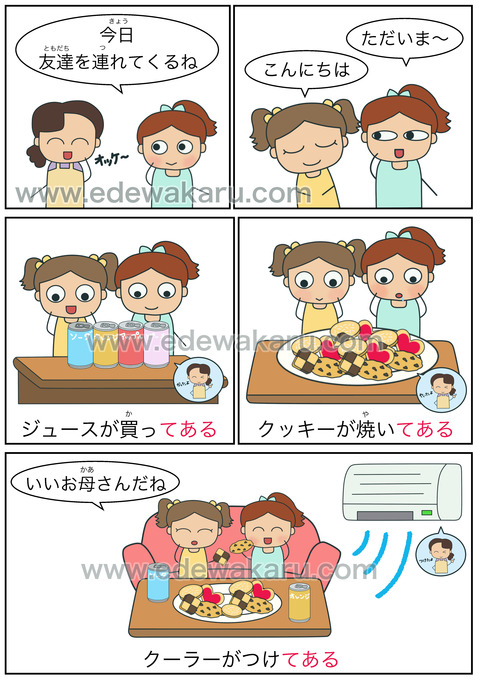
Meaning
誰かが〜した結果の状態が続いている
How to use it
動詞[て形]+てある
Explanation
「〜てある」は「誰かが〜した結果の状態が続いている」という意味の文型です。この文型は多くの場合、他動詞に使われ
「〜が〜てある」
の形で使用されます。この文型は「誰かがしたこと」という意味が入り、動作主がいることを表しています。
[例]
ジュースが買っ
てある
【動作主】お母さん
お母さんがジュースを買った
という行為結果の状態
クッキーが焼い
てある
【動作主】お母さん
お母さんがクッキーを焼いた
という行為の結果の状態
クーラーがつけ
てある
【動作主】お母さん
お母さんがクーラーをつけて、その状態が続いている
A:本はどこにあるの?
B:テレビの上に置い
てある
よ
【動作主】B
Bがテレビの上に本を置いて、その状態が続いている
A:なんで窓が閉め
てある
の?
B:だって今日は風が強いんだもん
【動作主】B
Bが窓を閉めて、その状態が続いている
「〜てある」「〜ている」は【結果の状態】を表す文型です。
初級で勉強する文型ですが会話でもよく使いとても重要です。また「〜ている」にはいくつか意味がありますので、一緒に復習をしておくといいと思います😉
(復習:〜ている(結果の状態))
(復習:〜ている(繰り返し))
(復習:〜ている(経験))
(復習:〜ている(進行中))
In context 5 examples
ジュースが買ってある
クッキーが焼いてある
クーラーがつけてある
A:本はどこにあるの?B:テレビの上に置いてあるよ
A:なんで窓が閉めてあるの?B:だって今日は風が強いんだもん(復習:なんで?・だって〜)(復習:〜もの・〜んだもの)
日本語文型辞典
Meaning
基本情報V-てある説明他動詞を用いて、だれかがした行為の結果として残っている状態を表す。文脈によっては「将来に備えて何かを行う」という意味が感じられる場合がある。動詞の意味上の目的語が主語になり、動作主はことばに表されないことが多いが動作主の存在は合意されている。「窓があけてある」と似た表現に「窓があいている」があるが、こちらは、動作主の存在を合意しない。「あけてある」のほうは言葉で表現しなくても動作主の存在が感じられるが、「あいている」のほうにはそれが感じられない。また⑪のように受身が用いられると、動作主の存在がより強く感じられるようになる。「ておく」との違いについては【ておく】を参照。例文① テーブルの上には花が飾ってある。② A:辞書ビこ?
B:辞書なら机の上においてあるだろ。③ 黒板に英語で Good Bye! と書いてあった。④ 窓が開けてあるのは空気を入れかえるためだ。⑤ あしたの授業の予習はしてあるが、持っていくものはまだ確かめていない。⑥ 起きてみると、もう朝食が作ってあった。⑦ 推薦状は準備してあるから、いつでも好きなときにとりにきてください。⑧ 電車の中に忘れたかさは、事務所に届けてあった。⑨ ホテルの手配は、もうしてあるので心配ありません。⑩ パスポートはとってあったので、安心していたら、ビザも必要だということが分かった。⑪ その手紙は、カウンターにおかれてあった。
日本語文型辞典 英語版
Meaning
【てある】[V-てある]
B:辞書なら机の上においてあるだろ。
The dictionary? It should be on the desk.
Uses a transitive verb to express that a situation exists as a result of someone’s action. In some cases, depending on the context, it can have the meaning “do something in preparation for the future.”
In this pattern, the semantic object of the verb becomes the subject and the person who has taken the action is often not expressed, but the existence of that person is implied. There is an expression 窓があいている, similar to 窓があけてある, but the former doesn’t imply an agent. In あけてある, the existence of the agent is felt even though it is not expressed, while this is not felt in あいている. In addition, when the passive is used, as in
(11)
, the existence of the agent is felt more strongly. Refer to
【ておく】for the difference between てある and ておく.
In context 11 examples
テーブルの上には花が飾ってある。
Flowers have been arranged on the tabletops.
A:辞書どこ?
Where is the dictionary?
黒板に英語でGoodbye!と書いてあった。
It said “Good-bye” in English on the blackboard.
窓が開けてあるのは空気を入れかえるためだ。
The window’s been left open to air out the room.
あしたの授業の予習はしてあるが、持っていくものはまだ確かめていない。
I have prepped for tomorrow’s class, but I haven’t checked what I have to take.
起きてみると、もう朝食が作ってあった。
Breakfast had already been cooked when I got up.
推薦状は準備してあるから、いつでも好きなときにとりにきてください。
The letter of recommendation is ready, so please come anytime to get it.
電車の中に忘れたかさは、事務所に届けてあった。
The umbrella which I left on the train had been delivered to the business office.
ホテルの手配は、もうしてあるので心配ありません。
The hotel’s already been reserved, so there’s no worry.
パスポートはとってあったので、安心していたら、ビザも必要だということが分かった。
Because I had already gotten a passport, I felt relieved, but then I found out that I needed a visa, too.
その手紙は、カウンターにおかれてあった。
The letter was lying on the counter.
IMABI
~てある
Read this IMABI lesson ↗Explanation
~てある
While we have just learned how ~ている may be used to indicate continuous action or status in a particular state, ~てある may similarly indicate a state that remains in place, but the two are quite different in their implications.
Structurally, ~ている and ~てある both utilize an existential verb turned supplementary verb (補助動詞). A supplementary verb is a verb that has lost most if not all of its literal meaning to serve a specific grammatical function. Oftentimes, they lose their original functionality as well.
In the case of ある・いる, they are fundamentally changed from standalone verbs which indicate that something exists to aspect markers1 which indicate exactly how a status persists over time. As for functionality, the basic sentence structure with either ~ている・てある is also not the same as いる・ある individually. Let’s compare the following.
1a. 窓がある。
There is a window.
2. 窓が開いている。
The window is open.
3. 窓が開けてある。
The window has been opened (and is still open).
The first commonalities that can be observed between these sentences tell us a lot about how ~ている・~てある both function.
①All three sentences describe a state of being regarding the window.
②~ている and ~てある both describe the speaker’s representation of what they see before them: “an open window.”
③The “state” of the window “being open” is a result of some sort.
In Ex. 1, all we know from the sentence alone is that there is a window. How it came into being, why it is where the speaker sees it, and so forth are irrelevant. In Ex. 2, similarly, how the window came to be open is left as an enigma. A person could have opened the window just as likely as the wind could have opened it. Whereas in Ex. 3, the window had been undoubtedly opened by some willful agent, and in most contexts, that said willful agent is a person.
Syntactically, we can observe several differences:
i. Though not shown in Ex. 1, the full iteration of its basic sentence structure is X (subject) が A (location) にある.
1b. 窓が部屋にある。
1c. 部屋に窓がある。
1b. There is a window in the room.
1c. In the room, there is a window.
ii. As for Ex. 2 and Ex. 4, the basic sentence structure is “X (subject) が + Z (intransitive verb + ~ている).
4. 窓が壊れている。
The window is broken.
iii. As for Ex. 3, the basic sentence structure is “X’ (object) が Z (stative-transitive verb2 predicate w/ ~てある). It can be more accurately translated as follows:
3. 窓が開けてある。
The window has been opened (by someone and is still open).
Contrast Exs. 1-4 with the basic sentence structure “(X (subject) が) Y (object) を Z (dynamic-transitive verb predicate).
5. 窓を開けた。
(I) opened the window.
~てある: Creating Stative Verbs
Before delving further into the mechanics of ~てある, let’s go over how it is joined with the different verbal classes. Note that this pattern is not used with the copular verb or adjectival predicates.
Verb Class連用形 + ~てある
上一段閉じてある
has been closed
下一段開けてある
has been opened
五段作ってある
has been made
サ変してある
has been done
カ変∅
Due to 来る neither being transitive nor necessarily always accompanied with a willful agent, 来てある is deemed ungrammatical.
Type I: -AGENT w/ ~てある
Agency (動作主性) is an important concept in understanding how aspect markers like ~てある function. Agency is defined as the thematic relation of the cause/initiator (doer) to an event.
As we have seen so far, the transitive predicate used with ~てある implies that there is a willful agent/initiator (doer) of said action which brought about the state in question.
The agent, however, is not overtly expressed with ~てある, with that implication being handled by ~てある itself. The agent would invariably manifest as the subject, but because the ‘subject’ also functions as the object of the agent’s action and is marked by が, as a consequence of the structure itself being ergative in nature, explicitly mentioning the agent is suppressed (抑制) from the surface structure3 of the sentence.
6. 花が生いけてある。
The flowers have been arranged (by someone and are still arranged as such).
In Ex. 6, we know that someone arranged the flowers, but why the person acted in this, or even if the act was entirely intentional, are irrelevant. What is important is the existence of the ‘object’ being affected and how that change (effect) persists.
The lack of an overt agent and the rendering of the object being marked by が does not exclude the possibility of an indirect object from being used in the sentence. In this case, the indirect object is regularly marked by に.
7. 彼女には前もって伝つたえてある。
She was informed (of that) beforehand.
Grammar Note: “She” has been informed about “that,” and “that” is the object which would otherwise be marked with が if overtly stated.
8. ガラスが割わってある。
The glass has been broken (because of the actions of someone and still is broken).
9. アンケートは集あつめてある。
The questionnaires have been gathered.
10. ストーブがつけてあります。
The heater was turned on (by someone) and has been kept that way.
11. 木が倒たおしてある。
The tree has been toppled down (by someone).
12. 彼の熱ねつは計ってある。
His temperature was checked (by someone).
13. 晩ばんご飯はんが作ってある。
Dinner has been made (by someone).
14. シャツが洗あらってある。
The shirt has been washed (by someone).
15. 机に本が置いてある。
The book was placed on the desk (by someone).
16. 荷物にもつが乱雑らんざつに積つんである。
The luggage was piled up in a clutter (by someone).
It must also be noted that ~てある may also be seen used with the past tense marker ~た, and in doing so, the speaker is describing the scene that they had witnessed, but with the statement being a recollection, whether the state is still ongoing or not is not pertinent.
17. 一階は古本屋に貸かしてあった。
The first floor had been rented to an old book store.
18. 新聞に書いてあった。
It had been written in the newspaper.
You may even see ~てある in the negative as ~てない, which notably does not have the same intonation as ~て(い)ない4. When this structure is used in the negative, the change/effect that would have transpired has not quite come into fruition.
19. あまり家具かぐが置いてありません。
There has not been much furniture placed (here).
Type II: +Agent w/ ~てある
There is one more distinct grammatical context in which ~てある appears. It is possible for the agent to appear when the agent is oneself and the predicate indicates effectiveness in bringing about some goal. Here, the distinction between ~ている and ~てある may seem unclear, but the interest that the speaker is demonstrating with the action paints a different mental image than if ~ている were used.
20. 元気げんきでいることにしてある。
(I) have (myself) out to be well (even though I’m really not).
21. 僕は健康のために体を鍛えてある。
I have my body well-trained for my health.
22. その時計とけいは五分進めてあります。
(I) have set the clock five minutes forward.
It would go without saying that the verbs used with these two distinct patterns of ~てある do differ considerably on semantic grounds, and as evident in these examples, the basic sentence structure is also different: X (agent) が Y (object) を・に・と Z (transitive predicate). For now, just know that this distinct ~てある, which we will refer to as Type II, exists (See Lesson 214).
Previous Lesson
Next Lesson
Aspect (相) is a crucial feature of Japanese grammar that cannot be overlooked even as a beginner. Aspect marking is often lumped together with the concept of tense, but in the context of ~てある, it is rather difficult to relate to any one structure in English to it. Though the tense of ~てある would default to the “present perfect (= “has/have been”),” the aspect of ~てある would pertain to how the state borne from some action came about via the willful intent of an agent and how the resultant state remains so; yet, the English translations do not employ “-ing” (the continuous form) despite the continuous state. This, however, is where ~てある・ている naturally form a semantic class which expresses the aspect of ongoing states, which can be viewed as an extension of their existential semantics, with their own implications on being that cannot be fully explained by how English tense/aspect syntactically work. ↩︎
Merely describing X’ as the subject with ~てある is not entirely accurate. This pattern is just one of many grammatical patterns in Japanese which invokes what is known as ergative grammar. In ergative grammar, the objects of transitive predicates become rendered as subjects when the predicate is rendered intransitive. ある imposes its intransitivity onto the transitive predicates utilized in ~てある, thus, causing this change in particle usage. As such, X’ can be viewed as both the subject and the object depending on which angle you view the construction. As a subject, X’ is what is experiencing the state, but it is also the object of the implied agent’s action which resulted in said state being described as if it were the subject. ↩︎
“Surface structures” (表層構造) are the versions of sentences that are actually uttered in speech. ↩︎
When ~ていない is contracted to ~てない, the intonation of ~ない itself is a continuation of the pattern attributed to the verb structure as one unit, whereas when ~てない is the negative form of ~てある, ある maintains its pitch nucleus on the first mora, which is naturally applied to ない. ↩︎
In context 24 examples
窓がある。
There is a window.
窓が開いている。
The window is open.
窓が開けてある。
The window has been opened (and is still open).
窓が部屋にある。
1b. There is a window in the room.
部屋に窓がある。
1b. There is a window in the room.
窓が壊れている。
The window is broken.
窓を開けた。
(I) opened the window.
花が生いけてある。
The flowers have been arranged (by someone and are still arranged as such).
彼女には前もって伝つたえてある。
She was informed (of that) beforehand.
ガラスが割わってある。
The glass has been broken (because of the actions of someone and still is broken).
アンケートは集あつめてある。
The questionnaires have been gathered.
ストーブがつけてあります。
The heater was turned on (by someone) and has been kept that way.
木が倒たおしてある。
The tree has been toppled down (by someone).
彼の熱ねつは計ってある。
His temperature was checked (by someone).
晩ばんご飯はんが作ってある。
Dinner has been made (by someone).
シャツが洗あらってある。
The shirt has been washed (by someone).
机に本が置いてある。
The book was placed on the desk (by someone).
荷物にもつが乱雑らんざつに積つんである。
The luggage was piled up in a clutter (by someone).
一階は古本屋に貸かしてあった。
The first floor had been rented to an old book store.
新聞に書いてあった。
It had been written in the newspaper.
あまり家具かぐが置いてありません。
There has not been much furniture placed (here).
元気げんきでいることにしてある。
(I) have (myself) out to be well (even though I’m really not).
僕は健康のために体を鍛えてある。
I have my body well-trained for my health.
その時計とけいは五分進めてあります。
(I) have set the clock five minutes forward.
~てある w/ を
Read this IMABI lesson ↗Explanation
~てある w/ を
Way back in Lesson 37, we learned that there are in fact two types of ~てある predicates. Type I ~てある predicates do not exhibit overt agents, although agency is inherently implied. Type II ~てある predicates, which were only briefly discussed, do exhibit overt agents. The role that ~てある plays differs between these two types on the grounds of how the change is perceived (and for what purpose).
Japanese resources aimed at beginners sometimes claim that Type II sentences are incorrect due to how difficult it is for learners to replicate them correctly as well as distinguish these predicates from those of Type I. This is largely due to there being no true fine line between which verbs can and cannot be used with them, although there are strong tendencies and other grammatical factors that can be used to better distinguish them.
Type II: +Agent w/ ~てある
Though Type I ~てある predicates are far more statistically common than those of Type II, that does not discredit the grammar behind the latter. To the contrary, it demands that we take a further look into how aspect, agency, and sentence structures all culminate to make both types possible.
Traditionally, Type II ~てある predicates are described as expressing premeditated preparation for a certain outcome and/or the accumulated result of some action, and this is believed to stem from how Type I ~てある predicates may also indicate preparations of some sort having been accomplished.
1. 補佐人にも口止めしてある。(Type I)
Even the aides have been hushed.
2. (事情を知っている全員に)口止め(を)してあるからといって噂が広まらないとは限らない。(Type II)
Just because (you) have hushed (everyone involved) doesn’t necessarily mean rumors won’t spread.
In Ex. 2, unlike in Ex. 1, the agent is clear in context, though the tendency to drop agents from a sentence in general still holds true for it being second person.
In Lesson 37, this premeditated preparation was described indirectly by how the action involved is effective in bringing about some goal, but it could also still be the case that said result brought about is still ongoing, thus an ‘accumulating effect’ that the agent ensured.
3. もちろん、それぞれの調整をしてあります。
Of course, I’ve made each individual adjustment.
4. 伊藤さんに来月の予定の話をしてありますか?
Have you gotten talks done for next month’s plans to Ito-san?
While perceived volition by the agent is an important factor in understanding most instances of ~てある regardless of predicate type, contexts can be found in which it is used with non-volitional or volitional actions with both types.
5. テーブルを見たら、財布が置き忘れてあったんですよ。
When I looked at the table, there was a wallet left behind (by someone).
6a. おや、ガスがつけっぱなしにしてある。
What’s this, (someone) left the gas on.
6b. おや、ガスをつけっぱなしにしてある。〇/△
What’s this, (someone) left the gas on.
Ex. 5 is a clear example of Type I being used with non-volitional actions, but there is a considerable decline in acceptance for 6b. in which Type II is used accordingly. Yet, when a speaker does choose to use the construct, the impact the situation has, and how the agent played a part (whether intentional or not), is heavily emphasized as an effect of using Type II.
Another commonality that Type I and Type II have is the notion of describing a visual representation. Though the observation can still ultimately come from any of the five senses, both types rely on the observation being made directly, and if the effect/result cannot be ascertained otherwise, the sentence becomes ungrammatical.
7. うちの息子は彼にチョコレートをもらってある。
My son has received chocolates from him (for a (romantic) purpose which is visually apparent).
8. 太郎はうちの息子にチョコレートをもらってある。X
Taro has received chocolates from my son (for a visually obvious purpose). X
Sentence Note: Japanese grammar disdains from making subjective judgements in such affirmative terms in the third person when the entity cannot be defined in one’s inner monologue or inner circle at the very least. If the speaker cannot perceive themselves in the same viewpoint as the agent, the effectiveness (goal) of the predicate itself also cannot be ascertained.
This is because ~てある, especially with Type II, emphasizes the agent out-of-the-picture as if the agent’s actions were immediately registerable from visual observation, which is further supported by the apparent grammatical person restriction found between Exs. 7-8, so much so that when the agent happens to be oneself, the effectiveness of the move is all the more apparent.
9. このとおり、俺の遺言状もちゃんと作ってある。
As you can see, I’ve also made sure to have my will prepared.
10. 護衛は、待たせてある車を呼んで、トランプ氏を乗せ、ドアを外から閉めた。
The guard fetched the car that he had waiting, had Mr. Trump get in, and locked the door from the outside.
You might wonder why Ex. 10 is in third person when we just discussed how the agent being oneself is all the more indicative of what ~てある implies, but through narration in which the narrator is by proxy the guard, we are able to view the guard’s perspective as if it were one’s own.
The only caveat to the grammaticality of Type II that comes into question is when, as we saw with Ex. 6b, the emphasis is on how the result of the agent’s action is having caused said state, but this is a matter of whether the speaker is both interested in the result just as much as in how the result came about.
In the overwhelming majority of cases, though, the agent is usually first person (oneself) or second person from a mutual standpoint of preparation for a common goal, and this is borne out in the examples that follow. In all of these examples, however, ~ている may just as easily replace ~てある, as the focus on the result borne from effective preparation is not always necessary to emphasize.
11. 英語ならもう予習してあるから、大丈夫だ。
I’ve already prepared for English class, so I’m fine.
12. 漢字を調べてありますか?
Have you gotten done researching the Kanji?
13. 予約をしてあります。
I have made the reservation.
14. はい、もう飛行機のチケットを買ってあります。
Yes, I’ve already bought plane tickets.
15. 子供がいたずらするといけないから、コンセントを抜いてある。
The kids shouldn’t mess with outlets, so I have them unplugged.
16. ご飯を作ってある。
I have dinner made.
17. いつ地震が起こるかわからないので、災害セットを用意してある。
I don’t know when an earthquake will hit, so I have a disaster kit prepared.
18. 貴重品はロッカーに預けてある。
I have my valuables stored in a locker.
19. 朝から洗濯物を外に干してあるのでそろそろ乾いただろう。
I’ve had the laundry drying outside since the morning, so they should be dry soon.
20. 前に水漏れが起きたので、ここの水道は水を止めてある。
There was a water leak earlier, so I’ve stopped the water supply here.
21. 外に置く予定なので、錆止めスプレーをかけてある。
I plan to place it outside, so I have it sprayed with anti-rusting spray.
There are some verbs, which for whatever semantic conflict, cannot be used in Type II てある predicates.
22a. 授業が始めてある。X
22b. 授業を始めてある。X
22c. 授業が始まっている。◎
22a-b. Class has been started. 〇/△
22c. Class has started. ◎
23. 水が飲んである。〇/△
水を飲んである。X
To have had water drunk.
With Type II resting on the notion that the agent serves a purpose (regardless of full intent) which is then manifested in the state described, if the event cannot be perceived as such an orchestrated act, or if the event is too generic of a description of reality, ~てある becomes unnatural if not completely ungrammatical.
Type II ~てある predicates can, on seldom occasion, be seen with intransitive verbs. In these cases, contextual qualities elevate said intransitive verb to behave with a transitive-like quality to express a preparation of sorts.
24. 明日の試験に備えて、たくさん寝てある。
I’ve slept a lot in preparation for the exam tomorrow.
The speaker (agent) having slept needed to transpire to be in the position they are in now is quintessential in context. In this sense, we say that ~てある can be used to show the building up of such effect/prior preparation even with intransitive verbs if the context substantiates the notion of an accumulating effect.
25. このコースは4回、5回{泳いである 〇・泳いだ ◎・泳いでおいた ◎}から、戸惑とまどうことはない。
I’ve swam the course 4, 5 times, so there is nothing to be perplexed about.
Such an application of Type II, though, as indicated by Ex. 25, dangerously encroaches on the semantic space that ~ておく serves, which does happen to be the more ‘natural’ choice, as it can be used with all verbs of volition to show that the agent is doing something in preparation for a beneficial result. Meanwhile, preparation indicated by Type II ~てある predicates rest on said preparation being done out of an inherent necessity and is also very contingent on the effect being accumulative.
Comparing ~てある, ~ている, & ~ておく
Having seen overlap between ~てある, ~ている, and ~ておく in our discussion so far, it is now time to thoroughly contrast them. The following chart describes these patterns in the broadest of terms when they are most likely to coincide.
~ておくExplicit, willful premeditated action by the agent for a perceived future benefit.
~ている The continuation of an action/state upon a certain state/effect taking place (due to said action) which may, in turn, include preparation.
~てある The effectiveness of the perceived outcome (result) of the agent (doer) is necessitated by that end.
As we have learned, aspect and tense often go hand in hand, but they are far from completely synonymous, and this is substantiated by how the tense marker ~た behaves with these aspect markers.
As for ~ている・てある, the predicates themselves in the non-past tense may still constitute an action that began in the past, while with ~た the sense of recalling said point in time (recollective past). As for, ~ておく, however, the action itself cannot be perceived as having already begun in the past, and ~た is required to place its point in time in the past. While with ~ている・てある, the predicate has already “realized” and the choice between the two illustrates how said realization persists (and possibly why), ~ておく only sets the context for “why” and its time frame must be set up externally. This can be attributed to how ある・いる are existential verbs with a firm footing in realities which are ‘in being,’ while 置く holds onto its literal sense of directionality, which is entirely dictated by the agent in both the sense of when and where.
Though these three patterns are clearly distinct in their implications, studying sentences in which they are more or less interchangeable may also give us insight to how they are both similar and dissimilar. Remember that while nuance will still differ, that in and of itself does not negate interchangeability.
■Scenario I: (Past) Perfect Tense = Had/Has Completed (Having Handled)
25. 教科書は借りて{あった・おいた・いた}が、結局、読まなかった。
I had borrowed the textbook, but in the end, I didn’t read it.
26. 夕食は用意して{ある・おいた・いる}から、食べていってね。
Dinner has been prepared, so go eat.
27. 明日、日本語の試験でしょう?ちゃんと勉強して{ある △・おいた・いる}のか。
Tomorrow’s the Japanese exam, right? Have you gotten your studying done?
28. 今日という日のために買い込んで{あった・おいた・いた}んだよ。
I have had it bought up for a day such as today.
■Scenario II: Continuous Effect of a Result
29. 思い出のある貴重品きちょうひんを、捨すてずに残して{ある・いる・おく}。
To keep one’s valuables with memories instead of throwing them away.
Of course, truly thinking about how each option differs in what little context one is given also provides crucial insight.
30. あのカップルは、よく喧嘩けんかするから、席を離して{ある・おいた・いる}。
Because that couple fights a lot, their seats [have been kept/were put/are]separate.
席を離してある: The agent has purposely ensured that the seats are kept apart for the goal of not making it feasible for the couple to argue. Unlike Type I, the situation feels dynamic because of how there seems to be such a concerted effort to keep them apart.
席を離しておいた: The benefit behind the agent separating the couple’s seats is at the forefront in the speaker’s mind.
席を離している: Indicates that the situation has been maintained, but the phrase itself does not add to the context as to why.
Adding Type 1 ~てある predicates back into the fold, as well as adjusting the tense of the dependent clause accordingly, we can come up scenarios like Ex. 31 in which six different iterations are plausible.
31a. そのテレビがついているのは、お昼のニュースを見るためですよ。
31b. そのテレビをつけているのは、お昼のニュースを見るためですよ。
31c. そのテレビがつけてあるのは、お昼のニュースを見るためですよ。
31d. そのテレビをつけてあるのは、お昼のニュースを見るためですよ。
31e. そのテレビをつけておくのは、お昼のニュースを見るためですよ。
31f. そのテレビをつけておいたのは、お昼のニュースを見るためですよ。
All of these iterations express the condition after the TV being turned on . However, 31b. also has the possible reading of currently turning on the TV.
Imagine the situation is someone asking why the TV is on. In such a situation, the speaker could use the aforementioned sentences to respond in the following ways.
テレビがついている: This iteration simply describes the state of the TV being on, and even if there were an agent which turned it on in the first place, the idea itself is not being entertained.
テレビをつけている: A nonspecific agent has turned on or is turning on the TV. Even if the speaker is the agent, the phrase itself only describes the act of someone having committed the act, with no context as to why.
テレビがつけてある: Someone has seemingly turned on the TV, perhaps with a purpose or out of a sense of preparation that could be gleamed from context. In any case, the exact identity of the agent is still held as an enigma.
テレビをつけてある: The agent has rather dynamically turned on the TV with a responsibility felt of doing so due to the effectiveness it has at accomplishing some goal.
テレビをつけておく: The agent is to have the TV on, as that is beneficial.
テレビをつけておいた: The agent has turned on the TV, as that is beneficial.
To condense these patterns as succinctly as possible, we may describe them by what exact function their predicates serve, including :
Pattern Onset of State Usage(s)
が + 自動詞 + ~ている PastOngoing set started by a natural phenomenon with no perceived agency.
を + 他動詞 + ~ている①Past
②Present①Continuation of action/state.
②In the act of doing something
が + 他動詞 + ~てある PastContinuation of effect by covert agent remains so.
を + 他動詞 + ~てあるPastContinuation of effect ensured by agent to maintain said status.
を + 他動詞 + ~ておくFutureWill set up state in such a way that is beneficial.
を + 他動詞 + ~ておいたPastEffect/condition has been set for a beneficial outcome.
参照
テアル構文の2類型 by 杉村泰
動作・状態を表す言い方 by 森田良行.
日本語類義表現使い分け辞典 pgs 285-288 by 泉原省二.
In context 40 examples
補佐人にも口止めしてある。(Type I)
Even the aides have been hushed.
(事情を知っている全員に)口止め(を)してあるからといって噂が広まらないとは限らない。(Type II)
Just because (you) have hushed (everyone involved) doesn’t necessarily mean rumors won’t spread.
もちろん、それぞれの調整をしてあります。
Of course, I’ve made each individual adjustment.
伊藤さんに来月の予定の話をしてありますか?
Have you gotten talks done for next month’s plans to Ito-san?
テーブルを見たら、財布が置き忘れてあったんですよ。
When I looked at the table, there was a wallet left behind (by someone).
おや、ガスがつけっぱなしにしてある。
What’s this, (someone) left the gas on.
おや、ガスをつけっぱなしにしてある。〇/△
What’s this, (someone) left the gas on.
うちの息子は彼にチョコレートをもらってある。
My son has received chocolates from him (for a (romantic) purpose which is visually apparent).
太郎はうちの息子にチョコレートをもらってある。X
Taro has received chocolates from my son (for a visually obvious purpose). X
このとおり、俺の遺言状もちゃんと作ってある。
As you can see, I’ve also made sure to have my will prepared.
護衛は、待たせてある車を呼んで、トランプ氏を乗せ、ドアを外から閉めた。
The guard fetched the car that he had waiting, had Mr. Trump get in, and locked the door from the outside.
英語ならもう予習してあるから、大丈夫だ。
I’ve already prepared for English class, so I’m fine.
漢字を調べてありますか?
Have you gotten done researching the Kanji?
予約をしてあります。
I have made the reservation.
はい、もう飛行機のチケットを買ってあります。
Yes, I’ve already bought plane tickets.
子供がいたずらするといけないから、コンセントを抜いてある。
The kids shouldn’t mess with outlets, so I have them unplugged.
ご飯を作ってある。
I have dinner made.
いつ地震が起こるかわからないので、災害セットを用意してある。
I don’t know when an earthquake will hit, so I have a disaster kit prepared.
貴重品はロッカーに預けてある。
I have my valuables stored in a locker.
朝から洗濯物を外に干してあるのでそろそろ乾いただろう。
I’ve had the laundry drying outside since the morning, so they should be dry soon.
前に水漏れが起きたので、ここの水道は水を止めてある。
There was a water leak earlier, so I’ve stopped the water supply here.
外に置く予定なので、錆止めスプレーをかけてある。
I plan to place it outside, so I have it sprayed with anti-rusting spray.
授業が始めてある。X
22a-b. Class has been started. 〇/△
授業を始めてある。X
22a-b. Class has been started. 〇/△
授業が始まっている。◎
22a-b. Class has been started. 〇/△
水が飲んである。〇/△
明日の試験に備えて、たくさん寝てある。
I’ve slept a lot in preparation for the exam tomorrow.
このコースは4回、5回{泳いである 〇・泳いだ ◎・泳いでおいた ◎}から、戸惑とまどうことはない。
I’ve swam the course 4, 5 times, so there is nothing to be perplexed about.
教科書は借りて{あった・おいた・いた}が、結局、読まなかった。
I had borrowed the textbook, but in the end, I didn’t read it.
夕食は用意して{ある・おいた・いる}から、食べていってね。
Dinner has been prepared, so go eat.
明日、日本語の試験でしょう?ちゃんと勉強して{ある △・おいた・いる}のか。
Tomorrow’s the Japanese exam, right? Have you gotten your studying done?
今日という日のために買い込んで{あった・おいた・いた}んだよ。
I have had it bought up for a day such as today.
思い出のある貴重品きちょうひんを、捨すてずに残して{ある・いる・おく}。
To keep one’s valuables with memories instead of throwing them away.
あのカップルは、よく喧嘩けんかするから、席を離して{ある・おいた・いる}。
Because that couple fights a lot, their seats [have been kept/were put/are]separate.
そのテレビがついているのは、お昼のニュースを見るためですよ。
All of these iterations express the condition after the TV being turned on . However, 31b. also has the possible reading of currently turning on the TV.
そのテレビをつけているのは、お昼のニュースを見るためですよ。
All of these iterations express the condition after the TV being turned on . However, 31b. also has the possible reading of currently turning on the TV.
そのテレビがつけてあるのは、お昼のニュースを見るためですよ。
All of these iterations express the condition after the TV being turned on . However, 31b. also has the possible reading of currently turning on the TV.
そのテレビをつけてあるのは、お昼のニュースを見るためですよ。
All of these iterations express the condition after the TV being turned on . However, 31b. also has the possible reading of currently turning on the TV.
そのテレビをつけておくのは、お昼のニュースを見るためですよ。
All of these iterations express the condition after the TV being turned on . However, 31b. also has the possible reading of currently turning on the TV.
そのテレビをつけておいたのは、お昼のニュースを見るためですよ。
All of these iterations express the condition after the TV being turned on . However, 31b. also has the possible reading of currently turning on the TV.
日本語NET JLPT文法解説まとめ
Meaning
誰かが何か目的があってその行為を行い、その行為の結果が残っていることを表す文型。
How to use it
V(て形) + ある
Explanation
somebody has done something intentionally and that state continues.
動詞は他動詞が来る。
In context 10 examples
壁にポスターが貼ってあります。
テーブルにお皿が並べてあります。
もう宿題はしてあります。
お風呂はもう沸かしてあります。
あ、机の上にケーキが置いてある。
もうホテルの予約はしてありますか?
昼ごはんは用意してあるから、電子レンジでチンして食べてね。
ん?机の上に何かメモが置いてあるなあ。
この問題の答えは120ページに書いてありますよ。
A:そろそろ帰りましょうか?
毎日のんびり日本語教師
How to use it
他動詞て形+ある
Explanation
2つの意味があります。
①動作の結果の持続
動作が終わった後に、ある状態が持続していることを表します。
他動詞の前には助詞「が」を用います。
②物事をあらかじめ完了させた
何らかの物事をあらかじめ終わらせておいたことを表します。
副詞「もう/すでに」がよく前項に呼応します。
Notes
特になし
In context 7 examples
壁に絵が飾ってある。(墙壁上装饰着画。)
机の上にメモが置いてあった。(桌子上放着便条。)
財布は椅子の上に置いてありますよ。(钱包放在椅子上。)
ホテルはもう予約してあります。
その件はもう先方に伝えてあります。
もう準備してありますから、安心してください。
このパソコンは誰でも使えるように設定してあります。
NINJAL 日本語文型データベース
Meaning
誰かが意図があってある行為を行い、その行為の結果が残っている状態を表します。
How to use it
Vてある
Notes
「~」には、「書く・開ける・予約する」など、意志的な行為を表す他動詞がきます。
行為の動作主は文中に現れませんが、動作主がいること・意図があることは意識されます。
行為の対象に注目して言うときは、行為の対象を「~が」で示します。行為に注目して言うときは、行為の対象を「~を」で示します。
In context 6 examples
「これ、誰のノート?」「ほら、裏に名前が書いてあるよ。加奈ちゃんのだよ」
2時間後に部屋のエアコンが切れるようにタイマーをセットしてある。
子どものとき、実家では、急な来客のためにいつもお菓子が買ってあった。
「田中君、忘年会は12月の3週目だよね」「はい、23日に会場を予約してあります」
あそこに置いてあるかばんは早川さんのだと思うけど、早川さん、どこに行ったのかな。
「寒いから、窓、閉めませんか」「あ、換気しようと思って、開けてあったんですが、もう大丈夫ですね」
Yokubi — The Common Grammar Guide (https://yoku.bi)
Explanation
Let's look at ている and てある now. They make use of いる/ある as auxiliary verbs.
ている indicates an enduring action or state. For a lot of verbs, this means progressive or continuous (enduring action), but for others, it means the result of an action remains in a certain condition (enduring state).
The い in ている is commonly dropped in conversation, both in writing and in speech. This includes ます form to (as てます).
ておる is a formal variant of ている. おる and いる have mostly the same meaning. ておる can be spoken as とる.
てある is about something being in an enduring state resulting from someone's action. てある always expresses a resulting state, **never** an action.
てある can turn the direct object into a subject. This means that the verb's normal "logical object" gets marked by が or は (or unmarked), like dinner in the example above. However, because Japanese is linguistically weird, sometimes を can be used, too.
Finally, it expresses a state, not an action, so てある should not be considered "the passive" version of the verb. Japanese has a real passive that we'll cover soon.
In context 1 examples
晩ご飯はもう作ってある
Dinner has already been made