AIUEO JLPT Grammar
Meaning
「〜ってば」 is a colloquial expression used to emphasize or urge the listener. It is often used when the speaker feels ignored or misunderstood and is commonly heard in emotional or familiar settings, such as among children, friends, or family.
Explanation · 日本語
「〜ってば」は、相手に対して強調や催促を表現する口語的な表現です。通常は、相手が聞いてくれない、または自分の言いたいことを理解していないと感じた時に、強めに再度伝えたい時に使います。感情的な場面や親しい間柄で使われることが多く、子供や友人、家族に対しての言葉です。
In context 5 examples
もう行くってば!
I told you, I’m leaving already!
静かにしてってば!
I told you to be quiet!
ちゃんと聞いてってば!
Listen to me properly!
早く行こうってば!
I told you, let’s go already!
あれ、やめてってば!
I told you to stop doing that!
Bunpro Grammar Reference
Meaning
I said...!, I told you...!, !
How to use it
Verb + ってば(1)。
[い]Adjective + ってば(1)。
[な]Adjective + (だ)+ ってば(1)。
Noun + (だ)+ ってば(1)。
(1) ったら
Nuance
A hypothetical, very casual grammar expression, emphasizing that (A) has already been said. I told you (A).
Explanation
ってば and ったら are often used in casual Japanese to insist the speaker's own viewpoint or opinion about something. The structures are frequently translated as 'I said (A)!', or 'I told you (A)!'. ってば and ったら are contractions of といえば 'if it were said', and といったら 'if it were said' respectively. In these cases, the literal meaning is very similar to the English 'didn't I say (A)!?' when used sarcastically or aggressively.
Either ってば or ったら may follow just about any word, but will require a だ to precede them when coming after nouns or な-Adjectives.
分かったってば!何回も言われると本当むかつくからちょっと黙ってて。
I said I got it! You telling me the same thing (repeatedly) is getting on my nerves so can you please be quiet for a little bit?
痛いったら!なんでずっと痛いって言ってるのに何回も何回もフォークでつついてくるの?
I said that hurts! Why do you keep poking me with a fork even when I say that it hurts?
嫌いだってば!あんな奴なんて大嫌いだ!
I said I don't like them! I don't like such people!
だから、俺は大人だったら!背が低いからってひどいぞ本当に。
For the last time, I said that I am an adult. It is kind of mean to say such things just because I am short.
Caution
ってば and ったら may also directly follow nouns without だ. In these cases, the noun is generally a person (perhaps the speaker themselves), and the translation will be 'oh that (A)', 'that darn (A)'. (A) will primarily be people that the speaker is quite familiar with, and they are expressing some kind of real or playful frustration.
金太郎ってば、またエアコンつけっぱなしで家出てったよ。
That darn Kintaro, he went out with his AC still running.
あなたったら本当におっちょこちょいね。
Oh you, you are such a clutz aren't you.
Nuance · 日本語
(A)は既に述べられたということを強調するカジュアルな仮定文法。(A)と言った。
Explanation · 日本語
「ってば」と「ったら」は、話し手が自分の意見や気持ちを強く主張したいときに使う、砕けた言い回しです。それぞれ「と言えば」と「と言ったら」が縮まった形で、皮肉や苛立ちを込めて「(A) と言ったでしょ!」という意味で使われます。
「ってば」と「ったら」の前にはさまざまな言葉が置かれますが、名詞やナ形容詞の場合は、間に「だ」を入れる必要があることが多いです。
分かったってば!何回も言われると本当むかつくからちょっと黙ってて。
I said I got it! You telling me the same thing (repeatedly) is getting on my nerves so can you please be quiet for a little bit?
痛いったら!なんでずっと痛いって言ってるのに何回も何回もフォークでつついてくるの?
I said that hurts! Why do you keep poking me with a fork even when I say that it hurts?
嫌いだってば!あんな奴なんて大嫌いだ!
I said I don't like them! I don't like such people!
だから、俺は大人だったら!背が低いからってひどいぞ本当に。
For the last time, I said that I am an adult. It is kind of mean to say such things just because I am short.
注意点
「ってば」や「ったら」が、そのまま名詞に付く場合は、感情を込めた「(A) は」という意味を表します。これは主に (A) に対する話し手の苛立ちや不満を、冗談っぽく、または本気で伝えるときに使われます。このときの (A) は、たいてい人を指す名詞になります。特に話し手と親しい人物に対して使われますが、ときには自分自身に対して使うこともあります。
金太郎ってば、またエアコンつけっぱなしで家出てったよ。
That darn Kintaro, he went out with his AC still running.
あなたったら本当におっちょこちょいね。
Oh you, you are such a clutz aren't you.
In context 18 examples
- 親:「もっとお姉ちゃんを見習いなさい!」
子供:「見習いたくないったら!」Parent: 'You need to better follow your sister's example! Child: 'I said I don't wanna!'
- 分かったってば!何回も言われると本当むかつくからちょっと黙ってて。
I said I got it! You telling me the same thing (repeatedly) is getting on my nerves so can you please be quiet for a little bit?
- 痛いったら!なんでずっと痛いって言ってるのに何回も何回もフォークでつついてくるの?
I said that hurts! Why do you keep poking me with a fork even when I say that it hurts?
- 嫌いだってば!あんな奴なんて大嫌いだ!
I said I don't like them! I don't like such people!
- だから、俺は大人だったら!背が低いからってひどいぞ本当に。
For the last time, I said that I am an adult. It is kind of mean to say such things just because I am short.
- 親:「宿題やりなさいよ!」
イライラした子供:「今からやるったら!」Parent: 'Do your homework!' Irritated child: 'I said I'm gonna do it!'
- 配偶者1がケーキを食べようとしている配偶者2に「ケーキを夕食の前に食べちゃダメったら!」
Spouse to spouse that is about to eat cake: 'I told you not to eat cake before dinner!'
- 友達1:「俺と一緒バンジージャンプ、やってみない?」
友達2:「興味ないんだ。」
友達1:「本当に?」
友達2:「やだってば、もう!」Friend1: 'Won't you go bungee jumping together with me?' Friend2: 'Not interested.' Friend1: 'Are you sure?' Friend2: 'I said no, Jeez!'
- 父:「宿題やったのか?」
息子:「やったよ〜。」
父:「ふむ…本当か?」
息子:「本当だってば!」Dad: 'Have you done your homework?' Son: 'Done.' Dad: 'Hmmm, is that true?' Son: 'I said it's true!'
- 娘:「お母さん、遊びに行ってもいい?」
母:「…」
娘:「お母さん?」
母:「…」
娘:「お母さんってば!聞いてる?」Daughter: 'Mom, can I go to hang out?' Mother: '...' Daughter: 'Mom?' Mother: '...' Daughter: 'I said 'mom', are you even listening?'
- 親:「夕飯前には家中に掃除機掛けといてね。」
子供:「わかった。」
3分後、親:「忘れないでね。」
子供:「わかったってば!」Parent: 'Vacuum the house before dinner, OK?' Child: 'Got it.' 3 minutes later, parent: 'Don't forget, OK??' Child: 'I said I got it!'
- 夫:「おい早くしろよ。」
妻:「待ってよ、準備中なの。」
夫:「早くしろってば。」
妻:「あのねぇ!あなたが協力しないから、まだ準備中なのよ!!」Husband: 'Oi, hurry it up' Wife: 'Please wait, I am in the middle of getting it ready.' Husband: 'I told you to hurry it up!' Wife: 'Listen here! Since you won't help, I am still in the middle of getting it ready!'
- 生徒:「先生、その問題なら先週やったってば!先生、最近ちょっと疲れてるんじゃない?」
Student: 'Sensei, I told you we did that question last week! Aren't you a bit tired recently, sensei?'
- 母:「明日は歯医者さんだから、忘れずに行くのよ?」
息子:「分かってるってば!何度も言わないでよ!」Mom: 'Because you have the dentist tomorrow, you won't forget to go, right?' Son: 'Oh my god I said I know! Don't tell me so many times!'
- 笑っている友達に向かって:「笑わないでってば!あんな間違いをして私は恥ずかしい思いをしているのよ!」
To a laughing friend: 'I told you not to laugh! That mistake makes me feel embarrassed!'
- 犬が飼い主を舐めている、飼い主:「アカマル、やめろ!」
舐めまわされること1分後、飼い主:「やめろってば!」A dog licking their owner, pet owner: 'Akamaru, stop!' One minute of licking later, pet owner: 'I said stop!'
- 金太郎ってば、またエアコンつけっぱなしで家出てったよ。
That darn Kintaro, he went out with his AC still running.
- あなたったら本当におっちょこちょいね。
Oh you, you are such a clutz aren't you.
絵でわかる日本語
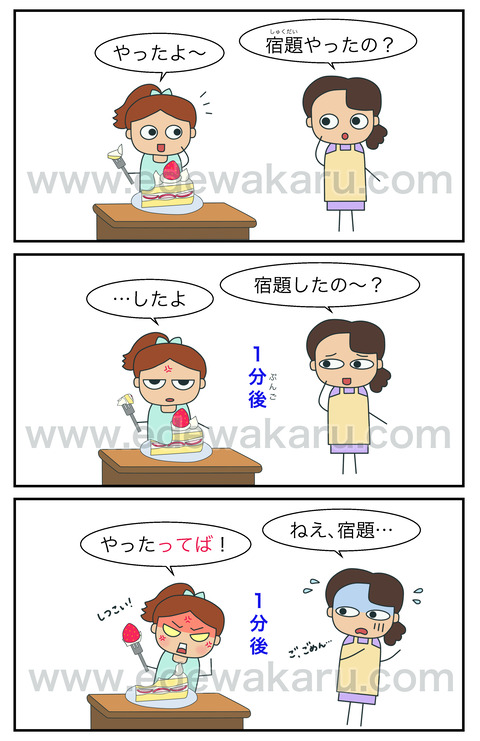
Meaning
相手に自分の主張を強調する
【例文1】
母:宿題やったの?
娘:やったよ〜
母:宿題したの?
娘:…したよ
母:ねぇ、宿題…
娘:やった
ってば!!!
【例文2】
夫:今日は飲み会があるから、夕ご飯いらないよ
妻:わかった
夫:本当にいらないよ。作ってあっても食べないよ
妻:わかった
ってば!
How to use it
動詞・形容詞・名詞[普通形]+ってば
*な形容詞・名詞の現在肯定形につく場合は「ーだってば」となる
(例:きれいだってば・学生だってば)
Explanation
「〜ってば」は
友達や家族との会話で使われる表現
です。これは
相手に自分の言いたいことがわかってもらえず、話し手がイライラしている様子を表すものです
😮目上の人に使うととても失礼ですから使わないように気をつけてください😨
意味は「話し手の主張を強調する表現」として覚えましょう
😉
【補足説明】
この文型の名詞接続は上でも説明しているように「ーだってば」となります。ですが、
相手を呼ぶ場合は「名詞[辞書形]+ってば」となりますので気をつけてください
😥
[例]
娘:お母さん、これ食べてもいい?
母:…
娘:お母さん、聞いてる?(〜てる・〜でる)
母:…
娘:
お母さんってば!!!
「〜ってば」はイライラしている気持ちが入ってしまう文型だというのを覚えておいてください
😊会話でとてもよく使いますので、テレビやドラマで聞く機会も多いと思います😄
日本語文型辞典
Meaning
基本情報説明親しい間柄同士のくだけた会話で、話し手の主張を強調するのに使う。自分の主張が通じなくて話し手が少しいらだっているような場合に使われる。また③のように相手の注意を引くときに用いることもある。例文① A:この字、間違ってるんじゃないか?
B:あってるよ。
A:いや、絶対、間違ってるってば。② A:宿題やったの?
B:うん。
A:もう9時よ。
B:やったってば。③ A:お母さんB:……
A:お母さんってば。聞いてる
日本語文型辞典 英語版
Meaning
B:あってるよ。
No, it’s right.
A:いや、絶対、間違ってるってば。
Nope, I’m sure it’s wrong.
B:うん。
Yeah.
A:もう9時よ。
It’s already nine o’clock.
B:やったってば。
I said I did it!
B:....
....
A:お母さんってば。聞いてるの?
Mother! Are you listening?
Used to emphasize the speaker’s point in informal conversation between people who are close to each other, particularly when the speaker is a little irritated because his/her point is not communicated. Also used to attract someone’s attention, as in example
(3)
.
In context 3 examples
A:この字、間違ってるんじゃないか?
Isn’t this letter wrong?
A:宿題やったの?
Did you do your homework?
A:お母さん
Mother?
NINJAL 日本語文型データベース
Meaning
[1] 話し手が自分の主張を強調するときに使います。主張が通じないために、話し手が少しいらいらしたり、もどかしく感じていることを表します。また、「ねぇってば」のように、相手の注意を引きたいときにも使います。
[2] 話題になっている人を示し、話し手のその人に対する意外な気持ちや非難を表します。自分自身の言動に対して自分を蔑む意味で「私ってば」と使うこともできます。
How to use it
V普通形(命令形・禁止形を含む)+ってば・V丁寧形+ってば
i-A普通形+ってば・i-A丁寧形+ってば
na-A普通形+ってば・na-A丁寧形+ってば
N普通形+ってば・N丁寧形+ってば
その他
Nってば
Notes
[2] 「〜」には、話題になっている人(または動物の場合もある)がきます。
In context 23 examples
親「歯磨きしたの?」子「うるさいなあ。今するってば!」
親「今度の日曜日、おばあちゃんの家に行こうか」子「えー? 今度の日曜日は遊園地行くって約束したってば!」
「まだ? あー、約束の時間に遅れちゃう。急いでってば」
「ちょっと! こんなところでお菓子食べないでってば」
「課長、まだお仕事ですか。今日はお子さんのお誕生日ですよね。早く帰ってあげてください」「はいはい。もう帰りますってば」
「今日は暑かった。疲れたー」「あーもう、すぐお風呂入って。汗くさいってば」
「これ、中古でいくらだったの?」「1万円。この値段でこの品質なら、悪くないってば」
「そんなに怒らないでよ。私が悪かったってば」
「明日、6時から朝練? 6時は早いってば。せめて7時からにして」
「あの人の言うことなんか、気にしなくていいってば」
「旅行保険、入らなくてもいいの?」「日帰りなんだから、大丈夫だってば。そんなに心配しないで」
「このお皿汚れてる。他のお皿取って」「あ、これはこういうお皿なの。洗ってあるから、きれいだってば」
「このお菓子、すっごくおいしいんだよ。食べてみて」「えー、甘いものは好きじゃないってば」
「昨日一緒に歩いてた人、本当に弟さんなの? 彼氏じゃないの?」「違うよ。本当に弟だってば」
「きゃー! 泥棒!」「泥棒じゃないってば! 俺だよ、俺!隆だよ」
「この絵、君が書いたの? 犬? 猫?」「ひどいなあ。犬ですよ、犬! 犬ですってば」
子「お母さん、おこづかいちょうだい」母「…」子「ねえ、ねえ! お母さんってば!」
「え? 幽霊見たの? まさかー!」「本当に見たんだってば」
「うちの子ってば、なんでも思ったことを口に出してしまうんですよ」
「部長ってば、最近働き過ぎじゃないですかね。昨日も遅くまで残業していたみたいだし」
子「旅行どうだった?」母「お父さんってば、せっかくの旅行なのにずっとホテルにいたのよ」
「あらー、プーちゃんってば、もうおなかすいたんですか」
「あ! やだ。私ってば、まだあるのにまたマヨネーズ買ってきちゃった」
IMABI
~ったら & ~ってば
Read this IMABI lesson ↗Explanation
~ったら & ~ってば
~ったら and ~ってば are technically the colloquial contractions of ~といったら and ~といえば respectively. Although they can be used solely as colloquial contractions of these patterns, they have also each evolved their own unique usages that we will primarily be learning about in this lesson.
~ったら
As stated above, ~ったら can simply be used as a very colloquial contraction of ~といったら, as demonstrated in the following example sentences.
1. 俺おれが来きいったら、来い!
When I say come, come!
2. カレーったらカレーだ!
Now this is curry!
3. うるさいったらうるさい!
God, you’re so annoying!
As can be deduced from these three examples, a lot of emotion is packed into this contraction, and it can be used in both positive and negative connotations. Ex. 1 even demonstrates how it can be used in a commanding manner.
~ったらない
The tone that can be seen in Ex. 2 can be expanded upon in the pattern ~ったらない. This can be viewed as a simplification of ~と言ったら他にない. Essentially, “there isn’t anything as…as” whatever is being discussed. Or, “it is impossible” for whatever you’re discussing to be “any more” like how you’re describing it because it is already so very “x.” Lastly, as far as its usage is concerned, it can go after nouns, adjectives, or verbs.
4. この子犬こいぬ、可愛かわいいったらない。
This puppy couldn’t be any cuter!
5. テキサス州しゅうの暑あつさといったらない。
The heat in Texas couldn’t get any hotter than this.
6. お袋ふくろの心配しんぱいったらなかった。
You can imagine how worried my mother was.
7. 日本語にほんごの曖昧あいまいさったらない。
Japanese couldn’t be vaguer.
8. このイワシ、臭くささったらない
These sardines, they couldn’t smell any worse!
Spelling Note: イワシ is seldom spelled as 鰯. For those of you who notice 鰮 as an option when typing, this character is essentially not used in Japanese, but it does incidentally mean “small fish” in Chinese.
9. 今いまの時代じだい、携帯けいたいやパソコンなどがないなら、不自由ふじゆうといったらない。
One couldn’t possibly be any more inconvenienced without having cellphones, PCs, etc. in this day in age.
10. みんなの前まえで転ころんで、恥はずかしいったらない。
There couldn’t be anything more embarrassing than tripping in front of everyone.
11. このところ、残業続ざんぎょうつづきで疲つかれると言いったらない。
You can imagine how tired I’ve been from continued overtime recently.
12. 成人女性せいじんじょせいの着物姿きものすがたの美うつくしさったらない。
There’s nothing as beautiful as an adult woman in kimono.
~ったらありゃしない
An even more emphatic variation of this is ~ったらありゃしない. This is essentially only used with adjectives. As seen below, some variation in its appearance can be found. You can see the ったら part uncontracted as といったら, see ったら as ったりゃ, or see the りゃ part elongated as りゃあ.
13. 1いっヶか月げつもお風呂ふろに入はいらないのは汚きたないといったらありゃしない。
One couldn’t possibly be any filthier than when one hasn’t bathed in over a month.
14. 寒さむいったりゃありゃしない!
It couldn’t be possibly colder than this!
15. 羨うらやましいったりゃありゃしない。
I couldn’t possibly be more jealous.
Expressing Annoyance
As you can imagine, if it can be used in such a positive manner, it can be used in the exact opposite way. Whenever ったら is seen after proper nouns, you can express exasperating frustration.
16. 兄貴あにきったらまだ寝ねてるぞ。
Ugh, my big brother…he’s still sleeping.
17. 神田かんださんったら、よく言いうよね。
Oh, Kanda-san, you say that a lot, don’t you.
18. 雅美まさみったら、無茶言むちゃいわないで。
Ugh, Masami, don’t say something so absurd.
19. もう彼氏かれしったら・・・
Ugh, my boyfriend…
20.トランプ大統領だいとうりょうったら、就任しゅうにん1いっヶか月げつで、じゃんじゃん大統領令だいとうりょうれいをサインしているけど、その速さが怖い!
Gah, President Trump has been signing executive orders like crazy in his first month since being inaugurated, but it’s the speed of that which is scary!
21. 自衛隊じえいたいったら、本当ほんとうにお堅けんいんだなあ。
The Self Defense Force is so uptight.
~ってば
As stated in the introduction, at its basic understanding, ~ってば can be viewed as a very colloquial contraction of ~といえば.
22. 暇ひまってば暇ひまでしょう。
When talking about free time, it (should be) free time, you know.
23. ブドウってばフランス産さんがいいなぁ。
Speaking of grapes, ones made-in-France are really good.
24. この和菓子わがしってば、ぴったりだね。
Speaking of this wagashi, it’s perfect, huh.
25. 海うみってば、昨日きのうまでずいぶん荒あれてたね。
Speaking of the sea, it was pretty rough until yesterday, huh.
Similarly to ~ったら but with far more anger behind it, ~ってば can be used to sharply criticize. It is a great way to indicate annoyance or giving a sharp command by expressing your annoyance.
26. 辰己たつみってば!
Gah, Tatsumi!!!
27. 違ちがうってば!
I said it’s wrong!
28. 早はやく持もってきなさいってば!
I told you to hurry and bring it!
29. 要いらないってば、要いらない!
When I say it’s not needed, it’s not needed!
30. ヤダったらヤダってば!
When I say no, I mean no!
In context 30 examples
俺おれが来きいったら、来い!
When I say come, come!
カレーったらカレーだ!
Now this is curry!
うるさいったらうるさい!
God, you’re so annoying!
この子犬こいぬ、可愛かわいいったらない。
This puppy couldn’t be any cuter!
テキサス州しゅうの暑あつさといったらない。
The heat in Texas couldn’t get any hotter than this.
お袋ふくろの心配しんぱいったらなかった。
You can imagine how worried my mother was.
日本語にほんごの曖昧あいまいさったらない。
Japanese couldn’t be vaguer.
このイワシ、臭くささったらない
These sardines, they couldn’t smell any worse!
今いまの時代じだい、携帯けいたいやパソコンなどがないなら、不自由ふじゆうといったらない。
One couldn’t possibly be any more inconvenienced without having cellphones, PCs, etc. in this day in age.
みんなの前まえで転ころんで、恥はずかしいったらない。
There couldn’t be anything more embarrassing than tripping in front of everyone.
このところ、残業続ざんぎょうつづきで疲つかれると言いったらない。
You can imagine how tired I’ve been from continued overtime recently.
成人女性せいじんじょせいの着物姿きものすがたの美うつくしさったらない。
There’s nothing as beautiful as an adult woman in kimono.
1いっヶか月げつもお風呂ふろに入はいらないのは汚きたないといったらありゃしない。
One couldn’t possibly be any filthier than when one hasn’t bathed in over a month.
寒さむいったりゃありゃしない!
It couldn’t be possibly colder than this!
羨うらやましいったりゃありゃしない。
I couldn’t possibly be more jealous.
兄貴あにきったらまだ寝ねてるぞ。
Ugh, my big brother…he’s still sleeping.
神田かんださんったら、よく言いうよね。
Oh, Kanda-san, you say that a lot, don’t you.
雅美まさみったら、無茶言むちゃいわないで。
Ugh, Masami, don’t say something so absurd.
もう彼氏かれしったら・・・
Ugh, my boyfriend…
トランプ大統領だいとうりょうったら、就任しゅうにん1いっヶか月げつで、じゃんじゃん大統領令だいとうりょうれいをサインしているけど、その速さが怖い!
Gah, President Trump has been signing executive orders like crazy in his first month since being inaugurated, but it’s the speed of that which is scary!
自衛隊じえいたいったら、本当ほんとうにお堅けんいんだなあ。
The Self Defense Force is so uptight.
暇ひまってば暇ひまでしょう。
When talking about free time, it (should be) free time, you know.
ブドウってばフランス産さんがいいなぁ。
Speaking of grapes, ones made-in-France are really good.
この和菓子わがしってば、ぴったりだね。
Speaking of this wagashi, it’s perfect, huh.
海うみってば、昨日きのうまでずいぶん荒あれてたね。
Speaking of the sea, it was pretty rough until yesterday, huh.
辰己たつみってば!
Gah, Tatsumi!!!
違ちがうってば!
I said it’s wrong!
早はやく持もってきなさいってば!
I told you to hurry and bring it!
要いらないってば、要いらない!
When I say it’s not needed, it’s not needed!
ヤダったらヤダってば!
When I say no, I mean no!