AIUEO JLPT Grammar
Meaning
「〜気味」is used when something is slightly inclined towards a certain tendency or feels a certain way. It is used to describe a situation or state with a light nuance.
How to use it
動詞ます形+気味名詞+気味
Explanation · 日本語
「〜気味」は、何かが少しその傾向にある、またはそう感じられる場合に使われる表現です。ある状況や自身の状態について軽いニュアンスで述べたいときに使用されます。
In context 5 examples
最近、風邪気味なので、早く寝るようにしています。
I’ve been feeling a bit like I’m catching a cold lately, so I’m trying to go to bed early.
彼は最近、仕事のストレスで疲れ気味です。
He has been feeling a bit tired lately due to work stress.
近頃体重が増え気味なので、運動を始めることにしました。
I've been feeling a bit overweight lately, so I've decided to start exercising.
彼は緊張気味にスピーチを始めた。
He started his speech with a bit of nervousness.
パソコンの調子が悪く、動作が遅れ気味です。
My computer has been acting up and running a bit slowly.
文法
Meaning
いつもと違って、少し〜の感じがする
ネガティブな言葉として使われる。
How to use it
V(ます形)ます + 気味
N + 気味
In context 8 examples
最近、ナタポンさんは疲れ気味で、授業中によく居眠りをしています。
ちょっと遅れ気味なので、補習授業を行いましょう。
社会人になってから、全然運動しなくなったので、最近太り気味だよ。
1年前は大人気だった彼女の人気も、最近では下がり気味だね。
ちょっと風邪気味なので、早めに帰らせていただけませんか。
トムさんは発表する時、ちょっと緊張気味だった。
最近ちょっと貧血気味で、立つとめまいがするんです。
先生、最近下痢気味なんですが、どうしたらいいですか。
どんなときどう使う 日本語表現文型辞典
Meaning
be a little; have a touch of
How to use it
Vます/N+気味
Explanation
少し~の感じがする
1)「程度はあまり強くないが、~の傾向がある」と言いたいときの表現。よくない場合に使うことが多い。
2)ほかに、太り気味・不足気味・相手チームに押され気味・物価が上がり気味、などの例がある。
2)Also used in such phrases as 太り気味(slightly fat), 不足気味 (tends to lack), 相手チームに押され気味 (tends to get checked by the other team), 物価が上がり気味 (prices tend to rise), etc.
1)Something does not have strong degree, but there is tendency toward something. Often used for unpleasant situations.
In context 4 examples
今日はちょっと風邪気味なので、早めに帰らせてください。
最近、忙しい仕事が続いたので少し疲れ気味です。
長雨のため、このところ工事はかなり遅れ気味だ。
このごろ成績がちょっと下がり気味ですが、どうかしたんですか。
絵でわかる日本語
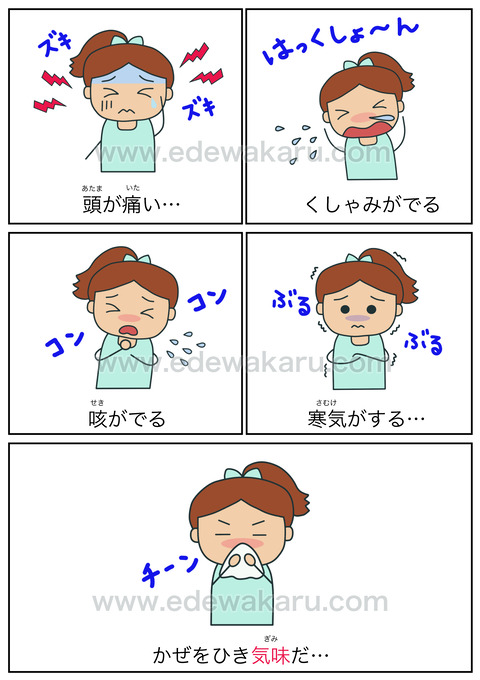
Meaning
(心や体に)
少し〜と感じる状態
・
様子
How to use it
動詞[ます形]+気味だ
名詞+気味
Explanation
「〜気味」は「少し〜と感じる状態」という意味の文型です。ほとんどの場合、マイナスのことに使用され、心や体で「少し〜だなぁ」と感じている時に使います。
[例]
①カゼをひき
気味
だ
→「頭が痛い」「寒気がする」と【体】で感じて「少しかぜをひいているな…」と思った
②最近太り
気味
だ
→「スカートが入らなくなった」「服がきつい」など【体】で感じて「少し太った」と思った
「〜気味」と混乱しやすい文型がいくつかありますので、復習をしておきましょう。
【混乱しやすい文型】
In context 5 examples
かぜをひき気味だ
→少しかぜをひいていると感じる状態太り気味なので、運動を始めた
→少し太ったと感じている状態A:元気がないみたいだけど、どうしたの?B:ここのところ疲れ気味なんだ…
→少し疲れていると感じている状態最近、成績が下がり気味だ…
→成績が少し下がっていると感じている台風のせいで、野菜の値段が上がり気味だ
→野菜の値段が少し上がったと感じている
日本語NET JLPT文法解説まとめ
Meaning
"いつもと違って、少し〜の感じがする"
ネガティブな言葉として使われる。
How to use it
V(ます形)ます + 気味
N + 気味
Explanation
"be a little / have a touch of"
Used as a negative word
In context 8 examples
最近、ナタポンさんは疲れ気味で、授業中によく居眠りをしています。
ちょっと遅れ気味なので、補習授業を行いましょう。
社会人になってから、全然運動しなくなったので、最近太り気味だよ。
1年前は大人気だった彼女の人気も、最近では下がり気味だね。
ちょっと風邪気味なので、早めに帰らせていただけませんか。
トムさんは発表する時、ちょっと緊張気味だった。
最近ちょっと貧血気味で、立つとめまいがするんです。
先生、最近下痢気味なんですが、どうしたらいいですか。
毎日のんびり日本語教師
How to use it
名詞+気味
動ます形+気味
Explanation
話し手がわずかに感じる感覚を表す文法です。
一般的に良くないことに対して使われます。
Notes
特になし
In context 8 examples
少し風邪気味だから、外出は控えようと思う。
治りかけだったけど、少し無理をしてしまって若干悪化気味だ。
変なものを食べたせいで下痢気味だ。
顔を見る限り、彼女はちょっとお疲れ気味だ。
最近太り気味なので運動しないと。
何度やっても失敗するから、半ば諦め気味だ。
彼女は内気で、何をするにも遠慮気味だ。
季節の変わり目は体調を崩し気味だ。(季节更替之际身体有些不适。)
IMABI
Appearance
Read this IMABI lesson ↗Explanation
Appearance: ~だらけ, ~まみれ, ~ずくめ, ~めく, ~げ, ~みどろ, & ~気味
There are several suffixes in Japanese that represent states of appearance.
~だらけ
~だらけ attaches to nouns to describe how something is riddled with something. ~だらけ may be used with both physical and psychological items. There is an extent to how you can use this though. Things like 混乱こんらんだらけ would be wrong. This is because it should be used with things that are either physical or dealing with (emotional) phenomenon and not a “state”. Rather than 混乱だらけ, consider phrases like すごく狼狽ろうばいしている or とても動揺どうようしている.
1. 彼女は(口を開けば){不平・不満}{ばっかり言ってる・だらけだ}な。
She’s full of complaints isn’t she?
2. パソコンは埃ほこり{かぶっていた・だらけだった}。
The desktop was covered in dust.
3. 後悔こうかいだらけ
Covered in regret
4. 傷きずだらけ
Covered in injuries
5. 血だらけになった殺人犯さつじんはんは逃にげ場ばがなくなって自殺じさつしたそうだ。
They say that since the murderer covered in blood didn’t have a place to run away, he committed suicide.
~塗れ
~まみれ comes from 塗まみれる which means “to be covered with”. Similar to ~だらけ ~まみれ shows how something is completely covered in something. Unlike ~だらけ, ~まみれ is solely used with physical objects. However, there is a trend to use ~まみれ with things that have a “physical persona”. This, though, is metaphoric. Creating metaphors in any language causes rules to become more flexible.
6. 遺体いたいは血塗れだったということです。
It is said that the corpse was completely covered in blood.
7. メキシコ湾わんは{辺り一面}重油じゅうゆ{埋め尽くされました・まみれになりました}。
The Gulf of Mexico became completely covered in heavy oil.
8. 彼はただの挫折塗ざせつまみれのやつだけだ。
He’s just completely covered in failure.
~尽くめ
~ずくめ shows that something is “completely…”. It is normally either attached to nouns of colors or こと. There is, though, a condition that whatever it attaches to that the context is in relation to human intent.
A similar ending is ~ずくし. It means “all sorts of”. Here, the human intent condition is non-existent. In writing, using づ instead of ず is OK. This is just a conflict between Old and New orthographies that has just been left to the individual to decide.
9. 人が黒尽くめでした。
The person was completely black.
10. いい事づくしの人
A person full of good luck
11a. 白づくめで抗議してる人は窃盗罪せっとうざいで訴うったえられた人達だ。
11b. 抗議をしている、白づくめの人達は、窃盗罪で訴うったえられた。
The people protesting dressed in white were accused of theft.
~めく
~めく shows what something looks like or what condition something becomes, and it may follow nouns, adverbs, or the stem of adjectives and verbs. The closest translation for ~めく is “to show signs of”. Although all tenses are possible, ~めく is normally only used in the non-past or past tense. Depending on the verb, there are may be more options. For instance, うごめく can be seen in things like the progressive.
To be astir ざわめく To flash 閃く To be mysterious 謎めく
To glimmer 仄めく To color 色めく To be spring-like 春めく
To wriggle うごめく To flourish 時めく To be autumn-like 秋めく
Grammar Note: When attached to verbs, the new verb is often seen contracted and then written differently. ~めく is most often used with nouns and 形容動詞.
12. 教室は興奮こうふんで騒ざわめいた。
The classroom stirred with excitement.
13. 庭の楓かえでが色めくのは本当に美しいですよね。
The changing in colors of the maple trees in the garden is really beautiful, isn’t it?
14. {うわぁ・ああ}、{もぞもぞ動いてる・蠢うごめいてる}虫(がいる)!
Ah, a wriggling worm!
15. 彼は今を時めく歌手・有名人です。
He is one of the most prosperous singers/famous people of the time.
16. 謎なぞめいた様子ようすをしている。
To have an air of mystery.
17. 謎めいた様相ようそうを呈ていする。
To be in a situation covered in mystery.
18. 冬めいてきた。
It became winter-like.
19. 陽光に川面が煌めく。
The river surface glistens in the sunlight.
20. どよめいて、人々が飛びのく。一人の背中が飛鳥にぶつかった。はね飛ばされて、壁に肩をぶつける。さらにはね返ってよろめき、あやうく転びかけたときだった。
Making a stir, people jumped back. A person’s back hit Asuka. Being sent flying, she hit her shoulder on the wall. In addition, it was when she had bounced back, staggered, and dangerously started to tumble.
From 野生の風 by 村山由佳.
~みどろ
~みどろ is a less common alternative to the suffix ~まみれ to show things being covered in something.
21. 血みどろの遺体
A bloody corpse
22. 汗みどろの労働者
A sweat covered laborer
~気
~げ conjugates as a 形容動詞けいようどうし. Used to show a sense of true appearance, it describes something with intense fervor and emotion. Lastly, ~げ may be attached to the stem of adjectives and to nouns.
23. 悲しげに泣く。
Cry while being sad all over.
24. 均衡予算を黙殺するのは大人げない。
Ignoring the balanced budget proposal is childish.
25. 彼は何か言いたげな顔をしていた。
He had the face of wanting to say something.
26. 「今も新しい戦争が僕らを追っかけて来ているのかもしれないし、僕らのなかの前の戦争が、亡霊のように僕らを追っかけているかもしれないんです。」と修一は憎さげに、「お父さまこそ、あの娘がちょっと変わっているから、ひそかに魅力を感じて、妙な考えをくどくどもってまわってらっしゃる。女がほかの女とどこかちょっとちがっているだけで、男はつかまるのですからね。」
“A new word may have come its way to chase after us even now, but the war of the past within ourselves may be chasing after us like a departed spirit”, and Shuichi continued odiously with “And you, of course, Father inwardly feel a mystique since she’s changed a little, and you’re going about stuttering long-winded, strange thoughts. That’s man is just something that it’s caught up with the small differences one woman has with other women.”
From 山の音 by 川端康成.
27. 菊子は不審げに信吾を見て、そして顔を赤らめた。
Kikuko looked strangely at Shingo and then blushed.
From 山の音 by 川端康成.
Grammar Note: ~げ is almost never used with verbs. ~げ is closest to ~そうだ, but ~そうだ lacks the emotional emphasis. As emotional emphasis is very important, it is used with nouns that we aspire to be and adjectives that express our emotions.
The reading け and ぎ also exist, and they confusingly are used similarly to the げ reading. Luckily, the latter reading is not written as 気. The reading け is seen a lot in phrases like 飾り気 (affectation), 色気 (sex appeal), and 寒気 (feeling chilly). 人気 has two readings. When it is read as にんき, it means “popularity”, and when it is read as ひとけ, it is the antonym of deserted, but it is usually used in this sense in the phrase 人気がない.
The reading ぎ of 気 is rather restricted to nouns that can have perceptually suitable characteristics. Words such as 商売気 (mercenary mind), 男気 (chivalry), and 女気 (woman care) come to mind, and the only other examples are all literary words unlikely to be used in conversation, or at the very least appear rarely in literature. Examples of such words include 謀反気 (rebelling spirit), 芝居気 (theatrical spirit), 芸気 (theatrical spirit), and 回り気 (worrying and doubtful spirit).
28. お前さんも余程回り気の人だね。
You’re quite the worry wort too, aren’t you.
From 深川女房 by 小栗風葉.
Interestingly enough, the most common examples of ぎ and け are replaced with っけ. Examples of this include人っ気, 飾りっ気, and 商売っ気. Even words that typically only use け such as 真っ黒け and 真っ白け may have っ insertion in actual conversation. Even more interesting is the fact that the phrases 真っ赤っ赤 (bright red) and 真っ黄っ黄 (bright yellow) exist. The first one shows up dictionaries and is used widely, but the latter is rather dialectical. The interesting point here is how the forms seem to mimic the use of っけ for emphasis.
29. 彼は仕事を事もなげにやってのけた。
He pulled the job off as if nothing happened.
~気味
~気味ぎみ is seen after either a noun or the 連用形れんようけい of a verb. It shows a visible indication or slight feeling and is often used in a negative context. Common translations include “sign of,” “on the…side,” and “slight.”
30. 彼は疲れ気味だ。
He has the signs of fatigue.
30. 彼は太り気味だ。
He’s a little on the heavy side.
31. 今朝はちょっと風邪気味だ。
I have a slight feeling of a cold this morning.
Word Note: ~味 comes from 気味, which means “sensation” or “tendency.”
In context 33 examples
彼女は(口を開けば){不平・不満}{ばっかり言ってる・だらけだ}な。
She’s full of complaints isn’t she?
パソコンは埃ほこり{かぶっていた・だらけだった}。
The desktop was covered in dust.
後悔こうかいだらけ
Covered in regret
傷きずだらけ
Covered in injuries
血だらけになった殺人犯さつじんはんは逃にげ場ばがなくなって自殺じさつしたそうだ。
They say that since the murderer covered in blood didn’t have a place to run away, he committed suicide.
遺体いたいは血塗れだったということです。
It is said that the corpse was completely covered in blood.
メキシコ湾わんは{辺り一面}重油じゅうゆ{埋め尽くされました・まみれになりました}。
The Gulf of Mexico became completely covered in heavy oil.
彼はただの挫折塗ざせつまみれのやつだけだ。
He’s just completely covered in failure.
人が黒尽くめでした。
The person was completely black.
いい事づくしの人
A person full of good luck
白づくめで抗議してる人は窃盗罪せっとうざいで訴うったえられた人達だ。
The people protesting dressed in white were accused of theft.
抗議をしている、白づくめの人達は、窃盗罪で訴うったえられた。
The people protesting dressed in white were accused of theft.
教室は興奮こうふんで騒ざわめいた。
The classroom stirred with excitement.
庭の楓かえでが色めくのは本当に美しいですよね。
The changing in colors of the maple trees in the garden is really beautiful, isn’t it?
{うわぁ・ああ}、{もぞもぞ動いてる・蠢うごめいてる}虫(がいる)!
Ah, a wriggling worm!
彼は今を時めく歌手・有名人です。
He is one of the most prosperous singers/famous people of the time.
謎なぞめいた様子ようすをしている。
To have an air of mystery.
謎めいた様相ようそうを呈ていする。
To be in a situation covered in mystery.
冬めいてきた。
It became winter-like.
陽光に川面が煌めく。
The river surface glistens in the sunlight.
どよめいて、人々が飛びのく。一人の背中が飛鳥にぶつかった。はね飛ばされて、壁に肩をぶつける。さらにはね返ってよろめき、あやうく転びかけたときだった。
Making a stir, people jumped back. A person’s back hit Asuka. Being sent flying, she hit her shoulder on the wall. In addition, it was when she had bounced back, staggered, and dangerously started to tumble.
血みどろの遺体
A bloody corpse
汗みどろの労働者
A sweat covered laborer
悲しげに泣く。
Cry while being sad all over.
均衡予算を黙殺するのは大人げない。
Ignoring the balanced budget proposal is childish.
彼は何か言いたげな顔をしていた。
He had the face of wanting to say something.
「今も新しい戦争が僕らを追っかけて来ているのかもしれないし、僕らのなかの前の戦争が、亡霊のように僕らを追っかけているかもしれないんです。」と修一は憎さげに、「お父さまこそ、あの娘がちょっと変わっているから、ひそかに魅力を感じて、妙な考えをくどくどもってまわってらっしゃる。女がほかの女とどこかちょっとちがっているだけで、男はつかまるのですからね。」
“A new word may have come its way to chase after us even now, but the war of the past within ourselves may be chasing after us like a departed spirit”, and Shuichi continued odiously with “And you, of course, Father inwardly feel a mystique since she’s changed a little, and you’re going about stuttering long-winded, strange thoughts. That’s man is just something that it’s caught up with the small differences one woman has with other women.”
菊子は不審げに信吾を見て、そして顔を赤らめた。
Kikuko looked strangely at Shingo and then blushed.
お前さんも余程回り気の人だね。
You’re quite the worry wort too, aren’t you.
彼は仕事を事もなげにやってのけた。
He pulled the job off as if nothing happened.
彼は疲れ気味だ。
He has the signs of fatigue.
彼は太り気味だ。
He’s a little on the heavy side.
今朝はちょっと風邪気味だ。
I have a slight feeling of a cold this morning.