AIUEO JLPT Grammar
Meaning
This sentence pattern is used when indicating that something is created or thought of based on a specific thing, like an idea, plan, or work. It refers to the elements that form the foundation of the item or concept.
How to use it
名詞を+もとに(+して)
Explanation · 日本語
この文型は、特定の物事や情報に基づいて、何かを作ったり考えたりするときに使われる表現で、アイデアや計画、作品などの土台となる要素を示します。
In context 5 examples
この映画は、実際にあった事件をもとに作られた。
This movie was made based on a true event.
彼は長年の経験をもとにして、この本を書いた。
He wrote this book based on his years of experience.
アンケート結果をもとに、新商品の開発が進められた。
The development of the new product was based on the survey results.
研究結果をもとに、新しい理論が提唱された。
A new theory was proposed based on the research results.
統計データをもとに、マーケティング戦略を立てます。
We develop a marketing strategy based on statistical data.
Bunpro Grammar Reference
Meaning
Based on, From, According to
How to use it
Noun + をもとに(して)
Noun + をもとにした + Noun
Nuance
An expression showing that (A) is the basis or foundation from which (B) is going off.
Explanation
When linked to a noun, を元に is an expression that indicates that something is 'based on (A)', 'from (A)', or 'according to (A)'. This is a combination of を, the noun 元 'origin', and に. The literal meaning is similar to 'with (A) as the origin, (B)', and is used primarily to reference a source from which something is created or started.
このドラマは実際に起こったことをもとに作られたそうだ。
Apparently, this TV show was created based on actual events.
研究の結果をもとにレポートを書いてください。
Please write a report based on the results of the research.
私はこのデータをもとにこのグラフを作成しました。
I created this graph based on this data.
Most of the time, をもとに will be written without kanji, but it is also possible to see it as を元に.
As this grammar pattern is mainly used to highlight an origin of creation, it will often be seen in sentences that use verbs like 書く 'to write', できる 'to be able', and 作る 'to make'.
Caution
を元に 'based on' differs to に基づいて 'based on', in that に基づいて indicates a foundation from which the judgement or conclusion of (B) is made, while を元に focuses more on being a source of inspiration for (B), or enabling (B).
彼は法律に基づいて処分されるだろう。
He will be receiving punishment according to the law.
彼は法律をもとに処分されるだろう。
He will be punished based on the law.
Fun Fact
Although 元に is perhaps the most common, either 基に or 下に may also be used in various circumstances. You can read about the slight variances in nuances online, but for the most part, they are as follows.
基に - With the root of (A), with a direct link or connection to (A).
元に - With the beginning or origin of (A).
下に - At the base of (A).
Nuance · 日本語
(A)が(B)のベース、又は土台だということを表す表現。
Explanation · 日本語
「を元に」は名詞と結びつき、何かが「(A) を基本にして」「(A) を材料にして」「(A) を参考にして」いることを表す文型です。これは「を」と名詞「元(主な意味:始め)」、そして「に」の組み合わせです。文字通りに解釈えると「(A) を始まりとして (B)」であり、主に何かが作られたり始まったりする起点を示すために使われます。
このドラマは実際に起こったことをもとに作られたそうだ。
Apparently, this TV show was created based on actual events.
研究の結果をもとにレポートを書いてください。
Please write a report based on the results of the research.
私はこのデータをもとにこのグラフを作成しました。
I created this graph based on this data.
ほとんどの場合、この表現は「をもとに」とひらがなで書かれますが、「を元に」の漢字が使われることもあります。
この表現は主に「何かを作るとき」に使われるので「書く」「できる」「作る」などの創作を表す動詞と一緒に使われることがよくあります。
注意点
「を元に」は「に基づいて」とは意味合いが異なります。「に基づいて」は (A) を根拠として (B) という判断をしたり結論を出したりすることを表すのに対し、「を元に」は (A) を参考にして (B) が生まれたり、(A) が (B) を可能にしたりすることを表します。
彼は法律に基づいて処分されるだろう。
He will be receiving punishment according to the law.
彼は法律をもとに処分されるだろう。
He will be punished based on the law.
豆知識
「元に」は最もよく使われる漢字ですが、場合によっては「基に」や「下に」という漢字が使われることもあります。これらの漢字には、大まかに次のようなニュアンスの違いがあります。
基に - (A) を基礎・土台として、(A) と直接的な関係を持って
元に - (A) を始まり・起点として
下に - (A) の支配・影響があるところで
In context 17 examples
- これはクックパッドを元に作ったうどんです。
This is udon made according to Cookpad.
- このドラマは実際に起こったことをもとに作られたそうだ。
Apparently, this TV show was created based on actual events.
- 研究の結果をもとにレポートを書いてください。
Please write a report based on the results of the research.
- 私はこのデータをもとにこのグラフを作成しました。
I created this graph based on this data.
- このインタビューを元に記事を書いてください。
Please write an article based on this interview.
- 息子の足跡を元に後を追った。
I pursued my son based on his footprints.
- 電話帳を元に宛名を書いてください。
Please write the name and address according to the telephone book.
- そんな主観を元に恨まれても困るよ。
If you feel bitter about it based on that personal opinion, I will not be thrilled.
- 編物の本を元に編んだらうまくできた。
When I knitted according to the knitting book, it turned out well.
- そんな不正確な情報を元に怪しむなんてどうかしている。
To suspect (something) based on such inaccurate information is crazy.
- 親の経験を元に育児のアドバイスをもらっている。
I am receiving child rearing advice based on my parent's experience.
- 市町村のホームページを元に移転先を決めました。
I decided to move based on the town's homepage.
- 税金の総額は年度の収入を元にして計算される。
The amount of tax is calculated based on revenue in a fiscal year.
- この恋愛漫画は実際に起こったことを元に作られているらしい。
I heard that this romance manga is based on actual events.
- 本当の魚の姿を元にしたロボットは普通の魚とともに暮らし、海洋生物についてのデータを収集しています。
Robots based on the shape of an actual fish are living with ordinary fish and are collecting data about marine life.
- 彼は法律に基づいて処分されるだろう。
He will be receiving punishment according to the law.
- 彼は法律をもとに処分されるだろう。
He will be punished based on the law.
どんなときどう使う 日本語表現文型辞典
Meaning
derived from
How to use it
N+をもとに(して)
Explanation
をもとに(して)
~を素材にして/~からヒントを得て
1)あるものが生み出される素材を表す。後には、「書く・話す・作る・創作する」などの意味を持つ文が来る。
2)「にもとづいて」と意味が似ているが、「をもとにして」は、それから具体的な素材を得るだけであり、精神的に離れずにという気持ちは薄い。
3)後に名詞が来る場合は ❸ ❹ のように「をもとにしたN」という形になる。
1)Describes material that creates something. Clauses with meanings of 書く, 話す,作る, 創作する, etc. follow.
2)Similar in meaning to にもとづいて, but をもとにして has less feeling of emotional inability to gain distance, and focuses instead of obtaining concrete materiel.
3)When followed by a noun, becomes をもとにした N, as in sentences ❸ and ❹ .
In context 4 examples
ひらがなとかたかなは漢字をもとにして生まれたものである。
北欧の古い歌をもとに、新しい音楽に作りかえたのがこの曲です。
ポップスの中には有名なクラシックの曲の一部をもとにしたものがある。
最近、戦争体験者の話してくれたことをもとにしたテレビドラマが多い。
絵でわかる日本語
Usage 1
Read this source entry ↗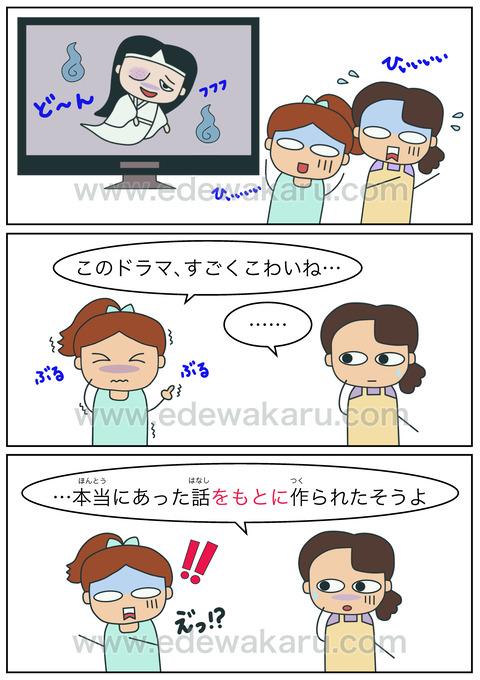
Meaning
〜を基本にして〜する
〜を素材にして〜をつくる
〜を題材に〜する
How to use it
名詞[辞書形]+をもとに
名詞[辞書形]+をもとにして
名詞[辞書形]+をもとにした+名詞
Explanation
「〜をもとに」は「〜を基本にして〜する」「〜を素材にして〜をつくる」という意味の文型です。この文型は「〜を素材や基本にして、何か新しいものをつくる」と言いたい時に使われます。
「〜をもとに」は「〜をもとにして」にチェンジすることができます。
また、
後ろに名詞がくる場合は「〜をもとにした+名詞」になります。
[例]
自分の経験
をもとに、本を書く
=自分の経験
をもとにして、本を書く
「〜をもとに」に似ている文型を復習しておきましょう😊
【関連文型】
In context 5 examples
娘:このドラマ、すごくこわいね…母:本当にあった話をもとに作られたそうよ
→本当にあった話を題材にして作られたそうよひらがなは漢字をもとにつくられた
→ひらがなは漢字を基本につくられたこの商品は女子高生(じょしこうせい)のアイデアをもとに作られた
→女子高生のアイデアを基本に作られた彼は自分の経験をもとに、本を書いた
→自分の経験を題材に、本を書いた調査結果(ちょうさけっか)をもとに、レポートを書きます
→調査結果を基本に、レポートを書きます
Usage 2
Read this source entry ↗Meaning
〜を基本にして〜する
〜を素材にして〜をつくる
〜を題材に〜する
How to use it
名詞[辞書形]+をもとに
名詞[辞書形]+をもとにして
名詞[辞書形]+をもとにした+名詞
Explanation
「〜をもとに」は「〜を基本にして〜する」「〜を素材にして〜をつくる」という意味の文型です。この文型は「〜を素材や基本にして、何か新しいものをつくる」と言いたい時に使われます。
「〜をもとに」は「〜をもとにして」にチェンジすることができます。
また、
後ろに名詞がくる場合は「〜をもとにした+名詞」になります。
[例]
自分の経験
をもとに、本を書く
=自分の経験
をもとにして、本を書く
「〜をもとに」に似ている文型を復習しておきましょう😊
【関連文型】
日本語文型辞典
Meaning
基本情報Nをもとに(して)説明「あるものを材料・ヒント・根拠などにして」という意味を表す。名詞を修飾する時は⑤のように「NをもとにしたN」になる。例文① 実際にあった話をもとにして脚本を書いた。② 人のうわさだけをもとにして人を判断するのはよくない。③ この地方に伝わる伝説をもとにして、女フ想的な映画を作ってみたい。④ 調査団からの報告をもとに救援物資の調達が行われた。⑤ 史実をもとにした作品を書き上げた。
日本語文型辞典 英語版
Meaning
【をもとに】[Nをもとに(して)]
Means “taking a particular thing as material, a hint, or the basis for (something).” When it modifies a noun, as in example
(5)
, it becomes NをもとにしたN.
In context 5 examples
実際にあった話をもとにして脚本を書いた。
I wrote the screenplay based on a true story.
人のうわさだけをもとにして人を判断するのはよくない。
It is not good to judge people only on the basis of gossip.
この地方に伝わる伝説をもとにして、幻想的な映画を作ってみたい。
I want to make a fantasy movie based on a traditional legend of this area.
調査団からの報告をもとに救援物資の調達が行われた。
Relief supplies were procured on the basis of the report of the inquiry commission.
史実をもとにした作品を書き上げた。
I wrote a work based on historical fact.
くらべてわかる日本語表現文型辞典
Meaning
AはBの基礎・土台。
How to use it
AをもとにB(AをもとにしてB)
[名詞-∅]をもとに
In context 4 examples
これは事実をもとに書かれた小説である。
警察は目撃者の情報をもとにして、犯人のモンタージュ写真を作った。
彼は退職金をもとに商売を始めた。
私は日本での経験をもとに、帰国後は両国のために働きたい。
毎日のんびり日本語教師
How to use it
名詞+をもとに(して)
名詞+をもとにした+名詞
Explanation
材料、素材、根拠となるもの、参考となるものを表します。
漢字は「基(もと)」です。
Notes
特になし
In context 7 examples
これは実話をもとに描いた絵本です。
膨大なデータをもとに未来を予測する。
この短編小説は実際に起きた事件をもとに書かれている。
彼女の経験をもとにアドバイスしてくれました。
お客さまの声をもとに今後とも改善に努めてまいります。
戦時中の状況を実体験をもとに語っていただいた。(以实际体验为基础讲述了战争时期的情况。)
新たな体験をもとに新しい価値観が形成されていく。
文法
Meaning
~を素材/基本/基準/参考にして
How to use it
N + をもとにして
In context 10 examples
このドラマは実話をもとにして、作られたそうだ。
日本の漫画をもとにして、たくさんのアニメやゲームが作られている。
これは彼の子供の時の経験をもとにして作られた小説です。
漢字をもとにして、ひらがなとカタカナが作られました。
アンケート結果をもとにして、レポートを書きます。
試験の結果をもとにして、合格か不合格か判断します。
食べログの評価をもとにして、どのレストランにするか決めましょう。
過去5年間のテストデータをもとにして、次のテストに出そうな問題を分析します。
これまでの経験をもとに本を書こうと思っている。
今日の会議で出たアイデアをもとにして、次に作るべき製品を考えましょう。
日本語NET JLPT文法解説まとめ
Meaning
~を素材/基本/基準/参考にして
How to use it
N + をもとにして
Explanation
based on ~
In context 10 examples
このドラマは実話をもとにして、作られたそうだ。
日本の漫画をもとにして、たくさんのアニメやゲームが作られている。
これは彼の子供の時の経験をもとにして作られた小説です。
漢字をもとにして、ひらがなとカタカナが作られました。
アンケート結果をもとにして、レポートを書きます。
試験の結果をもとにして、合格か不合格か判断します。
食べログの評価をもとにして、どのレストランにするか決めましょう。
過去5年間のテストデータをもとにして、次のテストに出そうな問題を分析します。
これまでの経験をもとに本を書こうと思っている。
今日の会議で出たアイデアをもとにして、次に作るべき製品を考えましょう。
IMABI
Based on
Read this IMABI lesson ↗Explanation
Based on: に基づいて、を踏まえて, をもとにして, に沿って, に即して, & に則って
These phrases are definitely very similar to each other, but as you will see during the compare and contrast sections of this lesson, there are important differences to keep in mind.
~に基づいて
~に基づいて means “based on.” Its attribute form may either be ~に基づいての or ~に基づいた. Broadly speaking, there are two main usages of Xに基づいてY. The first is “without deterring from a standard/criterion/norm/rule/law X, one carries out/executes an action Y.” The other, which is found primarily in the written language, is “having A as a basis/foundation/modal/example/pattern/reference, one does/makes a decision B.”
1. 事実に基づいた記述きじゅつをする。
Describe on the basis of reality.
2. 彼女の議論は確かに証拠しょうこに基もとづいていなかった。
Her argument was certainly not on the basis of evidence.
3. 明らかなことに基づいた議論の余地よちのない事実。
Unarguable facts based on obvious things.
4. このマニュアルに基づいて操作します。
I will operate it based on this manual.
5. 規則に基づいて処理する。
To process according to regulations.
6. さっきの例文に基づいた、もっと複雑なものです。
These are more complicated ones based off of the previous example sentences.
7. 証拠に基づいて、加害者かがいしゃに死刑しけいを言い渡わたした。
In line with the evidence, the assailant was sentenced to death.
Variant Note: ~に基づいて may also be ~に基づき in stiffer writing.
Grammar Note: For the attribute form, ~に基づいての must only be used when what it precedes is a standard of some sort. If it is not, you must use ~に基づいた instead.
を踏まえて
The 一段 verb 踏まえる means “to be based on”. So, ~を踏まえて means “on the basis of” just like ~に基づいて. It can also be seen as ~を踏まえ in the written language. Its attribute form may either be ~を踏まえての or ~を踏まえた. As its original literal meaning is “to tread on” in a defensive posture, it is used after words that can show a basis/foundation/precedent for something. Again, it cannot follow material for reference as a standard. Rather, it must follow an extant basis. This pattern is usually seen in the written language and finds itself in news reports all the time.
8. 自分の経験を踏まえてこういう。
To say such based on one’s own experience.
9. これまでの状況を踏まえて得た最終結論です。
This is the last argument gotten based on the conditions up to now.
10. 報告を{踏まえた・踏まえての}処理
Processing based on the report
Translation Note: 踏まえる may also mean “to tread”.
11. 両足で大地を{踏まえて・踏んで}立って!
Tread on the ground with both your legs and stand!
~をもとにして
~をもとにして is used to show that one bases off of the good qualities of something. It does not necessarily have to be 100% congruent with the full truth in the circumstances. It shows willful change, and it is usually shortened in the spoken language to ~をもとに. When this pattern happens to be used as an attribute, it becomes ~をもとにした.
12. 私は親譲おやゆずりの財産をもとにして富とみを作りました。
I built my wealth on the fortune from my father.
13. 嘘うそをもとにして行おこなう。
To act upon a lie.
14. 事実を基にして書かれた劇だ。
It is a play written on the basis of the truth.
漢字 Note: Although this pattern is used both in the spoken and written language, when もと is written in 漢字, you have the options 基, 本, 素, 原, 源, 元, and 下. Thus, the meaning of this expression can be further refined. The first refers to a standard. The second refers to the foundation of something. The third refers to the subject matter. The fourth refers to raw materials. The fifth refers to a source. The sixth refers to the original way. The seventh refers to being under an influence. However, most natives cannot distinguish this well, and this is only knowledge relevant for when reading through literature.
~に沿って & More
~に沿って
~に沿って is used in a physical or cause and effect sense. It can also be seen as ~に沿い is stiff writing, but even here it is considerably rare. The attribute forms ~に沿った and ~に沿っての are slightly different. The former can be used when A fits nicely with B, but there can be some deviance. However, there can be no such deviance with the latter.
15. 時勢じせいに沿って生きる。
To live in consonance of the times.
16. 土手に沿って、苔こけが生えている。
Moss is growing along the embankment.
17. 事実に沿って、話しをしてくださいますか。
Could you please talk along the facts (of the case)?
18. 湖に{〇 沿った・X 沿っての}公園を歩きました。
I walked through the park that’s alongside the lake.
19. 事業計画に{沿った・沿っての}実施状況じっしじょうきょう
The status of implementation along the business plan
20. 僕は川に沿って歩いた。
I walked along the river.
Variant Note: ~に沿って may be replaced by the suffixes ~沿ぞい and ~伝づたい in the physical sense.
21. 軒のきづたいに倉庫そうこの裏に廻って行った。
Along the eaves, I went around the back of the storehouse.
22. 川伝いに走り回る。
To run around along the river.
23. 湖畔こはん沿いの道路を歩く。
To walk through the street alongside the lake shore.
24. 流れに沿うてやがて広野に出ると、頂上ちょうじょうは面白く切り刻きざんだようで、そこからゆるやかに美しい斜線しゃせんが遠い裾すそまで伸びている山の端はに月が色づいた。野末のずえにただ一つの眺めである、その山の全まったき姿を、淡い夕映えの空がくっきりと濃深縹色ふかはなだいろに描き出した。
Along the stream, when we at last entered the wide, the moon changed colors in the edge of the mountain, which had a gently beautiful slant with the peak interestingly cutting it that stretched to the far base of the mountain. The light sunset sky sharply drew the perfect view of the mountain for the single view at the corner of the field a light yet deep indigo.
From 雪国 by 川端康成.
漢字 Note: The spellings 添う・副う exist. The first is seen with the sense of “addition” and the latter is seen with the sense of “expectation/satisfaction”.
25. 身に添った悲しみ
The sadness on oneself
26. 花が期待に副って見事に咲いたよ。
The flowers bloomed splendidly to my expectations.
~に即して
~に即して is reserved to writing and often very stiff. If used in the spoken language, it is very formal or official sounding. It is frequently used to show that something is based on/along things. In even more formal writing, it can be seen as ~に即し.
27. 時代に即した教育
Education according to the times
28. 事実に即したドラマ
A drama in accordance with the facts
29. 法律に即した判断
A decision in accordance with the law
30. 理念に即した行動
Actions in accordance to an ideal
Spelling Note: As for spelling そくして, when the situation is based off of a given fact or observation you use 即して. However, if the situation is based on rules you use 則して, following the meanings of the 漢字 in question. There is a tendency to only use the former.
31. 前例に則して処理する。
To process according to precedent.
Attribute Note: The attribute forms available depends on the spelling. If 即して, you can only use に即した. If 則して, you can use either ~に則しての or ~に則した. Although with ~に即して one can’t feel any sense of excess or deviance, with ~に則して you can. Thus, the differences in possible attribute forms arise. It’s opposite to that of ~に沿って’s attribute forms, so be careful.
~にのっとって
~に則って is from the て形 of 則る, which is used to show that one protects some sort of tradition/rule set up in the past. This part of the meaning comes from an old verb のる in combination with 採る. This のり can still be found in many words written as 法: 御法 (humble law), 内法 (inside measure), etc. This is why 則る can also, but rarely, be seen written as 法る. It is no surprise that these two concepts are found in the word 法則 (law; rule).
Whether this pattern is used in the spoken language or not is debatable, but it is very literary/rather stiff written speech modal. It can be used in official situations and in technical terms in relation to rules/costumes. It can also be seen as ~に則り, and the attribute form can be seen as ~に則っての or ~に則った without any restriction.
32. 遺言状に則って、遺産相続がなされます。
Inheritance will be carried out according to the will.
33. 憲法に則り、最高裁判所の判断が示される。
The Supreme Court’s decision will be presented in accordance with the Constitution.
34. 仕来りに{則った・則っての}儀式
A ceremony that is in accordance with tradition
Points of Confusion
Although this section is not meant to exhaustively nitpick things, by the end of this section you will certainly have a better understanding of the differences between these phrases taught. Note that only those that truly seem synonymous will be addressed here.
35a. これまでの経験に基づいて、これからも頑張りたいと思う。X
35b. これまでの経験を元にして、これからも頑張りたいと思う。〇
If you paid any attention to the kind of words and situations above with ~に基づいて, you should have noticed that they are all in the same vein in regards to the basis of something in regards to fact or circumstances. The problem with the first sentence, though, will lead us into a serious issue: what are the differences between ~に基づいて, ~をもとにして, ~に沿って, ~に即して, and ~に則って.
1. ~に基づいて, ~に基いて being a less common spelling, shows that an action or circumstance is taking place based on fundamentals, matter at hand, or in combination with some sort of proof.
36. 判決に{基づいて・基づき}、刑が執行される。
The verdict will be carried out according to the punishment.
37. 人は法に基づいて裁かれる。
People are judged according/based on the law.
Usage Note: This pattern is often used after words like 事実, 証拠, 経験, 規則, 情報, etc. Words that often follow this pattern include 判断する, 行動する, 決める, 作る, 裁く, 言い渡す, 下す, 等.
2. ~をもとにして, on the other hand, shows a meaning of “basing on fundamentals or matter at hand, while one capitalizes/utilizes on it or while one utilizes a certain part…”. The orientation of the expressions, thus, are quite different.
38. 資料を基にする。
To base it on the materials.
39. 人の噂をもとにして判断してはいけないよ。
I mustn’t judge something based on people’s rumors!
40. これまでの経験をもとにして、頑張りたいと思う。
I wish to try hard based on my experience up to now.
Usage Note: This pattern is often used after words like データ, 情報, 事件, 話, 噂, 等. Words that often follow this pattern include 頑張る, 書く, 作る, 対処する, 等.
3. ~に沿って, like the above two, all share the feature of being based on the matter at hand or fundamentals of something, but the peculiar part about this is that the meaning of “without there being a physical distance” is included.
41. 道に沿って花が植えられている。
Flowers are planted along the street.
42. 塀にそって進んでくれ。(Vulgar command)
Move forward along the wall!
43. 川に沿って歩きなさい。
Walk along the river.
44. 私の考えにそってやってほしい。
I would like for it to be done along my ideas.
Usage Note: This pattern is often used after words like 道路, 道, 川, 壁, 歩道, 考え, 意向, 等. Words that often follow this pattern include 行く, 歩く, する, やる, 進む, 等.
Without getting into the other two remaining patterns, there are still times when all three structures appear to work. However, there will always be nuance differences based on the lines outlined above.
45. 事実{に基づいて・をもとにして・にそって}作ってある。
It was created and based on facts.
Nuances differences still exist. The first sounds purely factual. The second sounds like it was based on fact but not entirely. The third sounds like it was closely aligned with the facts. In more complex sentences, these differences can be large enough for ungrammaticality calls if violated.
46. 取材{〇 に基づいて・〇 をもとにして・X にそって}書かれている。
It is written based on collected data.
Grammar Note: ~にそって is bad because collected data could be conflicting. If this were known not to be the case, the unnaturalness would go away. Contextual environment and what kind of word(s) you’re using a pattern with help you put things together within grammatical restrictions.
47. その図面{〇 に基づいて・X をもと(にして)・X にそって}、配線工事をお願いします。
Please do the wiring work according to the blueprint.
48. この判例{に基づいて・をもと(にして)}裁判での闘い方を考えてみよう。
Let’s try to consider the ways of fighting in the trial based on this judicial precedent.
49. 高校で得た経験に基づいて頑張りたい。X → をもとにして
I will try hard based on experience I got from high school.
50. 過去の経験に基づいて判断した。〇
I judged based on past experience.
~に即して・に則って
Besides getting the reading wrong for the last one, which is ~にのっとって, the latter is often attached to words concerning standards/norms. Experiences are personal, so using it with such expressions would be unnatural. On the other hand, ~に即して also has the same meaning of “being based on/following”, just not with the particular restraint as ~に則って. If the spelling of the first is changed to ~に則して, it can have a meaning of showing something is done along rules/laws.
51. 伝統に{則って・即して・基づいて}行われている。
It is being done according to tradition.
52. 不法入国者は法律に則して強制送還される。
Illegal immigrants will be forcefully repatriated according to the law.
In context 56 examples
事実に基づいた記述きじゅつをする。
Describe on the basis of reality.
彼女の議論は確かに証拠しょうこに基もとづいていなかった。
Her argument was certainly not on the basis of evidence.
明らかなことに基づいた議論の余地よちのない事実。
Unarguable facts based on obvious things.
このマニュアルに基づいて操作します。
I will operate it based on this manual.
規則に基づいて処理する。
To process according to regulations.
さっきの例文に基づいた、もっと複雑なものです。
These are more complicated ones based off of the previous example sentences.
証拠に基づいて、加害者かがいしゃに死刑しけいを言い渡わたした。
In line with the evidence, the assailant was sentenced to death.
自分の経験を踏まえてこういう。
To say such based on one’s own experience.
これまでの状況を踏まえて得た最終結論です。
This is the last argument gotten based on the conditions up to now.
報告を{踏まえた・踏まえての}処理
Processing based on the report
両足で大地を{踏まえて・踏んで}立って!
Tread on the ground with both your legs and stand!
私は親譲おやゆずりの財産をもとにして富とみを作りました。
I built my wealth on the fortune from my father.
嘘うそをもとにして行おこなう。
To act upon a lie.
事実を基にして書かれた劇だ。
It is a play written on the basis of the truth.
時勢じせいに沿って生きる。
To live in consonance of the times.
土手に沿って、苔こけが生えている。
Moss is growing along the embankment.
事実に沿って、話しをしてくださいますか。
Could you please talk along the facts (of the case)?
湖に{〇 沿った・X 沿っての}公園を歩きました。
I walked through the park that’s alongside the lake.
事業計画に{沿った・沿っての}実施状況じっしじょうきょう
The status of implementation along the business plan
僕は川に沿って歩いた。
I walked along the river.
軒のきづたいに倉庫そうこの裏に廻って行った。
Along the eaves, I went around the back of the storehouse.
川伝いに走り回る。
To run around along the river.
湖畔こはん沿いの道路を歩く。
To walk through the street alongside the lake shore.
流れに沿うてやがて広野に出ると、頂上ちょうじょうは面白く切り刻きざんだようで、そこからゆるやかに美しい斜線しゃせんが遠い裾すそまで伸びている山の端はに月が色づいた。野末のずえにただ一つの眺めである、その山の全まったき姿を、淡い夕映えの空がくっきりと濃深縹色ふかはなだいろに描き出した。
Along the stream, when we at last entered the wide, the moon changed colors in the edge of the mountain, which had a gently beautiful slant with the peak interestingly cutting it that stretched to the far base of the mountain. The light sunset sky sharply drew the perfect view of the mountain for the single view at the corner of the field a light yet deep indigo.
身に添った悲しみ
The sadness on oneself
花が期待に副って見事に咲いたよ。
The flowers bloomed splendidly to my expectations.
時代に即した教育
Education according to the times
事実に即したドラマ
A drama in accordance with the facts
法律に即した判断
A decision in accordance with the law
理念に即した行動
Actions in accordance to an ideal
前例に則して処理する。
To process according to precedent.
遺言状に則って、遺産相続がなされます。
Inheritance will be carried out according to the will.
憲法に則り、最高裁判所の判断が示される。
The Supreme Court’s decision will be presented in accordance with the Constitution.
仕来りに{則った・則っての}儀式
A ceremony that is in accordance with tradition
これまでの経験に基づいて、これからも頑張りたいと思う。X
これまでの経験を元にして、これからも頑張りたいと思う。〇
~に基づいて, ~に基いて being a less common spelling, shows that an action or circumstance is taking place based on fundamentals, matter at hand, or in combination with some sort of proof.
The verdict will be carried out according to the punishment.
判決に{基づいて・基づき}、刑が執行される。
The verdict will be carried out according to the punishment.
人は法に基づいて裁かれる。
People are judged according/based on the law.
~をもとにして, on the other hand, shows a meaning of “basing on fundamentals or matter at hand, while one capitalizes/utilizes on it or while one utilizes a certain part…”. The orientation of the expressions, thus, are quite different.
To base it on the materials.
資料を基にする。
To base it on the materials.
人の噂をもとにして判断してはいけないよ。
I mustn’t judge something based on people’s rumors!
これまでの経験をもとにして、頑張りたいと思う。
I wish to try hard based on my experience up to now.
~に沿って, like the above two, all share the feature of being based on the matter at hand or fundamentals of something, but the peculiar part about this is that the meaning of “without there being a physical distance” is included.
Flowers are planted along the street.
道に沿って花が植えられている。
Flowers are planted along the street.
塀にそって進んでくれ。(Vulgar command)
Move forward along the wall!
川に沿って歩きなさい。
Walk along the river.
私の考えにそってやってほしい。
I would like for it to be done along my ideas.
事実{に基づいて・をもとにして・にそって}作ってある。
It was created and based on facts.
取材{〇 に基づいて・〇 をもとにして・X にそって}書かれている。
It is written based on collected data.
その図面{〇 に基づいて・X をもと(にして)・X にそって}、配線工事をお願いします。
Please do the wiring work according to the blueprint.
この判例{に基づいて・をもと(にして)}裁判での闘い方を考えてみよう。
Let’s try to consider the ways of fighting in the trial based on this judicial precedent.
高校で得た経験に基づいて頑張りたい。X → をもとにして
I will try hard based on experience I got from high school.
過去の経験に基づいて判断した。〇
I judged based on past experience.
伝統に{則って・即して・基づいて}行われている。
It is being done according to tradition.
不法入国者は法律に則して強制送還される。
Illegal immigrants will be forcefully repatriated according to the law.