AIUEO JLPT Grammar
Meaning
This sentence pattern expresses a strong assumption that something is true. It is used when the speaker makes a statement based on intuition or certainty, believing it to be a fact.
How to use it
動詞に+違いない形容詞に+違いない形容動詞に+違いない名詞に+違いない
Explanation · 日本語
この文型は、ある事柄が確かであると強く推測する表現です。話し手の直感や確信に基づいて、事実であると思われることを述べるときに使います。
In context 5 examples
彼女が遅れるなんて、何かあったに違いない。
If she’s late, something must have happened.
彼の言うことは本当であるに違いありません。
What he says must be true.
これは犯人の仕業に違いない。
This must be the work of the culprit.
この箱の中には宝物が入っているに違いない。
There must be treasure inside this box.
彼女が笑っているのは、何かいいことがあったに違いないですね。
If she’s smiling, something good must have happened.
文法
Meaning
きっと〜と思う。〜に決まっている。
How to use it
V(普通形) + に違いない
イA(普通形) + に違いない
ナA(である) + に違いない
N(である) + に違いない
In context 12 examples
ジェシカさんは日本に10年も住んでいたから、日本語が上手に話せるに違いない。
トムさんは車を7台も持っているから、お金持ちに違いない。
あのレストランはいつも人が多いから、人気があるに違いない。
何度電話しても出ないから、ジョンさんはきっと買い物にでも行っているに違いない。
パクさんは3年も料理教室に通っているから、彼女が作る料理はきっと美味しいに違いない。
昨日のシステムトラブルについて、課長が知らないということは誰も報告しなかったに違いない。
もうすぐ大学を卒業して、4月からは日本の会社で働き始める。きっと楽しいことがいっぱいあるに違いない。
二人はいつもラブラブだったから、今頃は結婚しているに違いない。
あのマンションには大学生がたくさん住んでいるから、きっとうるさいに違いない。
中国人は漢字をたくさん知っているから、きっと日本の漢字もすぐに覚えられるに違いない。
韓国語の文法は日本語の文法と似ているから、勉強しやすいに違いない。
キムさんは5回目でようやくJLPT N1に合格できたので、誰よりも嬉しかったに違いない。
Bunpro Grammar Reference
Meaning
There is no doubt that, I'm sure
How to use it
Verb + に違いない
[い]Adjective + に違いない
[な]Adjective + に違いない
Noun + に違いない
Verb + に違いありません
[い]Adjective + に違いありません
[な]Adjective + に違いありません
Noun + に違いありません
Nuance
An expression that highlights that there is no mistaking (A).
Explanation
When the case marking particle に is combined with the noun 違い 'difference', and the い-Adjective ない, an expression similar to 'there is no doubt that (A)', or 'I'm sure that (A)' is created.
に違いない may be used with any verbs, い-Adjectives, な-Adjectives or nouns in their plain form.
彼らは、先生がいなくなったらふざけるに違いない。
There is no doubt that they will muck around once the teacher has gone.
あなたが美味しいというなら、美味しいに違いない。
If you say that it is good, I have no doubt that it is.
タナカ君は全然料理を食べてない。この料理が嫌いに違いない。
Tanaka-kun is not eating his food at all. There is no doubt that he does not like it.
今のピンポンは近所の子供のいたずらに違いない。
There's no doubt that the doorbell I just heard must have been a prank by the neighbor's kid.
Fun Fact
As に is marking the preceding word in this expression as an existing location (or state), 違いない is stating that no 'variance' exists within that state. This means that the literal translation of に違いない is close to 'there is no discrepancy in (A)'.
あの人はカメラマンに囲まれている、有名人に違いない。
That person is surrounded by cameramen. There is no discrepancy in that person being famous. (No reason to disbelieve)
Caution
It should be noted that 違いない is a combination of a noun and an い-Adjective, and not the negative form of the う - Verb 違う, which would be 違わない. 違いない translates as 'there is no difference', while 違わない would translate as 'it is not different'.
Nuance · 日本語
(A)だということに確信があるということを強調するときに使われる表現。
Explanation · 日本語
格助詞の「に」が名詞の「違い」とイ形容詞の「ない」と合わさると、「絶対に (A) だと思う」という意味の表現になります。
「に違いない」は、辞書形の動詞、イ形容詞、ナ形容詞、または名詞と一緒に使われます。
彼らは、先生がいなくなったらふざけるに違いない。
There is no doubt that they will muck around once the teacher has gone.
あなたが美味しいというなら、美味しいに違いない。
If you say that it is good, I have no doubt that it is.
タナカ君は全然料理を食べてない。この料理が嫌いに違いない。
Tanaka-kun is not eating his food at all. There is no doubt that he does not like it.
今のピンポンは近所の子供のいたずらに違いない。
There's no doubt that the doorbell I just heard must have been a prank by the neighbor's kid.
豆知識
「に違いない」には、場所や状態を指す助詞「に」が使われています。そのため、この表現は話し手の考えと事実の間に違いや差が存在しないという意味を表していると考えられます。
あの人はカメラマンに囲まれている、有名人に違いない。
That person is surrounded by cameramen. There is no discrepancy in that person being famous. (No reason to disbelieve)
注意点
「違いない」は、名詞とイ形容詞の組み合わせであって、五段動詞「違う」の否定形ではありません。「違う」の否定形は「違わない」です。「違いない」は、「違いが存在しない」ことを表しますが、「違わない」は「違っていない(=同じである)」ことを表します。
In context 17 examples
- あの顔は日本人に違いない。
That face... there is no doubt that that person is Japanese.
- タナカ君は全然料理を食べてない。この料理が嫌いに違いない。
Tanaka-kun is not eating his food at all. There is no doubt that he does not like it.
- 彼らは、先生がいなくなったらふざけるに違いない。
There is no doubt that they will muck around once the teacher has gone.
- あなたが美味しいというなら、美味しいに違いない。
If you say that it is good, I have no doubt that it is.
- 今のピンポンは近所の子供のいたずらに違いない。
There's no doubt that the doorbell I just heard must have been a prank by the neighbor's kid.
- 彼女は病気に違いない。
There is no doubt that she is sick.
- こんなに遅いなんて…、何かあったに違いない。
Being so late... there is no doubt that something happened.
- あの言い方だと、何か隠しているに違いない。
From the way he speaks, there is no doubt that he is hiding something.
- 大雪が降って大変だったに違いない。
I am sure that it was tough after that heavy snowfall.
- あんな転び方をして、痛いに違いない。
Falling in that way, there is no doubt that it hurts.
- 電話の声からいって、20代に違いない。
Judging from the voice on the phone, I am sure they were in their twenties.
- 最近全然休みがないから、彼は疲れているに違いない。
He hasn't rested at all recently, so I am sure he is tired.
- あの格好からいって、あの人はお金持ちに違いない。
Judging from appearances, I am sure that person is loaded.
- あの体つきからいって、相当筋トレをしているに違いない。
Judging from his body build, there is no doubt that he is working out a lot.
- 何回呼び鈴を押しても出てこない。きっと寝ているに違いない。
No matter how many times I ring the bell, they won't come out. I am sure they are sleeping.
- 現場で彼の髪の毛が見つかったので、彼は犯人に違いない。
His hair was found at the scene. There is no doubt that he is the offender.
- あの人はカメラマンに囲まれている、有名人に違いない。
That person is surrounded by cameramen. There is no discrepancy in that person being famous. (No reason to disbelieve)
絵でわかる日本語
Meaning
絶対に〜だと思う
きっと〜だと思う
How to use it
動詞・形容詞・名詞[辞書形]+に違いない
Explanation
「〜に違いない」は「絶対に〜と思う」「きっと〜だと思う」と言いたい時に使う文型です。何か理由や根拠になるものがあって、「だから、きっと〜だと思う」と、話者が確信をもって言う時に使います😊「〜に違いない」は少しかたい言い方なので、日常会話(にちじょうかいわ)では「きっと〜だと思うよ」の方がよく使われます😀
N3以上を受ける人は
「〜に決まっている」
と一緒に覚えておきましょう。
【関連文型】
In context 4 examples
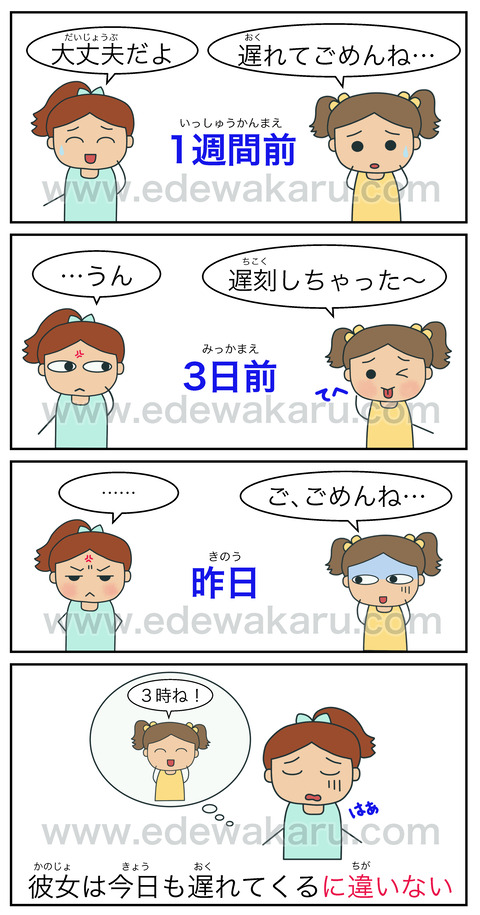
彼女は今日も遅刻するに違いない
→彼女は今日も絶対に遅刻すると思う彼女はアメリカに10年も住んでいたから、英語が話せるに違いない
→彼女はアメリカに10年も住んでいたから、きっと英語が話せると思う(復習:〜も(数量詞+も))あそこのケーキは安い上においしい。人気があるに違いない
→あそこのケーキは安い上においしい。きっと人気があると思う(復習:〜上に)彼に何度もLINEしたが、返事がない…既読スルーされているに違いない
→彼に何度もLINEしたが、返事がない…きっと既読スルーされているんだと思う(復習:「Google」や「Twitter」は日本語でどう読むの?)
くらべてわかる日本語表現文型辞典
Meaning
たぶんXはAだろう。確信度の高い推量表現である。
How to use it
Explanation
【対比1】
「Aに相違ない」(意味1 P.241)
「(Xは)Aに相違ない」はXはAだと強く断言する表現。
○「あなたが今述べたことは、真実に相違ないですか?」「はい、真実に相違ないです。」
「Aには違いない」(意味1 P.256)
「(Xは)Aには違いない」はXはAであることを事実として認めるが、続いてその一部否定や補足がくる。
○彼女の妹だったら、美人に違いない。
○彼女の妹は美人には違いないが、とてもわがままだ。
In context 4 examples
彼はお金を落として、きっと困っているに違いない。
両親が俳優なんだから、息子もハンサムに違いない。
こんないたずらをするのはあの子に違いないわ。
筆跡からすると、この手紙は山本さんが書いたに違いない。
日本語NET JLPT文法解説まとめ
Meaning
きっと〜と思う。〜に決まっている。
How to use it
V(普通形) + に違いない
イA(普通形) + に違いない
ナA(である) + に違いない
N(である) + に違いない
Explanation
no doubt
In context 12 examples
ジェシカさんは日本に10年も住んでいたから、日本語が上手に話せるに違いない。
トムさんは車を7台も持っているから、お金持ちに違いない。
あのレストランはいつも人が多いから、人気があるに違いない。
何度電話しても出ないから、ジョンさんはきっと買い物にでも行っているに違いない。
パクさんは3年も料理教室に通っているから、彼女が作る料理はきっと美味しいに違いない。
昨日のシステムトラブルについて、課長が知らないということは誰も報告しなかったに違いない。
もうすぐ大学を卒業して、4月からは日本の会社で働き始める。きっと楽しいことがいっぱいあるに違いない。
二人はいつもラブラブだったから、今頃は結婚しているに違いない。
あのマンションには大学生がたくさん住んでいるから、きっとうるさいに違いない。
中国人は漢字をたくさん知っているから、きっと日本の漢字もすぐに覚えられるに違いない。
韓国語の文法は日本語の文法と似ているから、勉強しやすいに違いない。
キムさんは5回目でようやくJLPT N1に合格できたので、誰よりも嬉しかったに違いない。
毎日のんびり日本語教師
How to use it
動詞普通形+に違いない
い形容詞普通形+に違いない
な形容詞語幹+に違いない
名詞+に違いない
Explanation
何らかの根拠に基づく、話し手の強めの判断・断定を表します。
Notes
似ている文法「【N2文法】~に決まっている」
似ている文法「【N2文法】~に相違ない」
「~に決まっている」「~に違いない」「~に相違ない」はそれぞれ同じ意味ですが、最も柔らかい表現は「~に決まっている」です。「~に相違ない」は主に書き言葉として用いられます。
In context 6 examples
彼女の表情を見る限り、何か秘密があるに違いない。
私が抱いているこの感情は、きっと彼女に対する恋心に違いない。
見た感じ、彼は相当な手練れに違いない。
みんなが口を揃えて言うんだから、そうに違いない。
神はいるに違いない。(神肯定存在。)
これらは何らかの陰謀に違いない。
NINJAL 日本語文型データベース
Meaning
ある根拠から生じる話し手の強い確信を表します。
How to use it
V普通形+に違いない
i-A普通形+に違いない
na-A普通形+に違いない(ただし、「na-Aだ」→「na-A+に違いない・na-Aである+に違いない」)
N普通形+に違いない(ただし、「Nだ」→「N+に違いない・Nである+に違いない」)
その他
Notes
丁寧体で使うときは、「〜に違いないです」より「~に違いありません」のほうをよく使います。
In context 23 examples
正確な居場所はわからないが、今日のSNSの写真からすると、太郎は今、アメリカにいるに違いない。
木村さんはお酒が苦手だと言っていたから、今日のパーティでもお酒を飲まないに違いない。
今日は寒いので、高齢の方は今夜の集まりにはいらっしゃらないに違いありません。
部屋の電気がついているから、お隣の一家はもう旅行から戻ったに違いない。
太郎君が「隣の部屋から焦げ臭い匂いがする」とアパートの管理人に知らせてくれなかったら、このアパートは火事になっていたに違いありません。
花子が泣きそうな顔をしている。今日の面接がうまくいかなかったに違いない。
父がこんなふうに笑うのを見るのは初めてだ。弟の優勝がよほどうれしいに違いない。
あの新藤監督のアクション映画なら、面白いに違いありません。楽しみです。
昼時なのにこの店には客がいない。おいしくないに違いない。別の店にしよう。
昨年のチャンピオンの西田が負けてしまうとは……。対戦相手はよほど強かったに違いない。
その日、友恵は先生に質問されても、ろくに返事もしなかったそうだ。いつもと違う彼女の様子を不思議に思ったクラスメートも少なくなかったに違いない。
都会育ちの彼には、この小さな村での暮らしは不自由に違いない。
裕のアキへの恋心を僕が勝手にアキに伝えるなどというおせっかいは、裕には迷惑であるに違いない。
漢字を1つでも多く覚えようとする今の努力は無駄ではないに違いない。しかし時々くじけそうになるのも本当だ。
恵の結婚式に私は行けなかった。真っ白なドレスを着た恵はきっと素敵だったに違いない。
太郎はすっかりやせ細ってしまって顔色も悪かった。あの様子だと離婚後の彼の生活はあまり健康的ではなかったに違いない。
あの事故は、非常に大きな事故だったので、直後には死亡者の数も定かではなかったに違いない。
この空模様だと、明日は雨に違いない。
あの制服からすると、あの子たちは南高校の生徒に違いありません。
隣のテーブルのあの人たちは、この辺りの人ではないに違いない。聞こえてくるのがこの地方の方言ではない。
先月は、ずっと胃の調子が悪かった。きっと仕事のストレスが原因だったに違いない。
明美は帰って来るとすぐ自分の部屋に入って出てこなかった。試験の結果が彼女の期待通りではなかったに違いない。
あれ? さっきまで手に持っていた傘がない。電車の中に忘れてきたのだろうか。きっとそうに違いない。
IMABI
No doubt that
Read this IMABI lesson ↗Explanation
No Doubt that: ~に違いない, ~に相違ない, & ~に決まっている
~に違いない and ~に相違ない are not necessarily difficult, but there are certain problems that students have. The unusual way it connects to adjective/verb expressions, not properly understanding what can follow them, and not understanding formality differences are the main sources of error. The lesson will be ended with the similar ~に決まっている.
~に違いない VS ~に相違ない
First and foremost, these expressions are both translated as “there is without a doubt that…”. This is the immediate source of confusion because you can add phrases like “I think that” or “probably” in English without causing ungrammaticality. However, with these Japanese expressions, doing so does. First, consider the following defining of these terms.
~に違いない: Not from objective proof or logical speculation, but rather from the speaker’s own experience, this phrase shows one’s intuitive speculation/confidence. With such a bold move, it is without surprise that this is quite strong. It is often used in situations where it’s as if one is talking to oneself in attempts to verify one’s own guess or deliberation.
~に相違ない: Like ~に違いない, it shows intuitive speculation/confidence, but it is more stiff and formal. This formality difference is very important to keep in mind. One reason is that speech modals more akin to the spoken language like the final particle から, which is commonly used with ~に違いない, are not typically used with ~相違ない. This also implies that there is no mistake in it; thus, it gives a more confident tone. Thus, although adverbs like きっと are common with ~に違いない, it is not with ~に相違ない due to the tone. Although perhaps of old logic, some speakers feel this is more so indicative of middle-aged/old men as they are more likely to use old-fashioned expressions, which would not be old-fashioned for them, and fits the traditional tone for masculine speech.
These patterns attach to phrases in the following manner.
Nouns N(である)+~に{違い・相違}ない
形容詞 形容詞 + ~に{違い・相違}ない
形容動詞 形容詞(である) + ~に{違い・相違}ない
Verbs Verb + ~に{違い・相違}ない
Notice that it does not say Adj/V + こと + に{違い・相違}ない. It is a set phrase, and like other phrases with に, the reason for why this is allowed stems from a Classical Japanese grammatical maneuver of using conjugational parts of speech as nominal phrases when in the 連体形. As this base has changed appearance for many items, it’s not surprising that in Modern Japanese this technique is limited.
Examples
1. 政府の報道官の応答はどんなに(か)悔しかったに違いない。
The response of the government spokesperson was in no doubt overly regrettable.
Grammar Note: In a more literary sense どんなに(か) may be replaced with いかばかりか. Also note that the use of か with this in the first place is hardly ever heard.
2. 違いない(その通り)、君の言う通りだ。
That’s right. It’s just as you say.
3. この計画の実行は困難に違いない。
It is without a doubt that this plan’s implementation is difficult.
4. 泥棒どろぼうが入ったに違いない。
There is no doubt that a robber came in.
5. 馬鹿者ばかものには違いないが、責任を取らざるをえないだろう。
Although it’s without a doubt that you’re an idiot, there’s no other way but to take responsibility.
By 大仏次郎おさらぎじろう
6. 明日は曇くもるに違いない。
It will definitely be cloudy tomorrow.
7. 社長は天才であることに相違ない。
There’s no doubt that the company president is a genius.
8. 「あの女の人は誰でしょうか」「ケンさんのガールフレンドに違いありません。手を繋つないで一緒に歩いていますから」
“Who is that woman?” “There’s no doubt that she’s Ken’s girlfriend because they’re holding hands walking together”.
9. 「あの人は何語なにごの学生でしょうか」「日本語の学生に違いありません。読んでいるものに「新しい」と書いてありますから」
“What language student is that person? “That person is no doubt a Japanese student because the thing (that person) is reading has “atarashii” written on it”
10. 「あの人は日本に住んでいたんでしょうか」「そうに違いありません。日本の新聞を読んでいますから」
“I wonder if that person lived in Japan” There’s no doubt about it because he’s reading a Japanese newspaper”
11. 「あの女の人は結婚しているんでしょうか」「そうに違いありません。指輪ゆびわを嵌はめていますから」
“I wonder if that woman is married” “There’s no doubt about it because she’s wearing a ring”
~に決まっている
~に決まっている means “it is certainly…” and follows nouns, adjectives, or verbs. This speech modal shows 100% certainty and is reflective of 話し言葉. It shows that the speaker is very confident in labeling something as so. It is also used in chastising.
12. 彼は嘘うそをついているに決まっている。
He’s certainly lying.
13. 夏は暑いに決まっている。
It is certainly hot in summer.
14. 負けるに決まってる。(Casual)
(They) will certainly lose.
In context 14 examples
政府の報道官の応答はどんなに(か)悔しかったに違いない。
The response of the government spokesperson was in no doubt overly regrettable.
違いない(その通り)、君の言う通りだ。
That’s right. It’s just as you say.
この計画の実行は困難に違いない。
It is without a doubt that this plan’s implementation is difficult.
泥棒どろぼうが入ったに違いない。
There is no doubt that a robber came in.
馬鹿者ばかものには違いないが、責任を取らざるをえないだろう。
Although it’s without a doubt that you’re an idiot, there’s no other way but to take responsibility.
明日は曇くもるに違いない。
It will definitely be cloudy tomorrow.
社長は天才であることに相違ない。
There’s no doubt that the company president is a genius.
「あの女の人は誰でしょうか」「ケンさんのガールフレンドに違いありません。手を繋つないで一緒に歩いていますから」
“Who is that woman?” “There’s no doubt that she’s Ken’s girlfriend because they’re holding hands walking together”.
「あの人は何語なにごの学生でしょうか」「日本語の学生に違いありません。読んでいるものに「新しい」と書いてありますから」
“What language student is that person? “That person is no doubt a Japanese student because the thing (that person) is reading has “atarashii” written on it”
「あの人は日本に住んでいたんでしょうか」「そうに違いありません。日本の新聞を読んでいますから」
“I wonder if that person lived in Japan” There’s no doubt about it because he’s reading a Japanese newspaper”
「あの女の人は結婚しているんでしょうか」「そうに違いありません。指輪ゆびわを嵌はめていますから」
“I wonder if that woman is married” “There’s no doubt about it because she’s wearing a ring”
彼は嘘うそをついているに決まっている。
He’s certainly lying.
夏は暑いに決まっている。
It is certainly hot in summer.
負けるに決まってる。(Casual)
(They) will certainly lose.