AIUEO JLPT Grammar
Meaning
This sentence pattern emphasizes that a situation or state is more intense than before or compared to others. It is used to indicate that something has become even more significant or changed further from its previous condition.
How to use it
動詞の+にも+まして形容詞辞書形の+にも+まして形容動詞なの+にも+まして名詞にも+まして
Explanation · 日本語
この文型は、ある事柄や状態が以前よりも、または他のものよりもさらに程度が強いことを強調する表現で、前の状況よりも一層変化していることを示すときに使われます。
In context 5 examples
個人消費は以前にもまして、低迷している。
Personal consumption is even more sluggish than before.
彼女は、以前にもまして美しくなった。
She has become even more beautiful than before.
今年の冬は、去年にもまして寒さが厳しい。
This winter is even colder than last year.
彼の仕事に対する熱意は、若い時にもまして強くなっている。
His passion for work has become even stronger than when he was young.
問題は、予想にもまして深刻だった。
The problem was even more serious than expected.
文法
Meaning
〜以上に / 〜もそうだが、それ以上に
How to use it
N + にもまして
疑問詞(何・だれ・いつ・どこ) + にもまして
In context 7 examples
今年は去年にもまして、暑くジメジメする。
この店、いつにもまして人が多い。何かあるのかな。
あ〜、以前にもましてニキビが増えてる。
今年の花火大会は例年にもまして、多くの方が来場されました。
海外旅行中はいつにもまして、注意を払わないと。
たくさん寝たのに、昨日にもまして頭痛がひどい。
ジョンさんはこのクラスの誰にもまして日本語の勉強を頑張っている。
Bunpro Grammar Reference
Meaning
Even -er than, Even more than, More than anything, More than anybody, More than ever
How to use it
Noun + にもまして
何にもまして
誰にもまして
いつにもまして
Nuance
A structure implying that something is more (B) than any (A). An increase from even (A) is (B).
Explanation
にもまして is a structure used to imply that something has surpassed a certain point, and will be used particularly when that thing was at a consistent level in the past, but has now risen. Common translations include 'more than ever, (B)', or 'even more than (A), (B)'.
にもまして is simply a combination of the case-marking particle に, the adverbial particle も 'even', and the て-form of the う-Verb 増す 'to increase'. The に will be attached to a noun which it is marking as the comparison point from which 増す indicates an increase or growth. This means that the literal translation is simply 'even increasing from (A), (B)'.
今年は去年にもまして、湿気が多い。
This year is even more humid than last year.
ちゃんと薬を飲んで体を休ませたのに、昨日にもまして腹痛がひどい。
I took the proper medication and rested my body, but my stomach ache is even worse than yesterday.
This pattern will regularly follow words like 誰 'who', 何 'what', or いつ 'when'. In these cases, (A) is just being expressed as 'anyone', 'anything', or 'ever', rather than something more specific.
斎藤くんは誰にもまして仕事を一生懸命やってくれるからものすごく助かっている。
Saito-kun works harder than anyone else, so he is very helpful.
このプロジェクトを成功させることは、何にもまして大切なんだ。
Succeeding in this project is more important than anything else.
彼女はいつにもまして輝いている。
She is shining brighter than ever.
Nuance · 日本語
あるものが他の(A)よりもはるかに(B)だということを示す表現。(A)から増えても(B)だ。
Explanation · 日本語
「にもまして」は、何かがある基準点を超えていることを示す文法です。特に、以前は一定のレベルにあったものが、現在はそれ以上に上昇しているような場合に、「(A) 以上に (B)」や「(A) よりもさらに (B)」といった意味で使われます。
「にもまして」は、格助詞「に」、副助詞「も」、そして五段動詞「増す」のテ形からできています。「に」は、「増す」の比較対象となる名詞に付きます。
今年は去年にもまして、湿気が多い。
This year is even more humid than last year.
ちゃんと薬を飲んで体を休ませたのに、昨日にもまして腹痛がひどい。
I took the proper medication and rested my body, but my stomach ache is even worse than yesterday.
この文型は、「誰」「何」「いつ」などの語の後に置かれることもよくあります。このような場合、(A) は特定のものではなく、「誰よりも」「何よりも」「いつもよりも」といった意味になります。
斎藤くんは誰にもまして仕事を一生懸命やってくれるからものすごく助かっている。
Saito-kun works harder than anyone else, so he is very helpful.
このプロジェクトを成功させることは、何にもまして大切なんだ。
Succeeding in this project is more important than anything else.
彼女はいつにもまして輝いている。
She is shining brighter than ever.
In context 17 examples
- 前にもまして元気になって、ようやく退院した。
I have gotten even better than before and am finally able to leave the hospital.
- 彼女はいつにもまして輝いている。
She is shining brighter than ever.
- 今年は去年にもまして、湿気が多い。
This year is even more humid than last year.
- 斎藤くんは誰にもまして仕事を一生懸命やってくれるからものすごく助かっている。
Saito-kun works harder than anyone else, so he is very helpful.
- ちゃんと薬を飲んで体を休ませたのに、昨日にもまして腹痛がひどい。
I took the proper medication and rested my body, but my stomach ache is even worse than yesterday.
- このプロジェクトを成功させることは、何にもまして大切なんだ。
Succeeding in this project is more important than anything else.
- 大学に合格したという知らせに、誰にもまして父が喜びました。
Having been informed about me passing the university entrance exams, my dad was happier than anybody else.
- 財布をなくした。それにもまして困ったのは、家の鍵をなくしたことだ。
I lost my wallet. And even more troubling than that was that I also lost the key to my house.
- 今年の花火大会は、例年にもまして豪華だったような気がします。
I have a feeling that this year’s fireworks festival was even more spectacular than the average year.
- このホテルの接客は、どこにもまして良いと評判になっている。
This hotel has a reputation of having better customer service than anywhere else.
- 親として、何にもましてうちの子供が健やかに成長できるように願う。
As a parent, even more than anything else, I wish for my children to grow up healthy.
- どんな人に応援されようとも、愛する人からの応援が何にもまして心に響きます。
No matter who encourages you, the encouragement of the ones you love resonates more in the heart than anything else.
- 日本の夏は常に蒸し暑いことで知られている。だが今年は例年にもまして湿度が高くなっている。
Summers in Japan are known for being sultry. But the humidity is even higher than average this year.
- 全ての選手が本当に奮闘したが、はいろさんに至っては、誰にもまして情熱を燃やした。
All of the team members are making an all-out effort, but when it comes to Hairo-san, he burns with passion even more than anyone else.
- 社会の情報化が進むにつれ、会社は従来にもましてセキュリティ上の危険にさらされるようになった。
With the informatization of the society, companies have come to be exposed to security risks even more than before.
- 利用者は大企業が常に大量のデータ収集する時代に、これまでにもまして自分のプライバシーを気にせざるを得ない。
In this age when large companies constantly gather data, users cannot help but pay even more attention to their privacy than before.
- 当社の成功のための重要な要素の中でいいアイデアや有能な従業員はもちろん、しかしそれにもまして大切なのは幸運であると思います。
Among the factors essential for company success, good ideas and skilled employees are important of course, however, the thing that is even more important than that is luck.
どんなときどう使う 日本語表現文型辞典
Meaning
more than
How to use it
N+にもましてW
Explanation
~以上に
1)「~もそうだが、それ以上に」と言いたいときに使う。
2) ❷ のように、「疑問詞+にもまして」の形では、「何よりも・だれよりも・いつよりも」などの意味になる。
2)In form interrogative + にもまして, means "more than anything," "more than anyone," or "more than any time."
1)Although one thing is true, something else is even more so.
In context 3 examples
わたし自身の結婚問題にもまして気がかりなのは姉の離婚問題です。
ゴミ問題は何にもまして急を要する問題だ。
きのう友だちが結婚するという手紙が来たが、それにもましてうれしかったのは友だちの病気がすっかり治ったということだった。
絵でわかる日本語
Meaning
〜もそうだが、〜はそれ以上に
〜以上に
How to use it
名詞[辞書形]+にもまして
疑問詞+にもまして
Explanation
「AにもましてB」は「Aもそうだが、Bはそれ以上に〜」「A以上にB」という意味の文型です。
「疑問詞+にもまして」
や
「Aにもまして〜のはBだ」
という形がよく使われます。「前にもまして・以前にもまして」は「前よりもっと」という慣用的表現(かんようてきひょうげん)です。
「疑問詞+にもまして」
・
いつにもまして
→いつも以上に
・
誰にもまして
→誰よりも
・
何にもまして
→何よりも一番・最も
・
どこにもまして
→どこよりも
「前にもまして・以前にもまして」
→前よりもっと
「Aにもまして〜のはBだ」
→Aはもちろん〜だが、Bはもっと〜だ
また、「A。それにもましてB」という形もあります。
[例]
去年は寒かった。それにもまして
今年は寒い
「〜にもまして」は漢字で書くと
「〜にも増して」
と書きます。使われる形が決まっていますので、覚えておくといいと思います😊
In context 7 examples
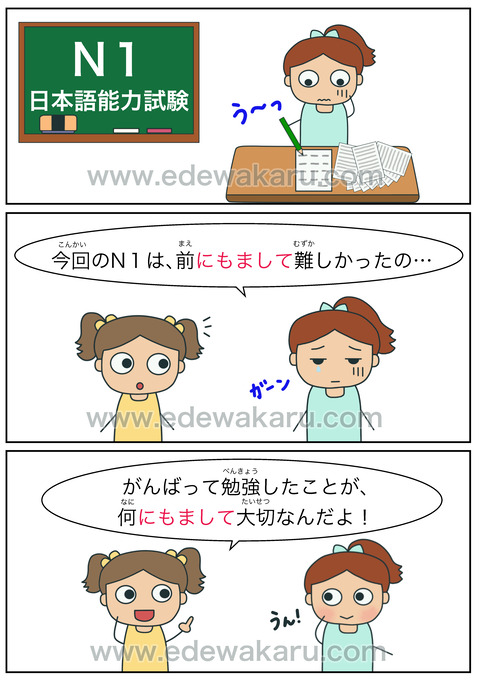
今回のN1は、前にもまして難しかったの…
→前のN1も難しかったが、今回は前よりももっと難しかったの…がんばって勉強したことが、何にもまして大切なんだよ
→がんばって勉強したことが、何よりも一番大切なんだよ今日の山田くんは、いつにもましてケチだ…
→今日の山田くんは、いつも以上にケチだ…去年にもまして、今年は寒いね
→去年も寒かったが、今年はそれ以上に寒いね夏の暑さにもまして嫌なのは、湿気だ
→夏の暑さも嫌だが、湿気はそれ以上に嫌だ以前にもまして、日本語が上手になったね!
→以前よりもっと日本語が上手になったね!彼女は、誰にもまして親切だ
→彼女は、誰よりも親切だ
くらべてわかる日本語表現文型辞典
Meaning
意味1:日常・以前の状態Aと比べ、現在・その後の傾向がさらに強くなりB。
意味2:「A。それにもましてB。」の形で。前文の事態Aより後文の事態Bのほうが傾向・程度が強い。
How to use it
AにもましてB(それにもましてB)
接続1:
[名詞-∅]にもまして
接続2:
[文]。それにもまして[文]。
Notes
【注意2】
・「A。それにもましてB。」は接続表現である。
In context 8 examples
今回の会合はいつにもまして、多くの参加者が集まった。
父は年をとってからは、前にもまして頑固になった。
今年の冬は例年にもまして、寒さが厳しかった。
もともと臆病な男だったが、会社をクビになって以来、以前にもまして、消極的になってしまった。
君は遅刻も多いが、それにもまして心配なのは成績のほうだ。
彼は仕事もできるが、それにもまして魅力的なのは人望がある点だ。
判断ミスもひどいが、それにもまして許しがたいのは嘘の報告だ。
娘が遊びに来てくれるのはうれしいことだが、それにもまして楽しみなのは孫の顔を見ることだよ。
日本語NET JLPT文法解説まとめ
Meaning
〜以上に / 〜もそうだが、それ以上に
How to use it
N + にもまして
疑問詞(何・だれ・いつ・どこ) + にもまして
Explanation
"more so than"
Used to indicate that something is even more extreme or significant compared to something else.
NINJAL 日本語文型データベース
Meaning
〜も程度が高いが、それよりもさらに程度が高いと言いたいときに使います。
「〜」に疑問詞「何・誰・いつ」などがくる場合、「いちばん〜」という最上級を表します。
How to use it
Nにもまして
Notes
「〜」には、普段のことや以前のことを表す言葉がきます。「〜にもまして」の後には、程度を表す形容詞や副詞を含む文がくることが多いです。
否定文では使いません。
In context 6 examples
今年の夏は例年にもまして暑く感じられます。
彼女は前回の大会で優勝を逃してから、以前にもまして熱心に練習に取り組んでいる。
会社で仕事をする上で、個人の能力はもちろん大切だが、それにもまして重要なのはチームワークである。
藤田さんは学生時代から他の誰にもまして雄弁な人でした。
世界各地で地球温暖化が原因とみられる異常気象が多発している。私たちは、何にもまして早急に対策に取り組まなければならない。
「もしもし、今、家に向かってるんだけど、国道がいつにもまして渋滞してて、着くのは10時ぐらいになりそうだよ」
IMABI
Compare/Contrast
Read this IMABI lesson ↗Explanation
Compare & Contrast: ~に比べて, ~に引き換え, ~に反して,~にもまして, & ~ないまでも
The patterns in this lesson deal with compare and contrast. Although not near as similar to each other as topics in other lessons, you still need to pay attention to detail so that you don’t confuse them with each other.
~{に・と}比べて
The verb 比べる means “to compare,” and because it is the quintessential verb for establishing comparisons, it is heavily used with the standard marking function of both the case particle に and the case particle と, and the choice between the two rests in how they differ in directionality.
XをYと比べる compares X and Y on an even playing field regardless of whether the comparison is contrastive, resulting in a more formal tone. As for XをYに比べる, Y is viewed as the standard for which the contrast that follows is based. Imagine with と that X and Y are brought together and compared side by side (X→←Y), while with に, the direction of focus is pointed at Y (X→Y). Consequently, because the focus is pointed at Y with に, it carries an implication about the merits of the comparison, which is not had with と.
Instead of seeing this grammar point rendered in the て form, you may also see it without て in formal speech (連用形中止法), or you may even see 比べると or any other conditional provided that you account for the unique layer of nuancing provided by said conditional grammar pattern – with 比べると being neutral but to the point.
1. 外は暑いが、それに比べて中は寒い。
It’s hot outside, but, moreover, in contrast, it’s cold inside.
2. この本は昨日読んだのと比べると全くつまらない。
This book compared to the one I read yesterday is completely boring.
3. 彼は妹と比べて若く見えました。
He looked younger beside his younger sister.
4. 今年は去年に比べ、雪の量りょうが多い。
In contrast to last year, there has been a lot of snowfall this year.
5. 欧米諸国の薬剤費が全体の一〇~ニ〇%にとどまっているのに較べて異常な数値だ。
(That) is a bizarre figure in comparison to the pharmaceutical costs of Western countries being confined to 10~20% of their total (costs).
Orthography Note: In formal writing, you may also see the verb 比べる spelled as 較べる.
~に引き換え vs ~と引き換えに
The verb 引き換える has two definitions, each which produces two unique grammar structures which hinge on how に and と differ as standard markers.
The pattern ~に引き換え follows nouns or nominalized expressions to indicate a sharp contrast, one that is both subjective and pertaining to a good vs. bad judgment call by the speaker.
When following nominalized expressions, the nominalizer of choice is the particle の, as is to be expected due to the highly subjective nature of this pattern.
6. 健太の住んでいるマンションは新しくて、広い。それに引き換え、僕のところは古くて狭いし、駅からも遠いよ。
The apartment that Kenta is living at is new and wide. By contrast, my place is old, small, and also far from the train station.
7. 同じ年の人に引き換え、彼はとても頭がよくて、たくさんの素晴らしい偉業いぎょうを成し遂とげました。
In sharp contrast to people of his same age, he is very smart and has made a lot of wonderful achievements.
8. 惑星わくせいの大きさに引き換え、冥王星めいおうせいはとても小さい。
In sharp contrast to the size of a planet, Pluto is very small.
When a contrast is not subjectively charged and the contrast being made is neutral in nature, ~に引き換え will not be the natural word choice. Instead, something like ~に対して would need to be used to enforce neutrality.
9. 整備して明るくなった竹林にはタケノコが生えているのに{対して 〇・引き換え X}、まだ整備していないところは竹が密生して暗く、タケノコが生えていない。
In bamboo forest areas that have gotten brighter from (the light fixtures) we set up, bamboo shoots are growing, whereas in areas where we have not set up (light fixtures), with the bamboo so dense and it being so dark, bamboo shoots are not growing.
The pattern ~と引き換えに means “in exchange for,” and from this we can gather how there is always a difference in directionality between に and と. In Exs. 6-8, we can envision a shift from one expectation, which we will call X, to some other reality, which we will call Y. This X → Y directionality is a fundamental property of に. Meanwhile, the directionality of と is X→←Y, and in this context of “exchange,” factors X and Y merely swap places. Similarly to ~に引き換えに, though, ~と引き換えに often remains highly subjective and emotionally charged, especially when Y is a situation (not restricted to nouns) as opposed to a concrete noun.
10. あいつはわずかなお金と引き換えに、自分の友達を裏切った。
That guy betrayed his own friends in exchange for a measly amount of money.
11. 犯人は人質と引き換えに大金を要求してきた。
The criminal came demanding for a large sum of money in exchange for the hostage(s).
~に反して
The verb 反する may be defined as “to be contrary/go against/violate,” and it is often seen in the pattern Xに反してY to indicate that “Y is contrary to/against X.”
12. 予想よそうに反して成功するのはいつもいいことでしょう。
Succeeding against one’s expectations is always a good thing isn’t it?
13. 神の意に反して人間は互たがいに殺害している。
Against the will of God, humans are slaying each other.
14. 2006年に反して、2007年のステンレス鋼スクラップの貿易では、欧州が輸出を増し、東南アジアが輸入を増した。
Contrary to (the expectation set by) 2006, Europe increased its exports and Southeast Asia increased its imports in the 2007 stainless steel scrap market.
15. 大方の期待に反してサービスの展開が遅れている。
the extending of services is delayed contrary to most expectations.
Note that although this verb is often seen in the て form, it is not limited to it. You may see it as the main verb, modifying another noun in the 連体形, or even see て dropped via 連用形中止法.
16. 我々の期待に反していた。
It was contrast to our expectations.
17. これは直感に反しているが、正しい主張だ。
This may be contrary to intuition, but it is the correct assertion.
18. スポーツ精神に反する卑劣な行為であります。
(It) is a contemptible act contrary to sportsmanship.
19. アメリカの4月の耐久財受注は前の月から減少するとの市場予想に反し、0.7%増加しました。
Durable goods manufacture’s orders for America in April increase 0.7% contrary to market expectation which foresaw a decline from the previous month.
Some learners confuse the purpose of the 連用形 and 連体形 with this construction, but it is important to note how the components of the sentence in relation to ~に反する are not the same. In the case of the 連用形, Y is a verbal expression, whereas in the case of the 連体形, Y is another noun.
20. 国防長官こくぼうちょうかんは事実に反する報告をしました。
The Secretary of Defense made a report contradictory to the facts.
21. 予想に反した1結果が出ると「なぜだろう?」という探究心が生まれ、ますます学ぶ意欲が湧いてきます。
The inquisitive mind is borne from the question of “why?” from getting results contrary to one’s expectations, which brings about all the more ambition to study.
~にもまして
~にもまして, which attaches to nouns including interrogatives, indicates that a current extent builds on a previous/aforementioned one. If a comparison does not have it that both reference points share the same quality to start out with, the use of ~にもまして becomes unnatural and would need to be replaced with something else like the particle より.
22. 今年は去年にもまして暑さが厳しい。
The heat is far more severe than even last year.
23. 最近は以前にもまして物覚えが悪くなった。
Recently, my memory has gotten worse than it was even before.
24. テイラー君は病気がちなセス先生{にもまして X・より 〇}体力があります。
Taylor-kun has more stamina than Seth Sensei, who has a tendency of getting sick.
25. 遼平君は何にも増してマルガリータが好きだ。
Ryо̄hei-kun loves margaritas above all else.
26. 今日はいつにも増して暑い。
Today is hotter than it usually is.
As indicated by the Kanji spelling in Ex. 26, the 増して in this expression derives from the verb 増す meaning “to increase.”
~ないまでも
The pattern ~ないまでも indicates that V1, though not exactly reaching the extent the speaker would prefer, it still reaches the threshold with which V2 is carried out.
27. 毎週とはいわないまでも、せめて月に1回は映画館に行きたい。
Not that it’d have to be every week, but I’d like to at least go to the movies once a month.
28. 快晴かいせいとはいかないまでも、雨は降らないでほしい。
Not that I won’t go if it doesn’t turn out to be clear weather, but I’d like it to not rain.
The use of ~た emphasizes that the realization at hand (the results), which is contrary to the expectation that the speaker had, has occurred as such and remains the case. ↩︎
In context 28 examples
外は暑いが、それに比べて中は寒い。
It’s hot outside, but, moreover, in contrast, it’s cold inside.
この本は昨日読んだのと比べると全くつまらない。
This book compared to the one I read yesterday is completely boring.
彼は妹と比べて若く見えました。
He looked younger beside his younger sister.
今年は去年に比べ、雪の量りょうが多い。
In contrast to last year, there has been a lot of snowfall this year.
欧米諸国の薬剤費が全体の一〇~ニ〇%にとどまっているのに較べて異常な数値だ。
(That) is a bizarre figure in comparison to the pharmaceutical costs of Western countries being confined to 10~20% of their total (costs).
健太の住んでいるマンションは新しくて、広い。それに引き換え、僕のところは古くて狭いし、駅からも遠いよ。
The apartment that Kenta is living at is new and wide. By contrast, my place is old, small, and also far from the train station.
同じ年の人に引き換え、彼はとても頭がよくて、たくさんの素晴らしい偉業いぎょうを成し遂とげました。
In sharp contrast to people of his same age, he is very smart and has made a lot of wonderful achievements.
惑星わくせいの大きさに引き換え、冥王星めいおうせいはとても小さい。
In sharp contrast to the size of a planet, Pluto is very small.
整備して明るくなった竹林にはタケノコが生えているのに{対して 〇・引き換え X}、まだ整備していないところは竹が密生して暗く、タケノコが生えていない。
In bamboo forest areas that have gotten brighter from (the light fixtures) we set up, bamboo shoots are growing, whereas in areas where we have not set up (light fixtures), with the bamboo so dense and it being so dark, bamboo shoots are not growing.
あいつはわずかなお金と引き換えに、自分の友達を裏切った。
That guy betrayed his own friends in exchange for a measly amount of money.
犯人は人質と引き換えに大金を要求してきた。
The criminal came demanding for a large sum of money in exchange for the hostage(s).
予想よそうに反して成功するのはいつもいいことでしょう。
Succeeding against one’s expectations is always a good thing isn’t it?
神の意に反して人間は互たがいに殺害している。
Against the will of God, humans are slaying each other.
2006年に反して、2007年のステンレス鋼スクラップの貿易では、欧州が輸出を増し、東南アジアが輸入を増した。
Contrary to (the expectation set by) 2006, Europe increased its exports and Southeast Asia increased its imports in the 2007 stainless steel scrap market.
大方の期待に反してサービスの展開が遅れている。
the extending of services is delayed contrary to most expectations.
我々の期待に反していた。
It was contrast to our expectations.
これは直感に反しているが、正しい主張だ。
This may be contrary to intuition, but it is the correct assertion.
スポーツ精神に反する卑劣な行為であります。
(It) is a contemptible act contrary to sportsmanship.
アメリカの4月の耐久財受注は前の月から減少するとの市場予想に反し、0.7%増加しました。
Durable goods manufacture’s orders for America in April increase 0.7% contrary to market expectation which foresaw a decline from the previous month.
国防長官こくぼうちょうかんは事実に反する報告をしました。
The Secretary of Defense made a report contradictory to the facts.
予想に反した1結果が出ると「なぜだろう?」という探究心が生まれ、ますます学ぶ意欲が湧いてきます。
The inquisitive mind is borne from the question of “why?” from getting results contrary to one’s expectations, which brings about all the more ambition to study.
今年は去年にもまして暑さが厳しい。
The heat is far more severe than even last year.
最近は以前にもまして物覚えが悪くなった。
Recently, my memory has gotten worse than it was even before.
テイラー君は病気がちなセス先生{にもまして X・より 〇}体力があります。
Taylor-kun has more stamina than Seth Sensei, who has a tendency of getting sick.
遼平君は何にも増してマルガリータが好きだ。
Ryо̄hei-kun loves margaritas above all else.
今日はいつにも増して暑い。
Today is hotter than it usually is.
毎週とはいわないまでも、せめて月に1回は映画館に行きたい。
Not that it’d have to be every week, but I’d like to at least go to the movies once a month.
快晴かいせいとはいかないまでも、雨は降らないでほしい。
Not that I won’t go if it doesn’t turn out to be clear weather, but I’d like it to not rain.
毎日のんびり日本語教師
How to use it
名詞+にも増して
Explanation
過去のある時点の状態と比較して、その時よりも程度が高くなることを後項で述べる比較の表現です。
前項には時間を表す言葉に接続されることが多いです。
良い事にも悪い事にも使うことができます。
慣用表現「以前にも増して」「いつにもまして」はよく使われます。
Notes
特になし
In context 12 examples
今日はいつもにも増して寒いし早く帰りたい。
彼は酔うと、普段にも増して素直になる。
肌荒れが前にも増して酷くなってる。(皮肤变得更加粗糙。)
今日の月は昨日にも増して本当に綺麗です。(今天的月亮比昨天更漂亮。)
熱は下がったが、昨日にも増して喉が痛い。
今年は、去年にも増してインフルエンザが猛威をふるっています。(今年流感比去年更猛烈。)
前回にも増して楽しい時間を過ごす事ができました。
仕事は以前にも増して忙しくなっている。(工作比以前更忙了。)
君の決心が本当に固いものなら、もうすでに希望の半分は実現している。夢を実現させるのだという強い決意こそが、何にもまして重要であることを決して忘れてはならない。(Abraham Lincoln)(如果你的决心非常坚定,那么你的希望已经实现了一半。永远不要忘记,实现梦想的坚定决心比什么都重要。(亚伯拉罕・林肯))
恋を得たことのない人は不幸である。それにもまして、恋を失ったことのない人はもっと不幸である。(瀬戸内寂聴)
あんなにかっこよくて美しい。それにもまして人柄が素晴らしい。
天気また悪くなりそう それにもまして湿度が高い。()