AIUEO JLPT Grammar
Meaning
「〜間に」is a sentence pattern used to indicate that an action happens temporarily within a specific time or period. It emphasizes that something occurs momentarily during a defined time frame.
How to use it
動詞+間に名詞の+間に
Explanation · 日本語
「〜間に」は、ある特定の期間や時間の範囲内で一時的に行われる動作を表す表現です。特定の期間中に行われる一時的な動作や出来事を強調するときに使われます。
In context 5 examples
買い物している間に、財布を落としました。
I dropped my wallet while shopping.
運動している間に、靴の紐がほどけました。
His shoelaces came undone while exercising.
システムを更新している間に、エラーが発生しました。
An error occurred while updating the system.
工事の間に、近所の人たちが苦情を言いました。
The neighbors complained during the construction.
料理している間に、鍋が焦げました。
The pot burned while I was cooking.
文法
Meaning
〜の期間に・・・する。
※ずっと〜するのではない。
How to use it
普通形 + 間に
Notes
「間に」の後ろに継続性のある動詞や表現は使えない。
●誤用例
兄がゲームをしている間に、私は隣でずっと見ていました。
In context 15 examples
昨日、寝ている間に地震がありました。
娘が出かけている間に晩御飯を作りました。
日本に住んでいる間に一度でいいから歌舞伎を見てみたいです。
会わない間にずいぶん大きくなりましたね。
夏休みの間に富士山に登りたいです。
留守の間に友達が訪ねて来たようです。
休み時間の間にトイレを済ませておきます。
若い間に色々なことにチャレンジするつもりです。
暇な間に宿題を終わらせてしまいます。
晩ご飯を作っている間に、誰か来ました。
夏休みで帰省している間に、泥棒に入られたようだ。
学生の間に、一度でいいから海外へ行ってみたい。
トムさんと話したり、遊んだりしている間に、彼のことが好きになった。
夏休みの間に、一度髪を染めてみようかな。
本を読んでいる間に、寝てしまった。
どんなときどう使う 日本語表現文型辞典
Meaning
during; when
How to use it
〔普通形〕(ナAな/Nの)+間に
Explanation
「間に」は時間幅のある状態を表す言葉につながり、「その時間幅が終わる前に」という意味を表す。後には瞬間性のことを言う表現が来る。
Appends to expressions involving length of time meaning "before the time interval ends." Expressions of momentariness follow.
In context 4 examples
夏休みの間に引っ越ししたいです。
わたしがいない間にだれか来たのでしょうか。門が少し開いています。
日本にいる間に一度富士山に登りたい。
暇な間に本だなをかたづけてしまおう。
絵でわかる日本語
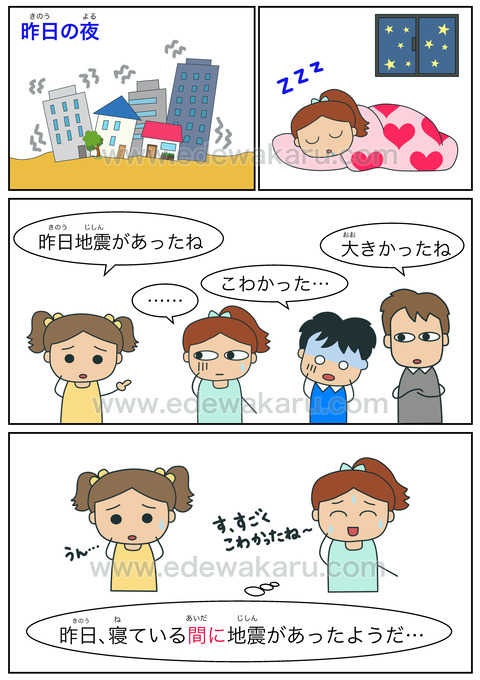
Meaning
〜の時間に〜する
〜の時間に〜が起きる
How to use it
動詞[辞書形・ている]+間に
形容詞[辞書形]+間に
名詞[辞書形]+の間に
Explanation
「〜間に」は「〜の時間に〜する」「〜の時間に〜が起きる」という意味を表す文型です。この文型は、
「〜の状態が続いている時に〜する・〜が起きる」「〜の動作が続いている時に〜する・〜が起きる」
という意味で使われます😊「〜間に」のポイントは、「〜の状態が続いている期間の中の、ある時間に〜する・〜が起こる」というように、その期間中に一時的に何かをしたり、何かが起こったりする時に使います😮
[例]
昨日、寝ている
間に
地震があったようだ
→(私が)「寝ている」という状態が続いている時に、地震が起きた
「寝ている」時間の中のある時に、一時的に地震が起きた
日本に留学している
間に、富士山を見に行きたい
→「留学している」という状態が続いているその期間の中で、いつか富士山を見に行きたい
「留学している」期間中のある時に、一度富士山を見に行きたい
「〜間に」は初級で勉強する文型ですが、似ている文型もいくつかあり複雑です😨他の文型と混乱しないように「〜間に」は「〜の期間中に、一時的に〜する・〜が起こる」と覚えておくといいと思います😉
(復習:〜ておく)
(復習:〜間(関係))
(復習:〜間(時間))
In context 5 examples
昨日、寝ている間に地震があったようだ
→昨日、寝ている時間に地震があったようだ(復習:〜ている(結果の状態))(復習:〜ようだ(五感推量))お風呂に入っている間に彼氏から電話があった
→お風呂に入っている時に、彼氏から電話があった日本に留学している間に、富士山を見に行きたい
→日本に留学している期間に、富士山を見に行きたい今日、会社にいる間に友達が家に来たそうだ
→今日、会社にいる時に友達が家に来たそうだ(復習:〜そうだ(伝聞))子供がゲームをしている間に夕ご飯を作ってしまおう
→子供がゲームをしている時に夕ご飯を作ってしまおう(復習:〜てしまう(完了))
日本語NET JLPT文法解説まとめ
Meaning
〜の期間に・・・する。
※ずっと〜するのではない。
How to use it
普通形 + 間に
Explanation
・・・ take place, while 〜
「間に」の後ろに継続性のある動詞や表現は使えない。
●誤用例
兄がゲームをしている間に、私は隣でずっと見ていました。
In context 17 examples
昨日、寝ている間に地震がありました。
娘が出かけている間に晩御飯を作りました。
日本に住んでいる間に一度でいいから歌舞伎を見てみたいです。
会わない間にずいぶん大きくなりましたね。
夏休みの間に富士山に登りたいです。
留守の間に友達が訪ねて来たようです。
休み時間の間にトイレを済ませておきます。
若い間に色々なことにチャレンジするつもりです。
暇な間に宿題を終わらせてしまいます。
晩ご飯を作っている間に、誰か来ました。
学生の間に、一度でいいから海外へ行ってみたい。
トムさんと話したり、遊んだりしている間に、彼のことが好きになった。
夏休みの間に、一度髪を染めてみようかな。
本を読んでいる間に、寝てしまった。
生きている間に、一度でいいからヨーロッパへ行ってみたい。
昼休み時間の間に、次の授業の予習をしておきます。
ちょっと見ない間に、ずいぶん大きくなりましたね。
NINJAL 日本語文型データベース
Meaning
~の期間のある時点で、ある動作・出来事が起こると言いたいときに使います。
How to use it
Vる間に・Vている間に/Vない間に
Nの間に
Notes
「〜」には、継続的な動作・状態を表す文や期間を表す言葉がきます。「〜間に」の後には、瞬間的な動作や出来事を表す文がきます。
In context 10 examples
日本にいる間に一度富士山に登りたいです。
昼寝をしている間に、夕立があったようだ。
日本を離れている間に味覚が変わってしまったのか、薄味が苦手になった。
駅で友達を待っている間に、行こうとしていた店が閉まってしまった。
「おかえり。加奈がいない間に荷物が届いたよ」
昼休みの間に郵便局に行ってきた。
冬の間に一度スキーをやってみたい。
この仕事は週末の間に済ませてしまおう。
木村さんは、出張の間にお子さんがけがをしてしまったそうだ。幸い大けがではなかったようだが。
留守の間に誰かが訪ねてきたらしいです。
IMABI
While III: ~隙に & ~間(ま)に
Read this IMABI lesson ↗Explanation
While III: ~隙に & ~間(ま)に
Back in Lesson 55 and Lesson 56, we learned about the basic expressions for expressing “while” – ~間に and ~うちに – respectively. However, there are two other similar expressions which share their own nuances that deserve attention. Those phrases are ~隙に and ~間(ま)に, and they are a further testament to just how many spatial nouns are repurposed into non-deictic time expressions.
Both patterns are quite similar to ~間に and ~うちに, but they possess their own nuances as to how and why V2 is undergone. In relation to tense, both are most similar to ~間に, as neither requires V2 to be completed within V1’s time frame.
~隙に
The noun 隙 is used in a physical sense to mean “gap/interval,” and this core meaning is further extended to refer to “carelessness” and/or “opportunities” borne from such flaws. You will notice that in many of the examples below, 隙 is very loosely translated.
1. 心の隙を突いてくる詐欺が多い。
There are a lot of scams that strike where it hurts.
2. 簡単なストレッチなのでお仕事の隙を見て一度試してみてください。
(It’s/they’re) simple stretches, so please try (it/them) once when you’ve found a moment away from work.
3. 戸に隙がある。
There are chinks in the door.
4. 口出しする隙もない。
I can’t get a word in edgewise.
5. その裏では常に犯行の隙を狙っている人がいる。
Behind the scenes, there are people who are always looking for opportunities to commit crime.
6. お手隙の際は是非ご覧ください。
By all means, please watch when you are free.
7. 馬鹿に付け入るスキを与えた自分も悪かった。
I was also at fault for giving idiots the chance to take advantage.
8. 隙あらば自分語りしてしまいます。
I seem to talk about myself whenever the chance presents itself.
9. こんな感情はオレには不要だ!隙になる!
There is no need for me to have these sort of feelings! They’ll just become weaknesses!
~隙に shows that one does what one wishes to do during an opportunity that opens up (from the negligence of someone). Putting aside tense or the affirmative-negative nature of the dependent clause itself, V2 is undertaken by the negligence inherent with how V1 does/did (not) go down.
10. ご飯デートで、女性がトイレに立った隙にお会計したのに、女性がトイレから戻ってドリンクを注文してしまったらどうしよう?
What should you do if on a dinner date, you pay the bill while the girl has gone to the restroom but she orders a drink when she returns from the restroom?
11. 子供が親が見ていない隙に高価な商品を触ろうとした。
The child attempted to touch something expensive while their parents weren’t watching.
12. お客さんが途切れた隙に休憩しておこう。
Let’s take our break when there is a break in customers.
13. 少し目を離した隙に逃げられた。
It got away while I was just a little distracted.
14. 犯人が怯んだ隙に警官は犯人に襲い掛かった。
The police officer swooped down on the criminal just as the criminal flinched.
隙(ひま)
A rather rare synonym of 隙(すき) is 隙(ひま), which is written with the same Kanji but etymologically related to the word 暇 meaning “free time.” While it has fallen out of use, it has roughly the same semantic domain as 隙(すき), though it noticeably does not get used whenever there is malicious intent.
15. 人のない隙(ひま)に持て来たる。(古語)
I brought it again when there was no one around.
~間(ま)に
The noun 間(ま)has several meanings, but its primary meaning is “space/interval,” and is the older word with this meaning in Japanese. It is primarily used in set phrases, and of its other meanings that are directly related to the concept of “space,” it may also translate to “room,” “just the right moment,” “spare moment,” etc.
16. 食べた瞬間は甘酸っぱくて少し間を置いてからビリビリって辛さがくる。
The second you eat it, it’s sweat and sour, then a little bit later, the tingly spiciness hits.
17. その侍女は次の間に控えていた。
The maid was waiting in the next room.
18. 子供が寝ている間(ま)を見計らって家事を済ました。
I waited for when my kids would be sleeping and finished the house choirs.
19. 駅で一休みする間もありませんでした。
There wasn’t even time to rest at the train station.
In scenarios in which V2 is a volitional act, ~間(ま)に indicates how the agent does so in the time frame in which V1 provides the perfect opportunity for it. Unlike ~隙に, it does not imply negligence by another party. Though principally interchangeable with ~あいだに, it only follows verbal predicates, meaning it may not follow adjectival predicates or noun-predicates. This is because although 間(ま) does not have a particular time frame associated with it, such predicates would render the time frame potentially indefinite until some external force changes it, which beats the point of pinpointing a perfect opportunity.
Due to these factors, it is rather rare in the spoken language, as is demonstrated by the following examples.
20. 先生のいない{うち ◎・あいだ 〇・ま ?1・すき 〇}に、すばやくホワイトボードを消してしまった。
I erased the white board quickly while the teacher wasn’t there.
21. 今だ!こっちを見ない{うち 〇・すき 〇・ま X・ 間 X}に、逃げて!
Now! Run away while they don’t look here!
22. 夜{が・の}涼しい{うち 〇・間 〇・ま X・すき X}に、部屋を綺麗にした。
I cleaned my room while the night was cool.
When it is used in the spoken language, ~間(ま)に, it is usually in set phrases, but the context at hand involves a V1 in which volition is taken completely out of the equation, with V2 occurring rather ‘conveniently’ during that time.
23. 鬼の居ぬ間(ま)に洗濯2。
Literally: The washing (must be done) before the ogre comes.
When the cat’s away, the mice will play.
24. 知らぬ間に母親が火葬されてしまっていた。
Before I even knew it, my mother had been cremated.
25. 気付かぬまに君を傷つけてしまった。
I had hurt you before I even noticed it.
As far as grammaticality is concerned, the use of ~ま in this sentence is not incorrect; however, due to its general lack of use, it would be subject to hypercorrection. ↩︎
洗濯 in this proverb refers to 命の洗濯, which refers to casting off the drudgery of everyday life and doing as one pleases. ↩︎
In context 25 examples
心の隙を突いてくる詐欺が多い。
There are a lot of scams that strike where it hurts.
簡単なストレッチなのでお仕事の隙を見て一度試してみてください。
(It’s/they’re) simple stretches, so please try (it/them) once when you’ve found a moment away from work.
戸に隙がある。
There are chinks in the door.
口出しする隙もない。
I can’t get a word in edgewise.
その裏では常に犯行の隙を狙っている人がいる。
Behind the scenes, there are people who are always looking for opportunities to commit crime.
お手隙の際は是非ご覧ください。
By all means, please watch when you are free.
馬鹿に付け入るスキを与えた自分も悪かった。
I was also at fault for giving idiots the chance to take advantage.
隙あらば自分語りしてしまいます。
I seem to talk about myself whenever the chance presents itself.
こんな感情はオレには不要だ!隙になる!
There is no need for me to have these sort of feelings! They’ll just become weaknesses!
ご飯デートで、女性がトイレに立った隙にお会計したのに、女性がトイレから戻ってドリンクを注文してしまったらどうしよう?
What should you do if on a dinner date, you pay the bill while the girl has gone to the restroom but she orders a drink when she returns from the restroom?
子供が親が見ていない隙に高価な商品を触ろうとした。
The child attempted to touch something expensive while their parents weren’t watching.
お客さんが途切れた隙に休憩しておこう。
Let’s take our break when there is a break in customers.
少し目を離した隙に逃げられた。
It got away while I was just a little distracted.
犯人が怯んだ隙に警官は犯人に襲い掛かった。
The police officer swooped down on the criminal just as the criminal flinched.
人のない隙(ひま)に持て来たる。(古語)
I brought it again when there was no one around.
食べた瞬間は甘酸っぱくて少し間を置いてからビリビリって辛さがくる。
The second you eat it, it’s sweat and sour, then a little bit later, the tingly spiciness hits.
その侍女は次の間に控えていた。
The maid was waiting in the next room.
子供が寝ている間(ま)を見計らって家事を済ました。
I waited for when my kids would be sleeping and finished the house choirs.
駅で一休みする間もありませんでした。
There wasn’t even time to rest at the train station.
先生のいない{うち ◎・あいだ 〇・ま ?1・すき 〇}に、すばやくホワイトボードを消してしまった。
I erased the white board quickly while the teacher wasn’t there.
今だ!こっちを見ない{うち 〇・すき 〇・ま X・ 間 X}に、逃げて!
Now! Run away while they don’t look here!
夜{が・の}涼しい{うち 〇・間 〇・ま X・すき X}に、部屋を綺麗にした。
I cleaned my room while the night was cool.
鬼の居ぬ間(ま)に洗濯2。
Literally: The washing (must be done) before the ogre comes.
知らぬ間に母親が火葬されてしまっていた。
Before I even knew it, my mother had been cremated.
気付かぬまに君を傷つけてしまった。
I had hurt you before I even noticed it.