くらべてわかる日本語表現文型辞典
Meaning
意味1:Aという時点でB。
意味2:Aを使って(Aで)B。
意味3:Aとともに、Aという心の状態でB。
意味4:Aを理由にB。
意味5:「AをBと決める(断定する)」という意味を重々しく表現する。
How to use it
AをもってB(AをもってしてもB/AをもってすればB)
[名詞-∅]をもって
Explanation
【対比1,2】
「AでもってB」
「AをもってB」と意味は同じだが、口語的な表現。単に「で」といえばすむところを、少しもったいをつけていう感じがある。この言い方では「地下鉄でもって学校へ行く」も言える。
【対比3】
「AとともにB」(意味3 P.182)
「AをもってB」はAの心の状態でB。「AとともにB」はAといっしょにB。「AをもってB」から「AとともにB」への置き換えは可能。
○夫とともに会に出席する。
×夫をもって会に出席する。
Notes
【注意1】
・主に相手に告知するときに使う、硬い表現である。
【注意2】
・やや古い表現で、現代の口語では使わない。
×地下鉄をもって学校へ行く。
In context 20 examples
当店は改装のため、本日をもってしばらく休業いたします。
以上をもちまして、本日の公演はすべて終了いたしました。
4月1日をもって、君たちを正社員に採用する。
運動会は校長の挨拶をもって、閉会となります。
商品の発送をもって、当選発表に代えさせていただきます。
論文の提出をもって、試験のかわりとする。
いかなる手段をもってしても、彼を捜し出す覚悟だ。
彼の財力をもってすれば、企業買収など簡単なことだ。
村人たちは満面の笑みをもって、我々を迎えてくれた。
子どもたちはスター選手を尊敬の眼差しをもって見上げた。
遺族は被告人を憎しみをもってにらみつけた。
少女は恥じらいをもって少年に花束を差し出した。
私、この度、老齢をもって会社の第一線から退くことになりました。
買主は商品の瑕疵をもって、売買契約を破棄することができる。
一身上の都合をもって、今月いっぱいで退社致します。
体力の限界をもって、この競技から引退することにした。
食は中国をもって第一とする。
茶道は千利休をもって祖となす。
三カ月の課程をもって修了とす。
人は何をもって幸せと感じるのか。
絵でわかる日本語
Usage 1
Read this source entry ↗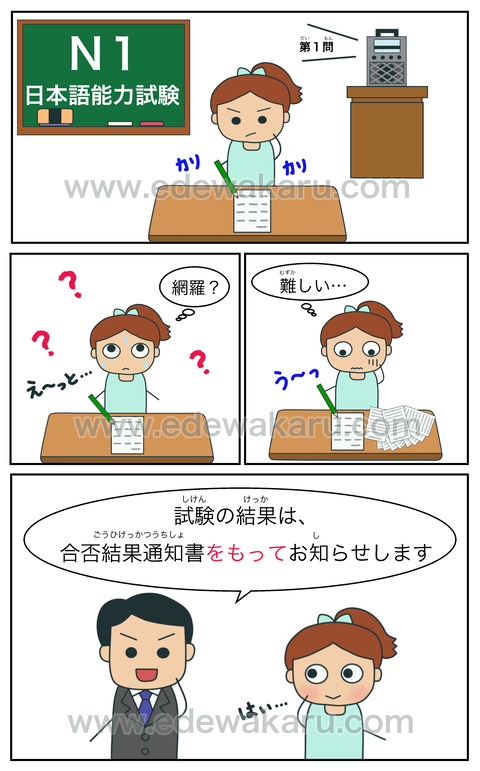
Meaning
〜で
〜を使って
How to use it
名詞[辞書形]+をもって
Explanation
「〜をもって」は「〜で」「〜を使って」という意味で【手段・方法】を表す文型です。
これはとてもかたい表現ですので
【正式な場面】
や
【書き言葉】
として使用されます😮「〜をもって」は日常会話(にちじょうかいわ)で使われることはほとんどないですが、
使われる場面やフレーズがだいたい決まっています
😮
[「〜をもって」がよく使われる場面]
・試験・面接などの結果通知
「〇〇の結果は〇〇
をもって
お知らせします」
「〇〇の結果は〇〇
をもって
通知します」
・懸賞などに応募した時
「当選者の発表は商品の発送
をもって
お知らせします」
「当選者の発表は商品の発送
をもって
代えさせていただきます」
*「誰が当選したかの発表はありませんが、当選した人には商品が届きます。(当選しなかった人には商品も連絡もありません)」という意味
・結婚式で司会者が言うフレーズ
「拍手
をもって
新郎新婦をお迎えしましょう」
「拍手
をもって
お二人をお迎えしましょう」
*「2人が入場する時に拍手をしましょう」という意味
【余裕のある人へ】
この文型を使った
「身をもって〜」という慣用表現(かんようひょうげん)
があります。意味は
「自分の体で〜」「自分自身で〜」
です。「自分の経験として〜」と言いたい時に使います😊
[例]
N1の難しさは
身をもって
知っている
→N1の難しさは、N1を受けたことがあるので知っている
地震のこわさは
身をもって
体験した
→地震のこわさは体験したことがあるので、とてもよく知っている
「〜をもって」は、ほとんどの場合はひらがなで書かれますが、
「〜を以って」
というように漢字が使われる場合もあります。会話で使われることはほとんどない文型ですが、N1を受ける人はテストのためにしっかりと覚えておきましょう😉また【終了】を表す「〜をもって」も一緒に覚えておくといいと思います。
(復習:〜ために(目的))
(復習:)
In context 5 examples
試験の結果は、合否結果通知書(ごうひけっかつうちしょ)をもってお知らせします
→試験の結果は、合否結果通知書でお知らせしますイベントを行うかどうかは、電話をもって連絡します
→イベントを開催するかどうかは、電話で連絡します面接結果(めんせつけっか)は、メールをもって通知します
→面接結果は、メールで通知します当選者の発表は商品の発送をもってお知らせいたします
→当選者の発表は商品の発送でお知らせいたしますみなさま、拍手をもって新郎新婦(しんろうしんぷ)をお迎えしましょう
→みなさま、拍手で新郎新婦をお迎えしましょう
Usage 2
Read this source entry ↗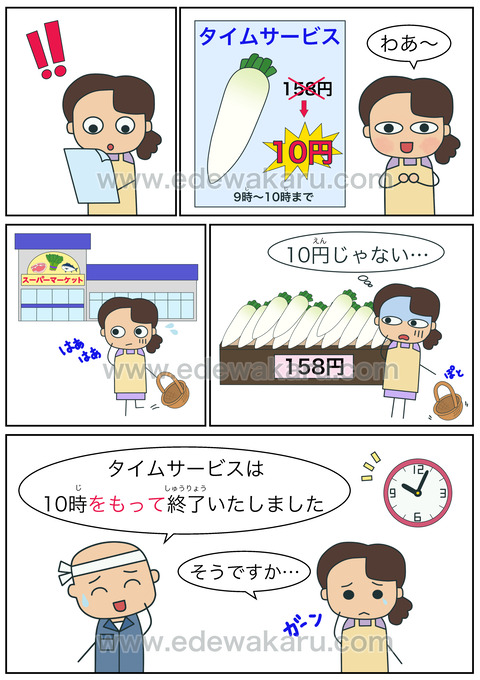
Meaning
〜で、〜をやめる
How to use it
名詞[辞書形]+をもって
Explanation
「Aをもって」は「Aで、今まで続けいてたことをやめる」「Aで、〜を終わりにする」という意味の文型です。「Aで最後になって、今まで続けていたことをやめる」と言いたい時に使います😮
後ろには「やめる」「終わる」「終了する」という意味の文がきます。
また「A」には【時】や【時間】を表す言葉が入ります😊
「〜をもちまして」は「〜をもって」の丁寧な言い方で、正式な場面などで使われます。
(復習:〜など・〜なんか・〜なんて)
[例]
夜9時
をもちまして、タイムサービスを終了させていただきます
「〜をもって」はとてもかたい言い方ですので、ほとんどの場合は
書き言葉
として使われます😉
(復習:〜として)
In context 5 examples
タイムサービスは10時をもって終了いたしました…
→タイムサービスは10時で終了いたしました…(復習:タイムサービス・タイムセール)今日をもって、この会社を退職します
→今日で、この会社を退職します今月末をもって、当店は閉店することになりました
→今週末で、当店は閉店することになりました(復習:〜ことになる・〜こととなる)あの人気グループは、12月31日をもって解散してしまった
→あの人気グループは、12月31日で解散してしまった(復習:〜てしまう)あのテニス選手は、今回の試合をもって引退することにしたそうだ
→あのテニス選手は、今回の試合で引退することにしたそうだ(復習:〜ことにする)(復習:〜そうだ(伝聞))
どんなときどう使う 日本語表現文型辞典
Usage 1
Meaning
by; with
How to use it
N+をもってW
Explanation
をもって〈手段〉
~で
1)「それを用いてあることをする」という意味。
2) ❸ の「身をもって」は慣用句として使われる。
3) ❹ ❺ のように、「をもってすれば・をもってしても」の形もよく使われる。
4)身近で具体的な道具や手段にはあまり使われない。
◆ × この紙を10枚ずつクリップをもって留めておいてください。→○この紙を10枚ずつクリップで留めておいてください。
2)The 身をもって in sentence ❸ is idiomatic.
3)Also often used in をもってすれば or をもってしても, as in sentences ❹ and ❺ .
1)Use some means to do something.
4)Not often used about concrete means or methods close at hand.
In context 5 examples
誠実な田中さんは非常な努力をもって問題解決に当たりました。
試験の結果は、1週間後に書面をもってお知らせします。
今回のアルバイトでわたしは働くことの厳しさを身をもって経験した。
彼の実力をもってすれば、金メダルは間違いないだろう。
彼の能力をもってしても、社長になるのは無理だろう。
Usage 2
Meaning
as of
How to use it
N+をもってF
Explanation
をもって〈期限〉
~で
期限を表す言葉(本日・今回・12時など)につき、それまで続いていたことの終わりを宣言するときに使う。 公式文書やあいさつなどに見られる硬い言い方。
Appends to words expressing time limits, such as 本日, 今回, 12時, etc.to declare that what has continued until now is over. Formal expression seen in official statements and salutations.
In context 3 examples
本日をもって今年の研修会は終了いたします。
(お知らせ)今回をもって粗大ごみの無料回収は終わりにさせていただきます。
これをもちまして第10回卒業式を終了いたします。
日本語NET JLPT文法解説まとめ
Meaning
〜で / 〜を最後として / 〜を基準に
How to use it
Nを + もって
Explanation
by, with, using, as the last
手段の「〜もって」は改まった場面で使われることが多い。
The term '〜をもって' meaning 'by means of' is often used in formal situations.
In context 9 examples
今回のライブをもって、私たちは解散します。
大阪店は、本日の営業をもって、閉店いたします。長い間ありがとうございました。
今学期をもって、私はこの学校を辞めることにしました。
本日をもって、セールは終了となります。
明日をもって、当システムの保守サービスは終了いたします。
試験の結果は、2ヶ月以内に書面をもって通知いたします。
当選者の発表は賞品の発送をもって代えさせて頂きます。
最新の医療技術をもってしても、まだこの病気は治せないようだ。
何をもって、そんな発言ができるのでしょうか。
毎日のんびり日本語教師
How to use it
名詞+をもって
名詞+をもちまして
Explanation
時間を表す語に接続し、物事の開始あるいは終了を表します。
告知、通知、会議、式などの正式な場における挨拶などに用います。
「をもちまして」は「をもって」よりも硬い表現です。
Notes
特になし
In context 8 examples
本日の営業は19時をもって終了いたします。
これをもちまして、会議を終わります。
当店は7月1日をもちまして閉店致します。今まで長い間ありがとうございました。
今シーズンをもちまして、引退することに決めました。
只今の時間をもちまして受付を終了させて頂きます。
5月5日をもちまして、20歳になりました。
A市長は任期満了をもって政界から引退することを表明した。
今日をもちまして20歳になりました。用法2 根拠、手段、方法
AIUEO JLPT Grammar
Meaning
This sentence pattern is used to indicate a specific point in time, method, or means and is often employed in polite expressions, particularly in business or formal settings.
How to use it
名詞を+もって名詞を+もちまし
Explanation · 日本語
この文型は、ある時点・手段・方法を示す表現で、丁寧な言い回しで使われることが多く、特にビジネスや公式な場面でよく見られます。
In context 5 examples
7時をもちまして、本日の営業を終了いたします。
As of 7 PM, today’s business hours will end.
これをもちまして、会議を閉会させていただきます。
With this, we would like to conclude the meeting.
本日をもちまして、当百貨店は閉店させていただきます。
As of today, our department store will be closed.
君の誠意をもってすれば、この問題を解決できるだろう。
Your sincerity will help us solve this problem.
この資料をもって、今後の活動を計画することができる。
With this data, we can plan future activities.
文法
Meaning
〜で / 〜を最後として / 〜を基準に
How to use it
Nを + もって
Notes
①手段の「〜もって」は改まった場面で使われることが多い。
In context 10 examples
今回のライブをもって、私たちは解散します。
大阪店は、本日の営業をもって、閉店いたします。長い間ありがとうございました。
今学期をもって、私はこの学校を辞めることにしました。
本日をもって、セールは終了となります。
明日をもって、当システムの保守サービスは終了いたします。
試験の結果は、2ヶ月以内に書面をもって通知いたします。
東南アジアではあまり大金を持ち歩かないほうがいいということを身をもって経験した。
当選者の発表は商品の発送をもって代えさせて頂きます。
最新の医療技術をもってしても、まだこの病気は治せないようだ。
何をもって、そんな発言ができるのでしょうか。
Bunpro Grammar Reference
Meaning
As of, With, Effective from
How to use it
Time-Related Expression + をもって
以上(1) + をもって
(1) これ
Time-Related Expression + をもちまして
以上(1) + をもちまして
(1) これ
Nuance
A formal phrase expressing something done or caused by the means of (A). (A) is often a time from when something comes into effect.
Explanation
When used with time related expressions, the structure をもって is often translated as 'as of (A)', or 'effective from (A)'. This grammar pattern is a construction of the adverbial particle を, and もって 'by means of'.
をもって will be used after nouns that indicate a time, or an event that happens at a specific time.
このゲームのオンラインサービスは2023年8月10日をもって終了することに決定しました。
It has been decided that the online service for this game will end as of August 10, 2023.
本日をもって、受付を終了いたします。
As of today, we will no longer be accepting applications.
今回のツアーをもって、解散することになりました。
We have decided to disband as of this tour.
As is frequently seen in polite speech or in official notifications, をもって may sometimes be read as をもちまして.
いつもご来店ありがとうございます。この店舗は本日をもちまして閉店いたします。
Thank you for always visiting our shops. As of the day of writing, this store location will be closed.
Alternatively, the small っ (called a 促音) may occasionally be dropped. This results in をもて.
父は4月2日をもて、40年間勤めていた会社をやめることにした。
As of April 2nd, my father decided to quit the company he had worked for for 40 years.
Caution
Although 'effective from' can have the nuance of 'starting' in English, をもって primarily focuses on something ending, or what has happened up until the end date specified. Due to this, it will not be used to indicate that something is starting from a date that had nothing significant happen before it.
2023年7月27日をもって、人気映画の続編が公開されます。
The sequel to the popular film will be released on July 27, 2023. (Unnatural Japanese)
Fun Fact
Coming from the kanji 以て, and specifically meaning 'by means of', もって originally derives its nuance from 持って, 'to hold', or 'to have'. In this way, it may help to remember もって as working in a similar way to 'having (A)', or 'having reached (A)' in English.
Nuance · 日本語
(A)という手段を使い何かが行われたということを表す丁寧な表現。(A)は何かが起こるまでの時間を示すことが多い。
Explanation · 日本語
「をもって」は時間に関する言葉と一緒に使われ、「(A) で」や「(A) を最後として」といった意味を表す表現です。これは、副助詞の「を」と「もって」(意味:〜という手段で)の組み合わせです。
「をもって」は、時間や出来事の区切りを示す名詞の後ろに置かれます。
このゲームのオンラインサービスは2023年8月10日をもって終了することに決定しました。
It has been decided that the online service for this game will end as of August 10, 2023.
本日をもって、受付を終了いたします。
As of today, we will no longer be accepting applications.
今回のツアーをもって、解散することになりました。
We have decided to disband as of this tour.
フォーマルなスピーチやお知らせの中では、「をもって」よりもさらに丁寧に「をもちまして」と言われることもあります。
いつもご来店ありがとうございます。この店舗は本日をもちまして閉店いたします。
Thank you for always visiting our shops. As of the day of writing, this store location will be closed.
ごく稀にではありますが、促音と呼ばれる小さい「っ」が省かれて「をもて」となることもあります。
父は4月2日をもて、40年間勤めていた会社をやめることにした。
As of April 2nd, my father decided to quit the company he had worked for for 40 years.
注意点
「をもって」は、主に何かが終了することを表す表現です。それ以前に何の文脈もなく、全く新しいことが始まる場合に使われることはないので気をつけましょう。
2023年7月27日をもって、人気映画の続編が公開されます。
The sequel to the popular film will be released on July 27, 2023. (Unnatural Japanese)
豆知識
「もって」は漢字で「以て」と書かれますが、もともとは「持って」(意味:掴む・自分のものにする)に由来する表現です。
In context 18 examples
- 以上をもちまして、私のスピーチは終わりとさせて頂きます。
'With this, I would like to conclude my speech.' (effective from)
- このゲームのオンラインサービスは2023年8月10日をもって終了することに決定しました。
It has been decided that the online service for this game will end as of August 10, 2023.
- 本日をもって、受付を終了いたします。
As of today, we will no longer be accepting applications.
- 今回のツアーをもって、解散することになりました。
We have decided to disband as of this tour.
- 父は4月2日をもて、40年間勤めていた会社をやめることにした。
As of April 2nd, my father decided to quit the company he had worked for for 40 years.
- いつもご来店ありがとうございます。この店舗は本日をもちまして閉店いたします。
Thank you for always visiting our shops. As of the day of writing, this store location will be closed.
- 会議、問いかけに答えた後:「これをもちまして質疑応答を終わります。ありがとうございます。」
The conference, after answering a question: 'With this, I will end the question-answer session. Thank you very much.' (effective from)
- 辞令:「一条蛍殿。令和2年5月1日をもって経理部第5課勤務を命ずる。」
Appointment notice: 'Ichijou Hotaru, we appoint you to a position in the fifth section of the accounting department, effective (from) May 1st, 2020.'
- 誠に勝手ながら「可愛い店」は本日をもちまして閉店いたします。長きに渡りご愛顧、誠にありがとうございました。
We regret to inform you that 'KawaiiMise' will close as of today. We are truly thankful for the long-lasting patronage. (effective from)
- 司会:「以上をもちまして、2021年度の運動会を閉会致します。」
Master of ceremonies: 'With this, I will bring a close to the 2021 sports carnival.'
- テレビCM(シーエム):「本日23:59分を以て、キャンペーンへの応募を締め切らせて頂きます。」
Television commercial: 'Effective from 11:59pm tonight, entries to the campaign will close off.'
- お笑い芸人の独り言:「こんなに精神的に辛い仕事は今年を以て終わりにしたいな...。」
The monologue of a comedian: 'Work that is this mentally tough, I want to stop as of this year.'
- 今回のプロジェクトをもちましてチームが解散となったため、メンバー全員で打ち上げを開く事にしました。
As of this project, since it has been decided that the team will dissolve, we have decided to hold a completion party with all the members.
- 体操選手としてはまだ若手の草彅選手が来月を以て引退すると聞き、多くのファンが悲しみに暮れている。
Upon hearing that Kusanagi, who is still young for a gymnastics competitor, will retire effective as of next month, many fans sunk into despair.
- ファイナルファンタジー 7のXbox Series(シリーズ) X版及びPlayStation(ステーション) 5版のサービスは2021年7月16日(金)をもちまして終了させていただくことになりました。
It has been decided that Final Fantasy 7's services for the Xbox Series X and PlayStation 5 will be shut down as of July 16th, 2021 (Friday).
- キャンパスツアーのガイド:「本日はこれをもちましてツアーは終わりとなります。ご参加して下さり有難う御座いました。」
Campus tour guide: 'For today, this will bring the tour to a finish. Thank you so very much for participating.' (effective from)
- 社長の退社の辞:「本年7月をもちまして社長の立場を退任することに致しました。今まで大変お世話になりましたことを心より御礼申し上げます。」
Company president's retirement speech: 'I decided to retire from the position of President effective from the month of July this year. I sincerely appreciate your continued patronage.'
- 2023年7月27日をもって、人気映画の続編が公開されます。
The sequel to the popular film will be released on July 27, 2023. (Unnatural Japanese)
IMABI
Defining Parameter
Read this IMABI lesson ↗Explanation
Defining Parameter: ~を始め(として), ~を皮切りに(して), ~に至るまで, ~をもって, & ~といったところだ
Defining the beginning and limitation of a parameter is something that people do all the time. These phrases, although not an exhaustive list of phrases in Japanese that fit this description, will allow you to become even more sophisticated in how you can articulate yourself in this regard.
~を始め(として)
As you should know, 始める means “to start”. をはじめ = “starting with”. It may also be expanded to をはじめとして, which is a bit more poignant.
1. 社長を始め、社員一同です。
Starting with the company president, all employees are present.
2. 日本の会社を始めとして、沢山の企業が業績悪化しています。
Starting with Japanese companies, a lot of businesses are in a downturn.
3. 彼は中国語を始め、日本語と韓国語にも堪能ですよ。
Starting with Chinese, he is also proficient in Japanese and Korean.
4. 春になると、桜をはじめとして、いろんな花が咲きます。
When it becomes spring, starting with cherry blossoms, various flowers blossom.
~を皮切りに(して)
皮切 かわきり means the “outset of things” and is used in the speech modal を皮切りに(して)・を皮切りとして to show that starting with X, you do something in succession. This pattern shouldn’t really be used with natural phenomena or bad things. What follows should be similar in nature, and it is especially used in situations where you want to clearly state such a chain of events.
5. 冗談じょうだんを皮切りに演説をする。
To give a speech by starting out with a joke.
6. 公演を皮切りに各地かくちで演奏会えんそうかいを開きました。
They opened up concerts in various/every place(s) as the start out of their public performance.
7. 今月6日の東京公演を皮切りにして、全国ツアーを予定しております。
We are planning to do a nationwide tour starting with a Tokyo performance on the sixth of this month.
8. 塩川さんの発言を皮切りにして、みんなが次々に意見を言った。
Starting with Shiokawa’s remarks, everyone said their opinions one after another.
9. カリフォルニアへの旅行を皮切りとして、国外をあちこち旅行しています。
Starting with a trip to California, I’m traveling all over outside the country.
~に至るまで
~に至るまで shows that a certain matter’s extent reaches a surprising state. As you will see in the examples, this speech modal attaches to nouns.
Examples
10. 今度の出張のスケジュール表ひょうは綿密めんみつすぎる!起床時間から飛行機内の食事開始時間に至るまで書いてあるよ。
This business trip’s schedule is too detailed! It has written on it the time from when we wake up to the time we start eating in the plane.
11. 畑中先生には卒業後の進路はもちろん、恋愛れんあいの悩なやみに至るまで何でも相談している。
My path after graduation is one thing, but I’m also consulting about everything to even love problems with Hatanaka Sensei.
12. 外国で暮らすことになったので、ベッドから台所用品だいどころようひんに至るまでみんなリサイクルショップに売った。
As it’s been decided that I live abroad, I sold everything from my bed to kitchen utensils to the recycling shop.
13. 今に至るまで作られている。
Even until now they are being made.
14. 頭から足先に至るまでのほぼ全身がびしょ濡ぬれだよ。
Basically my entire body is soaked from head to toe.
15. その大都市の学校はもちろんのこと、小さな分校に至るまで、統一されたカリキュラムで教育が行われている。
Of course, as far as that big city’s schools, education is done with a unified curriculum to even the smallest campus.
16. 彼は頭の上から爪先つまさきに至るまで全身泥まみれになった。
His entire body became covered in mud from the top of his head to his tiptoes.
Usage Note: This construction is not used in reference to animals. It is always used with something concerning humans.
More About 至る
至る means “to reach…”. It may follow the 連体形 or stem of する to show that something has finally reached a certain condition. ~に至って(は) and に至ると focus on something as the topic by raising an extreme example. Lastly, 至って as an adverb means “very” or “extremely”.
17. 中国語はもちろん、英語に至ってはからきしだめだよ。
Not to mention Chinese, reaching English is completely hopeless.
18. 年老いたとはいえ、至って健康です。
Although he has aged, he is extremely healthy.
19. 実施じっしするに至った状況を説明します。
I’ll explain the situation that’s led to this being implemented.
~をもって
Though only the first usage relates to the topic of this lesson, as this phrase has other important usages to know about, they will also be discussed at this time.
1. ~をもって marks the end of things, and is not used in daily conversation and it is very formal and official-like.
20. 本日の営業は10時をもって閉店致します。
Today’s business will close at 10 o’ clock.
21. 当店は10月末日をもちまして閉店させていただきました。長い間のご利用ありがとうございました。
This store will close at the end of October. Thank you for your long use (of our store).
22. 以上をもちまして本日の演説大会は終了いたします。
With this being the end, today’s speech convention is concluded.
23. 今期をもって私は退職するつもりでございます。
At the end of this term, I plan to retire.
24. 展覧会てんらんかいはこの時点を以って閉会とします。
We have decided to close this exhibition with/at this occasion.
It can also show a basis for something or object of judgment.
25. 一事いちじを以って人を判断するなかれ。(Archaic)
Do not judge a man by one action.
26. やつを以って嚆矢こうしとす。(Set phrase; archaism)
To hit the enemy as the aim with an arrow to signal the start of the battle.
27. 非人ひにんをもって任にんじるは悪し。(Archaic; classical)
It is bad to pose as a hinin.
Historical Note: A 非人 was a person of the lowest rank of society.
2. In でもって meaning “furthermore”. This is still used in formal writing.
28. 美人で以って頭も良い女
A woman who is a beautiful person, and furthermore smart
3. In まったくもって, a stronger version of まったく. Although more literary, it’s still possible to hear it used in the spoken language.
29. 宮城県は全くもって困った地方だね。
Miyagi Prefecture is a completely troubled region, isn’t it?
4. Older usages of this include being used as a conjunction to mean “thereupon” and as an equivalent to the case particle で to show means of action.
30. 以って瞑めいすべし。
Thereupon you should sleep.
31. 手紙を以って皇帝こうていを通達つうたつす。
To notify the Emperor with a letter.
~といったところだ
~といったところだ is used to say that at the most, something isn’t that high. It can be after nouns or verbs. It should only be used with phrases that concern a low number/amount.
41. せいぜい1泊で温泉に行くといったところでしょうか。
How about at the most going to an onsen for a night?
42. 私の睡眠すいみん時間は4時間といったところです。
My sleeping time is just at most four hours.
In context 37 examples
社長を始め、社員一同です。
Starting with the company president, all employees are present.
日本の会社を始めとして、沢山の企業が業績悪化しています。
Starting with Japanese companies, a lot of businesses are in a downturn.
彼は中国語を始め、日本語と韓国語にも堪能ですよ。
Starting with Chinese, he is also proficient in Japanese and Korean.
春になると、桜をはじめとして、いろんな花が咲きます。
When it becomes spring, starting with cherry blossoms, various flowers blossom.
冗談じょうだんを皮切りに演説をする。
To give a speech by starting out with a joke.
公演を皮切りに各地かくちで演奏会えんそうかいを開きました。
They opened up concerts in various/every place(s) as the start out of their public performance.
今月6日の東京公演を皮切りにして、全国ツアーを予定しております。
We are planning to do a nationwide tour starting with a Tokyo performance on the sixth of this month.
塩川さんの発言を皮切りにして、みんなが次々に意見を言った。
Starting with Shiokawa’s remarks, everyone said their opinions one after another.
カリフォルニアへの旅行を皮切りとして、国外をあちこち旅行しています。
Starting with a trip to California, I’m traveling all over outside the country.
今度の出張のスケジュール表ひょうは綿密めんみつすぎる!起床時間から飛行機内の食事開始時間に至るまで書いてあるよ。
This business trip’s schedule is too detailed! It has written on it the time from when we wake up to the time we start eating in the plane.
畑中先生には卒業後の進路はもちろん、恋愛れんあいの悩なやみに至るまで何でも相談している。
My path after graduation is one thing, but I’m also consulting about everything to even love problems with Hatanaka Sensei.
外国で暮らすことになったので、ベッドから台所用品だいどころようひんに至るまでみんなリサイクルショップに売った。
As it’s been decided that I live abroad, I sold everything from my bed to kitchen utensils to the recycling shop.
今に至るまで作られている。
Even until now they are being made.
頭から足先に至るまでのほぼ全身がびしょ濡ぬれだよ。
Basically my entire body is soaked from head to toe.
その大都市の学校はもちろんのこと、小さな分校に至るまで、統一されたカリキュラムで教育が行われている。
Of course, as far as that big city’s schools, education is done with a unified curriculum to even the smallest campus.
彼は頭の上から爪先つまさきに至るまで全身泥まみれになった。
His entire body became covered in mud from the top of his head to his tiptoes.
中国語はもちろん、英語に至ってはからきしだめだよ。
Not to mention Chinese, reaching English is completely hopeless.
年老いたとはいえ、至って健康です。
Although he has aged, he is extremely healthy.
実施じっしするに至った状況を説明します。
I’ll explain the situation that’s led to this being implemented.
~をもって marks the end of things, and is not used in daily conversation and it is very formal and official-like.
Today’s business will close at 10 o’ clock.
本日の営業は10時をもって閉店致します。
Today’s business will close at 10 o’ clock.
当店は10月末日をもちまして閉店させていただきました。長い間のご利用ありがとうございました。
This store will close at the end of October. Thank you for your long use (of our store).
以上をもちまして本日の演説大会は終了いたします。
With this being the end, today’s speech convention is concluded.
今期をもって私は退職するつもりでございます。
At the end of this term, I plan to retire.
展覧会てんらんかいはこの時点を以って閉会とします。
We have decided to close this exhibition with/at this occasion.
一事いちじを以って人を判断するなかれ。(Archaic)
Do not judge a man by one action.
やつを以って嚆矢こうしとす。(Set phrase; archaism)
To hit the enemy as the aim with an arrow to signal the start of the battle.
非人ひにんをもって任にんじるは悪し。(Archaic; classical)
It is bad to pose as a hinin.
In でもって meaning “furthermore”. This is still used in formal writing.
A woman who is a beautiful person, and furthermore smart
美人で以って頭も良い女
A woman who is a beautiful person, and furthermore smart
In まったくもって, a stronger version of まったく. Although more literary, it’s still possible to hear it used in the spoken language.
Miyagi Prefecture is a completely troubled region, isn’t it?
宮城県は全くもって困った地方だね。
Miyagi Prefecture is a completely troubled region, isn’t it?
Older usages of this include being used as a conjunction to mean “thereupon” and as an equivalent to the case particle で to show means of action.
Thereupon you should sleep.
以って瞑めいすべし。
Thereupon you should sleep.
手紙を以って皇帝こうていを通達つうたつす。
To notify the Emperor with a letter.
せいぜい1泊で温泉に行くといったところでしょうか。
How about at the most going to an onsen for a night?
私の睡眠すいみん時間は4時間といったところです。
My sleeping time is just at most four hours.