AIUEO JLPT Grammar
Meaning
This sentence pattern is used to add an opposing opinion or situation to a recognized fact or condition. It is often used to introduce limitations or counterarguments to the preceding content and carries a concessive meaning.
How to use it
動詞+とはいえ形容詞+とはいえ形容動詞+とはいえ名詞+とはいえ
Explanation · 日本語
この文型は、ある事実や状況に対して、その事実を認めつつも、それに反する意見や状況を付け加えるために使われる表現です。前述の内容に対して、何らかの制限や反論を加えるときに使用され、逆接の意味を持っています。
In context 5 examples
彼は若いとはいえ、仕事の経験が豊富だ。
Although he is young, he has plenty of work experience.
この家は古いとはいえ、住むには問題ない。
Although this house is old, there’s no problem living in it.
お金があるとはいえ、無駄遣いしてはいけない。
Even though you have money, you shouldn’t waste it.
彼は天才とはいえ、努力しなければ成功しない。
Even though he’s a genius, he won’t succeed without hard work.
その問題は簡単とはいえ、しっかり準備する必要がある。
Although the problem is simple, you still need to prepare thoroughly.
文法
Meaning
〜といっても
How to use it
V(普通形)+ とはいえ
イA(普通形) + とはいえ
ナA(普通形)+ とはいえ
N(普通形)+ とはいえ
In context 10 examples
ここは最寄り駅とはいえ、自宅から自転車でも20分はかかる。
親しい関係だとはいえ、最低限の礼儀を忘れてはいけない。
彼はまだ未成年だとはいえ、自分の犯した行為にしっかりと責任を持つべきだ。
私は日本人だとはいえ、アメリカで育ったので、漢字があまり読めません。
結婚に年齢差は関係ないとはいえ、やはり年の差結婚をした人を見ると色々考えてしまう。
男女平等とはいえ、会社で地位が高い人はたいてい男性だ。
分かっているとはいえ、やっぱり別れは辛いものだ。
気分が悪かったとはいえ、遅れるのであれば出社前に会社に連絡すべきである。
もう過去のこととはいえ、そう簡単には許すことはできない。
癌の手術に成功したとはいえ、他の場所に転移しているかもしれないし、まだまだ安心できない。
Bunpro Grammar Reference
Meaning
Though, Although (I admit that), Be that as it may, Nonetheless
How to use it
Verb + とはいえ + Phrase
[い]Adjective + とはいえ + Phrase
Noun + (だ)+ とはいえ + Phrase
[な]Adjective + (だ)+ とはいえ + Phrase
Phrase (A)。とはいえ + Phrase (B)
Nuance
A formal, imperative expression, showing that (A) may be said, but nonetheless (B). Go ahead and say (A), but (B).
Explanation
とは言え is one of the standard grammar patterns in Japanese that makes use of the imperative form in order to strongly state a point. It will often be translated as 'although (A), (B) will not change', or 'be that as it may, (B)'. Literally, it is just making use of the case-marking particle と in addition to the adverbial particle は to present (A) as a quote that the speaker acknowledges, but may not actually accept.
As this structure begins with と, it may be used at the end of any standard statement.
この事件の犯人が分かったとはいえ、犯人はまだ捕まっていないからまだ油断はできない。
Although the culprit in this case is known, we can't let our guard down yet because the culprit has not been caught yet.
このパソコンは新しいといえ、今持っているパソコンより性能がいいと言うわけではない。
Although this computer is new, it does not mean that it has better features than the computer that I already own.
この国は安全だといえ、日本ではないので子供から目を離さないようにしてください。
Although this country is safe, it is not Japan, so please keep an eye on your child.
日本人とはいえ、スペインで育ったから日本語があまり話せない。
Although I am Japanese, I grew up in Spain so I can't speak much Japanese.
In most situations, the way that とはいえ will be used is like the English 'say that it is (A), that still doesn't change (B)'. (A) will generally be something that is true, or true as far as the speaker knows.
Nuance · 日本語
(A)と述べることができるが、(B)であるということを丁寧に示す時に使われる命令形の表現。(A)と述べてもいいが、(B)だ。
Explanation · 日本語
「とは言え」は、「確かに (A) だけど、だからといって (B) にはならない」といった意味で使われる表現です。この表現は (A) の内容を格助詞「と」で引用し、それを副助詞「は」で話題として取り上げ、最後に「言え」(「言う」の命令形)を使って強い主張を作っています。(A) の内容は話し手がそうであると認めながらも、受け入れがたいと思っている事柄になります。
「とは言え」は「と」で始まるため、さまざまな言葉に続けて使うことができます。
この事件の犯人が分かったとはいえ、犯人はまだ捕まっていないからまだ油断はできない。
Although the culprit in this case is known, we can't let our guard down yet because the culprit has not been caught yet.
このパソコンは新しいといえ、今持っているパソコンより性能がいいと言うわけではない。
Although this computer is new, it does not mean that it has better features than the computer that I already own.
この国は安全だといえ、日本ではないので子供から目を離さないようにしてください。
Although this country is safe, it is not Japan, so please keep an eye on your child.
日本人とはいえ、スペインで育ったから日本語があまり話せない。
Although I am Japanese, I grew up in Spain so I can't speak much Japanese.
通常、(A) には一般的に事実とされていることや、少なくとも話し手が事実だと認識していることが入ります。</p
In context 16 examples
- 馬は肉を食べることができる。とは言え、普通は食べない。
Horses are perfectly capable of eating meat. Having said that, they generally do not eat it. (be that as it may)
- この事件の犯人が分かったとはいえ、犯人はまだ捕まっていないからまだ油断はできない。
Although the culprit in this case is known, we can't let our guard down yet because the culprit has not been caught yet.
- このパソコンは新しいといえ、今持っているパソコンより性能がいいと言うわけではない。
Although this computer is new, it does not mean that it has better features than the computer that I already own.
- 日本人とはいえ、スペインで育ったから日本語があまり話せない。
Although I am Japanese, I grew up in Spain so I can't speak much Japanese.
- この国は安全だといえ、日本ではないので子供から目を離さないようにしてください。
Although this country is safe, it is not Japan, so please keep an eye on your child.
- 犯人は逮捕されたとは言え有罪と宣告されるまで時間がかかるだろう。
Although (I admit that) the criminal has been caught, it will be some time before they are declared guilty. (be that as it may)
- 彼は社長とは言え名前ばかりだ。権限は取締役会にある。
Although he is admittedly the company president, it is in name only. It is the board of directors that holds the power. (be that as it may)
- 今では、パンデミックの進行状況は遅いとは言え、まだ安心するわけにはいかない。
Although (I admit that) the progress of the pandemic is slow, we cannot afford to feel at ease just yet. (be that as it may)
- 彼女があなたにとって実の母親であるとは言え、礼儀を欠くべきではない。
Although she is, for you, your real mother, you should not lack manners.
- 容疑者がまだ未成年だとは言え、残忍な事件を犯した事には何ら変わりはない。
Although it may be that the suspect is not of age, It does not in any way change the fact that he committed such a brutal act.
- ちょうどその時に急いでいたとは言え、友達からの挨拶を無視するのはどうかな...。
Although you were in a rush at precisely that moment, ignoring your friend's greeting, I don't know about that…
- 妹が犠牲となった交通事故から十年経ったとは言え、未だに立ち直る事は出来ていません。
Although 10 years have passed since my little sister ended up as the victim of a traffic accident, I still have not been able to get back on my feet.
- 体重が五キロ減ったとは言えまだまだ健康的な体型とは言えないため、食事制限を継続するつもりだ。
Although I lost 5 kilos, since it still cannot be said that I have a healthy figure, I intend to continue with calorie restriction.
- 僕は日本語が話せるとは言え日常会話止まりで、ビジネスとして使うにはまだまだ勉強が必要です。
Although I am able to speak Japanese, that stops at daily conversation. To use it for business, study is still necessary.
- 論文:「この場合、「ようだ」と「ごとし」のどちらを使ってもよいということである。しかしながら、どちらも使えるとは言え、実際には意味合いが異なる。」
Thesis: 'In this case, one can use both 'ようだ' and 'ごとし.' However, although I say you can use both, their meanings actually have different nuances.' (be that as it may)
- 記事:「キャッシュレス決済手段を日常的に使う人が増えたとは言え、20XX 年時点における日本での決済に占めるキャッシュレスの比率は僅か約20%(パーセント)程度です。」
Article: 'Although (I admit that) the number of people using cashless payments on a daily basis has increased, as of 20XX, they only account for about 20% of all payments made in Japan.' (be that as it may)
絵でわかる日本語
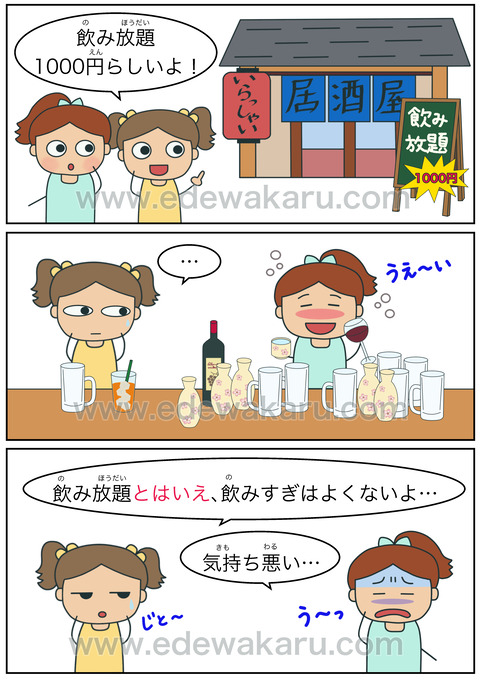
Meaning
〜けれども
How to use it
動詞・形容詞・名詞[普通形]+とはいえ
Explanation
「Aとはいえ〜」は「Aけれども、しかし〜」という意味の文型です。「Aは事実だが、しかし〜」というように、話者の意見や判断を言う時に使われます。
「A。とはいえ〜」という形もあります
ので、一緒に覚えておきましょう。
[例]
そんなことがあったなんて知らなかったんだ。
とはいえ、傷つけるようなことを言ってごめんね
「〜とはいえ」には似ている文型がありますので、復習をしておきましょう。
【関連文型】
In context 5 examples
飲み放題とはいえ、飲みすぎはよくないよ…
→飲み放題だけれども、飲みすぎはよくないよ…英語が話せるとはいえ、日常会話(にちじょうかいわ)できるくらいだ
→英語が話せると言っているけれど、日常会話ができるくらいだ知らなかったとはいえ、傷付けるようなことを言ってごめんね…
→知らなかったのは事実だが、傷付けるようなことを言ってごめんね…A:病気だったそうね。大丈夫?B:はい。病気だったとはいえ、ただかぜをひいただけですけどね
熱があったとはいえ、休むんだったら連絡すべきだったと思うよ
→熱があったのは事実だが、休むんだったら連絡すべきだったと思うよ
日本語文型辞典
Meaning
基本情報説明節や文を受け、「それはそうなのだが、しかし」といった意味を表す。前のことがらから予想・期待されることと結果が食い違うような場合に用いられる。書きことば。「とはいいながら」「とはいうものの」「と(は)いっても」に言いかえられる。
節を受けて、「それはそうなのだが、しかし」といった意味を表す。前のことがらから予想・期待されることと結果が食い違うような場合に用いられる。書きことば。「とはいいながら」「とはいうものの」「と(は)いっても」に言いかえられる。
前の文を受けて、「それはそうなのだが、しかし」といった意味を表す。前のことがらから予想・期待されることと結果が食い違うような場合に用いられる。書きことば。「とはいいながら」「とはいうものの」「と(は)いっても」に言いかえられる。
How to use it
…とはいえ
N/Na(だ)とはいえ
A/Vとはいえ
とはいえ
In context 4 examples
男女平等の世の中とはいえ、職場での地位や仕事の内容などの点でまだ差別が残っている。
国際化が進んだとはいえ、やはり日本社会には外国人を特別視するという態度が残っている。
病状は危険な状態を脱して、回復に向かっている。とはいえ、まだ完全に安心するわけにはいかない。
生徒の非行には家庭環境が強く影響する。とはいえ、学校教育のあり方に責任の一端もある。
日本語文型辞典 英語版
Meaning
【とはいえ】とはいえ follows a clause or a sentence and means “that is true, but....” Used when the actual result contradicts what is expected from the previous clause/sentence. A formal expression used mainly in written Japanese. とはいいながら, とはいうものの and と(は)いっても may be used instead of とはいえ.
Used after a clause, とはいえ means “that is true, but....” Used when the actual result contradicts what is expected from the preceding clause. A formal, mainly written expression. とはいいながら, とはいうものの, and と(は)いっても may be used instead.
Used at the beginning of a sentence, とはいえ refers to the previous sentence and means “that is true, but....” Used when the actual result contradicts what is expected from the previous sentence. A written expression. とはいいながら, とはいうものの, and と(は)いっても may be used instead.
How to use it
1. ...とはいえ[N/Na (だ)とはいえ][A/V とはいえ]
2. とはいえ
In context 4 examples
男女平等の世の中とはいえ、職場での地位や仕事の内容などの点でまだ差別が残っている。
Despite the so-called equality of the sexes in today’s world, there is still discrimination in the workplace with respect to things like status and job content.
国際化が進んだとはいえ、やはり日本社会には外国人を特別視するという態度が残っている。
Although internationalization has progressed, when all is said and done, Japanese society retains an attitude of looking at foreigners in a special way.
病状は危険な状態を脱して、回復に向かっている。とはいえ、まだ完全に安心するわけにはいかない。
She is out of critical condition and on her way to recovery. Having said that, we cannot let our guard down completely yet.
生徒の非行には家庭環境が強く影響する。とはいえ、学校教育のあり方に責任の一端もある。
The home environment strongly affect pupils’ delinquency. That said, the current system of school education is also partly responsible for it.
くらべてわかる日本語表現文型辞典
Meaning
意味1:確かにAという事実があるが、その意味や価値にあわない話し手の判断・評価や事態をBで付け加える。
意味2:Aには(ある事実から生じる)心の状態、Bではその心の状態に100%浸っていられない事情をのべる。
意味3:Aであることを理解していても、それに反する希望や要望をBで表す。
意味4:AなのでBは当たり前だ(ある程度仕方がない)が、それでもこのBの状態は程度をこえている。「いくら~とはいえ」の形でよく使われる。
How to use it
AとはいえB(いくらAとはいえB)
[動詞]とはいえ
[イ形-普]とはいえ
[ナ形-だ/である/だった/ではない]とはいえ
[名詞-∅/である/ではない/だ/だった]とはいえ
Explanation
【対比1】
「AにもかかわらずB」(意味1 P.262)
「AにもかかわらずB」は、AだけれどもBという結果になったことについての話し手の意外・残念などの感情(~なのに)を表す表現であるが、「AとはいえB」は、確かにAだけれどもAのもつ意味や価値に反する評価や判断をBで補足するものである。
○100点をとったにもかかわらず、うれしそうな顔をしない。
×100点をとったとはいえ、うれしそうな顔をしない。
○100点をとったとはいえ、いつものことだ。
×100点をとったにもかかわらず、いつものことだ。
「AもののB(AとはいうもののB)」(意味1 P.312)
「AもののB」はAという事実は認めるがそれに反する内容をBで表す。Bに判断や評価が含まれない場合は「AとはいえB」で置き換えられない。
○返事はするものの、行動には移さない。
×返事はするとはいえ、行動には移さない。
「AといえどもB」(意味1 P.156)
「AといえどもB」は一般論を述べる文であり、Aは個別のものをさしていない。Aに固有名詞が来る場合も「いわゆるA」というAの一般的イメージを述べている。またBには覚悟や義務を迫る表現がくることが多い。
○彼は留学生とはいえ、日本人以上に日本的だ。
×彼は留学生といえども、日本人以上に日本的だ。
○留学生といえども、漢字の試験を免除されるわけではない。
「AたところでB」(意味1 P.120)
「AたところでB」のAはたとえばAしてもという意味でBは話し手から見た意見である。「AとはいえB」のAはすでに起こった事実。
○いまから努力したところで、あの学校に合格できるはずがない。
×いまから努力したとはいえ、あの学校に合格できるはずがない。
「AといってもB」(意味1 P.161)
「AといってもB」のBは説明であり結果ではない。「AとはいえB」は、Aそのものの持つ意味や価値に反する話し手の判断や事態がBにくる。
○勉強しなかったとはいえ、大学に合格できた。
×勉強しなかったといっても、大学に合格できた。
In context 16 examples
春めいてきたとはいえ、まだ肌寒いですね。
政府の方針とはいえ、賛成しかねるものがある。
彼のほうが年上とはいえ、頼りになるのは彼女のほうだ。
ボーナスが出たとはいえ、全額借金返済に使わなければならない。
就職の内定通知をもらい安心したとはいえ、まだもらっていない友人のことを考えると、喜んでばかりはいられない。
子供が生まれた喜びはたとえようもない。とはいえ、家族を養う責任もいっそう強く感じる。
やっと我が家を手に入れたとはいえ、ローンの返済は気が重い。
彼のことを信じているとはいえ、疑う気持ちが全然ないわけではない。
試験は学生のために行われるとはいえ、受けずに済ませたいものだ。
梅雨だとはいえ、1日ぐらいは晴れてほしい。
減量中とはいえ、こんなにおいしそうなケーキを食べずにおれようか。
核実験はほかの国の出来事とはいえ、見捨てておくことはできない。
連休とはいえ、この人込みは異常だ。
あのタレントは人気があるとはいえ、態度が大きすぎる。
いくら兄弟とはいえ、あんなに似ているのもめずらしい。
いくら中学入試が難しくなっているとはいえ、大学生でも解けない問題を出すのは変だ。
日本語NET JLPT文法解説まとめ
Meaning
〜といっても / 〜であるが、しかし
How to use it
V(普通形)+ とはいえ
イA(普通形) + とはいえ
ナA(普通形)+ とはいえ
N(普通形)+ とはいえ
Explanation
"nevertheless"
Used to acknowledge a fact or condition while introducing a contrasting point or an exception.
In context 2 examples
ここは最寄り駅とはいえ、自宅から自転車でも20分はかかる。
親しい関係だとはいえ、最低限の礼儀を忘れてはいけない。
NINJAL 日本語文型データベース
Meaning
〜は事実だと認めるが、それでも状況は同じだと言いたいときに使います。
How to use it
V普通形+とはいえ
i-A普通形+とはいえ
na-A普通形+とはいえ(「na-A」だ→「na-A+とはいえ」の形になることが多い。「na-Aである+とはいえ」の形になることもある)
N普通形+とはいえ(「Nだ」→「N+とはいえ」の形になることが多い。「Nであるとはいえ」の形になることもある)
Notes
「〜」には、事実または話し手が事実だと考えていることがきます。「〜とはいえ」の後には、「〜」に反する話し手の感想・評価を表す文がきます。
In context 20 examples
電車が空いているとはいえ、横になって寝るとは非常識だ。
フリーランスの仕事は、比較的時間が自由になるとはいえ、自分でスケジュール管理をしなければならないという難しさはある。
ビル建設のために、町のみんなが大切にしてきた大きな桜の木を伐採するなんて、法に触れていないとはいえひどすぎる。
3世代同居の世帯は減ったとはいえ、なくなったわけではない。まだ1割程度は存在する。
準決勝には進めなかったとは言え、日本チームが8強に入れたことは賞賛に値する。
彼はまだ若いとはいえ、この研究所を代表するようなすばらしいプロジェクトリーダーだと言える。
台風で旅行をキャンセルせざるを得なくなった。仕方がないとはいえ、残念だ。
夜中に食べるのは好ましくないとはいえ、おなかがすいて眠れないこともあるのだ。
暖かかったとはいえまだ2月ですから、今日のイベントでもおでんなどの温かい食べ物がよく売れました。
この歌手のイベント出演時間は長くなかったとは言え、熱心なファンが大勢応援に駆けつけていた。
手術後の経過は順調とはいえ、まだ油断はできない。
自然食品をふんだんに取り入れた彼女の食生活は、健康的であるとはいえ、ストイックすぎて誰にも真似できない。
通勤2時間は楽ではないとはいえ、5年も続けていると慣れてしまった。
この小説の結末は意外だったとはいえ、納得のできるものだった。
今年のこの地方の干ばつの被害は、昨年ほど深刻ではなかったとは言え、やはり看過できるレベルではない。
夏とはいえ、山頂は10度以下になることもあるので、登山には長そでの服が必要だ。
まだ夕方だとはいえ、すぐに暗くなるのだから、早く帰ったほうがいい。
「受話する」とは電話を受けるという意味だ。間違いではないとはいえ、あまり一般的に使われる言葉ではないだろう。
数回しか履いていない靴下にもう穴が空いてしまった。安い品物だったとはいえ、この品質はどうなのだろう。
不合格ではなかったとはいえ、あまりいい点ではなかったのだから、慢心してはいけない。
IMABI
と Combination Particles IV
Read this IMABI lesson ↗Explanation
と Combination Particles IV
というのに という{の・こと}は とは{いえ・いいながら・いうもの}
というのに
というのに means “(al)though (that)”.
1. 彼女、何日も食くってないっていうのに、健康そうに見えたな。(ちょっと乱暴)
While she hadn’t eaten in days, she looked healthy.
Word Note: Remember that 食う is the vulgar form of 食べる.
2. 砂漠さばくはほとんど雨が降らないというのに、少数の植物は何とか生き永らえられるようだ。
While deserts receive almost no rain, it looks like a few plants are somehow able to manage to live there.
足が痛いくせに競走して勝ったんだ。
Even though his legs hurt, he ran and won!
彼女はもう大人のくせに、母親にまだ洗濯してもらってるそうだぞ。(Masculine)
Even though she’s already an adult, she still has her mother do the laundry!
やめろ。この間も傷ついたくせに。
Stop it! You got hurt just the other day, remember?
くせに VS ながら VS つつ
Question: It appears that these three expressions are interchangeable? If they aren’t, what is different about them?
Answer: There is one usage of ながら and つつ that is very similar to くせに and にもかかわらず.
As we learned in Lesson 55, the particle ながら can be used to show two opposing things happening simultaneously. For example, “despite hardship he achieved great things”. The two clauses should be similar in this matter. This is based on situations. For the most part, つつ is the same as ながら. It is not constructive as ながら is in expressions, but it is also used in patterns like つつある.
However, くせに・にもかかわらず simply shows that one moreover takes a contrary move. So, this usage is not grounds to use these expressions interchangeable. As mentioned, there is much more to ながら and つつ, and even in contrasting they’re not exactly the same.
という{の・こと}は
~ということは means “that means” and ~というのは means “the reason that”. Both are placed at the beginning of a sentence. In slang ~ということは may contract to ~ってことは. In extreme slang the entire phrase can be shortened to ~つうか.
10. ということは、まだ出張から帰ってないのだろう。
That means he probably hasn’t returned home from his business trip yet.
11. というのは、友達に騙だまされたことがあるからです。
The reason for that is that he has been deceived by his friends before.
12. というのも、新しい事業を始めたから。
The reason for that was that he started a new business.
と{はいえ・いうものの・いいながら}
~とはいえ/いいながら/いうものの means “even though”. The exact meanings are slightly different. The first emphasizes contrast with what “can be said”, the second is like “while though”, and the last is like “although…say”. They can more or less be translated as “even though” in English.
13. 梅雨つゆ・ばいうとはいえ、晴れる日もある。
Even though one may call it the rainy season, there are still also clear days.
Culture Note: The 梅雨 lasts from June to July. ばいう is a 書き言葉 reading.
14. 美味しいとはいいながら、まずいものも結構含まれている。
Though (this) may be delicious, there are bad things included as well.
15. まだ若いとはいうものの彼女はかなりの経験がある。
Even though she is young, she is quite experienced.
In context 8 examples
彼女、何日も食くってないっていうのに、健康そうに見えたな。(ちょっと乱暴)
While she hadn’t eaten in days, she looked healthy.
砂漠さばくはほとんど雨が降らないというのに、少数の植物は何とか生き永らえられるようだ。
While deserts receive almost no rain, it looks like a few plants are somehow able to manage to live there.
ということは、まだ出張から帰ってないのだろう。
That means he probably hasn’t returned home from his business trip yet.
というのは、友達に騙だまされたことがあるからです。
The reason for that is that he has been deceived by his friends before.
というのも、新しい事業を始めたから。
The reason for that was that he started a new business.
梅雨つゆ・ばいうとはいえ、晴れる日もある。
Even though one may call it the rainy season, there are still also clear days.
美味しいとはいいながら、まずいものも結構含まれている。
Though (this) may be delicious, there are bad things included as well.
まだ若いとはいうものの彼女はかなりの経験がある。
Even though she is young, she is quite experienced.
DoJG 日本語文法辞典(全集)
Meaning
Although (it is said that/someone says that); even though (it is said that/someone says that); admitting that; that being said; however; nevertheless
How to use it
(i) Sinformal | とは言え | だ after Adjectiveなstem and Noun is omitted |
| {知らない/知らなかった}とは言え | Although someone doesn’t/didn’t know |
| {寒い/寒かった}とは言え | Although it is/was cold |
| 不便{∅/だった}とは言え | Although something is/was inconvenient |
| 子供{∅/だった}とは言え | Although someone is/was a child |
(ii) Sentence1。 | とは言えSentence2。 | |
Explanation
A conjunctive phrase meaning "although it is said that"
In context 13 examples
夏とは言え、ここはまだちょっと肌寒いくらいの涼しさだ。
Although it is summer, it is still cool here—almost to the extent that it can be called a little chilly.
時間がなかったとは言え、ジェーンにこれくらいのレポートが書けないはずはない。
Even admitting that Jane didn't have much time, I don't believe that she couldn't write a (simple) report like this. (ii) Although Jane says that she didn't have much time (or you say that Jane didn't have much time), I don't believe that she couldn't write a (simple) report like this.
今度の学会が楽しみだ。とは言え、まだ発表準備は全然できていない。
I'm looking forward to the next academic conference. That being said, I haven't prepared for my presentation at all yet.
子供がやったこととは言え、これは立派な犯罪だ。
Although this was done by a child, it practically amounts to a crime.
予想していた返答だったとは言え、やはりそれを聞いた時はショックだった。
Although it was the response I'd expected, it really did shock me to hear it.
ノートブック型とは言え、ディスプレイは17インチ、プロセッサーは2.4GHz、内臓ドライブは250GBもあり、DVD/CD-RWコンボドライブ付きという優れものだ。
Although it is a laptop, it is an excellent machine, with a 17-inch display, a 2.4GHz processor, a voluminous 250GB internal drive and a DVD/CD-RW combo drive.
安いとは言え、都会の高級マンションだ。普通の者が簡単に買える代物ではない。
Although I say (it is) reasonable, it is an upscale condominium in the city. It's not something ordinary people can easily afford.
いかに暫定的処置とは言え、これはずさんすぎる。
No matter how temporary these measures are supposed to be, this is just too slipshod.
怪我をして動けないとは言え、ものを考えることはできる。
Even though I cannot move because of my injury, I can still think.
毎日走っているとは言え、1キロほどジョギングするだけだから大した運動にはならない。
Although I say I run every day, it's just one kilometre of jogging, so I don't get much exercise.
退職したとは言え、毎日やることがたくさんあるので忙しい。
Although I've retired, I have lots of things to do every day, which keeps me busy.
燃料電池は将来化石燃料に代わる主要エネルギーになるだろう。とは言え、これにはまだ解決すべき技術的な問題が多く残っている。
Fuel cells will probably become a major source of energy in the future, replacing fossil fuels. Having said that, many technical problems (with this technology) remain to be solved.
どんなときどう使う 日本語表現文型辞典
Meaning
nevertheless; be that as it may
How to use it
N/〔普通形〕+とはいえW
Explanation
~けれども/~といっても
「~とはいえ」の形で、「~」から受ける印象や特徴の一部を否定して実際のことを説明する表現。ふつう、後の文には話者の意見・判断などが来ることが多い。
Explains true situation while negating part of impression or characteristic implied from what comes before とはいえ. Often speaker's opinions or judgments follow.
In context 4 examples
彼は留学生とはいえ、日本語を読む力は普通の日本人以上です。
ここは山の中とはいえ、パソコンもファクスもあるから不便は感じない。
大新聞に書いてあるとはいえ、それがどこまで本当のことかはわからない。
山の夏は、8月とはいえ、朝夕は涼しくて少し寒いぐらいだ。