AIUEO JLPT Grammar
Meaning
This sentence pattern expresses that a certain event or situation caused an unexpected or undesirable outcome, often accompanied by regret or disappointment.
How to use it
動詞+ばかりに形容詞+ばかりに形容動詞な+ばかりに名詞である+ばかりに
Explanation · 日本語
この文型は、ある事柄が原因となって予想外の結果や悪い結果が生じたことを表す表現で、後悔や残念な気持ちを伴う場合が多いです。
In context 5 examples
彼が約束を守らなかったばかりに、全てが台無しになった。
Everything was ruined just because he didn’t keep his promise.
お金がないばかりに、旅行に行けなかった。
I couldn’t go on the trip simply because I had no money.
彼女が一言言ったばかりに、皆が怒ってしまった。
Just because of something she said, everyone got angry.
彼は慎重すぎたばかりに、チャンスを逃してしまった。
He missed the opportunity simply because he was too cautious.
彼の不注意な発言があったばかりに、問題が大きくなった。
The problem escalated simply because of his careless remark.
文法
Meaning
~ので / ~が原因で
話し手の後悔や残念な気持ちを表すことが多く、後ろの文には悪い結果が来る。
「~たいばかりに」や「~が欲しいばかりに」は「どうしても~したいので」という意味になる。
How to use it
V(普通形)+ ばかりに
イA(普通形)+ ばかりに
ナAな/である/だった + ばかりに
Nである/だった + ばかりに
In context 6 examples
Facebookの「いいね」が欲しいばかりに、嘘の投稿までした彼女はみんなから嫌われてしまった。
どうしても新しいi-phoneが欲しいばかりに、親の財布から少しずつお金を盗んだ。
手を洗わず、ハンバーガーを食べたばかりに、お腹を壊してしまった。
ホラー映画を見たばかりに、怖くてなかなか寝られない。
受験票を忘れたばかりに、テストを受けることができなかった。
大学を卒業していないばかりに、海外で働きたくてもビザがとれない。
Bunpro Grammar Reference
Meaning
Simply because, Only because, Just because, Simply on account of
How to use it
Verb[た]+ ばかりに
[い]Adjective + ばかりに
[な]Adjective + な(1) + ばかりに
Noun + な(1) + ばかりに
(1) である
Nuance
A slightly formal phrase used to show that just (A) caused (B), often despite being a minor thing.
Explanation
When paired with the case marking particle に, ばかり regularly conveys the meaning of 'simply because', or 'just because'. Literally, this expression means that 'even with just (A), (B) is/was able to occur'. This phrase is regularly paired with the past form of verbs, indicating that something that has already taken place, led to some other result.
To use ばかりに, simply attach the expression to the end of any word in its attributive form.
ボールをキャッチしたばかりに、肩が外れました。
Simply because I caught a ball, I dislocated my shoulders.
体が小さいばかりに、クラスメイトにいじめられた。
Simply because I am small, my classmates bullied me.
彼は練習が大変なばかりに、部活をやめることにした。
Simply because practice was difficult, he decided to quit.
新人であるばかりに、先輩たちがやりたくない仕事を押し付けられた。
Simply because I am new, my senpai made me do all the work they didn't want to.
It should be noted that this particular grammar pattern has a strong tendency to be used with results that are negative. However, this is not a requirement. A high level of eagerness/enthusiasm can also be expressed when paired with grammar points like たい, or ほしい.
釣りに行きたいばかりに、仕事を休んで海に行った。
Simply because he wanted to go fish, he took a day off of work and went to the ocean.
新しい車が欲しいばかりに、貯金を全部使った。
Just because I wanted a new car, I used all my savings.
Fun Fact
As we mention in our ばかり grammar point, one of the more common kanji that ばかり stems from is '許', which means to be 'let off' or 'let through'. It implies a minimum amount of something that is then deemed as 'permissible'. This nuance is kept in ばかりに, as the (A) part of the sentence is being highlighted as that minimum extent of something for which the (often surprising) result of (B) is/was possible. Due to this, translations such as 'even with only/just (A), (B)' are quite similar to ばかりに, so long as it is clear that (A) is surprising.
貰った肉を食べたばかりに、お腹を壊してしまった。
Even just with eating the meat that was given to me, I got a stomach ache.
Fun Fact
The kanji that is used most frequently for ばかり is the same kanji that is used for 許す 'to forgive'. In this particular use of 許, it still means 'to let off', or 'to let through', as 'to forgive' quite often has the nuance of letting something through/pass/slide.
今回は許すけど、またやったら許さないからね。
I will forgive you this time, but I will not forgive you if you do it again.
Nuance · 日本語
些細なことであるにも関わらず、(A)が(B)を引き起こしたということを表す少し丁寧な表現。
Explanation · 日本語
「ばかりに」は、「ばかり」と格助詞「に」を合わせたもので、「ただ (A) だけで」という意味を表します。「(A) だけが原因・理由で、(B) が起きた・(B) が可能だ」という状況で使われます。また、この表現は、動詞の過去形と一緒に使われることが多いです。その場合は、過去に起こったことが、ある結果を招いたことを表します。「ばかりに」は、連体形の語のあとに付けて使います。
ボールをキャッチしたばかりに、肩が外れました。
Simply because I caught a ball, I dislocated my shoulders.
体が小さいばかりに、クラスメイトにいじめられた。
Simply because I am small, my classmates bullied me.
彼は練習が大変なばかりに、部活をやめることにした。
Simply because practice was difficult, he decided to quit.
新人であるばかりに、先輩たちがやりたくない仕事を押し付けられた。
Simply because I am new, my senpai made me do all the work they didn't want to.
この文法は、結果が悪いときに使われることがほとんどですが、絶対ではありません。また、「たい」や「ほしい」のような文法と一緒に使えば、強い気持ちや願いを表すこともできます。
釣りに行きたいばかりに、仕事を休んで海に行った。
Simply because he wanted to go fish, he took a day off of work and went to the ocean.
新しい車が欲しいばかりに、貯金を全部使った。
Just because I wanted a new car, I used all my savings.
豆知識
「ばかり」の説明でも触れましたが、「ばかり」は漢字で書くと「許り」になります。この漢字には「範囲を限って、そこだけ許す」ようなイメージがあります、「ばかりに」は、「ただ (A) をしただけで、(B) になった」と、驚いたり意外に感じたりする気持ちを表すこともできます。この「ただ〜だけで」というニュアンスは、「許す」という漢字のイメージと関連づけて覚えるといいかもしれません。
貰った肉を食べたばかりに、お腹を壊してしまった。
Even just with eating the meat that was given to me, I got a stomach ache.
豆知識
「ばかり」の「許す」という漢字には、「認める」「通す」「責めない」のような意味もあります。
今回は許すけど、またやったら許さないからね。
I will forgive you this time, but I will not forgive you if you do it again.
In context 20 examples
- 財布を忘れたばかりに、お弁当を買えなかった。
Simply because I have forgotten my wallet, I couldn't buy a bento.
- ボールをキャッチしたばかりに、肩が外れました。
Simply because I caught a ball, I dislocated my shoulders.
- 体が小さいばかりに、クラスメイトにいじめられた。
Simply because I am small, my classmates bullied me.
- 彼は練習が大変なばかりに、部活をやめることにした。
Simply because practice was difficult, he decided to quit.
- 新人であるばかりに、先輩たちがやりたくない仕事を押し付けられた。
Simply because I am new, my senpai made me do all the work they didn't want to.
- 新しい車が欲しいばかりに、貯金を全部使った。
Just because I wanted a new car, I used all my savings.
- 釣りに行きたいばかりに、仕事を休んで海に行った。
Simply because he wanted to go fish, he took a day off of work and went to the ocean.
- 彼は驚かされたばかりに、気を失ってしまった。
He passed out simply because he got surprised.
- 恋人に会いたいばかりに、インドネシアに旅行した。
Simply because I wanted to see my significant other, I traveled all the way to Indonesia.
- 良いリーダーがいなかったばかりに、チームは試合に負けた。
Just because they didn't have a good leader, the team lost the match.
- 点検を怠っていたばかりに、タコマナローズ橋は崩壊した。
Just because of negligence in inspections, the Tacoma Narrows Bridge crumbled.
- 病院の予約を入れてしまったばかりに、試合に参加できなかった。
Unfortunately, just because I made an appointment at the hospital, I couldn't participate in the game.
- おとなしそうに見えた犬の頭を撫でたばかりに噛まれたんだ。まだ手が痛いよ。
Just because I patted the head of a docile-looking dog, I got bit. My hand still hurts.
- 私があんなことを言ってしまったばかりに、彼はひどく落ち込んでしまいました。
Just because I said those things to him, he got extremely depressed.
- 父親がたまにしか家にいないばかりに親子関係が冷たくなることがある。
Just because fathers are only home occasionally, the parent-child bond can become distant.
- 彼はスマホをちらりと見たばかりに、事故を起こしたんだ。運転するときは注意が必要だ。
Simply because he glanced at his phone, he caused the accident. It is necessary to be careful when driving.
- ある作家のサインがほしいばかりに、作家が普段、どういった行動をとっているかを調べた。
Just because I wanted the autograph of a certain author, I investigated what his usual routine is like.
- この鳥は孵化したあと弱かったばかりに、親に見放されたんだ。自然界は怖い...ね?
This bird was abandoned by its parents simply because it was weak after hatching. Nature is scary, huh?
- 貰った肉を食べたばかりに、お腹を壊してしまった。
Even just with eating the meat that was given to me, I got a stomach ache.
- 今回は許すけど、またやったら許さないからね。
I will forgive you this time, but I will not forgive you if you do it again.
DoJG 日本語文法辞典(全集)
Meaning
Simply because; just because; simply on account of ~
How to use it
(i) Vinformal past | ばかりに | |
| 食べたばかりに | Simple because someone ate it |
(ii) Adjective い informal | ばかりに | |
| 難し{い/かった}ばかりに | Simply because something is/was difficult |
(iii) Adjective な stem | {な/である/だった/であった}ばかりに | |
| 不便{な/である/だった/であった}ばかりに | Simply because something is/was inconvenient |
(iv) Noun | {である/だった/であった}ばかりに | |
| 学生{である/だった/であった}ばかりに | Simply because someone is/was a student |
Explanation
A conjunction indicating that a single factor causes a negative situation.
In context 11 examples
僕が一言変なことを言ったばかりに彼女との関係は悪くなってしまった。
Just because I said one nasty thing to her, my relationship with her deteriorated.
あの子は、体が弱いばかりにクラスメートにいじめられている。
That child is being bullied by his classmates simply because he is (physically) weak.
あの日たまたま休んでいたばかりに、大事な連絡を聞きそびれた。
I missed a really important announcement just because I happened to be absent that day.
彼女が会いたいと言ってきた時に会いに行かなかったばかりに、それが最後のチャンスになってしまった。
Simply because I didn't go see her when she wanted to see me, it turned out to be my last chance to see her.
遺言がないばかりに相続人の間で遺産争いに発展するということがよくある。
Disputes among heirs over an inheritance often develop simply because there is no will.
お金がなかったばかりに、映画もろくに見られなかった。
I couldn't even go to the movies just because I didn't have any money.
医者の処置が不適切であったばかりに、助かる患者を死なせてしまった。
Simply because the doctor's treatment wasn't appropriate, the patient, who could have been helped, lost his life.
彼女は黒人女性であったばかりに人種差別と性差別を受けた。
She suffered from racial and sexual discrimination simply because she was a black woman.
姑との関係が悪いばかりに嫁はストレスが溜まり、よく病気になった。
Just because her relationship with her mother-in-law was so bad, she often fell ill from the stress.
両親が甘かったばかりに子供たちは自立心がない。
Those children don't have a sense of independence just because they are spoiled so much by their parents.
高校時代の教育がよくなかったばかりに、大学に入ってから苦労している。
I'm having a difficult time in college all because my high school education wasn't good.
どんなときどう使う 日本語表現文型辞典
Meaning
simply because
How to use it
〔普通形〕(ナAな・ナAである/Nである)+ばかりに
Explanation
~だけが原因で
1)「~ばかりに、…」の形で、「~だけが原因で、…という予想外の悪い結果となった」と言いたいときに使う。「…」には悪い結果の文が来る。
2)話者の後悔の気持ちや残念な気持ちを表すことが多い。
3) ❸ のような「たいばかりに」を使う場合は、したくないことをあえてやったという意味の文が来る。
3)In sentence ❸ , たいばかりに, implies person didn't want to do particular action, but had little recourse.
1)Some single cause listed before pattern causes some unpredictably bad result. Clauses showing adverse results follow.
2)Often expresses speaker's feelings of regret or disappointment.
In context 4 examples
うっかり生水を飲んだばかりに、おなかを悪くしてしまった。
パスポートを取りに行ったが、はんこを忘れたばかりに、今日はもらえなかった。
彼は子どもの命を助けたいばかりに、薬を買うお金を盗んだのだそうだ。
パソコンのソフトがうまく使えないばかりに、やりたい仕事ができなかった。
絵でわかる日本語
Meaning
〜だけの理由で(悪い結果になった)
How to use it
動詞[普通形]+ばかりに
形容詞[普通形]+ばかりに
Explanation
「〜ばかりに」は「〜だけの理由で、よくない結果になった」という意味を表す文型です。この文型は
「不満」や「後悔」、「残念だ」という気持ちを込めて使われます
😮(復習:〜を込めて・〜を込めた) 後ろには必ず「悪い結果」がきます。
その理由のせいで、悪いことが起こってしまったと言いたい時にぴったりの文型です😊(復習:〜せいで・〜せいか)
【「ばかり」シリーズ】
〜たばかり
〜てばかりいる・〜てばかりだ
〜てばかりはいられない・〜てばかりもいられない
〜と言わんばかりに・〜とばかりに
〜とばかり思っていた
〜とばかりは言えない
〜ばかり(数量詞+ばかり)
〜ばかりだ
〜ばかりだ(準備完了)
〜ばかりで
〜ばかりでなく〜も
〜ばかりに
〜ばかりの(比喩)
〜ばかりは
〜んばかり
In context 4 examples
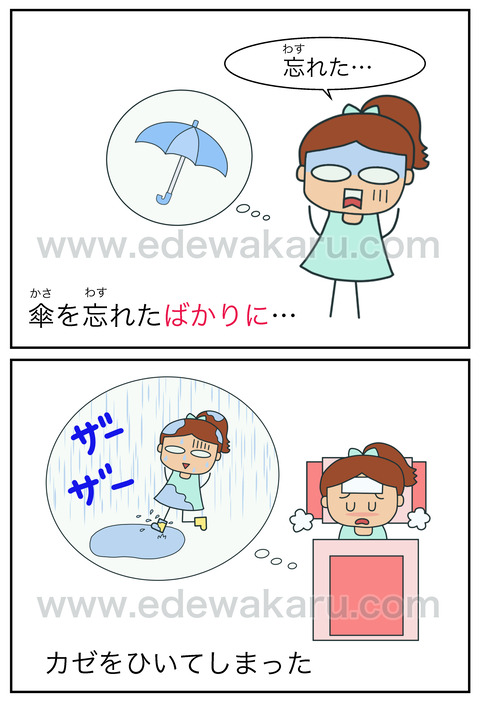
傘を忘れたばかりにカゼをひいてしまった
→傘を忘れたのでカゼをひいてしまったカゼをひいたばかりに試験が受けられなかった(復習:テストをする・テストを受ける)
→カゼをひいたので試験が受けられなかった名前を書き忘れたばかりに、0点にされてしまった
→名前を書き忘れたので、0点にされてしまった勉強しなかったばかりに不合格だった
→勉強しなかったので、不合格だった
くらべてわかる日本語表現文型辞典
Meaning
意味1:AだからこそBというよくない結果となった。
意味2:Aには話し手の希望がきて、それを望むために普通ではしないような行動Bに出る。
How to use it
AばかりにB(AばっかりにB)
接続1:
[動詞]ばかりに
[イ形-普]ばかりに
[ナ形-な/である/だった/ではない]ばかりに
接続2:
[動詞-ます形]+たい/たくない+ばかりに
[イ形-い/くない]ばかりに
Explanation
【対比1】
「AだけにB」(意味1 P.114)
「AがためにB」(意味1 P.56)
Notes
【注意1】
・Aでほかの理由を排除する、ただ、そのことだけが原因でという理由の強調があり、Bは普通ならそんなことはしないという好ましくない結果。話し手の後悔・残念の気持ちが含まれることもある。
【注意1,2】
・会話体や強めて言うときには「ばっかりに」となる。
○お金がほしいばっかりに、とうとう盗みまでしてしまった。
In context 8 examples
あの人を信じたばかりに、とんだ目にあってしまった。
彼は才能があるばかりに、学内でも疎まれている。
俺は酒が好きなばかりに、家族にも迷惑をかけたと思っているよ。
背が高くなかったばかりに、代表選手から外されてしまった。
大学に合格したいばかりに、問題用紙を盗んだらしい。
母親が恋しいばかりに、30キロの道を一人で歩いてきたのだ。
保険金を手に入れたいばかりに、妻を殺してしまった。
息子は運動会に出たくないばっかりに、頭が痛いと言っている。
日本語NET JLPT文法解説まとめ
Meaning
~ので / ~が原因で
話し手の後悔や残念な気持ちを表すことが多く、後ろの文には悪い結果が来る。
「~たいばかりに」や「~が欲しいばかりに」は「どうしても~したいので」という意味になる。
How to use it
V(普通形)+ ばかりに
イA(普通形)+ ばかりに
ナAな/である/だった + ばかりに
Nである/だった + ばかりに
Explanation
"because of / due to"
It often expresses the speaker's regret or disappointment, and the following sentence usually contains a negative result.
In context 6 examples
Facebookの「いいね」が欲しいばかりに、嘘の投稿までした彼女はみんなから嫌われてしまった。
どうしても新しいiPhoneが欲しいばかりに、親の財布から少しずつお金を盗んだ。
手を洗わず、ハンバーガーを食べたばかりに、お腹を壊してしまった。
ホラー映画を見たばかりに、怖くてなかなか寝られない。
受験票を忘れたばかりに、テストを受けることができなかった。
大学を卒業していないばかりに、海外で働きたくてもビザがとれない。
毎日のんびり日本語教師
How to use it
動詞普通形+ばかりに
い形容詞普通形+ばかりに
名詞+(な/である)+ばかりに
な形容詞+(な/である)+ばかりに
Explanation
悪い原因を表します。後項にはそれによって発生した、話し手にとって意外性のある悪い結果を述べます。
Notes
「ばかり」シリーズ
In context 8 examples
周囲が反対しているばかりに、留学できずにいる。
その言葉を信じたばかりにひどい目にあった。
先輩のアドバイスを聞き入れなかったばかりに大きな失敗をしてしまった。
経験がないばかりに、周囲に手間をかけさせてしまった。
絵を描くのが苦手なばかりに、下手だと馬鹿にされた。
私が不甲斐ないばかりに、本当に申し訳ない気持ちです。
親が過保護なばかりに、物心ついたときから自由ではなかった。
無理やり柵を跳び越えたばかりに怪我をしてしまった。
NINJAL 日本語文型データベース
Meaning
〜ということだけが原因で、残念な状態になったと言いたいときに使います。〜という原因さえなければ、残念な状態にはならないのに、という気持ちを表します。
How to use it
V普通形+ばかりに
i-A普通形+ばかりに
na-A普通形+ばかりに(ただし、「na-Aだ」→「na-Aな+ばかりに・na-Aである+ばかりに」)
N普通形+ばかりに(ただし、「Nだ」→「Nである+ばかりに・Nな+ばかりに」)
Notes
「〜」には原因を表す文がきます。「~ばかりに」の後には、予想外の悪い結果を表す文がきます。話し手の意志的な行為を表す文はきません。また、話し手の希望・意向を表す文や相手への働きかけの文もきません。
In context 19 examples
あそこに高いビルがあるばかりに、ここからは花火の音しか聞こえない。
決断ができないばかりにチャンスを逃してしまってはもったいない。
うっかり電車に乗り間違えてしまったばかりに、待ち合わせに遅刻してしまった。
外国に行くときは、その国の常識を知らなかったばかりに困るということがないように、よく調べて行ったほうがいい。
食が細いばかりに、おいしそうなものがたくさんあってもいろいろ食べられなくて残念だ。
主張が正しくても、伝え方が悪いばかりに相手に納得してもらえないこともある。
パソコンに詳しくないばかりに、少しの不具合でも人に尋ねなければ解決できない。
引っ越す前は、家が狭かったばかりに自分の部屋が持てないでいた。
洗った後、置いた場所がよくなかったばかりに、グラスが床に落ちて、割れてしまった。
能力があるのに、英語が苦手なばかりに、グローバルに活躍する機会を逃してしまう人も多い。
言葉の定義があいまいであるばかりに、あの二人の論客の議論はかみ合っていないように感じられる。
母は体が丈夫でないばかりに、働きたくてもあまりたくさん働くことができない。
高校時代の私は、少し臆病だったばかりに、憧れの先輩に声をかけることができなかった。
私はあまり練習熱心ではなかったばかりに、チームメートに迷惑をかけた。
長男であるばかりに、弟と妹のためにいろいろ我慢させられた。
父は言うことが時代おくれなばかりに、家族みんなに敬遠されている。
標準体型ではないばかりに、特注の割高な服を買わなければならない。
子どものころ遊園地に連れていってもらったが、制限身長以下だったばかりに乗りたかったアトラクションに乗れなくて、悔しい思いをした。
その日履いていた靴がウォーキング用ではなかったばかりに、長時間歩いて足が痛くなってしまった。