DoJG 日本語文法辞典(全集)
Meaning
Show signs of ~
How to use it
Adjective い/な stem | がる | |
| うれしがる | Someone shows signs of being glad |
| めんどうがる | Someone shows signs of being bothered |
Explanation
An auxiliary verb attached to a psychological/physiological adjective meaning a person other than the speaker shows signs of ~
In context 4 examples
一男はスポーツカーを欲しがった・がりました。
Kazuo showed signs of wanting a sports car.
上田さんはアイスクリームを食べたがった・がりました。
Mr Uedo showed signs of wanting to eat ice cream.
スーザンは一人で淋しがっています。
Susan feels lonely by herself.
子供が眠たがっている。
My child wants to go to sleep.
日本語文型辞典
Meaning
基本情報Na がるA-がるV-たがる説明形容詞や欲求を表す「V-たい」語幹に付いて、そのように思う、感じる、ふるまう、などの意味を表す。そのようすを客観的に叙述する動詞になっているので、小説の地の文や③のように自分を客観的している場合をのぞけば一人称では使わないのがふつう。「本が読みたい」「車がほしい」などの「が」は「本が読みたがる」「車をほしがる」のように「を」に変わる。例のほかによく使われるのは「はずかしがる」「さびしがる」「なつかしがる」「けむたがる」「つよがる」「いたがる」「とくいがる」など。「…たがり」や「あつがり」「さむがり」「さびしがり」「はずかしがり」「こわがり」など「がり」の形になると名詞になって、そのように思う・感じる・ふるまう人、という意味になる。例文① 注射をいやがるこどもは多い。② その子は自分と同じくらいの大きさの犬をかわいがっている。③ 妻の死をいつまでもかなしがってばかりはいられない。わたしには残されたこどもたちをそだてていく義務がある。④ こわがらなくてもいいのよ。この人はおかあさんのともだちなの。⑤ そのラーメン屋は朝8時から夜の2時までやっているうえに安くてうまいので、近所の学生たちに重宝がられていた。⑥ こどもがおもちゃをほしがって地べたにすわりこんで泣いていた。⑦ 人の話を最後まで聞かすに口をはさみたがる人がときどきいる。
絵でわかる日本語
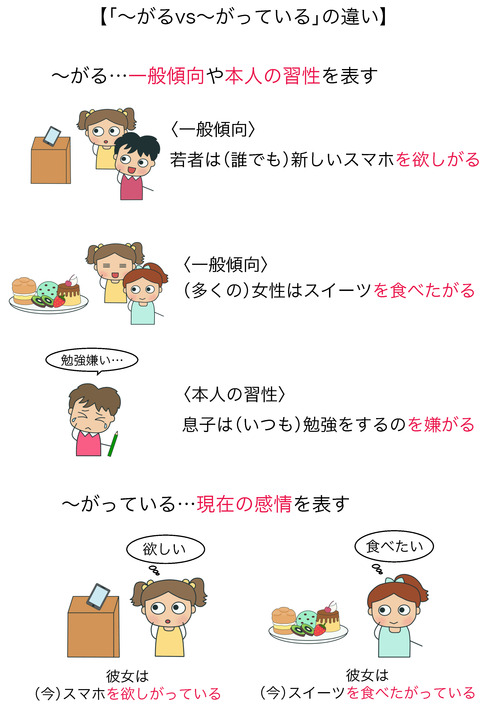
Usage 2
Read this source entry ↗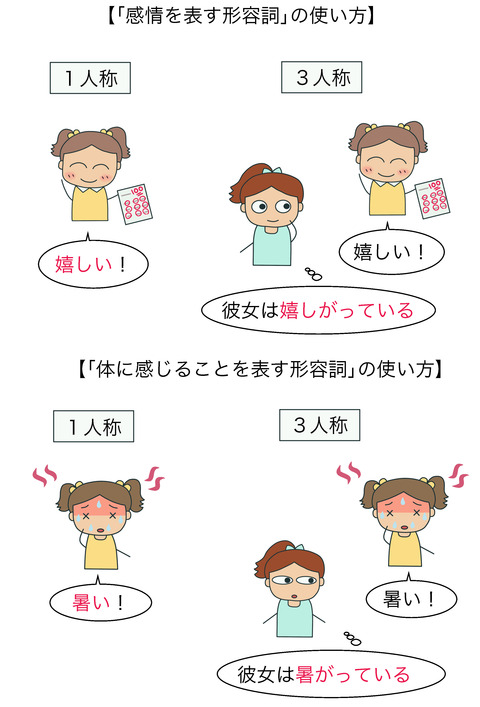
How to use it
形容詞語幹:[ーい][ーな]+がる・がっている
(例:悲しい→
悲しがる
・残念な→
残念がる
・痛い→
痛がる)
「〜がる・〜がっている」を使うほかに「
〜ようだ
(五感推量)・
〜そうだ
(様態・視覚推量)」を使用すると、3人称に「〜欲しい・〜たい」「感情を表す形容詞」「体に感じることを表す形容詞」を使うことができます😉
「〜ようだ・〜そうだ」も難しい初級文法の1つですので、しっかり復習できるといいですね😊
Usage 3
Read this source entry ↗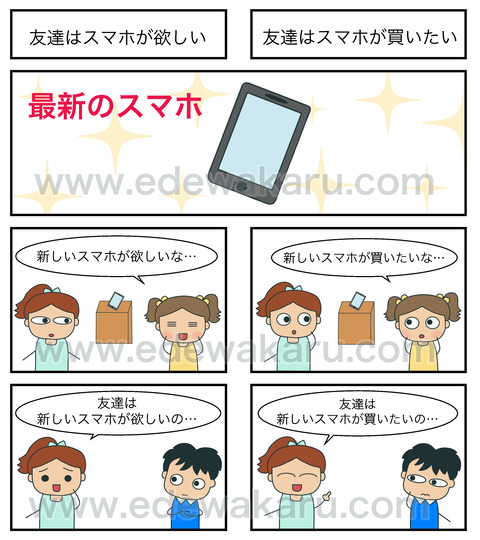
How to use it
〜欲しい→
〜欲しがる
・
〜欲しがっている
〜たい→
〜たがる
・
〜たがっている
これは日本語能力検定N4レベルの文法ですが、とても重要で会話でもよく使用されます。
みなさんもしっかり覚えて上手に使えるようになってくださいね 😊
どんなときどう使う 日本語表現文型辞典
Meaning
(he, she, it is) eager to; tends to
How to use it
イAい/ナA+がる
Explanation
1)「ほしい・Vたい、痛い・うれしい・残念だ」などについて、3人称の要望・希望、身体的感覚、感情を表す。
2)動詞Ⅰと同じように活用する。
3)「ほしい」につく場合、助詞「が」は「を」に変わる。
わたしはNがほしい。
→弟はNをほしがっている。
4)普通は「がっている」の形で使うが、 ❻ のように一般的な傾向を言う場合は「がる」の形で使う。
5)主語が目上の人の場合は使わない方がいい。
◆ △先生は車をほしがっています。
→○先生は車がほしいとおっしゃっています。
1)Third person's desires, wishes, physical sensations, or emotions.Uses phrases such as ほしい (want), V-たい (want to), 痛い (hurt), うれしい (happy), or 残念だ (too bad).
3)When attached to ほしい, particle が becomes を. Examples: わたしはNがほしい。→弟はNをほしがっている。
4)Usually in the form -がっている, but がる is used to express general trends, as in sentence ❻ .
2)Conjugates like -u verbs.
5)Best not to use when subject is social superior.
In context 6 examples
赤ちゃんがミルクをほしがって、泣いています。
弟はオーストラリアの大学に行きたがっています。
最近子どもが幼稚園に行きたがらないので、心配しています。
父が帰ってくると、犬はうれしがって部屋の中を走り回ります。
このごろ、たばこの煙を嫌がる人が多くなりました。
子どもはほかの子どもの持っているものをほしがります。
毎日のんびり日本語教師
How to use it
い形容詞語幹+がる/がっている
な形容詞語幹+がる/がっている
Explanation
感情・感覚形容詞に接続し、二人称、三人称の感情や感覚を表します。一人称には使えません。
この文法は形容詞を五段動詞化しますので、ここから「寒がり」「暑がり」「寂しがり」「恥ずかしがり」「怖がり」などの名詞が生まれています。
「可愛がる(爱)」「群がる」「繋がる」等、元々「~がる」の形を取る動詞もありますが、この文法とは関係ありませんので人称制限はありません。
Notes
関連文法
【N5文法】~したい/したくない/したがる/したがっている
【N5文法】~が欲しい/は欲しくない/を欲しがる/を欲しがっている
【N4文法】~がる/がっている
【N3文法】~てほしい
In context 8 examples
彼は死ぬことを怖がっている。(他害怕死亡。)
みんなが不思議がっている。(大家都觉得不可思议。)
階段から落ちたが、出血も痛がる様子も無かった。
うちの猫は爪切られるのをとても嫌がる。(我家的猫很讨厌剪指甲。)
猫が寒がっているので暖房をつけた。
恥ずかしがらなくてもいいです。(不用害羞。)
彼女は寂しがり屋だ。
彼は室温20度でも暑がっている。(他在室温20度的环境下也会觉得很热。)
日本語文型辞典 英語版
Meaning
【がる】[Na がる][A-がる][V-たがる]
Attaches to adjectives or stems of the V-たい form, which expresses desire. Means thinking, feeling, or acting a certain way. This pattern is used with verbs that describe a situation objectively, so it usually isn’t used in the first person, except in the narrative passages of a novel or in cases like
(3)
where one looks at oneself objectively. が in 本が読みたい and 車がほしい is changed toを, as in 本を読みたがる and 車をほしがる. In addition to the examples above, はずかしがる, さびしがる, なつかしがる, けむたがる, つよがる, いたがる and とくいがる are often used.
Variations such as たがり or あつがり, さむがり, さびしがり, はずかしがり and こわがり are nouns that refer to people who think, feel, or act in such-and-such a way.
In context 7 examples
注射をいやがるこどもは多い。
Many children hate injections.
その子は自分と同じくらいの大きさの犬をかわいがっている。
The girl loves the dog, which is almost her size.
妻の死をいつまでもかなしがってばかりはいられない。わたしには残されたこどもたちをそだてていく義務がある。
It is not good for me to do nothing but grieve over the death of my wife. I have a duty to bring up the children she left me.
こわがらなくてもいいのよ。この人はおかあさんのともだちなの。
You don’t need to be scared. She is a friend of my mother’s.
そのラーメン屋は朝8時から夜の2時までやっているうえに安くてうまいので、近所の学生たちに重宝がられていた。
That Chinese noodle soup shop is open from eight in the morning to two in the following morning, and what’s more, they serve cheap and tasty noodles, so it’s really prized by students in the neighborhood.
こどもがおもちゃをほしがって地べたにすわりこんで泣いていた。
The child wanted the toy and plopped down on the floor in tears.
人の話を最後まで聞かずに口をはさみたがる人がときどきいる。
There are some people who love to butt in without listening to the end of a story.
AIUEO JLPT Grammar
Meaning
「〜がる」is used to express the emotions or desires of others. It connects with the stem of adjectives or na-adjectives and indicates that someone is feeling or desiring something. This expression is used when conveying the emotions or desires of others from a third-person perspective.
How to use it
形容詞語幹+がる形容動詞+がる
Explanation · 日本語
「〜がる」は、他人の感情や欲求を表すときに使う表現です。形容詞語幹や形容動詞に接続して使用し、誰かが何かを感じている、または欲していることを示します。この表現は、第三者の視点から他人の感情や欲求を伝えるときに使います。
In context 5 examples
彼は寒がっている。
He feels cold.
彼は野菜を食べたがらない。
He doesn't like to eat vegetables.
学生はこの問題を難しがっています。
The students find this problem difficult.
彼は頭を痛がっているそうだ。
He seems to have a headache.
彼は新しいプロジェクトを怖がっている。
He is afraid of the new project.
Bunpro Grammar Reference
Meaning
To feel, To think, To act as if, To want, To desire
How to use it
[い]Adjective[い̶]+ がる
[な]Adjective + がる
[い]Adjective[い̶]+ がります
[な]Adjective + がります
Nuance
A word that describes the way that others are acting, or may be feeling.
Explanation
がる is a う-Verb that is primarily used as a suffix in Japanese. When used in this way, it means 'to act like (A)', or 'to show signs of being (A)', where (A) is the word that it is attached to.
To use がる, you will need to link it to the stem form of an い-Adjective (simply remove the い), or to the stem form of a な-Adjective (do not include the な).
彼はいつも女の子の前では強がるけど友達の中では彼は一番の怖がりだ。
He always acts tough in front of girls, but amongst our friends he is the biggest scaredy-cat.
犬が嫌がる事をしてはいけない。
You must not do anything that the dog would not like.
がる is a verb which means 'to give the impression of (A)', or 'to act like (A)'. This is very important in Japanese, as you would not usually say how somebody else feels, unless they told you directly and you are simply repeating what you heard (in which case you would use the quotation particle と).
トムはこの新しいゲームを欲しいと思うよ。
I think Tom would want this new game.
When you want to express the way you 'think' that someone else feels, but don't have any direct information about it, that is when がる would be natural to use. For example, if you see someone shivering in the cold, you would say something like the following.
あの人、寒がっている。ジャケット着ればいいのに。
That person seems like they feel cold. It would be better if he wore his jacket. (Natural Japanese, as がる shows how he 'appears to be acting', rather than what he is actually feeling)
The main difference between がる, and がっている, is that がる will be used when a person usually/always acts a certain way, whereas がっている is more about the way someone/something is acting in any specific moment.
この子はいつも新しいおもちゃを欲しがる。
This kid always wants new toys.
キムは新しいパソコンをほしがっている。
Kim is wanting a new computer.
Caution
がる may also be used to describe yourself (in the third person). This is when you want to express the way you think that you act/are acting, or a way you assume other people view your behavior.
俺はいつも人の前では強がる。
I always act tough in front of people. (I probably always appear to act tough)
私は今、犬をほしがっているけど、マンションに住んでいるからまだ飼えない。
Right now, I am wanting a dog, but since I live in an apartment, I can't get one yet. (I am currently acting like I want a dog)
Fun Fact
The use of がっている to express an 'in the moment' way that someone is acting, is slowly becoming less and less common in modern Japanese. Regularly, そう will be used instead, to express that someone (or something) 'seems' a certain way.
あの人、暑がっているね。
That person looks like they are hot, don't you think. (They're acting like they're hot)
あの人、暑そうだね。
That person looks like they are hot, don't you think. (They seem hot)
Nuance · 日本語
人の行動や気持ちを表す言葉。
In context 22 examples
- 私の猫は怖がる。
My cat is jumpy. (Acts scared)
- 彼はいつも女の子の前では強がるけど友達の中では彼は一番の怖がりだ。
He always acts tough in front of girls, but amongst our friends he is the biggest scaredy-cat.
- この子はいつも新しいおもちゃを欲しがる。
This kid always wants new toys.
- 犬が嫌がる事をしてはいけない。
You must not do anything that the dog would not like.
- トムはこの新しいゲームを欲しいと思うよ。
I think Tom would want this new game.
- キムは新しいパソコンをほしがっている。
Kim is wanting a new computer.
- あの人、寒がっている。ジャケット着ればいいのに。
That person seems like they feel cold. It would be better if he wore his jacket. (Natural Japanese, as がる shows how he 'appears to be acting', rather than what he is actually feeling)
- 私の弟は強がる。
My younger brother acts tough.
- あの子はゲームをほしがる。
That kid (always) wants games.
- 映画を見て、面白がっています。
Watching a movie and showing signs of interest.
- 君の車を欲しがる人はいないと思う。
I don't think that anyone feels like they want your car.
- 恥ずかしがらないで。スピーチが上手だったよ。
Don't feel ashamed. Your speech went well.
- 飼い猫を外に出してみれば?面白がるよ!
Why don't you try letting your cat outside? It seems like they'd enjoy it.
- 子供の時宇宙人のことを怖がっていた。
When they were a child they felt terrified of aliens.
- 嫌がっているから、ちょっと離れて。
He doesn't like (that). Give him a bit of space. (showing signs of distaste)
- 家の子供たちは家事の手伝いを嫌がっている。
Our kids show signs of distaste to helping with house chores.
- 初めての飛行機なので怖いと思うけど、怖がらないでね。
This is your first time on an airplane so I think it might be scary, but please don't act scared.
- 今Nintendo(ニンテンドー)スイッチを持っている人は皆ゼルダの伝説ブレスオブザワイルドを欲しがっているだろう。
Everyone who has a Nintendo Switch now is wanting The Legend of Zelda: Breath of the Wild, right?
- 俺はいつも人の前では強がる。
I always act tough in front of people. (I probably always appear to act tough)
- 私は今、犬をほしがっているけど、マンションに住んでいるからまだ飼えない。
Right now, I am wanting a dog, but since I live in an apartment, I can't get one yet. (I am currently acting like I want a dog)
- あの人、暑がっているね。
That person looks like they are hot, don't you think. (They're acting like they're hot)
- あの人、暑そうだね。
That person looks like they are hot, don't you think. (They seem hot)
NINJAL 日本語文型データベース
Meaning
話し手以外の人が〜という感情・感想・欲求を持っていることを表します。一般的な性質や傾向などを述べるときに使うことが多いです。
How to use it
Notes
「〜」には感情・感想を表す形容詞や欲求・願望を表す「〜たい・ほしい・〜てほしい」がきます。
動詞と同じ形に変化します。
欲求や感情が他者から観察できるものであることを暗に示すので、目上の人について使うと失礼になることがあります。
In context 16 examples
多くの犬が雷を怖がる。
「ふるさとを懐かしがる気持ち、よくわかるよ」
うちの猫は、私が仕事をしようとすると構ってほしがるんで、困ってしまいます。
近年、結婚したがらない若者の増加が問題になっている。
夫は会社のことを話したがらないので、私も聞かないことにしている。
「明日のスピーチ大会では、みなさん恥ずかしがらないでスピーチしてくださいね」
昨日、子どもが急におなかが痛いと言い出して、あんまり痛がったので病院に連れていった。
友達がなぞなぞの答えを聞きたがったので、まずヒントを出した。
「お姉さん、今日は子守ありがとう。で、りょう君どうだった?」「お利口さんだったよ。親がいなくてもまったく寂しがらなかったしね」
赤ちゃんがミルクをほしがらなくて、困っています。
最近、たばこの煙を嫌がる人が増えています。
「試合に負けたからってそんなに残念がるなよ。また頑張ればいいじゃないか」
面接試験を前に不安がる子どもに、「きっと大丈夫だよ」と声をかけた。
あの人は、人に褒められても決して得意がらない。立派な人だ。
盗難にあった私を気の毒がって、友達が少しずつお金を貸してくれた。
私はいろいろな物を集めるのが好きで、家族に迷惑がられている。
IMABI
The Auxiliary Verb ~がる
Read this IMABI lesson ↗Explanation
The Auxiliary Verb ~がる
The first time we saw the auxiliary verb ~がる was during our coverage on “want” with the expressions ほしがる and ~たがる. This time around, we’ll take a deeper look at how the auxiliary verb ~がる is used at large.
In-Depth Coverage of ~がる
The Definition of ~がる
The auxiliary verb ~がる is a 五段-conjugating ending that attaches to the stems of adjectives:
形容詞 形容動詞
Remove い and attach ~がる
Ex. 欲しがる (to want/wish for) Remove な and attach ~がる
Ex. 嫌がる (to be unwilling/dislike)
More specifically, ~がる attaches to adjectives of emotion or attribute* when the speaker describes how the subject is feeling/behaving, either to show that the (1) subject’s feelings contrast with what is thought/known about them or to indicate the (2) subject’s behavior (stands out) . In both situations, the internal state of the subject is being outwardly expressed. At times, the subject’s state will be outwardly visual (standing out), but at other times the speaker is having to point out that looks are not what they seem (usage one).
1a. セスは日本での生活が懐なつかしいです。X
1b. セスは日本での生活を懐かしがっています。〇
Seth remembers fondly of his life in Japan. (which you may have not known)
Seth acts like he thinks fondly of his life in Japan. (he sure acts this way)
Either translation is valid, but each is stilted toward one nuance over the other. In line with what we learned when talking about “want” phrases, it isn’t grammatical in Japanese to state someone else’s emotions in the affirmative—or at least outside of narration. “Seth” is someone else, and so ~がる must be attached to 懐かしい (missed/nostalgic) to make the sentence grammatical, and what was once the subject of 懐かしい is now the direct object of 懐かしがる.
2. 僕、おもちゃがほしくない!
I, I don’t want a toy!
3. 私の子も小さいころはあまりおもちゃを欲しがらなかったです。
My kid also didn’t really want toys when they were little.
4. 暗闇くらやみが怖い!
The dark is scary!
5. 子供も大人も暗闇を怖がるのはとても一般的いっぱんてきです。
It is very common for both children and adults to be afraid of the dark.
6. 遼太郎は口にはしなかったが、心の中では悔しがっていた。
Ryotaro didn’t say anything of it, but he was vexing deep down.
7. 携帯を地面に投げて悔しがった遼太郎は、心の中では喜んでいた。
Ryotaro through his phone on the ground all frustrated, but deep-down he was glad.
Grammar Note: Ex. 6 and 7 demonstrate how the internal state and perceived state of the subject of a ~がる do not have to match, and this is a major factor in using ~がる.
*: Not all adjectives can be used with ~がる, even if they express emotion or attributes (see below).
Not Limited to Third Person
The subject of the sentence in either meaning is not limited to third person. Although it is true that ~がる is required when the subject is third person (for the words it is used with), the two meanings above are not required to be used with the third person.
The subject might be first person if it is the case that oneself feels that one’s emotions haven’t gotten across. When this is the case, the speaker is having themselves stand out from everyone around them. You’ll find such first person examples of ~がる in outwardly critical rhetorical questions.
Second person is also possible when giving advice/commands on feelings/behavior. This is something often overlooked, but a good percentage of sentences using ~がる will be used in this way (see below for more about ~がる commands).
8. 俺おれだけが面白がっていたのか。(First Person)
Was I the only one amused?
Was I the only that thought it was amusing?
9. 欲しがりません、勝つまでは。(First Person Plural)
We won’t beg for things, at least until we win (the war).
Phrase Note: This was a slogan crafted towards children in World War II. This utilizes an important usage of ほしが/ ~たがる which can be interpreted as “to pester/beg” for things, a meaning that fits well in the context of kids wanting things.
10. 強がらなくていいよ。(Second Person)
It’s okay not to act strong.
11. あんまり残念がらなかくてもいい。
You don’t have to shed that many tears over it.
12. 妻が欲しがっているのは愛だ。(Third Person)
What my wife wants is love.
Critical Tone
As alluded to in the translation of Ex. 1., there is often a critical tone built into ~がる. Although this is not always the case, especially in literature where it is most often used to indicate behavior, when used in the spoken language, the speaker is often pointing out the thought/behavior of the subject in a negative light. Of course, this can be directed to oneself as well. We’re not always pleased with how we’re acting, after all.
13. 勝手に引退いんたいだと思って悲しがっていたのに。
So much for being all sad thinking as one pleased that (they) would retire.
14. あの小僧、2匹めで色違いのポケモンが出て嬉しがっていた。
That brat, all glad about a shiny Pokemon appearing at the second one.
15. 友達が色違いのマリルをゲットしたら、僕は「いいな」と褒めてやったが、彼女のことを羨ましがってる。
When my friend got a shiny Marill, I admired her by saying, “that’s nice,” but I’m jealous of her.
16. 誰でも神を信じたがります。
Everyone wants to believe in God.
17. 独ひとりよがりな上司を持つと、部下は苦労する。
When you have a self-conceited boss, the subordinates suffer.
Phrase Note: 独りよがり is a 形容動詞 that derives from ひとりよがる (to be conceited). Although the original verb form is no longer prevalent, this adjective phrase meaning “self-conceited/self-righteous” is a very common word.
~がるAttaches to Some Adjectives
~がる attaches to the stem of adjectives, but it is only used with adjectives of emotion (感情形容詞) such as 嬉しい (to be happy) and 寂しい (to be lonely) and attribute adjectives (属性形容詞) such as 新しい (to be new) and 珍しい (to be rare).
Japanese has hundreds of such adjectives, but only a handful of these are actually used with ~がる, and for the ones that are used with it, some combinations are far more common than others.
In the chart below, almost all extant examples of ~がる in Japanese are listed. This chart aims to address both frequency and naturalness of each example.
~がる Verb Chart
Legend:
◎ These phrases account for 90% of all instances of ~がる.
〇 These phrases aren’t as common, but they’re also recognized as being correct.
△ Though they exist, not all speakers may recognize these verbs.
X These are examples of nonexistent combinations.
自 Intransitive verb.
他 Transitive verb.
A List of ~がる Verbs
◎ 〇 (△) X
~たがる
To (seem) eager toきつがる
To complain of being tight/tough偉がる
To think highly of oneself 好きがる
欲しがる
To want/wish (for)辛がる
To (seem) in emotional pain得意がる
To be inflated with pride 軽がる
寂しがる
To feel lonely苦しがる
To complain of pain意外がる
To feel unexpected 暖かがる
怖がる
To be afraid of重たがる
To make out to be heavy古がる
To be fond of old things 楽がる
嫌がる
To dislike
To be unwilling新しがる
To be fond of new things涼しがる
To make out to be cool 綺麗がる
可愛がる
To treat tenderly
To be partial to
To fondle
To be tough on暑がる
To complain of the heat
To feel the heat決まり悪がる
To (seem) ashamed 心配がる
不安がる
To be uneasy寒がる
To be bothered/complain of the cold気味悪がる
To be revolted by
面白がる
To be amused珍しがる
To think…a curiosity楽しがる
To (seem) entertained
嬉しがる
To (seem) glad汚がる
To make out…to be dirty哀れがる*
To feel sympathy for
痛がる
To be in pain
To complain of pain不思議がる
To marvel憎がる
To detest
悲しがる
To be sad 不(愉)快がる
To feel uncomfortable 良がる
To feel satisfied
強がる
To put on a brave front 不気味がる
To feel nervous 気持よがる
To (seem) feeling good
煙たがる
To be sensitive to smoke
To consider…a nuisance 心細がる
To be concerned 弱がる
To feign being weak
恐ろしがる
To be frightened of 気持悪がる
To be grossed out by 独りよがる
To be conceited
羨ましがる
To be jealous of 悪がる
To feel bad about
To act bad憎たらしがる
To be hateful of
訝しがる
To doubt 興がる*
To be amused with妬(まし)がる
To be envious of
残念がる
To regret over 煙がる
To be sensitive to smoke 煩わしがる
To be annoyed of
悔しがる
To feel bitter恋しがる
To yearn for好もしがる
To outwardly prefer
うるさがる
To feel annoyed atすまながる
To feel sorry
有難がる
To be thankful for 不憫がる
To feel for
気の毒がる
To (seem to) pity悩ましがる
To act worried
億劫がる
To be reluctant to
品詞 Note: Rare examples involve ~がる attaching to nouns. 興がる and 哀れがる are examples. Both words are rare, only appearing in the written language.
18. この滝は様がる滝の興がる滝の水
This waterfall is quite a strange waterfall, its water so intriguing.
From the 梁塵秘抄
Word Note: This line comes from older Japanese, and when looking at older Japanese, you’ll be sure to encounter oddities. This example has what appears to be 様がる, but this is actually a contraction of 様がある, which means “to be strange/eccentric.”
Transitive or Intransitive?
The transitivity of a ~がる phrase can be hard to determine. Often, the expression itself will be easily found in a dictionary, in which case it will be labeled as either transitive or intransitive. However, not all expressions will be found in every dictionary, and not every dictionary will consider all grammatical circumstances.
In many of the example sentences thus far, the transitivity of the example expressions has been rather straightforward. Most ~がる phrases are transitive, but there are some that are effectively intransitive verbs such as 嬉しがる “to (seem) glad” but can be used as transitive verbs so long as it follows a の・こと-marked nominalized phrase.
19. お父さんに会ったけど、すごく寂しがっていたよ。(Intransitive)
I met dad, but he [was/seemed] really lonely.
20. ケイトはしばらくは父母との別れを寂しがっていた。
For a while, Kate felt lonely from leaving her parents.
21. ロバートは飼っていた猫が轢ひかれてすごく悲しがっていた。
Robert was very sad about how his cat got run over.
22. 彼は東京に帰れないことを悲しがっていた。 (Transitive)
He [was/seemed] really sad about not being able to return home to Tokyo.
Looking up either 寂しがる or 悲しがる in a dictionary would reveal that both are formally classified as 自動詞, but the use of ~の・ことを allows for ~がる to be grammatically synonymous with ~ように【思う・感じる】. Even without the intervention of の・こと, speakers will occasionally still use these verbs in the transitive sense with this same grammatical nuance.
Many ~がる verbs from adjectives of emotion/feeling will be labeled as 自動詞, but almost all can be potentially used as 他動詞 in this same situation. As for those from adjectives of attributes, as almost all of those ~がる verbs refer to how people view things, those will be 他動詞 by default.
Another instance in which using otherwise intransitive ~がる phrases in a transitive manner can be seen when used with 何を~.
23. 何を恥ずかしがってるの?
What are you acting all embarrassed for?
24. 何を強がっているんだ?!
What are you bluffing for?
Grouchy First Person ~がる
80% of the time, ~がる is used in the third person, but when it is in the first person (5% of the time), various negative emotions such as anger, frustration, remorse, etc. are often incorporated. The tendency of ~がる being used with negative situations also results in it often referring to people ‘acting out’ when used in the third person.
25. 私は今苦しがっています。
I’m suffering now (in case you didn’t know).
26. 私がそのことで不愉快がっていたことは君たちもご存じのはずだ。
You all too should be aware of how unpleasant I felt from that.
27. 私は子供のころ、歯医者に行くのを嫌がっていました。
When I was a kid, I [was unwilling to/hated] to go the dentist.
To Complain of
As seen in many of the translations above, “to complain of” is another way of viewing the meaning of many ~がる phrases, and by extension, “to pretend/make out to be” is yet another interpretation.
28. 皆が涼しがっている中、きょう一日中汗をかき続けていた。
While everyone was pretending that it was cool, I continued to sweat all day long.
29. 何度も子供が痛がるのを見ると心配になりますよね。
You only get worried when you see your child complain of pain all the time.
30. 子供がお腹のあたりを痛がっているときは、どうしたらいいでしょうか。
What should I do when my child is complaining of pain in the stomach?
Common Conjugations
~がる phrases are normally not used in the non-past form, but it is possible to see this form when used with the nominalizers の and こと or in attributive phrases followed by a noun. The reason why ~がっている is so common is because the speaker is typically talking about the subject’s current feelings/behavior when utilizing ~がる.
Other conjugations such as the negative, passive, and causative forms are all possible with ~がる when appropriate.
Common Forms Plain Speech Polite Speech
Non-Past ~がる ~がります
Past ~がった ~がりました
Negative ~がらない ~がりません
⁻Te Form ~がって ~がりまして △
Progressive ~がっている ~がっています
Passive ~がられる ~がられます
Causative ~がらせる ~がらせます
Chart Note: △ indicates a hardly used form.
The polite forms of ~がる are considerably rarer than their plain forms. This is because the only way to really go about using them would be speaking about people in one’s in-group. With ~ます being a polite marker, the context would really need to be void of the typical criticism that ~がる is known for.
31. うちの子は異常なほど食べ物を欲しがります。
My child abnormally asks for food.
32. 日本人と違ってアメリカ人はそういうことを真っ先に言いたがりますね。
Unlike Japanese people, Americans want to mention those things first and foremost.
33. このドラマの結末がどうなるか、みんな知りたがっています。
Everyone is wanting to know how the conclusion of this drama will end up.
34. 他人の犬をかわいがっておきながら内心汚がっている人って嫌じゃない?
Don’t you just hate people who fond over other peoples’ dogs but deep-down think of them as being filthy.
35. 自分を面白がらせるのも大切だ。
It’s also important to humor oneself.
36. 子供たちは孵ったばかりのオタマジャクシを珍しがった。
The children treated the newly hatched tadpoles as a curiosity.
37. 主人は疲れているので、早く寝たがっています。
My husband is tired, so he’s wanting to go to bed early.
38. ミミズさえ気味悪きみわるがっては草取くさとりもできないぞ。
If you’re revolted by even earthworms, you can’t possible cut the cross.
39. 待っている人たちは自分の出番でばんはいつかと訝いぶかしがっていることだろう。
The people waiting are surely doubtful of when their own turn is.
40. 愛犬を逆ぎゃくに暑がらせてしまうこともあるので十分注意してください。
You can also, conversely, overheat your beloved dog, so please take needed precaution.
41. 弟の従道にさえ不安がられている西郷という人物、あるいはその存在の危険性について触ふれねばならないために、話が一見横道よこみちに逸それている。
Saigo, even felt concerned by his younger brother Jūdō, perhaps I have digressed briefly from needing to touch on the danger behind the man’s existence.
From 翔ぶが如く by 司馬遼太郎.
42. 木戸は喜びとともにそう思っている。この人物の性格はむずかしかった。立ててくれなければむずかるし、立てられて責任ある地位に推戴すいたいされても不快がるのである。
Kido thought so with delight. His character was quite fussy. If you didn’t delegate him, he would be fretful, but even if he was recommended a position with responsibility, he would still feel displeased.
From 翔ぶが如く by 司馬遼太郎.
43. 犬が寒がっているときの合図あいずを見逃みのがさないようにしてください。
Please don’t overlook the signs of when your dog is cold.
44. 僕がアイスクリームを食べたがると、母が食べさせてくれた。
Whenever I would beg to eat ice cream, my mother would let me have some.
45. 弟はおもちゃを見ると、いつも欲しがる。
When my brother sees a toy, he always wants it.
46. 金が無くても、「次会ったときに俺が奢る!」と強がり、給料が入った日は「俺と一緒に来いよ、ご馳走するからさ」とまたも同じようなセリフを言ってしまうサラリーマン。
A salary-man who bluffs about “being the one who’ll treat everyone next time” when he has no money, who also repeats the same line of “come with me, I’ll treat ya’” the day he does get paid.
Grammar Note: 強がる is shown here in the 連用形, utilizing a grammar point in Japanese called 連用中止法. For the most part, it is analogous to using the particle て. This grammar point is common in the written language, but it also gets used in the spoken language because it is not restricted by chronological time as the particle て is.
47. 生徒は新しい単語や言い回しを知りたがりますが、まずは基本を教える事が大事です。 Students want to know new words and expressions, but it’s important to first teach them the basics.
48. 最近皆から煙たがられているような気がします。
I feel like I’ve been treated as a burden by everyone as of late.
49. 先生にお願いしましたが、嫌がられました。
I asked sensei, but (s)he was unwilling.
Grammar Note: ~がられる is both the passive form and the light honorific form of 嫌がる.
When Seen in Commands
~がる can be used in a command regarding someone’s behavior (including commanding oneself). This is only the case when there is a level of control the person has over their behavior. If the expression really doesn’t imply that it’s just a behavior of theirs, then it won’t be natural in a command.
50. 恥ずかしがらないでください。
Please, don’t be shy.
51. これくらいの罰ばつなら痛がらないで我慢がまんしてほしいですね。
If it’s just this level of punishment, you just want [them] to take it and not complain that it hurts.
52. べつにすまながらなくてもいい。
You really don’t have to feel sorry.
From 海辺のカフカ by 村上春樹.
53. この子を可愛がってあげてね。
Take good care of this kid!
~がり
A handful of expressions can be used as ナ形容詞—also seldom as ノ形容詞—when conjugated into their 連用形 and followed by the copula. These phrases can also be used as nouns. As you can see, the number of words that are commonly used this way are even fewer than the number of words that can take ~がる. This is largely due to ~がる being marginalized into set phrases.
暑がり(な・の)◎
(Person) sensitive to the heat 寒がり(な・の)◎
(Person) sensitive to the cold 怖がり(な・の)◎
Timid (person)
強がり(な・の)◎
(Person) pretending to be tough 弱がり(な・の)△
(Person) pretending to be weak 独りよがり(な・の)◎
(Being) self-righteous
面倒くさがり(な・の)
(Person who) finds things bothersome 悔しがり(な・の)〇
(Person who) takes defeat to heart 恥ずかしがり(な・の)
Shy (person)
出たがり(な・の)〇
Attention seeking (person) ~たがり
(The kind who) likes/wants to…
Notes:
1. 独り善がり may be used as a noun, but it isn’t used to refer to such a person as such. Rather, you would still need to say 独り善がりな人. 2. Of these phrases, 弱がり would be the least used. At first glance, it would seem to be synonymous with 弱虫, but the difference is that the former implies the person is feigning said behavior. Few people would behave this way on person, and so the word is as rare as is the phenomenon it reflects. 3. The use ~たがり is very productive in coining endless amounts of phrases. Minus a few common examples, most examples of this will be off-shoot phrases that people spontaneously think of to describe someone. 4. As a recap from earlier, the phrases in this chart are marked with △ when they are rare and not because they are inherently incorrect. Some phrases are realistically far more common than others, and this has a major effect on the recognition native speakers have toward the lesser common ones. 5. These phrases are all technically synonymous with ~がる being used as an attribute in the 連体形. For example, 面倒くさがる人 is just as valid as 面倒くさがりな人 grammatically. The difference is that the former would just describe the state of the person’s behavior whereas the latter describes inherent personality.
6. When used as adjectives preceding nouns, な is used far more often than の. 54. 暑がりな彼氏も快適かいてきそうです。My hot-natured boyfriend even seems comfortable.
55. 暑がりのご主人と寒がりの奥様おくさまA hot-natured husband and a cold-natured wife
56. 犬はとても警戒心けいかいしんが高い、怖こわがりな動物です。
Dogs are highly alert, timid animals.
57. 昆虫食こんちゅうしょくは決けっして趣味人しゅみじんの独ひとり善よがりな妄想もうそうだというわけではありません。Entomophagy is by no means just a self-righteous wild idea of the aficionado.
58. 男性は実は、怖がりが多いのよ。
There are actually a lot of guys that are timid. 59. 私は寒がりなので、北欧ほくおうはあまり好きじゃない。I’m sensitive to the cold, so I’d don’t like Northern Europe much.
60.「怖がり度ど」は遺伝子いでんしによって影響えいきょうを受けていることが分かってきた。
We’ve come to find out that the degree of cowardice in a person is influenced by one’s genetics.
~がり屋(さん)
Just when you thought there wasn’t anymore to be said, there is yet another subset of phrases in which the suffix ~屋. This suffix is used to denote someone with a particular personality, often in a critical tone. Wouldn’t you know that makes it perfect with ~がる. The addition of さん is optional, but rather than adding politeness, its use here only amplifies the critical tone in a comedic fashion.
Essentially all phrases that end in ~屋 can be used without, but whether a phrase is more common with or without it varies on a phrase by phrase basis.
暑がり屋 〇Hot-natured person 寒がり屋 〇Cold-natured person
恥ずかしがり屋 ◎Shy person 寂しがり屋 ◎Lonely person
強がり屋 〇Person who bluffs 弱がり屋 △Person who feigns weakness
怖がり屋 ◎Timid person 恐ろしがり屋 △Person who is terrified of things
悔しがり屋 △Person who is resentful/regretful 面倒くさがり屋 ◎Person bothered by everything
目立ちたがり屋 ◎Person who likes being the center of attention ~たがり屋 ◎Person who always likes/wants to…
Word Notes: 1. When comparing the frequency in use of these phrases with their non-屋 counterparts, you’ll notice that they aren’t quite the same. 2. ~たがり屋 is just as productive as ~たがり. Between the two, the former would be the most predominant form in the spoken language.
61. 俺は暑がり屋だから、家にいるときはいつも素っ裸でいる。
I’m sensitive to the heat, so I’m always completely naked when at home.
62. 私は少年時代から極端きょくたんな寒がり屋だった。
I’ve been extremely cold-natured since my youth.
63. 偉大いだいなことを成なし遂とげる人というのは誰よりも負けず嫌ぎらいで悔しがり屋さんなんでしょう。
That’s because people who accomplish magnificent things, more than anyone else, are determined and take defeat to heart, no?
64. 知恵袋では回答者の方々はプライドの高すぎる悔しがり屋さんの方が多いんじゃないかと思いませんか?
Don’t you think that there are a lot of people who respond on Chiebukuro that are resentful and full of pride.
Word Note: 悔しがり(屋) can be interpreted in two ways. Ex. 63 would be viewed as a compliment in which the person is vexing over a mistake but is really still trying to do good, but in Ex. 64, the same word is being used to describe those that resent being wrong.
65. 俺は彼氏ができて一番変わったところは寂しがり屋じゃなくなったことだと思う。
I think the biggest way I’ve changed since getting a boyfriend is that I’m no longer lonely.
66. 一匹狼いっぴきおおかみを気取る強がり屋さん
A guy whose bluff is pretending to be a lone wolf
67. 昔は恥ずかしがり屋だったよ。
In the past I was very shy.
68.「えー、コラッタ無視むしで良くない?」「いや、ほしのすな集めたがり屋だからね」
“Huh? Wouldn’t it be fine to ignore Rattata?” “No, you see, ‘cause I’m the kind of person to hoard stardust.”
69. 目立ちたがり屋の人はつまり、圧倒的あっとうてきに自分のことが好きなタイプばかりだ。
Those who like being the center of attention are overwhelmingly full of the type of people that like themselves.
70. 面倒くさがり屋の人は、とにかく面倒なことが嫌いだ。
People who find things bothersome, in any case, hate bothersome things.
Grammar Note: Ex. 70 would appear to be a violation of expressing third person in the affirmative, but there is actually a qualifier in the sentence―とにかく. Without such an adverb, the sentence would likely have needed 嫌がる instead.
Why Not 好きがる?
One would think that if 嫌がる is possible, then surely 好きがる should be, but the reason why it is not is because 好き is first and foremost the 連用形 of the verb 好く. Because ~がる cannot attach to verbs, 好きがる is not possible. Perhaps in the feature of the verb form were to disappear, this form may appear, but in today’s speech, other grammar points are needed to express third person likes.
Of the others that were listed as impossible combinations, 軽がる would also seem to be one that should be possible, but the reason for it is not is because it actually exists from a completely separate phenomenon. The word 軽々 is created from a repetition of the root, resulting in an adverb that means “carelessly.”
When You Can’t Use ~がる
As we have learned in this lesson, ~がる is only used in a very limited pool of expressions. These expressions all demonstrate particular feelings/behaviors, and it is that it should be known for rather than a third person emotional state.
From all this coverage, there is still one question that remains. What do you do when you want to express third person emotion but can’t use ~がる?
Remember that ~がる is limited to adjectives and that there are plenty of verbs in Japanese that exist for describing people’s states, many of which cover emotion. For example, 喜ぶ (to be delighted) and 怒る (to get angry) are verbs in Japanese just as they are in English. With such verbs, using them in the progressive form with ~ている is all you need to do to create a grammatically correct sentence in third person.
As for adjectives, there are plenty of other grammar points that can help you out. Consider ~そうだ, ~ようだ, and ~みたいだ as starters. After all, “seem,” “appear,” and “look” are just as common in English sentences when talking about how others feel.
In context 71 examples
セスは日本での生活が懐なつかしいです。X
Seth remembers fondly of his life in Japan. (which you may have not known)
セスは日本での生活を懐かしがっています。〇
Seth remembers fondly of his life in Japan. (which you may have not known)
僕、おもちゃがほしくない!
I, I don’t want a toy!
私の子も小さいころはあまりおもちゃを欲しがらなかったです。
My kid also didn’t really want toys when they were little.
暗闇くらやみが怖い!
The dark is scary!
子供も大人も暗闇を怖がるのはとても一般的いっぱんてきです。
It is very common for both children and adults to be afraid of the dark.
遼太郎は口にはしなかったが、心の中では悔しがっていた。
Ryotaro didn’t say anything of it, but he was vexing deep down.
携帯を地面に投げて悔しがった遼太郎は、心の中では喜んでいた。
Ryotaro through his phone on the ground all frustrated, but deep-down he was glad.
俺おれだけが面白がっていたのか。(First Person)
Was I the only one amused?
欲しがりません、勝つまでは。(First Person Plural)
We won’t beg for things, at least until we win (the war).
強がらなくていいよ。(Second Person)
It’s okay not to act strong.
あんまり残念がらなかくてもいい。
You don’t have to shed that many tears over it.
妻が欲しがっているのは愛だ。(Third Person)
What my wife wants is love.
勝手に引退いんたいだと思って悲しがっていたのに。
So much for being all sad thinking as one pleased that (they) would retire.
あの小僧、2匹めで色違いのポケモンが出て嬉しがっていた。
That brat, all glad about a shiny Pokemon appearing at the second one.
友達が色違いのマリルをゲットしたら、僕は「いいな」と褒めてやったが、彼女のことを羨ましがってる。
When my friend got a shiny Marill, I admired her by saying, “that’s nice,” but I’m jealous of her.
誰でも神を信じたがります。
Everyone wants to believe in God.
独ひとりよがりな上司を持つと、部下は苦労する。
When you have a self-conceited boss, the subordinates suffer.
この滝は様がる滝の興がる滝の水
This waterfall is quite a strange waterfall, its water so intriguing.
お父さんに会ったけど、すごく寂しがっていたよ。(Intransitive)
I met dad, but he [was/seemed] really lonely.
ケイトはしばらくは父母との別れを寂しがっていた。
For a while, Kate felt lonely from leaving her parents.
ロバートは飼っていた猫が轢ひかれてすごく悲しがっていた。
Robert was very sad about how his cat got run over.
彼は東京に帰れないことを悲しがっていた。 (Transitive)
He [was/seemed] really sad about not being able to return home to Tokyo.
何を恥ずかしがってるの?
What are you acting all embarrassed for?
何を強がっているんだ?!
What are you bluffing for?
私は今苦しがっています。
I’m suffering now (in case you didn’t know).
私がそのことで不愉快がっていたことは君たちもご存じのはずだ。
You all too should be aware of how unpleasant I felt from that.
私は子供のころ、歯医者に行くのを嫌がっていました。
When I was a kid, I [was unwilling to/hated] to go the dentist.
皆が涼しがっている中、きょう一日中汗をかき続けていた。
While everyone was pretending that it was cool, I continued to sweat all day long.
何度も子供が痛がるのを見ると心配になりますよね。
You only get worried when you see your child complain of pain all the time.
子供がお腹のあたりを痛がっているときは、どうしたらいいでしょうか。
What should I do when my child is complaining of pain in the stomach?
うちの子は異常なほど食べ物を欲しがります。
My child abnormally asks for food.
日本人と違ってアメリカ人はそういうことを真っ先に言いたがりますね。
Unlike Japanese people, Americans want to mention those things first and foremost.
このドラマの結末がどうなるか、みんな知りたがっています。
Everyone is wanting to know how the conclusion of this drama will end up.
他人の犬をかわいがっておきながら内心汚がっている人って嫌じゃない?
Don’t you just hate people who fond over other peoples’ dogs but deep-down think of them as being filthy.
自分を面白がらせるのも大切だ。
It’s also important to humor oneself.
子供たちは孵ったばかりのオタマジャクシを珍しがった。
The children treated the newly hatched tadpoles as a curiosity.
主人は疲れているので、早く寝たがっています。
My husband is tired, so he’s wanting to go to bed early.
ミミズさえ気味悪きみわるがっては草取くさとりもできないぞ。
If you’re revolted by even earthworms, you can’t possible cut the cross.
待っている人たちは自分の出番でばんはいつかと訝いぶかしがっていることだろう。
The people waiting are surely doubtful of when their own turn is.
愛犬を逆ぎゃくに暑がらせてしまうこともあるので十分注意してください。
You can also, conversely, overheat your beloved dog, so please take needed precaution.
弟の従道にさえ不安がられている西郷という人物、あるいはその存在の危険性について触ふれねばならないために、話が一見横道よこみちに逸それている。
Saigo, even felt concerned by his younger brother Jūdō, perhaps I have digressed briefly from needing to touch on the danger behind the man’s existence.
木戸は喜びとともにそう思っている。この人物の性格はむずかしかった。立ててくれなければむずかるし、立てられて責任ある地位に推戴すいたいされても不快がるのである。
Kido thought so with delight. His character was quite fussy. If you didn’t delegate him, he would be fretful, but even if he was recommended a position with responsibility, he would still feel displeased.
犬が寒がっているときの合図あいずを見逃みのがさないようにしてください。
Please don’t overlook the signs of when your dog is cold.
僕がアイスクリームを食べたがると、母が食べさせてくれた。
Whenever I would beg to eat ice cream, my mother would let me have some.
弟はおもちゃを見ると、いつも欲しがる。
When my brother sees a toy, he always wants it.
金が無くても、「次会ったときに俺が奢る!」と強がり、給料が入った日は「俺と一緒に来いよ、ご馳走するからさ」とまたも同じようなセリフを言ってしまうサラリーマン。
A salary-man who bluffs about “being the one who’ll treat everyone next time” when he has no money, who also repeats the same line of “come with me, I’ll treat ya’” the day he does get paid.
生徒は新しい単語や言い回しを知りたがりますが、まずは基本を教える事が大事です。 Students want to know new words and expressions, but it’s important to first teach them the basics.
I feel like I’ve been treated as a burden by everyone as of late.
最近皆から煙たがられているような気がします。
I feel like I’ve been treated as a burden by everyone as of late.
先生にお願いしましたが、嫌がられました。
I asked sensei, but (s)he was unwilling.
恥ずかしがらないでください。
Please, don’t be shy.
これくらいの罰ばつなら痛がらないで我慢がまんしてほしいですね。
If it’s just this level of punishment, you just want [them] to take it and not complain that it hurts.
べつにすまながらなくてもいい。
You really don’t have to feel sorry.
この子を可愛がってあげてね。
Take good care of this kid!
独り善がり may be used as a noun, but it isn’t used to refer to such a person as such. Rather, you would still need to say 独り善がりな人. 2. Of these phrases, 弱がり would be the least used. At first glance, it would seem to be synonymous with 弱虫, but the difference is that the former implies the person is feigning said behavior. Few people would behave this way on person, and so the word is as rare as is the phenomenon it reflects. 3. The use ~たがり is very productive in coining endless amounts of phrases. Minus a few common examples, most examples of this will be off-shoot phrases that people spontaneously think of to describe someone. 4. As a recap from earlier, the phrases in this chart are marked with △ when they are rare and not because they are inherently incorrect. Some phrases are realistically far more common than others, and this has a major effect on the recognition native speakers have toward the lesser common ones. 5. These phrases are all technically synonymous with ~がる being used as an attribute in the 連体形. For example, 面倒くさがる人 is just as valid as 面倒くさがりな人 grammatically. The difference is that the former would just describe the state of the person’s behavior whereas the latter describes inherent personality.
Dogs are highly alert, timid animals.
When used as adjectives preceding nouns, な is used far more often than の. 54. 暑がりな彼氏も快適かいてきそうです。My hot-natured boyfriend even seems comfortable.
Dogs are highly alert, timid animals.
暑がりのご主人と寒がりの奥様おくさまA hot-natured husband and a cold-natured wife
Dogs are highly alert, timid animals.
犬はとても警戒心けいかいしんが高い、怖こわがりな動物です。
Dogs are highly alert, timid animals.
昆虫食こんちゅうしょくは決けっして趣味人しゅみじんの独ひとり善よがりな妄想もうそうだというわけではありません。Entomophagy is by no means just a self-righteous wild idea of the aficionado.
男性は実は、怖がりが多いのよ。
「怖がり度ど」は遺伝子いでんしによって影響えいきょうを受けていることが分かってきた。
We’ve come to find out that the degree of cowardice in a person is influenced by one’s genetics.
俺は暑がり屋だから、家にいるときはいつも素っ裸でいる。
I’m sensitive to the heat, so I’m always completely naked when at home.
私は少年時代から極端きょくたんな寒がり屋だった。
I’ve been extremely cold-natured since my youth.
偉大いだいなことを成なし遂とげる人というのは誰よりも負けず嫌ぎらいで悔しがり屋さんなんでしょう。
That’s because people who accomplish magnificent things, more than anyone else, are determined and take defeat to heart, no?
知恵袋では回答者の方々はプライドの高すぎる悔しがり屋さんの方が多いんじゃないかと思いませんか?
Don’t you think that there are a lot of people who respond on Chiebukuro that are resentful and full of pride.
俺は彼氏ができて一番変わったところは寂しがり屋じゃなくなったことだと思う。
I think the biggest way I’ve changed since getting a boyfriend is that I’m no longer lonely.
一匹狼いっぴきおおかみを気取る強がり屋さん
A guy whose bluff is pretending to be a lone wolf
昔は恥ずかしがり屋だったよ。
In the past I was very shy.
「えー、コラッタ無視むしで良くない?」「いや、ほしのすな集めたがり屋だからね」
“Huh? Wouldn’t it be fine to ignore Rattata?” “No, you see, ‘cause I’m the kind of person to hoard stardust.”
目立ちたがり屋の人はつまり、圧倒的あっとうてきに自分のことが好きなタイプばかりだ。
Those who like being the center of attention are overwhelmingly full of the type of people that like themselves.
面倒くさがり屋の人は、とにかく面倒なことが嫌いだ。
People who find things bothersome, in any case, hate bothersome things.