Bunpro Grammar Reference
Meaning
Cannot help doing something, Cannot resist doing something
How to use it
Verb[ない]+ では(1) + いられない
(1) じゃ
Verb[ない]+ では(1) + いられません
(1) じゃ
Nuance
A phrase expressing that (A) cannot be avoided, by dramatically stating that the speaker would be unable to exist without doing it.
Explanation
In order to express that something cannot be helped or cannot be resisted in Japanese, the phrase ないではいられない will be used. This is a structure that is comprised of verbs in the negative form connected to で, は, and the negative-potential form of the る-Verb 居る 'to be'. In this way it just means 'to be unable to be without (A)'.
ないではいられない primarily expresses the inability of the speaker to tolerate (A) not happening, due to wanting to do it. It may also indicate that they will unfortunately do it despite knowing that they shouldn't.
セール品を見ると、買わないではいられなくなる。
When I see something on sale, I can't help but buy it.
私は辛い物を食べると、牛乳を飲まないではいられないの。
When I eat something spicy, I can't help but drink milk.
ペットのワンちゃんが自分の尻尾を追いかけているのを見るとおかしくて、笑わないではいられない。
When I see my pet dog chasing his tail around, it's so funny that I can't help but laugh.
ないではいられない may also be used to highlight that in the situation of (A), some particular emotion, feeling, or reaction cannot be repressed. (B) is something that happens naturally as a consequence of (A).
大親友が事故でなくなったときは、泣かないではいられなかった。
When my best friend died, I couldn't help but cry. (Emotion)
おばあさんが困っているのを見ると助けないではいられない。
When I see an old lady in need, I can't resist helping them. (Feeling)
上司に理不尽に怒られた時には、キレないではいられなかった。
When my boss yelled at me unreasonably, I couldn't help but lose my temper. (Reaction)
Nuance · 日本語
(A)をやらずに生きていくことはできない、(A)は避けられないということを表す表現。
Explanation · 日本語
「ないではいられない」は、何かが我慢できないときに使われる表現です。これは動詞の否定形に「で」と「は」そして一段動詞「居る」の可能形「居られる」の否定形が組み合わさったものです。
「ないではいられない」は主に話し手が (A) がしたいと思っており、そうしないことが耐えられないときに使われます。また、(A) をすべきでないと知っていながらもそれをしてしまうというニュアンスを含むこともあります。
セール品を見ると、買わないではいられなくなる。
When I see something on sale, I can't help but buy it.
私は辛い物を食べると、牛乳を飲まないではいられないの。
When I eat something spicy, I can't help but drink milk.
ペットのワンちゃんが自分の尻尾を追いかけているのを見るとおかしくて、笑わないではいられない。
When I see my pet dog chasing his tail around, it's so funny that I can't help but laugh.
「ないではいられない」は (A) の状況において、感情や気持ち、反応が抑えきれないことを強調することもあります。このとき、(B) には (A) の結果、自然に起こる出来事が来ます。
大親友が事故でなくなったときは、泣かないではいられなかった。
When my best friend died, I couldn't help but cry. (Emotion)
おばあさんが困っているのを見ると助けないではいられない。
When I see an old lady in need, I can't resist helping them. (Feeling)
上司に理不尽に怒られた時には、キレないではいられなかった。
When my boss yelled at me unreasonably, I couldn't help but lose my temper. (Reaction)
In context 18 examples
- 悔しすぎて、飲まないではいられない。
I am so frustrated, I can't help but drink.
- 私は辛い物を食べると、牛乳を飲まないではいられないの。
When I eat something spicy, I can't help but drink milk.
- セール品を見ると、買わないではいられなくなる。
When I see something on sale, I can't help but buy it.
- おばあさんが困っているのを見ると助けないではいられない。
When I see an old lady in need, I can't resist helping them. (Feeling)
- 上司に理不尽に怒られた時には、キレないではいられなかった。
When my boss yelled at me unreasonably, I couldn't help but lose my temper. (Reaction)
- ペットのワンちゃんが自分の尻尾を追いかけているのを見るとおかしくて、笑わないではいられない。
When I see my pet dog chasing his tail around, it's so funny that I can't help but laugh.
- 大親友が事故でなくなったときは、泣かないではいられなかった。
When my best friend died, I couldn't help but cry. (Emotion)
- いい金魚を見つけてしまった。買わないではいられない。
I found a good goldfish. I can't help but buy it.
- 架空請求され、怒らないではいられない。
I was charged with a fictitious claim. I can't help but feel angry.
- 困ったことがあって、神様に頼らないではいられない。
I got into some trouble and I can't help but rely on the gods.
- 引退試合に負けて、泣かないではいられません。
Having lost his last game before retirement, he can't help but cry.
- 高級なお寿司が半額だ。食べないではいられない。
Premium sushi is half price. I can't help but eat it.
- 競馬の馬の毛並みがあまりに美しい。触らないではいられない。
Race horses have such beautiful fur. I can't help but want to touch them.
- 大好きなお笑い番組を見て、笑わないではいられない。
I can't help but laugh while watching the comedy show I love.
- 焼き鳥屋さんの横を通るとき、匂いを嗅がないではいられません。
When passing by a Yakitori restaurant, I can't help but take a whiff.
- 毛糸が絡まり困っている娘に、手を出さないではいられない。
I can't help but give a hand to my daughter who is tangled up in yarn.
- 彼の辛い状況を見て助けないではいられない。
Seeing his suffering, I can't help but feel like helping. (Literally - Can't help but help)
- あまりにもひどい勘違いだから、口を出さないではいられない。
Since it was a rather horrible misunderstanding, I can't help but speak up.
どんなときどう使う 日本語表現文型辞典
Usage 1
Meaning
can't help but; feel must
How to use it
Vないでは+いられない
Explanation
どうしても~しないでいることはできない
1)身体的にがまんできないことを言うとき、または様子や事情を見て、話者の心の中に非常に~したいという気持ちが起こり、抑えられない、と言いたいときに使う。
2)話者の気持ちや体感などを表す言葉であるから、3人称に使うときは文末に「ようだ・らしい・のだ」をつける必要がある。
3)「ずにはいられない」と意味・用法が同じ。
2)Describes speaker's feelings or physical senses; when appending to sentence endings in the third person, must append ようだ, らしい, or のだ.
3)Same meaning and usage as ずにはいられない.
1)To physically not be able to bear something. Expresses that when speaker sees a situation, cannot suppress strong feeling of wanting to do something about it.
In context 3 examples
動物園のサルを見ると、いつもわたしは笑わないではいられない。
店の仕事と、子どもの世話と、お父さんの看病という花子の忙しさを見たら、何か手伝わないではいられない。
会議中だったが、気分が悪くて体を横にしないではいられなかった。
Usage 2
Meaning
can't help but; feel must
How to use it
Vないでは+いられない
Explanation
ないではいられない
どうしても~しないでいることはできない
1)身体的にがまんできないことを言うとき、または様子や事情を見て、話者の心の中に非常に~したいという気持ちが起こり、抑えられない、と言いたいときに使う。
2)話者の気持ちや体感などを表す言葉であるから、3人称に使うときは文末に「ようだ・らしい・のだ」をつける必要がある。
3)「ずにはいられない」と意味・用法が同じ。
2)Describes speaker's feelings or physical senses; when appending to sentence endings in the third person, must append ようだ, らしい, or のだ.
3)Same meaning and usage as ずにはいられない.ないではいられない
1)To physically not be able to bear something. Expresses that when speaker sees a situation, cannot suppress strong feeling of wanting to do something about it.
In context 3 examples
動物園のサルを見ると、いつもわたしは笑わないではいられない。
店の仕事と、子どもの世話と、お父さんの看病という花子の忙しさを見たら、何か手伝わないではいられない。
会議中だったが、気分が悪くて体を横にしないではいられなかった。
絵でわかる日本語
Usage 1
Read this source entry ↗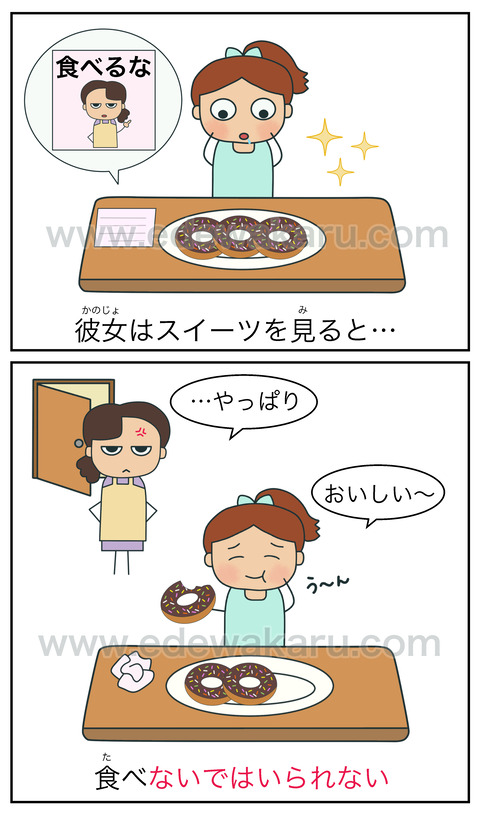
Meaning
我慢できず、自然に〜になってしまう
我慢できなくて、〜してしまう
〜しないでいることはできない
How to use it
動詞[ない形]+ないではいられない
動詞[ない形]+ずにはいられない
Explanation
「〜ないではいられない」は「我慢できずに〜してしまう」「〜しないでいることはできない」という意味を表す文型です。
「〜したい」という気持ちを自分の力では抑えることができなくて、自然に〜してしまう
と言いたい時に使います😊 主語になる人が「我慢できずに〜してしまう」という意味ですので、感情を持つものが使われます。
ほとんどの場合、主語には「人」がきます😮
[例]
①彼女はスイーツを見ると、食べ
ないではいられない
【主語】
彼女
②今日は暑かったので、エアコンをつけ
ないではいられなかった
【主語】
私
③彼の話はおもしろくて、笑わ
ないではいられなかった
よ
【主語】
私
④うちの犬は、人が来ると吠え
ないではいられない
ようだ
【主語】
うちの犬
*犬にも感情があるため、使うことができます😊
(復習:〜ために・〜ためか)
また
「〜ないではいられない」の書き言葉的な言い方は「〜ずにはいられない」です。
[例]
彼女はスイーツを見ると、食べ
ないではいられない
=彼女はスイーツを見ると、食べ
ずにはいられない
「〜ないではいられない」「〜ずにはいられない」は一緒に覚えておきましょう😉
In context 5 examples
彼女はスイーツを見ると、食べないではいられない
→彼女はスイーツを見ると、我慢できず食べてしまう(復習:「スイーツ」と「デザート」)今日は暑かったので、エアコンをつけないではいられなかった
→今日は暑かったので、我慢できずにエアコンをつけてしまった(復習:エアコン)彼の話はおもしろくて、笑わないではいられなかったよ
→彼の話はおもしろくて、我慢できずに笑ってしまったよあの本を読んだら、泣かないではいられない
→あの本を読んだら、泣かないでいることはできない「口が軽い人」とは、何でも人に話さないではいられない人のことです
→「口が軽い人」とは、我慢できずに何でも人に話してしまう人のことです(復習:〜とは(定義・説明))(復習:口が軽い)
Usage 2
Read this source entry ↗Meaning
我慢できず、自然に〜になってしまう
我慢できなくて、〜してしまう
〜しないでいることはできない
How to use it
動詞[ない形]+ないではいられない
動詞[ない形]+ずにはいられない
Explanation
「〜ないではいられない」は「我慢できずに〜してしまう」「〜しないでいることはできない」という意味を表す文型です。
「〜したい」という気持ちを自分の力では抑えることができなくて、自然に〜してしまう
と言いたい時に使います😊 主語になる人が「我慢できずに〜してしまう」という意味ですので、感情を持つものが使われます。
ほとんどの場合、主語には「人」がきます😮
[例]
①彼女はスイーツを見ると、食べ
ないではいられない
【主語】
彼女
②今日は暑かったので、エアコンをつけ
ないではいられなかった
【主語】
私
③彼の話はおもしろくて、笑わ
ないではいられなかった
よ
【主語】
私
④うちの犬は、人が来ると吠え
ないではいられない
ようだ
【主語】
うちの犬
*犬にも感情があるため、使うことができます😊
(復習:〜ために・〜ためか)
また
「〜ないではいられない」の書き言葉的な言い方は「〜ずにはいられない」です。
[例]
彼女はスイーツを見ると、食べ
ないではいられない
=彼女はスイーツを見ると、食べ
ずにはいられない
「〜ないではいられない」「〜ずにはいられない」は一緒に覚えておきましょう😉
In context 5 examples
彼女はスイーツを見ると、食べないではいられない
→彼女はスイーツを見ると、我慢できず食べてしまう(復習:「スイーツ」と「デザート」)今日は暑かったので、エアコンをつけないではいられなかった
→今日は暑かったので、我慢できずにエアコンをつけてしまった(復習:エアコン)彼の話はおもしろくて、笑わないではいられなかったよ
→彼の話はおもしろくて、我慢できずに笑ってしまったよあの本を読んだら、泣かないではいられない
→あの本を読んだら、泣かないでいることはできない「口が軽い人」とは、何でも人に話さないではいられない人のことです
→「口が軽い人」とは、我慢できずに何でも人に話してしまう人のことです(復習:〜とは(定義・説明))(復習:口が軽い)
日本語文型辞典
Meaning
基本情報V-ないではいられない説明動詞の否定形に続いて、意志の力では押さえることができないで自然にそうしてしまうという意味を表す。「泣く」「思う」「感動する」など、人間の行為や思考・感情の動きを表す動詞が用いられる。話し手がそれを「もっともだ」ととらえている含みがある。書きことばでは「…せずにはいられない」ともなる。例文① こんな悲しい話を聞いたら、泣かないではいられない。② 言わないほうがよいことは分かっているが、話さないではいられなかった。③ あの映画を見たら、誰だって感動しないではいられないだろう。④ 子供のことでは、日々悩まされないではいられない。
日本語文型辞典 英語版
Meaning
【ないではいられない】[V-ないではいられない]
This pattern attaches to the negative form of a verb and expresses the meaning that the subject cannot control him/herself by force of will but rather does something spontaneously, in spite of him/herself. Verbs that refer to a person’s actions or a change in someone’s thoughts or feelings are used, such as 泣く (cry), 思う (think) and 感動する (be impressed/moved by). This pattern implies that the speaker views the spontaneous response as natural. In written language, ...せずにはいられない can be used instead.
In context 4 examples
こんな悲しい話を聞いたら、泣かないではいられない。
I can’t help but cry when I hear such a tragic story.
言わないほうがよいことは分かっているが、話さないではいられなかった。
I know I shouldn’t have said anything, but I couldn’t help talking about it.
あの映画を見たら、誰だって感動しないではいられないだろう。
Anyone who sees that movie can’t help but be impressed by it.
子供のことでは、日々悩まされないではいられない。
I can’t stop worrying about my child every single day.
IMABI
Can’t Help I
Read this IMABI lesson ↗Explanation
Can’t Help I: ~ないではいられない
Double negative expressions seem to cause confusion for Japanese learners. Especially if these learners come from language backgrounds that include languages where these kind of expressions still yield negative meaning, it’s not surprising that phrases like ~ないではいられない would cause problems.
It’s also not helpful that some textbooks call certain adverbs “negative” when it’s just a matter of semantics. In this lesson, you will learn about ~ないではいられない by knowing not only what it means, but also what it is similar to and how it is different.
~ないではいられない
At a basic understanding, ~ないではいられない means “cannot help but…”. This translation, however, makes it seem a whole lot like ~てしまう.It also looks vaguely similar to ~なければならない and happens to also mean something similar. Consider the following errors.
1a. 期末試験があるので、今晩勉強しないではいられない。X
1b. 期末試験があるので、今晩勉強しなければならない。〇
Intended: Since I have a final exam, I have to study tonight.
2a. その赤ちゃんの笑顔を見ると、笑わないではいられなくなる。X
2b. その赤ちゃんの笑顔を見ると、自然と笑ってしまう。〇
Intended: When(ever) I see that baby’s smiling face, I cannot help but laugh.
If you couldn’t figure out why the first wording was wrong, we’ll reexamine them later as to why they’re wrong after we go through some facts about ~ないではいられない.
Conjugation and Variants
This pattern can also be seen as ~ずにはいられない, which is more literary. ~ず is an old negative ending. Like other negative endings, it attaches to the 未然形. As it is old, it attaches to the old 未然形 of する, せ-. Thus, you get せずにはいられない, and not しずにはいられない.
Class 例 ~ないではいられない ~ずにはいられない (書き言葉的)
一段 感じる 感じないではいられない 感じずにはいられない
感ぜずにはいられない (古風)
一段 食べる 食べないではいられない 食べずにはいられない
五段 泣く 泣かないではいられない 泣かずにはいられない
五段 思う 思わないではいられない 思わずにはいられない
カ変 来る 来ないではいられない 来ずにはいられない
サ変 する しないではいられない せずにはいられない
Defining
Now, what does ~ずにはいられない really mean? Consider the following.
~ずにはいられない: This expression shows the speaker’s feeling of ending up doing something without being able to restrain one’s willpower. So, it cannot be used with things that are deemed to be spontaneous. The situation must be one where you should have willful control over, but you succumb to something. This, though, doesn’t have to always be used in a negative fashion, because it’s often the case that the situation is good.
3. 会社でいやなことがあって、飲ま{ないで・ずに}はいられなかったんだ。
Bad things happened at the company, and so I couldn’t help but drink.
4. ダイエット中でも食べずにはいられない。
I can’t help but eat even during a diet.
5. 僕の彼女に勧められれば、買わないではいられないよ。
If I’m recommended to by my girlfriend, I can’t help but buy it.
More Notes
This phrase, as the last example shows, is often used with conditionals. Remember that when talking about a third person, speech modals like ~だろう and ~ようだ become necessary. This pattern is also frequently used after clauses that establish a reason as for why “one cannot help but…”. Although earlier it was noted that this does not necessarily have to be used in a negative light, it still can be.
6. その話を聞いたら、いくらやさしい彼女でも怒らずにはいられないだろう。
Even such a nice person like her wouldn’t probably be able to help but be angry if she heard that story.
7. そのニュースに対して疑問を抱かずにはいられませんでした。
I couldn’t help but hold doubts in regards to that news.
This expression is frequently used with verbs of action, emotion, and thought. As this pattern indicates a slipping of willful control to letting go in doing such action, it is frequently used with adverbs such as どうしても, なぜか, つい, etc.
8. 僕は黙ってたほうがええと思ったが、どうしても一言言わないではいられんかった。(Casual)
I thought that it would be best to just stay quiet, but I couldn’t help but say something.
This pattern is similar to ~てしまう in that both show a sense of accidentally doing something, but if something is felt to spontaneously/physiologically occur, ~てしまう remains grammatical while ~ないではいられない does not.
9a. 嬉しくて買わないではいられなかった。X
9b. 嬉しくて買ってしまった。
I was happy and ended up/accidentally bought it.
Mixing this phrase up with ~なければならない is not acceptable. The literal translation of such a mistake doesn’t even make much sense in English, that is unless you’re purposely being humorous, which in that case humor often breaks grammatical rules regardless of language.
10. 笑わないではいられません。
I can’t help but laugh.
11. おかしくて笑わないではいられない。
I couldn’t help but laugh because it was funny.
Sentence Note: Although the first sentence in this lesson with 笑う was marked wrong, with context that implies the willful effort of trying to withhold laughter, this pattern can be used. Remember that with this pattern you can’t restrain oneself from doing something, so there has to be some sense that you gave up trying.
More Examples
12. 会わないではいられなかった。
I couldn’t help but see her.
13. 泣かないではいられませんでした。
I couldn’t help but cry.
14. お酒を飲まないではいられない。
I can’t help but drink sake.
15. サービスが悪いと、一言文句を言わないではいられない。
When the service is bad, I can’t help but complain a bit.
16. 単純な質問を見ると、答えずにはいられないよ。
When I see a simple question, I can’t help but answer it.
17. 何かできることを手伝わないではいられなかった。
I couldn’t help but do what I could.
18. この本を読み始めたら、終りまで読まないではいられませんでした。
When I started reading this book, I couldn’t help but read it until the end.
19. 私は困っ{た・ている}人を見ると、声をかけないではいられません。
When I see someone in distress, I can’t help but call to them.
20. 私は困っ{た・ている}人を見ると、助けないではいられません。
When I see someone in distress, I can’t help but help them.
21. 当選とうせんしたからって喜よろこんではいられない。
I can’t be so happy just because I got elected.
Grammar Note: When you do not make this phrase a double negative, you change the translation as seen in the example above to “can’t be..”.
Curriculum Note: We will return to similar expressions dealing with restraint of various sorts later in IMABI.
~ざるを得ない VS ~ないではいられない
~ざるを得ない is very similar, but the speaker has more control in the fact that they feel an obligation to do something, but obligation itself is not all there has to be for someone to actually do something. Thus, the speaker still has some control, howbeit very little.
22. 酔っ払いに注意しないではいられなかった。
I couldn’t help but pay attention to the drunks.
23. 酔っ払いに注意せざるを得なかった。
I had no choice but to pay attention to the drunks.
In context 26 examples
期末試験があるので、今晩勉強しないではいられない。X
Intended: Since I have a final exam, I have to study tonight.
期末試験があるので、今晩勉強しなければならない。〇
Intended: Since I have a final exam, I have to study tonight.
その赤ちゃんの笑顔を見ると、笑わないではいられなくなる。X
Intended: When(ever) I see that baby’s smiling face, I cannot help but laugh.
その赤ちゃんの笑顔を見ると、自然と笑ってしまう。〇
Intended: When(ever) I see that baby’s smiling face, I cannot help but laugh.
会社でいやなことがあって、飲ま{ないで・ずに}はいられなかったんだ。
Bad things happened at the company, and so I couldn’t help but drink.
ダイエット中でも食べずにはいられない。
I can’t help but eat even during a diet.
僕の彼女に勧められれば、買わないではいられないよ。
If I’m recommended to by my girlfriend, I can’t help but buy it.
その話を聞いたら、いくらやさしい彼女でも怒らずにはいられないだろう。
Even such a nice person like her wouldn’t probably be able to help but be angry if she heard that story.
そのニュースに対して疑問を抱かずにはいられませんでした。
I couldn’t help but hold doubts in regards to that news.
僕は黙ってたほうがええと思ったが、どうしても一言言わないではいられんかった。(Casual)
I thought that it would be best to just stay quiet, but I couldn’t help but say something.
嬉しくて買わないではいられなかった。X
I was happy and ended up/accidentally bought it.
嬉しくて買ってしまった。
I was happy and ended up/accidentally bought it.
笑わないではいられません。
I can’t help but laugh.
おかしくて笑わないではいられない。
I couldn’t help but laugh because it was funny.
会わないではいられなかった。
I couldn’t help but see her.
泣かないではいられませんでした。
I couldn’t help but cry.
お酒を飲まないではいられない。
I can’t help but drink sake.
サービスが悪いと、一言文句を言わないではいられない。
When the service is bad, I can’t help but complain a bit.
単純な質問を見ると、答えずにはいられないよ。
When I see a simple question, I can’t help but answer it.
何かできることを手伝わないではいられなかった。
I couldn’t help but do what I could.
この本を読み始めたら、終りまで読まないではいられませんでした。
When I started reading this book, I couldn’t help but read it until the end.
私は困っ{た・ている}人を見ると、声をかけないではいられません。
When I see someone in distress, I can’t help but call to them.
私は困っ{た・ている}人を見ると、助けないではいられません。
When I see someone in distress, I can’t help but help them.
当選とうせんしたからって喜よろこんではいられない。
I can’t be so happy just because I got elected.
酔っ払いに注意しないではいられなかった。
I couldn’t help but pay attention to the drunks.
酔っ払いに注意せざるを得なかった。
I had no choice but to pay attention to the drunks.