Bunpro Grammar Reference
Meaning
Despite, In spite of, Regardless, Nevertheless
How to use it
Verb + にもかかわらず
[い]Adjective + にもかかわらず
[な]Adjective + である + にもかかわらず
Noun + (である)+ にもかかわらず
Nuance
A somewhat formal phrase highlighting that regardless of (A), (B). Without fixating on (A), (B).
Explanation
にもかかわらず is a formal grammar structure in Japanese used to convey that something is 'in spite of (A)', or 'despite (A)'. This pattern is a combination of に, も, the う-Verb 拘わる 'to fixate on', or 'to stick to', and the literary auxiliary verb ず, which connects with verbs in the same way, and carries the same meaning as ない.
This structure is most frequently seen connected to verbs, い-Adjectives and nouns in their standard forms. In most cases, this pattern will appear without kanji.
浜崎さんは毎日一生懸命働いていたのにもかかわらず、会社をクビになった。
Despite working hard every day, Hamasaki-san was fired by the company.
彼が悪いのにもかかわらず、私に謝らせようとしてきた。
Despite him being in the wrong, he tried to make me apologize.
田中さんは優しくて親切であるにもかかわらず、見た目が怖いから田中さんのことをよく知らない人からは怖がられて避けられている。
Despite Tanaka-san being kind and helpful, he's feared and avoided by those who don't know him well because of his scary appearance.
深夜にもかかわらず上司が鬼電をしてきたので、労基に報告しようと思う。
Despite being late at night, my boss blew up my phone, so I'm thinking of reporting it to the labor standards inspection office.
Literally, this phrase can be thought of as expressing 'without being affected by (A), (B)', or 'without fixating on (A), (B)'. However, it is almost always used in exactly the same way as のに 'despite'.
Caution
It is important not to get にも拘わらず mixed up with に関わらず. The former expresses 'despite', while the latter tends to be used more often for 'no matter if'.
お客さんが来ることを知っていたにもかかわらず、部屋の掃除をしていなかったので息子を叱った。
Despite knowing that we were going to have guests over, my son did not clean his room so I scolded him.
お客さんが来るかどうかに関わらず、部屋は綺麗にしておいてください。
Please keep your room clean no matter if guests are coming or not.
Nuance · 日本語
(A)であっても、(B)だということを強調する少し丁寧な表現。(A)を凝視せずに(B)。
Explanation · 日本語
「にもかかわらず」は日本語の硬い文型で「(A) のに」という意味を表します。この表現は「に」と「も」、五段動詞「拘わる」(意味:関係する)、そして文語助動詞「ず」(意味:ない)の組み合わせでできています。
この表現は普通形の動詞、イ形容詞、そして名詞と組み合わせて使われることが多く、ほとんどの場合、ひらがなで書かれます。
浜崎さんは毎日一生懸命働いていたのにもかかわらず、会社をクビになった。
Despite working hard every day, Hamasaki-san was fired by the company.
彼が悪いのにもかかわらず、私に謝らせようとしてきた。
Despite him being in the wrong, he tried to make me apologize.
田中さんは優しくて親切であるにもかかわらず、見た目が怖いから田中さんのことをよく知らない人からは怖がられて避けられている。
Despite Tanaka-san being kind and helpful, he's feared and avoided by those who don't know him well because of his scary appearance.
深夜にもかかわらず上司が鬼電をしてきたので、労基に報告しようと思う。
Despite being late at night, my boss blew up my phone, so I'm thinking of reporting it to the labor standards inspection office.
この表現は文字通りには「(A) の影響を受けずに (B)」のような意味を表すと考えることもできますが、実際には「のに」とほぼ同じ逆説的な意味で使われます。
注意点
「にも拘わらず」と「に関わらず」を混同しないように気をつけましょう!前者は (B) が (A) から予想された内容と異なる場合に使われますが、後者はただ (A) と (B) の間に関係がないことを表します。
お客さんが来ることを知っていたにもかかわらず、部屋の掃除をしていなかったので息子を叱った。
Despite knowing that we were going to have guests over, my son did not clean his room so I scolded him.
お客さんが来るかどうかに関わらず、部屋は綺麗にしておいてください。
Please keep your room clean no matter if guests are coming or not.
In context 18 examples
- 勘違いしたにもかかわらず、彼は一切謝らない。
Even though he made a mistake, he will never apologize.
- 深夜にもかかわらず上司が鬼電をしてきたので、労基に報告しようと思う。
Despite being late at night, my boss blew up my phone, so I'm thinking of reporting it to the labor standards inspection office.
- 浜崎さんは毎日一生懸命働いていたのにもかかわらず、会社をクビになった。
Despite working hard every day, Hamasaki-san was fired by the company.
- 彼が悪いのにもかかわらず、私に謝らせようとしてきた。
Despite him being in the wrong, he tried to make me apologize.
- 田中さんは優しくて親切であるにもかかわらず、見た目が怖いから田中さんのことをよく知らない人からは怖がられて避けられている。
Despite Tanaka-san being kind and helpful, he's feared and avoided by those who don't know him well because of his scary appearance.
- あんなにかわいがったにもかかわらず、裏切られるなんて…
Despite showing them that much adoration, (who would have thought) that they would betray us...
- 間隔があいたにもかかわらず、相変わらずいいプレーをしますね。
Even though a space opened, they made a nice play, like usual.
- 乾燥しているにもかかわらず加湿しないから、喉をやられた。
Since I didn't run the humidifier regardless of it being dry, my voice got hoarse.
- 喉が渇いているにもかかわらず、飲み物を与えないのは虐待だ。
Despite them being thirsty, not giving them anything to drink is cruel.
- 物理の授業:「この物体は小さいにもかかわらず、真空では大きい物体と同じ速度で落下します。」
Physics class: 'Despite being small, in a vacuum this object falls at the same speed as a large object.'
- カロリーが高いにもかかわらず、甘いものを毎日たくさん食べてしまう...
Even though they are high in calories, I unfortunately eat a lot of sweets every day...
- オデュッセウスは多数の危険にもかかわらず、大変な努力の結果、ついに彼の国に帰ることができた。
Despite numerous dangers, Odysseus was able to finally return to his country as a result of his great efforts.
- 農民が一生懸命に働いていたにもかかわらず、悪天候のせいで、作物の収穫が少なかった。
Despite the farmers giving it their all, due to the bad weather, there was a low harvest of crops.
- 古代ローマ時代、ガリアはローマによって征服されたにもかかわらず、ある小さな村はなおも戦い続けた。
In Ancient Roman times, despite Gaul being conquered by Rome, a certain small village was still fighting.
- 熊は重いにもかかわらず、速く走れたり、木に登れたりするので、危険な動物だ。本物を見かけたら、じっとして驚かさないでください。
Despite being heavy, since bears run fast, climb trees, and more, they are dangerous animals. If you happen to see one, stand still and do not surprise them.
- 単独の無名の英雄は満身創痍(傷だらけ)だった。それにもかかわらず、気力のみで、像のように立った。素晴らしい景色だったと思う。
A sole, nameless hero was wounded all over. Nevertheless, by sheer force of will, he remained standing like a statue. It was quite a beautiful sight.
- お客さんが来ることを知っていたにもかかわらず、部屋の掃除をしていなかったので息子を叱った。
Despite knowing that we were going to have guests over, my son did not clean his room so I scolded him.
- お客さんが来るかどうかに関わらず、部屋は綺麗にしておいてください。
Please keep your room clean no matter if guests are coming or not.
DoJG 日本語文法辞典(全集)
Meaning
Although; though; in spite of; despite; notwithstanding; nevertheless
How to use it
(i) Noun {Ø/なの/である(の)/だった(の)/であった(の)} | にもかかわらず | |
| 先生{Ø/なの/である(の)/だった(の)/であった(の)}にもかかわらず | In spite of being/having been a teacher |
(ii) Vinformal (の) | にもかかわらず | |
| {勉強する/勉強した}(の) にもかかわらず | In spite of studying/having studied |
(iii) Adjective い informal (の) | にもかかわらず | |
| {つまらない/つまらなかった}(の) にもかかわらず | Although something is/was boring |
(iv) Adjective な stem{なの/である(の)/だった(の)/であった(の)} | にもかかわらず | |
| 元気{なの/である(の)/だった(の)/であった(の)}にもかかわらず | Although someone is/was healthy |
In context 12 examples
懸命な努力にもかかわらず、健一は大学入試に失敗した。
In spite of his strenuous efforts, Ken'ichi failed the college entrance examination.
あの人はよく運動をする(の)にもかかわらず、太っている。
He is fat, although he exercises a lot.
試験が難しかった(の)にもかかわらず、よく出来た。
Although the exam was hard, I did well.
冬山は危険なのである(の)にもかかわらず、一郎は山へ出かけた。
Although winter mountains are dangerous, Ichiro left for the mountain.
激しい雨(だった)にもかかわらず、サッカーの試合は続いた。
In spite of the fierce rain, the soccer game continued.
安い値段(なの・である)にもかかわらず、その家はまだ売れていない。
Despite the inexpensive price, that house is not sold yet.
宏は美香を愛していた(の)にもかかわらず、結婚しなかった。
In spite of the fact that Hiroshi loved Mika, he didn't marry her.
昨日は徹夜して勉強した(の)にもかかわらず、試験は出来なかった。
Although I studied all night last night, I didn't do well on the exam.
キャロルは日本に三年も住んでいた(の)にもかかわらず、日本語は大変下手だ。
Although Carol lived in Japan for three years, her Japanese is very poor.
日本語経済力は強くなっている(の)にもかかわらず、日本人はそれを実感出来ない。
In spite of the fact that the Japanese economy has become strong, the Japanese people cannot feel the effects.
私のアパートは広い(の)にもかかわらず、家賃が安い。
My apartment is spacious, but the rent is cheap.
旅行が好き(なの・である(の))にもかかわらず、どこに行く暇もない。
I like to travel, but I don't have time to go anywhere.
どんなときどう使う 日本語表現文型辞典
Meaning
even though
How to use it
N/〔普通形〕(ナAである/Nである)+にもかかわらず
Explanation
~のに
1)「~にもかかわらず、…」の形で、「~の事態から予想されることとは違った『…』という結果になる」、と言いたいときの表現。「…」で話者の驚き・意外・不満・非難などの気持ちを表す文が多い。
2) ❷ は会などでのあいさつの言い方。
1)Outcome is contrary to expectations. Often what follows is speaker's surprise or feelings of unexpectedness, dissatisfaction, or criticism.
2)Sentence ❷ used as salutation in meetings.
In context 3 examples
耳が不自由というハンディキャップがあるにもかかわらず、彼は優秀な成績で大学を卒業した。
本日は雨にもかかわらず大勢の方々がお集まりくださって、本当にありがとうございました。
あれだけ多くの人がいたにもかかわらず、犯人の顔を見た人は一人もいなかった。
絵でわかる日本語
Meaning
〜のに
How to use it
動詞・形容詞・名詞[普通形]+にもかかわらず
Explanation
「〜にもかかわらず」は「〜のに」という意味を表す文型です。「〜のような状態なのに〜」というように、
「予想と違う!」
という話し手の
【驚き】【不満】【失望】
などの気持ちを表します。
(復習:〜など・〜なんか・〜なんて)
[例]
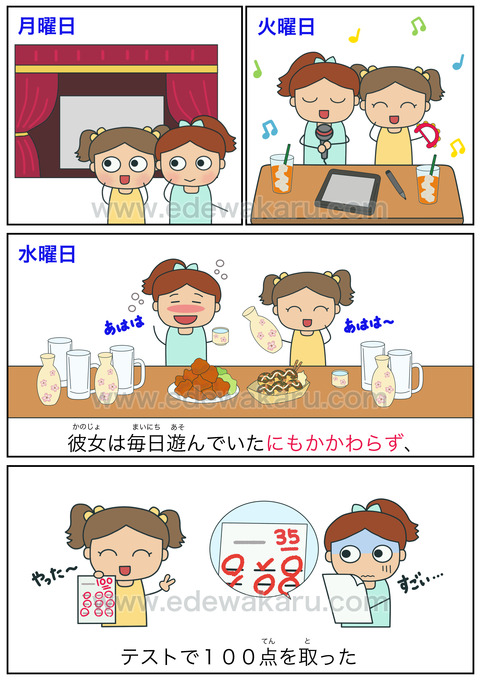
①彼女は毎日遊んでいた
にもかかわらず、テストで100点を取った
【予想】毎日遊んでいたから、テストではいい点が取れないだろう
→毎日遊んでいた
のに、テストで100点を取った
②15年もアメリカに住んでいる
にもかかわらず、あまり英語が話せない
【予想】15年も住んでいるから、普通は英語がペラペラになるはずだ
→15年も住んでいる
のに、あまり英語が話せない
(復習:〜はずだ)
③毎日がんばって勉強した
にもかかわらず、試験に合格することができなかった
【予想】毎日がんばったから、合格するだろう
→毎日がんばった
のに、合格できなかった
④あの人は雨が降っている
にもかかわらず、傘をささずに歩いている
【予想】雨が降っているから、傘をさすはずだ
→雨が降っている
のに、傘をささずに歩いている
⑤あそこのラーメンはおいしくない
にもかかわらず、いつもお客さんがたくさん並んでいる
【予想】おいしくないから、お客さんは来ないだろう
→おいしくない
のに、いつもお客さんがたくさん来る
【余裕のある人へ】
「〜にもかかわらず」は、文の始めに使うこともできます😮
[例]
彼女は毎日遊んでいた
にもかかわらず、テストで100点を取った
=彼女は毎日遊んでいた。
にもかかわらず、テストで100点を取った
「〜にもかかわらず」は日常会話(にちじょうかいわ)で使われることはあまりありませんが、N2以上を受ける人はしっかりと覚えておきましょう😀また
「〜にかかわらず」
は形が似ていますが、意味は全く違いますので区別をしておきましょう。
In context 5 examples
彼女は毎日遊んでいたにもかかわらず、テストで100点を取った
15年もアメリカに住んでいるにもかかわらず、あまり英語が話せない(復習:〜も(数量詞+も))(復習:〜ている(結果の状態))(復習:あまり〜ない)
がんばって勉強したにもかかわらず、試験に合格することができなかった(復習:〜ことができる(能力))
あの人は雨が降っているにもかかわらず、傘をささずに歩いている(復習:〜ずに)(復習:〜ている(進行中))
あそこのラーメンはおいしくないにもかかわらず、いつもお客さんがたくさん並んでいる(復習:並ぶ・並べる)
日本語文型辞典
Meaning
基本情報N/A/V にもかかわらずNaであるにもかかわらず説明「そのような事態であるのに」という意味を表す。後ろには、そのような事態なら当然予測できることと食い違った事態を表す表現が続く。次のように文のはじめに使うこともできる。例文① 悪条件にもかかわらず、無事登頂に成功した。② 母が止めたにもかかわらず、息子は出かけていった。③ あれだけ努力したにもかかわらず、すべて失敗に終わってしまった。④ 規則で禁止されているにもかかわらず、彼はバイクで通学した。例文(例) 危険な場所だと十分注意されていた。にもかかわらず、軽装で出かけて遭難するはめになった。
日本語文型辞典 英語版
Meaning
【にもかかわらず】[N/A/V にもかかわらず][Na であるにもかかわらず]
Means “in spite of such-and-such a situation.” Followed by a clause that expresses a situation quite different from what would normally be expected to occur from the situation described in the preceding clause. Can also be used at the beginning of a sentence, as below.
(例)危険な場所だと十分注意されていた。にもかかわらず、軽装で出かけて遭難するはめになった。
I was amply warned that it was a dangerous place. Nevertheless, I went out in light clothing and ended up getting lost.
In context 4 examples
悪条件にもかかわらず、無事登頂に成功した。
Despite the unfavorable conditions, she safely made a successful ascent of the mountain.
母が止めたにもかかわらず、息子は出かけていった。
Although his mother tried to stop him, the son went out.
あれだけ努力したにもかかわらず、すべて失敗に終わってしまった。
Even though I tried so hard, it all ended in failure.
規則で禁止されているにもかかわらず、彼はバイクで通学した。
Despite the fact that it is against the rules, he went to school by motorbike.
くらべてわかる日本語表現文型辞典
Meaning
Aという行為・状態から当然予想・期待された結果にならずBとなった。結果Bは、Aという行為・状態に影響を受けない、左右されない。話し手の残念・意外などの感情を表す表現。
How to use it
AにもかかわらずB
[動詞]にもかかわらず
[イ形-普]にもかかわらず
[ナ形-である/だった/ではない]+(の)+にもかかわらず
[名詞-∅/である/ではない/だった]にもかかわらず
Explanation
【対比1】
「AもののB(AとはいうもののB)」(意味1 P.312)
「AとはいうもののB」は、表面的にはAだが実際はBという表現にも使える。「AにもかかわらずB」は、A・Bともに事実である。
○自信があるとはいうものの、内心不安だった。
×自信があるにもかかわらず、内心不安だった。
「AのにB」
残念・意外などの感情を表す面では同じであるが、「AのにB」は会話で多く使われ、「Aのに…」とBが省略される形でもあらわれる。
○いやなくせに、ことわればいいのに…。
×いやなくせに、ことわればいいにもかかわらず…。
「AとはいえB」(意味1 P.184)
「AにかかわらずB」(意味2 P.218)
「AあげくB」(意味2 P.27)
「AもかまわずB」(意味1 P.300)
Notes
【注意1】
・「A。にもかかわらずB。」は接続表現である。
In context 4 examples
勉強したにもかかわらず、点数は悪かった。
彼は熱があるにもかかわらず、無理して会社に出てきた。
あの店は他の店より値段が高いにもかかわらず、いつも客で満員だ。
息子は進学を望んでいた。にもかかわらず、私はその願いをかなえてやることができなかった。
日本語NET JLPT文法解説まとめ
Meaning
"〜のに"
予想と違ったことに対する、話し手の驚き・不満・非難などの気持ちを表す。
How to use it
普通形 + にもかかわらず
Explanation
"in spite of"
Expresses the speaker's feelings of surprise, dissatisfaction, or criticism towards something that turned out differently from what was expected.
漢字で書くと「にも拘らず」
In context 12 examples
友達のトムさんは10年以上、日本に住んでいるにもかかわらず、全く日本が話せない。
一生懸命勉強したにもかかわらず、行きたかった大学の試験に落ちてしまった。
大型の台風が近くにきているにもかかわらず、会社は休みにならなかった。
彼は全く英語が話せないにもかかわらず、海外で生活したいと言っている。
田中さんのおじいさんは90歳にもかかわらず、毎日5km走るほど元気だ。
イベントは雨にもかかわらず、多くの人が集まった。
必死に説得したにもかかわらず、彼は会社を辞めてしまった。
校則で禁止されているにもかかわらず、授業中にスマホを使う学生が多い。
あまり勉強しなかったにもかかわらず、テストの成績はよかった。
彼は外国人であるにもかかわらず、僕よりも日本に詳しい。
彼は日本語が上手であるにもかかわらず、日本人と話す時はいつも英語を使う。
努力したにもかかわらず、うまくいかなかった。
毎日のんびり日本語教師
How to use it
名詞+(である)にもかかわらず
な形容詞語幹+(である)にもかかわらず
い形容詞普通形+にもかかわらず
動詞普通形+にもかかわらず
Explanation
逆接の文型です。
後件には既に発生した予想外の事態が述べられます。
「にもかかわらず」「それにもかかわらず」は接続詞として単独で使えます。
Notes
「関わる」シリーズ
In context 8 examples
彼は勤務時間にもかかわらず漫画を読んでいる。
このキャラクターは作品中にあまり登場しないのにもかかわらず、ファンから人気がある。
業務に大きな支障が出ている。にもかかわらず、社内では問題にもなっていない。
雨にもかかわらず来ていただいた皆さんに感謝申し上げます。
政府が数か月前からマスク増産を要請している。それにもかかわらず品薄は一向に解消されていない。
ダイエット中にもかかわらずケーキを食べてしまった。
この辺りは近年住民が増えている地域にもかかわらず、スーパーが少ない。
挨拶したにもかかわらず無視された。
IMABI
Disregard I
Read this IMABI lesson ↗Explanation
Disregard I: にもかかわらず, にかかわらず, & を問わず
In this lesson, we will begin coverage on phrases that all translate as “despite” and “regardless.” However, they each have their own nuances and restrictions. They are testaments to synonyms not being the same. Pay close attention to the kinds of words that these phrases are used with. This does not simply mean noticing whether they are used with nouns, particles, etc. but more so what kinds of nouns, what sort of particles, etc. are they used with. Semantic categorization of the things that come before these phrases ultimately determine the grammaticality of the sentences they are found in.
にもかかわらず
The phrase にもかかわらず derives from the verb 関(わ)る・拘(わ)る. The first spelling indicates as a meaning of “to be concerned with” and the second spelling indicates as a meaning of “to be held back by…” Inherently, the latter spelling denotes a negative connotation. When used in the form, にもかかわらず, we get an expression that means “although/despite X…” This can be used to indicate that an action/state Y is done/happens despite “X.” Or, the speaker is not constrained by “X” and Y, thus, can take place. Let’s look at a few examples.
Particle Note: The use of the particle も adds an emphatic tone that may express surprise, frustration, criticism, unpredictability, and various other emotions depending on the context.
1. 妊娠にんしんしているにもかかわらず、検査結果けんさけっかが陰性いんせいとなることがあります。
There are times when has a negative test result despite being pregnant.
In this example, the issue at hand is that pregnancy tests are not always accurate. Even when a woman gets a negative test result, she may still be pregnant. Therefore, despite “X” being the case, in which case the respected result is that the woman receives a positive reading, “Y” happens: she gets a negative reading.
As far as spelling is concerned, にもかかわらず is almost always not written in 漢字. If, however, it were in this situation 拘わらず would not be the appropriate spelling as it isn’t the case that situation Y involves a subject purposefully defying a restraining “X” circumstance. Thus, 関わる would be the more sensible spelling; however, in reality, this spelling is not used much in everyday writing. This is because かかわらず, in particular, was not given an authorized 漢字 spelling during language reform when the 常用漢字 list was made. Although this list’s influence is diminishing, its effects are still felt in the typical spelling of many phrases such as this one.
2. 雨あめが降ふっているにもかかわらず、皇居前こうきょまえにはたくさんの人々ひとびとが集あつまりました。
Many people gathered in front of the Imperial Palace despite it raining.
In this example, にもかかわらず demonstrates that “despite” the rain not stopping, in other words, despite situation X not changing, situation Y—people gathering in front of the Imperial Palace—remained constant. As far as we can glance from this single sentence, the people gathered didn’t just disperse because of the rain. Both situations, X and Y, didn’t change yet. This is the relationship that にもかかわらず verbalizes. It also demonstrates that the people gathered don’t view the rain as an issue to be grappled with or a something that’s even in consideration for them to appear at the Imperial Palace. Whatever is happening there is what’s truly important to these people.
3. 弟おとうとは深夜しんやにもかかわらず、ゲームに夢中むちゅうです。
My little brother is engrossed in his games regardless if it’s late at night.
Another means of interpreting にもかかわらず is that situation Y is contrary to what one would otherwise anticipate. The ‘natural prediction’ is situation Z, which isn’t the case. In lieu of Ex. 3, situation X would be the fact that it is late at night. Situation Y is the speaker’s little brother being engrossed in a game. Situation Z is the little brother sleeping instead, like a presumably younger child should be doing at that time of night. The observation here is that “despite X (being late in the night) otherwise leading to Z (sleeping at night like a young child should), Y (being engrossed in a game) happens instead.”
4. 結構有名けっこうゆうめいなのにもかかわらず、まだ流行はやっていないのが不思議ふしぎなくらいです。
It’s odd that it still hasn’t become popular despite being quite famous.
Most instances of にもかかわらず involve an active agent in situation Y. Even when one isn’t explicitly obvious, one is always implied. For instance, in Ex. 4, it takes people to determine the popularity of something. Similarly, in Ex. 5, it takes people to buy an expensive item for it be a hot seller.
5. 結構値段けっこうねだんが高たかいにもかかわらず、大変たいへんなヒット商品しょうひんになりました。
It’s become an incredible hot seller despite it being quite expensive.
Although にもかかわらず isn’t used as much in the spoken language as it is in the written language, it is still easily incorporated into everyday conversation.
6. 電車でんしゃに乗のっててちゃんと起おきてるにもかかわらず降おりる駅えきを通とおり過かぎてしまうことしょっちゅうですよ。
I frequently pass the station I get off at when I’m riding the train regardless if I’m properly awake.
にもかかわらず doesn’t need to always fall a dependent clause. “X” can simply be それ. In fact, especially in the written language, you may see a sentence start off with にもかかわらず, in which situation X will have been expressed immediately before the sentence.
7. 彼かれには欠点けってんが多おおいが、それにもかかわらず、彼かれと恋こいに落おちてしまった。
He has a lot of faults, but regardless of them, I ended up falling in love with him.
8. こんな霧きりにもかかわらずライトもつけずに走はしってる車くるまいるなんてちょっと信しんじられない。
It’s a little hard to believe that there are cars racing by without their lights on regardless of this kind of fog.
9. 昨日きのうは悪天候あくてんこうにもかかわらずご来店らいてんありがとうございました。
Thank you for visiting our store yesterday despite the bad weather.
10. サービス産業さんぎょうで人手ひとでが不足ふそくしているにもかかわらず、賃金ちんぎんの増加ぞうかは見みられていない。
There are no wage increases being seen despite labor shortages in the service industry.
11. 自分じぶんで言いったにもかかわらず、覚おぼえてないなんて、馬鹿ばかかよ。
How stupid can you be, not remembering despite the fact that you were the one who said it?
12. ここは禁煙きんえんなのにもかかわらず平気へいきで煙草たばこを吸すっている人ひとが多おおい。
There are many people who smoke without batting an eyelid here despite it being nonsmoking.
13. ペット禁止きんしなのにもかかわらず、お隣となりが猫ねこを数匹飼すうひきかってて、しかも家いえの中なかを綺麗きれいにしてないので、暖あたたかくなると、ノミが大量たいりょうに発生はっせいしてしまうんです。
Despite pets being banned, my neighbor(s) have several cats, and since (he/she/they) don’t keep the house clean, whenever it gets warm, there is a major flee outbreak.
Spelling Note: ノミ may seldom be spelled as 蚤.
14. 週末しゅうまつにもかかわらず、迅速じんそくかつ丁寧ていねいなお返事へんじをありがとうございました。
Thank you for the quick and polite response despite it being the weekend.
Grammatically, かかわらず is first and foremost derived from the verb かかわる combined with the negative auxiliary verb ず. In older forms of Japanese, ず stood for ない. At the end of sentences, it would take the form ず. As a participle, it would take the form ぬ. In the sense of ないで, it would take the form ず(に). In Modern Japanese, it survives in many set phrases, proverbs, and the written language, especially in literature. It largely survives, though, in grammar points such as this where it is very much still alive.
One thing that must be understood, however, is that not all phrases that have ず possess the same degree of grammatical capability. For instance, you can’t end a sentence with かかわらず. This is because the phrase has been grammaticalized to only appear mid-sentence in both にもかかわらず and にかかわらず (discussed below).
にかかわらず
にもかかわらず, when written as に関わらず, shows how its literal meaning is to indicate that “X” is not connected to the situation at hand. Therefore, “irrespective of X, Y still stands.” This expression is rather formal and stiff. There is a definitive tone that clearly states that “X” has nothing to do with the situation and that “Y” is the situation at hand.
This expression is frequently used after patterns such as など, かどうか, あるなし, words that indicate multiple values or elements such age, race, etc. as well as words that are composed of antonyms such as 好き嫌い (likes and dislikes) or 有無 (existence or nonexistence/presence or absence). It’s even possible for it to be seen after the doubling of adjectives and verbs without particle intervention (Exs. いい悪いにかかわらず・するしないにかかわらず, etc.).
Due to the lack of the particle も, にかかわらず is far more objective and formal.
15. 電車でんしゃの中なかで、年齢ねんれいにかかわらず、モンストをやってる人ひとって見みたことありますか。
Do you see people on the train irrespective of age playing Monster Strike?
16. 性別せいべつや年齢ねんれい、性的嗜好せいてきしこうなどにかかわらず、自分じぶんらしく暮くらすことができる社会しゃかいを目指めざしましょう。
Let us aim for a society where people can live as themselves irrespective of gender, age, sexual orientation, etc.
17. この企業きぎょうは、国籍こくせきにかかわらず、人材じんざいを採用さいようする意向いこうを示しめしている。
This company shows intention to recruit human resources irrespective of nationality.
18. ここは、学歴がくれきにかかわらず高卒こうそつ、大学院卒者だいがくいんそつしゃも、実質的じっしつてきに同おなじ内容ないようの仕事しごとでキャリアを始はじめるホワイトカラー職場だ。
This place is a white-collar workplace to start a career where, irrespective of education, high school graduates as well as graduate school graduates can start a job with effectively the same content.
19. 親おやが反対はんたいかどうかにかかわらず、僕ぼくは必かならず彼かれと結婚けっこんする!
Regardless if my parents are against it, I will marry my boyfriend!
20. 経験けいけんのあるなしにかかわらず、誰だれでも参加さんかすることができます。
Anyone can participate irrespective of whether or not one has experience.
21. アメリカでも、繊細せんさいで弱よわい男性だんせいは、性的嗜好せいてきしこうにかかわらず、同性愛者どうせいあいしゃだとのレッテルを貼はられてしまうことがよくあるのです。
Even in America, slender, weak men are often labeled as homosexuals irrespective of their sexual orientation.
22. 我々人間われわれにんげんは、好すき嫌きらいにかかわらず目立めだつものを優先的ゆうせんてきに脳のうで認識にんしきしてしまいます。
We as humans preferentially recognize things that stand out in the brain irrespective of our likes and dislikes.
23. 宿泊しゅくはくの有無うむにかかわらず、楽たのしめます。
You can have a good time regardless whether or not you lodge.
24. 症状しょうじょうの有無うむにかかわらず、虫除むしよけ剤ざいを使用しようするなど蚊かに刺さされない対策たいさくを少すくなくとも2に週間しゅうかんは継続けいぞくして行いってください。
Irrespective of the presence or absence of symptoms, please continue undergoing preventive measures from getting bitten by mosquitoes such as using bug spray for at least two weeks.
25. 気温きおんにかかわらず土中温度どちゅうおんどはほぼ一定いっていです。
The temperature in the ground is constant irrespective of air temperature.
26. 猛暑もうしょにかかわらず、エアコンの除湿機能じょしつきのうとシーリングファンで十分じゅうぶんでした。
The dehumidifier function of the air-conditioner and the ceiling fan were sufficient irrespective of the fierce heat.
27. 古新聞や古雑誌ふるざっしなどございましたら、多少たしょうにかかわらずお声こえをおかけください。
If you have any old newspapers or old magazines, please give a shout regardless of the quantity.
28. この路線ろせんバスの料金りょうきんは、乗のった距離きょりにかかわらず、一律いちりつ5ごドルです。
This bus line fare is a flat rate of five dollars regardless of the distance one rides.
29. 症状しょうじょうにかかわらず避さけたい食品添加物しょくひんてんかぶつについて一番下いちばんしたに記載きさいしてあります。
Food additives that you want to avoid regardless of symptoms are detailed at the very bottom.
30. 親おやの経済状況けいざいじょうきょうにかかわらず、子供こどもの生活せいかつや教育機会きょういくきかいが保障ほしょうされる必要ひつようがある。
The livelihood and chance of education for children needs to be assured regardless of the economic state of the parents.
を問わず
を問わず is always used with a noun that has multiple values, elements, etc. attributed to it. For instance, 四季 means “the four seasons,” and as is obvious from the word itself, there are four individual elements it refers to: spring, summer, fall, and winter. The purpose of を問わず is to demonstrate that the different elements/values at hand are not being considered and/or made into issues. In other words, situation Y is not limited to situation (restraint) X.
This pattern is not used with other grammatical items like にかかわらず is. In other words, you won’t see it with など, doubling of adjectives like in 高い安いにかかわらず, or the doubling of verbs like in するしないにかかわらず. Some speakers will use it with かどうか, but the noun before かどうか must be one that implies two or more elements for it to be grammatically passible.
31. この公園こうえんは四季しきを問とわず、綺麗きれいな花はなを咲さかせ、大勢たいせいの観光客かんこうきゃくを楽たのしませてくれます。
This park, regardless of the seasons, blooms beautiful flowers and delights a great number of tourists.
32. そういった政治決断は、党派を問わず米国ではマイナスとなります。
Such a political decision regardless of partisanship is a negative in America.
33. 男女だんじょを問とわず、家事かじや育児いくじを平等びょうどうに分担ぶんたんすべきだ。
Housework and child-rearing ought to be equally shared regardless of sex.
34. 現代げんだいの若者わかものは、性別せいべつを問とわず自分じぶんで調理ちょうりできることが大切たいせつだと思おもう。
I think it is important that modern young people are able to prepare food by themselves regardless of gender.
35. 老若男女ろうにゃくだんじょを問とわずに楽たのしめる海外旅行先かいがいりょこうさきといったらカナダのバンクーバーでしょう。
Speaking of an overseas destination where anyone regardless of age or sex can have fun at, that’d definitely be Vancouver in Canada.
36. 生死せいしを問とわず、湖みずうみにコイを遺棄いきしてはならない。
Whether dead or alive, you must not dispose of coy fish in the lake.
Spelling Note: コイ may also be spelled as 鯉.
37. 鉱物油こうぶつあぶらや動植物油どうしょくぶつあぶらの種類しゅるいを問とわず、吸収力きゅうしゅうりょくに優すぐれています。
Regardless of the kind of mineral oil or animal/vegetable oil, its absorption power is superior.
38. ゲシュタルト崩壊ほうかいは、言語げんごを問とわず起おこる心理的しんりてきな現象げんしょうである。
Gestaltzerfall is a psychological phenomenon that occurs regardless of language.
39. 次第しだいに人種じんしゅを問とわず国外こくがいでも使用しようされるようになってきました。
It has gradually become used outside the country irrespective of race.
40. 海外かいがいでは途上国とじょうこく、先進国せんしんこくを問とわず入院期間にゅういんきかんが短みじかいのが特徴とくちょうだ。
Short hospitalization time is a characteristic of overseas nations regardless of whether it is a developed or developing country.
41. 経験けいけんの有無うむは問とわず、誰だれでも応募おうぼできます。
Anyone can apply irrespective of having or lacking experience.
42. 場所ばしょを問とわずに会議かいぎができる。
You can have a meeting regardless of your location.
43. 政府軍せいふぐんは、軍人ぐんじん・難民なんみんを問とわず残虐行為ざんぎゃくこうい、虐殺ぎゃくさつを行おこなっている。
The government forces are committing atrocities and slaughters of people irrespective of whether they were militants or refugees.
44. 東京文京区とうきょうぶんきょうくは職員採用しょくいんさいように国籍こくせきを問とわない。
Bunkyo Ward of Tokyo does not inquire about nationality in personnel recruiting.
45. 金額きんがくは問といません。
Money is no object.
In context 45 examples
妊娠にんしんしているにもかかわらず、検査結果けんさけっかが陰性いんせいとなることがあります。
There are times when has a negative test result despite being pregnant.
雨あめが降ふっているにもかかわらず、皇居前こうきょまえにはたくさんの人々ひとびとが集あつまりました。
Many people gathered in front of the Imperial Palace despite it raining.
弟おとうとは深夜しんやにもかかわらず、ゲームに夢中むちゅうです。
My little brother is engrossed in his games regardless if it’s late at night.
結構有名けっこうゆうめいなのにもかかわらず、まだ流行はやっていないのが不思議ふしぎなくらいです。
It’s odd that it still hasn’t become popular despite being quite famous.
結構値段けっこうねだんが高たかいにもかかわらず、大変たいへんなヒット商品しょうひんになりました。
It’s become an incredible hot seller despite it being quite expensive.
電車でんしゃに乗のっててちゃんと起おきてるにもかかわらず降おりる駅えきを通とおり過かぎてしまうことしょっちゅうですよ。
I frequently pass the station I get off at when I’m riding the train regardless if I’m properly awake.
彼かれには欠点けってんが多おおいが、それにもかかわらず、彼かれと恋こいに落おちてしまった。
He has a lot of faults, but regardless of them, I ended up falling in love with him.
こんな霧きりにもかかわらずライトもつけずに走はしってる車くるまいるなんてちょっと信しんじられない。
It’s a little hard to believe that there are cars racing by without their lights on regardless of this kind of fog.
昨日きのうは悪天候あくてんこうにもかかわらずご来店らいてんありがとうございました。
Thank you for visiting our store yesterday despite the bad weather.
サービス産業さんぎょうで人手ひとでが不足ふそくしているにもかかわらず、賃金ちんぎんの増加ぞうかは見みられていない。
There are no wage increases being seen despite labor shortages in the service industry.
自分じぶんで言いったにもかかわらず、覚おぼえてないなんて、馬鹿ばかかよ。
How stupid can you be, not remembering despite the fact that you were the one who said it?
ここは禁煙きんえんなのにもかかわらず平気へいきで煙草たばこを吸すっている人ひとが多おおい。
There are many people who smoke without batting an eyelid here despite it being nonsmoking.
ペット禁止きんしなのにもかかわらず、お隣となりが猫ねこを数匹飼すうひきかってて、しかも家いえの中なかを綺麗きれいにしてないので、暖あたたかくなると、ノミが大量たいりょうに発生はっせいしてしまうんです。
Despite pets being banned, my neighbor(s) have several cats, and since (he/she/they) don’t keep the house clean, whenever it gets warm, there is a major flee outbreak.
週末しゅうまつにもかかわらず、迅速じんそくかつ丁寧ていねいなお返事へんじをありがとうございました。
Thank you for the quick and polite response despite it being the weekend.
電車でんしゃの中なかで、年齢ねんれいにかかわらず、モンストをやってる人ひとって見みたことありますか。
Do you see people on the train irrespective of age playing Monster Strike?
性別せいべつや年齢ねんれい、性的嗜好せいてきしこうなどにかかわらず、自分じぶんらしく暮くらすことができる社会しゃかいを目指めざしましょう。
Let us aim for a society where people can live as themselves irrespective of gender, age, sexual orientation, etc.
この企業きぎょうは、国籍こくせきにかかわらず、人材じんざいを採用さいようする意向いこうを示しめしている。
This company shows intention to recruit human resources irrespective of nationality.
ここは、学歴がくれきにかかわらず高卒こうそつ、大学院卒者だいがくいんそつしゃも、実質的じっしつてきに同おなじ内容ないようの仕事しごとでキャリアを始はじめるホワイトカラー職場だ。
This place is a white-collar workplace to start a career where, irrespective of education, high school graduates as well as graduate school graduates can start a job with effectively the same content.
親おやが反対はんたいかどうかにかかわらず、僕ぼくは必かならず彼かれと結婚けっこんする!
Regardless if my parents are against it, I will marry my boyfriend!
経験けいけんのあるなしにかかわらず、誰だれでも参加さんかすることができます。
Anyone can participate irrespective of whether or not one has experience.
アメリカでも、繊細せんさいで弱よわい男性だんせいは、性的嗜好せいてきしこうにかかわらず、同性愛者どうせいあいしゃだとのレッテルを貼はられてしまうことがよくあるのです。
Even in America, slender, weak men are often labeled as homosexuals irrespective of their sexual orientation.
我々人間われわれにんげんは、好すき嫌きらいにかかわらず目立めだつものを優先的ゆうせんてきに脳のうで認識にんしきしてしまいます。
We as humans preferentially recognize things that stand out in the brain irrespective of our likes and dislikes.
宿泊しゅくはくの有無うむにかかわらず、楽たのしめます。
You can have a good time regardless whether or not you lodge.
症状しょうじょうの有無うむにかかわらず、虫除むしよけ剤ざいを使用しようするなど蚊かに刺さされない対策たいさくを少すくなくとも2に週間しゅうかんは継続けいぞくして行いってください。
Irrespective of the presence or absence of symptoms, please continue undergoing preventive measures from getting bitten by mosquitoes such as using bug spray for at least two weeks.
気温きおんにかかわらず土中温度どちゅうおんどはほぼ一定いっていです。
The temperature in the ground is constant irrespective of air temperature.
猛暑もうしょにかかわらず、エアコンの除湿機能じょしつきのうとシーリングファンで十分じゅうぶんでした。
The dehumidifier function of the air-conditioner and the ceiling fan were sufficient irrespective of the fierce heat.
古新聞や古雑誌ふるざっしなどございましたら、多少たしょうにかかわらずお声こえをおかけください。
If you have any old newspapers or old magazines, please give a shout regardless of the quantity.
この路線ろせんバスの料金りょうきんは、乗のった距離きょりにかかわらず、一律いちりつ5ごドルです。
This bus line fare is a flat rate of five dollars regardless of the distance one rides.
症状しょうじょうにかかわらず避さけたい食品添加物しょくひんてんかぶつについて一番下いちばんしたに記載きさいしてあります。
Food additives that you want to avoid regardless of symptoms are detailed at the very bottom.
親おやの経済状況けいざいじょうきょうにかかわらず、子供こどもの生活せいかつや教育機会きょういくきかいが保障ほしょうされる必要ひつようがある。
The livelihood and chance of education for children needs to be assured regardless of the economic state of the parents.
この公園こうえんは四季しきを問とわず、綺麗きれいな花はなを咲さかせ、大勢たいせいの観光客かんこうきゃくを楽たのしませてくれます。
This park, regardless of the seasons, blooms beautiful flowers and delights a great number of tourists.
そういった政治決断は、党派を問わず米国ではマイナスとなります。
Such a political decision regardless of partisanship is a negative in America.
男女だんじょを問とわず、家事かじや育児いくじを平等びょうどうに分担ぶんたんすべきだ。
Housework and child-rearing ought to be equally shared regardless of sex.
現代げんだいの若者わかものは、性別せいべつを問とわず自分じぶんで調理ちょうりできることが大切たいせつだと思おもう。
I think it is important that modern young people are able to prepare food by themselves regardless of gender.
老若男女ろうにゃくだんじょを問とわずに楽たのしめる海外旅行先かいがいりょこうさきといったらカナダのバンクーバーでしょう。
Speaking of an overseas destination where anyone regardless of age or sex can have fun at, that’d definitely be Vancouver in Canada.
生死せいしを問とわず、湖みずうみにコイを遺棄いきしてはならない。
Whether dead or alive, you must not dispose of coy fish in the lake.
鉱物油こうぶつあぶらや動植物油どうしょくぶつあぶらの種類しゅるいを問とわず、吸収力きゅうしゅうりょくに優すぐれています。
Regardless of the kind of mineral oil or animal/vegetable oil, its absorption power is superior.
ゲシュタルト崩壊ほうかいは、言語げんごを問とわず起おこる心理的しんりてきな現象げんしょうである。
Gestaltzerfall is a psychological phenomenon that occurs regardless of language.
次第しだいに人種じんしゅを問とわず国外こくがいでも使用しようされるようになってきました。
It has gradually become used outside the country irrespective of race.
海外かいがいでは途上国とじょうこく、先進国せんしんこくを問とわず入院期間にゅういんきかんが短みじかいのが特徴とくちょうだ。
Short hospitalization time is a characteristic of overseas nations regardless of whether it is a developed or developing country.
経験けいけんの有無うむは問とわず、誰だれでも応募おうぼできます。
Anyone can apply irrespective of having or lacking experience.
場所ばしょを問とわずに会議かいぎができる。
You can have a meeting regardless of your location.
政府軍せいふぐんは、軍人ぐんじん・難民なんみんを問とわず残虐行為ざんぎゃくこうい、虐殺ぎゃくさつを行おこなっている。
The government forces are committing atrocities and slaughters of people irrespective of whether they were militants or refugees.
東京文京区とうきょうぶんきょうくは職員採用しょくいんさいように国籍こくせきを問とわない。
Bunkyo Ward of Tokyo does not inquire about nationality in personnel recruiting.
金額きんがくは問といません。
Money is no object.