AIUEO JLPT Grammar
Meaning
「〜中(ちゅう/じゅう)」is a suffix attached to nouns to express that something is happening within a certain time frame or range, or throughout a specific period or location. The pronunciation changes to「ちゅう」or「じゅう」depending on the noun it connects with.「〜中(ちゅう)」is used for states or activities, while「〜中(じゅう)」typically refers to time or spatial ranges.
How to use it
名詞+中
Explanation · 日本語
「〜中(ちゅう/じゅう)」は、名詞に接続して、その時間や範囲内で物事が進行していることや、特定の期間・場所全体にわたることを表す接尾語です。接続する名詞によって、発音が「ちゅう」と「じゅう」に変わります。「〜中(ちゅう)」は特定の状態や活動を示す名詞に使われ、「〜中(じゅう)」は時間や空間の範囲を示す名詞に使われることが一般的です。
In context 5 examples
仕事中は電話に出られません。
I can’t answer the phone during work.
一日中雨が降っています。
It has been raining all day.
勉強中は静かにしてください。
Please be quiet while studying.
彼女は世界中を旅行しました。
She traveled all over the world.
夏休み中に宿題を終わらせます。
I will finish my homework during the summer vacation.
Bunpro Grammar Reference
Meaning
During, While, Throughout, In the process of
How to use it
Noun + 中 (に)
Nuance
An expression that highlights an action in process, or the entire scope of something. To be within or throughout (A).
Explanation
As a suffix, 中 is frequently used to highlight a period of time (or space). By attaching the case marking particle に to 中, the sentence can be modified to show that (B) is happening/existing throughout the timeframe/space of (A). This is often translated as 'throughout (A), (B)', or 'during (A), (B)'. First, let's take a look at 中 being used to show events that are in process.
今は仕事中なんだ。
I am in the middle of working right now.
締め切りは今月中なんです。
The deadline is sometime (during) this month.
Now, to show that a (B) event is happening within (A), simply add the case marking particle に to show a 'temporal location'. This will be done by attaching に to the end of any noun that you would like to indicate as the being the 'space' within which another thing exists/occurs.
彼は休憩中に本を読む。
He reads books during his break. (At some point during the act of taking a break)
私は勉強中に話されるのが嫌いだ。
I don't like being talked to while studying. (At some point during the act of study)
今日中にレポートを提出してください。
Please submit your papers by today. (Within today as the limit)
今年中にイタリアに行きたい。
I want to go to Italy this year. (Within this year as the limit)
In these examples, we can see that 中に is sometimes read/said as 中に. The basic rule for when to use ちゅう or when to use じゅう is as follows:
中に - Expresses a very specific (usually small) amount of time/space, or something that is not always the same (an amount of time/space that can change, depending on the person/situation). This 'thing' that ちゅう highlights is usually a 'process', and therefore means that (A) is 'in the process' of happening.
Examples - A meeting, class, visit to somewhere.
食事中に電話がかかってくると、イラっとする。
It ticks me off when I get a phone call while I'm eating.
中に - Expresses a predetermined amount of time/space that will always remain the same, regardless of the person/situation. Therefore, じゅう does not highlight a 'process', but focuses on the 'length' or 'space' itself. This tends to mean 'all throughout', as it focuses on the full amount of time/space.
Examples - A day, year, house, town or country.
ゴミが家中に広がっていて、歩くスペースがない。
There is so much garbage throughout my house, that there is no room to walk.
Caution
There is also a difference between 音読み (Chinese readings of words), and 訓読み (Japanese readings of words).
じゅう is used more frequently with 訓読み - (今年中, 夏休み中, 今晩中).
ちゅう is used more frequently with 音読み - (水中, 会議中, 試合中).
Nuance · 日本語
現在行われている行動や、何かの全容を表す時に使われる表現。(A)の中にある、又は全体にあること。
Explanation · 日本語
接尾語の「中」は、時間(や空間)を表すときに使われます。「中」に格助詞の「に」を付けると、(A) の時間や空間の中で、(B) が起こったり、存在したりすることを表します。最初に、(B) が起こっていることを表す「中」の使い方を見てみましょう。
今は仕事中なんだ。
I am in the middle of working right now.
締め切りは今月中なんです。
The deadline is sometime (during) this month.
(B) の出来事が (A) の中で起こっていると言いたいときは、格助詞の「に」を使います。この場合、「に」を時間や空間を指す名詞のあとに付けます。
彼は休憩中に本を読む。
He reads books during his break. (At some point during the act of taking a break)
私は勉強中に話されるのが嫌いだ。
I don't like being talked to while studying. (At some point during the act of study)
今日中にレポートを提出してください。
Please submit your papers by today. (Within today as the limit)
今年中にイタリアに行きたい。
I want to go to Italy this year. (Within this year as the limit)
この「中」には「中」と「中」の二つの読み方があります。以下、読み方の基本のルールを見てみましょう。
「中に」は、特定の時間や空間を表すときに使われます。多くの場合、短い時間や小さい空間を指します(実際の時間の長さや空間の大きさは、決まっていません。「中に」が使われる場面で変わります)。この「ちゅう」は「物事の始まりから終わりまでの流れの中にある状態」に焦点を当てています。「会議」「授業」「訪問」のような言葉に付いて、「それが今起こっている」ことを表します。
食事中に電話がかかってくると、イラっとする。
It ticks me off when I get a phone call while I'm eating.
「中に」は、いつも同じ長さの時間や、決まった大きさの空間を表します。「じゅう」は「ちゅう」とは違って、「物事が進んでいる状態」を表すのではありません。時間の長さや空間の大きさ全体に焦点を当てます。例えば「日」「年」「家」「町」「国」のような言葉に付いて、その時間や空間の全体を表します。
ゴミが家中に広がっていて、歩くスペースがない。
There is so much garbage throughout my house, that there is no room to walk.
注意点
「中」の読み方は、一緒に使われる言葉が「音読み」か「訓読み」かでも変わります。(「音読み」は中国語から入ってきた漢字の読み方です。「訓読み」は、漢字に日本語にもともとあった言葉を当てた読み方です。)
「じゅう」は、訓読みの言葉と一緒に使われることが多いです。(今年中、夏休み中、今晩中など)
「ちゅう」は、音読みの言葉と一緒に使われることが多いです。(水中、会議中、試合中など)
In context 20 examples
- 一日中、勉強をした。
I studied (all) throughout the day.
- 私は勉強中に話されるのが嫌いだ。
I don't like being talked to while studying. (At some point during the act of study)
- 食事中に電話がかかってくると、イラっとする。
It ticks me off when I get a phone call while I'm eating.
- 彼は休憩中に本を読む。
He reads books during his break. (At some point during the act of taking a break)
- 今年中にイタリアに行きたい。
I want to go to Italy this year. (Within this year as the limit)
- 今は仕事中なんだ。
I am in the middle of working right now.
- 締め切りは今月中なんです。
The deadline is sometime (during) this month.
- 今日中にレポートを提出してください。
Please submit your papers by today. (Within today as the limit)
- ゴミが家中に広がっていて、歩くスペースがない。
There is so much garbage throughout my house, that there is no room to walk.
- 授業中に、トイレに行きたくなった。
During class, I began to feel I needed to go to the restroom.
- 食事中にスマホをいじるのはやめなさい。
Quit playing on your smartphone while you are eating!
- まだ考え中だから、決めていないよ。
I am still in the process of thinking, so I haven't decided yet.
- テスト中に私の携帯が鳴ってしまった。
My phone accidentally rang during the test.
- 僕はダイエット中なのに、ケーキがあったら食べてしまう。
Even while I am on a diet, if there is cake, I end up eating it.
- 今晩中にこの仕事を終わらせないといけないから、今夜は徹夜だ。
Because I have to finish this work tonight, I must stay up (all) throughout the night. (During tonight)
- ポケモンは、日本中だけでなく、世界中で流行ったゲームだ。
Pokémon is popular not only all over Japan, but throughout the world.
- 何度かけても電話中だ。誰と長電話しているんだろう…
No matter how many times I ring, they're in the middle of a call. Who is she talking to for so long?
- 試合中に足を怪我してしまって、松葉杖がなければ歩けない。
I got hurt during the game so I cannot walk without crutches.
- 今年中にこのプロジェクトを完成させなかったら、他社に遅れをとってしまう。
We must complete this project by the end of this year, otherwise we could fall behind other companies. (During, throughout this year)
- あの同僚は仕事中なのにいつも彼女とメールをする不真面目な奴だ。
That co-worker is so incompetent, always texting his girlfriend during work.
絵でわかる日本語
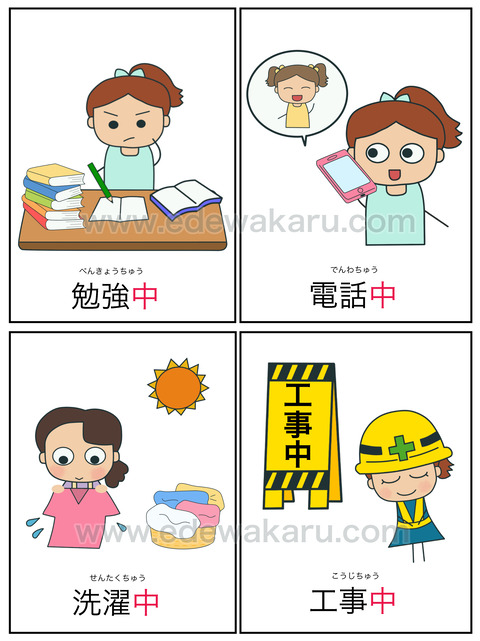
日本語文型辞典
Meaning
「ちゅう」は漢字「中」で書く。何かをしているところだ、ある状態が続いているところだ、という意味。この意味では、必ず「ちゅう」と読むことに注意。一緒に使う名詞は、一般に活動にかかわるもの。例:電話中・交渉中・婚約中・執筆中・旅行中・タイプ中など。「(名詞)中」を「じゅう」と読むこともあるが、この場合は、「一日中」「一年中」のように、「ある間ずっと」の意味になる。
時間を表す名詞とともに用いて、「ある期間」の意味を表す。ただし、「ごぜんちゆう」はあるが、「ごごちゅう」はない。
How to use it
Nちゅう【継続】
Nちゅう【期間】
In context 12 examples
会議中だから、入ってはいけない。
「営業中」の札がかかっている。
その件はただいま検討中です。
課長の休暇中に一大事が起こった。
工事中の道路が多くて、ここまで来るのに随分時間がかかった。
勤務中は個人的な電話をかけてはいけないことになっている。
彼女はダイエット中のはずなのに、どうしてあんなにたくさん食べ物を買い込むのだろう。
午前中は、図書館にいて、午後は実験室にいる予定だ。
戦時中、一家はばらばらになっていた。
夏休み中に水泳の練習をするつもりだ。
彼は試験期間中に病気になって気の毒だった。
この製品は、試用期間中に故障したら、ただで修理してもらえる。
NINJAL 日本語文型データベース
Meaning
~状況で、という意味を表します。
How to use it
Vる中
i-Aい中
Nの中
Notes
「~」には、状況を表す内容がきます。「~中」の後には「歩く・さまよう・来る」などの移動を表す動詞がくることが多いです。
In context 15 examples
子どもたちは雪が降る中、走り回っていました。
この祭では、多くの客でにぎわう中、最後に参加者全員で踊ります。
選手たちは、BGMが流れる中プレーしている。
道に迷ったせいで、雷が鳴る中さまよい続けることになってしまった。
オーケストラが優雅な音楽を演奏するなか、卒業生たちは歓談しています。
お忙しい中ご苦労さまです。
寒い中来ていただき、ありがとうございます。
本日は寒い中来ていただくことになり、申し訳ございませんでした。
体調が悪い中、わざわざ来てくださり、ありがとうございました。
早朝の公園でまだ暗いなか探し回ってみたが、カブトムシを捕まえることはできなかった。
雨の中、1時間近く歩いた。
大雪の中、彼らは2時間以上さまよい続けている。
「このような環境の中、今日は仕事を続けられそうにありません」
大喝采の中、その歌手はステージでアンコールの曲を歌い始めた。
火事という危険な状況の中、田中さんは状況を冷静に判断して社員を外に避難させた。
IMABI
During/Throughout
Read this IMABI lesson ↗Explanation
~中: During/Throughout
The suffix ~中 attaches to all sorts of nouns to indicate one of four functions:
To indicate “throughout” as in the predicate occurs within the entirety of the parameter provided, in which case it primarily follows nouns that pertain to a location (physical locations, body parts, etc.).
To indicate “within” as in a range.
As an aspect marker to indicate an [action/effect] that is [in the middle of being taken place/done].
To indicate “out of” in percentages.
For the meaning of “throughout,” ~中 is always read as じゅう. As an aspect marker, it is always read as ちゅう. Yet, for many temporal phrases with which it means “within/during,” it may be read as ~ちゅう or ~じゅう, with choosing between the two being quite complicated.
First, we will look at lots of examples of ~中 used in its respective meanings. Then, we will take a deeper look into the overlap that exists between its two readings ~ちゅう and ~じゅう.
Orthography Note: In reflection of reality, ~中 will be spelled in kanji or left in かな in the examples. Writers often choose to spell ~中 when the intended reading is ~じゅう, but this is not inherently due to avoiding ambiguity1.
~中じゅう: Throughout
There are three interrelated environments in which ~中 is read as ~じゅう:
~中じゅう with temporal nouns translates as “throughout” as in “from beginning to end.”
~中じゅう with location nouns or any noun which pertains to a range translates as “throughout.”
~中じゅう with nouns pertaining to a group translates as “the whole (of the group).”
Case particles may follow accordingly if the resultant phrase can be used as a standalone noun (Exs. 4-10), which is only the case for non-temporal nouns. Yet, it is often the case that no particle is used, in which case, the resultant phrase functions as an adverb (Exs. 1-3). Of course, in the event that a phrase made with ~中じゅう must modify a noun, the case particle の intervenes (Exs. 11-12).
1. 一年中毎日こんな天気だったらいいのに。
I wish the weather was like this every day of the year.
2. そのコンビニは24時間、年中無休で営業しています。
That convenience store is open 24 hours a day, 365 days a year.
3. 一晩中お酒を飲む人は、一晩でどれくらいの量のお酒を飲みますか?
For people who drink all night long, how much alcohol do they drink a night?
4. 体中からだじゅうが痛いたんだ。
It hurt all over my body.
5. 僕の夢は世界中を旅して友達を作ることです。
My dream is to travel the world and make friends.
6. その声を町中の人が聞きました。
Everyone in town heard the voice.
7. クッキーのおいしそうな香りが、家じゅうに漂っていた。
The delicious smell of cookies filled the house.
8. 電話を切ったあと、部屋中を歩き回って、とにかく考えた。
After hanging up the phone, I paced around the room, and thought (about it) at any rate.
9. 卒業式を目の前にひかえて、学校じゅうが沸いている。
With graduation just around the corner, the whole school is in an uproar.
10. クラス中が、涼介の転校を悲しみました。
The whole class was sad about Ryosuke’s transfer.
11. 日本中の様々な観光名所を訪れています。
I’m visiting all sorts of famous tourist attractions throughout Japan.
12. そこら中のアイテムを回収できる。
You can pick up items from all over the place.
~間中あいだじゅう
As for the phrase ~間中, 間 is a great example of spatial nouns being repurposed as temporal nouns. As a temporal noun, ~間 translates as “while,” which means that ~間じゅう translates as “the whole time while/all throughout2.”
13. 冬の間中、雪に埋もれていた。
(It) was buried in the snow all throughout winter.
14. 旅へ出る支度を終える間じゅう、扉を少し開け外の様子を窺っていた。
The whole time I was getting ready to leave on my trip. I had the door slightly open to see what was going on outside.
While it is tempting to view ~間中に as being synonymous with ~間, the meaning of “throughout” added by the use of ~中じゅう cannot be ignored. As for what would be synonymous with ~間中に, that would be ~間(中)ずっと, but the latter may only be used in temporal contexts.
15. その間(じゅう)、ずっと由紀子は付き添っていた。
During that time, Yukiko was with (them).
~中ちゅう: Within
When ~中ちゅう translates as “within,” it may appear after any word which can be viewed as a range/realm. While it may translate roughly as “within,” ~中 maintains a rather literal interpretation of denoting being right dab in (the middle) of the range at hand.
With non-temporal nouns, ~中ちゅう is often formal in tone and is readily interchangeable with its spoken language equivalent ~の中.
16. ロケットが飛ぶように、いま車は空中を飛んでいるのだ!
The car is flying through the air like a rocket!
空中 best translates as “midair” in contexts in which the “sky” is a medium through which travel occurs. Literally, it still maintains a direct translation of “in the sky, which would be natural in contexts such as Ex. 17.
17. 地上の獣類、空中の鳥類、海中の魚類は自然に増加する。
The beasts on the land, the birds in the sky, and the fish in the sea naturally increase in number.
Similarly, 海中 can be literally translated as “in the sea,” but depending on the context, other translations such as “undersea” may be more appropriate.
18. 海中の音環境は急速に変化している。
Undersea acoustic environments are changing rapidly.
An oddity you will come across is the difference between 車中 and 車内. While much can said on how 中 and 内 differ, unlike domains like 空, 海, etc. which are expansive, a car is not so wide and spacious to find oneself in. When focus is drawn inward rather than outward within finite boundaries, ~内 is typically used, as is evident by phrases such as 機内 (in-flight), 船内 (on-board), 室内 (indoors), etc. When describing where actions occur, these ~内-incorporated compounds must be used.
19.{車内 〇・車中 X}に財布を忘れた。
I forgot my wallet in the car.
20. 乗務員の機内アナウンスを聞きましょう。
Let’s listen, shall we, to the cabin crew’s in-flight announcement(s).
Even so, the phrases 機中, 船中, 室中, etc. do still exist, indicating what can be found within their respective domains, and that “what” is often people. Be that as it may, 車中 and 車内 oddly overlap in colloquial speech. For instance, spending nights in one’s car is usually described as 車中泊 as opposed to 車内拍. Also, 車内 can refer to the inside of any kind of car, including train cars, but 車中 only refers to the inside of a car one drives. This would imply that 車中泊 speaks to the circumstance one finds oneself in the middle of as opposed to just doing something inside a car3.
21. 車中泊グッズをたくさん用意しています。
(We) have a wide selection of car-camping items available.
22. 山中の生態系に影響も出るという。
(They) are saying that it will also have an impact on the mountain’s ecosystem.
23. 文章中から抜き出して答えよ。
Extract (what you need) from (within) the passage and answer (the questions).
24. 空気中の酸素濃度は通常役21%です。
The normal concentration of oxygen in the air is approximately 21%.
25. 空気中と真空中とでは光の速さに違いはありますか。
Is there a difference in the speed of light between in air versus in a vacuum?
26. 土中にはたくさんの微生物が生息しています。
Many microorganisms live in the soil.
27. このカメラは水中でも撮ることができます!
This camera can take pictures underwater!
28. どうしたらいいのか五里霧中だよ。
I haven’t the foggiest idea what to do.
When ~中ちゅう appears in the pattern A中のA, ~中 translates as “among,” indicating that the referent is an extraordinary example in said range.
29. 例外中の例外
An exception among exceptions
With temporal nouns, ~中ちゅう is not necessarily formal, but this is predicated on what phrases exist for the time range/period in question. For instance, 昨日中さくじつちゅう is highly formal and unlikely to be used in the spoken language due to the existence of the native equivalent きのう. Meanwhile, 今月中こんげつちゅう is used in both the spoken and written languages regardless of formality, as there is no native equivalent for 今月. In any event, it is worth noting that ~中ちゅう always takes the particle に with temporal nouns for the meaning “within,” and the resultant phrase functions more or less as a deadline, but with the parameter focusing on the time one has as opposed to being on the cutoff time.
30. 今月中に提出しなさい。
Please submit (it) [within this month=by the end of the month].
31. 購入品は、昨日中に到着していますが、購入者から何も連絡が来ていません。
The purchased items should have arrived sometime yesterday, but I haven’t heard anything from the buyer.
32. 本日中に資料をお送りいたします。
I will send you the documents [today = by EOD].
Note that there are some examples of this meaning of ~中 with temporal nouns in which ~ちゅうに is instead replaced with ~じゅうに, either obligatorily or optionally so. However, we will hold off momentarily on such instances (see below).
~中ちゅう: “-Ing”
~中ちゅう‘s ability to function as an aspect marker to indicate an [action/effect] that is [in the middle of being taken place/done] is quite unique. As for the specifics, several observations can be made:
Used in predicate position as ~中(だ) or in sentence-medial position as ~中に.
Used regardless of the agency involved in the predicate.
Often used in substitution of ~(し)ている in both formal and casual writing, which bleeds into the spoken language to some degree.
When ~中 indicates an action/effect that is “ongoing” in predicate position, copula ellipsis is prolific, allowing for the grammar point to occur in isolation to notify others that said action is taking place.
33. 営業中
OPEN
34. 休憩中
ON BREAK
When ~中 indicates an action/effect that is “ongoing” in sentence-medial position, it is followed by に, which is incidentally the adverbial 連用形 of the copula. In these contexts, “while” is an adequate translation for ~中, emphasizing that the predicate occurs while one is focused on the matter expressed by the dependent clause formed with ~中.
35. 料理中に指を切るところだった。
I nearly cut my finger while cooking.
36. ダウンロードの進行中に、デバイスがインターネット接続を失いました。
The device lost internet connectivity while the download was in progress.
37. 食事中にスマホに夢中になっていると分量を把握できません。
If you can’t take your eyes off your smartphone while eating, you won’t be able to keep track of your portion sizes.
As is the case with other structures that use ~に when denoting aspect, some contexts call for に, others allow for it to be dropped, and still others call for only は or even には. When to use which follows the same principles that we learned when we learned about non-deictic time.
38. 勉強中、どうしても別のことを考えてしまいます。
When I’m in the middle of studying, I always end up thinking about other things.
39. 勉強中は話しかけないでください。
Please don’t talk to me when I’m in the middle of studying.
40. 勉強中にはカフェインなどの集中力アップに効果がある成分が含まれる飲み物や、刺激を感じて気分転換ができる飲み物がおすすめです。
While studying, drinks that contain ingredients such as caffeine that are effective in boosting concentration or drinks that provide a stimulating effect for a change of pace are recommended.
It is also possible for this function of ~中 to modify a noun. In this event, the case particle の naturally intervenes.
41. 休業中きゅうぎょうちゅうの営業所えいぎょうしょ
A business office that’s closed for the holidays
42. 実行中の作戦が有効かどうか、厳しくチェックしてみてください。
Take a hard look at the strategies that you are currently implementing to see if they are effective.
Note that の may also be used in place of である when ~中 constitutes the verbal element of an embedded clause, which is the case in Ex. 41.
43. デバイスが更新中の場合、アプリは更新を一時的に停止します。
If your device is currently updating, the app will temporarily stop updating.
~中’s ability to indicate “-ing” regardless of agency makes it useful as a form of “abbreviated” speech. Agency refers to whether there is a doer. In examples like 冷房中 (Ex. 42), while a machine is responsible for the cooling, there is not necessarily a willful doer implied. In examples like 準備中 (Ex. 43), there is a doer implied, but the resultant translation could easily be written in either active or passive voice, with the choice hinging on whether the speaker is referring to their own actions or not.
44. 冷房中につき、扉をお閉めください。
The air conditioning is on. Please keep the door closed.
45. 只今準備中です。
(We)’re getting (that) ready (for you).
Preparing that right now.
46. その提案はまだ検討中です。
The proposal is still under consideration.
47. ご依頼は現在対応中です。
Your request is currently being processed.
48. 密漁みつりょう船せんが操業中そうぎょうちゅうに転てん覆ぷくした。
A poaching ship capsized in operation.
So far, it may be readily apparent that ~中’s use as an aspect marker is heavily used with Sino-Japanese vocabulary. However, in colloquial speech and writing, it can be seen with native vocabulary and loan words, even nouns which themselves are not normally treated as verbs but which still pertain to an activity (Ex. 50).
49. お祈り中は話し掛けないこと。
No talking (to others) during prayer.
50. 私の高校ではテスト中に携帯が鳴っただけでもカンニングとみなされ、全教科0点にされるうえ、停学になります。
At my high school, even if your cell phone happens to ring during a test, that is considered cheating, and on top of getting a zero for all subjects, you get suspended.
Although typical of chat-style speech patterns, you may even see ~られ中, in which case the structural ambiguity regarding agency is resolved, but this is, so far, uncommon in the spoken language.
51. 飼い主さんに怒られ中の猫ちゃんと怒られた後の表情の落差が可愛すぎる!
The difference in the look on the cat’s face between it being scolded by its owner and after it has been scolded is too cute!
The syntactic simplification inherent of ~中 does not readily discount it from being used in the spoken language on the grounds of being abbreviated speech. In fact, the higher propensity for Sino-Japanese vocabulary in formal speech makes ~中 fit right in, Exs. 44-47 from earlier being great examples. Of course, ~中 is not limited to Sino-Japanese vocabulary in formal language. Moreover, ~中’s ability to obfuscate agency can assist in avoiding placing responsibility on any given doer, which is a feature that makes it so popular.
52. 仕事4中に音楽を聴きますか。
Do you listen to music while you work?
53. お話し中すみませんが、お客様がお見えになりました。
I’m sorry to interrupt you, but a customer has come (to see you).
54. お食事中に失礼します。
Pardon me for interrupting (you) while (you’re) eating.
55. 入浴中にやってます。
I do (it) when I’m taking a bath.
Grammaticality of 発売中
While it is tempting to view ~中 as an almost all-purpose aspect marker for indicating that something is ongoing, there are verbal expressions with which it is incompatible. Most notably, ~中 cannot be used with instantaneous verbs whose results are done and final. Thus, phrases such as 死亡中5, 卒業中, 結婚中, etc. are typically ungrammatical.
This begs the question whether 発売中 is grammatical, as technically 発売 refers to the release of a product. In practice, 発売中 is frequently used instead of 販売中, and the motive for this is to continue the sensation of how new and great the product is.
~中ちゅう: Out Of
When used in the pattern “## Counter ~中 ## Counter,” ~中 translates to “out of.”
56. スクラッチ10枚中4枚当たりました。
I won 4 out of the 10 scratch cards.
57. 100人中、48人が男性、52人が女性。
Of the 100 people, 48 (are/were) men and 52 (are/were) women.
58. 百ひゃく人中にんちゅう半数はんすう避難ひなんしました。
Out of the 100 people, half evacuated.
59. マルマインの素早さは151匹中1番。
Electrode’s speed is the fastest out of the 151 Pokémon.
60. 十中八九6間違いないだろう。
That’s most likely right.
History Behind the Sound Change ちゅう → じゅう
When ~中 entered the language, its initial ON reading was ちゅう7 and the morpheme itself meant “within/during.” For Sino-Japanese compounds in which the first kanji ended in a nasal consonant—those being [n], [ng], or [m]8 in their original Chinese pronunciations but which all end in ん upon being integrated into Japanese—voicing of the initial consonant of the second kanji often occurred9. This phenomenon is what produced ~ぢゅう—the traditional10 spelling of ~じゅう—from ~ちゅう.
Unlike in Modern Japanese, the first instances of ~ぢゅう(=じゅう)in Japanese retained 中’s original meaning of “within,” but over time, starting with nouns indicating places or things, it gained the meaning of “throughout,” which ultimately became extended to temporal nouns. In both cases, ~ぢゅう was no longer limited to words ending in ~ん. The one word that survives from this original environment in Modern Japanese is:
Example Word新濁 ConditionModern ReadingMeaning
心中[m]11 + ~ちうしんじゅうlovers’ suicide
In Modern Japanese, ~ちゅう by and large only means “within,” while ~じゅう(=ぢゅう) largely corresponds to “throughout.” It is with certain temporal nouns, however, that both readings are possible, or ironically, cases in which only ~じゅう(=ぢゅう)is possible despite meaning “within.” Incidentally, the emergence of the meaning “throughout” left the original instances of ~ぢゅう meaning “within,” which appeared with non-temporal nouns, obsolete or exceedingly rare.
While ~じゅう(=ぢゅう)is often used with temporal nouns, using it properly is actually fairly complicated, with “cohesiveness (まとまり性) of the domain/range at hand often determining whether it sounds natural. 小林 posits that the basic time periods in Japanese can be arranged from highest to lowest in cohesiveness as follow: 日12 (day) > 夜13 (night) > 年14 (year) > 月15 (month) > 週16 (week). The lack of “cohesiveness” of the time ranges to the right is attributed to these units of time not having their durations defined as they are in modernity until fairly recently in history.
Temporal Noun + [~じゅうに・ちゅうに]
While cohesiveness of a time period does affect whether ~じゅう is used naturally in the sense of “throughout” the relationship between it and ~じゅうに・~ちゅうに is far from simple. To better streamline this discussion, the meaning of “within” will be referred to as “Meaning ①” and the meaning of “throughout” will be referred to as “Meaning ②.”
Non-Deictic Time + ~中じゅう
When used in the pattern 一・・・~中, ~中 is understood as “throughout,” and with the non-deictic time units “day,” “night,” and “year,” it is obligatorily read as ~じゅう=ぢゅう. While possible with “month” and “week,” with those words, ~中 is instead usually read as ~ちゅう17.
Below, you will see these non-deictic time units in this pattern along with their English translations. Aside from “day” and “year,” it is not as simple as plugging in the unit in the middle to necessarily get the expression you are going for. Periods of months and weeks, for instance, are still expressed with ~か月 and ~週間 respectively. As for why 夜 is replaced with 晩 and is then used with the native number for one, this is simply a matter of convention.
一日中いちにちじゅうall day long; throughout the day
一晩中ひとばんじゅうall evening/night long; throughout the evening/night
一年中いちねんじゅうall year round
一か月中いっかげつじゅう18all month long
一週間中いっしゅうかんじゅうall week long
61. 曇りの日は8日ほどで、丸一日太陽が出ない曇りの日も、一か月中4日と、少なめです。
There are roughly eight days (a month) that are cloudy and there are only four days a month that are cloudy to the point that no sun gets through, which is on the low end.
62. フロリダなどではほぼ一年中暖かいです。
In places like Florida, it is warm almost all year round.
63. 一晩中起きてたような気がするのに、実は寝てたってこと、ある?
Have you ever felt like you were awake all night but you were actually asleep the whole time?
64. 鬱状態では、一日中気分が落ち込んだり、何をしても楽しめない、食欲減退、自分を責めたり過去を悔やんだりします。
When you’re depressed, you feel down all day, can’t enjoy anything, lose your appetite, blame yourself (for things), and (find yourself) regretting the past.
Interestingly, 夜中 and 年中 also exist with ~中じゅう meaning “throughout.”
夜中よじゅう19all night; the whole night
年中ねんじゅう=ねんぢゅう
ねんちゅう20all year round
65. 赤ん坊が夜じゅう泣いていた。
The baby cried all night.
66. その店舗は年中無休です。
That store is open all year round.
As for other non-deictic time phrases such as 夏 and 冬, ~中じゅう is frequently used with them as well, but this cannot be said for all non-deictic time expressions. The sticking point as to whether ~中じゅう is natural, in such situations, appears to be cohesiveness.
67. イネがよく育つように、夏じゅう何度も草ひきをして、水を増やしたり減らしたりして世話をする。
To ensure that the rice grows well, it gets weeding repeatedly and its water intake regulated repeatedly throughout the summer.
68. タマネギには、冬じゅう、水やりの必要はありませんが、天候によって、苗がしおれるほど極端に乾きすぎる場合は、水やりをします。
Onions do not need to be watered throughout the winter, if the seedlings becomes too dry and wilt depending on the weather, water them.
69.{春じゅう △・春の間}ずっと〇着倒せる!
You can wear (this to death) all throughout winter!
70. 夏休みじゅう遊びまくった。
I had a great time throughout my summer break.
71. 今年はゴールデンウィーク{じゅう X・の間 〇}はステイホームの方がいいのかな。
I wonder if it’d just be best to stay home for Golden Week this year.
Deictic Time + ~中じゅう
One thing that all these expressions with 一・・・~中 have in common is that they do not refer to a specific day, year, etc. – their non-deictic nature. Conversely, deictic phrases made with the prefix 今~ are anchored to the time of utterance by the speaker, thus making them subjective in nature.
When combined with deictic time phrases, ~じゅう becomes interpreted as “during/within” as opposed to “throughout,” and as mentioned earlier, this is attributed to the cohesiveness of the units involved. Incidentally, though, the particle に becomes obligatory for the meaning of “during/within” to hold.
In practice, however, as the perceived “cohesiveness” of the time unit lowers, interchangeability between ~じゅうに and ~ちゅうに becomes possible, and for those speakers, so does the option of dropping に, and when に gets dropped, the meaning of “throughout” resurfaces.
In the chart below, the atypical meaning of “throughout” for ~中 is denoted as ②, with it being understood that the default meaning for ~じゅうに is “within/during” (①), as well as for ~ちゅうに whenever it occurs.
Deictic PhraseReading(s)w/o に → ②
今日中にきょうじゅうにX
今晩中にこんばんじゅうに
こんばんちゅうに21 △
今夜中にこんやじゅうに
こんやちゅうに △
今年中にことしじゅうに22
ことしちゅうに△
今月中にこんげつちゅうに
こんげつじゅうに(?)
今週中にこんしゅうちゅうに
こんしゅうじゅうに
From this chart, we can make two observations pertaining to naturalness.
~じゅうに・ちゅうに interchangeability is rare but possible for “evening/night/year.” Conversely, interchangeability is commonplace with “month/week,” with ~ちゅうに preferred.
Meaning ② with ~じゅう is uncommon across the board, but as the perceived cohesiveness of the unit at hand lowers, naturalness improves.
Now, let’s delve into the grammaticality of Meaning ② with these deictic phrases as a whole, starting with how it is not grammatical at all with 今日中.
One fairly obvious reason for why 今日中 does not exist in the sense of “throughout today = all day” (②) is because the phrase 一日中 already exists for that.
72a. 今日中雨が降るだろう。X
72b. 今日は一日中雨が降るだろう。〇
It will likely ran all throughout today.
73. 今日中きょうじゅうに仕上しあげてください。
Please finish it up within (the end of) today.
While this may be a fairly obvious observation, it also goes without saying that the particle に also helps establish Meaning ① as the meaning of ~中 with 今日.
Likewise, the heavy use of 一晩中 and 一年中, in large part, prevents 今晩中・今夜中・今年中 from exhibiting Meaning ②, though examples can still be found, thus △.
74. {今晩じゅう X・一晩中 〇}、降り続いた。
It rained all night long.
75. 不順な天候は今年{じゅう △・も ◎}続くでしょう。
Unstable weather will likely continue throughout the year.
As for 今月中 and 今週中, it turns out that Meaning ② is quite common with them, and for all intended purposes, natural with 今週中, but as a consequence, the battle of ~ちゅう vs ~じゅう becomes more complicated.
Firstly, we expect to find that when に is not present, that ~じゅう ought to be understand as “throughout.”
76a. 今週じゅう休業いたします。
(We) will be closed throughout this week.
77a. 今月じゅうソウルに出張です。
I will be out on business in Seoul all throughout this month.
We would also expect that if に were to be inserted into these sentences, that Meaning ① would be invoked.
76b. 今週じゅうに休業いたします。
We will close within the week.
77b. 今月じゅうにソウルへ出張です。
I will be off on business to Seoul within the month.
As indicated by the chart above, however, not only can ~ちゅうに not be ruled out, it actually becomes the norm.
78. 今週中に店を閉鎖する予定です。
We plan to close our store within the week.
79. 今月中に韓国のビザを取りたいです。
I want to get my visa to Korea within the month.
This is so much so that even ~じゅう (②) may get replaced by ~ちゅう, and since に is not present, we know not to interpret ~中 as ①.
80. 今週中こんしゅうちゅう雪が降る見込みです。
Snow is predicted to fall all throughout this week.
81. 今月中こんげつちゅうずっと残業・・・
I have overtime all throughout this month…
In contexts with which we have a fully formed predicate, the presence of に, regardless of whether ~中 is read as ~じゅう or ~ちゅう, dictates its meaning, but when these phrases are in isolation, that context clue is no longer present. Yet, oddly enough, this is when the difference between “within/during” and “throughout” becomes nigh existent 23.
To play the devil’s advocate, though, the argument can be made that all instances of ~じゅうに maintain a vague sense of “throughout” so long as the act does not extend beyond said range. In other words, whereas ~ちゅうに makes it sound as though the action occurs at a certain point in time within the range, ~じゅうに makes it sound as though the action(s) could be occurring throughout said time frame.
76b. 今週じゅうに休業いたします。
Interpretation A: We will close within the week.
Interpretation B: We will be closing throughout the week. (?)
77b. 今月じゅうにソウルへ出張です。
Interpretation A: I will be off on business to Seoul within the month.
Interpretation B: I will be off on business to Seoul throughout the month. (?)
In Ex. 76b, the deadline for which the predicate [休業いたします] may occur is set to when [今週] expires, but whereas 今週ちゅうに may indicate that [休業いたします] only occurs for specific points in time within [今週], 今週じゅうに may make it sound more like [休業いたします] is continuously so, which is also ambiguous. Is the process of closing a process that continues throughout the week and ends by the end of the week, or will the store close all the time within said week? In practice, there may not be much of a practical difference. Nonetheless, even when it is not necessarily the case that the predicate continuously occurs with ~じゅうに, the looming sense that it ought not go past the time frame is more present than with ~ちゅうに.
In the context of deadlines in which it may seem more natural for the predicate to occur in a specific point in time of the range denoted by ~じゅうに, it may seem odd to interpret these actions as being continuously slow, but while ~ちゅうに is naturally preferred in such scenarios, if the event can be viewed as a process, ~じゅうに can still spring up in conversation.
82. 明日{じゅうに 〇・ちゅうに ◎}お金を払ってください。
Please pay by tomorrow.
83. 今週{じゅうに 〇・ちゅうに ◎}帰国しなければならない。
I must return to my country this week.
Incidentally, when an event only occurs within a point in time set forth by ~中に, and it is plainly being stated as such, only the reading ~ちゅうに is appropriate.
84. 今週ちゅうに、トランプ大統領が来日する。
President Trump will arrive in Japan within the week.
In Ex. 84, ~じゅうに would be highly unnatural, as it would be naturally assumed that once the meeting is over, so too is the president’s visit to Japan.
Formality Favors ~ちゅう?
In addition to 今日中, the following deictic phrases pertaining to “day” are also obligatorily read with ~じゅう and are also obligatorily used with に to that effect.
明日中にあすじゅうに
明日中にあしたじゅうに
昨日中にきのうじゅうに
明後日中にあさってじゅうに
一昨日中におとといじゅうに
As we have learned, the presence of に results in ~中 being interpreted as “within/during,” but at times, the difference between Meaning ① and Meaning ② is negligible, especially when the particle に happens to get dropped anyway. Some speakers are prone to replacing ~じゅうに with ~ちゅうに to pinpoint Meaning ① even for phrases which would otherwise only take ~じゅうに, viewing ~ちゅうに as being more “formal/polite” for and as an unambiguous means to distinguish these meanings. Nonetheless, such replacements would only be seldom heard. In the end, the readings listed above are by and large deemed fixed and obligatory, the native origins of the time phrases in question also being a primary factor. Now, with ~じゅうに obligatory, Meaning ② may still be ruled out provided that the action is not continuously possibly so within the range provided (Ex. 87).
85. 昨日じゅうになんとか終えて、いったん提出することが出来た。
I somehow got it finished yesterday and got it submitted for now.
86. 次の章は明日、明後日じゅうにはアップロードできるかと思います。
I think I’ll be able to upload the next chapter by sometime tomorrow or the day after.
87. 明日じゅうに長崎に着く予定です。
I plan on arriving in Nagasaki by sometime tomorrow.
Sino-Japanese Words Favor ~ちゅう
Not only is formality a potential factor in the swapping of ~じゅうに for ~ちゅうに, but also the fact that most time phrases, non-deictic and deictic time phrases alike, are Sino-Japanese may be another reason for why ~ちゅうに dominates.
Of the words with which ~じゅうに is largely obligatory – きょう, きのう, あす, あした, and ことし – they are all native in origin. Meanwhile, all other cases which typically utilize ~ちゅうに are Sino-Japanese, as is the case for those listed below. However, the use of ~じゅうに cannot be discounted entirely.
本日~ちゅうにby/for today
一両日~ちゅうにwithin the next couple of days
昨日(さくじつ)~ちゅうにby yesterday
明日(みょうにち)~ちゅうにby (the end of) tomorrow
日曜日~ちゅうに
~じゅうに(△)by (the end of) Sunday
2025年~ちゅうに
~じゅうに(△)by (the end of) 2025
1月~ちゅうに ◎
~じゅうに (△)within January
来年~ちゅうに
~じゅうに(△)within next year
去年~ちゅうにin the last year
先月~ちゅうにin the last month
先週~ちゅうにin the last week
来月~ちゅうに
~じゅうに(△)by (the end of) next month
来週~ちゅうに
~じゅうに(△)by (the end of) next week
数日~ちゅうにwithin (the next) several days
期間~ちゅうにduring
午前~ちゅうにin the morning/by noon
From this chart, we see that ~じゅうに does have some acceptance with non-deictic phrases pertaining to future contexts but not so with those pertaining to the past or periods of time. The same applies to their native counterparts as far as frequency of use is concerned.
88. 一両日中にご返事ください。
Please reply within a day or two.
89. 2026年中に営業を再開する予定だそうだ。
They apparently plan to reopen within the year of 2026.
90. 本当は去年中に描き上げる予定だったんだけど間に合わなかった。
I was actually planning to finish it last year, but I couldn’t get it done in time.
While all the words listed in the chart above are Sino-Japanese in origin, ~ちゅうに may even be seen after non-deictic time phrases of native origin, despite ~じゅうに’s prevalence in that niche environment.
91. 夏休み中{じゅうに・ちゅうに}に漢字の復習をしよう!
Let’s do our kanji reviews throughout summer break!
To throw a wrench into all this, however, rare instances of ~じゅうに after nouns which are essentially always used with ~ちゅうに , such as those pertaining to the past like 先月, can still be found.
92. 急ぐって先月中せんげつじゅうに越すはずのところをあさっての天長節まで待たしたんだから、どうしたってあしたじゅうに捜さなければならない。どこか心当りはないか」と言う。
“What’s the hurry,” you ask? I should’ve been moved last month, but I had it put off till the Emperor’s Birthday, which is two days from now, so that means I got to find someplace sometime tomorrow no matter what. Would you have any good ideas as to where I could move?”
From 『三四郎』by 夏目漱石.
As to why ~じゅうに is used with 先月, with the speaker treating it as if it should be yesterday, relating as such seems to be what triggers the use of this reading over ~ちゅうに.
Overall, ~じゅうに has a high affinity with deictic phrases made with 今~, so any context that brings other time phrases closer to those contexts, perhaps say by modifying a non-deictic time phrase with a deictic time phrase with 今~, we would expect some but not a lot of speakers to accept ~じゅうに in those contexts.
93. 今年の6月{ちゅう ◎・じゅう ?}にビルが完成するだろう。
This building will likely be complicated (sometime) this June.
午前中 vs 午後中
At first glance, one might expect 午前中 and 午後中 to be perfect antonyms of each other, but it turns out that that is not the case, and lo and behold, the reason behind this is how 午前 and 午後 differ in “cohesiveness” as units of time.
Firstly, the expressions 午前 and 午後 were born from the need to divide our twenty-four hour “days” in two.
94. 午前5時
5 AM
95. 午後5時
5 PM
In these contexts, it is clear that 午前 and 午後 refer to these succinct halves of the day. Outside the context of AM/PM respectively, 午前 and 午後 behave rather differently.
When it does not correspond to AM, 午前 necessarily appears as 午前中, in which case it translates more so as “during the pre-noon hours/up until noon.”
96. 午前{∅ X・中 〇}に、ラファエル君と会いました。
I met with Rafael-kun within the AM hours.
When it does not correspond to PM, in practice, the end of 午後 refers to the end of the work day, and as a consequence, when paired with ~中, ~中 is obligatorily read as ~じゅう and obligatorily interpreted as “throughout.” If the meaning “within the afternoon” is intended, 午後 alone suffices.
This would imply that in order to say “throughout the pre-noun hours,” 午前中中 ought to be possible, but there are no instances of the ~じゅう reading of ~中 following its ~ちゅう to alleviate this, and this is largely due to this discrepancy being a unique problem to 午前 on top of such repetition being unprecedented.
As for the correct way to go about saying this, ひと朝中 or まるまる午前中 would need to be used. While まるまる午前中 utilizes ~ちゅう, it is worth noting that it is まるまる that denotes the meaning of “throughout,” not ~中.
期間中
期間 (duration) is the Sino-Japanese equivalent of 間, albeit limited to temporal contexts. Incidentally, much like 午前, it is necessarily used with ~中 when denoting the time frame of the predicate.
97. 試験期間{∅ X・中 〇}に急に家での勉強に切り替えるというのは良くないです。
It’s not a good idea to suddenly switch to studying at home during your exam period.
If, however, the time frame itself is being defined, ~中 does not appear.
98. テスト期間は10日から15日までだ。
The test period is from the 10th to the 15th.
【参照】
https://nihon5ch.net/contents/ch5/kosatsu/33.html
『時名詞と接尾辞「中」による熟語についての考察』by 胡新祥・趙梓瑤
Which is not to say that writing ~じゅう cannot disambiguate. For instance, 町中 could be read as まちなか (downtown) or まちじゅう (throughout town). ↩︎
While a spatial interpretation is not impossible, the temporal sense is overwhelmingly dominant. ↩︎
Incidentally, the formal means of referring to living in one’s car is 車上生活, but in casual conversation, 車中生活 is commonly heard instead. It is important, though, not to view 車上 as literally meaning “on top of a car” but rather where a circumstance takes place, which also explains its appearance in other phrases such as 車上荒らし (vehicle burglary). ↩︎
Possibly due to being written in kanji, albeit ateji, 仕事 is highly compatible with suffixes that typically only occur in the written language. ↩︎
The argument can be made that 死亡中 could be used in a comedic sci-fi context in which “being dead” is not final but an ongoing status that can eventually change. The same could be said for other instantaneous verbs provided the extraordinary context warrants such a phrasing. ↩︎
Literally translates as “10; 8, 9.” ↩︎
When accounting for historical kana orthography, this ON reading would be spelled as ちう. ↩︎
While all three final consonants were ultimately incorporated into Japanese as ん, when Sino-Japanese words were initially borrowed, their pronunciations were far more conservative. Nonetheless, sound changes such as 新濁 still occurred upon incorporation. ↩︎
Voicing of consonants in compounds is known as 連濁. In contexts such as this in which the reading is deemed innovative, as is the case with voiced ON readings that did not exist prior to 連濁 occurring, the term 新濁 is used. The opposite of 新濁 is 本濁, which refers to readings that were voiced to begin with. ↩︎
As ~じゅう derives from ~ちゅう via 連濁, the correct spelling ought to be ~ぢゅう to reflect this. However, this spelling has largely fallen out of use. To be completely true to historical kana orthography, though, ~ぢゅう would be rendered as ~ぢう. ↩︎
心’s ON reading しん came into the language with a final /m/. ↩︎
“Day” has the largest array of expressions pertaining to duration in that increment: まる一日 (for a whole day), 日々 (daily), 日に日に (day by day), 日を追うごとに (with every passing day), etc. Incidentally, the definition of “day” itself largely referring to the time between sunrise and sunset, as that is what was historically treated as a “day.” ↩︎
Historically, “night” would have been defined as the time between sunset and the next sunrise, and it too has a similarly sized wealth of expressions for describing duration, effectively possessing the same cohesiveness as “day” for being its antonym: 夜々 (nightly), 夜な夜な (night by night), 夜を追うごとに (with every passing night), etc. ↩︎
Regardless of the calendar systems that have been in use in Japan, revolutions around the Sun constituting a year has readily understood, resulting in 年 possessing a high level of cohesiveness: 年々 (yearly), 年を追うごとに (with every passing year). ↩︎
Meanwhile, 月 has relatively low cohesion, which is perhaps a reflection of what defines a “month” differing between calendar systems. Nonetheless, we still find expressions such as 月々 (monthly). ↩︎
Possessing the lowest level of cohesiveness, 週 it was not until the Meiji Period that the “seven-day week” became widely used and only since the end of the Taisho Period that months were regularly split up into weeks. ↩︎
For both 一か月中 and 一週間中, the meaning of “throughout” is overshadowed by the meaning “within/during,” in which case both would normally be read with ~中 read as ~ちゅう. ↩︎
How many speakers actually distinguish between いっかげつちゅう and いっかげつじゅう as well as between いっしゅうかんちゅう and いっしゅうかんじゅう is uncertain, given how both are rendered the same when written in kanji. ↩︎
When read as やちゅう, 夜中 instead means “during the night,” reflecting the original meaning of 中 as well as 中’s original restriction to Sino-Japanese words. Incidentally, 夜中 is nowhere nearly as common as the similar 夜中じゅう, but it too is an example of ~じゅう with non-deictic time. In fact, 夜中(よじゅう) is so rare that a not so small percentage of native speakers would hypercorrect as よるじゅう. ↩︎
The most prominent reading of 年中 is ねんじゅう=ねんぢゅう, with its original spelling in kana notably more likely to be used than with other words. In the phrase 年中行事, 年中 notably means “annually” as opposed to “all year round,” which prompts many speakers to use ねんちゅう instead. In practice, ねんじゅう=ねんぢゅう still remain prominent with this phrase as well, a testament to the high degree of cohesiveness of “year” as a unit as well as to ねんじゅう=ねんぢゅう being the more historically accurate reading following the aforementioned 新濁 sound change which affected words like 年中 for 年’s ON reading ending in ~ん. ↩︎
When speakers do read 今晩中 and 今夜中 with ~中 as ~ちゅう when the particle に is present with them, and when this swapping of readings occurs, ~中’s meaning of “within/during” is imposed so that 今晩中 and 今夜中 in isolation with ~中’s reading of ~じゅう may be interpreted as “throughout.” From the angle of “cohesiveness,” “night/evening” as a unit exhibiting this wavering between ~ちゅう and ~じゅう in the first place can be attributed to “night/evening” not being as cohesive as “day.” ↩︎
When speakers do read 今年中 with ~中 as ~ちゅう when the particle に is present with it, and when this swapping of readings occurs, ~中’s meaning of “within/during” is imposed so that 今年中 in isolation with ~中’s reading of ~じゅう may be interpreted as “throughout.” From the angle of “cohesiveness,” “year” as a unit exhibiting this wavering between ~ちゅう and ~じゅう in the first place can be attributed to “year” not being as cohesive as “day.” ↩︎
Reading such instances of ~中 as ちゅう heightens the perceived formality of the statement, but because ~ちゅう is only associated with the meaning of “within,” it leaves the statement somewhat ambiguous if に were dropped, which may incidentally also be dropped to enhance the formal tone being made, with 中 translating more as “for.” Now, as for whether the predicate occurs throughout or partially occurs within the stated time span does ultimately become a rather innocuous discrepancy. ↩︎
In context 101 examples
一年中毎日こんな天気だったらいいのに。
I wish the weather was like this every day of the year.
そのコンビニは24時間、年中無休で営業しています。
That convenience store is open 24 hours a day, 365 days a year.
一晩中お酒を飲む人は、一晩でどれくらいの量のお酒を飲みますか?
For people who drink all night long, how much alcohol do they drink a night?
体中からだじゅうが痛いたんだ。
It hurt all over my body.
僕の夢は世界中を旅して友達を作ることです。
My dream is to travel the world and make friends.
その声を町中の人が聞きました。
Everyone in town heard the voice.
クッキーのおいしそうな香りが、家じゅうに漂っていた。
The delicious smell of cookies filled the house.
電話を切ったあと、部屋中を歩き回って、とにかく考えた。
After hanging up the phone, I paced around the room, and thought (about it) at any rate.
卒業式を目の前にひかえて、学校じゅうが沸いている。
With graduation just around the corner, the whole school is in an uproar.
クラス中が、涼介の転校を悲しみました。
The whole class was sad about Ryosuke’s transfer.
日本中の様々な観光名所を訪れています。
I’m visiting all sorts of famous tourist attractions throughout Japan.
そこら中のアイテムを回収できる。
You can pick up items from all over the place.
冬の間中、雪に埋もれていた。
(It) was buried in the snow all throughout winter.
旅へ出る支度を終える間じゅう、扉を少し開け外の様子を窺っていた。
The whole time I was getting ready to leave on my trip. I had the door slightly open to see what was going on outside.
その間(じゅう)、ずっと由紀子は付き添っていた。
During that time, Yukiko was with (them).
ロケットが飛ぶように、いま車は空中を飛んでいるのだ!
The car is flying through the air like a rocket!
地上の獣類、空中の鳥類、海中の魚類は自然に増加する。
The beasts on the land, the birds in the sky, and the fish in the sea naturally increase in number.
海中の音環境は急速に変化している。
Undersea acoustic environments are changing rapidly.
{車内 〇・車中 X}に財布を忘れた。
I forgot my wallet in the car.
乗務員の機内アナウンスを聞きましょう。
Let’s listen, shall we, to the cabin crew’s in-flight announcement(s).
車中泊グッズをたくさん用意しています。
(We) have a wide selection of car-camping items available.
山中の生態系に影響も出るという。
(They) are saying that it will also have an impact on the mountain’s ecosystem.
文章中から抜き出して答えよ。
Extract (what you need) from (within) the passage and answer (the questions).
空気中の酸素濃度は通常役21%です。
The normal concentration of oxygen in the air is approximately 21%.
空気中と真空中とでは光の速さに違いはありますか。
Is there a difference in the speed of light between in air versus in a vacuum?
土中にはたくさんの微生物が生息しています。
Many microorganisms live in the soil.
このカメラは水中でも撮ることができます!
This camera can take pictures underwater!
どうしたらいいのか五里霧中だよ。
I haven’t the foggiest idea what to do.
例外中の例外
An exception among exceptions
今月中に提出しなさい。
Please submit (it) [within this month=by the end of the month].
購入品は、昨日中に到着していますが、購入者から何も連絡が来ていません。
The purchased items should have arrived sometime yesterday, but I haven’t heard anything from the buyer.
本日中に資料をお送りいたします。
I will send you the documents [today = by EOD].
営業中
OPEN
休憩中
ON BREAK
料理中に指を切るところだった。
I nearly cut my finger while cooking.
ダウンロードの進行中に、デバイスがインターネット接続を失いました。
The device lost internet connectivity while the download was in progress.
食事中にスマホに夢中になっていると分量を把握できません。
If you can’t take your eyes off your smartphone while eating, you won’t be able to keep track of your portion sizes.
勉強中、どうしても別のことを考えてしまいます。
When I’m in the middle of studying, I always end up thinking about other things.
勉強中は話しかけないでください。
Please don’t talk to me when I’m in the middle of studying.
勉強中にはカフェインなどの集中力アップに効果がある成分が含まれる飲み物や、刺激を感じて気分転換ができる飲み物がおすすめです。
While studying, drinks that contain ingredients such as caffeine that are effective in boosting concentration or drinks that provide a stimulating effect for a change of pace are recommended.
休業中きゅうぎょうちゅうの営業所えいぎょうしょ
A business office that’s closed for the holidays
実行中の作戦が有効かどうか、厳しくチェックしてみてください。
Take a hard look at the strategies that you are currently implementing to see if they are effective.
デバイスが更新中の場合、アプリは更新を一時的に停止します。
If your device is currently updating, the app will temporarily stop updating.
冷房中につき、扉をお閉めください。
The air conditioning is on. Please keep the door closed.
只今準備中です。
(We)’re getting (that) ready (for you).
その提案はまだ検討中です。
The proposal is still under consideration.
ご依頼は現在対応中です。
Your request is currently being processed.
密漁みつりょう船せんが操業中そうぎょうちゅうに転てん覆ぷくした。
A poaching ship capsized in operation.
お祈り中は話し掛けないこと。
No talking (to others) during prayer.
私の高校ではテスト中に携帯が鳴っただけでもカンニングとみなされ、全教科0点にされるうえ、停学になります。
At my high school, even if your cell phone happens to ring during a test, that is considered cheating, and on top of getting a zero for all subjects, you get suspended.
飼い主さんに怒られ中の猫ちゃんと怒られた後の表情の落差が可愛すぎる!
The difference in the look on the cat’s face between it being scolded by its owner and after it has been scolded is too cute!
仕事4中に音楽を聴きますか。
Do you listen to music while you work?
お話し中すみませんが、お客様がお見えになりました。
I’m sorry to interrupt you, but a customer has come (to see you).
お食事中に失礼します。
Pardon me for interrupting (you) while (you’re) eating.
入浴中にやってます。
I do (it) when I’m taking a bath.
スクラッチ10枚中4枚当たりました。
I won 4 out of the 10 scratch cards.
100人中、48人が男性、52人が女性。
Of the 100 people, 48 (are/were) men and 52 (are/were) women.
百ひゃく人中にんちゅう半数はんすう避難ひなんしました。
Out of the 100 people, half evacuated.
マルマインの素早さは151匹中1番。
Electrode’s speed is the fastest out of the 151 Pokémon.
十中八九6間違いないだろう。
That’s most likely right.
曇りの日は8日ほどで、丸一日太陽が出ない曇りの日も、一か月中4日と、少なめです。
There are roughly eight days (a month) that are cloudy and there are only four days a month that are cloudy to the point that no sun gets through, which is on the low end.
フロリダなどではほぼ一年中暖かいです。
In places like Florida, it is warm almost all year round.
一晩中起きてたような気がするのに、実は寝てたってこと、ある?
Have you ever felt like you were awake all night but you were actually asleep the whole time?
鬱状態では、一日中気分が落ち込んだり、何をしても楽しめない、食欲減退、自分を責めたり過去を悔やんだりします。
When you’re depressed, you feel down all day, can’t enjoy anything, lose your appetite, blame yourself (for things), and (find yourself) regretting the past.
赤ん坊が夜じゅう泣いていた。
The baby cried all night.
その店舗は年中無休です。
That store is open all year round.
イネがよく育つように、夏じゅう何度も草ひきをして、水を増やしたり減らしたりして世話をする。
To ensure that the rice grows well, it gets weeding repeatedly and its water intake regulated repeatedly throughout the summer.
タマネギには、冬じゅう、水やりの必要はありませんが、天候によって、苗がしおれるほど極端に乾きすぎる場合は、水やりをします。
Onions do not need to be watered throughout the winter, if the seedlings becomes too dry and wilt depending on the weather, water them.
{春じゅう △・春の間}ずっと〇着倒せる!
You can wear (this to death) all throughout winter!
夏休みじゅう遊びまくった。
I had a great time throughout my summer break.
今年はゴールデンウィーク{じゅう X・の間 〇}はステイホームの方がいいのかな。
I wonder if it’d just be best to stay home for Golden Week this year.
今日中雨が降るだろう。X
It will likely ran all throughout today.
今日は一日中雨が降るだろう。〇
It will likely ran all throughout today.
今日中きょうじゅうに仕上しあげてください。
Please finish it up within (the end of) today.
{今晩じゅう X・一晩中 〇}、降り続いた。
It rained all night long.
不順な天候は今年{じゅう △・も ◎}続くでしょう。
Unstable weather will likely continue throughout the year.
今週じゅう休業いたします。
(We) will be closed throughout this week.
今月じゅうソウルに出張です。
I will be out on business in Seoul all throughout this month.
今週じゅうに休業いたします。
We will close within the week.
今月じゅうにソウルへ出張です。
I will be off on business to Seoul within the month.
今週中に店を閉鎖する予定です。
We plan to close our store within the week.
今月中に韓国のビザを取りたいです。
I want to get my visa to Korea within the month.
今週中こんしゅうちゅう雪が降る見込みです。
Snow is predicted to fall all throughout this week.
今月中こんげつちゅうずっと残業・・・
I have overtime all throughout this month…
明日{じゅうに 〇・ちゅうに ◎}お金を払ってください。
Please pay by tomorrow.
今週{じゅうに 〇・ちゅうに ◎}帰国しなければならない。
I must return to my country this week.
今週ちゅうに、トランプ大統領が来日する。
President Trump will arrive in Japan within the week.
昨日じゅうになんとか終えて、いったん提出することが出来た。
I somehow got it finished yesterday and got it submitted for now.
次の章は明日、明後日じゅうにはアップロードできるかと思います。
I think I’ll be able to upload the next chapter by sometime tomorrow or the day after.
明日じゅうに長崎に着く予定です。
I plan on arriving in Nagasaki by sometime tomorrow.
一両日中にご返事ください。
Please reply within a day or two.
2026年中に営業を再開する予定だそうだ。
They apparently plan to reopen within the year of 2026.
本当は去年中に描き上げる予定だったんだけど間に合わなかった。
I was actually planning to finish it last year, but I couldn’t get it done in time.
夏休み中{じゅうに・ちゅうに}に漢字の復習をしよう!
Let’s do our kanji reviews throughout summer break!
急ぐって先月中せんげつじゅうに越すはずのところをあさっての天長節まで待たしたんだから、どうしたってあしたじゅうに捜さなければならない。どこか心当りはないか」と言う。
“What’s the hurry,” you ask? I should’ve been moved last month, but I had it put off till the Emperor’s Birthday, which is two days from now, so that means I got to find someplace sometime tomorrow no matter what. Would you have any good ideas as to where I could move?”
今年の6月{ちゅう ◎・じゅう ?}にビルが完成するだろう。
This building will likely be complicated (sometime) this June.
午前5時
5 AM
午後5時
5 PM
午前{∅ X・中 〇}に、ラファエル君と会いました。
I met with Rafael-kun within the AM hours.
試験期間{∅ X・中 〇}に急に家での勉強に切り替えるというのは良くないです。
It’s not a good idea to suddenly switch to studying at home during your exam period.
テスト期間は10日から15日までだ。
The test period is from the 10th to the 15th.