どんなときどう使う 日本語表現文型辞典
Meaning
use the opportunity of
How to use it
N+をきっかけに(して)
Explanation
をきっかけに(して)
~が行動の発端や動機になって
1)ある新たな行動を起こした発端や動機を言うときの表現。 ❸ のように「がきっかけで」の形もある。
2)「をけいきに(して)」と意味・用法がよく似ているが、「をきっかけに(して)」の後の文は特にプラス的な行動でなくてもいい。
1)Outset or motive causes new action. Also found in: がきっかけで, as in sentence ❸ .
2)Pattern をけいきに(して)is similar in usage and meaning, but clauses following をきっかけに(して)do not necessarily have to be positive actions.
In context 3 examples
春のハイキングをきっかけに、わたしは山登りに興味を持つようになった。
今日の料理番組をきっかけにして、母が昔よく作った料理を思い出した。
ある日本人と友達になったことがきっかけで、日本留学を考えるようになった。
絵でわかる日本語
Meaning
〜があったから、〜するようになった
〜が動機になって〜
How to use it
名詞[辞書形]+をきっかけに
名詞[辞書形]+をきっかけにして
名詞[辞書形]+をきっかけとして
動詞[普通形]+のをきっかけに
Explanation
「〜をきっかけに・〜をきっかけにして・〜をきっかけとして」は「〜があったから〜するようになった」「〜が動機になって〜」という意味を表す文型です。「AをきっかけにB」の形で使われ
「AがあったからBするようになった」「AしたからBするようになった」
というように、「B」をするようになった動機を表します😊
「〜をきっかけに」は「〜をきっかけにして」「〜をきっかけとして」にチェンジすることができます。
[例]
海外旅行
をきっかけに、英語を始めた
=海外旅行
をきっかけにして、英語を始めた
=海外旅行
をきっかけとして、英語を始めた
また、動詞と使う場合は「動詞+のをきっかけに」という形が使われます。
[例]
病気
をきっかけに
タバコを吸わなくなった
=病気になった
のをきっかけに
タバコを吸わなくなった
=病気になった
のをきっかけにして
タバコを吸わなくなった
=病気になった
のをきっかけとして
タバコを吸わなくなった
【上級レベルの人へ】
N1の文型に
「〜を皮切りに・〜を皮切りにして」
という文型があります。これは「〜から始まって、次々に(同じことが起きる)」という意味で【同類行為(どうるいこうい)の発生】を表します。「〜をきっかけに」と混乱しがちですが、しっかりと区別をして覚えておきましょう😀
【関連文型】
In context 5 examples
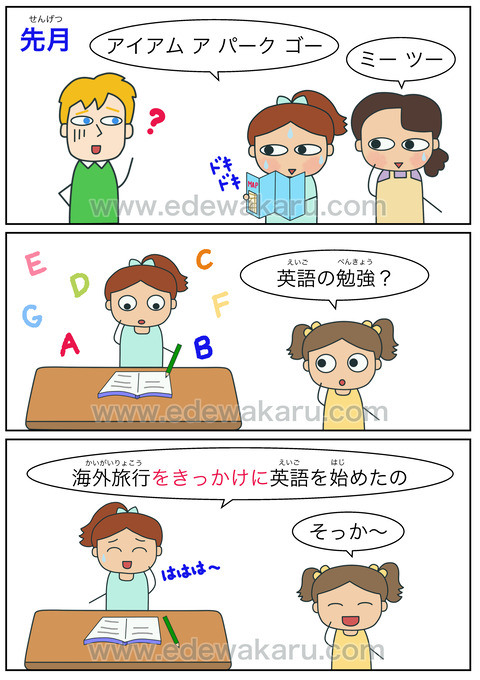
海外旅行(かいがいりょこう)をきっかけに、英語を始めたの
→海外旅行をして、英語を勉強するようになった日本のアニメを見たのをきっかけに、日本へ留学したいと思うようになりました
→日本のアニメを見て、日本へ留学したいと思うようになったお父さんは、病気をきっかけにタバコを吸わなくなった
→病気になったということがあったから、タバコを吸わなくなった彼女は、結婚をきっかけに仕事を辞めた
→結婚をして、仕事を辞めたあの俳優は、あの映画をきっかけに有名になった
→あの映画に出てから、有名になった
くらべてわかる日本語表現文型辞典
Meaning
Aを発端・始まりとしてB。Aが影響を与えてB。
How to use it
AをきっかけにB(AがきっかけでB)
[動詞-た形]+の+をきっかけに
[名詞-∅]をきっかけに
Explanation
【対比1】
「Aを契機にB」(意味1 P.337)
Notes
【注意1】
・AとBの因果関係がはっきりしているものには使えない。
×古い刺身を食べたのがきっかけで、食中毒になった。
「きっかけ」は「手がかり・動機」という意味の名詞でもある。
○あなたが日本に留学しようと思ったきっかけを教えてください。
○彼と話をしたいがなかなかきっかけがつかめない。
In context 4 examples
去年の社内旅行をきっかけに、二人の交際が始まった。
父は大病したのをきっかけに、毎年検診を受けるようになった。
社長の逮捕がきっかけで、ずさんな経営が露呈した。
姉は失恋がきっかけで、仕事にのめり込むようになった。
IMABI
Opportunity
Read this IMABI lesson ↗Explanation
Opportunity: きっかけ & 契機
The nouns きっかけ and 契機 both indicate taking advantage of a situation in a positive light to bring about what follows.
きっかけ
きっかけ can literally be translated as “chance/cue/motive/occasion” or more loosely translated as “trigger/prompt.” Although 機会 and チャンス both translate as “chance,” they are one-time opportunities that one does not wish to miss out on, whereas きっかけ is the “chance” to start something that is long lasting.
Orthography Note: きっかけ is only seldom spelled in kanji as 切っ掛け.
1. 日本語を勉強し始めたきっかけは何ですか。
What was it that triggered you to start studying Japanese?
2. 自分磨きのきっかけと過程とその結果
The motive to improve myself, the course of doing so, and the results
3. 英語ができるようになったきっかけや過程は人それぞれですが、共通点はいくつかあります。
The motive and process for how one becomes able to speak English differs from person to person, but there are several points of commonality.
~をきっかけ【に(して)・として】
In the grammar pattern ~をきっかけ【に(して)・として】, it is translated as “taking advantage of…/inspired by…” What follows is something that the speaker/agent is now actively doing.
4. この事件をきっかけに、一般の警察官が持つ銃器に関して大きな見直しが迫られた。
Prompted by this case, major revision regarding the weapons that regular officers possess became pressing.
5. 事故をきっかけに家族の愛情に気づき、家族との結束も強まった。
With the accident as a start, I realized the love my family had for me, and my solidarity with them strengthened.
6. 結婚をきっかけに(して)転職した。
I took advantage of getting married to change jobs.
7. 若者たちがSNSをきっかけとして犯罪に巻き込まれている。
Young people are being involved in crimes with social media as their motive.
You may also see the pattern ~がきっかけで, which indicates that something happens due to a trigger. It is most appropriate in contexts regarding happenstance.
8. その一言がきっかけで、彼の理性は完全に崩壊した。
That single comment was what prompted his sense of reasoning to completely collapse.
9. ポケモンがきっかけで日本語に興味を持ちました。
I became interested in Japanese with Pokemon as the motive.
契機
The noun 契機 meaning “opportunity” is a rather formal word that is usually only seen in the written language. Similarly to きっかけ, it can be seen in the pattern ~を契機【に(して)・として】.
The use of として over に(して) is both a matter of formality and semantics. While the former is more formal by default, it also implies that the action bringing brought about is the final solution that the speaker/agent is working towards. On the other hand, に(して)will imply that the action bringing brought about is ongoing and still may change given the right (change in) motive.
10. 言論の弾圧を契機に(して)暴動が起きています。
Violence is occurring over the suppression of speech.
11. テロを契機として警備が一層強化された。
Taking the (act of) terrorism as a motivation, security has been greatly enhanced.
In context 11 examples
日本語を勉強し始めたきっかけは何ですか。
What was it that triggered you to start studying Japanese?
自分磨きのきっかけと過程とその結果
The motive to improve myself, the course of doing so, and the results
英語ができるようになったきっかけや過程は人それぞれですが、共通点はいくつかあります。
The motive and process for how one becomes able to speak English differs from person to person, but there are several points of commonality.
この事件をきっかけに、一般の警察官が持つ銃器に関して大きな見直しが迫られた。
Prompted by this case, major revision regarding the weapons that regular officers possess became pressing.
事故をきっかけに家族の愛情に気づき、家族との結束も強まった。
With the accident as a start, I realized the love my family had for me, and my solidarity with them strengthened.
結婚をきっかけに(して)転職した。
I took advantage of getting married to change jobs.
若者たちがSNSをきっかけとして犯罪に巻き込まれている。
Young people are being involved in crimes with social media as their motive.
その一言がきっかけで、彼の理性は完全に崩壊した。
That single comment was what prompted his sense of reasoning to completely collapse.
ポケモンがきっかけで日本語に興味を持ちました。
I became interested in Japanese with Pokemon as the motive.
言論の弾圧を契機に(して)暴動が起きています。
Violence is occurring over the suppression of speech.
テロを契機として警備が一層強化された。
Taking the (act of) terrorism as a motivation, security has been greatly enhanced.
文法
Meaning
〜の行動が動機になって / それをするようになったのは〜があったからだ。
How to use it
V(タ形)+ ことがきっかけで
N + がきっかけで / をきっかけにして
In context 14 examples
インターネットで日本人の友達ができたことがきっかけで日本語を勉強するようになった。
アニメがきっかけで日本語の文化に興味を持った。
アニメをきっかけに日本語に興味を持つ学生が多い。
友達に紹介されたことがきっかけで、僕は彼女と付き合い、結婚することになった。
洋楽をきっかけに、私は英語を勉強するようになった。
ブログを見たことをきっかけに、私は日本へ行きたいと思うようになった。
錦織圭のプレイを見たことがきっかけで、私もテニスを始めるようになった。
海外旅行がきっかけで、世界一周に興味を持った。
結婚をきっかけに、新しい家を買った。
国際交流がきっかけで日本語教師の仕事に興味を持った。
海外出張がきっかけで、英会話教室に通うようになりました。
友達に誘われて見にいったライブがきっかけで、ギターに興味を持った。
パソコンを買ってもらったことがきっかけで、プログラミングの勉強を始めました。
僕たちは共通の友達が開いた飲み会がきっかけで出会って、結婚しました。
日本語NET JLPT文法解説まとめ
Meaning
〜の行動が動機になって / それをするようになったのは〜があったからだ。
How to use it
V(タ形)+ ことがきっかけで
N + がきっかけで / をきっかけにして
Explanation
for the initial reason of ~
In context 14 examples
インターネットで日本人の友達ができたことがきっかけで日本語を勉強するようになった。
アニメがきっかけで日本語の文化に興味を持った。
アニメをきっかけに日本語に興味を持つ学生が多い。
友達に紹介されたことがきっかけで、僕は彼女と付き合い、結婚することになった。
洋楽をきっかけに、私は英語を勉強するようになった。
ブログを見たことをきっかけに、私は日本へ行きたいと思うようになった。
錦織圭のプレイを見たことがきっかけで、私もテニスを始めるようになった。
海外旅行がきっかけで、世界一周に興味を持った。
結婚をきっかけに、新しい家を買った。
国際交流がきっかけで日本語教師の仕事に興味を持った。
海外出張がきっかけで、英会話教室に通うようになりました。
友達に誘われて見にいったライブがきっかけで、ギターに興味を持った。
パソコンを買ってもらったことがきっかけで、プログラミングの勉強を始めました。
僕たちは共通の友達が開いた飲み会がきっかけで出会って、結婚しました。