くらべてわかる日本語表現文型辞典
Meaning
意味1:話し手がAに対して持っている評価と合わないBを示され、信じられないという気持ちを表す。
意味2:ほかと違ってAだけがB。
意味3:Aの場合はほとんどいつもBと話し手が思っている表現。
How to use it
Aに限ってB(Aに限ってはB)
[名詞-∅]に限って
Notes
【注意2】
・「Aに限ってはB」の形になると、意味は「Aに限ってB」と同じだが、言外にAではないものはBではないという意味を含む。
○クレジットの申し込みは未成年者に限っては親の同意が必要だ。
In context 12 examples
彼に限って、遅れてくるということはないだろう。
あの店に限って、そんなまずい料理を出すはずがない。
うちの子に限って、万引きをするなんて考えられません。
夫に限って会社の人気者だなんてありえないわ。家では無口なのに…。
このビールは関西地方に限って販売されている。
出かける予定をしていた今日に限って、天気が崩れた。
この見舞い金はご自宅が全壊した方に限って、支払われるものです。
市場では株価が下落しているが当社に限っては大幅に上昇している。
ほしい本に限って、いつも在庫がないといわれる。
言葉巧みに近づいてくる男に限って、下心がある。
私が予習してきた日に限って、先生は私を当てない。
いそがしいときに限って、このパソコンは調子が悪くなる。
DoJG 日本語文法辞典(全集)
Meaning
(X) of all (X's); only
How to use it
Noun | に限って | |
| あの日に限って | Only on that day |
| あの人に限って | Only that person |
Explanation
A compound particle to show that only X is different from others.
In context 6 examples
うちの子供に限ってそんなひどいことはしませんよ。
Our child, of all children, would not do such a terrible thing.
中野先生はたいてい研究室にいらっしゃるのに、今日に限っていらっしゃらなかった。
Professor Nakano is usually in his office, but today, of all days, he wasn't there.
傘を持って来ない日に限って雨が降るんですよ。
Only on the day when I don't bring my umbrella, it rains, you know.
急ぐ時に限って、バスがなかなか来ない。
Of all times, when I am in a hurry, the bus doesn't come for ages.
嫌なことがある時に限って、嫌なことが重なる。
Only when something unpleasant happens, do other unpleasant things occur.
この小説家の書いたものに限って、つまらないものはない。
Only works written by this novelist are never boring.
絵でわかる日本語
Usage 1
Read this source entry ↗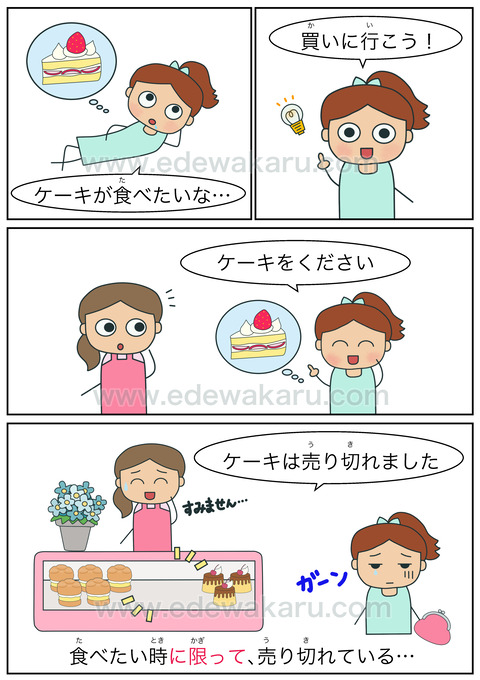
Meaning
ちょうど〜時に、悪いことが起こる
How to use it
名詞[辞書形]+に限って
Explanation
「〜に限って」は「ちょうど〜時に、悪いことが起こる」という意味を表す文型です。「〜が起こってほしくないな…と思っている時に〜が起こった」と言いたい時に使います。 後ろには【悪いことの発生】がきます。
[例]
①食べたい時
に限って、売り切れている
→ちょうど食べたいと思っていた時なのに、売り切れている
②傘を持っていない時
に限って
雨が降る…
→傘を持っていないから、雨が降らないでほしいと思っていたのに雨が降った
③急いでいる時
に限って、渋滞している
→急いでいる時なのに、渋滞している
④デートの日
に限って、お腹を壊してしまった
→デートの日なのに、お腹を壊してしまった
⑤試験の日
に限って
二度寝をしてしまい、遅刻した
→試験の日は絶対に遅刻してはいけないと思っていたのに、遅刻してしまった
「〜に限って」にはいくつか意味がありますので、N2以上を受ける人はまとめて覚えておきましょう😀
In context 5 examples
食べたい時に限って、売り切れている(復習:〜ている(結果の状態))
傘を持っていない時に限って雨が降る…
急いでいる時に限って、渋滞している
デートの日に限って、お腹を壊してしまった(復習:腹を壊す)(復習:壊れる・壊す①)
試験の日に限って二度寝をしてしまい、遅刻した(復習:二度寝)(復習:〜てしまう(残念・後悔))
Usage 2
Read this source entry ↗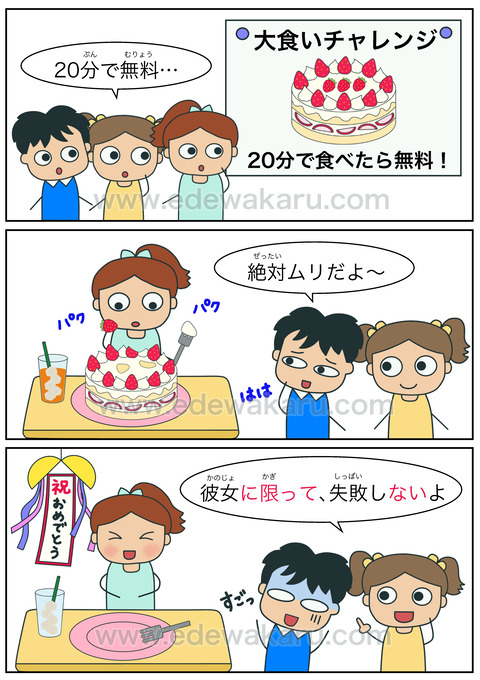
Meaning
〜だけは絶対〜ない
〜だけは〜ないと信じている
How to use it
名詞[辞書形]+に限って
Explanation
「〜に限って〜ない」は「〜だけは、絶対に〜ない」という意味を表す文型です。これは「〜だけは、絶対に〜ないから、悪い結果にはならない」という気持ちを込めて使われる文型です。
(復習:〜を込めて・〜を込めた)
「〜に限って」がつく文型は他にもありますので、復習をしておきましょう😀
【「限る」シリーズ】
〜限り(限界)
〜限り
〜限りだ
〜限りで・N限りのN(限定)
〜限りでは(範囲)
限りなく〜に近い
〜とは限らない
〜ない限り
〜に限ったことではない
〜に限って①(悪いことの発生)
〜に限って②(いつもと違う)
〜に限って〜ない
〜に限らず(〜も)
〜に限る
〜を限りに
In context 6 examples
彼女に限って失敗しないよ
→彼女だけは絶対に失敗しないよお母さんに限って、うそをつくはずがないよ
→お母さんだけは、絶対にうそをつくはずがないよ(復習:〜はずがない)あの子(こ)に限って、0点を取るはずがない
→あの子だけは、絶対に0点を取るはずがない口がかたい田中さんに限って、秘密を言ってしまうことはないと思うよ
→田中さんだけは、絶対に秘密を言ってしまうことはないよ(復習:口がかたい)(復習:〜ことはない②(全面否定))うちの娘に限って、そんな悪いことをするわけがありません
→うちの娘だけは、絶対にそんな悪いことをするわけがありません(復習:〜わけがない)彼に限って、ドタキャンするなんてありえないわ!
→彼だけは、絶対にドタキャンなんてしないと信じているわ!(復習:ドタキャン)(復習:〜など・〜なんか・〜なんて)(復習:〜得る・〜得ない)
Usage 3
Read this source entry ↗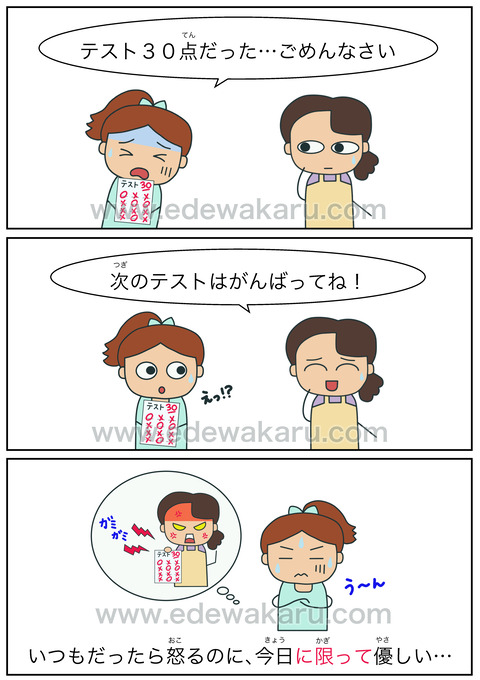
Meaning
いつもと違って、〜だけ特別に〜
How to use it
名詞[辞書形]+に限って
Explanation
「〜に限って」は「いつもと違って、〜だけ特別に〜」という意味を表す文型です。「
いつもとは違う」「〜だけ特別だ」
と言いたい時に使用されます。
[例]
①いつもだったら怒るのに、今日
に限って
優しい…
【いつも】怒る
→いつもと違って優しい
②ここ1週間ずっと晴れだったのに、明日
に限って
雨が降るらしい
【いつも】晴れ
→明日だけ違って雨が降るらしい
③毎朝7時に起きるのに、試験の日
に限って
起きられなかった
【いつも】7時に起きる
→いつも7時に起きるのに、試験の日だけ起きられなかった
④彼女はいつも元気なのに、旅行の日
に限って
かぜをひいてしまった
【いつも】元気
→いつも元気なのに、旅行の日だけかぜをひいてしまった
⑤ここのところ暇だったのに、この1週間
に限って
忙しかったな…
【いつも】暇
→ずっと暇だったのに、この1週間だけ忙しかった
「〜に限って」にはいくつか意味がありますので、区別をして覚えておきましょう😊
In context 5 examples
いつもだったら怒るのに、今日に限って優しい…
ここ1週間ずっと晴れだったのに、明日に限って雨が降るらしい(復習:ここ〜)(復習:〜らしい(推量))
毎朝7時に起きるのに、試験の日に限って起きられなかった
彼女はいつも元気なのに、旅行の日に限ってかぜをひいてしまった
ここのところ暇だったのに、この1週間に限って忙しかったな…(復習:〜ところ(Nのところ))
どんなときどう使う 日本語表現文型辞典
Meaning
only in the case of; only at times when
How to use it
N+に限って
Explanation
~の場合だけは
「~のときだけ、~だけは特に」と言いたいときに使う。 ❶ ❷ のように「特別にその場合だけ好ましくない状況になって不満だ」と言いたいとき、また ❸ ❹ のように、信頼や特別な期待をもって話題にし、「~だけは好ましくないことはないはずだ」という判断を言うときに使う。
Emphasizes something happens only in certain occasions or in particular cases. As in sentences ❶ and ❷ , can be used to show unhappiness with unpleasant circumstances that arise only in certain instances.Also as in sentences ❸ and ❹ , to show trust or judgment that something unpleasant cannot possibly happen in this one particular instance.
In context 4 examples
自信があると言う人に限って、試験はあまりよくできていないようだ。
ハイキングに行こうという日に限って雨が降る。わたしはいつも運が悪いなあ。
あの先生に限ってそんなしかり方はしないと思う。
S社の製品に限ってすぐに壊れるなんてことはないだろうと思っていたのに……。
日本語NET JLPT文法解説まとめ
Meaning
①〜の場合だけ、絶対に〜ない。
②〜の場合だけ、特にそうである / 運悪くそうなる。
① "only in a certain case is 〜 definitely not"
② "this is especially true in the case of"
How to use it
N + に限って
In context 10 examples
うちの子に限って、そんなことをするはずはない。
スペインに限って、初戦敗退なんてあり得ないよ。
彼女に限って、遅刻するなんてありえない。何かトラブルでもあったのかな。
彼に限って、約束を忘れるはずがないと思うんだけど。
遠足の日に限って、いつも雨が降るんだよね。
試験の日に限って、なぜかお腹を壊すんだよね。
予定がある日に限って、なぜか仕事が多いんだよね。
急いでいる時に限って、何でいつも渋滞なのよ。
仕事が忙しい日に限って、なぜかシステムトラブルが発生する。
大事な日に限って、朝寝坊してしまう。
毎日のんびり日本語教師
How to use it
名詞+に限って
Explanation
他の場合は発生しない状況が、ある重要なときだけに偏って発生することを表します
後項では予想外のことが述べられます。
Notes
「限る」シリーズ
In context 10 examples
体調悪い時に限って予定が入ってくる。(偏偏身体不舒服的时候才会有安排。)
天気が良い時に限って仕事。(只有天气好的时候才工作。)
自分が外出するときに限っていつも雨が降る。(偏偏自己外出的时候总是下雨。)
寂しい時に限って好きな人は側に居てくれない。
遅刻しちゃいけない日に限って寝坊してしまう。
早く帰りたいと思うときに限って時間が経つのめちゃくちゃ遅い。
理想が高い人に限って、自分自身を客観的に見ることができていない場合も多い。(理想高的人往往无法客观地看待自己。)
いつもよりメイクが上手くいった日に限って、会いたい人に会えない。
釣りは期待してない日に限ってよく釣れるものだ。(只有在不抱有任何期待的时候才能钓到很多鱼。)
どうでもいい事に限ってなかなか忘れない。
AIUEO JLPT Grammar
Meaning
This sentence pattern is used when expressing that something unusual or unexpected happens only under specific circumstances. It usually indicates that something is different from the norm or happens only at a certain time.
How to use it
名詞に+限って名詞に+限り
Explanation · 日本語
この文型は、名詞に接続して使われ、特定の人物や状況に対して、例外的な事態や予想外のことが起こることを表します。通常は、普段とは違う特別な状況や、なぜかそのときだけ起こることに対して使われます。
In context 5 examples
忙しい時に限って、電話が多くなる。
Only when I’m busy do I get a lot of phone calls.
彼に限って、そんなミスをするはずがない。
Of all people, he would never make such a mistake.
雨が降っている日に限って、傘を忘れてしまう。
It’s only on rainy days that I forget my umbrella.
お金がない時に限って、友達が遊びに誘ってくる。
It’s only when I’m broke that my friends invite me out.
彼に限って、約束を破るなんて信じられない。
It’s hard to believe that he, of all people, would break a promise.
文法
Meaning
①〜の場合だけ、絶対に〜ない。
②〜の場合だけ、特にそうである / 運悪くそうなる。
How to use it
N + に限って
In context 10 examples
うちの子に限って、そんなことをするはずはない。
スペインに限って、初戦敗退なんてあり得ないよ。
彼女に限って、遅刻するなんてありえない。何かトラブルでもあったのかな。
彼に限って、約束を忘れるはずがないと思うんだけど。
遠足の日に限って、いつも雨が降るんだよね。
試験の日に限って、なぜかお腹を壊すんだよね。
予定がある日に限って、なぜか仕事が多いんだよね。
急いでいる時に限って、何でいつも渋滞なのよ。
仕事が忙しい日に限って、なぜかシステムトラブルが発生する。
大事な日に限って、朝寝坊してしまう。
Bunpro Grammar Reference
Meaning
Particularly when, Those who, Only when
How to use it
Noun + に限って
Nuance
A structure that expresses that something is limited to things in (A), or within the situation of (A).
Explanation
The expression に限って in Japanese is a phrase that has three primary uses, the first is to show that (B) is an unbelievable thing about (A), the second is to express that something is limited to (A), and the third highlights that in most cases for (A), (B). Depending on the particular nuance that is being used, common translations include 'particularly when (A), (B)', 'those who (A), (B)', and 'only when (A), (B)'.
This structure is comprised of に, and the て-form of the う-Verb 限る 'to limit'. Let's look at a few examples of each potential meaning.
First, when something about (A) is unbelievable due to what is either expected or previously known.
うちの子に限って、他の子に手を出すなんて考えられない。
I can't imagine that my child, in particular, would hit another kid.
彼に限って、こんな簡単なことでミスをする訳が無い。
There is no way that he, in particular, would make a mistake on something this simple.
Second, when something is limited to (A).
武くんと釣りに行く日に限って、いつも雨が降るんだよな。
Only on days when I go fishing with Takeshi-kun does it always rain.
先輩は忙しい日に限って、飲みに誘ってくる。
My senpai invites me to go drinking with him only on days that I am busy.
Third, when (B) is true in most cases concerning (A).
「クレームを入れるぞ」って言う人に限ってクレームを入れないからあまり気にしていない。
I'm not too worried because particularly those who say, 'I'm going to file a claim', never do (file a claim).
「絶対後でやる」って言う人に限って、いつまでもやらない人が多い。
Many of those who say, 'I'll definitely do it later', never do.
While each of these uses can roughly be translated as 'only when', it will be important to keep all three meanings in mind when interpreting sentences that use に限って.
Nuance · 日本語
(A)というものの中、又は(A)という状況の中でしか何かが起こらないということを表す表現。
Explanation · 日本語
日本語の「に限って」という表現には、主に三つの使い方があります。一つ目は「(A) について (B) だとは信じられない」という表現、二つ目は「何かが (A) のときに限られる」という表現、三つ目は「(A) に関してほとんどの場合 (B) だ」という表現です。文脈によって「特に (A) のときは (B)」「(A) の人は (B)」「(A) のときだけ (B)」のような意味になります。
この表現は「に」と五段動詞「限る」のテ形の組み合わせです。それぞれの使い方についていくつか例を見ていきましょう!
まずは、(A) を知っている人にとって、「(A) について (B) であるとは信じられない・予想外だ」という場合です。
うちの子に限って、他の子に手を出すなんて考えられない。
I can't imagine that my child, in particular, would hit another kid.
彼に限って、こんな簡単なことでミスをする訳が無い。
There is no way that he, in particular, would make a mistake on something this simple.
次に、「(B) が (A) のときに限られる」という場合です。これは、「(B) が (A) のときだけ当てはまる」と言い換えることもできます。
武くんと釣りに行く日に限って、いつも雨が降るんだよな。
Only on days when I go fishing with Takeshi-kun does it always rain.
先輩は忙しい日に限って、飲みに誘ってくる。
My senpai invites me to go drinking with him only on days that I am busy.
最後に、「(A) に関してはほとんどのケースで (B) である」という場合です。
「クレームを入れるぞ」って言う人に限ってクレームを入れないからあまり気にしていない。
I'm not too worried because particularly those who say, 'I'm going to file a claim', never do (file a claim).
「絶対後でやる」って言う人に限って、いつまでもやらない人が多い。
Many of those who say, 'I'll definitely do it later', never do.
これらの使い方は、どれも大まかに「(A) のとき・人だけ」という意味だと言えますが、文脈によってニュアンスが異なるため、三つの意味を意識しながら理解することが大切です。
In context 18 examples
- 昼寝をしている時に限って電話が鳴る。
Particularly when I am napping does the phone ring.
- 彼に限って、こんな簡単なことでミスをする訳が無い。
There is no way that he, in particular, would make a mistake on something this simple.
- うちの子に限って、他の子に手を出すなんて考えられない。
I can't imagine that my child, in particular, would hit another kid.
- 「絶対後でやる」って言う人に限って、いつまでもやらない人が多い。
Many of those who say, 'I'll definitely do it later', never do.
- 武くんと釣りに行く日に限って、いつも雨が降るんだよな。
Only on days when I go fishing with Takeshi-kun does it always rain.
- 先輩は忙しい日に限って、飲みに誘ってくる。
My senpai invites me to go drinking with him only on days that I am busy.
- 「クレームを入れるぞ」って言う人に限ってクレームを入れないからあまり気にしていない。
I'm not too worried because particularly those who say, 'I'm going to file a claim', never do (file a claim).
- 僕がカメラを忘れた日に限って虹が出る。
Only on days when I forget my camera, do rainbows appear.
- 新曲発売日に限って大雨だ。
Only on days when a new song is released is it pouring rain.
- 早口の人に限ってたくさんしゃべるから、聞き取れない。
It’s always the fast talkers who talk a lot, so I can’t catch what they’re saying.
- 外に調査へ出かける時に限って、雨が降る。
It is only when I go out to investigate that it rains.
- 僕は大事な時に限って力を発揮できない。
Only when it is important, am I unable to demonstrate my strength.
- 飛行機に乗る時に限って、天候が悪かったりする。
The weather becomes bad and such particularly when I board an airplane.
- 花火の日に限って仕事が入り見に行けない。
Particularly on days when there are fireworks I have to go to work, preventing me from being able to go watch.
- 歯磨きをした後に限って夫がお土産を買ってくる。
Only when I brush my teeth will my husband buy me a present.
- 人通りが多い日に限ってあの場所に行かなければいけないから嫌だ。
I dislike it because, only on days when there is a lot of pedestrian traffic do I have to go to that place.
- 定休日ではないのに、僕があの店に行く日に限って臨時休業している。
Despite it not being a set holiday, only on days when I go to that store is it temporarily closed.
- よく節約を口にしている人に限って、給料を受け取っては、後で身につけもしない服など無駄遣いしがちだ。
Those who often speak about 'economizing' tend to waste their money on things like clothes they don't even wear whenever they receive salary.
IMABI
Limit
Read this IMABI lesson ↗Explanation
Limit: ~限り, ~を限りに, ~限りでは, ~に限って, ~に限らない, & ~とは限らない
限り is a rather complicated noun. Although it means “limit” and understanding it is no problem for most students, similar looking structures with it cause problems.
限り
~かぎり shows up in a lot of expressions, but what comes before it must be taken into account. Although particles may be a pain to get used to, you should still love them.
1. ~かぎり: This shows a parameter of a certain condition. Before ~かぎり, you may see nouns, adjectives, and verbs.
1. 保証ほしょうの限りではない。
It is not in the warranty.
2. 目の届とどく限り、晴れ渡わたっている。
The sky is clear as far as the eye can see.
3. 可能な限り、薬を飲まないようにしています。
I’m trying as best I can to not take the medicine.
4. できる限りのことをするのも無理なのだ。
Doing as much as possible is also no good.
5. 法律ほうりつの及およぶ限り厳密げんみつに処しょすべきだ。
It should be strictly dealt with to the full extent of the law.
6. 今年も能力の限り、お役に立てるよう働くことを誓ちかいます。
I vow to work to be of benefit [to X] to the best of my ability this year as well.
7. 外は豪雪ごうせつでも、部屋のなかにいるかぎりは真夏日まなつびのようだ。
Even if there is heavy snowfall outside, for as long as you’re inside the room, it’s like a hot summer day.
読み物: A Passage from 心 by 夏目漱石
8. 次の日私は先生の後あとにつづいて海へ飛び込こんだ。そうして先生といっしょの方角ほうがくに泳いで行った。二丁ちょうほど沖おきへ出ると、先生は後ろを振ふり返って私に話し掛かけた。広い蒼あおい海の表面に浮ういているものは、その近所に私ら二人より外ほかになかった。そうして強い太陽の光が、眼めの届く限り水と山とを照らしていた。私は自由と歓喜かんきに充みちた筋肉を動かして海の中で躍おどり狂くるった。先生はまたぱたりと手足の運動を已やめて仰向あおむけになったまま浪なみの上に寝た。私もその真似まねをした。青空の色がぎらぎらと眼を射いるように痛烈つうれつな色を私の顔に投なげ付つけた。「愉快ゆかいですね」と私は大きな声を出した。
漢字 Notes:
1. 蒼い is a very literary spelling for blue. And, you may also encounter 碧い in similar contexts. 蒼い is a rather dull “blue”, and it is often used in contexts where one “is blue in the face”. 碧い is used when “blue” may have anywhere from a light to dark green hue to it.
2. ~掛ける is usually spelled as ~かける in everyday writing.
3. Rather than using 満ちる, 充ちる has the added nuance of inundation. 満ちる is over all the most important spelling due to the fact that 充 does not have the reading み(ちる) listed in the 常用漢字表.
4. 躍る differs from 踊る in the sense that the latter is “dance” in a rhythmic sense whereas the former is just jumping up and down.
5. 已む specifically describes a phenomenon, action, or condition that has continued for some time stopping completely. It is generally replaced with 止む except in literal situations like this when the writer wishes to make this nuance clear.
6. 浪 specifically refers to ripples in water or water rising up.
The next day, I followed Sensei into the ocean. I then swam in the same direction as him. After going over a hundred meters offshore, Sensei turned around to talk to me. It was only us floating atop the surface of the wide, blue sea. The strong sunlight made the water and mountains glow for as far as one could see. I madly danced around in the waves with my muscles full of joy and freedom. Sensei, again, suddenly froze his arms and legs and lay flat on his back asleep on the waves, and so I mimicked him. The blue sky cast a scathing light into my eyes as if to pierce them out. “How pleasant!”, I yelled out.
Questions:
1. Find an example where a Japanese item is naturalized for the English translation.
2. Why might liberties in translation be needed with this passage?
~ない限り, which is an application of above, can be translated as “until” in contexts like below.
9. 君が考えを改あらためないかぎり、うまくいかない。
Until you rethink yourself, things won’t go well.
10. あいつは、あまりにも疲れていないかぎり、夜遅くまでIMABIを編集へんしゅうするそうだ。
That guy seems to edit IMABI up into the night unless he’s too tired.
11. 汚水おすいを飲まないかぎり大丈夫ですよ。
So long as you don’t drink filthy water, you should be fine.
After adjectives at the end of a sentence, ~かぎりだ shows the speaker’s emotions with what is being said not being simply about the nature of things, but the matter at hand doesn’t extend beyond a certain limit.
12. 誰からも連絡がなく、寂さびしいかぎりだ。
It’s just very lonely that I don’t get contact from anyone.
Another thing that this form can do that the two below cannot is be followed with a volitional expression.
13. 生きている限り歌おう。
I’ll sing until I die.
As a suffix after temporal phrases in the form of ~かぎりで, it express deadline.
14. 来月末限りで辞任するつもりだ。
I plan to resign at the end of next month.
2. ~を限りに, when used with time phrases, explicitly states when will be the last time that one does something. With non-temporal phrases, it shows some sort of physical limitation.
15. 彼は声の限りに叫さけんだ。
He screamed to the top of list lungs.
16. 今日を限りに酒は飲みません。
I will not drink alcohol from this day forward!
17. これを限りにお前とは縁えんを切る。
From here on I break my ties with you.
18. 今年の年末を限りに期限が切れる。
The term/period/deadline will expire at the end of this year.
3. ~限りでは: Verbs of cognition such as 知る, 見る, 聞く, 読む, etc. come before, and the following clause deals with a judgment. In totality, this construction means “as far as…”.
19. 知られる限りでは依然行方不明いぜんゆくえふめい。 (Headline)
[X] is/are still missing as far as is known.
20. 私の知っている限りでは、彼はそんなことをする人ではありません。
As far as I know, he is not the kind of person to do something like that.
4. ~に限って: This raises a time, person, or thing to mean “insofar/unless”. This is used a lot with とき.
21. あたしが出かけるときにかぎって、雨が降るのよ。(女性語)
It doesn’t rain unless I go out [somewhere].
22. 我わが社しゃの社員に限って、そのような不正はするはずがない。
Insofar as our company’s workers, we have no reason to do such illegality.
23. 読みたいときに限って、アクセスできない。
I can’t access it insofar as to when I want to read it.
As one would expect, this phrase has a negative form, ~に限らない. This means that something is not yet decided. Of course, in formal/written situations, you can see it as ~に限らず.
24. 怠なまけたがるのは、子供に限ったことじゃない。
Wanting to slack off is not limited to just kids.
25. 対象はアメリカ人に限りません。
Our target is not limited to Americans.
26. 韓国語を勉強している学生は、東アジア専攻に限りません。
Students who study Korean are not limited to East Asian majors.
5. ~とは限らない may resemble ~に限らない, and the best of students mix them up. However, because of the particle と, no part of speech limitations exists. ~とは限らない means “not necessarily”. This phrase is frequently used to speak against stereotypes.
27. 日本人がみんな勉強ばかりしているとは限らない。
It’s not necessarily the case that all Japanese people do nothing but study.
28. アメリカ人は、必ずしも日本人より背が高いとは限らない。
Americans are not necessarily taller than Japanese people.
29. テキサスの人がみんな必ずバーベキューばかり食べるとは限らない。
All Texans don’t necessarily eat just barbecue.
30. 念ねんを入れたからっていい仕上しあがりになるとは限らない。
Because we paid attention to detail, it’s (now) a good finish.
In context 41 examples
~かぎり: This shows a parameter of a certain condition. Before ~かぎり, you may see nouns, adjectives, and verbs.
It is not in the warranty.
保証ほしょうの限りではない。
It is not in the warranty.
目の届とどく限り、晴れ渡わたっている。
The sky is clear as far as the eye can see.
可能な限り、薬を飲まないようにしています。
I’m trying as best I can to not take the medicine.
できる限りのことをするのも無理なのだ。
Doing as much as possible is also no good.
法律ほうりつの及およぶ限り厳密げんみつに処しょすべきだ。
It should be strictly dealt with to the full extent of the law.
今年も能力の限り、お役に立てるよう働くことを誓ちかいます。
I vow to work to be of benefit [to X] to the best of my ability this year as well.
外は豪雪ごうせつでも、部屋のなかにいるかぎりは真夏日まなつびのようだ。
Even if there is heavy snowfall outside, for as long as you’re inside the room, it’s like a hot summer day.
次の日私は先生の後あとにつづいて海へ飛び込こんだ。そうして先生といっしょの方角ほうがくに泳いで行った。二丁ちょうほど沖おきへ出ると、先生は後ろを振ふり返って私に話し掛かけた。広い蒼あおい海の表面に浮ういているものは、その近所に私ら二人より外ほかになかった。そうして強い太陽の光が、眼めの届く限り水と山とを照らしていた。私は自由と歓喜かんきに充みちた筋肉を動かして海の中で躍おどり狂くるった。先生はまたぱたりと手足の運動を已やめて仰向あおむけになったまま浪なみの上に寝た。私もその真似まねをした。青空の色がぎらぎらと眼を射いるように痛烈つうれつな色を私の顔に投なげ付つけた。「愉快ゆかいですね」と私は大きな声を出した。
蒼い is a very literary spelling for blue. And, you may also encounter 碧い in similar contexts. 蒼い is a rather dull “blue”, and it is often used in contexts where one “is blue in the face”. 碧い is used when “blue” may have anywhere from a light to dark green hue to it.
The next day, I followed Sensei into the ocean. I then swam in the same direction as him. After going over a hundred meters offshore, Sensei turned around to talk to me. It was only us floating atop the surface of the wide, blue sea. The strong sunlight made the water and mountains glow for as far as one could see. I madly danced around in the waves with my muscles full of joy and freedom. Sensei, again, suddenly froze his arms and legs and lay flat on his back asleep on the waves, and so I mimicked him. The blue sky cast a scathing light into my eyes as if to pierce them out. “How pleasant!”, I yelled out.
~掛ける is usually spelled as ~かける in everyday writing.
The next day, I followed Sensei into the ocean. I then swam in the same direction as him. After going over a hundred meters offshore, Sensei turned around to talk to me. It was only us floating atop the surface of the wide, blue sea. The strong sunlight made the water and mountains glow for as far as one could see. I madly danced around in the waves with my muscles full of joy and freedom. Sensei, again, suddenly froze his arms and legs and lay flat on his back asleep on the waves, and so I mimicked him. The blue sky cast a scathing light into my eyes as if to pierce them out. “How pleasant!”, I yelled out.
Rather than using 満ちる, 充ちる has the added nuance of inundation. 満ちる is over all the most important spelling due to the fact that 充 does not have the reading み(ちる) listed in the 常用漢字表.
The next day, I followed Sensei into the ocean. I then swam in the same direction as him. After going over a hundred meters offshore, Sensei turned around to talk to me. It was only us floating atop the surface of the wide, blue sea. The strong sunlight made the water and mountains glow for as far as one could see. I madly danced around in the waves with my muscles full of joy and freedom. Sensei, again, suddenly froze his arms and legs and lay flat on his back asleep on the waves, and so I mimicked him. The blue sky cast a scathing light into my eyes as if to pierce them out. “How pleasant!”, I yelled out.
躍る differs from 踊る in the sense that the latter is “dance” in a rhythmic sense whereas the former is just jumping up and down.
The next day, I followed Sensei into the ocean. I then swam in the same direction as him. After going over a hundred meters offshore, Sensei turned around to talk to me. It was only us floating atop the surface of the wide, blue sea. The strong sunlight made the water and mountains glow for as far as one could see. I madly danced around in the waves with my muscles full of joy and freedom. Sensei, again, suddenly froze his arms and legs and lay flat on his back asleep on the waves, and so I mimicked him. The blue sky cast a scathing light into my eyes as if to pierce them out. “How pleasant!”, I yelled out.
已む specifically describes a phenomenon, action, or condition that has continued for some time stopping completely. It is generally replaced with 止む except in literal situations like this when the writer wishes to make this nuance clear.
The next day, I followed Sensei into the ocean. I then swam in the same direction as him. After going over a hundred meters offshore, Sensei turned around to talk to me. It was only us floating atop the surface of the wide, blue sea. The strong sunlight made the water and mountains glow for as far as one could see. I madly danced around in the waves with my muscles full of joy and freedom. Sensei, again, suddenly froze his arms and legs and lay flat on his back asleep on the waves, and so I mimicked him. The blue sky cast a scathing light into my eyes as if to pierce them out. “How pleasant!”, I yelled out.
浪 specifically refers to ripples in water or water rising up.
The next day, I followed Sensei into the ocean. I then swam in the same direction as him. After going over a hundred meters offshore, Sensei turned around to talk to me. It was only us floating atop the surface of the wide, blue sea. The strong sunlight made the water and mountains glow for as far as one could see. I madly danced around in the waves with my muscles full of joy and freedom. Sensei, again, suddenly froze his arms and legs and lay flat on his back asleep on the waves, and so I mimicked him. The blue sky cast a scathing light into my eyes as if to pierce them out. “How pleasant!”, I yelled out.
君が考えを改あらためないかぎり、うまくいかない。
Until you rethink yourself, things won’t go well.
あいつは、あまりにも疲れていないかぎり、夜遅くまでIMABIを編集へんしゅうするそうだ。
That guy seems to edit IMABI up into the night unless he’s too tired.
汚水おすいを飲まないかぎり大丈夫ですよ。
So long as you don’t drink filthy water, you should be fine.
誰からも連絡がなく、寂さびしいかぎりだ。
It’s just very lonely that I don’t get contact from anyone.
生きている限り歌おう。
I’ll sing until I die.
来月末限りで辞任するつもりだ。
I plan to resign at the end of next month.
~を限りに, when used with time phrases, explicitly states when will be the last time that one does something. With non-temporal phrases, it shows some sort of physical limitation.
He screamed to the top of list lungs.
彼は声の限りに叫さけんだ。
He screamed to the top of list lungs.
今日を限りに酒は飲みません。
I will not drink alcohol from this day forward!
これを限りにお前とは縁えんを切る。
From here on I break my ties with you.
今年の年末を限りに期限が切れる。
The term/period/deadline will expire at the end of this year.
~限りでは: Verbs of cognition such as 知る, 見る, 聞く, 読む, etc. come before, and the following clause deals with a judgment. In totality, this construction means “as far as…”.
[X] is/are still missing as far as is known.
知られる限りでは依然行方不明いぜんゆくえふめい。 (Headline)
[X] is/are still missing as far as is known.
私の知っている限りでは、彼はそんなことをする人ではありません。
As far as I know, he is not the kind of person to do something like that.
~に限って: This raises a time, person, or thing to mean “insofar/unless”. This is used a lot with とき.
It doesn’t rain unless I go out [somewhere].
あたしが出かけるときにかぎって、雨が降るのよ。(女性語)
It doesn’t rain unless I go out [somewhere].
我わが社しゃの社員に限って、そのような不正はするはずがない。
Insofar as our company’s workers, we have no reason to do such illegality.
読みたいときに限って、アクセスできない。
I can’t access it insofar as to when I want to read it.
怠なまけたがるのは、子供に限ったことじゃない。
Wanting to slack off is not limited to just kids.
対象はアメリカ人に限りません。
Our target is not limited to Americans.
韓国語を勉強している学生は、東アジア専攻に限りません。
Students who study Korean are not limited to East Asian majors.
~とは限らない may resemble ~に限らない, and the best of students mix them up. However, because of the particle と, no part of speech limitations exists. ~とは限らない means “not necessarily”. This phrase is frequently used to speak against stereotypes.
It’s not necessarily the case that all Japanese people do nothing but study.
日本人がみんな勉強ばかりしているとは限らない。
It’s not necessarily the case that all Japanese people do nothing but study.
アメリカ人は、必ずしも日本人より背が高いとは限らない。
Americans are not necessarily taller than Japanese people.
テキサスの人がみんな必ずバーベキューばかり食べるとは限らない。
All Texans don’t necessarily eat just barbecue.
念ねんを入れたからっていい仕上しあがりになるとは限らない。
Because we paid attention to detail, it’s (now) a good finish.