DoJG 日本語文法辞典(全集)
Usage 1
Meaning
I wonder if ~
How to use it
(i) {V/Vvolitional} informal | かな | |
| {話す/話した/話そう} かな | I wonder if someone talks/if someone talked/if I should talk |
(ii) Adjective い informal | かな | |
| {大きい/大きかった} かな | I wonder if something is/was big |
(iii) {Adjective な stem/Noun} | {Ø/だった} かな | |
| 静か{Ø/だった} かな | I wonder if something is/was quiet |
| 先生{Ø/だった} かな | I wonder if someone is/was a teacher |
(iv) Wh-word | {Ø/だった} かな | |
| いつ{Ø/だった} かな | I wonder when something is/was |
Explanation
A sentence-final particle that indicates a self-addressed question or a question addressed to an in-group member.
In context 9 examples
今週末には何をしようかな。
I wonder what I should do this weekend.
この問題、君に分かるかな。
Can you figure out this problem?
今日は何曜日だったかな。
I wonder what day of the week today is.
来学期から日本語を始めようかな。
I wonder if I should start Japanese next semester.
日本での生活はどうかな。
I wonder what life is like in Japan.
今日の晩ご飯は何かな。
I wonder what today's dinner will be.
アパートの家賃は高いかな。
I wonder if the apartment rent is high.
先生はお元気かな。
I wonder if my teacher is in good health.
音楽会の切符があるんだけど、君は行けるかな。
There is a concert ticket, but I wonder if you can go.
Usage 2
Meaning
How ~ !; what a(n) ~ !; to my/our ~; it is ~ that
How to use it
(i) {V/Vvolitional} informal | かな | |
| {話す/話した/話そう} かな | I wonder if someone talks/if someone talked/if I should talk |
(ii) Adjective い informal | かな | |
| {大きい/大きかった} かな | I wonder if something is/was big |
(iii) {Adjective な stem/Noun} | {Ø/だった} かな | |
| 静か{Ø/だった} かな | I wonder if something is/was quiet |
| 先生{Ø/だった} かな | I wonder if someone is/was a teacher |
(iv) Wh-word | {Ø/だった} かな | |
| いつ{Ø/だった} かな | I wonder when something is/was |
Explanation
An interjection that expresses deep felt emotion.
In context 7 examples
悲しいかな、年を取って往年の記憶力がなくなってしまった。
How sad (it is) that I no longer have as strong a memory as I had in my younger days.
悲しいかな、自分の能力を過大評価する人間がいる。
It's so sad that there are people who overestimate their ability.
インターネットを使うといろいろ面白いことが分かるそうですが、惜しいかな、私はコンピュータを買うお金がないんです。
They say that you can find out many interesting things if you use the Internet, but, to my great regret, I don't have the money to buy a computer.
画面では絵も動きます。チャットもできます。惜しいかな、全部英語ですが。
On the screen, pictures move, and you can chat, too. Regrettably, everything is in English.
秋の訪れを知ると共に、大空は広大なるかなと驚く。
With the coming of autumn, I am astonished by how broad the sky is.
みんな退職後の生活の甘いイメージを抱いている。しかし、残念なるかな、現実には、熟年離婚や体の不調にさいなまれている。
Everybody has a rosy image of post-retirement life. But, to our great regret, the reality is not as it seems; people are vexed by "vintage year divorce" and poor physical condition.
途中に教会があったので期待して入ってみると、果たせるかな、クリスマス礼拝で荘厳な雰囲気であった。
There was a church on my way, so I entered it, hoping (for a feeling of Christmas). Just as I expected, there was a solemn atmosphere for the Christmas service.
日本語文型辞典
Meaning
基本情報説明疑問を表す「か」に「な」が付いたもので、文末に用い、自分自身に問いかける気持ちを表す。ひとりごとで不思議に思う気持ちや疑問の気持ちを表すが、聞き手に向けられたときは疑問の表明で、そこから遠回しに許可を求めたり依頼したりする気持ちを表すこともある。丁寧体にはつかない。くだけた話しことば。「…かなあ」とのばして発音することもある。例文① 山田さんは今日来るかな。② これ、おいしいのかな。③ これ、もらって帰ってもいいのかな。④ ちょっと手伝ってくれないかな。⑤ 今度の旅行はどこへ行こうかな。⑥ 最近なんでこんなに疲れやすいのかなあ。
絵でわかる日本語
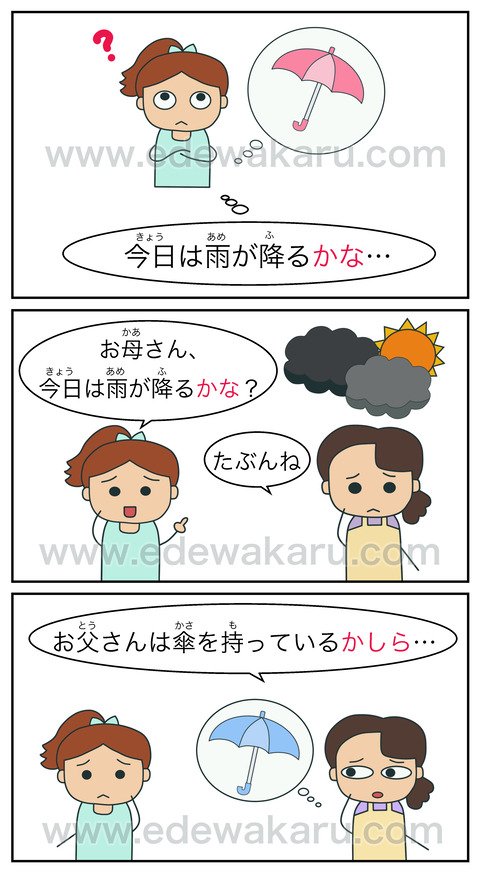
Usage 2
Read this source entry ↗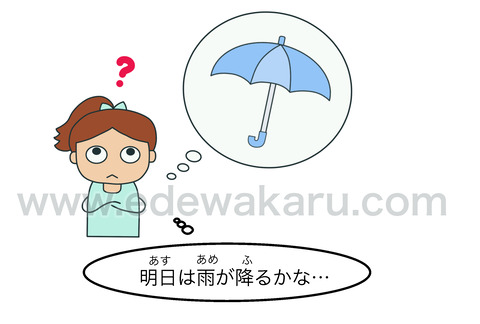
How to use it
動詞・形容詞・名詞[普通形]+かな
動詞・形容詞・名詞[普通形]+かしら
1 疑問に思う気持ち、不思議に思う気持ちを表す
Explanation
「〜かな」「〜かしら」を独り言で使う場合は疑問・不思議に思う気持ちを表します😊推量・疑問を表す「〜だろうか」にチェンジすることができます😀
2 相手に依頼する
In context 3 examples
明日は雨が降るかな…
→明日は雨が降るだろうか?これはおいしいかな…
→これはおいしいだろうか?最近、なんで(口語形「なんで?」)眠れないのかな…
→最近、なんで眠れないのだろうか?
日本語NET JLPT文法解説まとめ
Meaning
① 疑問の気持ちを表す
② 依頼したり、許可を求めるときに使う
How to use it
普通形 + かな(あ)
Explanation
① To express a sense of doubt
② To use when making requests or seeking permission
In context 8 examples
あと、30分でコンサートが始まっちゃう。電車が遅れてるし、間に合うかなあ。
一応、習った単語や漢字を復習したつもりだけど、明日のテスト大丈夫かなあ。
A:少し雲が出てきたね。
A:見て!このオムライス2,000円だって。
A:トムさん遅いね。
A:田中くん、悪いんだけど明日までにプレゼンの資料を用意してくれるかな。
A:(WBを指して)これ、消してもいいかな。
A:わぁ、美味しそう。一口食べてみてもいいかな。
日本語文型辞典 英語版
Meaning
かな is formed by attaching な to か, which is a marker indicating a question. かなis used at the end of a sentence and conveys the feeling of asking oneself a question. Although it expresses self-directed wondering or pondering, when uttered to another person it can be interpreted as an indirect request for assistance, permission, etc. Not combined with polite forms. A casual expression used in spoken language. The final sound な may be lengthened so it is pronounced as ...かなあ.
In context 6 examples
山田さんは今日来るかな。
I wonder if Yamada-san will come today.
これ、おいしいのかな。
I wonder if this is tasty.
これ、もらって帰ってもいいのかな。
I wonder if I can take this home.
ちょっと手伝ってくれないかな。
I wonder if you would give me a hand?
今度の旅行はどこへ行こうかな。
Where should I go on my next trip?
最近なんでこんなに疲れやすいのかなあ。
I wonder why I get tired so easily these days.
AIUEO JLPT Grammar
Meaning
「〜かな」is an ending particle used to softly express the speaker’s thoughts or doubts. It conveys uncertainty or expectation for the listener’s response and is often used in self-reflection or soliloquy.
Explanation · 日本語
「〜かな」は、話し手が自分の考えや疑問を柔らかく述べるときに使われ、文末に置かれる終助詞です。話し手が不確かなことや、相手の反応を期待しているニュアンスを含みます。また自問自答や独り言のように使われることも多いです。
In context 5 examples
明日は晴れるかな。
I wonder if it will be sunny tomorrow.
この問題、みんな解けるかな。
I wonder if everyone can solve this problem.
今年の夏は暑くなるかな。
I wonder if this summer will be hot.
この条件で合意できるかなと心配しています。
I wonder if we can reach an agreement under these conditions.
夕飯は何がいいかな。
I wonder what would be good for dinner.
Bunpro Grammar Reference
Meaning
I wonder
How to use it
Sentence + かな
Nuance
A word used to casually express uncertainty, or soften personal opinions.
Explanation
Originally a mixture of the sentence ending particles か, and な, かな evolved over time to become its own (singular) sentence ending particle, which roughly translates as 'I wonder if (A)?'.
As it is a sentence ending particle, かな can be added to the end of almost any sentence. However, in the case of な-adjectives, both だ and です will usually be omitted, with かな simply following the word stem itself.
あの人が道の真ん中で倒れてるけど、大丈夫かな。
That person over there is laying collapsed in the middle of the street, but I wonder if they are okay.
このコンロにこの魚が入るかな?
I wonder if the fish will fit in this stove.
Combining the meanings か and な, we can see where かな gets its original meaning. か presents questions (usually to other people), while な shows that a statement is related purely to the speaker's own thoughts/opinions. In this way, かな expresses that the speaker's own thoughts are being questioned.
Fun Fact
In the past, かな was thought of as being a fairly feminine way to express 'I wonder', and males tended to use phrases like だろうか to express the same type of statement. However, in modern day Japanese, かな is used by both men and women equally.
この通帳はお母さんのだろうか。
I wonder if this is my mother's checkbook. (Slightly masculine)
あの人は本当に弁護士なのかな。
I wonder if that person is really a lawyer. (Commonly used by anybody)
Nuance · 日本語
確信がないことを表したいときや、自分の意見を和らげるときに使うカジュアルな言葉。
In context 16 examples
- もうすぐ食べに行くかな。
I wonder if we will go eat soon...
- あの人が道の真ん中で倒れてるけど、大丈夫かな。
That person over there is laying collapsed in the middle of the street, but I wonder if they are okay.
- このコンロにこの魚が入るかな?
I wonder if the fish will fit in this stove.
- 明日は運動をした方がいいかな。
I wonder, if I should exercise tomorrow...
- 今週末に友達と会えるかな。
I wonder if I can meet my friends this weekend...
- 冷蔵庫にケーキまだあるかな。
I wonder if there is still cake in the fridge.
- お母さんは何をくれるかな。
I wonder what my mom will give me.
- 松本さんは図書館に居るかな。
I wonder if Matsumoto-san is at the library.
- 君は何を考えているのかな。
I wonder what you are thinking.
- 大分元気になったから、薬は飲まなくていいかな。
I wonder if it is okay not to take any medicine because I feel much better.
- 姉が 居ないから、誰かとどこかに行ったのかな。
I wonder if my older sister went somewhere with someone because she is not around.
- 彼女は外国人と付き合ったことがあるのかな。
I wonder if she has ever dated a foreigner.
- あの人の日本語は上手だね。日本に行った事があるのかな。
That person's Japanese is really good, don't you think? I wonder if that person has been to Japan.
- ユウキがあそこのレストランが美味しいって言っていたけど、本当に美味しいのかな。
Yuki said that that restaurant was good, but I wonder if it really is or not.
- この通帳はお母さんのだろうか。
I wonder if this is my mother's checkbook. (Slightly masculine)
- あの人は本当に弁護士なのかな。
I wonder if that person is really a lawyer. (Commonly used by anybody)
文法
Meaning
①疑問の気持ちを表す
②依頼したり、許可を求めるときに使う
How to use it
普通形 + かな(あ)
In context 8 examples
あと、30分でコンサートが始まっちゃう。電車が遅れてるし、間に合うかなあ。
一応、習った単語や漢字を復習したつもりだけど、明日のテスト大丈夫かなあ。
A:少し雲が出てきたね。
B:そうだね。あとで雨が降るかなあ。A:見て!このオムライス2,000円だって。
B:えっ!美味しいのかなあ。A:トムさん遅いね。
B:そうだね。LINEしても返事がないし、何かあったのかなあ。A:田中くん、悪いんだけど明日までにプレゼンの資料を用意してくれるかな。
B:はい、かしこまりました。A:(WBを指して)これ、消してもいいかな。
B:はい。A:わぁ、美味しそう。一口食べてみてもいいかな。
B:うん、どうぞ。
Yokubi — The Common Grammar Guide (https://yoku.bi)
Explanation
っけ is used when the speaker has forgotten something or is trying to recall something they once knew. It is usually, although not exclusively, used as a question directed to oneself.
っけ is almost never used with non-nouns except in the past tense. When it is, other stuff (like explanatory んだ) is usually put in between.
Similar to っけ, there is also かな. It is usually pronounced with a rising intonation as a question, but just like っけ it is a self-directed one. It simply means the speaker is wondering or unsure or hesitant about something, similar to "I wonder" in English. Needless to say it comes from the union of the question particle か and the sentence ending particle な.
It often comes after the volitional form of a verb to indicate that the speaker is about to decide to do something.
かい is a "friendly" question marker, especially for masculine speakers. Outside of familiar conversation, it can come across as rude/too direct. It's not as common in real life as it is in media. In standard usage, it can only be used to ask yes/no questions.
Parallel to かい, there is also だい. The vibes are pretty much the same, but unlike かい, だい is used to ask questions that expect an actual answer.
じゃない can also be used to ask confirmation questions. Yes, when attached to nouns, it's identical to normal "is not". No, there's no way around it. If you are lucky, there will be a question mark after it.
Note how adding a copula after verbs and い adjectives is technically incorrect but this type of じゃない lives on its own and can show up after them. It's not negating the predicate, it's just adding a negative question nuance ("isn't it?") and behaves like a sentence-ending particle.
じゃん is a casual contraction of じゃない.
In context 2 examples
話したいことがあるんだけど、いいかな?
I have something I need to talk to you about, I wonder if now is okay?
さて、本でも読もうかな
Well then, shall we read a book or something?
IMABI
語尾 III
Read this IMABI lesson ↗Explanation
語尾 III: かな, かしら, じゃん, い, け, が, こと, & たら
As the curriculum remastering progresses, the goal is to have all final particles given proper discussions, with most receiving their own lessons.
The Final Particle かな & かしら
かな = “I wonder” and is a colloquial variant of ~でしょう. ~ないかな shows wishful thinking by stressing desire for something to happen already. かしら is a feminine version.
1. 終わるかな。
I wonder if it’s going to end.
2. 悲しいかな。
How sad!
3. 窓まどを開けてくれないかな。
Could you open up the window?
Nuance Note: As demonstrated, かな may also elicit a request to people familiar/close to you.
4. 喋しゃべりすぎたのかな。
I wonder if I chatted too much?
5. どのくらい雪が積つもったかしらね。
I wonder how much snow accumulated.
6. どうかしら?
How does it look?
7. これをいただけるかしら?
May I take this?
9. 大丈夫だいじょうぶかしら。
I wonder if he’s OK.
10. あの男、誰だれかしら。
I wonder who that man is.
11a. 売らんかなの宣伝せんでん (慣用句)
11b. 売ってなんぼの姿勢が見え隠れする宣伝 (普通の言い方)
Exploitation/sales talk
Phrase Note: 売らんかな is a set phrase made up of the verb 売る (to sell), the auxiliary verb ~ん, which is a contraction of ~む (a Classical ending that shows guess here), and かな.
13. 「トルコで最もっとも危険な道路」と言われるのもむべなるかなである。
It’s also plausible that it’s called “the most dangerous road in Turkey”.
From 雨天炎天 by 村上春樹.
Phrase Note: むべなるかな is a set phrase made up an old 形容動詞 in its 連体形, むべなる, which is equivalent to もっともな (plausible; quite right), followed by かな.
果 はたせるかな means “just as expected”. It is interchangeable with 果たして, but it may be confusing to some simply because it has かな in it.
14. {果たせるかな・案の定じょう・思った通り}試こころみはことごとく失敗しっぱいしたんだ。
As expected, the experiment failed altogether.
The Final Particle じゃん
じゃん started out as a contraction of じゃないか. Once it reached Tokyo, it reached national stardom. Unlike what it came from, it is quite casual and is by no means blunt.
15. 足元あしもとが危なっかしいじゃん?
Isn’t your footing unsteady?
Word Note: 危なっかしい is not a typo of 危ない (dangerous). The word is very similar and refers to a situation that is either unsteady or dangerous. It is very similar to the word “precarious”.
16. いいじゃん。
Isn’t that good?
The Final Particle い
い is quite explosive and normally rude. It is almost always used by guys but is most importantly used by people of high temperament. It is often seen after だ, や, or じゃ and is also seen often after the 命令形.
17. 当たり前だぜぃ。
That is obvious!
18. おい、こりゃ何だい?
Hey, what is this!?
19. 何か飲むかい?
Will you drink anything?
20. こりゃ何じゃい?
What’s that?
Etymology Note: This particle comes from the particle よ. よ → え → い.
The Final Particle け
(っ)け is casually used in attempt to recall something by jogging one’s memory and perhaps also the listener(s). っけ can only follow either the plain non-past or the plain or polite past forms. So, ですっけ isn’t used. It is most often used with the plain forms, probably due to the fact that it is a contraction. However, with adjectives and verbs in the non-past, んだ is almost always inserted. So, you will see 新しいんだっけ but not 新しいっけ. This, though, may be acceptable in certain dialects.
This restriction stems from the fact that its usage with the past tense has a much longer history. -た can show confirmation in sentences like “what was his name?”. Obviously the person’s name hasn’t changed, but we still use the past tense form of the verb.
Similarly, with interrogatives it solicits a response from the listener, whether it’s something that the listener(s) have actually said before or not. Some situations, then, require the past tense. For instance, if you’re recalling an event that’s already happened, だっけ is wrong.
Examples
21. よく喧嘩けんかしたっけねえ。
We often bickered, didn’t we?
22. このパンはもう賞味期限しょうみきげんが切れてるんだっけ?
Isn’t this bread already passed the expiration date?
23. いつ象ぞうを捕つかまえたっけ?
When did you catch the elephant?
24. アメリカでは、税金ぜいきんが去年ぐーんと引き上げられたっけ。
Weren’t taxes raised straight up in America last year?
25. いつだ(った)っけ。
When is it?
Historical Note: ~たっけ comes from ~たりけり. It does not come from ~たかえ. ~かえ is now old-fashioned, but it is a feature of Eastern Japanese dialects similar to かい without the vulgarity.
26. 出来たかえ。
Could you do it?
From 我輩わがはいは猫である by 漱石.
Dialect Note: In some dialects け can be a ruder or typical version of か.
27. これ要るけ。(京都弁)
Do you need this?
Also, in some dialects け → かいな. In Standard Japanese, though, this is an old ending that stresses a thought with a sense of doubt or is a contraction of そうかな.
28. やったかいな (京都弁) = やったっけ
The Final Particle が
1. The final particle が shows malice by speaking ill of someone. This usage is very rude and may cause sharp backlashes.
29. ガキめが!
You brat!
2. The final particle が may hint at one’s own thoughts rather than what’s at hand.
30. 今日はもう閉店なんですが。
But we’re already closed for today. (Polite)
31. 引っ越こせばよかったんだが。
It would be good if we had moved, but…
32. 僕も注意したんだが。
I also warned them, but…
33. もしもし、鈴木ですが。
Hello, this is Suzuki. (Polite)
34. 社長がお呼びですが。 (Respectful)
The company president has called for you.
The Final Particle たら
This たら brings up something to someone’s attention with a sense of surprise, criticism, or impatience. This has nothing to do with the conditionals, but don’t be surprised when you hear it. It’s not a good thing if such a statement is directed to you.
35. やめてったら!
Stop that!
36. だまってたら!
Shut it!
Multiple 語尾
You will often see more than one 語尾 at once. There are several important combinations that you should be aware that you can make. Exact combinations may not be common in some parts of Japan. Plus, there are plenty of interjectory particles that are very regional.
かね
かな is the combination of か and な. かね is also possible. It works the same way as かな, but it is definitely more common in certain age groups and or dialects in Japanese. It can also be used to soften a criticism like in “どうしてそんなことをしているのかね?” It is softer than かな.
がな
This comes from the archaic particle もがな, which shows wishful thinking. This is equivalent to といいなあ. がな is still occasionally used. It may also be dialectal to emphasize (a reminder).
37. もう済すんだがな!
It should already be done!
かい
かい is a more harsh version of か. Its use is declining and can be associated with foreigner speech as learners tend to overuse it.
38. もういいのかい。
Are you done already?
わい
わい is typical of (older) male speech, and it is more common in dialectical speech, especially in West Japanese Dialects. This ending shows exclamation.
39. こんな老人を目の前にして「お墓」の一語をさらりと口に出すというのはなかなか良い根性をしておるわいと平岡は思い一転して愉快な気分になってきた。
Having such an old man in front of his eyes without hesitation express the word “grave” shows good tenacity, Hiraoka thought, and in turn, he came to feel delightful.
From 不可能 by 松浦寿輝.
40. 困ったことだわい。
I’m troubled.
41. そんなことないわい。
That’s not it at all.
In context 42 examples
終わるかな。
I wonder if it’s going to end.
悲しいかな。
How sad!
窓まどを開けてくれないかな。
Could you open up the window?
喋しゃべりすぎたのかな。
I wonder if I chatted too much?
どのくらい雪が積つもったかしらね。
I wonder how much snow accumulated.
どうかしら?
How does it look?
これをいただけるかしら?
May I take this?
大丈夫だいじょうぶかしら。
I wonder if he’s OK.
あの男、誰だれかしら。
I wonder who that man is.
売らんかなの宣伝せんでん (慣用句)
Exploitation/sales talk
売ってなんぼの姿勢が見え隠れする宣伝 (普通の言い方)
Exploitation/sales talk
「トルコで最もっとも危険な道路」と言われるのもむべなるかなである。
It’s also plausible that it’s called “the most dangerous road in Turkey”.
{果たせるかな・案の定じょう・思った通り}試こころみはことごとく失敗しっぱいしたんだ。
As expected, the experiment failed altogether.
足元あしもとが危なっかしいじゃん?
Isn’t your footing unsteady?
いいじゃん。
Isn’t that good?
当たり前だぜぃ。
That is obvious!
おい、こりゃ何だい?
Hey, what is this!?
何か飲むかい?
Will you drink anything?
こりゃ何じゃい?
What’s that?
よく喧嘩けんかしたっけねえ。
We often bickered, didn’t we?
このパンはもう賞味期限しょうみきげんが切れてるんだっけ?
Isn’t this bread already passed the expiration date?
いつ象ぞうを捕つかまえたっけ?
When did you catch the elephant?
アメリカでは、税金ぜいきんが去年ぐーんと引き上げられたっけ。
Weren’t taxes raised straight up in America last year?
いつだ(った)っけ。
When is it?
出来たかえ。
Could you do it?
これ要るけ。(京都弁)
Do you need this?
やったかいな (京都弁) = やったっけ
The final particle が shows malice by speaking ill of someone. This usage is very rude and may cause sharp backlashes.
You brat!
ガキめが!
You brat!
The final particle が may hint at one’s own thoughts rather than what’s at hand.
But we’re already closed for today. (Polite)
今日はもう閉店なんですが。
But we’re already closed for today. (Polite)
引っ越こせばよかったんだが。
It would be good if we had moved, but…
僕も注意したんだが。
I also warned them, but…
もしもし、鈴木ですが。
Hello, this is Suzuki. (Polite)
社長がお呼びですが。 (Respectful)
The company president has called for you.
やめてったら!
Stop that!
だまってたら!
Shut it!
もう済すんだがな!
It should already be done!
もういいのかい。
Are you done already?
こんな老人を目の前にして「お墓」の一語をさらりと口に出すというのはなかなか良い根性をしておるわいと平岡は思い一転して愉快な気分になってきた。
Having such an old man in front of his eyes without hesitation express the word “grave” shows good tenacity, Hiraoka thought, and in turn, he came to feel delightful.
困ったことだわい。
I’m troubled.
そんなことないわい。
That’s not it at all.