AIUEO JLPT Grammar
Meaning
This sentence pattern is used to show that something is added to or is in addition to another thing. It emphasizes the increase or addition to something.
How to use it
動詞+上 (+に)形容詞+上 (+に)形容動詞な+上 (+に)名詞の+上 (+に)
Explanation · 日本語
この文型は、ある事柄が他の事柄に加わっていることを表す表現です。この表現は、何かが増加している、または何かに追加されていることを強調するときに使われます。「〜上に」の「に」は省略可能です。
In context 5 examples
この店は安い上に、品揃えも豊富です。
This store is cheap, and moreover, it has a wide selection.
今日は寒い上に、風も強いです。
Today is cold, and on top of that, it is very windy.
このパソコンは性能が良い上、価格も手頃です。
This computer has good performance, and on top of that, it is affordable.
道路が渋滞している上に、事故も起こりました。
The road is congested, and on top of that, there was an accident.
この車は高い上、維持費もかかります。
This car is expensive, and on top of that, it also costs a lot to maintain.
Bunpro Grammar Reference
Meaning
As well, Besides, In addition to
How to use it
Verb + 上(に)
[い]Adjective + 上(に)
[な]Adjective + な(1) + 上(に)
Noun + の(1) + 上(に)
(1) である
Nuance
A slightly formal structure which adds information on top of (A), as a means of saying something in addition.
Explanation
上に is a grammar pattern that functions as a slightly formal way of saying 'and' in Japanese. It shows that something is 'in addition to (A)', 'as well as (A)', or 'besides (A)'. Literally, it simply shows that 'on top of (A), (B)'.
上に may be used after that standard form of verbs and い-Adjectives, な-Adjectives followed by な上に, and nouns followed by の上に. Occasionally, the に may be dropped from this structure, without changing the meaning at all.
私の犬は子供を見ると吠える上に噛みつこうとするので子供には近づけさせないようにしています。
In addition to barking, my dog tries to bite children when he sees them, so I try not to let him get close to them.
家の近所にあるレストランはまずい上に、高いからいつも空いている。
The restaurant near my house is always empty because in addition to having bad food, they are expensive.
高橋くんは無礼な上に清潔感がないため、周りの人たちには避けられている。
Takahashi-kun is rude as well as unhygienic, so he is avoided by the people around him.
彼女は調理師免許の上に健康食アドバイザーの資格も持っているので、彼女が作る料理は健康的で美味しいです。
In addition to having a chef's license, she also has qualification as a nutrition advisor, so the food she makes is healthy and delicious.
When it comes to な-Adjectives and nouns, it is also common to see である上に used as a conjugation pattern.
あそこの駅は不便である上に利用者が減っている為、来月の中旬に取り壊されるそうだ。
I heard that the station over there is going to get torn down in the middle of next month because in addition to being inconvenient, it is losing users.
ケントさんは新聞記者である上にスーパーヒーローでもあった。
Kent-san was a newspaper reporter as well as a superhero.
Caution
上に must always be used to highlight qualities of things that are equivalent to each other. For example, a good thing and another good thing, or a bad thing and another bad thing.
あの建築会社が建てる家は丈夫な上にお洒落なので、すごく人気があるらしい。
Apparently that building company is very popular right now because the houses they build are durable as well as stylish. (Natural Japanese)
彼はハンサムな上に失礼だから、あまりモテない。
He is not very popular because in addition to being handsome, he is rude. (Unnatural Japanese)
Nuance · 日本語
さらに何かを言う手段として(A)に情報を追加する、少し丁寧な表現。
Explanation · 日本語
「上に」は (A) に (B) を足すときに使われる少し硬めの文型です。文字通り (A) の上に (B) があるようなイメージで「(A) だし、それに (B)」のような意味で使われます。
「上に」は、動詞やイ形容詞の普通形、後ろに「な」を伴ったナ形容詞、後ろに「の」を伴った名詞の後ろに置かれます。ときどき「に」が省略されることもありますが、意味は変わりません。
私の犬は子供を見ると吠える上に噛みつこうとするので子供には近づけさせないようにしています。
In addition to barking, my dog tries to bite children when he sees them, so I try not to let him get close to them.
家の近所にあるレストランはまずい上に、高いからいつも空いている。
The restaurant near my house is always empty because in addition to having bad food, they are expensive.
高橋くんは無礼な上に清潔感がないため、周りの人たちには避けられている。
Takahashi-kun is rude as well as unhygienic, so he is avoided by the people around him.
彼女は調理師免許の上に健康食アドバイザーの資格も持っているので、彼女が作る料理は健康的で美味しいです。
In addition to having a chef's license, she also has qualification as a nutrition advisor, so the food she makes is healthy and delicious.
ナ形容詞や名詞の場合、「である上に」という形で使われることもよくあります。
あそこの駅は不便である上に利用者が減っている為、来月の中旬に取り壊されるそうだ。
I heard that the station over there is going to get torn down in the middle of next month because in addition to being inconvenient, it is losing users.
ケントさんは新聞記者である上にスーパーヒーローでもあった。
Kent-san was a newspaper reporter as well as a superhero.
注意点
「上に」を使うとき、(A) と (B) は必ず同じ性質を持つものになります。例えば、(A) が良いことであれば (B) も良いことになり、(A) が悪いことなら (B) も悪いことになります。
あの建築会社が建てる家は丈夫な上にお洒落なので、すごく人気があるらしい。
Apparently that building company is very popular right now because the houses they build are durable as well as stylish. (Natural Japanese)
彼はハンサムな上に失礼だから、あまりモテない。
He is not very popular because in addition to being handsome, he is rude. (Unnatural Japanese)
In context 20 examples
- そのジムは安い上に、私の家から近い。
As well as being cheap, that gym is close to my house. (on top of that)
- 彼女は調理師免許の上に健康食アドバイザーの資格も持っているので、彼女が作る料理は健康的で美味しいです。
In addition to having a chef's license, she also has qualification as a nutrition advisor, so the food she makes is healthy and delicious.
- あそこの駅は不便である上に利用者が減っている為、来月の中旬に取り壊されるそうだ。
I heard that the station over there is going to get torn down in the middle of next month because in addition to being inconvenient, it is losing users.
- 私の犬は子供を見ると吠える上に噛みつこうとするので子供には近づけさせないようにしています。
In addition to barking, my dog tries to bite children when he sees them, so I try not to let him get close to them.
- 家の近所にあるレストランはまずい上に、高いからいつも空いている。
The restaurant near my house is always empty because in addition to having bad food, they are expensive.
- ケントさんは新聞記者である上にスーパーヒーローでもあった。
Kent-san was a newspaper reporter as well as a superhero.
- 高橋くんは無礼な上に清潔感がないため、周りの人たちには避けられている。
Takahashi-kun is rude as well as unhygienic, so he is avoided by the people around him.
- あの店はリフォームした上に、メニューも変わったらしい。
I heard that restaurant changed its menu, in addition to being remodeled. (on top of)
- 彼はお洒落な上にイケメンだから、モテモテだ。
Because he is stylish as well as good-looking, he is well-liked. (on top of that)
- 今日の宿題は簡単な上に、少ない。
In addition to being easy, today's homework load was light. (on top of that)
- あの人の説明は、曖昧な上に不正確だ。
That person's explanation was vague, as well as inaccurate. (on top of that)
- 彼は、怪しい上に気持ち悪いから、まずもてない。
Besides being dodgy, he is also unpleasant so he is hardly popular with the ladies. (on top of that)
- 友人は、知恵がある上に勇ましいから頼りになります。
Because my friend is wise, as well as brave, he is reliable. (on top of that)
- 園芸は、楽しい上に達成感があります。
In addition to being fun, gardening also gives you a sense of achievement. (on top of that)
- 今日のおかずは豪華な上に品数も多いのだが、今日は何の日なんだろう?
Today's side dishes are extravagant as well as numerous. I wonder what the occasion is... (on top of that)
- あの店は、美味しい上に落ち着く雰囲気だから、また行きたい。
Because that shop has a calm atmosphere, in addition to being delicious, I want to go again. (on top of that)
- 彼はお酒を飲むと、暴れる上に悪態をつくから手に負えない。
If he drinks alcohol, in addition to being violent, he uses abusive language, so he is uncontrollable. (on top of that)
- 彼女は、おとなしい上に人見知りだから、なかなか友達ができません。
Because she is quiet as well as shy, she is not really able to make friends. (on top of that)
- あの建築会社が建てる家は丈夫な上にお洒落なので、すごく人気があるらしい。
Apparently that building company is very popular right now because the houses they build are durable as well as stylish. (Natural Japanese)
- 彼はハンサムな上に失礼だから、あまりモテない。
He is not very popular because in addition to being handsome, he is rude. (Unnatural Japanese)
DoJG 日本語文法辞典(全集)
Meaning
As well; in addition; besides; furthermore; moreover; not only ~ but also
How to use it
Sentence | 上(に) | The same as relative clause connection rules |
Explanation
上(に)A conjunction which introduces an additional, emphatic statement.
In context 10 examples
この映画は話の筋が面白い上(に)配役がいい。
Besides the fact that this movie has an interesting storyline, the cast is good.
彼は仕事を見つけてくれた上(に)お金まで貸してくれた。
Not only did he find me a job, he even lent me some money.
彼女はフランス語が専門の上(に)パリにしばらく住んでいたから、フランス語かペラペラだ。
She is fluent in French because she majored in French and, in addition, she lived in Paris for a while.
吉岡さんは奥さんに離婚された上(に)仕事まで失った。
Not only was Mr. Yoshioka divorced by his wife, he also (literally: even) lost his job.
私は年をとっている上(に)特に技能もないので、なかなか仕事が見つからない。
Because I am not only old but also have no special skills, it is hard to find a job.
この車は故障が少ない上(に)燃費がいいので、よく売れている。
This car sells well because (besides the fact that) it seldom needs repairs (literally: seldom has trouble) and furthermore it gets good mileage.
私のアパートは狭い上(に)家具が沢山あるので、お客さんが来た時、寝てもらう場所がない。
Besides being small, my apartment has a lot of furniture, so there is no space for guests to sleep when they come.
私のアパートは通勤に便利な上(に)家賃が安い。
My apartment is convenient for commuting to work and, furthermore, the rent is inexpensive.
田中先生は教え方が上手な上(に)学生の面倒をよく見るから、とても人気がある。
Ms. Tanaka is very popular because she is good not only at teaching but also at taking care of her students.
彼はスピード違反で捕まった時、無免許の上(に)酒に酔っていた。
When he was caught for speeding, he had no driver's license (i.e., he was not licensed) and, moreover, he was drunk.
絵でわかる日本語
Meaning
〜し、それに〜
〜し、更に〜
How to use it
動詞・形容詞[普通形]+上に
名詞[ーである]+上に
Explanation
「〜上に」は「〜し、それに〜」という意味を表す文型です。この文型を使う時に注意しなければいけないことは
「いいことにはいいこと」を、「悪いことには悪いこと」
をプラスして言わなければいけないところです😮
[例]
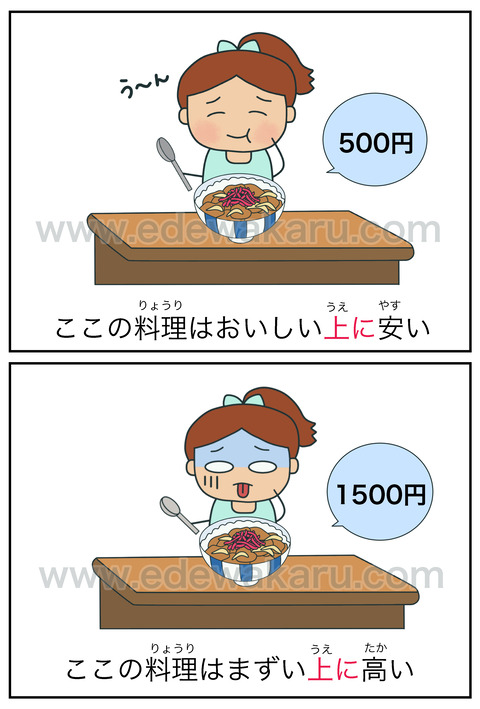
⭕️ここの料理はおいしい
上に
安い【おいしい・安い→いいこと】
⭕️ここの料理はまずい
上に
高い【まずい→悪いこと 高い→悪いこと】
❌ここの料理はおいしい
上に
高い 【おいしい→いいこと 高い→悪いこと】
また
「〜上に」の「に」は省略することができます。
[例]
ここの料理はおいしい
上、安い
彼女は優しい
上、かわいい
「〜上」とつく文型はいくつかありますので区別して覚えておきましょう😀
In context 3 examples
ここの料理はおいしい上に安い
→ここの料理はおいしいし、それに安い彼女は優しい上にかわいい
→彼女は優しいし、それにかわいい山田さんはごちそうしてくれた上にお土産もくれた
→山田さんはごちそうしてくれたし、更にお土産もくれた
NINJAL 日本語文型データベース
Meaning
〜のほかに、さらに予想外の他のことも重なると言いたいときに使います。
How to use it
V普通形+上に
i-A普通形+上に
na-A普通形+上に(ただし、「na-Aだ」→「na-Aな+上に・na-Aである+上に」
Nの上に・N普通形+上に(ただし、「Nだ」→「Nの+上に・Nである+上に」)
Notes
「~」には、予想しやすい事柄がきます。「~上に」の後には、「~」と同じ評価(プラス評価またはマイナス評価)の、「〜」より予想しにくい別の事柄がきます。話し手の意向を表す文や相手への働きかけの文はきません。
「~も~上に、~も~」のように、「〜」と「〜上に」の後の文の強調したい事柄を表す言葉に「も」をつけることもあります。
In context 23 examples
いつもお世話になっている上に、本日はおいしい果物まで送っていただきまして、本当にありがとうございます。
私は楽天的に考えられない上に、過去のことにいつまでもこだわる癖がある。
今日のドライブはさんざんだった。ひどい渋滞に巻き込まれた上に、大雨になり景色を楽しむこともできなかった。
昨日は食欲がなかった上に、何もやる気が出ない一日だった。
今日の入社試験では、筆記試験もよくできなかったうえに、面接でもうまく答えられなかった。
「この店はおいしい上に安くて、言うことないね」
当地は空気がいい上に静かで、別荘地としてはおすすめですよ。
今日は私自身の体調がよくない上に、子どもも熱を出している。困ったなあ。
学生時代は経済的にきつかった。授業料が高かった上に、教材費もかなりかかった。
今年の夏は猛暑の日が多くなかった上に、湿気もあまりなくて過ごしやすかった。
その映画はストーリーが面白くなかったうえに長くて、私は途中で眠ってしまった。
兄は生来、楽天的な上に世話好きなので、友人が多い。
この論文は論拠が明確でない上に、データの信頼性にも欠ける。
今日のA議員の答弁は説明不十分だった上に感情的だった。明日の新聞で批判されることだろう。
以前の私は論理的に話をするのが得意ではなかった上に、人の話に耳を傾けるのも苦手だった。就職してからこの欠点を直す努力をした。
彼は仕事がスピーディであるうえに非常に誠実なので、まわりの人から頼りにされている。
悪天候の上に災害にも見舞われて、今年のりんごの収穫量は大幅に減少した。
低賃金の上に見返りもない仕事を10年続けたが、嫌気がさしてきた。
私にとって、住宅ローンを払うのはかなりの負担である上に、物価が上がった不安も強い。なんとかならないものか。
ここに3分ぐらい車を止めていたら「駐車禁止」の紙を貼られてしまった。違反ではない上に歩道に倒れていた人を助けるためだったのに。
冠婚葬祭は日常的なことではない上に、地域による違いも大きいので、細かいしきたりを覚えているのは大変だ。
1人目の子は、難産だった上に未熟児だったので、大変だった。
運転中、事故を起こしてしまった。しかし、大事故ではなかったうえに、すぐに救急車が来てくれたので助かった。