Bunpro Grammar Reference
Meaning
Over (a period), From ~ until, Through
How to use it
Noun + にかけて(は)
Nuance
An expression used to highlight a duration of time during which a certain action will be suspended in an ongoing state.
Explanation
Coming from the る - Verb 掛ける 'to suspend', にかけて conveys that something is happening 'over a period of time', 'from (A) until (B)', or 'all through (A)'. This grammar structure is a combination of the case marking particle に, and 掛ける combined with the conjunction particle て. Literally, the meaning can be thought of as follows:
に - Marks (A) as the location/state.
掛けて - States that something is 'suspended' (in an ongoing process) in that location/state.
The 'something' that is an ongoing process will usually be indicated by a (B) part of the sentence. This expression will primarily be used with nouns.
今夜から朝にかけて大雨が降るでしょう。
It looks like it will rain from tonight through til the morning.
毎年、三月末から五月の頭にかけて多くの人が引っ越しをします。
Every year, a lot of people move from the end of March through the beginning of May.
にかけて is primarily used in written language, although it appears quite often in the news as well, indicating that some weather pattern is expected to continue for a set period of time.
Caution
Occasionally, the adverbial particle は is used after にかけて. This transforms the meaning of 'all through (A)', to something similar to 'limited to within (A)'. Any (B) phrase in these types of sentences will be contrasting (B) with (A), rather than saying (B) is occurring within (A).
今は雨が降っていますが、朝にかけては晴れるでしょう。
It is raining right now, but it seems like it will clear up during the morning. (Limited to the extent of tomorrow morning)
今月から来月にかけては忙しい時期になるので、無理せずに頑張ってください。
Limited from this month through until next month, it is going to be a busy season, so please do your best without overworking yourself.
As we can see by these examples, this is an extension of the standard use of は, which shows that everything before it is a 'set state'. Therefore '(A) は (B)', means that 'only (A) defines (A), (B) is a separate entity/discussion'.
Nuance · 日本語
ある行動が進行中の状態で中断される期間を強調するために使用される表現。
Explanation · 日本語
「にかけて」は、一段動詞「掛ける」から来ている表現で、「(A) から (B) まで」や「(A) の期間や範囲で」という意味を表します。この文法は、格助詞「に」と「掛ける」のテ形を合わせてできています。意味についてはそのまま、以下のように考えることができます。
「に」- (A) を場所や状態として示す。
「掛けて」- ある出来事がその場所や状態に「掛かって続いている」ことを表す。
この「続いている」出来事がどのようなものであるかは、文の後半 (B) で説明されることが多いです。また、この表現は主に名詞のあとで使われます。
今夜から朝にかけて大雨が降るでしょう。
It looks like it will rain from tonight through til the morning.
毎年、三月末から五月の頭にかけて多くの人が引っ越しをします。
Every year, a lot of people move from the end of March through the beginning of May.
「にかけて」は基本的に書き言葉ですが、ニュースの天気予報などではよく使われます。
注意点
「にかけて」のあとに、副助詞の「は」が付くことがあります。このときは、文の (B) は、ただ「(A) の中で (B) が起こっている」という意味ではなく、「(A) の範囲に限って言えば」という限定や比較のニュアンスが生まれます。
今は雨が降っていますが、朝にかけては晴れるでしょう。
It is raining right now, but it seems like it will clear up during the morning. (Limited to the extent of tomorrow morning)
今月から来月にかけては忙しい時期になるので、無理せずに頑張ってください。
Limited from this month through until next month, it is going to be a busy season, so please do your best without overworking yourself.
これは「は」の基本的な使い方を広げたものです。「にかけては」の「は」は、いつものように、その前の部分を一つのまとまり(話題)として示します。そのため、「(A) は (B)」という形は、(A) が話題の範囲を表し、(B) はその内容を述べる、という構造になっています。
In context 16 examples
- 今週末に掛けて、雨が降るでしょう。
It looks like it is going to rain over the weekend. (through)
- 今夜から朝にかけて大雨が降るでしょう。
It looks like it will rain from tonight through til the morning.
- 毎年、三月末から五月の頭にかけて多くの人が引っ越しをします。
Every year, a lot of people move from the end of March through the beginning of May.
- この一年に掛けて、いろいろなことを経験したい。
I want to experience a variety of things over this next year. (through)
- 先週に掛けて降った大雪が、まだ全然溶けない。
It kept snowing all through last week, and it hasn't melted yet. (over)
- 来年に掛けての目標を立ててください。
Please establish your goals over the next year. (from ~ until)
- 関東から東北に掛けて雨が降り続いている。
It has been raining from the Kanto area to the Tohoku area. (throughout)
- 毎年春に掛けて花粉症が大流行します。
There is a hay fever epidemic all through spring each year. (over a period)
- 今月に掛けて急に仕事が増えた。
Over the period of this month, the amount of work I have to do has suddenly increased. (throughout)
- 夜から朝に掛けて急に冷え込むみたいだから、気をつけた方がいい。
You should be careful because it will get much colder from tonight until tomorrow morning. (through)
- 今月の4日から5日に掛けて、台風が上陸しそうだ。
It seems that this month typhoons will hit Japan from the fourth until the fifth. (over a period of ~)
- 中学から高校に掛けて急激に背が伸びたんです。
He/She has become much taller during the time between middle school and high school. (over a period of ~)
- 昭和から平成に掛けて変わったことと言えば何ですか?
What are the things that changed from the Showa era to the Heisei era? (until)
- あのスーパーは今日から、明日に掛けて、セールがあるらしい。
I heard that that supermarket is having a sale from today through tomorrow. (over a period of~)
- 今は雨が降っていますが、朝にかけては晴れるでしょう。
It is raining right now, but it seems like it will clear up during the morning. (Limited to the extent of tomorrow morning)
- 今月から来月にかけては忙しい時期になるので、無理せずに頑張ってください。
Limited from this month through until next month, it is going to be a busy season, so please do your best without overworking yourself.
DoJG 日本語文法辞典(全集)
Meaning
Through ~ into ~; through ~ on to; from ~ till/to
How to use it
Noun | からNounにかけて | |
| 一月から二月にかけて | From January through February |
Explanation
から~にかけて A structure that expresses coverage from one time/location into the other.
In context 4 examples
今年の夏、七月から八月にかけて中国大陸を旅行した。
This summer I travelled on the Chinese continent from July through August.
今週は木曜から金曜にかけて雪が降るでしょう。
This week it will probably snow from Thursday through Friday.
日本は六月から七月にかけて梅雨が続く。
In Japan the rainy season continues through June and July.
高気圧が朝鮮半島から九州にかけて張り出している。
High atmospheric pressure extends from the Korean Peninsula up through Kyushu.
絵でわかる日本語
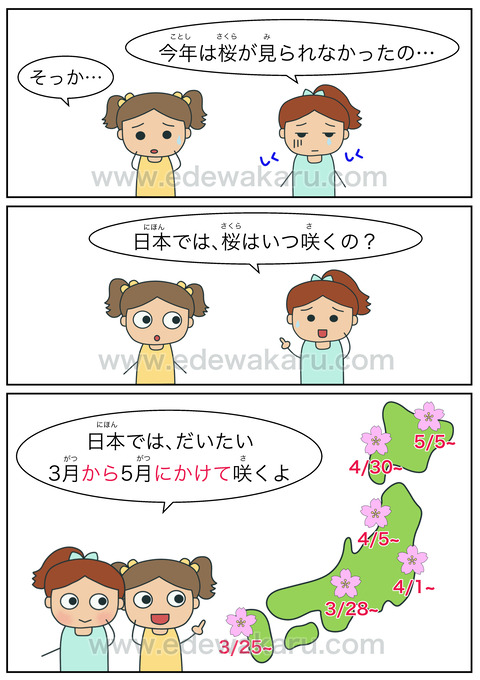
Meaning
〜から〜までの間のある時に〜
〜から〜までの場所のある場所で〜
〜から〜まで、ずっと〜
How to use it
名詞[辞書形]+から+名詞[辞書形]にかけて
Explanation
「〜から〜にかけて」は時間や場所の範囲を表す文型で、「〜から〜までの間のある時に〜」「〜から〜までの場所のある場所で〜」という意味で使われます。また、例文④⑤のように「〜から〜までの間ずっと〜」という意味でも使われます。「〜から〜にかけて」は、「その範囲の間、ずっと〜の状態が続く」というように、【継続していること】を強調します😮
この文型は【始まり】と【終わり】をはっきり表さない場合に使われることがほとんどです。
[例]
今日の夜
から
明日の朝
にかけて
雨が降るらしい
→夜
から
明日の朝
のある間に
雨が降り
続ける
日本では、桜は3月
から
5月
にかけて
咲きます
→3月
から
5月
の間のある時に
咲き
続ける
「〜から〜にかけて」に似ている文型はいくつかありますので、しっかりと区別をして覚えておきましょう😉
【「から」シリーズ】
〜から〜にかけて
〜からする・〜からある・〜からの
〜からといって・〜からって
〜からなる
〜からには
〜てからでないと〜ない
〜てからというもの
In context 6 examples
日本では、桜は3月から5月にかけて咲きます
→日本では、桜は3月から5月の間のある期間に咲きます今日の夜から明日の朝にかけて雨が降るらしい
→今日の夜から明日の朝の間のある時間に雨が降るらしい(復習:〜らしい(推量))台風は、夏から秋にかけて発生しやすい
→台風は、夏から秋の間に発生しやすい(復習:〜やすい)(復習:「〜やすい」と「〜にくい」を使う時の注意)明日は昼から夜にかけて暑くなるそうだよ
→明日は昼から夜までずっと暑くなるそうだよ(復習:〜そうだ(伝聞))うちのお店は、金曜日から週末にかけてお客さんが多くなります
→うちのお店は、金曜日から週末までずっとお客さんが多くなります東京から大阪にかけて強い雨が降るでしょう
→東京から大阪までの間の場所で強い雨が降るでしょう
日本語文型辞典
Meaning
場所や時間を表す名詞を受けて、「二つの地点・時点の間」という意味を表す。時間を表す表現の場合、①のように二つの時点の間のある時を表す場合と②のようにその間の時間帯を表す場合がある。「…から…まで(に)」と類似の用法だが、それほど明確に境界を特定せずに、二つの領域にまたがった時間や空間を漠然と問題にする場合に用いる。
「そのことに関しては」という意味を表す。後ろには人の技術や能力などに関してなんらかの評価を述べる表現が続くことが多い。名詞を修飾するときは③のように「NにかけてのN」となる。
慣用句的な表現で、「命」「名誉」「信用」「面目」など、人の生存や価値を社会的に保証するものを表す名詞が用いられて、「何がなんでも絶対に」と強い決意を表すのに用いられる。後ろには決意や約束を表す表現が続く。
How to use it
NからNにかけて
Nにかけて
Nにかけて(も)
In context 9 examples
台風は今晩から明日の朝にかけて上陸するもようです。
今月から来月にかけて休暇をとるつもりだ。
北陸から東北にかけての一帯が大雪の被害に見舞われた。
話術にかけては彼の右にでるものはいない。
忍耐力にかけては人より優れているという自信がある。
彼は誠実な男だが、商売にかけての才能はあまり期待できない。
命にかけてもこの秘密は守り通す。
私の命にかけて、彼らを助け出してみせます。
面子にかけても約束は守る。
日本語文型辞典 英語版
Meaning
With a noun expressing a place or time, means “between/over the two places or times.” When it indicates time, there are two cases. One is that にかけて refers to a particular moment between the two, as shown in
(1)
, and the other is that it refers to the time over the two, as shown in
(2)
. にかけて has uses similar to those for ...から...まで(に). However, にかけて is used when the speaker is not overly concerned with the time or space between or over the two mentioned in the sentence or about clearly-defined boundaries.
Expresses the meaning of “concerning something.” Often followed by an expression to state some evaluation for a skill or ability. Becomes NにかけてのN, as shown in
(3)
, when modifying a noun.
An idiomatic expression. With a noun expressing something which assures someone’s existence or value socially, such as 命 (life), 名誉 (honor), 信用 (trust) or 面子 (face), used to express the speaker’s firm determination and means “even if it is risked” or “at all costs.” Followed by an expression showing the speaker’s determination or promise.
How to use it
1. NからNにかけて
2. Nにかけて
3. Nにかけて(も)
In context 9 examples
台風は今晩から明日の朝にかけて上陸するもようです。
The typhoon will probably hit land some time between tonight and tomorrow morning.
今月から来月にかけて休暇をとるつもりだ。
I intend to take a holiday from this month to next month.
北陸から東北にかけての一帯が大雪の被害に見舞われた。
They were hard hit by a heavy snow throughout the Hokuriku and Tohoku districts.
話術にかけては彼の右にでるものはいない。
No one can match him in story-telling.
忍耐力にかけては人より優れているという自信がある。
I have confidence that I surpass all others in patience.
彼は誠実な男だが、商売にかけての才能はあまり期待できない。
He is a man of sincerity, but when it comes to his business ability, he doesn’t meet our expectations.
命にかけてもこの秘密は守り通す。
I pledge my life to keep this secret.
私の命にかけて、彼らを助け出してみせます。
I pledge my life to save them.
面子にかけても約束は守る。
On my honor, I will keep my promise.
毎日のんびり日本語教師
Meaning
~から~まで
How to use it
名詞+から+名詞+にかけて
名詞+から+名詞+にかけ
Explanation
「~から~まで」と同じく時間や空間の範囲を表します。ただし、その範囲の起点と終点がはっきりしない場合によく用いられます。範囲は線状です。
その範囲内で物事が継続的に発生するのを強調します。
起点を述べる必要がなければ、「~から」を省略することができます。
Notes
似ている文法「~から~まで」
似ている文法「~から~にわたって/にわたり/にわたる/にわたった」
In context 5 examples
関東北部はこれから10日の朝にかけて山沿いを中心に雪が降り、平野部でも積もるところがある見込みです。
日本では3月から5月にかけて桜が見られます。
茜は夏から秋にかけて花を咲かせる。
年末にかけて更に忙しくなるだろう。(至年末预计会更加繁忙。)
肩から指先にかけて痺れている。(从肩膀到指尖都在麻木。)
IMABI
Span: ~にかけて & にわたって
Read this IMABI lesson ↗Explanation
Span: ~にかけて & にわたって
A common error made by students is not understanding the difference between ~から~まで and ~から~にかけて. Then, if they learn about ~にわたって, this quickly becomes confused with ~にかけて. The nouns that students chose before these expressions are also often very problematic. So, this lesson will delve into these issues so that you don’t end up making the same mistakes!
~から~まで VS ~から~にかけて
First, let’s discuss the basic information about ~から~にかけて. This is a less concrete variant of ~から~まで. Both から and まで concretely define beginning and end points, so with the replacement of まで with ~にかけて, you make this less poignant. The main issues, then, will come from not thinking closely enough as to what’s practical.
1a. 秋田から大阪まで地震がありました。X
1b. 秋田から大阪にかけて地震がありました。〇
There was an earthquake from Akita to Osaka.
2. この道路は夕方5時半から9時にかけて必ず渋滞じゅうたいする。
This road is always congested from 5:30 to 9 in the evening.
3. 青森県から岩手県にかけて震度5の地震が起こりました。
A Shindo scale 5 earthquake occurred from Aomori to Iwate Prefecture.
4a. 午前8時から午後7時にかけて宿題をしました。X
4b. 午前8時から午後7時まで宿題をしました。〇
I did my homework from 8 A.M to 7 P.M.
5a. オースティンでは、北側から南側にかけて車で一時間でかかる。X
5b. オースティンでは、北側から南側に行くのに車で一時間かかる。〇
In Austin, it takes an hour by car to get from the north side to the south side.
6. テキサスからフロリダにかけて土砂降りに降った。
It down-poured from Texas to Florida.
7. 週末にかけて仕事をする。
To work over the weekend.
The Meanings of わたる
Before getting to any particular usage of わたる, it’s important to know all what it could possibly mean. This gives insight as to what particles and kinds of words that it is to be used with. This, of course, is the primary source of confusion and error by students, so it’s very important to pay attention to these things.
# 語義 適当な助詞 書き方
1. To cross over を 渡る・渉る
2. To cross over a route/bridge を 渡る
3. One goes to/comes from a far place に/から 渡る
4. To pass (by) through things such as the air を 渡る
5. To migrate through the sky を 渡る
6. To wander about を 渡る
7. To live through を 渡る・亘る・亙る
8. 手に渡る = To be handed down に 渡る
9. To cover/range/span に 渡る・亘る・亙る
10. To continue without being interrupted に 渡る・亘る・亙る
Orthography Note: This verb regardless of meaning is almost always written as 渡る. Most Japanese people might not even recognize the alternative spellings. So, keep that in mind.
These meanings for the most are interrelated with each other. So, it shouldn’t feel as if you’re learning over ten completely different usages. Rather, it’s just defining with more specificity the kinds of environments that you can find the word in.
Examples
8. 私事に{関かかわる・亙わたる}質問をするのは失礼ですね。
Asking personal questions is rude, isn’t it?
9. 橋を渡る。
To cross a bridge.
10. 通りを向こう側へ渡る。
To get across the street.
11. 彼は中国へ渡りました。
He went over to China.
12. その土地は彼女の息子の手に渡った。
The land was passed down to her son.
13. 世の中をうまく渡っていく。
To get along living well in the world.
14. 微風そよかぜが梢こずえを渡った。
The breeze passed through the treetops.
15. 雁かりが空中を渡る。
Wild geese migrate through the skies.
~にわたって
This grammar point is the て形 of usage #9 from the chart above, and as implied, this pattern follows a noun that expresses some quantity in regards to time, parameter, space, etc. The noun that precedesにわたって is quite limited, and the verb phrase that follows deals with continuation.
16a. ゴールデンウィークにわたって関東全体を観光した。X
16b. ゴールデンウィークのあいだ、関東全体を観光した。〇
During Golden week, I went sightseeing through all of Kanto.
17a.老若男女ろうにゃくだんじょにわたって世論調査よろんちょうさが行われました。X
17b. 老若男女すべてに(対して)世論調査が行われました。〇
A public opinion survey was done to men and women of all ages.
18. 五十肩ごじゅうかたかもしれませんけど、肩から腕にかけて、痛くて、重くて・・・・。
It may be a stiff shoulder, but it’s heavy and painful from my shoulder to my arm.
19. 倉田博士は35年にわたって研究を続け、新療法を開発した。
Professor Kurata continued to research over 35 years and developed a new treatment.
20. その火事は広範囲に渡って損害を与えた。
The fire gave damage over a vast range.
21. 営業案内が全員に渡った。
A pamphlet of business information was passed out to everyone.
Sentence and Word Differences: ~にかけて VS ~にわたって
As errors arise from incorrect matching of pattern and word choice, we will now example the kind of sentences and words that accompany ~にかけて and ~にわたって.
Condition: ~から~にかけて。(だから・それで~)
22. 今晩から明朝にかけて台風が上陸します。海岸寄りの皆さんは高潮に警戒してください。
The typhoon will reach landfall from this evening to tomorrow morning. Everyone along the coast please take caution with high tide.
This could be reworded in a sentence that more explicitly shows reasoning. In this manner, it is possible to see ~から~にかけては.
23. 今晩から明朝にかけて台風が上陸するので、海岸寄りの皆さんは高潮に警戒してください。
The typhoon will reach landfall from this evening to tomorrow morning, so everyone along the coast please take caution with high tide.
24. 豪雪が予測されるので、北海道から福島県にかけては注意が必要です。
Since heavy snow is expected, warning is needed from Hokkaido to Fukushima Prefectures.
Pattern Note: The pattern ~にかけては is quite different from above. Rather than showing a temporal or spatial range, it is followed by expressions of high evaluation regarding ability, strength, etc. In this sense, it can be translated as “regarding”.
25. 彼は法律にかけては欠けている。
He lacks regarding to the (knowledge of the) law.
26. ラーメン作りにかけては王さんの右に出る人はいない。
In regards to ramen making, there is no one superior to Mr. Wang.
Condition: Clause concerning the course of a condition + ~にわたって + Effect
The effect doesn’t necessarily have to be bad. However, most usages of ~にわたって fit pretty well within this framework.
27. 15年にわたって遺跡の調査が行われた。その結果、このあたりは奈良時代の住居の跡だということがわかってきた。
An excavation inquiry has gone on for a span of 15 years. As a result, we have come to understand that this area is the remains of Nara Period dwellings.
Word Notes:
1. Words that ~にかけて easily follows: Words of time/place such as ~日, ~時, ~県.
2. Words that easily follow ~にかけて: Verbs that describe something happening: 降る, 起こる, ある, 発生する, 等.
3. Words that ~にわたって easily follows: Words of some parameter such as 長年, 全般, ~年, 将来, 範囲, 等.
4. Words that easily follow ~にわたって: Verbs of continuation: 続ける, 記録する, 継続する, 行(な)う, 等.
In context 46 examples
秋田から大阪まで地震がありました。X
There was an earthquake from Akita to Osaka.
秋田から大阪にかけて地震がありました。〇
There was an earthquake from Akita to Osaka.
この道路は夕方5時半から9時にかけて必ず渋滞じゅうたいする。
This road is always congested from 5:30 to 9 in the evening.
青森県から岩手県にかけて震度5の地震が起こりました。
A Shindo scale 5 earthquake occurred from Aomori to Iwate Prefecture.
午前8時から午後7時にかけて宿題をしました。X
I did my homework from 8 A.M to 7 P.M.
午前8時から午後7時まで宿題をしました。〇
I did my homework from 8 A.M to 7 P.M.
オースティンでは、北側から南側にかけて車で一時間でかかる。X
In Austin, it takes an hour by car to get from the north side to the south side.
オースティンでは、北側から南側に行くのに車で一時間かかる。〇
In Austin, it takes an hour by car to get from the north side to the south side.
テキサスからフロリダにかけて土砂降りに降った。
It down-poured from Texas to Florida.
週末にかけて仕事をする。
To work over the weekend.
To cross over を 渡る・渉る
To cross over a route/bridge を 渡る
One goes to/comes from a far place に/から 渡る
To pass (by) through things such as the air を 渡る
To migrate through the sky を 渡る
To wander about を 渡る
To live through を 渡る・亘る・亙る
手に渡る = To be handed down に 渡る
To cover/range/span に 渡る・亘る・亙る
To continue without being interrupted に 渡る・亘る・亙る
私事に{関かかわる・亙わたる}質問をするのは失礼ですね。
Asking personal questions is rude, isn’t it?
橋を渡る。
To cross a bridge.
通りを向こう側へ渡る。
To get across the street.
彼は中国へ渡りました。
He went over to China.
その土地は彼女の息子の手に渡った。
The land was passed down to her son.
世の中をうまく渡っていく。
To get along living well in the world.
微風そよかぜが梢こずえを渡った。
The breeze passed through the treetops.
雁かりが空中を渡る。
Wild geese migrate through the skies.
ゴールデンウィークにわたって関東全体を観光した。X
During Golden week, I went sightseeing through all of Kanto.
ゴールデンウィークのあいだ、関東全体を観光した。〇
During Golden week, I went sightseeing through all of Kanto.
老若男女ろうにゃくだんじょにわたって世論調査よろんちょうさが行われました。X
A public opinion survey was done to men and women of all ages.
老若男女すべてに(対して)世論調査が行われました。〇
A public opinion survey was done to men and women of all ages.
五十肩ごじゅうかたかもしれませんけど、肩から腕にかけて、痛くて、重くて・・・・。
It may be a stiff shoulder, but it’s heavy and painful from my shoulder to my arm.
倉田博士は35年にわたって研究を続け、新療法を開発した。
Professor Kurata continued to research over 35 years and developed a new treatment.
その火事は広範囲に渡って損害を与えた。
The fire gave damage over a vast range.
営業案内が全員に渡った。
A pamphlet of business information was passed out to everyone.
今晩から明朝にかけて台風が上陸します。海岸寄りの皆さんは高潮に警戒してください。
The typhoon will reach landfall from this evening to tomorrow morning. Everyone along the coast please take caution with high tide.
今晩から明朝にかけて台風が上陸するので、海岸寄りの皆さんは高潮に警戒してください。
The typhoon will reach landfall from this evening to tomorrow morning, so everyone along the coast please take caution with high tide.
豪雪が予測されるので、北海道から福島県にかけては注意が必要です。
Since heavy snow is expected, warning is needed from Hokkaido to Fukushima Prefectures.
彼は法律にかけては欠けている。
He lacks regarding to the (knowledge of the) law.
ラーメン作りにかけては王さんの右に出る人はいない。
In regards to ramen making, there is no one superior to Mr. Wang.
15年にわたって遺跡の調査が行われた。その結果、このあたりは奈良時代の住居の跡だということがわかってきた。
An excavation inquiry has gone on for a span of 15 years. As a result, we have come to understand that this area is the remains of Nara Period dwellings.
Words that ~にかけて easily follows: Words of time/place such as ~日, ~時, ~県.
Words that easily follow ~にかけて: Verbs that describe something happening: 降る, 起こる, ある, 発生する, 等.
Words that ~にわたって easily follows: Words of some parameter such as 長年, 全般, ~年, 将来, 範囲, 等.
Words that easily follow ~にわたって: Verbs of continuation: 続ける, 記録する, 継続する, 行(な)う, 等.
AIUEO JLPT Grammar
Meaning
This sentence pattern expresses a range of time or location, generally with a broader scope than「〜から〜まで」and is used to indicate an approximate period or location.
How to use it
名詞から+名詞に+かけて
Explanation · 日本語
この文型は、時間や場所の範囲を表す表現で、「〜から〜まで」よりも範囲が曖昧で、おおよその期間や地点を示すときに使われます。
In context 5 examples
春から夏にかけて、この地域では美しい花が咲きます。
From spring to summer, beautiful flowers bloom in this area.
今週の水曜日から金曜日にかけて、雨が降り続くでしょう。
It will likely continue raining from Wednesday to Friday this week.
日本列島の北部から南部にかけて、大雨の影響が出ています。
Heavy rain is affecting areas from the northern to the southern parts of the Japanese archipelago.
1980年代から1990年代にかけて、テクノロジーの進化が急速に進みました。
From the 1980s to the 1990s, technological advancements progressed rapidly.
この道は、町の中心から郊外にかけて続いています。
This road extends from the town center to the outskirts.
文法
Meaning
"〜ぐらいから〜ぐらいまで"範囲の始まりと終わりを表す。
How to use it
N1 + から + N2 + にかけて
Notes
①「〜から〜まで」と違って、始まりと終わりがはっきりしていない。
② 1回だけのことには使わない。
③ 「~から」を省略して使うことも可。
In context 10 examples
今晩から明日にかけて、蒸し暑い天気となるでしょう。
夕方から明日の朝にかけて大雨となるでしょう。
毎朝7時から8時にかけて、バスが込む
土曜日の夕方から日曜日の朝にかけて、雨になりそうです。
六月から七月にかけて、日本は梅雨のシーズンです。
年末から年始にかけて、国へ帰るつもりです。
関東地方から東北地方にかけて台風の被害が出ています。
12時から1時にかけてレストランは混みます。
3月中旬から4月の終わりにかけて 、桜が見られるでしょう。
これから年末にかけて、忙しくなるなあ。
くらべてわかる日本語表現文型辞典
Meaning
AとBを含む大体の範囲を表す。その範囲は厳密なものではなく大きくAとBにまたがっていることを示す。
How to use it
AからBにかけて(AからBにかけての)
[名詞-∅]から[名詞-∅]にかけて
Explanation
【対比1】
「AからBまで」(意味1 P.64)
「AからBまで」は「AB間」というはっきりした範囲を表す。
○10時から12時まで、授業です。
×10時から12時にかけて、授業です。
○昨夜から今朝にかけて、風が強かった。
×昨夜から今朝まで、風が強かった。
Notes
【注意1】
・「Aから」を省略した使い方もある。
○明日夕方にかけて、大雪になる恐れがあります。
In context 4 examples
関西から関東にかけての広い範囲で、地震の揺れが感じられた。
今週から来週にかけて、冷込みが厳しくなりそうだ。
首から肩にかけて激痛が走った。
この歌手は中学生から高校生にかけての若い世代に支持されている。
日本語NET JLPT文法解説まとめ
Meaning
"〜ぐらいから〜ぐらいまで"
範囲の始まりと終わりを表す。
How to use it
N1 + から + N2 + にかけて
Explanation
from N1 to N2
Indicates the beginning and end of a range.
①「〜から〜まで」と違って、始まりと終わりがはっきりしていない。
② 1回だけのことには使わない。
③ 「~から」を省略して使うことも可。
① Unlike "〜から〜まで," it doesn't clearly indicate a beginning and end.
② It's not used for one-time events.
③ It's also acceptable to use it without "〜から."
In context 11 examples
今晩から明日にかけて、蒸し暑い天気となるでしょう。
夕方から明日の朝にかけて大雨となるでしょう。
毎朝7時から8時にかけて、バスが込む
明日は近畿地方から関東地方にかけて、大雨が降るでしょう。
土曜日の夕方から日曜日の朝にかけて、雨になりそうです。
六月から七月にかけて、日本は梅雨のシーズンです。
年末から年始にかけて、国へ帰るつもりです。
関東地方から東北地方にかけて台風の被害が出ています。
12時から1時にかけてレストランは混みます。
3月中旬から4月の終わりにかけて 、桜が見られるでしょう。
これから年末にかけて、忙しくなるなあ。
NINJAL 日本語文型データベース
Usage 1
Meaning
始まりと終わりをはっきりと示すことができない場所や時間などの範囲を表します。ある範囲内で連続的、または、継続的に出来事や状態が続いていることを言うときに使います。
How to use it
N1からN2にかけて
Notes
2つの「〜」には、始まりと終わりの時間や場所を表す言葉がきます。
「~から~にかけて」の後には、続いている出来事や状態を説明する文がきます。
In context 7 examples
日本では6月から7月にかけて雨の日が多い。この時期を「梅雨」という。
彼は10代後半から20代にかけて外国で暮らしていたらしい。
最近、肩から腕にかけて痛みを感じる。
この辺りから駅前にかけて道路の拡張計画があるそうだ。
明日は関東地方から東北地方にかけて雨が降るでしょう。
この地方では、春から夏にかけては米を栽培し、秋から春にかけては麦を栽培している。
中学時代から高校時代にかけての多感な時期を共に過ごした友人は、私にとって特別な存在だ。
Usage 2
Meaning
始まりと終わりをはっきりと示すことができない場所や時間などの範囲を表します。ある範囲内で連続的、または、継続的に出来事や状態が続いていることを言うときに使います。
How to use it
N1からN2にかけ
Notes
2つの「〜」には、始まりと終わりの時間や場所を表す言葉がきます。
「~から~にかけ」の後には、続いている出来事や状態を説明する文がきます。
In context 7 examples
年末から年始にかけ、空港は海外旅行に出かける人で混雑する。
1980年代から2000年代にかけ、世界中で内乱が絶えなかった。
日本では江戸時代末期から明治時代にかけ、急速に外国の文化が流入した。
今日の夜遅くから明日の明け方にかけ、豪雨が予想されます。警戒してください。
この部屋は、午後になると、南側から西側にかけ、強い日差しを受ける。
来週は東海から関東にかけ桜が見ごろとなるでしょう。
2世紀には、地中海北岸からイングランド北部にかけ、ローマ帝国が支配した。