AIUEO JLPT Grammar
Meaning
「〜おきに」is a sentence pattern used to express something happening at regular intervals, such as over a specific period of time or distance.
How to use it
数量詞+おきに
Explanation · 日本語
「〜おきに」は、一定の間隔で何かが繰り返されることを表します。具体的には、ある時間や距離の間隔で物事が繰り返される場合に使われます。
In context 5 examples
バスは10分おきに来ます。
The bus comes every 10 minutes.
5キロおきに休憩を取ります。
We take a break every 5 kilometers.
この店は1年おきに新しい商品を出します。
This store releases new products every 2 years.
このイベントは2週間おきに開催されます。
This event is held every three weeks.
彼女は1時間おきにメールをチェックします。
She checks her email every hour.
文法
Meaning
〜間隔で / 〜の間を置いて
How to use it
N + おきに
※Nには数量を表す言葉が来る
In context 5 examples
この薬は、6時間おきに1錠飲んでください。
関西国際空港行きのバスは15分おきに出ます。
入社1年目の社員には、2ヶ月おきに部署を異動してもらい、色々な仕事を経験してもらうようにしています。
コンサート会場の周りには、100メートルおきに警備員が警備を行っています。
駅周辺には、50メートルおきにコンビニがある。
Bunpro Grammar Reference
Meaning
Repeated at intervals, Every other, Every, At intervals of
How to use it
Number + Counter + おきに
Nuance
A phrase which indicates something happening every (A), focusing on repeated intervals or spaces of (A).
Explanation
置きに is a combination of 置き, a suffix meaning 'opening' or 'interval', and the case marking particle に. Primarily written without kanji, it is an expression used to show that something happens 'every (A)', or 'at intervals of (A)'.
The difference between something being interpreted as 'every', or 'at intervals of' can be tricky though, so we'll look at both.
Due to おきに being a suffix, it will be attached to the end of numbers, counters, or any 'space' that it is highlighting as being an 'opening' or 'interval'.
この薬は一日おきに飲んでください。
Please drink this medicine at intervals of one day. (Every second day)
一ヶ月おきに病院に来るように先生に言われました。
I was told by the doctor to come to the hospital at intervals of one month. (Every second month)
二日おきに部屋の掃除をしないと気が落ち着かない。
I can't relax if I don't clean my room at intervals of two days. (Every three days)
Looking at these sentences, we can see that the 'interval' is a bit difficult to understand even in English. However, the easier way to think of おきに in this sense is 'leaving a space of (A), (B)'. So if we say 'leaving a space of two days, (B)', it becomes a bit clearer that something is happening during the third day.
Caution
It is very common to get ごとに and おきに mixed up. The former literally means 'every'. However, the latter having the meaning of 'at intervals' makes things confusing. おきに itself will only mean 'every' sometimes. Let's look at some examples of when these two expressions overlap in meaning, and when they do not.
Large time frames or distances - Only ごとに will be used to express 'every'. It makes sense to ask 'at what point' during a day, a week, or a month. Due to this, only おきに will mean 'after the interval of (A)', while ごとに means 'every'.
一日ごとに目薬を差す。
I use my eye drops every day. (It doesn't matter what part of the day, but it does happen every day)
一日おきに目薬を差す。
I use my eye drops every second day. (It makes sense to wonder when it may occur during the second day, but we know it doesn't happen for at least an interval of one whole day)
Small time frames or distances - Both ごとに and おきに may be used to express 'every'. It doesn't make sense to care about 'at what point' during seconds, minutes, or hours. Here, because おきに points at the interval, it will mean 'every interval of one second' etc, because nobody is going to ask 'when did (B) happen during the next second', so the space is just assumed to be 'one second'.
毎日2時間ごとに体を動かしている。
I move my body every two hours, every day. (At some point during every group of 2 hours)
毎日2時間おきに体を動かしている。
I move my body every two hours, every day. (After every interval of two hours. Nobody cares about 'when during the third hour', so we just understand it as 'every two hours')
In summary, おきに will mean 'every (A)' for seconds, minutes, hours, millimeters, centimeters, and kilometers. But it will mean 'with spaces of' for almost anything bigger than that. This is not an exception to the rule, it is just a change of focus as spaces get larger. We can just remember that おきに always has one job. It highlights that (B) occurs after or outside of (A). While ごとに highlights (B) happening within (A).
一秒おきに - The space is 'one second', so if おきに points to the beginning of the next second, the space is still only 'one second'. Because おきに doesn't care about where (B) happens within that next second, we assume straight away.
五年おきに - The space is 'five years', so if おきに points to the beginning of the next year, the space becomes 'six years', because we are going to want to know where (B) happens within that next year. It would be strange to assume someone is waiting for New Year of the sixth year to do something instantly.
Fun Fact
This is a topic that native speakers frequently get wrong themselves, so don't worry if it takes a while to understand! If you are unsure about which one to use, think of 置きに as 'leaving intervals of (A), (B)' for most purposes. 一時間 tends to be the upper limit of time that most people disagree about whether the meaning is 'every hour', or 'every second hour'. This makes sense, as the time frame is short, but still sort of long, so whether someone takes it as the beginning of the hour or some point during that hour being the important information, their opinions may differ. Remember though, おきに itself only ever points to the beginning of the space after (A), it doesn't care when/where (B) happens afterward.
Nuance · 日本語
(A)の度に何かが起こるということを表す表現。(A)と(A)の間に行われることを強調した表現。
Explanation · 日本語
「置きに」は、接尾語の「置き」に格助詞の「に」を付けた文法です。主にひらがなで書かれます。これは、「(A) の間を空けて、(B) が繰り返されること」を表します。
「おきに」には、二つの使い方があります。一つは、「(A) に一回、(B)」という意味です。もう一つは「(A) の間を置いて、(B)」という意味です。実際の使い方を確認していきましょう。
「おきに」は接尾語なので、数字や数助詞、または「間」を表す言葉のあとに付けて使います。
この薬は一日おきに飲んでください。
Please drink this medicine at intervals of one day. (Every second day)
一ヶ月おきに病院に来るように先生に言われました。
I was told by the doctor to come to the hospital at intervals of one month. (Every second month)
二日おきに部屋の掃除をしないと気が落ち着かない。
I can't relax if I don't clean my room at intervals of two days. (Every three days)
例えば、「二日おきに、(B)」と言うと、「二日を置いて、三日目に (B) が起こる」という意味になります。
注意点
「ごとに」と「おきに」は混同しやすい表現です。基本的に、「ごとに」は「〜に一回」や「毎〜」という意味を表し、「おきに」は「〜の間を空けて」という意味を表します。しかし、この二つは同じ意味で使われることもあるので、混乱しやすいのです。以下、意味が同じになる場合と、ならない場合の例を見てみましょう。
時間や距離が大きい場合(一日、一週間、一ヶ月など)。「ごとに」だけが「〜に一回」や「毎〜」という意味を表します。「おきに」は必ず「(A) の間を空けて」という意味になります。
一日ごとに目薬を差す。
I use my eye drops every day. (It doesn't matter what part of the day, but it does happen every day)
一日おきに目薬を差す。
I use my eye drops every second day. (It makes sense to wonder when it may occur during the second day, but we know it doesn't happen for at least an interval of one whole day)
時間や距離が小さい場合。「ごとに」も「おきに」も「〜に一回」という意味を表します。例えば、「一秒おきに」は「一秒を空けて、次の秒の始まりで (B) が起こる」という意味ですが、秒という単位は、始めや終わりを意識するほど大きくないので、「ごとに」と同じように「毎秒」という意味に解釈されます。
毎日2時間ごとに体を動かしている。
I move my body every two hours, every day. (At some point during every group of 2 hours)
毎日2時間おきに体を動かしている。
I move my body every two hours, every day. (After every interval of two hours. Nobody cares about 'when during the third hour', so we just understand it as 'every two hours')
まとめると、「おきに」は秒、分、時間、ミリメートル、センチメートル、キロメートルなどでは「ごとに」と同じ意味になります。それ以上大きな単位になると「間を空けて」という意味になります。これは、「おきに」の使い方に例外があるからというわけではありません。ただ、単位が大きくなるにつれて、焦点が「間を置くこと」に移っていくためです。覚えておきたいのは、「おきに」は (A) という区切りを過ぎたあとで (B) が起こることを表し、「ごとに」は (A) という区切りの中のどこかで一回 (B) が起こることを表すということです。
「一秒おきに」- 間は「一秒」。次の秒の始めに (B) が起こりますが、秒のような短い時間の単位では「毎秒」と理解されます。
「五年おきに」- 間は「五年」。五年を空けて、次の一年のどこかで (B) が起こることを表すので(五年を空けて、六年目の元日に (B) が起こると考えるのは不自然なため)、実際には、「六年ごと」に近い意味になります。
豆知識
「おきに」と「ごとに」は、母語話者もよく間違えるので、理解に時間がかかっても気にしないでください。どちらを使えばいいのか迷ったときは、「おきに」は「(A) の間を空けて、(B) が起こる」という意味だと思い出すといいでしょう。
「一時間」は、人によっては短く感じられたり長く感じられたりするので、「ごとに」と「おきに」の解釈が分かれやすい単位です。「一時間おきに」を「一時間を置いて、そのあと起こる」と考える人もいますし、「一時間の中のどこかで一回起こる」と考える人もいます。
いずれにしても、本来「おきに」は「(A) の間を置く」という表現で、そのあといつ (B) が起こるかまでは示さないものだと覚えておきましょう。
In context 19 examples
- 30分置きに休憩しよう。
Let's take a break in intervals of 30 minutes.
- 一ヶ月おきに病院に来るように先生に言われました。
I was told by the doctor to come to the hospital at intervals of one month. (Every second month)
- この薬は一日おきに飲んでください。
Please drink this medicine at intervals of one day. (Every second day)
- 二日おきに部屋の掃除をしないと気が落ち着かない。
I can't relax if I don't clean my room at intervals of two days. (Every three days)
- 約3分置きに電車が来ます。
Trains come about every 3 minutes.
- 1時間置きに温度を測ってください。
Please check the temperature every other hour.
- 50メートル置きに自動販売機がある。
There are vending machines every 50 meters.
- 階段を一段置きに飛ばして上がる。
He goes up the stairs skipping every second step.
- 一部屋置きに消火器を設置しました。
I installed fire extinguishers in every other room.
- 一週間置きに、水槽の水を換えています。
We change the water of the fish tank every other week.
- 金魚には餌を一日置きにやればいいらしい。
I've heard that you can feed goldfish every second day.
- この地域はだいたい一軒置きに新聞をとっている。
In this area, every other house is subscribed to the newspaper.
- メイ:「バスは何分置きにくるの?」
サツキ:「1時間置きに。」Mei: 'How often does the bus come?' Satsuki: 'Every other hour.'
- だいたい二年置きにスマホを買い替えます。
I change my smartphone at about two-year intervals.
- 数時間置きに目が覚めるから寝不足です。
I lack sleep because I wake up every few hours.
- 一日ごとに目薬を差す。
I use my eye drops every day. (It doesn't matter what part of the day, but it does happen every day)
- 一日おきに目薬を差す。
I use my eye drops every second day. (It makes sense to wonder when it may occur during the second day, but we know it doesn't happen for at least an interval of one whole day)
- 毎日2時間ごとに体を動かしている。
I move my body every two hours, every day. (At some point during every group of 2 hours)
- 毎日2時間おきに体を動かしている。
I move my body every two hours, every day. (After every interval of two hours. Nobody cares about 'when during the third hour', so we just understand it as 'every two hours')
絵でわかる日本語
Meaning
〜の間をおいて
〜の間隔をあけて
How to use it
数量詞+おきに
Explanation
「〜おきに」は時間・期間・距離などを表す数量詞について
「〜の間を置いて」という意味で使われます。
[例文の説明]
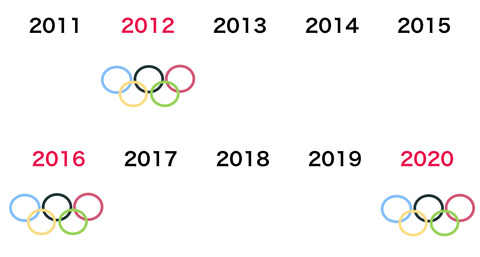
①オリンピックは3年
おきに
開催される
「3年おきに」ですから「3年の間をおいて」という意味ですね
😉2012年に開催されて2013年・2014年・2015年というように「3年間があいています」。
②2か月
おきに
授業料を払う
「2か月おきに」ですから「2か月の間隔をあけて」という意味です。2月に払った後、3月・4月というように「2か月間あけて」から、また5月に払うということです。(復習:〜ということだ)
③1日
おきに
ゴミを出す
「1日おきに」ですから「1日あけて」という意味ですね
😊ゴミを出して、次の日は「1日間隔をあけて」またその次の日に出すという意味です。
「〜おきに」は少し複雑な文型ですが、よく使われます。N2やN3を受ける人は「〜ごとに」とチェンジできる場合とできない場合がありますので、しっかりと違いを勉強しておいてください😌
In context 3 examples
オリンピックは3年おきに開催される
→オリンピックは3年の間隔をあけて開催される2か月おきに授業料(じゅぎょうりょう)を払う
→2か月の間隔をあけて授業料を払う1日おきにゴミを出す
→1日の間をあけてゴミを出す
日本語文型辞典
Meaning
基本情報数量詞+おきに説明おもに時間や距顧を表す言葉について、「それだけの間をおいて」という意味を表す。④⑤は距離ではないが、一列に並んだものの場合、それが距離を表すような意味で用いられる。①~③のように、時間や距離の和上の点を意味する場合は、「ごとに」と置きかえられる。ただし、1という数の場合は、次の例のように「おきに」を「ごとに」に変えると意味が変わる。例文① 大学行きのバスは10分おきに出ている。② この薬は2時間おきに飲んでください。③ この道路には10mおきにポプラが植えられている。④ このあたりは高級住宅街で、2軒おきぐらいに外車を持っている家がある。⑤ 映画館に入ると、座席は一つおきにしかあいていなかったので、友達とは離れて座ることになった。例文(例) 1年おきに大会が開かれる。(2年に1回)
1年ごとに大会が開かれる。(1年に1回)
日本語文型辞典 英語版
Meaning
【おきに】[数量詞+おきに]
Usually follows a word expressing time or distance and means “with that amount of time or space in between.” The words used with おき in
(4)
and
(5)
don’t express distance, but they do refer to things arranged in a line (houses
(4)
, seats
(5)) and are interpreted to express distance. When おきに refers to a point in time or space, as in
(1)
-
(3)
, it can be replaced with ごとに. However, when おきに and ごとに are used to refer to the number one, they differ in meaning, as shown in the examples below.
(例)1年おきに大会が開かれる。(2年に1回)
The meeting is held every other year. (= once every two years)
(例)1年ごとに大会が開かれる。(1年に1回)
The meeting is held every year. (= once a year)
In context 5 examples
大学行きのバスは 10 分おきに出ている。
The buses to the university run every ten minutes.
この薬は2時間おきに飲んでください。
Please take this medicine every two hours.
この道路には 10 mおきにポプラが植えられている。
On this street, poplars have been planted at intervals of ten meters.
このあたりは高級住宅街で、2軒おきぐらいに外車を持っている家がある。
This area is an upscale residential district, and every third house or so has an imported car.
映画館に入ると、座席は一つおきにしかあいていなかったので、友達とは離れて座ることになった。
When we got into the theater, every other seat was taken, so my friend and I ended up sitting separately.
くらべてわかる日本語表現文型辞典
Meaning
Bという動作や状態が繰り返される間隔をAで表す。
How to use it
AおきにB
[数詞]おきに
Explanation
【対比1】
「AごとにB」(意味4 P.92)
距離・時間などのように区切りを意識しない、継続したものについては、「AごとにB」と「AおきにB」は、同じ意味になるが、ニュアンスは少し違う。「AおきにB」は間隔をあけることに焦点があるが、「AごとにB」はAの時点に焦点がある。
○この薬は6時間ごとに飲んでください。(6時間目に飲む)
○この薬は(強い薬なので)6時間おきに飲んでください。(6時間間隔をあけて飲む)
「人・家・・・」などのような個体や、時間的なものでも「日」などのように、一つずつがまとまりとなって継続している場合は、意味がずれる。
○2軒ごとに赤い屋根の家がある。 ○●○●○●○●○●○●
○2軒おきに赤い屋根の家がある。 ○○●○○●○○●○○●
○3日ごとに電話をかける。 ☎○○☎○○☎○○☎○○
○3日おきに電話をかける。 ☎○○○☎○○○☎○○○
Notes
【注意1】
・Aが時間的な区切り、特に「週間・カ月・年」では解釈の揺れがある。その理由については次の三つが考えられる。
(ア)Aの区切りをBが行われる一つの単位と考えるか、またはBの事象をAの区切りの中の一点ととらえるか。
○1週間おきにゴルフにいく。(毎週か隔週か)
(月曜日はゴルフをする日ととらえて、その日から1週間をあける)
(今週はゴルフをする週ととらえて、1週間の間隔をあける)
(イ)「AおきにB」の文以外の情報や場面、また聞き手の体験によって左右される。
○「田中さんっていつもおしゃれね。」
「本当ね。1カ月おきに美容院へ行くんですって。」
「へえー。すごいわね。」(頻度の多いことをのべている=毎月)
○「ヘアー・スタイル、いつもきれいね。よく美容院へ行くの?」
「いいえ、自分でするのよ。美容院へは1カ月おきぐらいかしら。」(頻度の少ないことをのべている=隔月)
(ウ)固定観念に影響される場合。(ただし、Aの区切りを一つの単位としてとらえられる文をのぞく)
○運転免許の更新は3年おきにしなければならない。(2年おき・3年ごと)
○オリンピックは4年おきに開催される。(3年おき・4年ごと)
○うるう年は3年おきにある。/4年ごとにある。
In context 4 examples
この薬は6時間おきに飲んでください。
本を速読するときは、1行おきに読むそうです。
スタート地点から10メートルおきに、旗を立ててください。
「君は毎月、散髪屋にいきますか?」
「いや、2カ月おきぐらいかな。」
日本語NET JLPT文法解説まとめ
Meaning
〜間隔で / 〜の間を置いて
How to use it
N + おきに
※Nには数量を表す言葉が来る
Explanation
"every / at intervals of / at intervals of time"
In context 5 examples
この薬は、6時間おきに1錠飲んでください。
関西国際空港行きのバスは15分おきに出ます。
入社1年目の社員には、2ヶ月おきに部署を異動してもらい、色々な仕事を経験してもらうようにしています。
コンサート会場の周りには、100メートルおきに警備員が警備を行っています。
駅周辺には、50メートルおきにコンビニがある。
毎日のんびり日本語教師
Meaning
~間隔で
その間隔を空けて~
How to use it
名詞+おきに
Explanation
数詞に接続して「その間隔を空けて~」という意味を表します。
数詞とは1つ、2本、3台、4個、5日、6年などのことです。
例えば1日おきには隔日、1週間おきには隔週、1年おきには隔年と同じ意味になります。
Notes
「~ごとに」と似ているので注意。
1日おきに:●〇●〇●〇●〇
1日ごとに:●●●●●●●●
2日おきに:●〇〇●〇〇●〇
2日ごとに:●〇●〇●〇●〇
ただし例外があります。小さい数字に「秒」「分」がついたり、短い距離を表したりするときは、「隔〇」という意味になりません。(なりにくいです)
5秒おきに:●●●●●●●●●
5秒ごとに:●●●●●●●●●
1kmおきに:●●●●●●●●●
1kmごとに:●●●●●●●●●
「1時間おきに」などは、長い時間とも短い時間とも言えない中間的な位置にあるので、「●〇●〇●〇●〇」と思う人もいれば、「●●●●●●●●●」と思う人もいます。複数の解釈ができますので、コミュニケーションにおいては言い方を変えるなど工夫が必要です。
In context 5 examples
2日おきにしかシャワーを浴びない。(隔两天洗一次澡。)
医者から1か月おきに通院するように言われている。
多くのマラソン大会では5kmおきに給水ポイントが設けられている。
5メートルおきに植樹する。(每隔5米种一棵树。)
駅へ向かうバスは15分おきに出ている。
NINJAL 日本語文型データベース
Meaning
時間や距離について繰り返される一定の範囲を表します。
How to use it
N(数量詞)おきに
In context 5 examples
駅から大学行きのバスは10分おきに出ています。
ここは田舎なので1時間おきにしか電車がないので不便だ。
この薬は4時間おきに飲むことになっている。
メインストリートの街路樹は5メートルおきに植えられている。
このエリアはラーメン激戦区で、2~3軒おきにラーメン屋が並んでいる。
IMABI
毎~, ~ごとに, & ~おきに
Read this IMABI lesson ↗Explanation
毎~, ~毎に, & ~おきに
In this lesson, we will learn about three grammar points which roughly translate to “every/each…” in the context of repetition.
The Prefix 毎~
The prefix 毎~ denotes an ordinary repetition of time. While it is used in response to common, habitual actions, it is limited to idiomatic expressions and cannot generate new possible combinations:
毎朝まいあさevery morning毎晩every evening
毎日every day毎週every week
毎月まいつきevery month毎年まいとしevery year
毎春まいはるevery spring毎夏まいなつevery summer
毎秋まいあきevery autumn毎冬まいふゆevery winter
毎時(間)every hour毎分every minute
毎秒every second毎回every time
毎度always/often毎期every term
毎学期every semester毎号every issue
1. 毎朝散歩に出かけます。
I go out on a walk every morning.
2. 台風20号は毎時50キロメートルの速度で進んでいる。
Typhoon No. 20 is moving at a speed of 50 kilometers per hour.
3. 家の近くに野良猫が棲んでいて、1年くらい、ほぼ毎晩食事をあげています。
There is a stray cat that lives near my house, and I’ve been feeding it almost every evening for about a year.
4. 人間の意識的な思考速度は毎秒10ビット、一方で感覚器官の情報処理速度は毎秒約1ギガビット(10億ビット)に達することが判明しました。
It has been found that the speed of conscious thought for humans is 10 bits per second, while the processing speed for the sensory organs reaches approximately 1 gigabit (1 billion bits) per second.
5. 日本人は毎日三回食事まいにちさんかいしょくじをするのが普通ふつうだ。
It is typical for Japanese people to eat three meals every day.
6. 日本の首相は毎年のように替わる。
The Japanese prime minister changes practically every year.
7. 毎月のように熱を出すけど、変な病気ではない?
I get a fever like every month, but isn’t this some sort of strange illness?
8. 連載記事を毎号愛読してくださる方におすすめ!
Recommended for those who enjoy reading every issue of our serialized articles!
As is borne out in the chart above, 毎~ is primarily used with one-character words, but examples like 毎学期 (every semester) and 毎学年 (every academic year) are notable exceptions to this norm.
9. 毎学期楽しく過ごせています。
I’ve been able to enjoy every semester.
The most common lengthy utilization of 毎~ happens to be found when expressing “every [day of the week],” which is typically formed by using “毎週+ day of the week,” as opposed to “毎 + day of the week,” which is possible yet rather rare, particularly in the spoken language.
10. 毎週日曜日に教会に通うことにどのような意味があるのでしょうか。
What does it mean to go to church every Sunday.
In formal writing, more expressions utilizing 毎~ may be found, almost all of which relate to non-deictic time expressions. In this environment, it is also possible to find example words mentioned in the previous chart read solely with ON readings to heighten the literary tone.
毎朝まいちょうevery morning毎月まいげつevery month
毎年まいねんevery year毎夕まいゆう1every evening
毎夜まいよ2every night毎春まいしゅんevery spring
毎夏まいかevery summer毎秋まいしゅうevery autumn
毎冬まいとうevery winter毎季every season
In the spoken language, these formal expressions are switched out with their equivalents shown in the previous chart or replaced altogether with help from the next item of discussion in this lesson, ~ごとに.
~ごとに
~ごとに, written in kanji as ~毎に, is the native equivalent of 毎~, translating into English as “every/each…,” but its utility is far more versatile. Its usage can be summarized with the four following environments:
For every constant place, time period, person, etc., something is repeated, translating as “each/every.”
Something differs between instances of a given variable, translating as “from X to X…”
For every constant spatial or temporal interval, something is repeated, translating as “every/per.”
With each passing interval, a change progresses, translating as “with each…”
Each/Every…
Attaching after nouns, ~ごとに may translate as “each/every,” indicating the repetition of some action/event with each/every identified constant.”
11. 祝日ごとに、家族みんなでドライブに出かけることにしてますよ。
The whole family goes out on a drive every holiday.
12. 降りてくる人ごとに「あとどれぐらい?」と尋ねた。
With each person (I passed that was) descending, I would ask, “how much longer is there?”
From X to X…
Attaching after nouns, ~ごとに may translate as “each/from X to X” to indicate that some circumstance differs between each variable.
13. 会社ごとに、それぞれの社是しゃぜと社則しゃそくがあるから、よく注意してください。
[Each company/from company to company, each one] has its own policies and rules. So, please pay close attention.
14. カレーの味は地方ごとに異なります。
The way curry tastes differs from region to region.
15. 相続人ごとに考え方が異なり、「公平感」の違いから争いに発展することがあります。
Each heir has their own way of thinking, and differences in their sense of “fairness” can often lead to disputes.
Every/Each…
Paired with either spatial or temporal nouns, including counter phrases, ~ごとに may translate as “every/each” to indicate some repetition in constant intervals.
16. 4年ごとに閏年うるうどしになって、オリンピックが開かれるということは常識じょうしきだ。
It’s common sense that every four years is a leap year and that the Olympics are held.
17. 一時間ごとに手洗い消毒を行っています。
We disinfect or hands every hour.
18. 土曜日ごとに塾に通います。
I go to cram school every Saturday.
19. 昔は、3月から5月にかけて週末ごとに釣りに行っていました。
I used to go fishing every weekend from March to May back in the day.
20. 長さ100メートルの道に端から端まで5メートルごとに木が植えられています。
The 100 meter-long road has trees planted every 5 meters from one end to the other.
With Each…
At every stated constant interval, some effect becomes more pronounced.
21. 一雨ごとに、もっと暖かくなる。
With each rain, it gets warmer.
22. 年ごとに、地球温暖化が加速しているように思えます。
With each passing year, global warming seems to be accelerating.
For some non-deictic temporal nouns such as 年 and 月, duplicating the noun is a common, more prominent paraphrasing of ~ごとに. Meaning, 年々 = 年ごとに; 月々 = 月ごとに. While it may not be always the case that what is repeated has an accumulated effect (Usage 3), the interchangeability is maintained.
23. 家賃を{月々 ◎・月ごとに 〇}ちゃんと払っています。(Usage 3)
I properly pay my rent every month.
This is not to say that ~ごとに is entirely synonymous with 毎~ as it pertains to cyclical behavior. 毎~ simply denotes repetition, whereas ~ごとに, especially with Usage 4, implies accumulation, which the former can never express.
24. 毎年調査を行っていますが、年々店舗の意識も上がり、ほとんどの店舗できちんとした規制が行われていました。
(We) conduct surveys every year, and with each year, we find that awareness (of the matters at hand) at those stores is improving, with proper regulations being enforced at nearly all stores.
~ごとに = Objective
Expressions made with ~ごとに have a strong objective feel, and there is often a sense that whatever is happening repeats cyclically as the rule. In this light, it may follow verbal predicates, but this is quite rare, being inappropriate when describing personal, emotional anecdotes. However, if the repetition described is just an objective statement of fact, “Verb + ~ごとに” may be used naturally, although this is still quite uncommon and overshadowed by other grammar points.
25. 買い物するごとに、還元ポイントがもらえます。
Every time you shop, you received cash-back points.
In older language, “Verb + ~ごとに” could be seen more broadly to mean “whenever,” and in this greater capacity, it holds on in set phrases such as ことあるごとに (with every little thing/at every turn), albeit with a negative connotation.
26. オレの彼女だが、ことあるごとに浮気を疑ってくる。
My girlfriend suspects that I’m cheating on her at every turn.
Expressing “Every Time”
As you may have noticed, 毎~ may be used with the counters ~回 and ~度, and while it may seem like common sense that both would be synonymous to mean “every time,” they are not as interchangeable as one might expect.
While both 毎回 and 毎度 may translate as “every time/occurrence,” the literal sense of what is meant by “every time” is not nearly as felt with 毎度, allowing it to be used more idiomatically.
27. お客さんは毎回違う。
The patrons/guests are different each time.
28. 毎回このパターンだ・・・
Each time, it’s this same pattern (of behavior)…
29. 毎度ありがとうございます3。(Said often to customers)
Thank you as always.
30. 毎度のことだけれど、どこから手をつけていいか悩むわ。
As always, I’m not sure where to start.
31. 2人分の晩御飯が毎回毎回多すぎなのは知ってる。
I’m aware that dinner enough for two each and every time is too much.
~おきに
~おきに is equivalent to “every other,” and it can be used with temporal or spatial intervals. While it shows repetition within a given interval, the spacing out of said repetition is not the same as ~ごとに. To see how this manifests, compare the following:
32a. 2日おきに (●○○●○○●○○●)
Every other two days
32b. 2日ごとに (●○●○●○●)
Every two days
33a. 3メートルおきに (●○○○●○○○●)
Every other three meters
33b. 3メートルごとに (●○○●○○●)
Every three meters
34. きょうから一日いちにちおきに出勤です!
It’s going into work every other day starting today (for me)!
35. 部屋は5分おきに揺ゆれた。
The room shook every other five minutes.
When the interval of time or space is so small that the gap that ~おきに literally imposes is negligible, it essentially becomes synonymous with ~ごとに. Here are some scenarios to figure out the logic behind this:
Imagine you are planting trees 10 meters away from each other for 100 meters. If you measure so that the 10 meters goes from center to center, you can ensure that each interval is the same regardless of how thick each tree is (think ~ごとに). If, however, each interval of 10 meters begins at the edge of each tree, fewer trees will be planted the thicker the trees are (think ~おきに).
Imagine aftershocks are occurring in intervals of five minutes. Earthquakes typically only last for a few seconds. Here, the difference between ~ごとに and ~おきに is arguably negligible.
Though not heard in the spoken language, 毎夕 is generally read as まいゆう, with the reading まいせき giving off an even stronger literary tone. ↩︎
Though its traditional reading is まいや, it is generally read まいよ in modern speech. However, the word is normally replaced with 毎晩 in everyday speech. ↩︎
The Kansai Dialect iteration of this expression, 毎度大きに, is widely known. ↩︎
In context 37 examples
毎朝散歩に出かけます。
I go out on a walk every morning.
台風20号は毎時50キロメートルの速度で進んでいる。
Typhoon No. 20 is moving at a speed of 50 kilometers per hour.
家の近くに野良猫が棲んでいて、1年くらい、ほぼ毎晩食事をあげています。
There is a stray cat that lives near my house, and I’ve been feeding it almost every evening for about a year.
人間の意識的な思考速度は毎秒10ビット、一方で感覚器官の情報処理速度は毎秒約1ギガビット(10億ビット)に達することが判明しました。
It has been found that the speed of conscious thought for humans is 10 bits per second, while the processing speed for the sensory organs reaches approximately 1 gigabit (1 billion bits) per second.
日本人は毎日三回食事まいにちさんかいしょくじをするのが普通ふつうだ。
It is typical for Japanese people to eat three meals every day.
日本の首相は毎年のように替わる。
The Japanese prime minister changes practically every year.
毎月のように熱を出すけど、変な病気ではない?
I get a fever like every month, but isn’t this some sort of strange illness?
連載記事を毎号愛読してくださる方におすすめ!
Recommended for those who enjoy reading every issue of our serialized articles!
毎学期楽しく過ごせています。
I’ve been able to enjoy every semester.
毎週日曜日に教会に通うことにどのような意味があるのでしょうか。
What does it mean to go to church every Sunday.
祝日ごとに、家族みんなでドライブに出かけることにしてますよ。
The whole family goes out on a drive every holiday.
降りてくる人ごとに「あとどれぐらい?」と尋ねた。
With each person (I passed that was) descending, I would ask, “how much longer is there?”
会社ごとに、それぞれの社是しゃぜと社則しゃそくがあるから、よく注意してください。
[Each company/from company to company, each one] has its own policies and rules. So, please pay close attention.
カレーの味は地方ごとに異なります。
The way curry tastes differs from region to region.
相続人ごとに考え方が異なり、「公平感」の違いから争いに発展することがあります。
Each heir has their own way of thinking, and differences in their sense of “fairness” can often lead to disputes.
4年ごとに閏年うるうどしになって、オリンピックが開かれるということは常識じょうしきだ。
It’s common sense that every four years is a leap year and that the Olympics are held.
一時間ごとに手洗い消毒を行っています。
We disinfect or hands every hour.
土曜日ごとに塾に通います。
I go to cram school every Saturday.
昔は、3月から5月にかけて週末ごとに釣りに行っていました。
I used to go fishing every weekend from March to May back in the day.
長さ100メートルの道に端から端まで5メートルごとに木が植えられています。
The 100 meter-long road has trees planted every 5 meters from one end to the other.
一雨ごとに、もっと暖かくなる。
With each rain, it gets warmer.
年ごとに、地球温暖化が加速しているように思えます。
With each passing year, global warming seems to be accelerating.
家賃を{月々 ◎・月ごとに 〇}ちゃんと払っています。(Usage 3)
I properly pay my rent every month.
毎年調査を行っていますが、年々店舗の意識も上がり、ほとんどの店舗できちんとした規制が行われていました。
(We) conduct surveys every year, and with each year, we find that awareness (of the matters at hand) at those stores is improving, with proper regulations being enforced at nearly all stores.
買い物するごとに、還元ポイントがもらえます。
Every time you shop, you received cash-back points.
オレの彼女だが、ことあるごとに浮気を疑ってくる。
My girlfriend suspects that I’m cheating on her at every turn.
お客さんは毎回違う。
The patrons/guests are different each time.
毎回このパターンだ・・・
Each time, it’s this same pattern (of behavior)…
毎度ありがとうございます3。(Said often to customers)
Thank you as always.
毎度のことだけれど、どこから手をつけていいか悩むわ。
As always, I’m not sure where to start.
2人分の晩御飯が毎回毎回多すぎなのは知ってる。
I’m aware that dinner enough for two each and every time is too much.
2日おきに (●○○●○○●○○●)
Every other two days
2日ごとに (●○●○●○●)
Every two days
3メートルおきに (●○○○●○○○●)
Every other three meters
3メートルごとに (●○○●○○●)
Every three meters
きょうから一日いちにちおきに出勤です!
It’s going into work every other day starting today (for me)!
部屋は5分おきに揺ゆれた。
The room shook every other five minutes.