AIUEO JLPT Grammar
Meaning
This sentence pattern is a formal expression used to describe performing an action with two or more purposes, commonly seen in greetings, reports, or formal letters. It is rarely used in daily conversation but often appears in business or official documents.
How to use it
名詞+かたがた
Explanation · 日本語
この文型は、二つ以上の目的を持って何かを行う場合に使われるフォーマルな表現で、挨拶や報告、礼状などの公式な目的を表すときによく使われます。日常会話ではあまり使用されず、ビジネスや正式な文書で見られることが多いです。
In context 5 examples
ご挨拶かたがた、近況をご報告いたします。
I would like to take this opportunity to greet you and update you on my current situation.
お礼かたがた、先日の会議のご報告をさせていただきます。
I would like to take this opportunity to both express my thanks and report on the recent meeting.
本日はお詫びかたがた、こちらに参りました。
I have come here today to offer my apologies.
ご報告かたがた、今後の計画についてお話しします。
I would like to both report and discuss future plans.
お祝いかたがた、これまでの努力に敬意を表します。
I would like to take this opportunity to congratulate you and show respect for all your efforts.
文法
Meaning
〜のついでに / 〜も兼ねて
How to use it
N + かたがた
※Nはする動詞
●よく使う名詞
ご挨拶、お礼、お見舞い、ご報告、お詫び
Notes
・硬い表現でビジネスシーンや目上の人との会話で使われることが多い。
・後件には移動に関する動詞がよく使われる。
・Nに来る単語は限定的。
In context 4 examples
今度、結婚の挨拶かたがた、そちらに伺います。
近くに寄ったので、先日のお礼かたがた挨拶に伺いました。
ご出張かたがた、ぜひ京都を観光なさってください。
メールにて大変恐縮ではございますが、ご報告かたがたお礼申し上げます。
Bunpro Grammar Reference
Meaning
Partly for (the purpose of), In addition to, Along with, By the way, And also to, Incidentally, While
How to use it
Noun + かたがた
[する]Verb + かたがた
Nuance
A formal structure, expressing that (A) is also partly for the purpose of (B). Incidentally to (A), (B). Strong nuance of respect.
Explanation
旁 is a conjunction that will be seen primarily in hiragana. This word will be translated as ‘in addition to doing (A), (B)’, ‘along with (A), (B)’, or ‘incidentally to (A), (B)’. Both (A) and (B) usually have an equal level of priority, but (B) will have the nuance of ‘while (A), also (B) in passing’.
かたがた will attach to the end of a noun that marks (A), while (B) will often, but not always, mark a verb of action.
婚約の報告かたがた、お父様とお母様に会いに行きます。
I will go see (my partner’s) father and mother, partly for the purpose of letting them know about our engagement.
妊娠の報告かたがた、相手の両親の家を訪ねた。
I visited my partner’s parents, partly for the purpose of letting them know about the pregnancy.
お礼かたがた、そちらにお伺いをしたいと思っています。
I would like to come visit you, partly for the purpose of thanking you.
In cases where (A) is a noun that would usually take する, the する will be omitted entirely.
Caution
かたがた is a formal structure that will primarily be seen in writing, but also has a tendency to be used as a part of either apologies or thanks. Due to this, it will tend to sound unnatural if there is no special purpose for the linked actions.
本棚の整理かたがた、春の大掃除をした。
I did some spring cleaning, partly for the purpose of cleaning out my bookshelf. (Unnatural Japanese)
Nuance · 日本語
(A)は(B)の目的でもあるということを表す丁寧な表現。(A)のついでに(B)。尊敬のニュアンスが強い。
Explanation · 日本語
「旁」は、主にひらがなで書かれる接続詞です。「(A) のついでに (B) をする」「(A) と一緒に (B) もする」「(A) に加えて (B) をする」といった意味で使われます。通常は (A) も (B) も、どちらも大切な目的として扱われますが、(B) には「(A) をする際に、ついでに (B) もする」という軽いニュアンスがあることもあります。
「かたがた 」は、(A) を表す名詞の後につきます。(B) には、行動を表す動詞が来ることが多いです。
婚約の報告かたがた、お父様とお母様に会いに行きます。
I will go see (my partner’s) father and mother, partly for the purpose of letting them know about our engagement.
妊娠の報告かたがた、相手の両親の家を訪ねた。
I visited my partner’s parents, partly for the purpose of letting them know about the pregnancy.
お礼かたがた、そちらにお伺いをしたいと思っています。
I would like to come visit you, partly for the purpose of thanking you.
(A) に来る名詞が、通常「する」を伴って使われるものであっても、「かたがた 」を使うときには、「する」は省略されます。
注意点
「かたがた 」は改まった表現で、主に書き言葉として使われます。特に謝罪やお礼などの場面で使われることが多いです。そのため、(A) と (B) の行動に特別な目的がない場合に「かたがた 」を使うと、不自然に聞こえることがあります。
本棚の整理かたがた、春の大掃除をした。
I did some spring cleaning, partly for the purpose of cleaning out my bookshelf. (Unnatural Japanese)
In context 10 examples
- 恩師の訪問:「本日は当時のお礼かたがた、卒業して以来どうしているかをご報告しに訪ねさせていただきました。」
Visiting a former teacher: 'Today I visited her to express my gratitude for that time in my life, and also to let her know how I have been doing since I graduated.'
- 婚約の報告かたがた、お父様とお母様に会いに行きます。
I will go see (my partner’s) father and mother, partly for the purpose of letting them know about our engagement.
- 妊娠の報告かたがた、相手の両親の家を訪ねた。
I visited my partner’s parents, partly for the purpose of letting them know about the pregnancy.
- お礼かたがた、そちらにお伺いをしたいと思っています。
I would like to come visit you, partly for the purpose of thanking you.
- 挨拶状:「まずは右ご挨拶かたがたお知らせまで。」
Greeting card: For now, this is only a notification and also greetings.
- 結婚の報告かたがた、妻の兄弟の家を訪ねました。
I visited my wife's sibling's house partly for the purpose of announcing our marriage.
- 同じ会社で働く上司へのメール:「ご挨拶かたがた訪問をさせて頂きたいのですが、明日のご都合はいかがでしょうか。」
Email to a superior in the same company: 'I would like to pay you a visit to say hello and also other things. How would tomorrow be for you?'
- 同じ会社で働く上司へのメール:「まずはお礼かたがたご挨拶申し上げます。」
Email to a superior in the same company: 'For now, I would like to express my gratitude, and also greetings.'
- 恩師の田中先生の家を、お見舞いかたがた訪問しました。
I visited the house of my former teacher, Mr. Tanaka, partly to express my heartfelt sympathy.
- 本棚の整理かたがた、春の大掃除をした。
I did some spring cleaning, partly for the purpose of cleaning out my bookshelf. (Unnatural Japanese)
どんなときどう使う 日本語表現文型辞典
Meaning
by way of; while happening to…; also
How to use it
N・する動詞のN+かたがた
Explanation
~も同時にするつもりで
1)「~かたがた、…」の形で、「一つの行為に、二つの目的を持たせて行う」という表現。改まった場面やビジネス上の人間関係の場面でよく使われる。
2)「…」には、「訪問する・上京する」など移動に関係のある動詞がよく使われる。
3)「お祝いかたがた・お礼かたがた・ご報告かたがた」などが慣用的によく使われる。
2)Verbs of motion, such as 訪問する, 上京する often follow.
3)Often used in idioms such as お祝いかたがた, お礼かたがた, ご報告かたがた, etc.
1)One action serves to achieve two goals. Often used on formal occasions or in interpersonal relations in business settings.
In context 3 examples
最近ごぶさたをしているので、卒業のあいさつかたがた保証人のうちを訪ねた。
ごぶさたのおわびかたがた、近況報告に先生をお訪ねした。
彼がけがをしたということを聞いたので、お見舞いかたがた、彼のうちを訪ねた。
絵でわかる日本語
Meaning
〜をする時に〜も一緒にする
〜する機会を使って〜する
How to use it
名詞[辞書形]+かたがた
Explanation
「AかたがたB」は「Aする時にBも一緒にする」「Aする機会を使ってBする」という意味の文型です。この文型は2つの目的があることを表します。かたくて丁寧な言い方ですので、多くの場合は手紙や改まった場面で使われます。「A」には
[あいさつ][報告][お見舞い][お礼][お詫び]
などがよく入ります。
「〜かたがた」はかたい言い方ですので、会話では「〜がてら」の方がよく使われます。「〜かたがた」に似ている文型を復習しておきましょう😊
【類似文型】
In context 5 examples
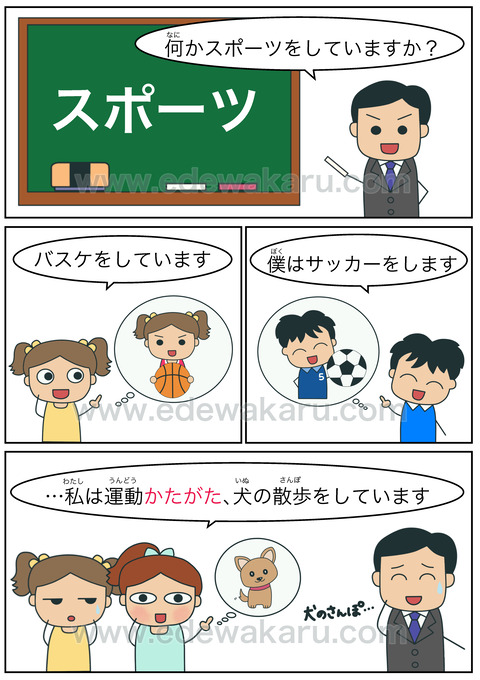
毎朝、運動かたがた犬の散歩をしています
→運動する時に犬の散歩もしていますお仕事かたがた、また大阪に遊びにきてくださいね
→お仕事の機会に、また大阪に遊びにきてくださいね本日は、お礼かたがたごあいさつに伺いました
→お礼と一緒にごあいさつに伺いました結婚の報告かたがた、実家に帰ることにした
→結婚の報告をしに行く機会を使って、実家に帰ることにした東京出張かたがた、スカイツリーを見に行ってきた
→東京出張する時に、スカイツリーを見に行ってきた
日本語文型辞典
Meaning
基本情報Nかたがた説明動作を表す名詞に付いて、その動作をかねて、そのあとに述べる動作を行うという意味を表す。「お見舞い」「散歩」など限られた名詞にしか使えない。例文① 友達が風邪をひいたというので、お見舞いかたがた家を訪ねることにした。② 散歩かたがたパン屋さんに行ってこよう。③ ≪手紙文≫以上お礼かたがたお願いまで。
日本語文型辞典 英語版
Meaning
【かたがた】[Nかたがた]
Attaches to a noun that describes an action; expresses that another action which is described after this noun takes place at the same time. The nouns with which かたがた can be used are limited in number and include お見舞い (a visit to someone who is ill/an expression of sympathy) and 散歩 (a walk/stroll).
In context 3 examples
友達が風邪をひいたというので、お見舞いかたがた家を訪ねることにした。
My friend said he had caught a cold, so I decided to visit him at home to see how he was.
散歩かたがたパン屋さんに行ってこよう。
I will stop by a bakery on my stroll.
《手紙文》以上お礼かたがたお願いまで。
《in a letter》I thought I would send you this brief note to thank you and also to take this opportunity to ask you another favor.
くらべてわかる日本語表現文型辞典
Meaning
AとBが同程度の目的であることを示す。主に改まった場面や手紙などに使われる表現である。
How to use it
AかたがたB
[名詞-∅]かたがた
Explanation
【対比1】
「AをかねてB」(意味1 P.335)
意味は変わりがないが「AかたがたB」のAに使われる言葉は限られる。
○家族旅行をかねて、現地を視察してきた。
×家族旅行かたがた現地を視察してきた。
In context 4 examples
仲人さんの家へお礼かたがた新年のご挨拶にうかがった。
社長の病院へ毎週お見舞いかたがた会社の様子を報告にいく。
先生、大変お世話になりありがとうございました。おかげさまで大学に合格いたしました。ご報告かたがたお礼まで。
建築中はいろいろと近所に迷惑をかけたので、お詫びかたがた引っ越しの挨拶に行ってきた。
日本語NET JLPT文法解説まとめ
Meaning
〜のついでに / 〜も兼ねて
How to use it
N + かたがた
※Nはする動詞
●よく使う名詞
ご挨拶、お礼、お見舞い、ご報告、お詫び
Explanation
To indicate doing something for two or more purposes simultaneously.
It is often used in written language or formal speech and is typically paired with actions that serve dual functions, such as making a courtesy visit while also conducting business.
・硬い表現でビジネスシーンや目上の人との会話で使われることが多い。
・後件には移動に関する動詞がよく使われる。
・Nに来る単語は限定的。
In context 5 examples
今度、結婚の挨拶かたがた、そちらに伺います。
近くに寄ったので、先日のお礼かたがた挨拶に伺いました。
ご出張かたがた、ぜひ京都を観光なさってください。
メールにて大変恐縮ではございますが、ご報告かたがたお礼申し上げます。
お礼かたがた、お伺いいたしました。
毎日のんびり日本語教師
Meaning
~のついでに
~もかねて
How to use it
名詞+かたがた
Explanation
【 A 】かたがた【 B 】
二つの目的を示す文型です。
後件が主な目的で、前件は後件に付随する副次的な目的です。
硬い表現で、目上の人への挨拶、手紙、お礼、お見舞い、報告、お詫び等で用いられます。
Notes
動作の並立シリーズ
In context 5 examples
まず始めに書状にて、お礼かたがたご挨拶申し上げます。
結婚の報告かたがた、一度お伺い致します。
お仕事かたがた、東京観光にいらして下さい。
まずはお詫びかたがた、お願い申し上げます。
共同募金のご報告かたがた厚くお礼申し上げます。
NINJAL 日本語文型データベース
Meaning
〜という目的も兼ねて、あることをすると言いたいときに使います。儀礼的な文でよく使われます。
How to use it
Nかたがた
Notes
「〜」には、「(ご)挨拶・おわび・お礼・お見舞い・(ご)報告」などの限られた言葉がきます。「〜かたがた」の後には、「行く・訪ねる」など、移動を表す動詞の文がくることが多いです。
In context 4 examples
父の見舞いかたがた、叔父が上京してきた。
就職の際お世話になった先生のところには、改めてお礼かたがたご挨拶に伺いたいと思っている。
先日の会議ではご迷惑をおかけしまして誠に申し訳ございませんでした。おわびかたがた、現状のご報告に参りました。
年末年始の休業日は以下のとおりとさせていただきます。年末のご挨拶かたがた、お知らせいたします。
IMABI
Incidental
Read this IMABI lesson ↗Explanation
Incidental: がてら, かたがた, かたわら, & ついで
All of these items have a common theme, but don’t let this confuse you! Pay attention to how these items are exactly used, and see if you can come up with a chart to differentiate them. Then, compare your chart to the one that ends this lesson.
がてら
~がてら either attaches to the 連用形 of a verb or to a noun. ~がてら shows that while you’re doing something, you’re also taking the opportunity to do something else. So, whatever it attaches to, there should be some sense of movement implied.
~がてら is primarily used with nouns that express an action of movement such as walking or shopping. Unlike ~ながら, ~がてら doesn’t indicate that two things are simultaneous. In both cases, though, the two actions are happening in the same time period.
~がてら shows that things are happening in a relatively close time span. This is rather old-fashioned, so you probably will not see it often. However, it does show up in writing and the JLPT 1, so you still need to know what it is.
Examples
1. 散歩がてら友達と話し合う。
While taking a walk, I talk with my friend.
2. 散歩がてら買い物に行く。
While taking a walk, I go shopping.
3. 駅に行きがてら郵便局に立ち寄ります。
While going to the train station, I’ll drop by the post office.
4. 教会に行きがてら、おじさんの家に寄ってきた。
While I went to church, I went to visit my uncle (on the way).
5. 散歩がてらちょっとピーマンを買いに行ってきます。
I’ll get some peppers on my walk.
6. 外に行きがてら、手紙を出してきてくれない?
Can’t you send out this letter as you go outside?
7. 友だちを駅まで送りがてら本を返してきた。
I returned a book back to my friend while I sent him to the train station.
8. 運動がてら犬の散歩に出かけたっけ。
You said you took the dog on a walk in exercising?
Grammar Note: When using a noun that can be made verbs by adding する, you shouldn’t attach がてら to the 連用形. So, rather than ever saying 運動しがてら, simply use 運動がてら.
9. 暖かい日の午過ひるすぎ食後の運動がてら水仙の水を易かえてやろうと思って洗面所へ出て、水道の栓せんを捩ねじっていると、その看護婦が受持の室へやの茶器を洗いに来て、例の通り挨拶あいさつをしながら、しばらく自分の手にした朱泥しゅでいの鉢はちと、その中に盛り上げられたように膨ふくれて見える珠根たまねを眺めていたが、やがてその眼を自分の横顔に移して、この前御入院の時よりもうずっと御顔色が好くなりましたねと、三カ月前の自分と今の自分を比較したような批評をした。
Past noon on a warm day, I thought about watering the daffodil on going to exercise and went to the washroom, and when I had twisted the water nob, the nurse had come to wash the tea utensils of the room she was in charge of, and as she gave regular greetings, she gazed at the reddish-brown pot in my hand and the bulbs that seemed swollen up like they had been piled in there, but she finally moved her glance to my profile and gave the comment, “Your complexion has really improved lately since you came in the hospital”, which seemed to be a comparison of me now and three months ago.
From 変な音 by 夏目漱石. 暖かい日の午過(ひるすぎ)食後の運動がてら水仙の水を易(か)えてやろうと思って洗面所へ出て、水道の栓(せん)を捩(ねじ)っていると、その看護婦が受持の室(へや)の茶器を洗いに来て、例の通り挨拶(あいさつ)をしながら、しばらく自分の手にした朱泥(しゅでい)の鉢(はち)と、その中に盛り上げられたように膨(ふく)れて見える珠根(たまね)を眺めていたが、やがてその眼を自分の横顔に移して、この前御入院の時よりもうずっと御顔色が好くなりましたねと、三カ月前の自分と今の自分を比較したような批評をした。Past noon on a warm day, I thought about watering the daffodil on going to exercise and went to the washroom, and when I had twisted the water nob, the nurse had come to wash the tea utensils of the room she was in charge of, and as she gave regular greetings, she gazed at the bulbs, which looked swollen up like they had been piled in the flower pot that I held in my hand, but she finally moved her glance to my face and gave the comment, “Your complex has really improved lately since you came in the hospital”, which seemed to be a comparison of me now and three months ago.
Fr
Some usages of ~がてら, given that it has passed its heyday, may be questionable. If it is a situation seemingly not completely within one’s free will, it can sound unnatural. In the following case, it would be natural if the meeting is most important to you and you just had to go on a 出張 for your own comfort.
10a. イギリスへの出張がてら、地球環境会議に出席しました。
10b. イギリスへの出張(の)ついでに、地球環境会議に出席しました。
On the occasion of going on a business trip to England, I attended a global environment meeting.
To reiterate, if there isn’t a sense of moving, ~がてら becomes ungrammatical and you would have to use something else like ついでに (see below) or rephrase the sentence entirely.
11a. 食事がてらこの間話していた映画でも見に行こう。〇
11b. 食事がてらこの間話していた映画でも見よう。X
Let’s go see the movie we’ve been talking about recently while out to dinner.
12. 散歩がてら(に)行って来よう。
I’ll come by way of going on a walk.
Particle Note: You can also rarely see がてらに. This explicitly establishes a sense of direction/movement.
かたがた
~かたがた: attaches to nouns. “Previously” or “on the occasion/same time as”. It is mainly used with verbs related to movement such as 行く. Essentially, you do a certain thing on the occasion of tending to another prerogative. As you will see, this is typically only used in 敬語 in the form of あいさつ文. It can still be used in the sense of ~がてら by older speakers, which still makes it old-fashioned.
13. お礼かたがたご機嫌伺いをしてきましょう。
Let’s go come and make an inquiry on good times for their previous gratitude to us.
14. 見舞いかたがた手伝いに行った。
On the occasion of inquiring on (him), I went to give some help.
15. お近くにお越しの節は、お遊びかたがた、お立ち寄りください。
Please stop by when you are near while on your excursion.
16. ご挨拶かたがたお宅に伺います。
I will come to your house as I give my salutations.
17. 散歩かたがた
On the same time as my walk
Usage Note: This suffix is normally replaced with something like ついでに in the spoken language.
漢字 Note: かたがた may also rarely be written as 旁(々).
かたわら
Literally meaning “beside”, 傍ら is after the 連体形 of verbs or the nominal form of a verb to show simultaneous action and is equivalent to “一方で…と同時に”. 傍ら is often used with time frames that are much broader. This pattern implies that the first action is the primary action and the second is something that is also occurring in parallel with the first.
If you were to turn this into a verbal expression, they would all turn to “連用形+ながら”. かたわら is used a lot in the written language whereas ~ながら would be used in the spoken language. The former is used a lot in regard to protagonists in describing their lifestyle backgrounds in novels. If a description was given for a character to only appear once, ~ながら would be used. The pattern Xは動詞+人の+かたわらで is also literary, and it is used in describing condition, but it is only describing place of activity. In this manner, the distance between X and A (動詞+人) is like the following with the right being larger: そば → 隣 → 横 → かたわら.
Examples
18. 道のかたわらで
Beside the road
19. 彼女は高校の数学の教師の傍ら、バレーボール部の監督かんとくをしています。
While she is a high school mathematics teacher, she is at the same time the volleyball department manager.
20. 私はスペイン語を習う傍ら、韓国語を習うことにしました。
Alongside Spanish, I have also decided to study Korean.
21a. 先生たちのかたわらで、彼らの相談事そうだんごとに耳を傾けていた。X
21b. 先生たちのそばで、彼らの相談事に耳を傾けていた。
I was listening to the side of the teachers discussing things.
22. 傍らに人なきがごとし。(Set Phrase)
Act outrageously as if no one is around.
ついで
Written as 次いで, ついで is a conjunction meaning “subsequently”. Written as 序で, ついで is a noun meaning “opportunity”. Building on this, 序でに means “incidentally”.
23. 序でに一言ひとこと言っておく。
To incidentally give a word about something in advance.
24. 開会式が終わりました。次いで、競技きょうぎに移ります。
The opening ceremony ended. Subsequently/afterwards, we’ll move to the events.
25. 「一瞬いっしゅんの塵ちり」という歌に次いで「ヴェロニカ」というのは僕の好きな歌だよ。
After the song, “Dust of a Moment”, my favorite song is called, “Velonica”.
26. 序でがあったら、これを渡わたしておいてください。
If you have a chance, please send this to him.
~ついでに is somewhat interchangeable with ~がてら. However, they’re not exactly the same. 「A-る・た・動作名詞(の)+ついでにB」 shows that the speaker does/wants to end up doing B as well in the case that A–a daily task, chore, duty, or obligation–has to be done. Using ~がてら has no such requirements. Rather, ~がてら is more like saying “Aというせっかくの機会だから、Bもしてみよう”.
27a. 図書館へ本を返しに行くついでに、ジョギングする。
27b. 図書館へ本を返しに行きがてら、ジョギングする。
I’ll go jogging while I go return the book/books to the library.
28a. 周りの景色を楽しむついでに、山を下りた。X
28b. 周りの景色を楽しみがてら、山を下りた。〇
On the occasion of enjoying the surrounding scenery, I descended down the mountain.
When ついでに shows ordinariness, の may be dropped with 動作名詞 in the spoken language. Don’t do this in writing unless you’re writing a dialogue.
29. 登山ついでに、いろんな写真を撮ってみたよ。
I took all sorts of pictures when going mountain climbing.
Although context is crucial, there are instances when it doesn’t have to be used with a 動作名詞, but the conditions mentioned above still apply.
30a. お風呂がてら、浴槽よくそうを洗っておいて。X
30b. お風呂ついでに、浴槽を洗っておいて。 〇
30c. お風呂のついでに、浴槽を洗っておいて。〇
When you get a bath, be sure to wash the tub.
31. 居間の壁かべのついでに、家の外壁がいへきも塗ぬる。
To paint the outside of the house on the occasion of (painting) the living room walls.
32a. 彼女を見舞まうついでに、定期健診けんしんを受けてくる。
32b. 彼女を見舞いがてら、定期健診を受けてくる。
I’ll get my regular medical check up on the occasion that I see her.
When reversed, only ついでに is possible because it’s something you have an obligation for. In this situation, the order of events is unclear. It’s also unclear whether the two events are happening in the same place or not. If in the same place, then the speaker would be taking the checkup in the midst of going to see about her.
It’s thought to be that the two events are taking place at basically same time. However, when strictly speaking, taking the latter action as the standard point of time, one can express whether or not it is before, after, or at the same time as A. On the other hand, がてら limits interpretations to just getting both down during the time you’re at the same hospital/facility.
When the non-past tense is used before ついでに, A and B can either be happening at the same time or B happens before A. When the past tense is used before ついでに, B happens after A.
33. 友達の家へ行くついでに、海岸で泳いだ。
I swam in the ocean on the occasion of going to my friend’s house.
Note: The swimming can be simultaneous to going to your friend’s house or before.
34a. こっちへ来るついでに、土産みやげを買ってきてほしいんだけど。
34b. こっちへ来たついでに、土産を買ってきてほしいんだけど。X
You want someone as they are to come over to get a souvenir. Why on Earth would you want a souvenir from your own place anyway? Is that even a possible usage of the word 土産? No! In reality, speakers, even when B is after A, will use the non-past with ついでに because of the previous statement that the two actions are usually deemed as happening basically at the same time. This practical interchangeability, though, is in regards to 瞬間動詞.
35. 花瓶かびんを壊すついでに、それらの皿も壊しといてくれないか?
While you destroy the vase, can’t you also break those plates?
Consider the following where the opposite situation holds: flipping them potentially makes ついでに ungrammatical. It just so happens that the following sentences don’t have this problem as both directions are logical. The meanings of these phrases are summarized below, so don’t think that all of these mean the same things.
36a. 実家に帰るついでに遊んできた。〇
36b. 実家に帰ったついでに遊んできた。〇
36c. 実家に帰りがてら、遊んできた。〇
36d. 遊ぶついでに、実家に帰ってきた。〇
36e. 遊んだついでに、実家に帰ってきた。△
36f. 遊びがてら、実家に帰ってきた。〇
がてら VS ついでに VS かたわら VS かたがた VS ながら
Hopefully you’ve seen a lot of differences and overlap between these phrases. So, to summarize, here is a chart to act as your cheat sheet on how to distinguish.
Phrase Characteristics of A Importance Time Ordering Period
A+ながら+B Ordinary A≦B Same time One scene
A+かたわら+B Ordinary A>B Parallel Long time
A+かたがた+B Unordinary A=B Same time Short time
A+ついでに+B Obligatory A>B Before or after or same Short time
A+がてら+B Pleasure 不明 Same time Short distance
In context 50 examples
散歩がてら友達と話し合う。
While taking a walk, I talk with my friend.
散歩がてら買い物に行く。
While taking a walk, I go shopping.
駅に行きがてら郵便局に立ち寄ります。
While going to the train station, I’ll drop by the post office.
教会に行きがてら、おじさんの家に寄ってきた。
While I went to church, I went to visit my uncle (on the way).
散歩がてらちょっとピーマンを買いに行ってきます。
I’ll get some peppers on my walk.
外に行きがてら、手紙を出してきてくれない?
Can’t you send out this letter as you go outside?
友だちを駅まで送りがてら本を返してきた。
I returned a book back to my friend while I sent him to the train station.
運動がてら犬の散歩に出かけたっけ。
You said you took the dog on a walk in exercising?
暖かい日の午過ひるすぎ食後の運動がてら水仙の水を易かえてやろうと思って洗面所へ出て、水道の栓せんを捩ねじっていると、その看護婦が受持の室へやの茶器を洗いに来て、例の通り挨拶あいさつをしながら、しばらく自分の手にした朱泥しゅでいの鉢はちと、その中に盛り上げられたように膨ふくれて見える珠根たまねを眺めていたが、やがてその眼を自分の横顔に移して、この前御入院の時よりもうずっと御顔色が好くなりましたねと、三カ月前の自分と今の自分を比較したような批評をした。
Past noon on a warm day, I thought about watering the daffodil on going to exercise and went to the washroom, and when I had twisted the water nob, the nurse had come to wash the tea utensils of the room she was in charge of, and as she gave regular greetings, she gazed at the reddish-brown pot in my hand and the bulbs that seemed swollen up like they had been piled in there, but she finally moved her glance to my profile and gave the comment, “Your complexion has really improved lately since you came in the hospital”, which seemed to be a comparison of me now and three months ago.
イギリスへの出張がてら、地球環境会議に出席しました。
On the occasion of going on a business trip to England, I attended a global environment meeting.
イギリスへの出張(の)ついでに、地球環境会議に出席しました。
On the occasion of going on a business trip to England, I attended a global environment meeting.
食事がてらこの間話していた映画でも見に行こう。〇
Let’s go see the movie we’ve been talking about recently while out to dinner.
食事がてらこの間話していた映画でも見よう。X
Let’s go see the movie we’ve been talking about recently while out to dinner.
散歩がてら(に)行って来よう。
I’ll come by way of going on a walk.
お礼かたがたご機嫌伺いをしてきましょう。
Let’s go come and make an inquiry on good times for their previous gratitude to us.
見舞いかたがた手伝いに行った。
On the occasion of inquiring on (him), I went to give some help.
お近くにお越しの節は、お遊びかたがた、お立ち寄りください。
Please stop by when you are near while on your excursion.
ご挨拶かたがたお宅に伺います。
I will come to your house as I give my salutations.
散歩かたがた
On the same time as my walk
道のかたわらで
Beside the road
彼女は高校の数学の教師の傍ら、バレーボール部の監督かんとくをしています。
While she is a high school mathematics teacher, she is at the same time the volleyball department manager.
私はスペイン語を習う傍ら、韓国語を習うことにしました。
Alongside Spanish, I have also decided to study Korean.
先生たちのかたわらで、彼らの相談事そうだんごとに耳を傾けていた。X
I was listening to the side of the teachers discussing things.
先生たちのそばで、彼らの相談事に耳を傾けていた。
I was listening to the side of the teachers discussing things.
傍らに人なきがごとし。(Set Phrase)
Act outrageously as if no one is around.
序でに一言ひとこと言っておく。
To incidentally give a word about something in advance.
開会式が終わりました。次いで、競技きょうぎに移ります。
The opening ceremony ended. Subsequently/afterwards, we’ll move to the events.
「一瞬いっしゅんの塵ちり」という歌に次いで「ヴェロニカ」というのは僕の好きな歌だよ。
After the song, “Dust of a Moment”, my favorite song is called, “Velonica”.
序でがあったら、これを渡わたしておいてください。
If you have a chance, please send this to him.
図書館へ本を返しに行くついでに、ジョギングする。
I’ll go jogging while I go return the book/books to the library.
図書館へ本を返しに行きがてら、ジョギングする。
I’ll go jogging while I go return the book/books to the library.
周りの景色を楽しむついでに、山を下りた。X
On the occasion of enjoying the surrounding scenery, I descended down the mountain.
周りの景色を楽しみがてら、山を下りた。〇
On the occasion of enjoying the surrounding scenery, I descended down the mountain.
登山ついでに、いろんな写真を撮ってみたよ。
I took all sorts of pictures when going mountain climbing.
お風呂がてら、浴槽よくそうを洗っておいて。X
When you get a bath, be sure to wash the tub.
お風呂ついでに、浴槽を洗っておいて。 〇
When you get a bath, be sure to wash the tub.
お風呂のついでに、浴槽を洗っておいて。〇
When you get a bath, be sure to wash the tub.
居間の壁かべのついでに、家の外壁がいへきも塗ぬる。
To paint the outside of the house on the occasion of (painting) the living room walls.
彼女を見舞まうついでに、定期健診けんしんを受けてくる。
I’ll get my regular medical check up on the occasion that I see her.
彼女を見舞いがてら、定期健診を受けてくる。
I’ll get my regular medical check up on the occasion that I see her.
友達の家へ行くついでに、海岸で泳いだ。
I swam in the ocean on the occasion of going to my friend’s house.
こっちへ来るついでに、土産みやげを買ってきてほしいんだけど。
こっちへ来たついでに、土産を買ってきてほしいんだけど。X
花瓶かびんを壊すついでに、それらの皿も壊しといてくれないか?
While you destroy the vase, can’t you also break those plates?
実家に帰るついでに遊んできた。〇
実家に帰ったついでに遊んできた。〇
実家に帰りがてら、遊んできた。〇
遊ぶついでに、実家に帰ってきた。〇
遊んだついでに、実家に帰ってきた。△
遊びがてら、実家に帰ってきた。〇