AIUEO JLPT Grammar
Usage 1
Meaning
This sentence pattern is used to summarize a series of examples, showing the category or common feature of the examples provided.
How to use it
(名詞や+) 名詞と+いった
Explanation · 日本語
この文型は、いくつかの例を挙げた後、それらの例を総括する表現です。具体的な例を挙げ、それが属するカテゴリーや共通する特徴を示すために用いられます。
In context 5 examples
日本や韓国といった東アジアの国々では、四季がはっきりしている。
In East Asian countries like Japan and Korea, the four seasons are distinct.
テニスやサッカーといったスポーツは、世界中で人気がある。
Sports like tennis and soccer are popular worldwide.
大都市といった場所は、生活費が高い。
In places like large cities, the cost of living is high.
桃梨葡萄といった果物がとれます。
Fruits such as peaches, pears, and grapes are harvested.
漫画やアニメといったものは、日本の文化の一つだ。
Manga and animation are part of Japanese culture.
Usage 2
Meaning
This sentence pattern emphasizes the absence of something special regarding a particular matter.
How to use it
これと+いって+否定文これと+いう+名詞はないこれと+いった+名詞はない
Explanation · 日本語
この文型は、特定の事柄に対して、何か特別な事実がないことを強調するときに使います。
In context 5 examples
これといって特別な趣味はないです。
I don’t have any particularly special hobbies.
これといった問題はないけど、もう少し様子を見ましょう。
There doesn’t seem to be any major issues, but let’s observe a bit longer.
これといって好きなものはないけど、辛いものはあまり食べない。
I don’t have any strong likes, but I don’t eat spicy food often.
これといった計画はないけど、旅行に行けたらいいなと思っている。
I don’t have any specific plans, but I’d like to go on a trip if I can.
これといって大きな目標はないが、毎日を大切に過ごしたい。
I don’t have any major goals, but I want to make the most of each day.
文法
Meaning
〜のような
例を挙げるときに使う表現。
How to use it
N + といった
Notes
「~や~といった」の形で使うことが多い。
In context 6 examples
ハワイやグアムといった国が日本人の新婚旅行先として人気があります。
とんかつや天ぷらといった揚げ物の料理が好きです。
私の町ではにベトナム料理やタイ料理といった東南アジア料理を扱うレストランが増えてきている。
私の国ではトヨタやホンダといった日本の車が人気があります。
この学校には、ベトナムや中国といった学生が多い。
私はファイナルファンタジーやドラゴンクエストといったRPGが好きです。
Bunpro Grammar Reference
Meaning
Such as, Like, So much as
How to use it
Noun + といった + Noun
Nuance
A phrase that which emphasizes things like those which are said to be in category (A), and then explains them.
Explanation
といった is a fairly casual expression which indicates lists in the same way as structures like などの, or のような. Stemming from と, and the past-tense form of the う-Verb 言う, といった is often translated as '(B) such as (A)', or '(B) like (A)'.
といった will always be followed directly by a noun expressing the general group that (B) belongs to, with the literal translation being similar to '(B) that can be called (A)'.
といった will appear with nouns both in (A) and (B).
私の父は、ゲートボールといったスポーツが好きだそうです。
Apparently my father likes sports such as gateball.
あなたの国ではおはぎといった和菓子は売られていますか?
Are Japanese sweets such as ohagi sold in your country?
旦那は洗濯や料理といった家事は一切しません。
My husband does not do any household chores such as laundry or cooking.
私は生姜とかパクチーといった香味野菜を使った料理が苦手です。
I am not a fan of food that uses pot-herbs such as ginger and cilantro.
As can be seen in the last two examples above, constructions such as や and とか may be used if there is more than one (B) that fits in the category of (A).
Nuance · 日本語
(A)というカテゴリに属しているものを強調して、それについて説明する時に使われる表現。
Explanation · 日本語
「といった」は、「などの」や「のような」と同じように、例を挙げるときに使われる、比較的砕けた表現です。この表現は「と」に五段動詞「言う」の過去形「言った」が付いてできたものです。
「といった」は例を挙げる名詞 (B) の後に付き、その後に (B) を含む広いカテゴリーの名詞 (A) が続きます。
「といった」を使う場合は、(A) も (B) も名詞になります。
私の父は、ゲートボールといったスポーツが好きだそうです。
Apparently my father likes sports such as gateball.
あなたの国ではおはぎといった和菓子は売られていますか?
Are Japanese sweets such as ohagi sold in your country?
旦那は洗濯や料理といった家事は一切しません。
My husband does not do any household chores such as laundry or cooking.
私は生姜とかパクチーといった香味野菜を使った料理が苦手です。
I am not a fan of food that uses pot-herbs such as ginger and cilantro.
最後の二つの例文のように、(A) のカテゴリーに当てはまる (B) が複数ある場合は「や」や「とか」のような接続助詞を使って並べましょう。
In context 16 examples
- 勝敗といったものにこだわるのはやめよう。
Let's stop fussing over things such as winning or losing.
- 私の父は、ゲートボールといったスポーツが好きだそうです。
Apparently my father likes sports such as gateball.
- あなたの国ではおはぎといった和菓子は売られていますか?
Are Japanese sweets such as ohagi sold in your country?
- 旦那は洗濯や料理といった家事は一切しません。
My husband does not do any household chores such as laundry or cooking.
- 私は生姜とかパクチーといった香味野菜を使った料理が苦手です。
I am not a fan of food that uses pot-herbs such as ginger and cilantro.
- 蕎麦といった麺類があまり好きではありません。
I don't really like noodles such as soba.
- 相撲といった日本の文化に興味がある。
I have interest in Japanese culture such as sumo.
- 宣伝といったものに振り回されてはいけません。
You must not be manipulated by things such as advertisements.
- これといった理由もないのに約束を破ってはいけない。
Since you don't even have so much as a reason you cannot break your promise.
- 「末っ子だからね」といったレッテルを貼るのはやめてください。
Please stop labeling me with such things as 'It is because you are the youngest child'.
- 彼は将棋やポーカーといった勝負ごとに強い。
He is skilled at match-based games like Shogi and Poker. (such as)
- 総理大臣といった偉い人には簡単には会えません。
You cannot simply meet a prominent person such as the Prime Minister.
- 素質といったものは、遺伝的な要素が大きいのかもしれない。
Genetics are maybe a big factor in things such as one's character.
- 炊事洗濯といった家事もりっぱな仕事だと思います。
I think doing housework, such as cooking and washing, is a splendid job.
- 休みの日に何かを習いに行くといった趣味はない。
My hobbies don't include things such as going to learn something on my days off.
- 団地といった集合住宅では、近所付き合いが大変な場合がある。
There are situations where neighborhood interaction is tough in housing complexes such as multi-unit apartments.
DoJG 日本語文法辞典(全集)
Meaning
Like; such as; among others
How to use it
(i) Noun1、Noun2(、…) | といったNoun | |
| 犬、猫といったペット | Pets like dogs and cats |
(ii) Sentence1 (、Sentence2、Sentence3、…) | といったNoun | |
| 持ち運びしやすい、容量が大きいといった特徴 | Such characteristics as portability and large capacity |
Explanation
A compound particle that introduces examples.
In context 8 examples
ドイツ、フランス、ロシアといった国々が戦争に反対した。
Countries such as Germany, France and Russia opposed the war.
このエンジンで一番困るのはパワーが弱い、製造コストが高いといった問題だ。
The problems that are giving me the most trouble with this engine are things like weak power and high production costs.
終身雇用、年功序列といった日本の伝統的雇用形態が崩れつつある。
Japan's traditional employment practices, such as permanent employment and seniority systems, are (in the process of) falling apart.
ここではBMWやベンツといったドイツの高級車が人気があるようだ。
It looks like expensive German cars such as BMWs and Mercedes Benzes are popular here.
学校選択制、そして基礎学力の向上といったテーマが今、全国で議論されている。
Themes like school-choice systems and the improvement of basic academic skills are being discussed all over the country now.
こんな機能があるといい、こんな情報が欲しいといったご意見・ご要望がありましたら、下記のアドレスに電子メールでお知らせ下さい。
If you have opinions/requests such as ""This kind of function would be helpful"" or ""I want this kind of information,"" please let us know via e-mail at the address below.
一流大学から一流企業に就職すれば一生安泰の人生が送れるといった考え方はもう通用しない。
It's no longer realistic to think that if you graduate from a first-class university and get a job at a first-class company you are set for life.
ゴミを燃やせばダイオキシン二酸化炭素といった有害物質が排出される。またゴミの埋立地もあとわずかで満杯になる、しかも新たな埋立地がない、といった問題がある。
If you burn trash, toxic materials such as dioxin and carbon dioxide are emitted. There is also the problem that landfills will soon be full and, to make the matter worse, no new land for landfills is available.
絵でわかる日本語
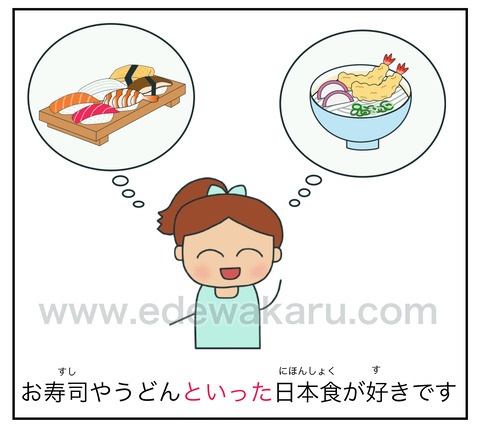
Meaning
〜などの
〜のような
How to use it
名詞[辞書形]+といった+名詞
Explanation
「〜といった」は2つ以上の例を並べて「〜などの」「〜のような」という意味を表します。例を並べて、他にもまだあると言いたい時に使用します😊
後ろには必ず名詞を使うことをしっかりと覚えておきましょう
😉
In context 3 examples
お寿司、うどんといった日本食が好きです
→お寿司、ラーメン、うどんなどの日本食が好きです台湾、韓国、グアム、ハワイといった国が日本人に人気です
→台湾、韓国、グアム、ハワイなどの国が日本人に人気です日本にはセブンイレブン、ファミリーマートといったコンビニがあります
→日本にはセブンイレブン、ファミリーマートなどのコンビニがあります
日本語文型辞典
Meaning
例を列挙するのに使う。これが全部ではなく、ほかにまだあるという含みがある。
その段階での状況を説明するのに用いる。「…というところだ」とも言う。
How to use it
N、NといったN
…といったところだ
In context 6 examples
黒沢、小津といった日本の有名な映画監督の作品を上映するそうだ。
この学校には、タイ、インドネシア、マレーシアといった東南アジアの国々からの留学生が多い。
この豪華な催しの行われているホールの駐車場には、ペンツ、ロールスロイスといった超高級車がずらりと止まっている。
A:最近よく借りだされるビデオは何ですか。
B:ダイハード、スターウォーズといったところですね。A:体の調子、どうですか。
B:回復まであと一歩といったところです。A:彼の運転の腕はどうですか。
B:まあまあといったところですね。
日本語文型辞典 英語版
Meaning
Used for listing examples. Implies that there are others as well.
B:ダイハード、スターウォーズといったところですね。
Movies like Diehard and Star Wars.
B:回復まであと一歩といったところです。
I’m quite close to full recovery.
B:まあまあといったところですね。
Well, you could say they’re not so bad.
Used to explain what the situation is at a particular stage. It is also possible to say というところだ.
How to use it
1. N、NといったN
2. ...といったところだ
In context 6 examples
黒沢、小津といった日本の有名な映画監督の作品を上映するそうだ。
It sounds like they’re going to show works by famous Japanese film directors like Kurosawa and Ozu.
この学校には、タイ、インドネシア、マレーシアといった東南アジアの国々からの留学生が多い。
At this school, there are a lot of foreign students from Southeast Asian countries like Thailand, Indonesia, and Malaysia.
この豪華な催しの行われているホールの駐車場には、ベンツ、ロールスロイスといった超高級車がずらりと止まっている。
The parking lot at the venue for this sumptuous event was filled with luxury cars such as Mercedes-Benzes and Rolls Royces.
A:最近よく借りだされるビデオは何ですか。
Which videos are being rented out the most these days?
A:体の調子、どうですか。
How are you feeling?
A:彼の運転の腕はどうですか。
How are his driving skills?
日本語NET JLPT文法解説まとめ
Meaning
"〜のような"
例を挙げるときに使う表現。
How to use it
N + といった
Explanation
like / such as
An expression used when giving examples.
「~や~といった」の形で使うことが多い。
In context 6 examples
ハワイやグアムといった国が日本人の新婚旅行先として人気があります。
とんかつや天ぷらといった揚げ物の料理が好きです。
私の町ではにベトナム料理やタイ料理といった東南アジア料理を扱うレストランが増えてきている。
私の国ではトヨタやホンダといった日本の車が人気があります。
この学校には、ベトナムや中国といった学生が多い。
この学私はファイナルファンタジーやドラゴンクエストといったRPGが好きです。
毎日のんびり日本語教師
How to use it
名詞(や)、名詞+といった+名詞
Explanation
代表的なものをいくつか挙げてするときに使う文型です。挙げられたもの以外の存在も暗示します。
後件にはそれらをまとめる上位語がきます。
Notes
特になし
In context 12 examples
農業、漁業、林業といった過酷な仕事を今の若者はやりたがらない。
頭皮が固くなると、抜け毛や頭痛、肩こりといったトラブルを引き起こす。
ストレス解消には、よく聴く音楽や鳥の鳴き声、風の音等といった自然の音を聴いてみるのも一つの方法だ。
学歴や経歴などといった要素で人を見ないようになりたい。
会計や事務、人事といった分野は今後AIに仕事を奪われる可能性が高い。(会计、事务、人事等领域今后被AI人工智能剥夺工作的可能性很高。)
男ですが、料理や掃除などといった家事は得意です。
社会への不安や不信感といったものが高まっている。
「女子力」が指すものは、美容やファッションといった外見に限らない。
神話の生き物や妖怪といった架空の生き物が大好きだ。
突然起こる片側の手足・顔のマヒや痺れ、呂律が回らないといった症状は脳卒中のサインです。
私の理念や信条といったものを信じてくれる相手とだけビジネスをしたい。
春の妖精や冬の妖精といった季節の妖精が現れることで季節が変わっていく。
IMABI
と Combination Particles II
Read this IMABI lesson ↗Explanation
と Combination Particles II
In the next two lessons we will learn about more combination particles with と.
とも とあって とあれば といっ{た・て}
とも
とも is an emphatic version of the case particle と. Do not confuse with the conjunctive/final particle とも.
1. 君とも逢あえなくなるだろう。
I probably won’t be able to see you.
とあって
とあって means “because under the circumstances that/due to the fact that”.
2. 三連休とあって、すごい人出だ。
There is a turnout due to the fact that it is a three-day weekend.
3. 先生の頼みとあっては、お断りできません。
Because it is at your request, I cannot decline.
4. 素晴らしいホテルとあって、サービスは素晴らしい。
Since it is a wonderful hotel, the service is wonderful.
5. 休日とあって人出が多い。
It is also that there is a lot of people out on the holidays.
といって・といった
{と・そう}いった is placed after a list of nouns that are listed with particles like や, と, and とか to mean “such as”. といって means “however”. When not at the beginning of the sentence, it is often translated as “because” or “that…”. Though these phrases are from 言う, they are normally written in かな.
8. うちの息子は、科学や世界史といった科目が得意です。(From a mother)
Our son is good at subjects such as chemistry and world history.
9. 日本は、確かに経済大国となりました。{と言って・しかし}、国民一人一人の暮らしが豊かになったわけではあ りません。
Japan has certainly become an “economic giant”. However, that doesn’t mean that the way of life for each individual citizen has become wealthy.
Sentence Note: といって would not suitable for writing, but it would be fine in speech.
10a. 私は同意しました。だからといって、(私が)満足まんぞくしているわけではありません。
10b. 私は同意しましたが、満足しているわけではありません。
I agreed, but that doesn’t mean I am satisfied.
11a. そのように感じたからといって、誰も彼らを非難できませんよ。(Less natural ordering)
11b. 彼らがそのように感じたからといって、誰も非難できませんよ。
Nobody can blame them that they felt that way.
12. 今はこれといってすることがない。
I have nothing particular to do now.
13. 試験が終ったからといって努力を怠おこたってはいけない。
You mustn’t give up your efforts because the exam is over.
14. 彼女はケーキとかそういったものを焼いた。
She baked cakes and stuff like that.
15. 「真理」とか「美び」といった抽象的ちゅうしょうてきな言葉
Abstract words such as “truth” and “beauty
~からといって means “while it’s true that/even though/just because”. It normally sends a message of warning. The clause that follows should be negative in some way, either grammatically or in perspective. Don’t let translation confuse you.
A similar phrase is からに, which means “just by/from” and is used with the non-past. からには, on the other hand, expresses determination and is equivalent to “now that.”
16. 天才てんさいだからといって威張いばるなよ。
Don’t brag just because you’re a genius.
17. 皆みなそういうからには怖こわい話だよ。
Just by everyone saying it, it’s a scary story!
18. 彼は約束やくそくしたからには必かならずやる(男だ)。
He will surely do it just from promising.
Variant Notes:
1. からといって may be からって(ー) in colloquial speech or からとて in formal texts.
2. からには may be からは in literary language.
とあれば
Also as とあらば, which is more poetic/nostalgic and old-fashioned, it shows a case established in a latter event(s) and is best translated as “if it is the case that”.
19. お望みとあらば、今すぐ。(Slightly archaic)
(Go) right now if it is your wish.
20. 必要とあればすぐに伺います。(A little old-fashioned)
I will come immediately if it is necessary.
In context 22 examples
君とも逢あえなくなるだろう。
I probably won’t be able to see you.
三連休とあって、すごい人出だ。
There is a turnout due to the fact that it is a three-day weekend.
先生の頼みとあっては、お断りできません。
Because it is at your request, I cannot decline.
素晴らしいホテルとあって、サービスは素晴らしい。
Since it is a wonderful hotel, the service is wonderful.
休日とあって人出が多い。
It is also that there is a lot of people out on the holidays.
うちの息子は、科学や世界史といった科目が得意です。(From a mother)
Our son is good at subjects such as chemistry and world history.
日本は、確かに経済大国となりました。{と言って・しかし}、国民一人一人の暮らしが豊かになったわけではあ りません。
Japan has certainly become an “economic giant”. However, that doesn’t mean that the way of life for each individual citizen has become wealthy.
私は同意しました。だからといって、(私が)満足まんぞくしているわけではありません。
I agreed, but that doesn’t mean I am satisfied.
私は同意しましたが、満足しているわけではありません。
I agreed, but that doesn’t mean I am satisfied.
そのように感じたからといって、誰も彼らを非難できませんよ。(Less natural ordering)
Nobody can blame them that they felt that way.
彼らがそのように感じたからといって、誰も非難できませんよ。
Nobody can blame them that they felt that way.
今はこれといってすることがない。
I have nothing particular to do now.
試験が終ったからといって努力を怠おこたってはいけない。
You mustn’t give up your efforts because the exam is over.
彼女はケーキとかそういったものを焼いた。
She baked cakes and stuff like that.
「真理」とか「美び」といった抽象的ちゅうしょうてきな言葉
Abstract words such as “truth” and “beauty
天才てんさいだからといって威張いばるなよ。
Don’t brag just because you’re a genius.
皆みなそういうからには怖こわい話だよ。
Just by everyone saying it, it’s a scary story!
彼は約束やくそくしたからには必かならずやる(男だ)。
He will surely do it just from promising.
からといって may be からって(ー) in colloquial speech or からとて in formal texts.
からには may be からは in literary language.
お望みとあらば、今すぐ。(Slightly archaic)
(Go) right now if it is your wish.
必要とあればすぐに伺います。(A little old-fashioned)
I will come immediately if it is necessary.
どんなときどう使う 日本語表現文型辞典
Meaning
like, such as
How to use it
N+といった
Explanation
~のような
1)「~といったN」の形で、あるものごとの同類の具体例をいくつか示したいときの言い方。「とか~とか」と意味・用法が同じ。
2)「~とか~と(か)いった」の形で使うことが多い。
1)In pattern ~といった N, indicates similar concrete examples of something. Same meaning and usage as とか~とか.
2)Often used in pattern ~とか~と(か) いった.
In context 3 examples
インド料理やタイ料理といった南の国の食べ物には辛いものが多い。
駅とかレストランとかいった所では、全面禁煙が望ましい。
うちの祖父母はパソコンとかデジタルカメラといった機械が大好きだ。