くらべてわかる日本語表現文型辞典
Usage 1
Meaning
意味1:たくさんある中でAやBを例示する表現。
意味2:話し手の複雑な感情をAやBを例としてあげて表現する。
意味3:「AのやらBのやら」の形で。AかBかわからないことを表す。
How to use it
Explanation
【対比1】
「Aとか(AとかBとか)」(意味4 P.165)
「AやらBやら」には話し手の「嫌だ」という感情が含まれているが、「AとかBとか」は単なる例示である。
○誕生日にはきれいな花とか欲しかった本とかをもらいました。
×誕生日にはきれいな花やら欲しかった本やらをもらいました。
「AだのBだの」
話し手のA,Bに対する感情は「AやらBやら」より強いが意味は同じ。
「AだのBだの」は動詞にはつきにくい。
【対比3】
「AだのBだの」
「AだのBだの」はA,Bに相手の発話を引用して使うものであり、「AやらBやら」とは意味が異なる。
○あの人は行くだの行かないだのはっきりしない。(「行く」と言ったり「行かない」と言ったりするのでわからない)
○あの人は行くのやら行かないのやらはっきりしない。(行くか行かないか知らない)
Notes
【注意1】
・AやBは話し手にとって嫌なもの、うっとうしいもの、面倒なものが多く使われる。
【注意2,3】
・意味2,3の接続の組み合わせは自由。
In context 12 examples
作文やら読解やら宿題がいっぱいあって、何から手をつけたらいいのかわからない。
彼は酒癖が悪くて、酒を飲んだら泣くやらわめくやら大変だ。
部屋は掃除をしていないのかごみやら食べ残しやらが散乱していた。
目の前で事故が起こり、けが人を運び出すやら、救急車を呼ぶやらで大騒ぎだった。
20年ぶりの同窓会はうれしいやらなつかしいやら話は尽きなかった。
彼が犯行に至った動機を聞いて可哀相やら気の毒やら複雑な心境だ。
話が面白すぎておかしいやらおなかが痛いやら大声で笑ったよ。
信じていた人に裏切られたと知って悔しいやら腹が立つやら…。
地図を忘れたので、右へ行くのやら左へ行くのやら見当がつかない。
太っていてかわいいと言われ、喜んでいいのやら悲しんでいいのやら。
海水浴場は、どこが浜辺やら海やらわからないぐらい人でいっぱいだ。
彼は旅行に行きたいのやら行きたくないのやら、はっきりしない。
Usage 2
Meaning
意味1:相手の言葉や行動やその場の状況に対して、軽く相手を非難したり、責めたり、あきれたりする表現。
意味2:はっきりわからないという話し手の気持ちを表す。
How to use it
疑問詞+Aやら
接続1:
疑問詞+[動詞](の)やら
接続2:
疑問詞+[動詞-る形/ている/た形]のやら
疑問詞+[イ形-普](の)やら
疑問詞+[ナ形-な/だった]のやら
疑問詞+[名詞-∅](なの)やら
Explanation
【対比1】
「疑問詞+Aことか」(意味2 P.73)
【対比2】
「疑問詞+Aことか」(意味2 P.74)
In context 8 examples
あの男はごみの日でもないのにごみを出して、何をするやら…。
入社面接の日にジーパン姿で現れた。今の学生は何を着てくるやら。
朝からこの子は泣き続けて、どれだけ泣いたら気が済むのやら。
社長が今日中にこの仕事をしろと言った。できるはずがないのに、なんてことを言い出すやら。
いつになったら日本語が上手に話せるやら、努力が報われない。
それぞれの言い訳を聞いているとどっちが悪いのやらわからない。
霧が出てきて、どこが頂上やら見えなくなってしまった。
どんな話が聞けるやら、楽しみでわくわくしています。
DoJG 日本語文法辞典(全集)
Usage 1
Meaning
X and Y; things like X and Y; X, Y and so on; whether X or Y; whether X or not
How to use it
(i) Sinformalの | やら | だ after Adjectiveなstem and Noun changes to な |
| {行く/行った}のやら | I wonder if someone will go/went |
| {高い/高かった}のやら | I wonder if something is/was expensive |
| 不便{な/である/だった/であった}のやら | I wonder if something is/was inconvenient |
| 学生{な/である/だった/であった}のやら | I wonder if someone is/was a student |
(ii) Sinformalこと | やら | だ cannot be used beforeこと Adjectiveな stem{な/である}こと;Nounであること |
| {行く/行った}ことやら | I wonder if someone will go/went |
| {高い/高かった}ことやら | I wonder if something is/was expensive |
| 不便{である/だった/であった}ことやら | I wonder if something is/was inconvenient |
| 学生{である/だった/であった}ことやら | I wonder if someone is/was a student |
(ii) Sinformal | やら | だ after Adjectiveな stem and Noun is omitted |
| {行く/行った}やら | I wonder if someone will go/went; whether someone will go/went |
| {大きい/大きかった}やら | I wonder if something is/was large; whether something is/was large |
| 上手{∅/だった}やら | I wonder if someone is/was good at something; whether someone is/was skillful |
| 学生{∅/だった}やら | I wonder if someone is/was a student; whether someone is/was a student |
Explanation
~やら~やら A structure to present things, events, actions, etc., as examples, reasons or possibilities.
In context 13 examples
私は会議やら講習会やらでこのところ出張が続いている。
I have been traveling for business a lot these days to conferences, workshops, etc.
みんなに自分の写真をほめられて嬉しいやら恥ずかしいやら(で)変な気持ちでした。
When people praised the picture of me I felt strange, both happy and shy.
今日は、上司に叱られるやら財布を落とすやら(で)さんざんな一日だった。
I got told off by my boss; I lost my wallet—it's been a horrible day today.
久子は来るやらこないやら分からないから、もう行こう。
We can't tell whether Hisako will come or not, so let's just go.
美術品のことは何も知らないので、この壷が安いのやら高いのやら全然見当がつかない。
Because I know nothing about art objects, I have no idea whether this pot is cheap or expensive.
着替えやらお土産やらでスーツケースはもういっぱいになってしまった。
My suitcase is full now with a change of clothes and souvenirs and other things.
趣味のことやら家族のことやらを時々ブログに書いている。
I write about my hobbies and my family in my blog from time to time.
音を立ててスープを飲むやら口にものを入れたまま話すやら、直樹のテーブルマナーはひどかった。
Naoki did things like slurping his soup and talking with food in his mouth—his table manners were horrible.
アンディと楽しそうにおしゃべりしている陽子が憎らしいやらねたましいやらで、人と話していても上の空だった。
My mind was somewhere else when I was talking with people because I was mad at and jealous of Yoko, whom I saw talking happily with Andy.
彼女は日本語を話すそうだが、まだ話すのを聞いたことがないので、上手やら下手やら全く見当がつかない。
I heard that she speaks Japanese, but because I haven't heard her speak yet, I have no idea whether she's good or bad at it.
この仕事は自分にできるやらできないやら、やってみなければ分からない。
I can't tell if l can do this job unless I try.
彼はアメリカ生まれの生粋のアメリカ人だが、日本人なのやらアメリカ人なのやら分からないくらい、考え方が日本人的だ。
He is a genuine born-in-the-USA American, but his ways of thinking are so much like those of Japanese people that we (almost) cannot tell whether he is a Japanese or an American. (literally: his ways of thinking are like those of Japanese people to the extent that we cannot tell whether he is a Japanese or an American.)
貸してもらえるのやらもらえないのやら分からないお金を当てにしているのはよくない。
It's not good to count on the money before you know if they will lend it to you or not.
Usage 2
Meaning
I wonder (if)
How to use it
(i) Sinformalの | やら | だ after Adjectiveなstem and Noun changes to な |
| {行く/行った}のやら | I wonder if someone will go/went |
| {高い/高かった}のやら | I wonder if something is/was expensive |
| 不便{な/である/だった/であった}のやら | I wonder if something is/was inconvenient |
| 学生{な/である/だった/であった}のやら | I wonder if someone is/was a student |
(ii) Sinformalこと | やら | だ cannot be used beforeこと Adjectiveな stem{な/である}こと;Nounであること |
| {行く/行った}ことやら | I wonder if someone will go/went |
| {高い/高かった}ことやら | I wonder if something is/was expensive |
| 不便{である/だった/であった}ことやら | I wonder if something is/was inconvenient |
| 学生{である/だった/であった}ことやら | I wonder if someone is/was a student |
(ii) Sinformal | やら | だ after Adjectiveな stem and Noun is omitted |
| {行く/行った}やら | I wonder if someone will go/went; whether someone will go/went |
| {大きい/大きかった}やら | I wonder if something is/was large; whether something is/was large |
| 上手{∅/だった}やら | I wonder if someone is/was good at something; whether someone is/was skillful |
| 学生{∅/だった}やら | I wonder if someone is/was a student; whether someone is/was a student |
Explanation
A sentence-final particle that marks a self-addressed question.
In context 11 examples
このビルが完成するのはいつになるのやら。
I wonder when this building will be finished.
これから先、うちの会社は一体どうなることやら。
I wonder what will happen to our company from now on. (I'm quite worried.)
こんな映画のどこがいいのやらさっぱり分からない。
I just don't understand what is good about this movie.
学生たちが何やら面白そうな計画をしている。
The students are planning something interesting.
競技場ははたしてオリンピック開会までに完成するのやら。
I really wonder if the stadium will be completed in time for the Olympic Games.
一体いつになったら自分の家が持てることやら。
I wonder when I'll be able to have my own house. (I feel almost hopeless.)
さっきまでの元気はどこへ行ったのやら。
I wonder where all the energy he had just a little bit ago has gone.
どこが入り口やら分からずビルの周りを何度も回った。
Not being able to figure out where the entrance was, I walked around the building several times.
誰も名札をつけていないので誰が誰やらさっぱり分からない。
No one is wearing a name tag, so I simply cannot figure out who's who.
今日はどんなご馳走を食べさせてもらえるのやら、とても楽しみだ。
I wonder what kind of feast they'll have for me to eat today. I can't wait!
いつのまにやら外は暗くなっていた。
It got dark outside before I realised it.
日本語文型辞典
Meaning
「…や…などいろいろ」「…たり…たりして」のようにいくつかの中から並べあげるのに用いる。「いろいろあって大変だ」という意味で使われることが多い。
「二つのうちのどちらかよく分からない」という意味。話し手が判断に困っていたり、話題の主の態度がはっきりしないのを快く思っていないときに使われることが多い。話しことばでは⑥のように後ろの部分の「していないのやらわからない」を略すことも多い。
「なに、いつ、どこ、だれ、どう…かわからない」の意味。「のやら」の「の」を言わないこともある。⑤の「だれがだれやら」は誰かわからないことを強調する慣用句。ほかに「なにがなにやら」「どれがどれやら」「どこがどこやら」「いつのことやら」などの言い方がある。少し古い表現。
「なに」「どこ」などの疑問詞に付いて、はっきりそれとは指し示せないことを表す。①は「なにか、なんだか」②は「いつか」、③は「どこか」、④は「どうにか」に言いかえられる。
How to use it
…やら…やら
…のやら…のやら
疑問詞…のやら
疑問詞+やら
In context 20 examples
来月はレポートやら試験やらでひどく忙しくなりそうだ。
スケート場は子供やらつきそいの母親やらでごったがえしていた。
日が沈んで、山道は寒いやらこわいやらで小さい子は泣きだしてしまった。
皆さんにこんなに祝ってもらえるとは恥ずかしいやら、嬉しいやら、なんともお礼の言いようがありません。
きのうは電車で財布をすられるやら傘を忘れるやらでさんざんだった。
行きたいのやら行きたくないのやら、あの人の気持ちはどうもよくわからない。
息子に結婚する気があるのやらないのやら私にはわかりません。
うちの子はいつも部屋にいるけど、勉強しているのやらしていないのやら、まったくわからない。
こんなに辛くては、味がいいのやら悪いのやらさっぱりわからない。
本人に直接、病名を言っていい(の)やら悪い(の)やら判断がつかない。
毎日カバンを持って家を出るけど、どこで何をしているのやら。
きのうの昼に何を食べたのやらまったく思い出せない。
お祝いに何をあげていいのやらわからない。
どこにしまったのやらいくらさがしても見つからない。
彼に会ったのがいつのことやらはっきり覚えていない。
40年も会っていないのではじめは誰が誰やらさっぱりわからなかった。
なにやら騒がしいと思ったら、近所が火事だった。
妻の誕生日がいつやらはっきりおぼえていない。
会議のあとでどこやら高そうなバーに連れて行かれた。
どうやらやっと事件の解決の糸口が見えてきた。
絵でわかる日本語
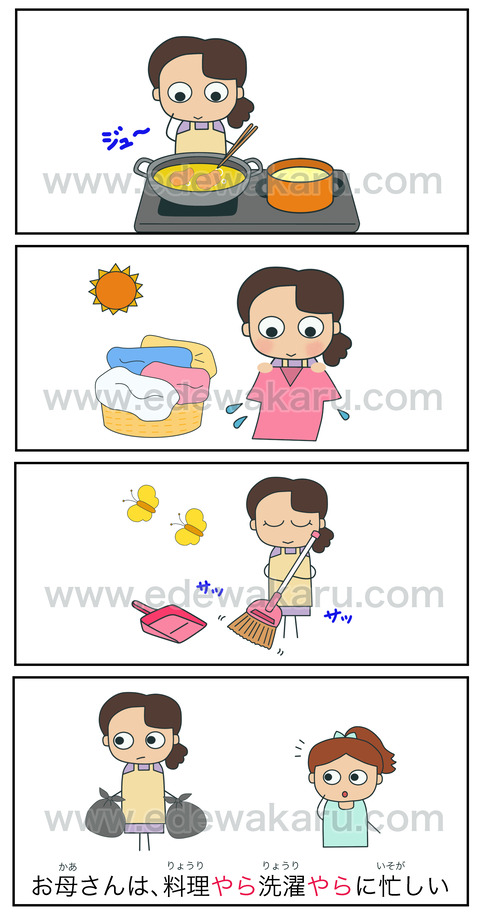
Meaning
〜や〜など、他にもいろいろ
〜とか〜など、いろいろ
How to use it
動詞・形容詞・名詞[普通形]+やら〜やら
Explanation
「〜やら〜やら」は「〜や〜など、他にもいろいろ」「〜たり〜たり」という意味で使われる文型です。「〜や〜」「〜とか〜」「〜たり〜たり」とほとんど同じ意味ですが、「〜や〜など、他にもいろいろある」「〜とか〜など他にもいろいろある」「〜たり〜たり他にも〜たり」というように、
似ているものが他にもあるということを強調します
😮
[例]
①料理
やら
洗濯
やら
に忙しい
→料理
とか
洗濯
とか
掃除
とかいろいろ
なことに忙しい
②最近は勉強
やら
バイト
やら
に忙しい
→勉強
とか
バイト
以外に、試験
とか
レポート
とかいろいろ
なことに忙しい
③コンビニでジュース
やら
おにぎり
やら
を買った
→コンビニでジュース
とか
おにぎりの
他に、チョコ
とか
プリン
とかいろいろ
買った
「〜やら〜やら」は「〜とか〜とか」などに比べて、「他にもいろいろあるが、例をあげて言う時に使われる」と覚えておくといいと思います😉
In context 4 examples
お母さんは、料理やら洗濯やらに忙しい
→お母さんは、料理とか洗濯とか、他にもいろいろと忙しい最近、勉強やらバイトやらに忙しい
→最近は勉強やバイトなど色々なことに忙しいコンビニでジュースやらおにぎりやらを買った(復習:「おにぎり」と「にぎり」)
→コンビニでジュースやおにぎりなどを買った子供はお腹が痛いやら暑いやらで泣いている
→子供はお腹が痛いとか暑いとかで泣いている
どんなときどう使う 日本語表現文型辞典
Usage 1
Meaning
and so forth
How to use it
Vる/イAい/N+やら
Explanation
やら~やら
~や~など
1)まだほかにもいろいろあるが、まず1、2の例を挙げたいときに使う。
2)いろいろなものや気持ちがあって整理できないという気持ちで使うことが多い。
1)Gives one or two examples from among many.
2)Often used when speaker feels overwhelmed by extent or number of something.
In context 4 examples
色紙は赤いのやら青いのやらいろいろあります。
机の上には紙くずやらノートやらのりやらがごちゃごちゃ置いてある。
びっくりするやら悲しむやら、ニュースを聞いた人たちの反応はさまざまだった。
マラソンで3位に入賞したとき、わたしはうれしいやら悔しいやら複雑な気持ちだった。
Usage 2
Meaning
what; where; who; whether
How to use it
〔普通形〕(ナAなの/Nなの)+やらS
Explanation
~のか
1)「~か、まったくわからない」という疑問を表す。少し古い表現。 ❶ ~ ❸ のように疑問詞といっしょに使ったり、対の言葉の両方につけたりする。 ❸ のように「やら」の後の「わからない」という語を省略した言い方もある。
2)後には「さっぱりわからない・見当もつかない」などの表現が来る。
1)Speaker knows nothing about subject. Slightly old-fashioned expression. Can be used with interrogatives, as in sentences ❶ to ❸ ; appended to both words in a pair. わからない can be omitted after やら, as in sentence ❸ .
2)Phrases following include: さっぱりわからない, 見当もつかない, etc.
In context 4 examples
何を考えているやら、息子の心の中はさっぱりわからない。
名前が書いてないノートがこんなにたくさんある。これではどれがだれのやらわからない。
バイクで出かけた太郎がまだ帰ってこない、いったいどこへ行ったやら……。
願書の書き方はこれでいいやら悪いやらわからないが、とにかく出してみよう。
毎日のんびり日本語教師
How to use it
名詞+やら
動辞形+やら
い形容詞辞書形+やら
Explanation
2つの代表的なものを例として挙げ、その他の存在も暗示する並列の文法です。
多くは良くないことに対して用い、「大変」「忙しい」「難しい」などマイナスの感情が含まれます。
Notes
特になし
In context 8 examples
浮気やら何やらで失った信頼はもう取り戻すことができません。
皆から手紙やらプレゼントやらもらってすごく嬉しい。
大人になると、仕事の愚痴やら何やらの悪い話題が多くなる。
映画やらアニメやら見続け、結局朝方5時まで起きてた。
子供が生まれると、貯金やら何やらと大変だ。
今年は就活やら何やらで忙しくなる。
寝る前にチョコやらクッキーやら食べるときっと太る。
今嬉しいやら悲しいやら、よく分からない感情だ。
日本語文型辞典 英語版
Meaning
Like ...や...などいろいろ and ...たり...たりして, used to pick out examples from many. Often used to mean “various things happened, it was terrible.”
Means “(I) don’t know which of the two is the case.” Often used in cases where the speaker is having difficulty making a decision or where the attitude of the subject of the conversation is not known. In spoken language, often abbreviated as in example
(6)
, with the latter part していないのやらわからない being omitted.
Means “(I) don’t understand what, when, where, who, how....” の is often omitted. だれがだれやら of example
(5)
is an idiomatic phrase used to emphasize that the speaker does not know/recognize someone. なにがなにやら, どれがどれやら, どこがどこやら and いつのことやら are also used. A somewhat old-fashioned expression.
Attached to interrogative words such as なに and どこ, shows that something is indicated only vaguely. Example
(1)
can be rephrased as なにか, なんだか,
(2)
as いつか,
(3)
as どこか and
(4)
as どうにか.
How to use it
1. ...やら...やら
2. ...のやら...のやら
3. 疑問詞...のやら
4. 疑問詞+やら
In context 20 examples
来月はレポートやら試験やらでひどく忙しくなりそうだ。
It looks like I will be awfully busy next month, what with reports and exams.
スケート場は子供やらつきそいの母親やらでごったがえしていた。
The skating rink was chaotic with children and their mothers chaperoning them.
日が沈んで、山道は寒いやらこわいやらで小さい子は泣きだしてしまった。
The sun set, and the mountain road was cold and scary so the small child began to cry.
皆さんにこんなに祝ってもらえるとは恥ずかしいやら、嬉しいやら、なんともお礼の言いようがありません。
To receive such congratulations from everyone makes me feel both embarrassed and happy and there is nothing I can say to thank you enough.
きのうは電車で財布をすられるやら傘を忘れるやらでさんざんだった。
Yesterday my wallet was pickpocketed on the train and I forgot my umbrella. It was terrible!
行きたいのやら行きたくないのやら、あの人の気持ちはどうもよくわからない。
Does she or doesn’t she want to go; I just can’t figure out her intentions.
息子に結婚する気があるのやらないのやら私にはわかりません。
I don’t know whether my son wants to get married or not.
うちの子はいつも部屋にいるけど、勉強しているのやらしていないのやら、まったくわからない。
My child is always in his room, but whether he is studying or not, I have absolutely no idea.
こんなに辛くては、味がいいのやら悪いのやらさっぱりわからない。
I can’t tell at all whether something this spicy tastes good or bad.
本人に直接、病名を言っていい(の)やら悪い(の)やら判断がつかない。
I can’t decide whether it would be good or bad to tell the person herself the name of the disease directly.
毎日カバンを持って家を出るけど、どこで何をしているのやら。
He leaves the house with his briefcase every day, but I have no idea where he goes or what he even does.
きのうの昼に何を食べたのやらまったく思い出せない。
I really can’t remember what I ate for lunch yesterday.
お祝いに何をあげていいのやらわからない。
I don’t know what to give them as a congratulations.
どこにしまったのやらいくらさがしても見つからない。
I haven’t found it no matter how much I search; I have no idea where I put it.
彼に会ったのがいつのことやらはっきり覚えていない。
I don’t remember clearly when I met him.
40 年も会っていないのではじめは誰が誰やらさっぱりわからなかった。
Having not met them for forty years, at first I had no idea who was who.
なにやら騒がしいと思ったら、近所が火事だった。
I thought that it was noisy for some reason, and then I realized that the neighborhood was on fire.
妻の誕生日がいつやらはっきりおぼえていない。
I don’t remember exactly when my wife’s birthday is.
会議のあとでどこやら高そうなバーに連れて行かれた。
After the meeting I was taken to some expensive-looking bar somewhere.
どうやらやっと事件の解決の糸口が見えてきた。
Somehow, we could at last see the beginnings of a resolution to the affair.
IMABI
The Particles やら, なり, & きり
Read this IMABI lesson ↗Explanation
The Particles やら, なり, & きり
In this lesson we will learn about the adverbial particles やら, なり, and きり. Some of them have usages that have different classifications. So, always be careful.
The Particle やら
The Adverbial Particle やら
This particle is rather interesting. Some phrases such as どうやら shown below in sentences are used all of the time. However, when used to list things vaguely (usage 2), it is not so common and generally mainly found in books. Despite this, it is not impossible to hear someone say it every now and then because it is more emphatic than typical means of expression.
Shows uncertainty
やら lists things very vaguely and emphatically. May be rude as it should not be used in reference to someone above you.
とやら shows obscurity without any particularity.
Examples
1a. 雨が降るのやら降らないのやらよく分からない。
1b. 雨が降るのか降らないのかよく分からない。(もっと一般的な言い方)
I don’t know whether it’s going to rain or not rain.
2. どうやら留守るすのようです。
It looks like they’re somehow not at home.
3. えっと、英之とやらだったかな。(ちょっと失礼な言い方)
Uh, it was a person called Hideyuki.
4. どうやら一荒れ来そうだ。
It looks like we’re going to have a storm.
5. モウリさんはどうやら置いてきたものが多いらしかった。わたしは、一つか二つしか、置いてきたものはない。その一つ二つでさえ持て余しているのだから、モウリさんの疲れかたをや、だろう。
Mouri somehow seemed to have come with a lot of things. As for me, I’ve only came with one or two things. Since even those one or two things are hard to deal with, I guess you could say that’s her way of fatigue.
From 溺レる by 川上弘美.
Particle Note: をや is a combination of the case particle を and the adverbial particle や. It is more common in things like 漢文訓読. It is often seen with いわんや (Let alone)、~において~をや. The phrase itself is a rhetorical device used to add a sense of lament. So, with the example, the author chose it to give the impression that the speaker might get fatigued thinking about his partner’s things.
The Final Particle やら
Questions oneself with a sense of uncertainty. This is rarely used nowadays. The variant patterns in the first example apply for the second as well, but they are meant to show you how this has been absorbed by other speech patterns.
6a. 彼は勝った(の)やら。 (May sound old to some)
6b. 彼は勝った(の)かな(あ) (一般的な言い方)
6c. 彼は勝ったのかしら。 (Feminine)
6d. 彼は勝ったんだろうか。 (Somewhat masculine)
I wonder if he won.
7. 行ったやら。 (古風)
I wonder if he went.
8. 私もどれほど安堵あんどしましたことやら。 (Literary)
Oh how I was relieved too.
From 光の雨 by 立松和平.
The Particle なり
The Adverbial Particle なり
1. In “AなりBなり” meaning “either…or…”. B may be a question word hinting at other options. This is normally replaced by other things. In this case, though, it’s not necessarily old-fashioned.
9a. 俺なりあんたやりが行かなきゃ。(Masculine)
9b. 俺かあんたが行かなきゃ。(Masculine)
Either I or you have to go.
10. 大だいなり小しょうなり欠点はある。
There is either a fault in being big or in being small.
Sentence Note: Ex. 10 is more common as it is a common expression.
11a. フランスなりどこなりへ引っ越したらいい。
11b. フランスかどこかに引っ越したらいい。(Better choice)
It would be nice to move to France or somewhere.
2. A more literary variant of ~なければ~ほど.
12. 「なんで君はある金全部を使ってしまうの」とユキヲは言うのだが、どうやって金の始末をうまくすればいいのか、私には見当もつかないのだ。少なければ少ないなりに、多ければ多いなりに、私はいつでもぴたりと使いきってしまう。体が、あり金にあわせて伸のびたり縮ちぢんだりするような感じだった。
Yukio asks “why do you end up using all the money?”, but I can’t guess on how to dispose of the money well. Whether it be less or more, I always completely use it up. I felt as if my body stretched and contracted with [how much] money I had.
From 溺レる by 川上弘美.
3. Shows an example with the implication of the possibility of other options.
13.
Aくん「どこか海外に行きたいかな。」
Bくん「なんか西洋の空気を感じたいな。」
Aくん「じゃ、ヨーロッパへなり行きましょう。」
A: I kind of want to go overseas.
B: I’d like to feel the West and what not.
A: Let’s go to somewhere like Europe.
14. 運動するなりしてみてはどうか。
How about trying to drive or something?
なりと
This is a very interesting combination particle that has several usages. In its first usage, it sets up something as a bare minimal condition, making it essentially a humble でも. This usage, though, has become quite old-fashioned. Some exceptions to this include 何なりと which is used frequently.
15. 何なりとお申し付けを
Whatever I instruct…
16. よろしかったらお茶なりと召めし上がってください。
If it’s all right, please have something like tea.
17. どうなりと好きにせよ! (Rude , old-style command)
Do what you’d like!
Speech Note: Using something humble like this in a command results in a rather rude command.
~なりと may also be seldom seen abbreviated as ~なと. However, this is out of use in mainstream Japanese and is viewed to be dialectical.
18. 「まことに申し訳ございません。お腹が減ったでしょうから、どうぞ、これなと召し上がって下さい。いずれあとから主人がご挨拶に参ります」
“I sincerely apologize. I’m sure you are hungry, so please have this. The owner will come by to greet you sometime later.”
From 翳った旋舞 by 松本清張.
In other contexts, it can show that one may choose voluntarily, but this doesn’t always have to be in nice contexts. It can also be used in the pattern AなりとBなりと and function just like なり above. It may be seen as なと, which is somewhat dialectical and very old-fashioned, and なりとも.
19. 死ぬなり(と)生きるなり(と)勝手にしろ。
Whether you die or live, do whatever you want.
20. 願わくは一言なりとも知らせてほしゅうございます。(すごく古い言い方)
I wish to be informed at least one word.
The Conjunctive Particle なり
After the 連体形 of a verb, it shows that something is done as soon as something else is done. So right when someone does something, they do something next in sequence to the first action. The subject is normally third person, and the subject is the same in both clauses. The second part has a little sense of unexpected strong will.
21a. 宿題を済ませるなり、すぐに彼らはインターネットを使った。
21b. 宿題を済ませるとすぐに彼らはインターネットを使った。(More natural)
They used the Internet as soon as they finished their homework.
22. 彼は帰るなり、トイレに行った。
He went to the bathroom as soon as he got home.
23. 社長は入ってくるなり、大声で怒鳴どなりました。
As soon as the company president came in, he shouted in a big voice.
After the past tense, it shows a situation that is still in play as another action begins. There shouldn’t be any movement involved by the individual.
24. 机の椅子に座ったなり、眠ってしまった。
I feel sleep in my desk chair.
The Suffix ~なり
~なり may attach to nouns to give a meaning of “like”. It may attach itself to nominal phrases or the 連体形 of adjectives to show the means by which something is done like. It may also be after the 連用形 of verbs to be like the phrase ~まま (as is).
25. 彼は親の言いなりになった。
He did as his parents told (and never changed).
26. 道なりに行く。
To go along the road.
27. 私なりに努力します。
I will put effort into it a way that suits me.
28. 体を弓なりに反そらす。
To lean one’s body back in an arch-like shape.
The Adverbial Particle きり
きり is generally used to limit things. In this sense, it is just like だけ. The sense of limitation is stronger. Consider this. だけ comes from 丈. But, きり comes from 切り. With this alone, you can see how they would have slightly different nuances.
きり may also follow ~た followed by a negative expression to refer to something that has not surpassed a limit meaning “after doing…”. It may also be in 丸まるっきり which means “at all” in a negative potential expression.
Variant Notes:
1. きり may be seen as っきり a lot in the spoken language.
2. ぎり is an old-fashioned variant.
Etymology Note: This particle comes from the noun 切り, which means “limit” in this instance.
Examples
29. 二人きりで話しましょう。
Let’s talk just the two of us.
30. たった二人きりで国を征服せいふくした。
The two of them conquered the country.
31. 寝たきりになる。
To become confined to continuously lying down.
32. {座りっきりで・座ったまま(で)・座りっぱなしで}仕事を続ける母はいつも肩が凝こっている。
My mother, who continuously sits while working, is stiff in the shoulders.
33. 中国に行ったきり、彼の行方ゆくえが分からない。
After going to China, we don’t know his whereabouts.
34. まるっきり飲めない。
I can’t drink at all.
35. もうこれ(っ)きりだよ。
Make this the last time.
36. 俺の手元にあるのは1円これきりだぞ。(男性語)
This is my very last yen.
Literally: The last thing in my hands is just this yen.
37. 二階の彼女の―そして彼のともなる部屋は、通りに向いた窓際に、安い塗ぬり薬ぐすりの匂においがする粗末そまつな机があるきりで、その外は灰色の壁かべと押入れの襖ふすまだけだった。
Near the window in her room on the second floor–the room he and she had together–facing the street, there was just a crude desk with the smell of cheap ointment, and aside from that there was only a gray wall and the closet fusuma.
From 死体紹介人 by 川端康成.
37. 「父や母は忙しいからたまにきり来ないだろうがね。よかったら君も泊りがけに来たまえ」 (ちょっと古風)
“But my mom and dad don’t come but occasionally because they’re busy. If it’s alright, come stay over”.
From 友情 by 武者小路実篤.
Grammar Notes:
1. たまにきり is an instance where this particle can be seen with an adverb, but in today’s speech, the phrase would be replaced with たまにしか.
2. ~たまえ is now old-fashioned and normally used by middle aged men and older in various situations, of which none are polite to say. However, given that the book in which this sentence is from was published in 1920, the users would be of the same generation. This is a clear instance of a generational shift.
In context 50 examples
雨が降るのやら降らないのやらよく分からない。
I don’t know whether it’s going to rain or not rain.
雨が降るのか降らないのかよく分からない。(もっと一般的な言い方)
I don’t know whether it’s going to rain or not rain.
どうやら留守るすのようです。
It looks like they’re somehow not at home.
えっと、英之とやらだったかな。(ちょっと失礼な言い方)
Uh, it was a person called Hideyuki.
どうやら一荒れ来そうだ。
It looks like we’re going to have a storm.
モウリさんはどうやら置いてきたものが多いらしかった。わたしは、一つか二つしか、置いてきたものはない。その一つ二つでさえ持て余しているのだから、モウリさんの疲れかたをや、だろう。
Mouri somehow seemed to have come with a lot of things. As for me, I’ve only came with one or two things. Since even those one or two things are hard to deal with, I guess you could say that’s her way of fatigue.
彼は勝った(の)やら。 (May sound old to some)
I wonder if he won.
彼は勝った(の)かな(あ) (一般的な言い方)
I wonder if he won.
彼は勝ったのかしら。 (Feminine)
I wonder if he won.
彼は勝ったんだろうか。 (Somewhat masculine)
I wonder if he won.
行ったやら。 (古風)
I wonder if he went.
私もどれほど安堵あんどしましたことやら。 (Literary)
Oh how I was relieved too.
In “AなりBなり” meaning “either…or…”. B may be a question word hinting at other options. This is normally replaced by other things. In this case, though, it’s not necessarily old-fashioned.
Either I or you have to go.
俺なりあんたやりが行かなきゃ。(Masculine)
Either I or you have to go.
俺かあんたが行かなきゃ。(Masculine)
Either I or you have to go.
大だいなり小しょうなり欠点はある。
There is either a fault in being big or in being small.
フランスなりどこなりへ引っ越したらいい。
It would be nice to move to France or somewhere.
フランスかどこかに引っ越したらいい。(Better choice)
It would be nice to move to France or somewhere.
A more literary variant of ~なければ~ほど.
Yukio asks “why do you end up using all the money?”, but I can’t guess on how to dispose of the money well. Whether it be less or more, I always completely use it up. I felt as if my body stretched and contracted with [how much] money I had.
「なんで君はある金全部を使ってしまうの」とユキヲは言うのだが、どうやって金の始末をうまくすればいいのか、私には見当もつかないのだ。少なければ少ないなりに、多ければ多いなりに、私はいつでもぴたりと使いきってしまう。体が、あり金にあわせて伸のびたり縮ちぢんだりするような感じだった。
Yukio asks “why do you end up using all the money?”, but I can’t guess on how to dispose of the money well. Whether it be less or more, I always completely use it up. I felt as if my body stretched and contracted with [how much] money I had.
運動するなりしてみてはどうか。
How about trying to drive or something?
何なりとお申し付けを
Whatever I instruct…
よろしかったらお茶なりと召めし上がってください。
If it’s all right, please have something like tea.
どうなりと好きにせよ! (Rude , old-style command)
Do what you’d like!
「まことに申し訳ございません。お腹が減ったでしょうから、どうぞ、これなと召し上がって下さい。いずれあとから主人がご挨拶に参ります」
“I sincerely apologize. I’m sure you are hungry, so please have this. The owner will come by to greet you sometime later.”
死ぬなり(と)生きるなり(と)勝手にしろ。
Whether you die or live, do whatever you want.
願わくは一言なりとも知らせてほしゅうございます。(すごく古い言い方)
I wish to be informed at least one word.
宿題を済ませるなり、すぐに彼らはインターネットを使った。
They used the Internet as soon as they finished their homework.
宿題を済ませるとすぐに彼らはインターネットを使った。(More natural)
They used the Internet as soon as they finished their homework.
彼は帰るなり、トイレに行った。
He went to the bathroom as soon as he got home.
社長は入ってくるなり、大声で怒鳴どなりました。
As soon as the company president came in, he shouted in a big voice.
机の椅子に座ったなり、眠ってしまった。
I feel sleep in my desk chair.
彼は親の言いなりになった。
He did as his parents told (and never changed).
道なりに行く。
To go along the road.
私なりに努力します。
I will put effort into it a way that suits me.
体を弓なりに反そらす。
To lean one’s body back in an arch-like shape.
きり may be seen as っきり a lot in the spoken language.
ぎり is an old-fashioned variant.
二人きりで話しましょう。
Let’s talk just the two of us.
たった二人きりで国を征服せいふくした。
The two of them conquered the country.
寝たきりになる。
To become confined to continuously lying down.
{座りっきりで・座ったまま(で)・座りっぱなしで}仕事を続ける母はいつも肩が凝こっている。
My mother, who continuously sits while working, is stiff in the shoulders.
中国に行ったきり、彼の行方ゆくえが分からない。
After going to China, we don’t know his whereabouts.
まるっきり飲めない。
I can’t drink at all.
もうこれ(っ)きりだよ。
Make this the last time.
俺の手元にあるのは1円これきりだぞ。(男性語)
This is my very last yen.
二階の彼女の―そして彼のともなる部屋は、通りに向いた窓際に、安い塗ぬり薬ぐすりの匂においがする粗末そまつな机があるきりで、その外は灰色の壁かべと押入れの襖ふすまだけだった。
Near the window in her room on the second floor–the room he and she had together–facing the street, there was just a crude desk with the smell of cheap ointment, and aside from that there was only a gray wall and the closet fusuma.
「父や母は忙しいからたまにきり来ないだろうがね。よかったら君も泊りがけに来たまえ」 (ちょっと古風)
“But my mom and dad don’t come but occasionally because they’re busy. If it’s alright, come stay over”.
たまにきり is an instance where this particle can be seen with an adverb, but in today’s speech, the phrase would be replaced with たまにしか.
~たまえ is now old-fashioned and normally used by middle aged men and older in various situations, of which none are polite to say. However, given that the book in which this sentence is from was published in 1920, the users would be of the same generation. This is a clear instance of a generational shift.
AIUEO JLPT Grammar
Usage 1
Meaning
「やら」is used when listing multiple items and often suggests that the things listed are uncertain or ambiguous. It shows that the speaker is unsure or feels there are multiple choices.
How to use it
動詞辞書形+やら+動詞辞書形+やら形容詞辞書形+やら+形容詞辞書形+やら名詞+やら+名詞+やら
Explanation · 日本語
「やら」は、複数の事柄を列挙するときに使われる助詞です。列挙されたものがはっきりしない、または混乱している状態を表すことが多く、話し手が迷っている、あるいは複数の選択肢があると感じていることを示します。
In context 5 examples
勉強するやら、アルバイトをするやらで忙しい。
I’m busy with studying, working part-time, and so on.
暑いやら、眠いやらで仕事に集中できない。
It’s too hot, I’m too sleepy, and I can’t focus on my work.
雨やら風やらで外は大変な状況だ。
It’s a mess outside with the rain and wind and everything else.
机の上には本やらノートやらが散らばっている。
There are books, notebooks, and other things scattered on the desk.
彼の話は仕事が大変やら辛いやら、愚痴ばかりだ。
All he talks about is how difficult and tough the job is and he complains.
Usage 2
Meaning
“〜やら〜やら” is used to list multiple items or states. This expression is used to give examples of various things or situations, often conveying a sense of confusion, overwhelming feelings, or a mixture of emotions. It indicates that there are several things happening at once, often with a nuance of not knowing what to prioritize.
How to use it
動詞辞書形+やら+動詞辞書形+やら形容詞辞書形+やら+形容詞辞書形+やら名詞+やら+名詞+やら
Explanation · 日本語
「〜やら〜やら」は、複数の事柄や状態を列挙する際に用いられます。この表現は、具体的にいくつかの例を挙げて、さまざまな事柄が混在している状況や、感情の入り混じった状態を表します。文全体には、少し混乱している、または何を優先すべきかわからないというニュアンスが含まれることが多いです。
In context 5 examples
彼の部屋は本やら雑誌やらで散らかっている。
His room is messy with books, magazines, and other things scattered around.
彼は何をしていいのかわからず、悩むやら焦るやらで混乱している。
He is confused, not knowing what to do, and is both worried and anxious.
引っ越しの日は、荷物を詰めるやら掃除するやらで忙しかった。
On the moving day, I was busy packing, cleaning, and doing other things.
仕事やら家事やらで、休む暇もない。
I’m so busy with work, housework, and other things that I don’t even have time to rest.
嬉しいやら恥ずかしいやら、彼の褒め言葉にどう反応すればいいかわからなかった。
I didn’t know how to react to his compliments; I felt both happy and embarrassed.
文法
Meaning
〜や〜など色々あるがその中の代表例を1つ2つあげる時に使う。いろいろあって大変だ、不満があるということに使われることが多い。
How to use it
V(辞)+ やら
イAい + やら
N + やら
In context 5 examples
最近、勉強やらバイトやらで毎日忙しい。
昨日、お酒を飲み過ぎたせいで、頭が痛いやら吐き気がするやらで大変だったよ。
12月は部屋を掃除するやら年賀状を書くやらで忙しい。
大事に育てた娘が結婚することになって嬉しいやら寂しいやら複雑な気持ちだ。
さっきコンビニでおにぎりやらお茶やらを買った。
Bunpro Grammar Reference
Meaning
Whether or, Things like, And … so on
How to use it
A(1) + やら + B(1) + やら
(1) Verb[る]、Noun、[い]Adjective
Nuance
A structure used to express things from within a list when the speaker is uncertain about determining any one thing as the main part.
Explanation
やら is an adverbial particle in Japanese which expresses lack of determination or limitation in regard to (A). Due to this, it is very similar to other structures like など, and will often translate as '(A) and so on', or '(A) and the like'.
やら may appear following verbs in their dictionary form, nouns, い-Adjectives, or な-Adjectives. When repeated as (A) やら (B) やら, both (A) and (B) will often be the same type of word, although this is not a limitation when the speaker is expressing various feelings in relation to something.
毎日子供の世話をするやら家事をするやらで忙しいです。
I am busy everyday with things such as taking care of my child and doing house chores.
先週は身体中が痛いやら、体調が悪いやらで大変でした。
Last week I had a tough week because my whole body was aching, wasn't feeling well and so on.
あのニュースを聞いてから不安やら怒りやら、色々な感情が溢れ出てきた。
After hearing that news, I was flooded with feelings such as anxiety, anger, and many other emotions.
文法だけではなく漢字やら単語やらも勉強した方がいい。
You should study not only grammar but also things such as kanji and vocabulary.
Compared to とか, やら puts more emphasis on the scope of things within the category of (A) and (B), thus making it sound like (A) and (B) are only a small fraction of many different things within a complex pool of various emotions, actions, etc.
Caution
When appearing as のやら~のやら, this emphasizes that the speaker does not actually know which one out of (A) and (B) is the correct option, and is just presenting both as potential possibilities. Due to this, (A) and (B) will often be antonyms or opposites of some sort in these types of sentences, but not always.
彼女は大学に行くのやら行かないのやらはっきりしない。
It is not clear whether she is going to college or not.
あの歌手は上手なのやら下手なのやら、私にはさっぱりわかりません。
I have no idea if that person is a good singer or not.
Nuance · 日本語
話し手が話題の主役を断定することができない時に話題に出てきた物事を表すために使われる表現。
Explanation · 日本語
「やら」は日本語の副助詞の一つで、(A) をはっきりと断定せず、曖昧に示すときに使われます。これは「など」のような表現にも似ており、「(A) やそのようなもの」といった意味を表します。
「やら」は動詞の辞書形や、名詞、イ形容詞、ナ形容詞の語幹に付けて使われます。「(A) やら (B) やら」の形で繰り返して使う場合、(A) と (B) は同じ品詞になることが多いですが、話し手がさまざまな感情を例に挙げるときには異なる品詞が使われることもあります。
毎日子供の世話をするやら家事をするやらで忙しいです。
I am busy everyday with things such as taking care of my child and doing house chores.
先週は身体中が痛いやら、体調が悪いやらで大変でした。
Last week I had a tough week because my whole body was aching, wasn't feeling well and so on.
あのニュースを聞いてから不安やら怒りやら、色々な感情が溢れ出てきた。
After hearing that news, I was flooded with feelings such as anxiety, anger, and many other emotions.
文法だけではなく漢字やら単語やらも勉強した方がいい。
You should study not only grammar but also things such as kanji and vocabulary.
「とか」と比べると、「やら」は (A) と (B) を含む物事の範囲をより強調する表現です。そのため、「やら」で挙げられた (A) と (B) は「ほかにもいろいろある中のほんの一部に過ぎない」というニュアンスが強くなります。こうした理由から、「やら」は「たくさんあって大変だ」「状況が複雑だ」という話し手の気持ちを表すときにもよく使われます。
注意点
「のやら~のやら」という形で使われるときは、話し手が (A) か (B) のどちらが正しいのか判断できない中で、可能性のある選択肢を挙げていることを表します。そのため、(A) と (B) には反対の意味を持つ言葉が入ることが多いですが、例外もあります。
彼女は大学に行くのやら行かないのやらはっきりしない。
It is not clear whether she is going to college or not.
あの歌手は上手なのやら下手なのやら、私にはさっぱりわかりません。
I have no idea if that person is a good singer or not.
In context 18 examples
- 嬉しいやら恥ずかしいやらで、どんな顔をしていればいいのか、わからなかった。
I didn't know whether I should react with happiness or shyness.
- あのニュースを聞いてから不安やら怒りやら、色々な感情が溢れ出てきた。
After hearing that news, I was flooded with feelings such as anxiety, anger, and many other emotions.
- 毎日子供の世話をするやら家事をするやらで忙しいです。
I am busy everyday with things such as taking care of my child and doing house chores.
- 先週は身体中が痛いやら、体調が悪いやらで大変でした。
Last week I had a tough week because my whole body was aching, wasn't feeling well and so on.
- 文法だけではなく漢字やら単語やらも勉強した方がいい。
You should study not only grammar but also things such as kanji and vocabulary.
- 彼に褒めてもらうとうれしいやら恥ずかしいやら、とにかく気持ちがよかったわ。
When I was praised by him, I don't know whether I felt happiness or shyness. Anyway, it felt great.
- 髭やら頭髪やらの身だしなみのチェックが厳しくて困る。
Checking personal grooming such as beard and hair and so on, is so strict that I am bothered.
- 悪口やら皮肉やら、彼はとにかく口が悪いから、あまり付き合いたくない。
Whether it is insults or sarcasm, he has a dirty mouth, so I don't really want to spend time with him.
- 小数やら分数やらの問題を教えて欲しいと言われても、算数が苦手なもので...
Even if someone says they want me to teach them about decimals and fractions and such problems, I am no good at math...
- マスクやら手洗い・うがいやら、他にも万全の風邪対策をしている。
I wear a mask and wash my hands and gargle and so on in addition to taking perfect countermeasures against catching a cold.
- この時期には、マフラーやら手袋やらの忘れ物がかなりの数に上ります。
In this season, the number of lost property like scarves, gloves and so on increases.
- あの映画は、戦闘シーンやら冒険シーン等があるから、君も見てみたらいいよ。
In that movie, there are many scenes of battles, adventures and so on, you should watch it.
- 歯磨きやら化粧やらでバタバタとしていたら、家を出るのが遅くなってしまいました。
Hurriedly brushing my teeth and doing my makeup and so on, I ended up leaving the house late.
- 子供は母に叱られたあと、泣くやら、鼻が出ているやらで、ひどい騒ぎだった。
When a child was scolded by her mother, she ended up crying, having a runny nose and so on. It was quite the scene.
- さまらさん:「明日パーティーやるんだけど、来る?男の子もいっぱいくるよ。」
さだこさん:「パーティー?仕事やら大学やらいろいろあるから遠慮しておくわ。」Samara: 'I am having a party tomorrow, are you coming? There will be a lot of boys!' Sadako: 'Party? I have things like work and college, so I have to refuse.'
- A(エー):「GPS(ジーピーエス)を買うか買わないかわからん...でも、GPS(ジーピーエス)がどうしてもほしい。」
B(ビー):「どうせGPS(ジーピーエス)を買いたいと思ってるなら 、最近の携帯電話はカメラやらGPS(ジーピーエス)やらついているからただのGPS(ジーピーエス)よりスマホを買ったらいい。」A: 'I don't know whether to buy a GPS or not… But I want one so much.' B: 'If you want to buy a GPS anyway, modern mobile phones have cameras, GPS and so on. So rather than buying an ordinary GPS, it's better to get a smartphone.'
- 彼女は大学に行くのやら行かないのやらはっきりしない。
It is not clear whether she is going to college or not.
- あの歌手は上手なのやら下手なのやら、私にはさっぱりわかりません。
I have no idea if that person is a good singer or not.
日本語NET JLPT文法解説まとめ
Meaning
〜や〜など
色々あるがその中の代表例を1つ2つあげる時に使う。いろいろあって大変だ、不満があるということに使われることが多い。
How to use it
V(辞)+ やら
イAい + やら
N + やら
Explanation
and so on
① It is used when mentioning one or two representative examples among many.
② It is often used to express that there are many difficulties or complaints.
In context 5 examples
最近、勉強やらバイトやらで毎日忙しい。
昨日、お酒を飲み過ぎたせいで、頭が痛いやら吐き気がするやらで大変だったよ。
12月は部屋を掃除するやら年賀状を書くやらで忙しい。
大事に育てた娘が結婚することになって嬉しいやら寂しいやら複雑な気持ちだ。
さっきコンビニでおにぎりやらお茶やらを買った。
NINJAL 日本語文型データベース
Meaning
~で2つの例を挙げて、〜以外にもさまざまな状態や様子があることを表します。気持ちがまとまらず、すっきり整理されないときによく使います。
「〜やら何やら」の形も使い、「〜」と同じようなものがさらにあることを表します。
How to use it
V1るやらV2るやら
i-A1いやらi-A2いやら
N1やらN2やら
Notes
2つの「〜」には異なる品詞がくる場合もあります。
「〜やら〜やら」を名詞として扱い、「「〜やら〜やらだ・〜やら〜やらで」などの形で使います。また、「〜やら〜やら」の後に、大変だという意味の感想を表す文が直接くることもあります。
「〜やら」は1文中にふつう2つですが、3つ以上のこともあります。
In context 15 examples
今日は家に定期券を忘れるやら財布を落とすやら、最悪の一日だった。
台風で窓が割れるやら屋根が飛ばされるやら、大変でした。
蚊に食われるやら蜂に刺されるやらで、庭の掃除はもうこりごりです。
去年は娘が大学に受かるやら息子が結婚するやらで、出費が多かった。
きのうはせきが出るやら頭が痛いやらで、一日中寝ていました。
引っ越しするので、部屋を片付けるやら荷造りするやら転居届を提出するやらで、いろいろ忙しい。
娘の留学が決まって、うれしいやら寂しいやらです。
食べ物に当たったのか、昨夜は気分が悪いやらおなかが痛いやらで、つらかった。
借金があったが、親が黙って全部払ってくれた。ありがたいやら申し訳ないやらで、親には頭が上がらない。
昇級試験に2回も落ちてしまい、情けないやらふがいないやらで、落ち込んでしまった。
弟の部屋は、床一面に漫画やら洋服やらが散らかっていて、足の踏み場もない。
先月は友達の結婚式やら同窓会やらがあって、帰省しました。
休日は掃除やら洗濯やら買い物やらに時間を取られて、のんびりする暇もありません。
先週は会議やら出張やらで、落ち着いて仕事ができなかった。
昨晩、夫に仕事の愚痴やら何やらを聞かされた。