AIUEO JLPT Grammar
Meaning
This sentence pattern expresses that something is filled with a specific characteristic. It is often used positively, but depending on the situation, it can also be used with a negative connotation.
How to use it
名詞+ずくめ
Explanation · 日本語
この文型は、特定の事柄や状態が一色に満ちていることを表す表現です。多くの場合、好ましいことに使われることが多いですが、状況によっては悪い意味で使われることもあります。
In context 5 examples
黒ずくめの服装をした彼は、まるで影のようだった。
Dressed entirely in black, he looked like a shadow.
今日は朝からいいことずくめだ。
Today has been full of good things since morning.
彼の人生は成功ずくめだ。
His life has been full of successes.
結婚式は笑顔ずくめの素晴らしい日だった。
The wedding was a wonderful day full of smiles.
その日は驚きずくめの一日だった。
That day was full of surprises.
文法
Meaning
〜が多い / 〜ばかりだ
How to use it
N + ずくめ
Notes
① 物、色、出来事などに使う。
②「黒ずくめ」「いいことずくめ」など慣用的に使われるものが多い。
In context 9 examples
試験には合格できたし、彼女もできたし、最近いいことずくめだ。
今日は朝から会議ずくめで疲れたよ。
ワンさんはお金持ちで、毎日全身ブランドずくめだ。
わーい。ステーキに、エビフライに、今日はご馳走ずくめだ。
コナンは黒ずくめの男たちによって、体を小さくされてしまった。
毎日、残業ずくめで大変だ。
この学校は規則ずくめで、嫌になる。
今回のオリンピックは記録ずくめの大会となった
アイドル「BABYMETAL」、異例ずくめの非アイドル的戦略で大ヒットした。
Bunpro Grammar Reference
Meaning
Completely, Entirely, All in, Nothing but, A real streak of, Without exception, Jet
How to use it
Noun + ずくめ
Noun (A) + ずくめ + の + Noun (B)
Nuance
A suffix highlighting that something is completely (A), or nothing but (A). Exhaustively (A).
Explanation
Originally stemming from the suffix use of 尽く 'completely', or 'using solely', and the addition of め, ずくめ came to be preferentially written as hiragana, with ず replacing づ. This structure may be translated as 'completely (A)', 'all in (A)', or 'nothing but (A)'. Generally, it is attached directly to nouns, and expresses that (A) is to such an extent that nothing apart from (A) can be seen, felt, or noticed.
In cases where ずくめ will directly modify the following noun, の will come between ずくめ and that noun.
今月も仕事ずくめになりそうだ。
It seems like I'm going to be doing nothing but work again this month.
最近は嫌なことずくめで全然楽しくない。
I'm not having the best time right now, because nothing but bad things are happening.
彼は黒ずくめの男たちに誘拐された。
He was kidnapped by men covered in black.
警察への電話:「もしもし、家の前に黒ずくめの車が何台も止まっているんで今から言う住所まできてもらってもいいですか。」
Calling the cops: Hello, there are several jet black cars parked in front of my house, so could you please come to the address I'm about to tell you?
Although づくめ may occasionally be seen in older literature, it is mostly considered incorrect kana usage these days.
While ずくめ may be used in either positive or negative contexts, it is mainly seen in set expressions, so is best used with combinations that you have already heard or read.
Fun Fact
尽くし is another older structure that is used to express things that are separate, but are grouped together. This is usually translated as 'all sorts of (A)', or 'all kinds of (A)'. It is the conjunctive form of the う-Verb 尽くす 'to be exhaustive' with a voiced pronunciation of the つ.
国づくしの偉い人が集まった。
Great people from all sorts of countries gathered.
Nuance · 日本語
何かが完全に(A)、又は(A)のみだということを強調する接尾語。網羅的に(A)。
Explanation · 日本語
「ずくめ」は、接尾語の「尽く」(意味:一つだけのものを使う)に「め」が加わったものです。この表現は、「づ」ではなく「ず」が使われ、ひらがなで書かれるのが一般的です。意味としては、「完全に (A)」「すべて (A)」「(A) ばかり」などを表します。(A) だけが目立ち、ほかのものが見えない、感じられないほどであるときに使われる表現です。
「ずくめ」は、名詞に直接付いて使われます。後の名詞を直接修飾する場合は、「ずくめ」と名詞の間に「の」が入ります。
今月も仕事ずくめになりそうだ。
It seems like I'm going to be doing nothing but work again this month.
最近は嫌なことずくめで全然楽しくない。
I'm not having the best time right now, because nothing but bad things are happening.
彼は黒ずくめの男たちに誘拐された。
He was kidnapped by men covered in black.
警察への電話:「もしもし、家の前に黒ずくめの車が何台も止まっているんで今から言う住所まできてもらってもいいですか。」
Calling the cops: Hello, there are several jet black cars parked in front of my house, so could you please come to the address I'm about to tell you?
古い文学作品には「づくめ」という表記が見られることもありますが、現在では誤った仮名遣いとされることが多いです。
「ずくめ」は肯定的な文脈でも否定的な文脈でも使われますが、主に定型表現として使われるため、これまでに見聞きしたことのある組み合わせに限って使うのがいいでしょう。
豆知識
「尽くし」は、「ずくめ」に関係する古い文法の一つで、個々の物事をまとめて表現するときに使われます。通常は「ありとあらゆる (A)」「全ての種類の (A)」という意味になります。これは、五段動詞「尽くす」の連用形に、濁った「づ」をつけたものです。
国づくしの偉い人が集まった。
Great people from all sorts of countries gathered.
In context 18 examples
- 新聞の見出し:「6月猛暑記録ずくめ」
Newspaper headline: 'June - A Heatwave full of Temperature Records'
- 警察への電話:「もしもし、家の前に黒ずくめの車が何台も止まっているんで今から言う住所まできてもらってもいいですか。」
Calling the cops: Hello, there are several jet black cars parked in front of my house, so could you please come to the address I'm about to tell you?
- 今月も仕事ずくめになりそうだ。
It seems like I'm going to be doing nothing but work again this month.
- 最近は嫌なことずくめで全然楽しくない。
I'm not having the best time right now, because nothing but bad things are happening.
- 彼は黒ずくめの男たちに誘拐された。
He was kidnapped by men covered in black.
- 規制は必要であるが規則ずくめで窒息しそうな社会は強圧的ではないだろうか。
Regulations are needed, but isn't a society that is about to suffocate with nothing but restrictions overbearing ?
- 2020年は異例ずくめの大変な年でしたが何とか乗り切りました。
2020 was a very challenging year full of irregularities, but we somehow got through it.
- ツイッターの投稿:「朝から晩まで、ごちそうずくめで結婚を祝う。」
Twitter post: 'We are celebrating the marriage with nothing but delicacies from morning till night.'
- 黒ずくめのスーツに身を包んだ男はベンチに座り、逆さに持った新聞を読むふりをしていた。
A man dressed in a completely black suit was sitting on a bench and pretending to read a newspaper that was upside down.
- 今日は妹が生まれたし大学に受かったし朝からいいことずくめで、万々歳だ。
Today calls for celebration, because nothing but good things have been happening since the morning, like my younger sister being born, and my acceptance to university.
- 子供:「野菜ずくめのこの料理なんて美味しくなさそうで食べたくないよ!」
Child: ‘This food is nothing but vegetables and doesn’t seem tasty so I don’t wanna eat it!’
- 独り言:「最近は良い事ずくめだから、そろそろ悪い事が起こりそう…。」
Mumblings: ‘It’s been nothing but good things recently, so it seems like something bad is about to happen…’
- 新記録ずくめの大会を会場で観戦する事が出来て、とても嬉しいです。
Since I was able to spectate an event that had a real streak of new records, I am really thrilled!
- 映画のナレーター:「彼女の幸せずくめの毎日はここで終わりを告げました…。」
Movie narrator: ‘It announced to her that her days of nothing but happiness were over.’
- 父は働きずくめの今の生活に不満は無いと言っていたが、絶対に少しはあるはずだ。
Although dad was saying that he has no grievances with his current lifestyle of nothing but work, he absolutely has at least some.’
- 同僚の高橋さんは全身ブランドずくめですが、一体そんなお金はどこから湧いているのでしょう…。
My colleague Takahashi-san is covered from head to toe in branded clothes without exception, but where the heck does the money sprout up from for that…’
- 会社員:「残業ずくめの毎日なんて、もう沢山だ!こんな会社さっさと辞めないと、絶対に精神が病んでしまう…!」
Company employee: ‘Something like having nothing but overtime work every day, I am at my wits end! If I don’t quit this company straight away my mental health is going to deteriorate...!’
- 国づくしの偉い人が集まった。
Great people from all sorts of countries gathered.
どんなときどう使う 日本語表現文型辞典
Meaning
totally immersed in; all in…
How to use it
N+ずくめ
Explanation
~が多い/~が身の回りに続いて起こる
1)「~で満たされている・~が次々起こる」という意味。物・色・できごとなどにも使う。身の周りの生活上のことでいいことの例が多い。
2)ほかに「ごちそうずくめ・宝石ずくめ・けっこうずくめ」など。
2)Other examples: ごちそうずくめ (to treat lavishly), 宝石ずくめ (dripping in jewels), and けっこうずくめ (immersed in agreeable things).
1)To be filled with something, or one thing after another happens. Used for things, colors, and events. Most often used when a person is inundated in nice things.
In context 3 examples
山田さんのうちは、長男の結婚、長女の出産と、最近、おめでたいことずくめだ。
あの時、彼はお葬式の帰りだったらしく、黒ずくめの服装だった。
彼から手紙が来たし、叔父さんからお小遣いももらったし、今日は朝からいいことずくめだ。
絵でわかる日本語
Meaning
全部〜だ
〜ばかりある
How to use it
名詞[辞書形]+ずくめ
Explanation
「〜ずくめ」は「全部が〜だ」「〜ばかりだ」という意味の文型です。この文型は
【いいこと】【悪いこと】両方に使うことができます
😊「〜ずくめ」は決まった単語と使用されることが多いですので、いくつかを暗記しておくといいと思います😉
[ずくめの慣用表現]
いいことずくめ
→全ていいことだ
黒ずくめ
→全身黒い服を身につけている(身につける:着る)
ごちそうずくめ
→ごちそうばかりだ
慣用表現がよく使われますので、「白ずくめ」「ピンクずくめ」などの言い方はあまりしません…😥
色は「黒」にしか使わないと覚えているといいと思います
😀
例文にも挙げましたが、人気アニメ「名探偵コナン」の中では「黒ずくめの男」という言葉がたくさん出てきます。コナンに薬を飲ませて小さくした「黒の組織」の人たち(ジン・ウォッカ・ベルモットなど)はみんな全身「黒ずくめ」(黒い帽子・黒い服・黒いパンツ・黒い靴)ですね😅
少しアニメの話が多くなってしまいましたが、「〜ずくめ」は
ほとんど使われる単語が決まっています
ので、見たり聞いたりして覚えておくといいと思います😊
【関連文型】
In context 5 examples
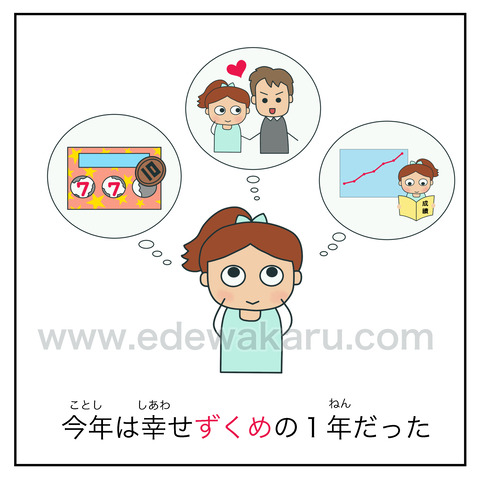
今年は幸せずくめの1年だった
→今年は幸せなことばかりの1年だったいいことずくめの人生なんてあるわけがないよ(復習:〜わけがない)
→全部がいいことばかりの人生なんてあるわけがないよ最近残業ずくめでとても忙しい
→最近残業ばかりでとても忙しいあそこに立っている全身黒ずくめの男の人はこわそうだ…
→あそこに立っている全身黒い服を着ている男の人はこわそうだ…【「名探偵コナン」を見たことがある人は…】コナンは黒ずくめの男たちに小さくされた
→コナンは上から下まで黒い服を着ている男たちに小さくされた
日本語文型辞典
Meaning
基本情報Nずくめ説明名詞に付いて、身の回りにあるのがそればかりであることを表す。「黒ずくめ」「いいことずくめ」「ごちそうずくめ」など、定型化した言い方で使うことが多く、「赤ずくめ」「本ずくめ」などは使えない。例文① 彼女はいつも黒ずくめのかっこうをしている。② この頃なぜかいいことずくめだ。③ 今日の夕食は、新鮮なお刺身やいただきもののロブスターなど、ごちそうずくめだった。④ 毎日毎日残業ずくめで、このままだと自分がすり減っていきそうだ。
日本語文型辞典 英語版
Meaning
【ずくめ】[Nずくめ]
Attaches to a noun and expresses the notion that one is surrounded by an abundance of something. Often used in fixed expressions, such as 黒ずくめ (entirely in black), いいことずくめ (one good thing after another), and ごちそうずくめ (nothing but delicacies). Mostly idiomatic, so expressions like 赤ずくめ (entirely in red) and 本ずくめ (nothing but books) are not used.
In context 4 examples
彼女はいつも黒ずくめのかっこうをしている。
She always dresses completely in black.
この頃なぜかいいことずくめだ。
For some reason, one good thing after another is happening these days.
今日の夕食は、新鮮なお刺身やいただきもののロブスターなど、ごちそうずくめだった。
Today’s supper was all delicacies, like fresh raw fish and some lobster we’d been given.
毎日毎日残業ずくめで、このままだと自分がすり減っていきそうだ。
Every single day I have to do overtime, and I feel like I’m going to wear out if things go on like this.
くらべてわかる日本語表現文型辞典
Meaning
Aの数が多く、全体として見た時に大部分がAで占められている状態。ほとんどAで揃えている状態。
How to use it
Aずくめ
[イ形-い]+こと+ずくめ
[ナ形-な]+こと+ずくめ
[名詞-∅]ずくめ
Explanation
【対比1】
「Aだらけ」(意味1 P.129)
Aが数えられるものであれば、置き換え可能のものもある。
○この寮は規則ずくめでいやになる。
○この寮は規則だらけでいやになる。
Aが量を表す場合は「Aずくめ」では言いにくい。
×泥ずくめの服 ○泥だらけの服
「Aづくし」
「Aづくし」は同類のものを数多くそろえてある状態。
○松茸づくしのご馳走をいただいた。
×松茸ずくめのご馳走をいただいた。
In context 4 examples
黒ずくめの男がさっきからこちらを見ている。
彼女の家ではご主人の昇進や息子さんの大学入学など、結構なことずくめでうらやましい。
オリンピックの予選会は記録ずくめの大会となった。
長時間にわたる公判、整理券を配るほどの傍聴希望者と異例ずくめの裁判が始まった。
日本語NET JLPT文法解説まとめ
Meaning
〜が多い / 〜ばかりだ
How to use it
N + ずくめ
Explanation
Indicates that something is full of or completely composed of the specified element.
① 物、色、出来事などに使う。
②「黒ずくめ」「いいことずくめ」など慣用的に使われるものが多い。
In context 2 examples
アイドル「BABYMETAL」、異例ずくめの非アイドル的戦略で大ヒットした。
今年はいいことずくめの一年だった。
毎日のんびり日本語教師
How to use it
名詞+ずくめ
Explanation
全体的にそればかりであることを表します。
「黒ずくめ(一身净黑的)」「幸せずくめ(全是好事)」「ご馳走ずくめ(全是好吃的)」などの慣用表現が多く、「白ずくめ」のような言い方は基本的に言いません。この文型を使った表現は限られています。
漢字は「尽くめ」です。
Notes
特になし
In context 10 examples
防犯カメラに写っている黒ずくめの男が犯人だ。(监控器照到一身黑的男子就是犯人。)
今年は幸せずくめの一年だった。(今年是充满幸福的一年。)
しかし人生は良いことずくめではない。(可是人生不只是好事情而已。)
ご馳走ずくめの晩ご飯。(丰盛的晚餐。)
仕事ずくめで休む暇がない。
来週は3連休だしその次はお盆休みだし8月は良い事ずくめだ!
2021年は記録ずくめのオリンピックだった。
彼は常識的には有り得ない異例ずくめのスピード出世をした。
昼も夜も働きずくめ。
全身ブランドずくめの人は品がないと思う。
IMABI
Appearance
Read this IMABI lesson ↗Explanation
Appearance: ~だらけ, ~まみれ, ~ずくめ, ~めく, ~げ, ~みどろ, & ~気味
There are several suffixes in Japanese that represent states of appearance.
~だらけ
~だらけ attaches to nouns to describe how something is riddled with something. ~だらけ may be used with both physical and psychological items. There is an extent to how you can use this though. Things like 混乱こんらんだらけ would be wrong. This is because it should be used with things that are either physical or dealing with (emotional) phenomenon and not a “state”. Rather than 混乱だらけ, consider phrases like すごく狼狽ろうばいしている or とても動揺どうようしている.
1. 彼女は(口を開けば){不平・不満}{ばっかり言ってる・だらけだ}な。
She’s full of complaints isn’t she?
2. パソコンは埃ほこり{かぶっていた・だらけだった}。
The desktop was covered in dust.
3. 後悔こうかいだらけ
Covered in regret
4. 傷きずだらけ
Covered in injuries
5. 血だらけになった殺人犯さつじんはんは逃にげ場ばがなくなって自殺じさつしたそうだ。
They say that since the murderer covered in blood didn’t have a place to run away, he committed suicide.
~塗れ
~まみれ comes from 塗まみれる which means “to be covered with”. Similar to ~だらけ ~まみれ shows how something is completely covered in something. Unlike ~だらけ, ~まみれ is solely used with physical objects. However, there is a trend to use ~まみれ with things that have a “physical persona”. This, though, is metaphoric. Creating metaphors in any language causes rules to become more flexible.
6. 遺体いたいは血塗れだったということです。
It is said that the corpse was completely covered in blood.
7. メキシコ湾わんは{辺り一面}重油じゅうゆ{埋め尽くされました・まみれになりました}。
The Gulf of Mexico became completely covered in heavy oil.
8. 彼はただの挫折塗ざせつまみれのやつだけだ。
He’s just completely covered in failure.
~尽くめ
~ずくめ shows that something is “completely…”. It is normally either attached to nouns of colors or こと. There is, though, a condition that whatever it attaches to that the context is in relation to human intent.
A similar ending is ~ずくし. It means “all sorts of”. Here, the human intent condition is non-existent. In writing, using づ instead of ず is OK. This is just a conflict between Old and New orthographies that has just been left to the individual to decide.
9. 人が黒尽くめでした。
The person was completely black.
10. いい事づくしの人
A person full of good luck
11a. 白づくめで抗議してる人は窃盗罪せっとうざいで訴うったえられた人達だ。
11b. 抗議をしている、白づくめの人達は、窃盗罪で訴うったえられた。
The people protesting dressed in white were accused of theft.
~めく
~めく shows what something looks like or what condition something becomes, and it may follow nouns, adverbs, or the stem of adjectives and verbs. The closest translation for ~めく is “to show signs of”. Although all tenses are possible, ~めく is normally only used in the non-past or past tense. Depending on the verb, there are may be more options. For instance, うごめく can be seen in things like the progressive.
To be astir ざわめく To flash 閃く To be mysterious 謎めく
To glimmer 仄めく To color 色めく To be spring-like 春めく
To wriggle うごめく To flourish 時めく To be autumn-like 秋めく
Grammar Note: When attached to verbs, the new verb is often seen contracted and then written differently. ~めく is most often used with nouns and 形容動詞.
12. 教室は興奮こうふんで騒ざわめいた。
The classroom stirred with excitement.
13. 庭の楓かえでが色めくのは本当に美しいですよね。
The changing in colors of the maple trees in the garden is really beautiful, isn’t it?
14. {うわぁ・ああ}、{もぞもぞ動いてる・蠢うごめいてる}虫(がいる)!
Ah, a wriggling worm!
15. 彼は今を時めく歌手・有名人です。
He is one of the most prosperous singers/famous people of the time.
16. 謎なぞめいた様子ようすをしている。
To have an air of mystery.
17. 謎めいた様相ようそうを呈ていする。
To be in a situation covered in mystery.
18. 冬めいてきた。
It became winter-like.
19. 陽光に川面が煌めく。
The river surface glistens in the sunlight.
20. どよめいて、人々が飛びのく。一人の背中が飛鳥にぶつかった。はね飛ばされて、壁に肩をぶつける。さらにはね返ってよろめき、あやうく転びかけたときだった。
Making a stir, people jumped back. A person’s back hit Asuka. Being sent flying, she hit her shoulder on the wall. In addition, it was when she had bounced back, staggered, and dangerously started to tumble.
From 野生の風 by 村山由佳.
~みどろ
~みどろ is a less common alternative to the suffix ~まみれ to show things being covered in something.
21. 血みどろの遺体
A bloody corpse
22. 汗みどろの労働者
A sweat covered laborer
~気
~げ conjugates as a 形容動詞けいようどうし. Used to show a sense of true appearance, it describes something with intense fervor and emotion. Lastly, ~げ may be attached to the stem of adjectives and to nouns.
23. 悲しげに泣く。
Cry while being sad all over.
24. 均衡予算を黙殺するのは大人げない。
Ignoring the balanced budget proposal is childish.
25. 彼は何か言いたげな顔をしていた。
He had the face of wanting to say something.
26. 「今も新しい戦争が僕らを追っかけて来ているのかもしれないし、僕らのなかの前の戦争が、亡霊のように僕らを追っかけているかもしれないんです。」と修一は憎さげに、「お父さまこそ、あの娘がちょっと変わっているから、ひそかに魅力を感じて、妙な考えをくどくどもってまわってらっしゃる。女がほかの女とどこかちょっとちがっているだけで、男はつかまるのですからね。」
“A new word may have come its way to chase after us even now, but the war of the past within ourselves may be chasing after us like a departed spirit”, and Shuichi continued odiously with “And you, of course, Father inwardly feel a mystique since she’s changed a little, and you’re going about stuttering long-winded, strange thoughts. That’s man is just something that it’s caught up with the small differences one woman has with other women.”
From 山の音 by 川端康成.
27. 菊子は不審げに信吾を見て、そして顔を赤らめた。
Kikuko looked strangely at Shingo and then blushed.
From 山の音 by 川端康成.
Grammar Note: ~げ is almost never used with verbs. ~げ is closest to ~そうだ, but ~そうだ lacks the emotional emphasis. As emotional emphasis is very important, it is used with nouns that we aspire to be and adjectives that express our emotions.
The reading け and ぎ also exist, and they confusingly are used similarly to the げ reading. Luckily, the latter reading is not written as 気. The reading け is seen a lot in phrases like 飾り気 (affectation), 色気 (sex appeal), and 寒気 (feeling chilly). 人気 has two readings. When it is read as にんき, it means “popularity”, and when it is read as ひとけ, it is the antonym of deserted, but it is usually used in this sense in the phrase 人気がない.
The reading ぎ of 気 is rather restricted to nouns that can have perceptually suitable characteristics. Words such as 商売気 (mercenary mind), 男気 (chivalry), and 女気 (woman care) come to mind, and the only other examples are all literary words unlikely to be used in conversation, or at the very least appear rarely in literature. Examples of such words include 謀反気 (rebelling spirit), 芝居気 (theatrical spirit), 芸気 (theatrical spirit), and 回り気 (worrying and doubtful spirit).
28. お前さんも余程回り気の人だね。
You’re quite the worry wort too, aren’t you.
From 深川女房 by 小栗風葉.
Interestingly enough, the most common examples of ぎ and け are replaced with っけ. Examples of this include人っ気, 飾りっ気, and 商売っ気. Even words that typically only use け such as 真っ黒け and 真っ白け may have っ insertion in actual conversation. Even more interesting is the fact that the phrases 真っ赤っ赤 (bright red) and 真っ黄っ黄 (bright yellow) exist. The first one shows up dictionaries and is used widely, but the latter is rather dialectical. The interesting point here is how the forms seem to mimic the use of っけ for emphasis.
29. 彼は仕事を事もなげにやってのけた。
He pulled the job off as if nothing happened.
~気味
~気味ぎみ is seen after either a noun or the 連用形れんようけい of a verb. It shows a visible indication or slight feeling and is often used in a negative context. Common translations include “sign of,” “on the…side,” and “slight.”
30. 彼は疲れ気味だ。
He has the signs of fatigue.
30. 彼は太り気味だ。
He’s a little on the heavy side.
31. 今朝はちょっと風邪気味だ。
I have a slight feeling of a cold this morning.
Word Note: ~味 comes from 気味, which means “sensation” or “tendency.”
In context 33 examples
彼女は(口を開けば){不平・不満}{ばっかり言ってる・だらけだ}な。
She’s full of complaints isn’t she?
パソコンは埃ほこり{かぶっていた・だらけだった}。
The desktop was covered in dust.
後悔こうかいだらけ
Covered in regret
傷きずだらけ
Covered in injuries
血だらけになった殺人犯さつじんはんは逃にげ場ばがなくなって自殺じさつしたそうだ。
They say that since the murderer covered in blood didn’t have a place to run away, he committed suicide.
遺体いたいは血塗れだったということです。
It is said that the corpse was completely covered in blood.
メキシコ湾わんは{辺り一面}重油じゅうゆ{埋め尽くされました・まみれになりました}。
The Gulf of Mexico became completely covered in heavy oil.
彼はただの挫折塗ざせつまみれのやつだけだ。
He’s just completely covered in failure.
人が黒尽くめでした。
The person was completely black.
いい事づくしの人
A person full of good luck
白づくめで抗議してる人は窃盗罪せっとうざいで訴うったえられた人達だ。
The people protesting dressed in white were accused of theft.
抗議をしている、白づくめの人達は、窃盗罪で訴うったえられた。
The people protesting dressed in white were accused of theft.
教室は興奮こうふんで騒ざわめいた。
The classroom stirred with excitement.
庭の楓かえでが色めくのは本当に美しいですよね。
The changing in colors of the maple trees in the garden is really beautiful, isn’t it?
{うわぁ・ああ}、{もぞもぞ動いてる・蠢うごめいてる}虫(がいる)!
Ah, a wriggling worm!
彼は今を時めく歌手・有名人です。
He is one of the most prosperous singers/famous people of the time.
謎なぞめいた様子ようすをしている。
To have an air of mystery.
謎めいた様相ようそうを呈ていする。
To be in a situation covered in mystery.
冬めいてきた。
It became winter-like.
陽光に川面が煌めく。
The river surface glistens in the sunlight.
どよめいて、人々が飛びのく。一人の背中が飛鳥にぶつかった。はね飛ばされて、壁に肩をぶつける。さらにはね返ってよろめき、あやうく転びかけたときだった。
Making a stir, people jumped back. A person’s back hit Asuka. Being sent flying, she hit her shoulder on the wall. In addition, it was when she had bounced back, staggered, and dangerously started to tumble.
血みどろの遺体
A bloody corpse
汗みどろの労働者
A sweat covered laborer
悲しげに泣く。
Cry while being sad all over.
均衡予算を黙殺するのは大人げない。
Ignoring the balanced budget proposal is childish.
彼は何か言いたげな顔をしていた。
He had the face of wanting to say something.
「今も新しい戦争が僕らを追っかけて来ているのかもしれないし、僕らのなかの前の戦争が、亡霊のように僕らを追っかけているかもしれないんです。」と修一は憎さげに、「お父さまこそ、あの娘がちょっと変わっているから、ひそかに魅力を感じて、妙な考えをくどくどもってまわってらっしゃる。女がほかの女とどこかちょっとちがっているだけで、男はつかまるのですからね。」
“A new word may have come its way to chase after us even now, but the war of the past within ourselves may be chasing after us like a departed spirit”, and Shuichi continued odiously with “And you, of course, Father inwardly feel a mystique since she’s changed a little, and you’re going about stuttering long-winded, strange thoughts. That’s man is just something that it’s caught up with the small differences one woman has with other women.”
菊子は不審げに信吾を見て、そして顔を赤らめた。
Kikuko looked strangely at Shingo and then blushed.
お前さんも余程回り気の人だね。
You’re quite the worry wort too, aren’t you.
彼は仕事を事もなげにやってのけた。
He pulled the job off as if nothing happened.
彼は疲れ気味だ。
He has the signs of fatigue.
彼は太り気味だ。
He’s a little on the heavy side.
今朝はちょっと風邪気味だ。
I have a slight feeling of a cold this morning.