AIUEO JLPT Grammar
Meaning
This sentence pattern is used to express the cause of a bad result or negative situation.
How to use it
動詞+せいでorせいだ形容詞+せいでorせいだ形容動詞な+せいでorせいだ名詞の+せいでorせいだ
Explanation · 日本語
この文型は、悪い結果や否定的な状況の原因を表現するときに使われる表現です。
In context 5 examples
彼が遅刻したせいで、会議が遅れた。
Because he was late, the meeting was delayed.
天気が悪いせいで、旅行を中止した。
Because of the bad weather, the trip was canceled.
食べ過ぎたせいで、お腹が痛くなった。
Because I ate too much, I got a stomachache.
仕事に集中できなかったのは寝不足のせいだ。
I couldn’t concentrate on my work because of lack of sleep.
家族との時間が取れないのは忙しすぎるせいです。
I can’t spend time with my family because I am too busy.
文法
Meaning
「〜が原因で」
悪い結果になった原因を言う時に使う。
How to use it
V(普通形) + せいで
イA(普通形)+せいで
ナA(普通形) + せいで
N(普通形)+ せいで
※ナAが現在形の肯定形の場合は「ナAなせいで」あるいは「ナAであるせいで」となる。
※Nが現在形の肯定形の場合は「Nのせいで」あるいは「Nであるせいで」となる。
Notes
「〜せいか」という言い方もあるが、こちらは原因がはっきりとわかっていない場合に使う。
In context 15 examples
雨が降ったせいで、楽しみにしていた旅行が中止になった。
さっきコーヒを飲んだせいで、全然眠れない。
体調が悪かったせいで、試験に集中できなかった。
昨日、徹夜したせいで、今とても眠い。
時差のせいで、アメリカに住んでいる彼女に毎日電話するのは難しい。
電車が遅れたせいで、飛行機に乗れなかった。
食べすぎたせいで、ちょっと太ってしまった。
私のせいで、この会社は倒産しそうだ。
昨日、飲みすぎたせいで、頭が痛くて気持ち悪い。
毎日、タバコを吸いすぎたせいで、病気になってしまった。
毎日、夜遅くまで働きすぎたせいで、入院することになった。
さっきホラー映画を見たせいで、怖くてなかなか寝られない。
彼女とあまり連絡をとらなかったせいで、別れることになった。
甘い物ばかり食べすぎたせいで、虫歯になってしまった。
目覚まし時計が鳴らなかったせいで、朝寝坊してしまった。
Bunpro Grammar Reference
Meaning
Because of, Due to, Blame
How to use it
Verb + せいで
[い]Adjective + せいで
[な]Adjective + な + せいで
Noun + の + せいで
Nuance
A phrase which puts the blame on (A), due to something its doings have caused.
Explanation
Although written almost exclusively in hiragana, せい is a noun that may be better understood from its kanji, 所為, meaning 'doings'. せい is used to convey negative results that occurred due to the behavior or actions of another person/thing. Because of this, common translations of せい are 'fault', 'due to', or 'because of'.
As せい is a noun, it may be used after the attributive form of any other word. The case marking particle で will also regularly be seen after せい, especially when conveying the (B) result that occurred 'with' or 'by means of' those 'doings'.
昨日夜遅くまで起きていたせいで寝坊した。
Because I stayed up late last night, I overslept today.
外が寒いせいで風邪を引いた。
Because it is chilly outside, I caught a cold.
犬の手術の事が心配なせいで今日は寝れなさそう。
Due to me being worried about my dog's surgery, it doesn't seem like I am going to be able to sleep.
大雪のせいで道が渋滞してる。
Because of the heavy snow, the road is congested.
Fun Fact
The 'doings' that 所為 represents is similar to the negative 'doings' that is used in English to place blame. This can be seen in phrases such as 'it was the weather's doings', or 'ah, so the missing cookies were your doings!'
遅刻したのは渋滞のせいだ!
Me being late is the traffic's doing!
台風のせいでまた予定が変わったよ。
Due to the typhoon's doings, my plans have changed again.
Nuance · 日本語
(A)が何かを引き起こしたから、(A)に責任を押し付けるときに使われる表現。
Explanation · 日本語
「せい」は、悪い結果を起こした原因や理由を表す名詞です。「(A) が原因で」や「(A) という理由で」という意味で、その責任を誰かや何かに向けるときに使われます。「せいで」はひらがなで書かれることがほとんどですが、漢字では「所為」と書かれます。この漢字は、「所為」と読むと「行い」という意味になります。このことから、「せいで」は「〜の行いによって」という意味から生まれた使い方だと考えると覚えやすいかもしれません。
「せい」は、連体形の語のあとに付けて使われます。格助詞「で」と合わさった「せいで」の形で、そのあとに悪い結果の内容について説明することが多いです。
昨日夜遅くまで起きていたせいで寝坊した。
Because I stayed up late last night, I overslept today.
外が寒いせいで風邪を引いた。
Because it is chilly outside, I caught a cold.
犬の手術の事が心配なせいで今日は寝れなさそう。
Due to me being worried about my dog's surgery, it doesn't seem like I am going to be able to sleep.
大雪のせいで道が渋滞してる。
Because of the heavy snow, the road is congested.
豆知識
「所為」は、ある結果になったことを、誰かや何かの「行い」が原因だと責めるような場面でよく使われます。
遅刻したのは渋滞のせいだ!
Me being late is the traffic's doing!
台風のせいでまた予定が変わったよ。
Due to the typhoon's doings, my plans have changed again.
In context 18 examples
- トムは暑さのせいで気を失った。
Tom passed out because of the heat.
- 犬の手術の事が心配なせいで今日は寝れなさそう。
Due to me being worried about my dog's surgery, it doesn't seem like I am going to be able to sleep.
- 昨日夜遅くまで起きていたせいで寝坊した。
Because I stayed up late last night, I overslept today.
- 外が寒いせいで風邪を引いた。
Because it is chilly outside, I caught a cold.
- 大雪のせいで道が渋滞してる。
Because of the heavy snow, the road is congested.
- 誰のせいでもないと思います。
I don't think it's because of anyone. (no one to blame)
- 湿気のせいでカビがひどい。
The mold is out of control because of the humidity.
- ストレスのせいで病気になってしまった。
I became ill due to stress.
- 物忘れがひどいのは、たぶん年のせいです。
You are quite forgetful probably because of your age.
- 気分が悪くなったせいで、仕事を休んでしまった。
Because I wasn't feeling well, I took the day off.
- 雨のせいでせっかくの遠足が中止になってしまった。
The long awaited trip was cancelled because of the rain.
- トムがお皿を割ってしまったせいで、私は怪我をしてしまった。
I got injured because Tom broke a plate.
- 寒いのは風のせいでしょう。そんなに気温は低くないですよ。
I think you feel cold due to the wind. The temperature is not that low.
- (彼女が)変に見えるのはたぶん、髪型のせいですよ。
I think she looks strange because of her hairstyle.
- 人間関係がうまくいかないのは、たぶんあなたの性格のせいでしょうね。
I think your relationships are not going smoothly because of your personality.
- 日本語能力試験に失敗したのは、たぶん彼氏のせいでしょう。
I think I failed the JLPT because of my boyfriend.
- 遅刻したのは渋滞のせいだ!
Me being late is the traffic's doing!
- 台風のせいでまた予定が変わったよ。
Due to the typhoon's doings, my plans have changed again.
どんなときどう使う 日本語表現文型辞典
Meaning
on account of
How to use it
〔普通形〕(ナAな・ナAである/Nの・Nである)+せいで
Explanation
~が原因で
「~せいで、…」の形で「~が原因で、…という悪い結果となった」と言いたいときに使う。 ❸ の「せいか」は、それだけが原因かどうかわからないが、という感じがある。
Some adverse consequence results from some cause. In sentence ❸ , せいか has nuance that other factors might have contributed to the adverse consequences.
In context 4 examples
林さんが急に休んだせいで、今日は3時間も残業しなければならなかった。
マリが授業中に何回も話しかけてくる。そのせいでわたしまで先生にしかられてしまう。
タンさんは最近体の具合が悪いと聞いているが、気のせいか、顔色が悪く見える。
兄さんが今日晩ご飯を全然食べなかったのは病気のせいだと思う。
絵でわかる日本語
Meaning
〜が原因で…(悪いことが起こった)
How to use it
動詞[普通形]+せいで・せいか
い形容詞[辞書形]+せいで・せいか
な形容詞[辞書形]+せいで・せいか
名詞[辞書形]+のせいで・せいか
Explanation
「〜せいで」は「〜おかげで」(復習:〜おかげで)と同じように、
原因・理由を表す文型で「〜が原因・理由で…が起こった」という意味で使用されます。
「〜せいで」は後ろに必ず【悪い結果】を表す
ということをしっかりと覚えておきましょう😮
【補足説明】
「〜せいで」は「〜おかげで」と同じように、「〜せいか」という形もあります😮
「〜せいか」は原因がはっきりわかっていない時に使用されます。「たぶん〜が原因で…が起こった」というように覚えておくといいですね
😊1つ気をつけなければいけないことは、
「〜せいで」は悪い結果にしか使用できませんが「〜せいか」はいい結果にも悪い結果にも使えるというところです
😨
[まとめ]
⭕️薬を飲んだ
せいで
眠くなった【悪い結果】
⭕️薬を飲んだ
せいか
眠くなった【悪い結果】
❌薬を飲んだ
せいで
頭痛が治った【いい結果】
⭕️薬を飲んだ
せいか
頭痛が治った【いい結果】
「〜せいか」は悪い結果にもいい結果にも使えるというのを覚えておけば、とてもシンプルで簡単な文型だと思います😉
【関連文型】
In context 3 examples
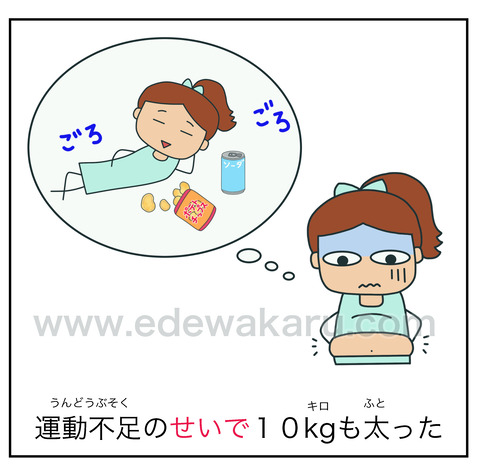
運動不足のせいで10kgも太った
→運動不足が原因で10kgも太った薬を飲んだせいで眠くなってきた
→薬を飲んだのが原因で眠くなってきた大雨のせいで電車が遅れ、遅刻してしまった
→大雨が原因で電車が遅れ、遅刻してしまった
くらべてわかる日本語表現文型辞典
Meaning
意味1:AによってBという悪い結果になった。Aという事態や相手を非難する気持ちが込められる。
意味2:「AせいかB」の形で。Aという理由・原因かどうかはわからないが、Bという悪い結果になった。
How to use it
AせいでB(AせいかB)
[動詞]せいで
[イ形-普]せいで
[ナ形-な/である/だった/ではない]せいで
[名詞-の/ではない/だった]せいで
Explanation
【対比1】
「AおかげでB」(意味2 P.44)
「AためにB」(意味2 P.126)
In context 8 examples
彼が噂をばらまいたせいで、たいへんな目にあった。
あいつのせいで、みんなの前で恥をかいてしまった。
毎日暖かい日が続くせいで、冬だというのに冬物が売れない。
アパートの壁が薄いせいで、となりの部屋の音がうるさい。
風邪を引いたせいか、頭が痛い。
あわてて食べたせいか、お腹が痛くなってきた。
夕べ酒を飲みすぎたせいか、今日は一日中ぼうっとしていた。
緊張していたせいか、面接で何を聞かれたのか覚えていない。
日本語NET JLPT文法解説まとめ
Meaning
「〜が原因で」
悪い結果になった原因を言う時に使う。
How to use it
V(普通形) + せいで
イA(普通形)+せいで
ナA(普通形) + せいで
N(普通形)+ せいで
※ナAが現在形の肯定形の場合は「ナAなせいで」あるいは「ナAであるせいで」となる。
※Nが現在形の肯定形の場合は「Nのせいで」あるいは「Nであるせいで」となる。
Explanation
"because of / due to / on account of"
Used to describe the cause of a bad result.
「〜せいか」という言い方もあるが、こちらは原因がはっきりとわかっていない場合に使う。
In context 17 examples
雨が降ったせいで、楽しみにしていた旅行が中止になった。
さっきコーヒを飲んだせいで、全然眠れない。
体調が悪かったせいで、試験に集中できなかった。
昨日、徹夜したせいで、今とても眠い。
時差のせいで、アメリカに住んでいる彼女に毎日電話するのは難しい。
電車が遅れたせいで、飛行機に乗れなかった。
食べすぎたせいで、ちょっと太ってしまった。
私のせいで、この会社は倒産しそうだ。
昨日、飲みすぎたせいで、頭が痛くて気持ち悪い。
毎日、タバコを吸いすぎたせいで、病気になってしまった。
毎日、夜遅くまで働きすぎたせいで、入院することになった。
さっきホラー映画を見たせいで、怖くてなかなか寝られない。
彼女とあまり連絡をとらなかったせいで、別れることになった。
甘い物ばかり食べすぎたせいで、虫歯になってしまった。
目覚まし時計が鳴らなかったせいで、朝寝坊してしまった。
お前のせいで、こんなことになったんだ!
ギャンブルに手を出してしまったせいで、彼の人生は変わってしまった。
毎日のんびり日本語教師
Meaning
~が原因で
~だから
How to use it
動詞普通形+せいで/せいか/せいだ/せいにする
い形容詞普通形+せいで/せいか/せいだ/せいにする
な形容詞語幹+な+せいで/せいか/せいだ/せいにする
名詞+の(な)+せいで/せいか/せいだ/せいにする
Explanation
前項に原因を、後項にはその原因から発生した良くない結果を述べる傾向があります(他の辞書はよい結果の例も認めます)。悪い結果や悪い原因を表す時に使い、話者の残念な気持ちや後悔の気持ちを表します。
「せい」自体は名詞として扱い、「~せいで」は文中、「~せいだ」は文末に使います。
「せいか(可能是因为…)」は不確定な原因を表します。
よく「~を~のせいにする(把责任归咎于…)」や「~のは~のせいだ」などの形で用いられます。
Notes
似ている文法「~おかげで/おかげだ」
「おかげ」とは違い、「せい」には皮肉としての用法は存在しません。
In context 16 examples
雨降ったせいでめっちゃ寒い。(因为下雨所以特别冷。)
好き嫌いが多いせいで、外食しても食べられるものが少ない。
徹夜してゲームしていたせいか、目が痛い。
年を取ったせいか、涙脆くなってきた。
喉が痛いのは部屋が乾燥しているせいだ。
夏場の電気代が高いのは、エアコンが古いせいだ。
彼は自分にとって都合の悪いことを全て他人のせいにする。
甘やかされて育てられた人は失敗を人のせいにしがちだ。(被娇惯养大的人容易把失败归咎于别人。)
慣れない靴で散歩したせいで足が痛い。
寝る前にお腹いっぱい食べたせいで、逆に寝れなくなってしまった。(睡前吃饱了反而睡不着了。)
会社で嫌な事があったせいで、つい飲み過ぎてしまった。
タバコのせいで、多くの人が健康を害している。
こんな時間まで寝てるのは、昨晩仕事で徹夜していたせいだ。
私は口下手なせいで人をあまりうまく褒めたりできない。
私が優柔不断なせいで、チームのみんなにはいつも迷惑をかけている。
脂っこいものが好きなせいで高脂血症を患っている。
NINJAL 日本語文型データベース
Meaning
〜が原因で、よくない結果になると言いたいときに使います。
How to use it
V普通形+せいで
i-A普通形+せいで
na-A普通形+せいで(ただし、「na-Aだ」→「na-Aな+せいで・na-Aである+せいで」)
Nのせいで・N普通形+せいで(ただし、「Nだ」→「Nの+せいで・Nである+せいで)
Notes
「~せいで」の後には、話し手の希望・意向を表す文や相手への働きかけの文はきません。
In context 23 examples
家族がタバコを吸うせいで、部屋のタバコ臭さが取れない。
仕事の経験が足りないせいで、トラブルが起きたときうまく対処できないのが悔しい。
隣に高層マンションが建ったせいで、我が家の日当たりが悪くなった。
慌てて家を飛び出したせいで、いろいろ忘れ物をしてしまった。
十分準備運動をしなかったせいで、泳ぎ始めてすぐに足がつった。
最近の若者言葉に疎いせいで、娘の話がよく理解できない。
景気があまりよくないせいで、タクシーを利用する人は減っている。
喫茶店で本を読もうとしたが、周りがうるさかったせいで、集中できなかった。
授業中とても眠かったせいで、先生が何を話したかまるで覚えていない。
メモしてあった電話番号が正しくなかったせいで、その人とは連絡が取れなかった。
物の整理が苦手なせいで、いつも探し物ばかりしている。
あの子は見た目が派手なせいで誤解されやすいけど、実際は控えめな性格の子だ。
この文章は説明が抽象的であるせいで理解しにくい。例を挙げてほしい。
英語を勉強していても、目的が明確でないせいでなかなか上達しない人も多い。
私の断り方があいまいだったせいで、セールスマンから何度も電話がかかってきて困った。
他のメンバーが協力的ではなかったせいで、私たちのグループワークはあまりうまくいかなかった。
大雨のせいで、花火大会が中止になってしまいました。
彼は試合で大きな失敗をしてしまって、自分のせいで負けたのだと落ち込んでいる。
仕事の休みが平日のせいで、週末になかなか子どもの相手をしてやれない。
左利きであるせいでいろいろな道具が使いにくく、不便な思いをしている。
仕事の休みが土日ではないせいで、友達と休みを合わせるのが難しい。
飛行機の中でずっと同じ姿勢だったせいで、首や背中が痛くなってしまった。
山登りをしたが、登山靴じゃなかったせいで、岩場で滑って転んでしまった。
Yokubi — The Common Grammar Guide (https://yoku.bi)
Explanation
のに is related to ので, but it works in the opposite direction. While ので means "because of X, Y", のに means "despite X, Y". Like ので, this is more "objective" than other adversatives. のに also loves being attached to the end of sentences as an emphasis marker of disappointment or discontentment.
Just like ので, のに needs な after nouns and な adjectives
ように essentially means "so as to", as in "walk so as to keep your back hidden". This treads a fine line between "for the purpose of" and "in such a way as".
If it helps, you can think of ように as a noun (よう = "manner") turned into adverb by に. The clause that qualifies よう becomes "adverbial" to the main verb.
ために literally uses the noun ため "purpose" plus に to make a conjunction.
In many situations, ために and ように are interchangeable with the meaning of "for the purpose of", but not always.
ために can also be used to mean "for the sake of" rather than "for the purpose of". The nuance is different in English but in Japanese it is not always obvious. に can also be dropped.
せい is a noun meaning "fault" used to indicate cause/blame/reason. It usually implies that the effect is undesirable.
The opposite of せいで is おかげで, which implies a thankful feeling.
In context 1 examples
お前のせいで俺はこんなことになったんだよ!
It is because of you that I became like this!
IMABI
Fault: ~せいで & ~にかこつけて
Read this IMABI lesson ↗Explanation
Fault: ~せいで & ~にかこつけて
This lesson is all about ways in Japanese to give an excuse/reason in ways we have yet to see thus far in the curriculum.
~せいで
~せいで means “since/because of/due to” in the sense of blame. If you use this pattern with something that is generally perceived as being a good thing, it will sound strange and usually unnatural. You would have to do some explaining. The way to express this in a positive fashion is by using のおかげ(さま)で, which doesn’t always have to be used in a positive situation. The point is that at least it can.
Examples
1. 妹のせいで、父に叱られた。
I was scolded by my dad because of my little sister.
2. 俺のせいにすんな。(ちょっと失礼)
Don’t blame me.
3. 津波のせいで食糧不足になった。
We got into a food shortage due to the tsunami.
4. 病気のせいで、パーティーに行けなかった。
I didn’t come to the party due to an illness.
5. 休みなのに強風と花粉のせいで家から出れない。(Casual)
Although I’m on a break, due to strong winds and pollen, I can’t leave the house.
6a. 彼が失敗したのは怠惰のせいだ。
6b. 彼が失敗したのは怠けたからだ。(More natural)
He failed because of his laziness.
7. 雨のせいで、遅刻した。
I arrived later due to the rain.
8. 彼は疲労のせいで、眠いというよりも疲れているのです。
He is less sleepy than tired due to his fatigue.
~(の)せいか
As the adverbial particle か shows uncertainty, it shows in translation when used with せい.
9. 天気のせいか、気分が悪い。
I don’t know if it’s because of the weather, but I feel bad.
10. 山田さんは、試験ができなかったせいか今日は元気がありません。
Mr. Yamada isn’t well today apparently because he did bad on his exam.
11.
小林:ちょっと元気がないみたいけど、どうかしたの?
出口: うん、食中たりのせいかお腹が痛いんだ。
Kobayashi: You look a little bad; what’s wrong?
Deguchi: Yeah, I think my stomache’s hurting because of food poisoning.
12.
中田:どうかしたの。
川崎:うん、昨日の晩風邪を引いたせいか頭が痛くて。。。
中田:じゃ、早く帰って寝たら?
Nakada: What’s wrong?
Kawasaki: My head is hurting cause I might have gotten a cold last night.
Nakada: Well, how about getting home quickly and sleep?
~に託けて
The 一段 verb 託ける means “to use as an excuse” and ~に託けて is often translated as “under (the excuse of)”.
13.宗教しゅうきょうの名に託かこつけてコンキスタドーレスはアステックの帝国を攻せめ滅ぼした。
The Spanish Conquistadors attacked and utterly destroyed the Aztec Empire under the name of religion.
14. 彼は雪に託けて仕事をサボった。
He skipped work under the excuse of snow.
In context 13 examples
妹のせいで、父に叱られた。
I was scolded by my dad because of my little sister.
俺のせいにすんな。(ちょっと失礼)
Don’t blame me.
津波のせいで食糧不足になった。
We got into a food shortage due to the tsunami.
病気のせいで、パーティーに行けなかった。
I didn’t come to the party due to an illness.
休みなのに強風と花粉のせいで家から出れない。(Casual)
Although I’m on a break, due to strong winds and pollen, I can’t leave the house.
彼が失敗したのは怠惰のせいだ。
He failed because of his laziness.
彼が失敗したのは怠けたからだ。(More natural)
He failed because of his laziness.
雨のせいで、遅刻した。
I arrived later due to the rain.
彼は疲労のせいで、眠いというよりも疲れているのです。
He is less sleepy than tired due to his fatigue.
天気のせいか、気分が悪い。
I don’t know if it’s because of the weather, but I feel bad.
山田さんは、試験ができなかったせいか今日は元気がありません。
Mr. Yamada isn’t well today apparently because he did bad on his exam.
宗教しゅうきょうの名に託かこつけてコンキスタドーレスはアステックの帝国を攻せめ滅ぼした。
The Spanish Conquistadors attacked and utterly destroyed the Aztec Empire under the name of religion.
彼は雪に託けて仕事をサボった。
He skipped work under the excuse of snow.