AIUEO JLPT Grammar
Meaning
This sentence pattern is used to nostalgically reflect on past habits or memories, emphasizing past experiences or emotions.
How to use it
動詞た形+ものだ形容詞た形+ものだ形容動詞だった+ものだ名詞だった+ものだ
Explanation · 日本語
この文型は、過去の習慣や思い出を懐かしく振り返るときに使われる表現です。感慨深い思い出や、過去の経験を強調するために使用されます。
In context 5 examples
若い頃はよく遊んだものだ。
I used to play a lot when I was young.
昔はよく図書館に通ったものです。
I used to go to the library often in the past.
以前は残業が多かったものだ。
I used to have a lot of overtime work in the past.
運動が得意だったものだ。
I used to be good at sports.
若い頃はもっと健康に気を使ったものです。
When I was younger I paid more attention to my health.
文法
Meaning
過去の状態やよく起こったことを思い出して言う時の表現。
How to use it
V(タ形) + ものだ
In context 13 examples
子供の時は、よく友達とサッカーをしたものだ。
子供の頃は、よく家族で旅行したものだが、最近はしなくなってしまった。
子供の頃は、よく母に叱られたものだ。
子供の頃は、よく川へ遊びに行ったものだ。
大学生の時は、よく友達と朝までカラオケをしたものだ。
学生の頃は、よく勉強し、よく遊んだものだ。
昔はよく、兄と兄弟喧嘩をしたものだ。
数年前はよく、バイクで色々なところへ行ったものだ。
昔の子供は、よく公園で遊んだり、広場でサッカーをしたりしたものだ。
若い頃は、よく無茶をしたものだ。
結婚した頃は、妻とよく二人で旅行したものだ。
受験生の頃は、毎日図書館に通って勉強したものだ。
独身の頃は、よく合コンをしたものだ。
Bunpro Grammar Reference
Meaning
Used to
How to use it
Verb[た]+ ものだ
Verb[た]+ ものです
Nuance
A strong expression that says that which is (A) used to be a certain way in the past, often with a nuance of being nostalgic or reminiscing.
Explanation
As mentioned in the ものだ lesson, the combination of the noun 物 'thing', with the auxiliary verb だ forms a strong determination about whatever comes before it as being 'the way it is'. As an extension of this nuance, ものだ can be paired with verbs in the past tense, creating a phrase similar to 'I used to (A) in the past'. However, the literal meaning is closer to '(A) was the way it used to be'.
子供の頃はよく先生に怒られたものだ。
I used to get yelled at by the teacher often when I was still a kid.
昔はよく親父と釣りに行ったものだ。
I often used to go fishing with my father in the past.
若い頃は色々と苦労したものだ。
When I was young, I used to suffer a lot.
Due to ものだ being a strong determination of something's existence/truth, this expression quite often carries the nuance that the speaker is nostalgic about (A), reminiscing about (A), or being introspective about (A). This means that it will not sound natural when describing things that are seemingly inconsequential, or have no meaningful significance.
小学生の頃は毎日学校に行ったものだ。
I used to go to school everyday when I was an elementary student. (Unnatural, as this is a normal event)
昔は毎日のように親父とけんかをしたものだ。
In the past I fought with my father every day. (Natural, as this is a meaningful event)
When highlighting things in the past that are not particularly important, たことがある will be used instead.
多分子供の頃に食べたことがある。
I may have eaten this when I was a kid. (Unimportant)
子供の頃はよく、神社で遊んだ事がある。
When I was a kid, I played at the shrine a lot. (Potentially important, but not in this speaker's opinion)
Nuance · 日本語
過去は(A)だったということを示す表現。懐かしいことや過去を振り返る時に使われることが多い。
Explanation · 日本語
文法「ものだ」でも述べた通り、名詞の「物」と助動詞の「だ」の組み合わせ「ものだ」は、そのあとに来る言葉を強く断定する表現です。この「ものだ」が動詞の過去形と合わさると、「昔はよく (A) をしたなあ」と昔のことを懐かしく思い出すときの表現になります。
子供の頃はよく先生に怒られたものだ。
I used to get yelled at by the teacher often when I was still a kid.
昔はよく親父と釣りに行ったものだ。
I often used to go fishing with my father in the past.
若い頃は色々と苦労したものだ。
When I was young, I used to suffer a lot.
「ものだ」は、何かの存在や事実を強く言い切って、「あの頃はそれが当たり前だった」という懐かしいという感情を起こすような表現です。あまり大事ではないことや、特に意味のないことを言う場合に「ものだ」を使うと、不自然に聞こえます。
小学生の頃は毎日学校に行ったものだ。
I used to go to school everyday when I was an elementary student. (Unnatural, as this is a normal event)
昔は毎日のように親父とけんかをしたものだ。
In the past I fought with my father every day. (Natural, as this is a meaningful event)
感情を含めない、ただの経験や事実を述べるときは、「たことがある」が使われます。
多分子供の頃に食べたことがある。
I may have eaten this when I was a kid. (Unimportant)
子供の頃はよく、神社で遊んだ事がある。
When I was a kid, I played at the shrine a lot. (Potentially important, but not in this speaker's opinion)
In context 19 examples
- 若い頃は、いろんな苦労をしたものだ。
I used to have lots of hardships when I was young.
- 昔は毎日のように親父とけんかをしたものだ。
In the past I fought with my father every day. (Natural, as this is a meaningful event)
- 子供の頃はよく先生に怒られたものだ。
I used to get yelled at by the teacher often when I was still a kid.
- 若い頃は色々と苦労したものだ。
When I was young, I used to suffer a lot.
- 小学生の頃は毎日学校に行ったものだ。
I used to go to school everyday when I was an elementary student. (Unnatural, as this is a normal event)
- 多分子供の頃に食べたことがある。
I may have eaten this when I was a kid. (Unimportant)
- 子供の頃はよく、神社で遊んだ事がある。
When I was a kid, I played at the shrine a lot. (Potentially important, but not in this speaker's opinion)
- 昔はよく親父と釣りに行ったものだ。
I often used to go fishing with my father in the past.
- 子供の頃はよく海に泳ぎに行ったものだ。
I used to go swimming in the ocean a lot when I was a child.
- 昔はよく、車を運転して遠くに出かけたものだ。
A long time ago, I often used to go out and take long drives.
- 子供の頃は授業中、よく居眠りをしたものだ。
When I was a child, I used to nod off a lot in the middle of class.
- 私が子どもの頃、よく父に映画を見に連れていってもらったものだ。
Dad used to take me to the movies when I was a child.
- 小学生の頃は雪が降るたびに、必ず雪だるまを作ったものだ。
I used to make a snowman every time it snowed when I was in elementary school.
- 子供のころ、父親と様々な教科書を読みながら田舎を歩いたものだ。
As a child, I used to walk through the countryside while reading various textbooks with my father.
- 昔は井戸から水をくんだものだが、今は水道を出すだけでいい。
People used to take their water from wells, but now you can just get it (directly) from the water supply.
- 昔、母親は寝る前にはほとんど毎晩絵本を読んでくれたものだ。
Long ago, my mom used to read me picture books almost every night before going to bed.
- 夏休みは友達のクリスと彼の別荘に行っていろいろ遊んだものだ。
During summer vacation I used to go with my friend Chris to his summer house and would play a lot.
- 今はこの場所はガソリンスタンドになっているけど、昔はここには図書館があってよくそこで本を読んだものだ。
This place is a gas station now, but in the past there was a library here and I often used to read there.
- この庭には15年前までは桜があって、昔は家族で花見をしたものだ。
A cherry tree was in this garden until 15 years ago, and in the past I used to look at it with my family.
絵でわかる日本語
Meaning
(過去を回想する表現)
よく〜したなぁ
・
〜だったなぁ
How to use it
動詞[た形]+ものだ
Explanation
「〜たものだ」は「よく〜したなぁ」となつかしい気持ちを込めて
過去のことを回想する
時に使用されます。「〜たことがある」も
過去の経験
を表しますが、意味は少し違ってきます。
[〜たものだ]昔、この公園で遊んだものだ→この公園で
よく遊んだなぁ
…なつかしい思い出だ
[〜たことがある]昔、この公園で遊んだことがある→この公園で
遊んだ経験がある
「〜たものだ」は「よく〜した」と
習慣性
を表すのに対し、「〜たことがある」は「〜た経験がある」というように回数には関係なく、多くの場合
一回性
のことを表します。
【まとめ】
[〜たものだ]→
よく〜したなぁと過去の回想を表す《習慣性》
[〜たことがある]→
経験を表す《一回性》
「〜たことがある」はN4の文法ですが会話でもよく使用されますので、しっかりと覚えられるといいですね😊
【「もの」シリーズ】
〜たいものだ・〜てほしいものだ
〜たものだ
〜たものではない
〜というもの(Nというもの)
〜ないものだろうか
〜ないものは〜ない
〜もの・〜んだもの
〜ものか
〜ものがある
〜ものだ(感慨)
〜ものだ(本来の性質・一般的な考え方)
〜ものだ・〜ものではない
〜もので・〜ものだから
〜ものと思っていた
〜ものなら
〜ものの
〜ものを
〜ようものなら
In context 2 examples
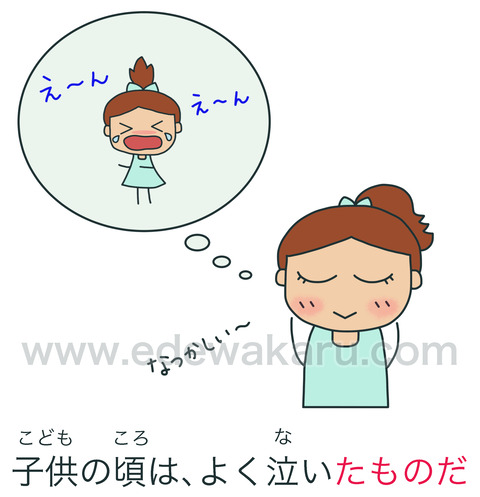
子供の頃は、よく泣いたものだ
→子供の頃は、よく泣いたなぁ…昔、この公園で遊んだものだ
→昔、この公園でよく遊んだなぁ…
日本語NET JLPT文法解説まとめ
Meaning
過去の状態やよく起こったことを思い出して言う時の表現。
How to use it
V(タ形) + ものだ
Explanation
"used to / would often"
Used to express a past situation or what frequently occurred while remembering it.
In context 13 examples
子供の時は、よく友達とサッカーをしたものだ。
子供の頃は、よく家族で旅行したものだが、最近はしなくなってしまった。
子供の頃は、よく母に叱られたものだ。
子供の頃は、よく川へ遊びに行ったものだ。
大学生の時は、よく友達と朝までカラオケをしたものだ。
学生の頃は、よく勉強し、よく遊んだものだ。
昔はよく、兄と兄弟喧嘩をしたものだ。
数年前はよく、バイクで色々なところへ行ったものだ。
昔の子供は、よく公園で遊んだり、広場でサッカーをしたりしたものだ。
若い頃は、よく無茶をしたものだ。
結婚した頃は、妻とよく二人で旅行したものだ。
受験生の頃は、毎日図書館に通って勉強したものだ。
独身の頃は、よく合コンをしたものだ。
毎日のんびり日本語教師
How to use it
動た形+ものだ
Explanation
過去のことを思い出して感慨深く感じる様子を表します。思い出に浸ったり、懐かしく思うような感じを強く表せます。
口語では「~たもんだ」となります。
Notes
「ものだ」シリーズ
In context 8 examples
子どもの頃はよく川で泳いだものだ。
高校時代の先生にはよく遅刻して怒られたものだ。
学生時代は授業サボってよく遊びにいったもんだ。
母親からは部屋片づけなさいとよく言われたもんだ。
彼とは昔よくケンカしたもんだ。
母と喧嘩してよく家出したものだ。
若い時はよく徹夜したものだが、今はもうそういう気力もない。
学生の頃はよくアルバイトで稼いだお金で遠くまで旅行しにいったものだ。
IMABI
Used To: ~たものだ& かつて
Read this IMABI lesson ↗Explanation
Used To: ~たものだ& かつて
In this lesson, we will learn how to express recalling how one used to do something, then investigate how to express how something used to be.
Verb + ~たものだ
The pattern ” Verb + ~たものだ” may be used to reminisce about or confirm a past experience, often with a palpable attachment to said memory. In colloquial speech, you may also see ~ものだ contracted to ~もんだ. When used for this meaning1, it is usually accompanied with adverbs of frequency such as よく (often), しばしば (frequently), いつも (always).
※This pattern is only used with verbs of volition (intent). Meaning, it may still be used with either intransitive verbs or transitive verbs, but if the verb itself has no relation with purposeful intent, ~ものだ cannot be seen as an indicator of once repetitive behavior. In the case it is paired with a non-volitional verb, ~ものだ should be interpreted as a final particle (終助詞) that emphasizes something as common knowledge/personal opinion.
1. 火曜日にはいつも友だちと釣りに行ったものだ。
I used to always go fishing with my friends on Tuesdays.
2. 学生時代は授業をサボってよく遊びにいったもんだ。
Back when I was a student, I’d often skip class and go have fun.
3. 子供のころ、俺もよくケンカしたもんだな。
I also used to argue a lot when I was a kid.
4. 昔はよく徹夜したものだが、今はもうそういう気力はない。
In the past, I used to stay up all night, but now I just don’t have that kind of energy.
5. あたしだって10代のときはよく家出したもんだよ。
Heck, I used to run away from home all the time in my teens.
The use of ~ものだった・もんだった adds another layer of emphasis, indicating just how much the memory of once past experiences still affect the speaker by ironically putting heavier emphasis on said past.
6. 以前はよく旅行に行ったものだった。
I used to travel often back in the day.
Ultimately, もの is grammatically a noun, no matter what grammar pattern it is used in. The nuance that it has when used to mean “used to,” from the perspective of indicating a knowledge-based experience, is something that you will discover is a commonality in various other patterns which utilize もの.
The ~ものだ at the center of this grammar point is a final particle (終助詞), and so the もの should not be confused with its literal, completely nominal interpretation as meaning “thing.” Consider the following examples.
7. 抵当に入れたもんだぞ?
This is what you put as collateral, you know?
8. お前が払ったものだと思ってた!
I thought you had paid for that!
9. 派閥の政治資金の取り扱いについては刑事告発がなされ、それに関連して捜査が行われているもの(だ)と承知しております。
There has been a criminal indictment regarding the handling of the financing within political factions, and (we) are of the understanding that an investigation is underway regarding that matter.
Grammar Note: The use of ~ものだ to indicate an objective statement, as demonstrated by this sentence, does rely on its literal interpretation as a noun. This is “the thing” which is being stated as true. As for why だ is optional here, this is a both a matter of style and a reflection of how もの is more so than not functionally a final particle.
Customary Action
Customary action may also be simply expressed with ~ていた, which also equates to “used to.” However, unlike ~たものだ, there is no reminiscent undertone.
10. 毎朝ジョギングをしていました。
I used to jog every morning.
11. 中学校の時、毎晩9時に寝ていた。
I used to go to bed every night at nine when I was in junior high.
Though not shown previously, ~ていたものだ is, in fact, grammatical. In this situation, ~ていた maintains its function of describing repetitive action and/or action that is done over a prolonged period of time, and ~ものだ reflects over that experience in hindsight.
12. 高校生の時、朝っぱらから毎日ジョギングをしていたもんだ。
When I was a high school student, I used to jog every day early in the morning.
Based on the emotional status of the speaker, however, even a rather emotionally significant matter need not necessarily be accompanied with ものだ. This is because, in many ways, ~ものだ functions as a complex final particle whose purpose is borne out by the speaker’s mental reflection on the experience. If the speaker does not feel any particular reason to add weight/significance to the statement, ~ものだ is less likely to be used.
13. 私が小さかった頃、毎夜おねしょしてよく泣いていました。なぜお漏らしするのと母によく聞かれ、怯えて答えられずにいました。
When I was little, I would wet the bed and cried a lot. I would be asked why I peed by my mother, but I could never answer out of fright.
The lack of ~ものだ does not pose a grammatical issue. Rather, if it had been used, the speaker would be trying to make a point based on this experience. Instead, the speaker here sounds composed. Note that the act of highlighting any particular emotion, positive or negative, by ~ものだ is done so at a personal yet objective level, often to make a point of some sort, which is not the speaker’s motive here.
かつて
Usually spelled in Hiragana2 as かつて, this adverb translates as “formerly/once,” which are both less colloquial means of phrasing “used to be.” かつて is not as common as 前は・以前は (previously), but they are largely synonymous.
As these temporal phrases serve to point to a vague point in time in the past, they may be used with ~ものだ when the emotional conditions are met.
14. 彼はかつて組織の一員であった。
He used to be a member of the organization.
15. かつてこちらに住んでいました。
I once used to live here.
16. かつて、第二次世界大戦で、ドイツはイタリアと同盟国でした。
Germany was once an ally of Italy in World War II.
Occasionally, you may even see かつて followed by the particle の as an adverbial noun. In this situation, it is synonymous with 旧来の.
17. {かつて・旧来}の友 (Somewhat lyrical)
A former friend
One unique usage of かつて is when it is paired with the negative, in which it is instead interpreted as “have yet to be so,” or more simply as “never before.”
18. こんな事件はいまだかつてなかった。
We have not yet had this kind of case ever before.
19. かつてないほどの円高だ。
The appreciation of the yen is better than it has ever been before.
Previous Lesson
Next Lesson
~ものだ has a broader meaning of highlighting personal experience and/or a personal statement of some in an objective light. ↩︎
Aside from 嘗て, かつて may also seldom be spelled with an array of alternative kanji spellings: 曾て・曽て・都て・甞て. ↩︎
In context 19 examples
火曜日にはいつも友だちと釣りに行ったものだ。
I used to always go fishing with my friends on Tuesdays.
学生時代は授業をサボってよく遊びにいったもんだ。
Back when I was a student, I’d often skip class and go have fun.
子供のころ、俺もよくケンカしたもんだな。
I also used to argue a lot when I was a kid.
昔はよく徹夜したものだが、今はもうそういう気力はない。
In the past, I used to stay up all night, but now I just don’t have that kind of energy.
あたしだって10代のときはよく家出したもんだよ。
Heck, I used to run away from home all the time in my teens.
以前はよく旅行に行ったものだった。
I used to travel often back in the day.
抵当に入れたもんだぞ?
This is what you put as collateral, you know?
お前が払ったものだと思ってた!
I thought you had paid for that!
派閥の政治資金の取り扱いについては刑事告発がなされ、それに関連して捜査が行われているもの(だ)と承知しております。
There has been a criminal indictment regarding the handling of the financing within political factions, and (we) are of the understanding that an investigation is underway regarding that matter.
毎朝ジョギングをしていました。
I used to jog every morning.
中学校の時、毎晩9時に寝ていた。
I used to go to bed every night at nine when I was in junior high.
高校生の時、朝っぱらから毎日ジョギングをしていたもんだ。
When I was a high school student, I used to jog every day early in the morning.
私が小さかった頃、毎夜おねしょしてよく泣いていました。なぜお漏らしするのと母によく聞かれ、怯えて答えられずにいました。
When I was little, I would wet the bed and cried a lot. I would be asked why I peed by my mother, but I could never answer out of fright.
彼はかつて組織の一員であった。
He used to be a member of the organization.
かつてこちらに住んでいました。
I once used to live here.
かつて、第二次世界大戦で、ドイツはイタリアと同盟国でした。
Germany was once an ally of Italy in World War II.
{かつて・旧来}の友 (Somewhat lyrical)
A former friend
こんな事件はいまだかつてなかった。
We have not yet had this kind of case ever before.
かつてないほどの円高だ。
The appreciation of the yen is better than it has ever been before.