絵でわかる日本語
日本語文型辞典
Meaning
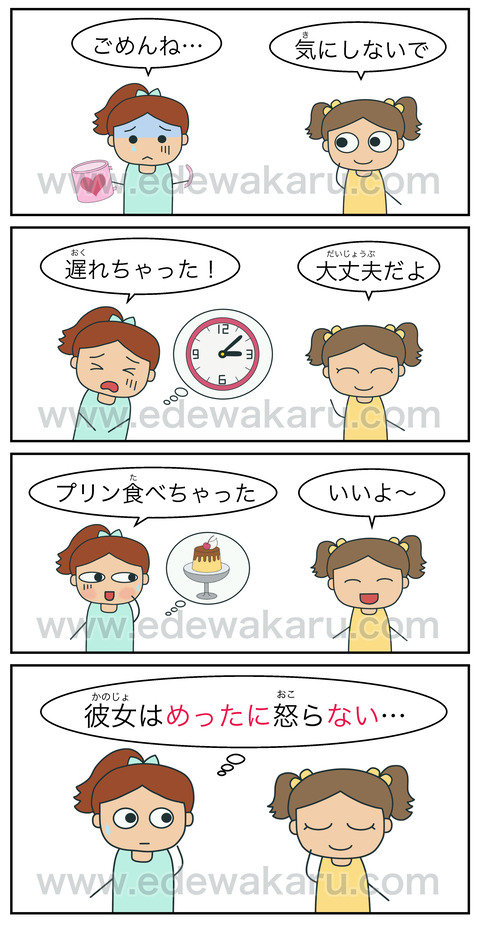
何かをする回数が非常に少ないことを表す。①~③のように、「めったにV-ない」の形か、④⑤のように「…はめったにない」の形で使われることが多い。「たまに」も頻度が少ないことを表すが、強調する点が違う。例えば、次の例1、2はどちらも「酒を飲む回数がたいへん少ないこと」を表しているが、(例1)の「めったに…ない」は回数が「少ない」ことを強調している。それに対して、(例2)の「たまに」は頻度は低いが飲むことが「ある」ことを表現している。
あまり…ない】ほとんど/めったに…ない】ぜんぜん/まったく…ないの順に頻度が低くなる。
慣用的な表現。「めったなことで(は)…ない」の形で使われて、「よほど特別なことがなければ.-ない」という意味を表す。①は、「驚くことはほとんどない、たいていのことは平気だ」、②は「いいかげんなこと、思慮のないことを言ってはいけない」という意味。④の「めったなN」の形は、あまり使われなくなってきている。ここでは「よほど特別な人以外には話してはいけない。」という意味。
How to use it
めったに…ない
めったな
In context 12 examples
私は酒はめったに飲まない。
うちの子は丈夫でめったに病気もしない。
人混みは好きではないので、東京や大阪などの大都市にはめったに行かない。
この頃の機械は優秀で故障はめったにない。
わが家はずいぶん田舎にあるので、お客がやって来ることはめったにない。
学生時代の友人とも遠く離れてしまって、めったに会うこともない。
近頃は町中で野生の小動物を見かけるようなこともめったになくなった。
(例) 1。私は酒はめったに飲みません。
2。私は酒は嫌いですが、友だちに誘われたときなど、たまには飲むこともあります。めったなことで驚かない私も、そのときばかりはさすがにうろたえてしまった。
A:山下さんが盗ったんじゃない?
B:しっ。証拠もないのに、めったなことを言うもんじゃないよ。この機械は丈夫ですから、めったなことでは故障しません。
このことは、めったな人に話してはいけない。
日本語文型辞典 英語版
Meaning
Expresses that the frequency with which something is done is extremely low. Often used in the form めったにV-ない, as in examples
(1)
-
(3)
, or in the form ...はめったにない, as in examples
(4)
and
(5)
.
たまに also expresses low frequency, but the point of emphasis is different. For example, both
(1)
and
(2)
below mean “alcohol is consumed very infrequently” but the めったに...ない in example
(1)
emphasizes the low frequency. In contrast, たまに in example
(2)
expresses that, although the frequency is low, it does take place.
(例1)私は酒はめったに飲みません。
I rarely drink alcohol.
(例2)私は酒は嫌いですが、友だちに誘われたときなど、たまには飲むこともあります。
I don’t like alcohol but, when I am invited by a friend, for example, I occasionally do drink it.
For these phrases, frequency decreases in this order: あまり...ない > ほとんど/めったに...ない > ぜんぜん/まったく...ない.
B:しっ。証拠もないのに、めったなことを言うもんじゃないよ。
Shh! There’s no evidence of that, so don’t say such things.
An idiomatic expression. Used in the form of めったなことで(は)...ない, it expresses that “unless there is a set of extreme circumstance/conditions, the event/action in question does not take place.” Example
(1)
means “generally not surprised, can take most things calmly” and
(2)
means “it is wrong to say irresponsible/imprudent things.”
Use of the form めったなN, as in example
(4)
, is becoming rare. Means “it is wrong to talk (of this) to people other than a select (few/group).”
How to use it
1. めったに...ない
2. めったな
In context 11 examples
私は酒はめったに飲まない。
I seldom drink alcohol.
うちの子は丈夫でめったに病気もしない。
Our child is in good health and rarely gets sick.
人混みは好きではないので、東京や大阪などの大都市にはめったに行かない。
I don’t like crowds of people and so I rarely go to big cities like Tokyo or Osaka.
この頃の機械は優秀で故障はめったにない。
Appliances these days are well-made and so rarely break down.
わが家はずいぶん田舎にあるので、お客がやって来ることはめったにない。
Our house is in a pretty rural area, so we rarely have guests dropping by.
学生時代の友人とも遠く離れてしまって、めったに会うこともない。
I rarely meet friends from my university days because we live so far apart.
近頃は町中で野生の小動物を見かけるようなこともめったになくなった。
Nowadays you rarely catch sight of small wild animals in town anymore.
めったなことで驚かない私も、そのときばかりはさすがにうろたえてしまった。
I am usually not surprised by things, but even so, I lost my cool just at that moment.
A:山下さんが盗ったんじゃない?
Didn’t Yamashita-san steal it?
この機械は丈夫ですから、めったなことでは故障しません。
This appliance is so durable it hardly ever breaks down.
このことは、めったな人に話してはいけない。
You shouldn’t talk of this to just anyone.
Bunpro Grammar Reference
Meaning
Hardly, Rarely, Seldom
How to use it
めったに + Verb[ない]
Noun + は + めったにない
めったに + Verb[ない]
Noun + は + めったにありません
Nuance
A phrase that means something is seldom done, but literally means not done thoughtlessly or recklessly.
Explanation
めったに~ない is an expression that may be translated as 'hardly', 'seldom', or 'rarely'. Originally, 滅多 is a な-Adjective that means 'thoughtless', or 'reckless'. Due to this, as an adverb, 滅多に literally means 'thoughtlessly' or 'recklessly'.
めったに~ない will usually be paired with a verb in the negative form, or following a noun, and the adverbial particle は.
大人になってから駄菓子屋にはめったに行かない。
Ever since I became an adult, I hardly go to candy stores.
親とは正月以外にはめったに会わない。
Other than New Years, I hardly see my parents.
こんなチャンスはめったにないぞ!
A chance like this is very rare.
パーティーに行くことはめったにない。
I rarely go to parties.
Caution
It is far more common to see めったに written without kanji, than with. However, both are used.
Fun Fact
As めったに originally means 'thoughtlessly', when appearing in a negative statement, the nuance becomes 'to not (A) thoughtlessly' (mindlessly, or aimlessly). This simply expresses that the speaker will not do (A) unintentionally, or (A) will not happen unless there is some special reason for it.
私は何か大事が起きない限り、電話はめったに掛けない。
Unless something big happens, I don't mindlessly make phone calls.
家の誰かがテレビを見ていない限り、自分からはテレビをめったに見ない。
Unless someone in my house is watching TV, I don't aimlessly watch TV on my own.
Nuance · 日本語
ほとんどされていない事を意味する言葉だが、文字通り、軽率に、あるいは無謀に行われないという意味を表す表現。
Explanation · 日本語
「めったに〜ない」は、それが起こる回数がとても低いことを表す表現です。「滅多」はもともと「物事をよく考えない」ことを表すナ形容詞ですが、「めったに〜ない」は、「ほとんど〜しない」や「稀に〜する」という意味で使われます。
「めったに〜ない」は、主に動詞の否定形や、名詞と副助詞の「は」と一緒に使われます。
大人になってから駄菓子屋にはめったに行かない。
Ever since I became an adult, I hardly go to candy stores.
親とは正月以外にはめったに会わない。
Other than New Years, I hardly see my parents.
こんなチャンスはめったにないぞ!
A chance like this is very rare.
パーティーに行くことはめったにない。
I rarely go to parties.
注意点
「めったに」は基本的にひらがなで書かれますが、漢字も使われます。
豆知識
「めったに」はもともと「物事をよく考えないで」という意味を持っています。そのため、「めったに〜ない」は「よく考えないで、ただ (A) をすることはない」のようなニュアンスになります。つまり、「特別な理由がなければ、(A) をしない」ということを表しているのです。
私は何か大事が起きない限り、電話はめったに掛けない。
Unless something big happens, I don't mindlessly make phone calls.
家の誰かがテレビを見ていない限り、自分からはテレビをめったに見ない。
Unless someone in my house is watching TV, I don't aimlessly watch TV on my own.
In context 18 examples
- 父は滅多にテレビを見ない。
My father rarely watches TV.
- 親とは正月以外にはめったに会わない。
Other than New Years, I hardly see my parents.
- パーティーに行くことはめったにない。
I rarely go to parties.
- こんなチャンスはめったにないぞ!
A chance like this is very rare.
- 大人になってから駄菓子屋にはめったに行かない。
Ever since I became an adult, I hardly go to candy stores.
- こんなにいい話しは滅多にない。
Such a nice story is rarely (heard).
- 滅多に泣かない彼が泣いていた。
He, who hardly cries, was crying. (seldom・rarely)
- 僕のおじいちゃんは滅多に笑わない。
My grandpa seldom smiles.
- 彼は滅多に忘れないのに、今日はどうしたんだろう?
He rarely forgets, I wonder what happened today?
- 彼は出不精だから、滅多に出かけない。
Since he is a homebody, he hardly goes out. (seldom・rarely)
- 最近は彼に滅多に会わない。どうしたんだろう?
I rarely see him around these days. I wonder what's up?
- 彼女についての悪口を滅多に聞かない。
I seldom hear bad things about her.
- せっかく日本語を勉強したけど、滅多に話さないね。
After going through all the trouble of studying Japanese, you hardly speak it. (seldom・rarely)
- うちの親は滅多に怒りませんが、本当に悪いことをした時には怒ります。
My parents seldom get angry, but when I do something really bad, they will get mad.
- 滅多に休まない彼が休んでいるのだから、かなり体調が悪いんだろうな。
Since he, who rarely takes leave, took time off, his condition is probably quite bad.
- 滅多に本を読みませんが、珍しく読みたい本があったので買ってみました。
I seldom read, but there was a book that I wanted to read, so I bought it.
- 私は何か大事が起きない限り、電話はめったに掛けない。
Unless something big happens, I don't mindlessly make phone calls.
- 家の誰かがテレビを見ていない限り、自分からはテレビをめったに見ない。
Unless someone in my house is watching TV, I don't aimlessly watch TV on my own.
DoJG 日本語文法辞典(全集)
Meaning
Rarely; seldom; hardly; almost never
How to use it
滅多に~ | Vnegative ない | |
| 滅多に外国に行かない | Someone seldom goes abroad |
| 滅多に肉を食べない | Someone seldom eats meat |
Explanation
滅多に~ない A structure that indicates extremely low frequency.
In context 5 examples
この辺りでは地震は滅多に起きない。
Earthquakes seldom occur in this area.
日本の父親は忙しいので、週末でも滅多にうちにいない。
Japanese fathers are so busy that even on weekends they are seldom at home.
大学時代の同級生とは滅多に合えない。
I can hardly ever see my college classmates.
日本の車は滅多に故障しないので、外海で人気がある。
Because Japanese cars rarely break down, they are popular abroad.
汚染のためにこの川では滅多に魚が泳いでいるのを見られなくなった。
Due to pollution, we almost never see fish swimming in this river now.
毎日のんびり日本語教師
How to use it
滅多に+動ない形+ない
~は滅多にない
Explanation
発生頻度や回数が非常に少ないことを強調する文型です。
Notes
特になし
In context 7 examples
酒は普段めったに飲まない。(平时很少喝酒。)
うちの家族は生活リズムがそれぞれ違うから、朝ご飯揃って食べることは滅多にない。
怒りにはいつも理由がある。ただし、正当な理由はめったにない。
褒められることは滅多にないので嬉しいです。ありがとうございます。
仕事し始めたら恋愛なんてめったにない。出会いがあるのは学生だけだ。
知らない番号からの電話には滅多に出ないようにしている。
彼女のめったに見れない満面の笑みがめちゃくちゃ可愛い。