日本語文型辞典
Meaning
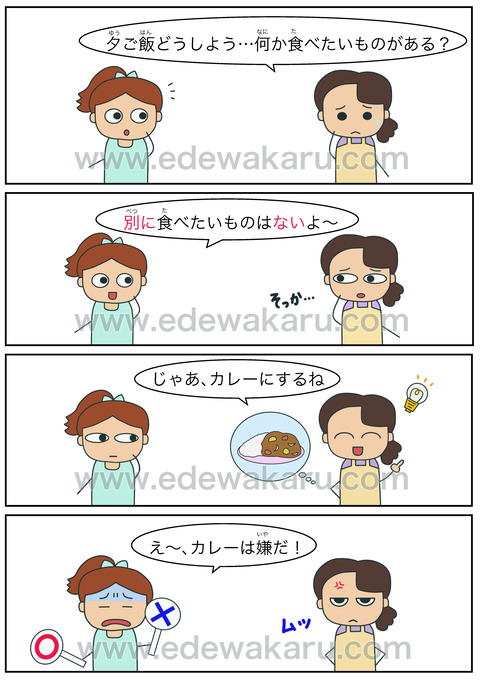
「特に…ない」「とりたてて…ない」という意味を表す。⑤のように「…ない」の部分が省略されることもある。
①~④は、「…以外に」「…のほかに」、⑤⑥は「…とはなれて」「…とちがう」という意味を表す。
「Nごとに」「Nを基準に」という意味。
How to use it
べつに…ない
(…とは)べつに
Nとはべつに
Vのとはべつに
Nベつに
In context 15 examples
別に変わったことは何もない。
会社の宴会など別に行きたくはないが、断わる適当な理由も見つからないので、しかたなく行くことにした。
今どき洋酒なんか、別に珍しくはないが、海外旅行のおみやげにとわざわざ持ってきてくれた彼の気持ちがうれしい。
あなたなんかいなくても、別に困らないわ。
A:どうかしたの。
B:いや、べつに。料金とは別に600円の送料が必要です。
サービス料は別にいただきます。
みんなに配ったのとは別に、君には特別なプレゼントを用意しておいた。
昨日来たのとは別に、もうひとつ小包が来ています。
映画館はすごく込んでいたので、友だちとは別に座ることにした。
彼女は旅館に泊まった私達とは別にとなりの町のホテルに泊まった。
クラス別に写真を撮った。
小学校や中学校では男女別に名簿をつくるのをやめようという動きがある。
アンケートの結果を、年齢別に集計した。
調査の結果を国別に見ていくと、中国をはじめとしたアジアの国々の経済成長が著しいことがわかる。
絵でわかる日本語
Usage 2
Read this source entry ↗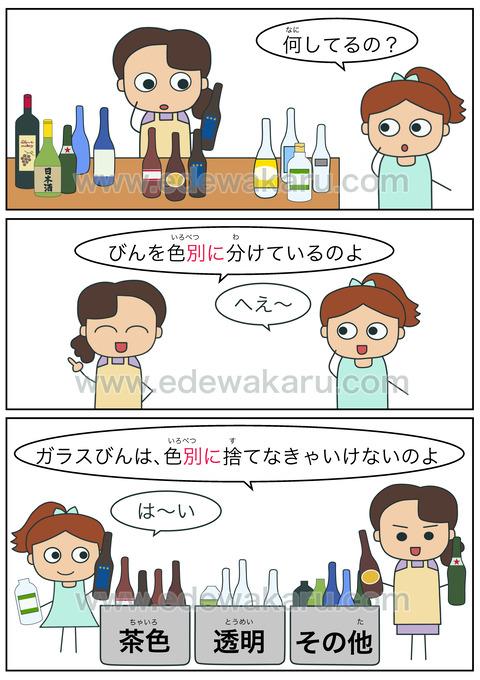
Meaning
〜それぞれに
〜を基準にして
How to use it
名詞[辞書形]+別に
Explanation
「〜別に」は「〜それぞれに」「〜を基準にして」という意味の文型です。大きさや色、性質などを基準にして何かを行う時に使われます。類似文型(るいじぶんけい)「〜ごとに」を使って表すこともできます。
[例]
ガラスびんは、色
別に
分けて捨てなければいけない
=ガラスびんは、色
ごとに
分けて捨てなければいけない
クラス
別に
写真を撮った
=クラス
ごとに
写真を撮った
「別」がつく文型はたくさんありますので、復習をしておきましょう😊
【「別」がつく文型】
In context 5 examples
ガラスびんは、色別に分けて捨てなければいけない
→色をそれぞれ分けて捨てなければいけない採ったりんごを大きさ別に分ける
→採ったりんごを大きさを基準にして分ける卒業アルバムを作るために、クラス別に写真を撮った
→全てのクラスが、それぞれ写真を撮った年齢別にアンケートを行った
→年齢を基準にして、それぞれにアンケートを行った男女別に1列に並んでください
→男女それぞれ1列に並んでください
毎日のんびり日本語教師
Usage 1
Read this source entry ↗How to use it
別に~動ない形+ない
Explanation
わざわざ取り立てる必要がないほどの程度であることを表します。後件には必ず否定形が呼応しますが、省略されることもあります。
話し言葉では否定形を伴わない「別にいい」がよく用いられますが、これは「別に(そんなことをしなくても)いい」等のように、何かが省略されているものと考えられます。また、もともと「いい」にはOKの意味もありますし、NOの意味もありますので、「いい」自体が否定形であると考えることもできます。
Notes
特になし
In context 7 examples
好きな事を仕事にしたほうがいいと言うが、別にやりたいこともない。
酒は好きですけど別に強くはないです。
今の自分に妥協して、別に今のままでいいやと思うのも悪くない。
休みでも別に何にもすることない。
「可愛い」はいつも言われ慣れているから別に嬉しくない。
彼のこと別に好きっていうわけじゃないけど、一緒にいると何だか…
「今日はハンバーグでいい?」「別にいいよ」
Usage 2
Read this source entry ↗How to use it
名詞+別に
名詞+別で
Explanation
物事をある性質や単位で括り、それを基準にすることを表します。
「~ごとに」に言い換えられます。
Notes
特になし
In context 8 examples
調査結果は男女別にまとめてください。
今回開催する婚活パーティーは年齢別で行われる。
4月からは世界国別対抗戦が始まる。
クローゼットの服は色別に並べるようにしている。(衣橱里的衣服按颜色排列。)
本棚の本を大きさ別に並び替えた。
ワインを種類別に紹介します。
工具は用途別にしまっておいてください。
サイズ別で価格が違います。
AIUEO JLPT Grammar
Meaning
「〜別に」 connects to nouns to categorize or classify things based on different criteria or elements. It is used for organizing or analyzing actions or information based on separate groups or categories.
How to use it
名詞+別に
Explanation · 日本語
「〜別に」は、名詞に接続して、異なる基準や要素に基づいて分類や区別を行うときに使われる表現です。何かを特定の基準で分けるときに使い、それぞれのグループやカテゴリーに基づいて行動や分析をする場面で用いられます。
In context 5 examples
年齢別にアンケートを行った。
The survey was conducted according to age groups.
男女別にデータを分析した結果、興味の違いが見られた。
After analyzing the data by gender, differences in interests were observed.
地域別に商品を販売する計画です。
We plan to sell the products by region.
サイズ別に商品を整理した。
The products were organized by size.
カテゴリー別に売上を分析する。
We analyze sales by category.
Bunpro Grammar Reference
Meaning
Not really, Not particularly, It's not like...
How to use it
別に + Verb[ない]
別に + [い]Adjective[ない]
別に + [な]Adjective + ではない(1)
別に + Noun + ではない(1)
(1) じゃない
Nuance
An expression that shows that (A) is not really the case, or not exclusively the case.
Explanation
When paired with ない (either the い-Adjective or the auxiliary verb), the adverb 別に 'separately' changes slightly in definition to that of 特に 'especially'. Let's have a look at a few examples.
私は別に構わないけど、お父さんはそういうの気にするから、お父さんの前ではそういう事言わないでね。
I actually don't mind, but my dad cares a lot about things like that, so please don't say such things in front of him.
別に痛くないよ。少しチクってするだけ。
It's not really painful. It just stings a little.
あなたの事は別に嫌いではないよ。ただあなたと何について話せばいいか分からないだけ。
It's not that I don't like you at all. It's just that I don't know what to talk about with you.
パーティーってみんな言っているけど、別にそんなに大したものではないよ。
Everyone is calling it a party, but it is actually not that big of a deal.
This 'especially' nuance of 別に comes from 'separately' being negated. The literal meaning of 別に~ない is something like '(A) cannot be separated/differentiated'. This comes across as 'maybe it is a little (A), maybe a lot (A), but in any case, it cannot be said that it IS (A)'.
Caution
別に will quite often be paired with わけではない, as they both express uncertainty. However, it should never be paired with わけがない, as this would be combining a statement that removes certainty, with one that adds certainty.
別にケーキが嫌いというわけではない。今は食べたくないだけ。
It is not that I dislike cakes. I just don't want one right now.
別にケーキが嫌いというわけがない。今は食べたくないだけ。
It is not that I SO don't not like cakes. I just don't want any right now. (Grammatically correct, but very confusing for the listener)
Nuance · 日本語
特に(A)ではない、又は(A)ではなくてもいいということを表す表現。
Explanation · 日本語
副詞の「別に」が「ない」(イ形容詞または助動詞)と合わさると、「特に〜ない」のような意味になります。いくつか例を見てみましょう。
私は別に構わないけど、お父さんはそういうの気にするから、お父さんの前ではそういう事言わないでね。
I actually don't mind, but my dad cares a lot about things like that, so please don't say such things in front of him.
別に痛くないよ。少しチクってするだけ。
It's not really painful. It just stings a little.
あなたの事は別に嫌いではないよ。ただあなたと何について話せばいいか分からないだけ。
It's not that I don't like you at all. It's just that I don't know what to talk about with you.
パーティーってみんな言っているけど、別にそんなに大したものではないよ。
Everyone is calling it a party, but it is actually not that big of a deal.
この「別に」が持つ「特に」というニュアンスは、「別に」(意味:区別して、ほかに)を否定することから生まれています。「別に〜ない」は、「((A) かもしれないけど)それを特別に取り上げる必要はない」のようなニュアンスで使われます。
注意点
「別に」は「わけではない」と一緒に使われることがよくありますが、「わけがない」とは使われません。「わけではない」は不確かなニュアンスを含むので「別に」と合いますが、「わけがない」は断定の表現で、「別に」が持つ不確かさと矛盾してしまうためです。
別にケーキが嫌いというわけではない。今は食べたくないだけ。
It is not that I dislike cakes. I just don't want one right now.
別にケーキが嫌いというわけがない。今は食べたくないだけ。
It is not that I SO don't not like cakes. I just don't want any right now. (Grammatically correct, but very confusing for the listener)
In context 18 examples
- トムが悪いとは別にいっていないよ。
I'm not really saying that Tom is bad. (not particularly)
- 私は別に構わないけど、お父さんはそういうの気にするから、お父さんの前ではそういう事言わないでね。
I actually don't mind, but my dad cares a lot about things like that, so please don't say such things in front of him.
- 別に痛くないよ。少しチクってするだけ。
It's not really painful. It just stings a little.
- あなたの事は別に嫌いではないよ。ただあなたと何について話せばいいか分からないだけ。
It's not that I don't like you at all. It's just that I don't know what to talk about with you.
- パーティーってみんな言っているけど、別にそんなに大したものではないよ。
Everyone is calling it a party, but it is actually not that big of a deal.
- それは別に悪いことではないよ。
That's not particularly a bad thing.
- 別に夢がないわけではないよ。
It is not that I don't really have a dream.
- 私はそんなに音楽がうるさくても、別に気にしない。
Even if the music is that loud, I don't particularly care.
- 別に楽しくないわけではない。少し疲れているだけだ。
It is not like I am not particularly having fun. I am just a bit tired.
- 別に問題ない。時間が解決してくれるよ。
That's not particularly a problem. It will sort itself out in time.
- 別に深い意味はないですよ。考えすぎです。
No, I didn't mean anything in particular. You think too much.
- 別に何でもないです。気にしないでください。
It's nothing in particular. Don't worry about it.
- 別に自慢しているわけじゃない。事実を話しただけだ。
It is not like I am boasting. I just told you the truth. (not particularly)
- 別に怒っているわけではないですよ。元々ああいう顔なんです。
It is not like I am particularly angry. This is my neutral face expression.
- 別に君だけに言ったわけではない。みんなに言ったんだ。
It is not like I said it just to you. I said it to everyone. (not particularly)
- 別に自分が汗だらけになってもかまわないが、他の人の汗は嫌です。
I don't particularly mind being drenched in sweat, but I don't like other people's sweat.
- 別にケーキが嫌いというわけではない。今は食べたくないだけ。
It is not that I dislike cakes. I just don't want one right now.
- 別にケーキが嫌いというわけがない。今は食べたくないだけ。
It is not that I SO don't not like cakes. I just don't want any right now. (Grammatically correct, but very confusing for the listener)