絵でわかる日本語
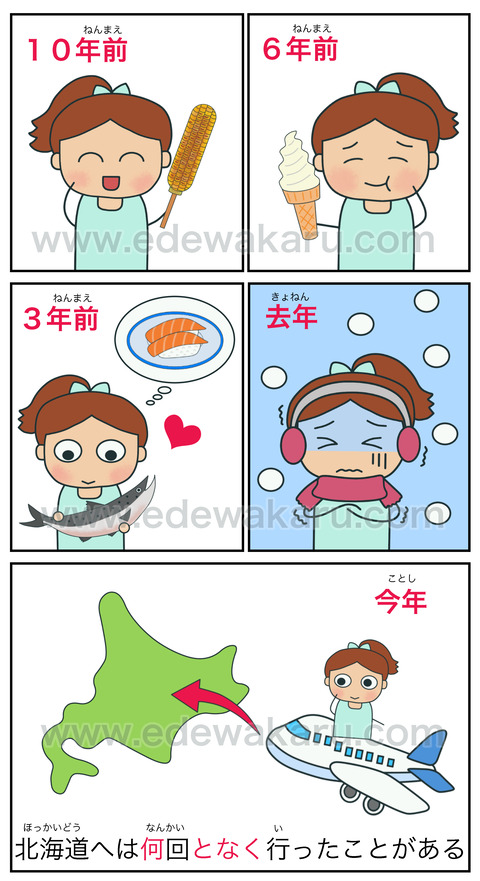
Meaning
何〜も
How to use it
なん+助数詞+となく
Explanation
「なん+助数詞+となく」は「何〜も」という意味を表す文型で、数が多いことを強調したい場合に使います。かたい言い方ですので、書き言葉として使われます😊
日常会話(にちじょうかいわ)では「何〜も」の方がよく使われます
😅
「何」は「なに」ではなく「なん」と読むと覚えておきましょう😉
In context 3 examples
北海道へは何回となく行ったことがある
→北海道へは何回も行ったことがある飲み放題だったので、ビールを何杯となく飲んだ
→飲み放題だったので、ビールを何杯も飲んだ(復習:〜放題・〜たい放題)お腹がすいていたので、おにぎりを何個となく食べた
→お腹がすいていたので、おにぎりを何個も食べた(復習:「おにぎり」と「にぎり」)
日本語文型辞典
Meaning
「何(なん)」「幾(いく)」など不定の数量を表すことばに「…人」「…回」などの助数詞がついたものを受け、その数量がかなり多いことを表す。書きことば的で、話しことばでは、「何回も」「幾組みも」のような表現のほうがよく使われる。
「昼も夜も」すなわち「一日中」という意味を表す。書きことば的。
How to use it
なん+助数詞+となく
ひるとなくよるとなく
In context 5 examples
原始林の中には、巨大な樹木が何本となく茂っている。
彼は世界選手権にはすでに何回となく参加した経験をもっている。
公園のベンチには若いカップルが幾組となく腰掛けて愛を語り合っている。
世界の至るところで、昼となく夜となく様々な事件が発生している。
母は昼となく夜となく病気の祖母の世話で忙しく暮らしている。
日本語文型辞典 英語版
Meaning
となく is placed after the combination of a prefix that indicates an indefinite number, such as 何 (なん) or 幾 (いく), and a counter such as ...人 (...person/people) or ...回 (...time(s)). This pattern indicates that there is a rather large quantity of the thing in question. More common in written language. In spoken language, expressions like 何回も (many times) and 幾組みも (many pairs) are more commonly used.
Means “day and night,” or in other words, “twenty-four hours a day.” More of a written expression.
How to use it
1. なん+助数詞+となく
2. ひるとなくよるとなく
In context 5 examples
原始林の中には、巨大な樹木が何本となく茂っている。
In the middle of the virgin forest grew a dense stand of huge trees.
彼は世界選手権にはすでに何回となく参加した経験をもっている。
He has already participated many times in world championships.
公園のベンチには若いカップルが幾組となく腰掛けて愛を語り合っている。
On the park benches were seated a lot of young couples, lost in romantic conversation.
世界の至るところで、昼となく夜となく様々な事件が発生している。
All over the world, all sorts of incidents arise both day and night.
母は昼となく夜となく病気の祖母の世話で忙しく暮らしている。
My mother has a busy life taking care of my sick grandmother day and night.
IMABI
と Combination Particles I: となく & とは
Read this IMABI lesson ↗Explanation
と Combination Particles I: となく & とは
となく
となく shows the inability to clearly decide something. It may also show a befitting uncertain amount with counter expressions. 何となく is a common phrase with it that means “somehow or another” or “vaguely”.
1. どことなく似ている。
They somehow look alike.
2. なんとなく覚えてる。
I vaguely remember.
3. 幾度いくどとなく試みる。
To try out countless times.
4. 何度か試みる。
To try it several times.
Word Note: 幾度 is just like 何度も(何度も), しばしば, 何度も繰り返して, and 再三(再四).
5a. 何人となく辞めた。Countless people quit.
5b. 何人か(が)辞めた。Several people quit.
6. 何百{となく・も}
By the hundreds
7. あいつは何回となくチャンスがあったよ。
That guy’s had who knows how many times a chance.
8. この取扱説明書はそれとなく静電気の危険性についても触れている。
This instruction manual also touches upon the dangers of static electricity, albeit indirectly.
“…となく…となく” shows a sense of extent to all of a certain thing.
9a. 彼らは昼となく夜となく働いた。
9b. 彼らは昼夜となく働いた。
9c. 彼らは昼夜関係なく働いた。
They worked without day or night.
10a. 老人となく若人わこうどとなく男となく女となくあらゆる人が泣いた。
10b. 老人だけでなく若人、男と女が泣き出した。
Not only the old, not only the young, not only men and women, but all kinds of people cried.
Somehow
There are other expressions like なんとなく. However, like with everything in Japanese, there are going to be differences. The expressions in question are なんか, なんだか, and なんとか(して).
なんか is equivalent to など. Or, the slang version of 何か used as an adverb to show a feeling of obscurity.
なんだか may just be the same as 何であるか・何か in an embedded sentence. Or, it is interchangeable with なんとなく・なぜか to show vagueness/uncertainty in reason.
なんとか(して) = なんらかの方法で
どことなく = なんとかして. Can’t seem to show where.
11. 宿題なんか要らないよ。
I don’t need something like homework.
12. 何だか変だね。
Isn’t it strange for some reason?
13. 何だか妙だ。
It’s odd for some reason.
14. 何かの拍子ひょうしで
By some chance
15. なんかキモい。(Slang)
I feel bad.
16. なんとかしてそこへ辿たどり着きます。
I’ll get there somehow.
17. なんとかしてくれ!
Do something about it!
18. なんとかなるさ。
Things’ll work out.
19. 僕はなんとなく悲しい。
I’m sad somehow or another.
とは
とは may show surprise meaning “to think that…” as a final particle. It may also be used to in defining a word.
20. ブラックホールとは、一体どんなものなのでしょうか。
What kind of thing is a black hole exactly?
21. 方言とは何でしょうか。
What is a dialect?
22. 小川さんとは、小学校の時からの友だちです。
I’ve been friends with Ogawa since elementary school.
23. もう今年も12月とは。
To think that it’s already December this year too!
24. 標準語とは20世紀初頭に誰でも分かる標準的な日本語を定めるために、当時の東京下町弁に基づいて文法的によく通じる新方言として人工的に生み出されてしまったものなんです。
Hyojungo is a grammatically sound “new dialect” artificially created in the beginning of the 20th century to make Standard Japanese for everyone to understand based on Tokyo Shitamachi Dialect of the time
In context 28 examples
どことなく似ている。
They somehow look alike.
なんとなく覚えてる。
I vaguely remember.
幾度いくどとなく試みる。
To try out countless times.
何度か試みる。
To try it several times.
何人となく辞めた。Countless people quit.
By the hundreds
何人か(が)辞めた。Several people quit.
By the hundreds
何百{となく・も}
By the hundreds
あいつは何回となくチャンスがあったよ。
That guy’s had who knows how many times a chance.
この取扱説明書はそれとなく静電気の危険性についても触れている。
This instruction manual also touches upon the dangers of static electricity, albeit indirectly.
彼らは昼となく夜となく働いた。
They worked without day or night.
彼らは昼夜となく働いた。
They worked without day or night.
彼らは昼夜関係なく働いた。
They worked without day or night.
老人となく若人わこうどとなく男となく女となくあらゆる人が泣いた。
Not only the old, not only the young, not only men and women, but all kinds of people cried.
老人だけでなく若人、男と女が泣き出した。
Not only the old, not only the young, not only men and women, but all kinds of people cried.
宿題なんか要らないよ。
I don’t need something like homework.
何だか変だね。
Isn’t it strange for some reason?
何だか妙だ。
It’s odd for some reason.
何かの拍子ひょうしで
By some chance
なんかキモい。(Slang)
I feel bad.
なんとかしてそこへ辿たどり着きます。
I’ll get there somehow.
なんとかしてくれ!
Do something about it!
なんとかなるさ。
Things’ll work out.
僕はなんとなく悲しい。
I’m sad somehow or another.
ブラックホールとは、一体どんなものなのでしょうか。
What kind of thing is a black hole exactly?
方言とは何でしょうか。
What is a dialect?
小川さんとは、小学校の時からの友だちです。
I’ve been friends with Ogawa since elementary school.
もう今年も12月とは。
To think that it’s already December this year too!
標準語とは20世紀初頭に誰でも分かる標準的な日本語を定めるために、当時の東京下町弁に基づいて文法的によく通じる新方言として人工的に生み出されてしまったものなんです。
Hyojungo is a grammatically sound “new dialect” artificially created in the beginning of the 20th century to make Standard Japanese for everyone to understand based on Tokyo Shitamachi Dialect of the time